


Agreement in the room is not the same thing as a decision the organization can execute.
Plain-English premise: A consequential roadmap decision is not finished when everyone nods. It is finished when the trigger was tested, the trade-off was named, the state was declared, the reasoning was captured, the interpretation was confirmed, and one current record was published where execution can find it.
👋 Welcome to the capstone of Executive Override. For six issues, this series treated one pressure moment at a time: the override with no owner, the urgent ask with no tradeoff, the stakeholder room that agrees and then fragments, the rationale that evaporates, the record that cannot close, the commercial escalation that impersonates a decision. This week puts those moments on one operating sequence, stage by stage.
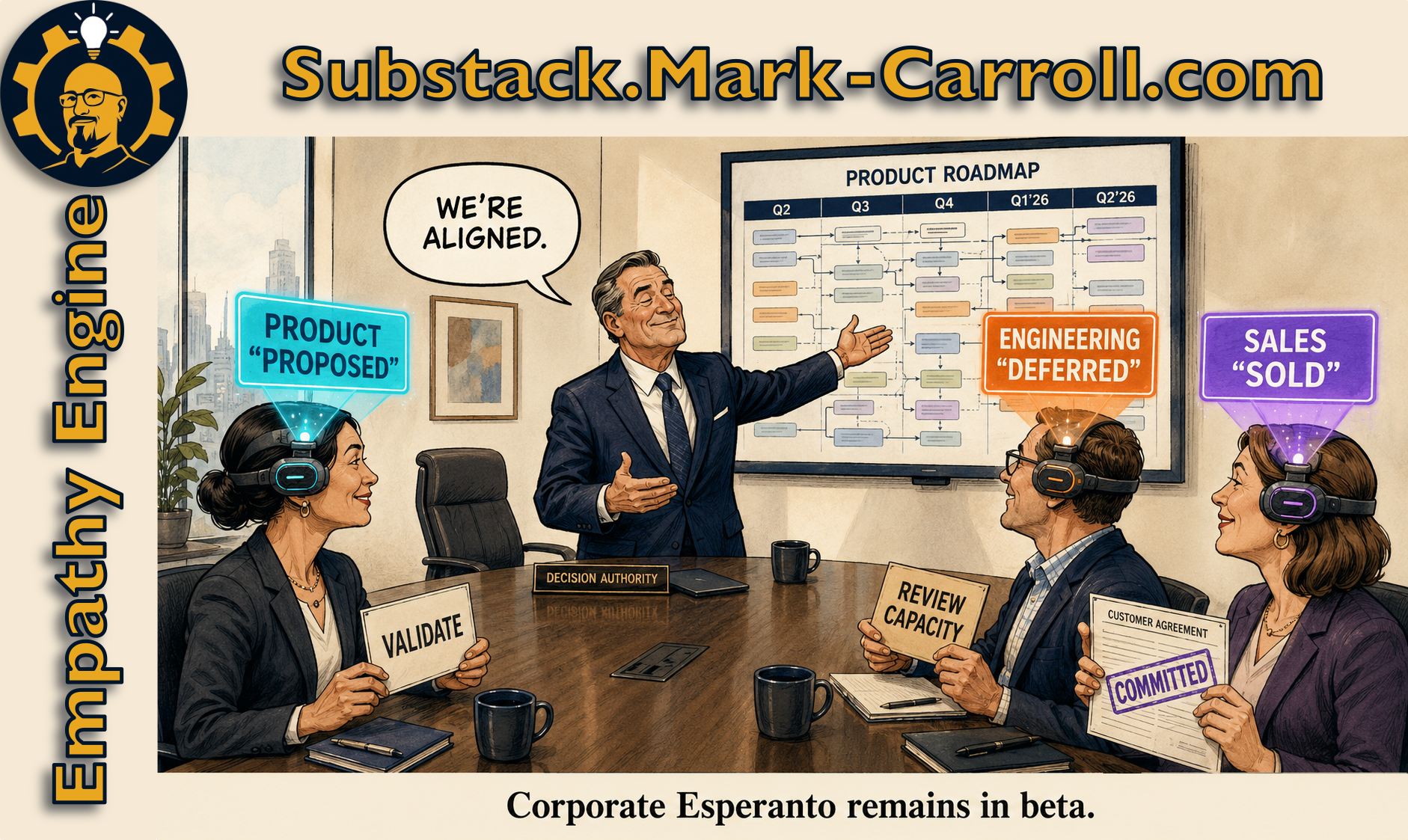
Research Binder: the receipts (citations + source notes) are compiled in a PDF at the bottom of this post.
Episode 6:

⚠ Tension
The room believes the fight is over. By Friday, three functions are executing three different versions of what just got decided.
🎯 Payoff
Inside: the Logged Decision Workflow, a six-stage sequence for turning agreement into one decision execution can actually inspect and use.
Trigger Moment
I’ve watched one meeting produce three honest plans: the plan leadership believed it authorized, the plan Product believed it negotiated, and the plan Engineering believed it could deliver. Agreement wasn’t the problem. The decision never became transferable.
A cross-functional roadmap review had just landed. Product, Engineering, Operations, and a commercial lead had spent the hour on the same collision: keep the original release window, absorb a late enterprise request, or slip a commitment customers could already see. People were tired. Someone said the sentence that ends too many of these rooms: “I think we’re aligned.” Laptops closed.
By Friday, the delivery lead was working the original window. Sales was briefing the customer on the new request. The sponsor remembered authorizing a risk exception nobody had written down. Three honest readings of one meeting, later becoming three Slack threads and three different builds. No one was lying. The decision agreed to in the room never made it into the systems where execution actually lives.
That is the failure this series has been circling from six different angles. Not the disagreement. The missing hand-off from a room that felt closed into a record that could travel.
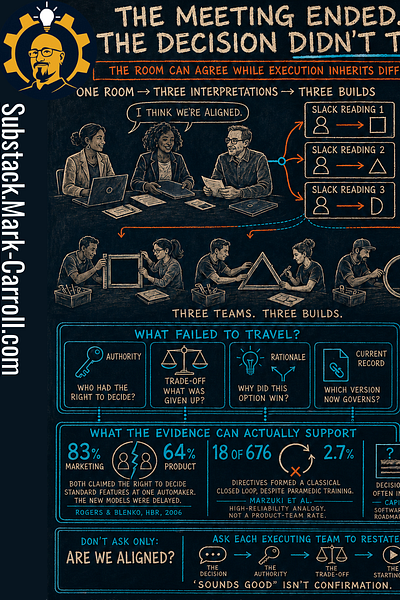
The meeting ended. The decision didn’t travel.
The room can agree while execution inherits different calls.
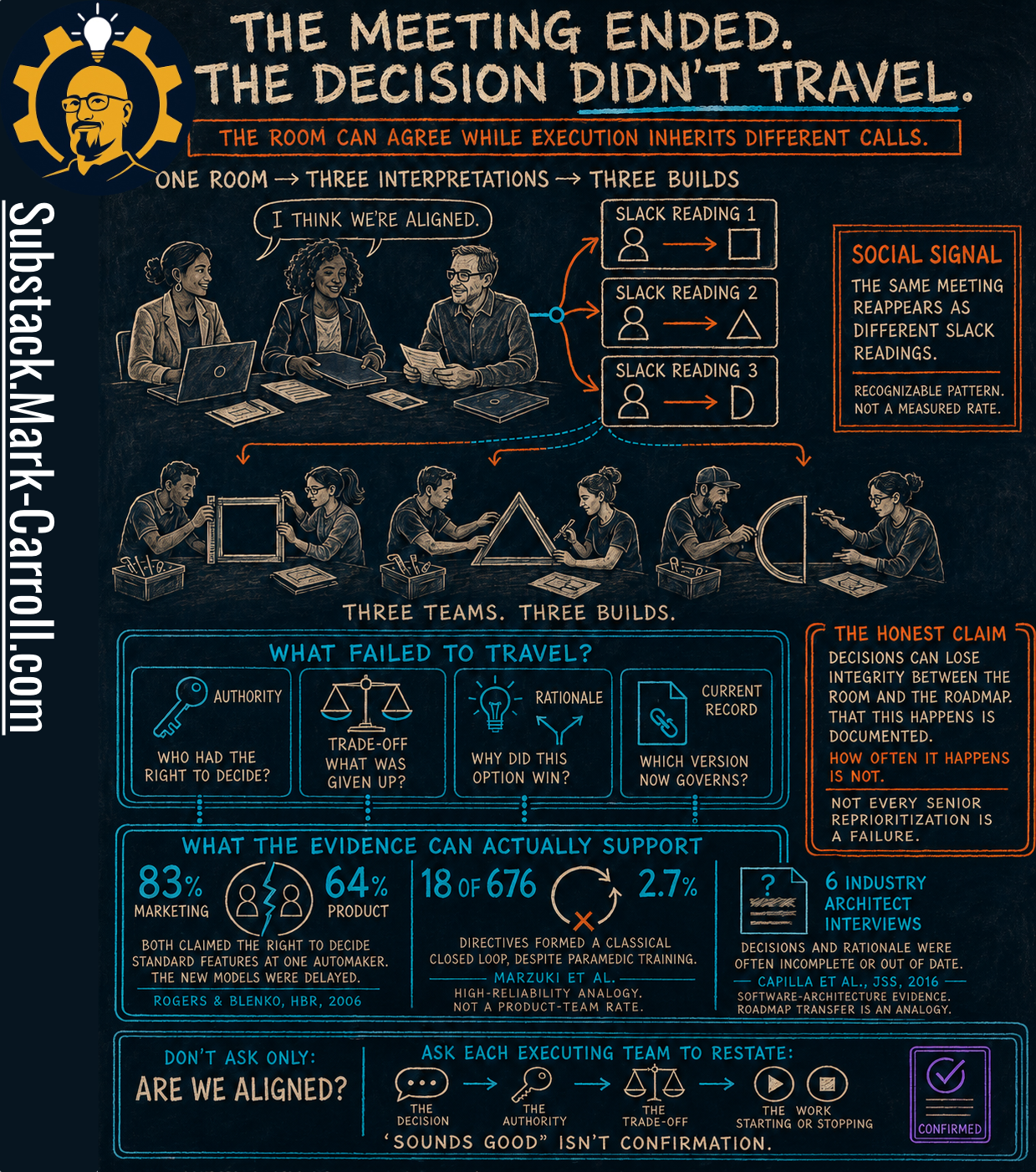
Notice what the diagram actually traces. Not who was wrong, but where the decision stopped carrying information. Authority, trade-off, rationale, and current record all survived the meeting. None of them survived the hand-off. That is the whole argument in one picture, and it is the reason a single “are we aligned?” question in the room is never enough. The fix is not a better recap. It is asking each executing function to restate the decision, the authority behind it, and the trade-off it accepted, before anyone leaves.
🎒 The Move: The Logged Decision Workflow
Orienting sentence: When a consequential decision looks resolved in the room, run six stages before anyone leaves, so the trigger, the tradeoff, the state, the reasoning, the interpretation, and one current record travel together into execution.
This sequence is something I’ve assembled from practices that already have their own track record elsewhere. It hasn’t been tested as one integrated method. Treat it as a structured way of working, not a finding you can cite.
Stage 1: Recognize the trigger. Not every message is a decision event. The channel a request arrives through doesn’t decide its weight. A Slack DM can move a commitment as much as a formal review can. One of the most consequential decisions I’ve had to catch wasn’t made in a decision meeting. It arrived disguised as a quick update, then revealed itself when the roadmap no longer matched what teams had been told to deliver.
A “quick update” can be a decision event.
The wording can be casual. The commitment change isn’t.
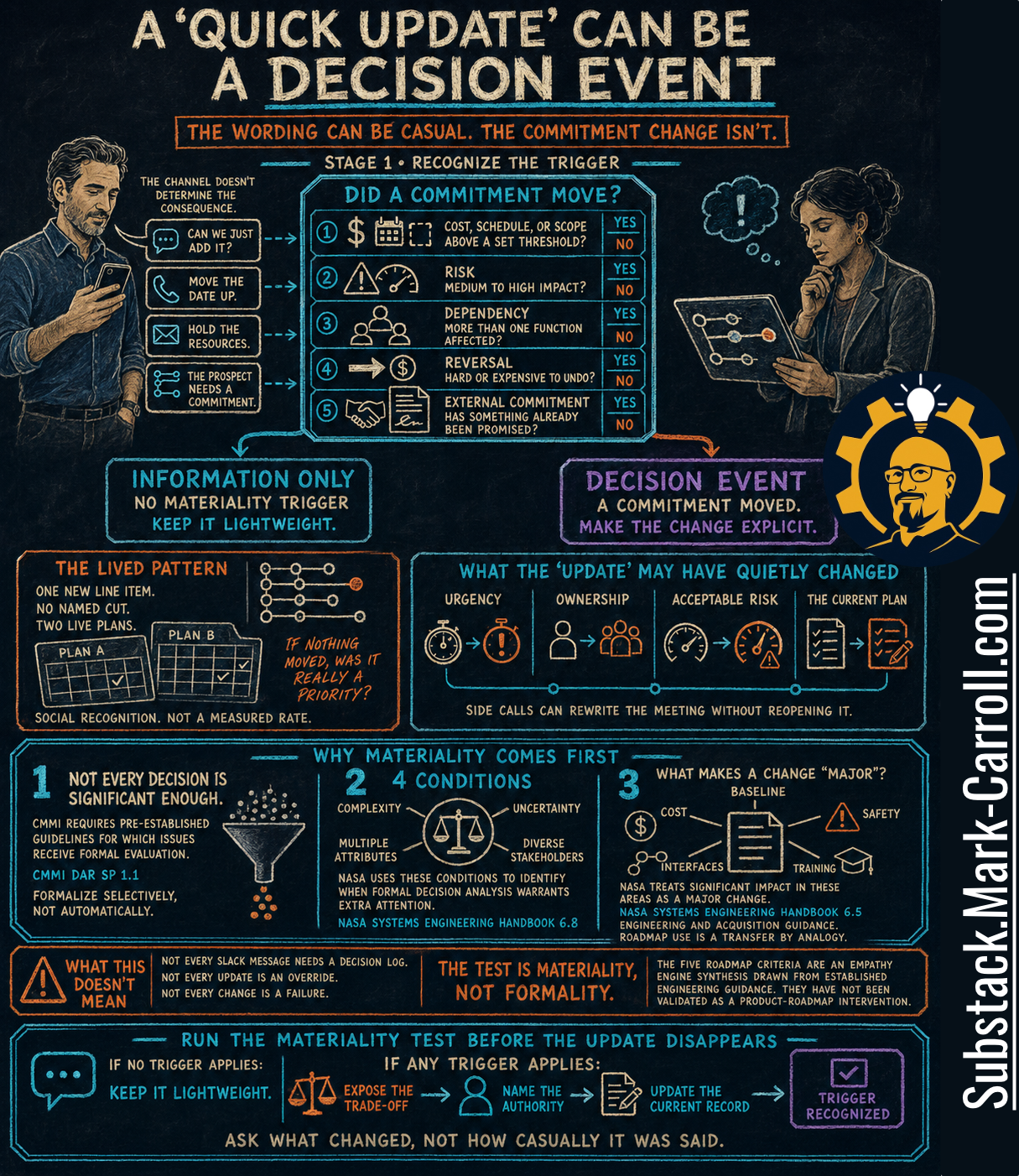
CMMI’s own decision-analysis guidance exists for exactly this filter. Organizations need pre-set criteria for which issues warrant a formal process, on the stated grounds that not every decision is significant enough to earn one. NASA runs the same logic through four conditions: complexity, uncertainty, competing attributes, diverse stakeholders. Borrow the discipline, not the bureaucracy. If cost, schedule, or scope hasn’t moved past a threshold you set in advance, if the risk is low, if nothing external has been promised, keep it lightweight and move on. The test is materiality, not formality.
Stage 2: Expose the trade-off. A new priority does not create new capacity on its own. Name which move makes it real: remove an existing commitment, delay one to a later date, resize the new or existing scope, fund real capacity, or accept the risk and name who owns it.
New work doesn’t create new capacity.
A new priority requires a named portfolio move.
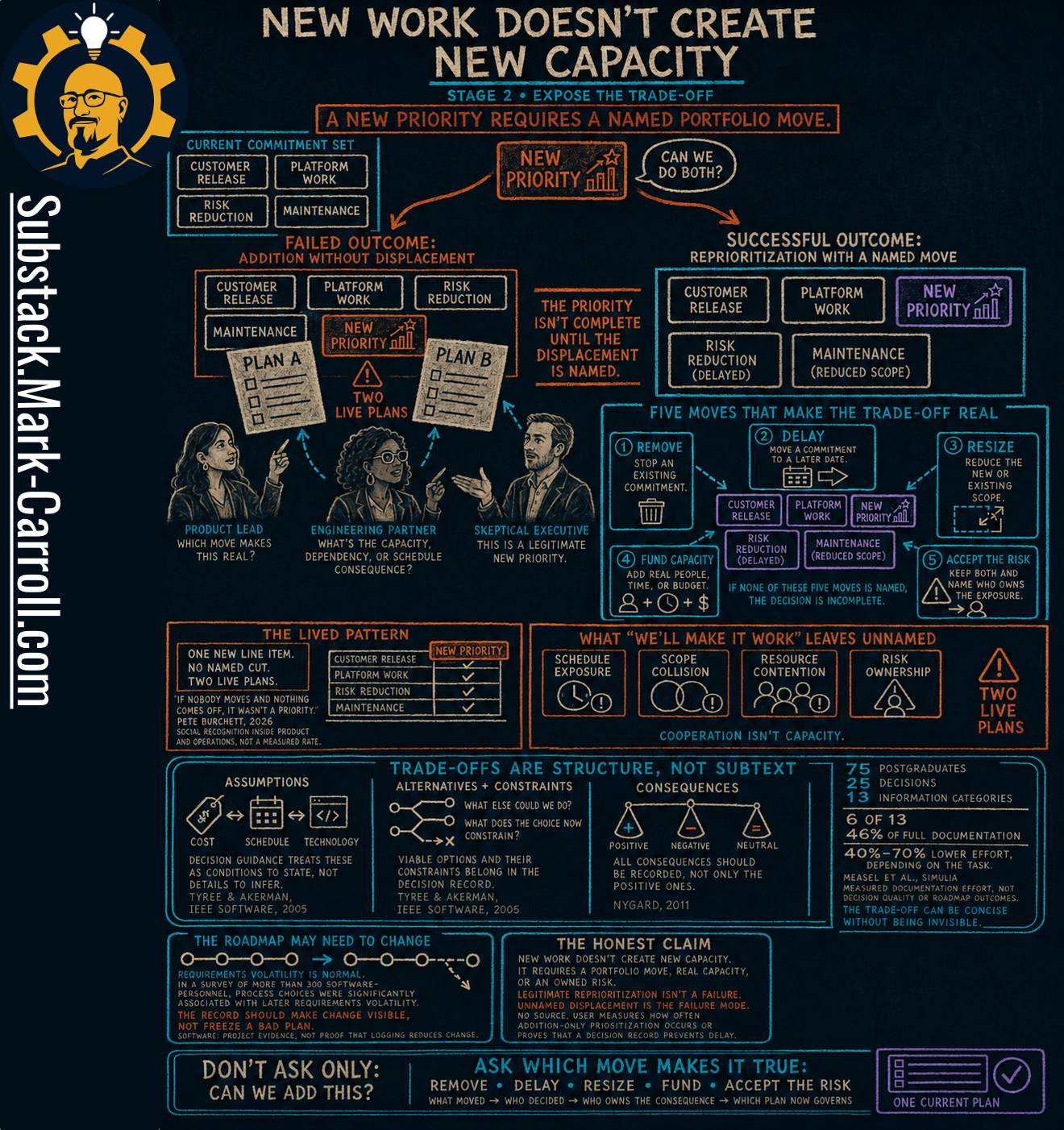
“We’ll make it work” is not one of those five moves. It’s two live plans wearing one name. The practical discipline is a short commitment ledger: what moved, who decided it, who owns the consequence, which plan now governs. Cooperation from the team is valuable. Cooperation is not capacity. I once told a leader, ‘We can absolutely make this the priority, but we can’t make it additional capacity.’ Naming [existing commitment] as the work that would move turned an urgent preference into an actual portfolio decision.
Stage 3: Name the decision state. Teams routinely compress three different conditions into the word “aligned”: people understood what was said, people supported the direction, and someone with actual authority committed the organization. Those three can coexist. They are not interchangeable, and a room can clear one while quietly failing the other two.
Agreement isn’t a decision state. Agreement describes a social response.
State tells execution what governs.
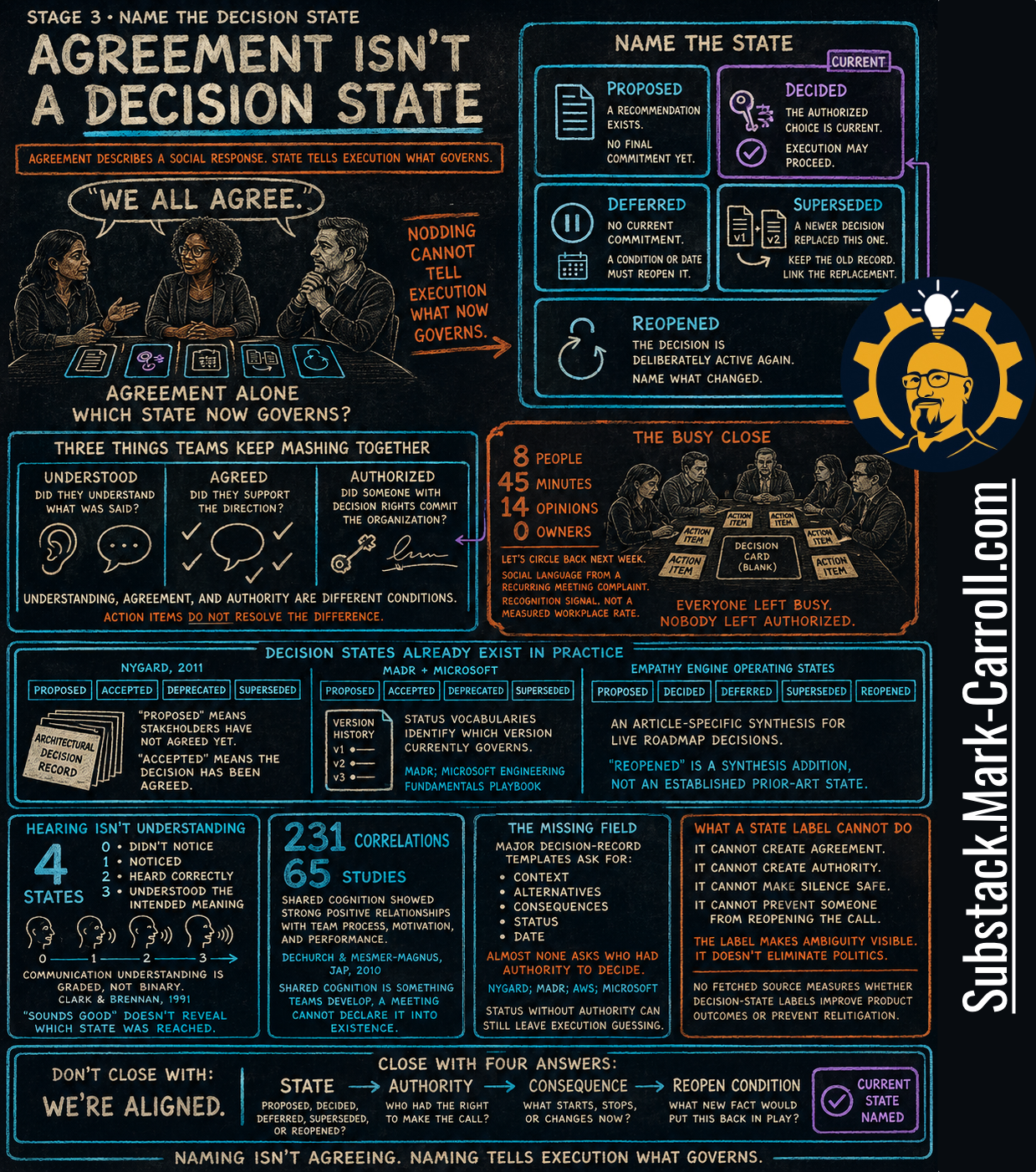
Declare one of five states instead: proposed, decided, deferred, superseded, reopened. This isn’t just tidiness. Decision rights are genuinely contested in practice. At one automaker, 83% of marketers and 64% of product developers each separately claimed the right to decide standard features, and the new models were delayed while that fight played out (Rogers and Blenko, HBR, 2006). Unresolved role ambiguity carries a real, if modest, drag on individual performance across a meta-analysis of 169 samples (Gilboa et al.). Neither finding proves that naming a state fixes the underlying authority conflict. What it does is make the conflict visible enough to argue about directly, instead of discovering it three weeks later as a memory fight.
Stage 4: Capture the decision logic. A final answer is not the same as a usable record. “Delay the launch” can survive for months while the reasoning underneath it quietly goes stale.
The answer survived. The why didn’t.
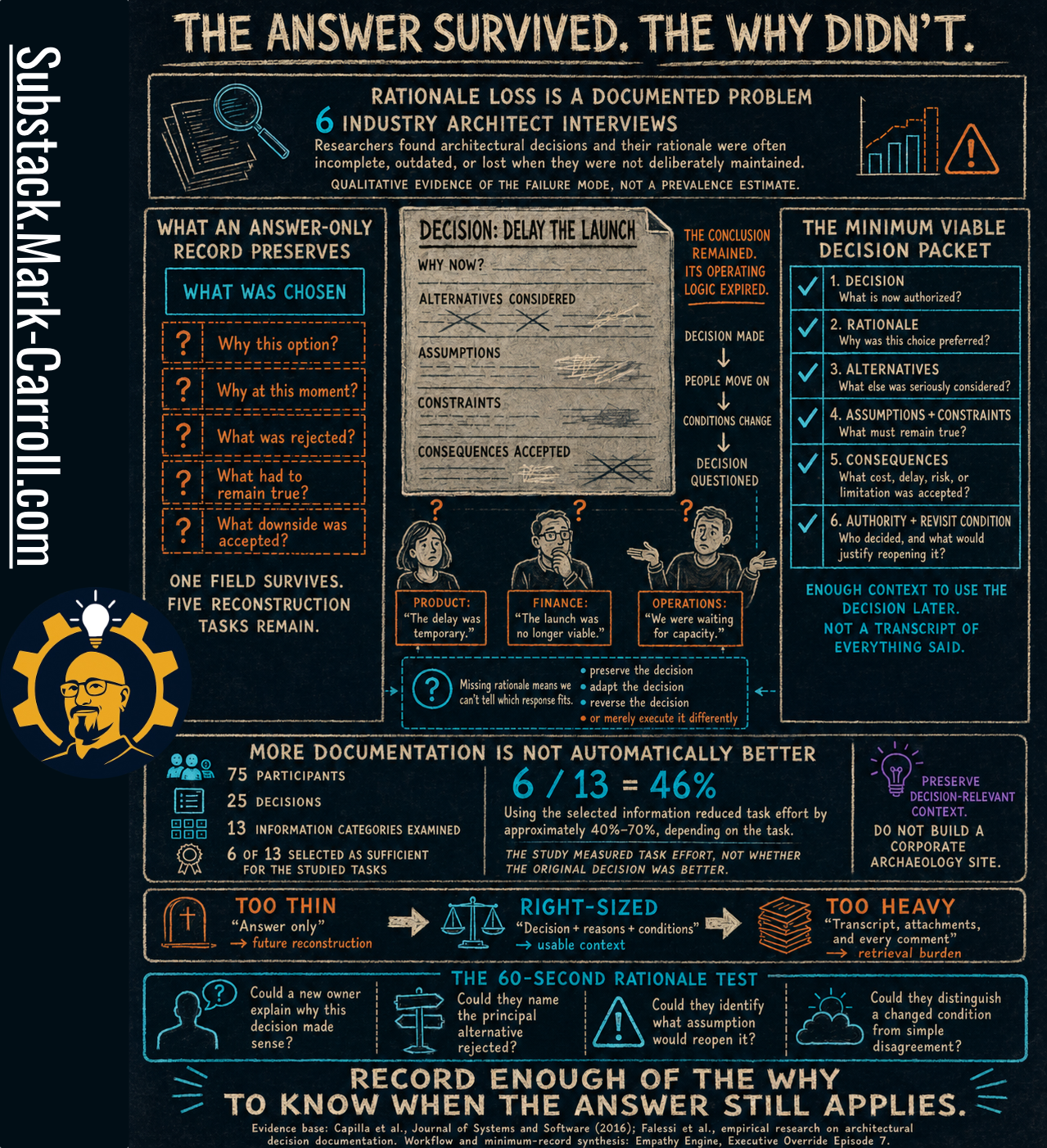
Preserve enough that someone who wasn’t in the room could later explain why the option won: the decision, the rationale, the alternatives considered, the assumptions and constraints, the consequences accepted, who had the authority to decide, and what would justify reopening it. That’s more than most teams keep and less than most templates ask for. In two controlled experiments, a value-based subset, six of thirteen possible information categories, cut documentation effort 40 to 70 percent depending on the task, without any claim about whether the underlying decisions were better (Falessi et al.). Keep it small on purpose. I once had to reopen a decision months after the answer had been recorded but the reasoning had scattered. We spent more time reconstructing why the choice had made sense than evaluating whether it still did.
Stage 5: Confirm the interpretation. A reply confirms that communication happened. It does not confirm the decision arrived intact.
Confirmation isn’t closure.
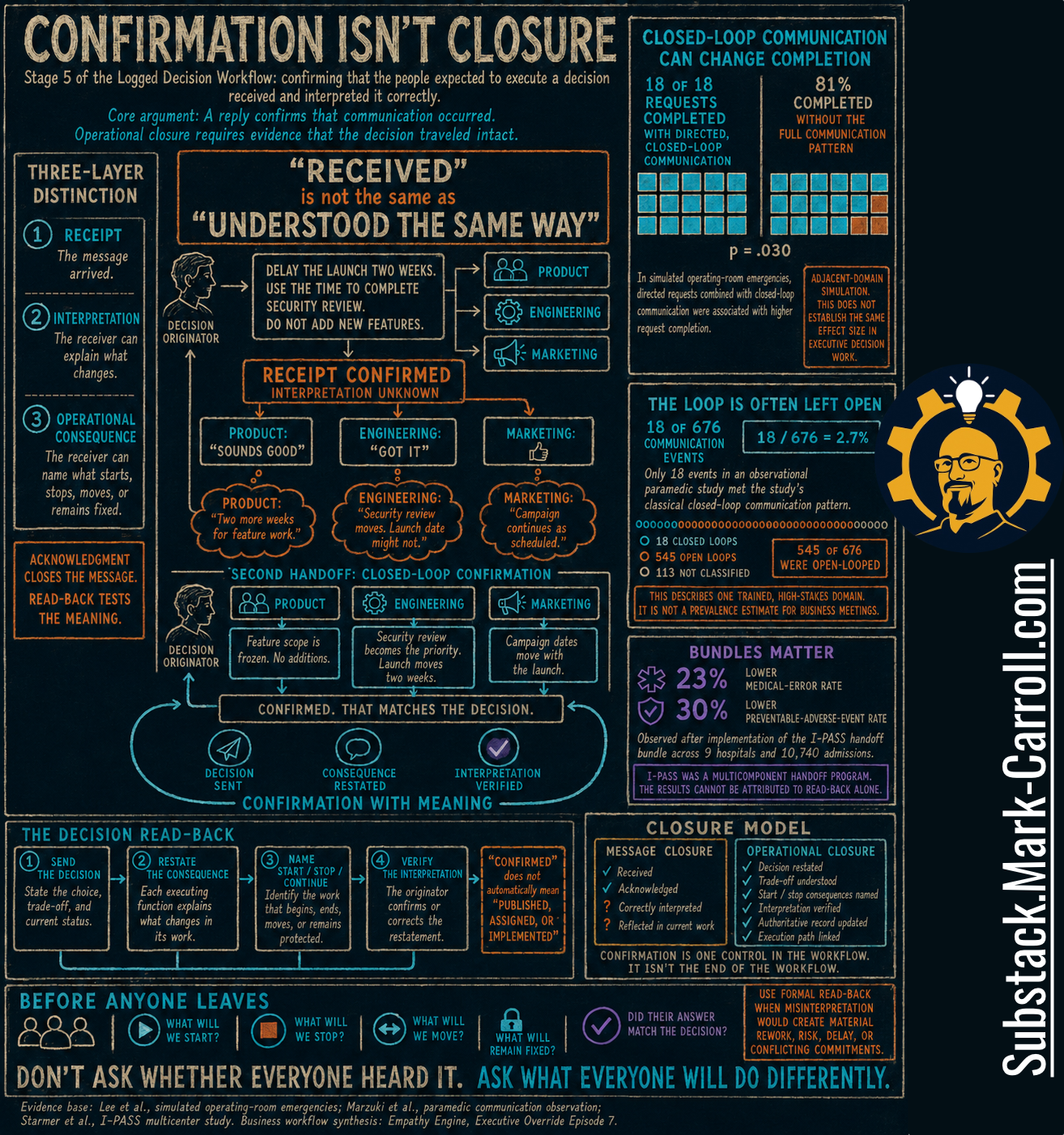
“Sounds good,” a thumbs-up, “got it,” all three close the message. None of them tell you whether Product, Engineering, and Marketing now believe the same thing changed. Ask each executing function to restate what starts, stops, or moves, and have the person who made the call confirm or correct that restatement before treating it as settled. The evidence for why this matters comes from outside product work, and it’s worth being honest about that gap. In simulated operating-room emergencies, directed closed-loop requests completed 18 of 18 times, against 81 percent otherwise (Lee et al., BJA). But among paramedics actually trained in the technique, only 2.7 percent of 676 real communication events closed the loop the textbook way (Marzuki et al.). That’s the caution worth sitting with. The method works when people actually run it. Most people, most of the time, don’t.
Stage 6: Publish the current record. “One source of truth” gets misheard as “one enormous file,” which is how good records turn into abandoned ones.
One current record doesn’t have to mean one file.
One current answer does not require everything in one document.
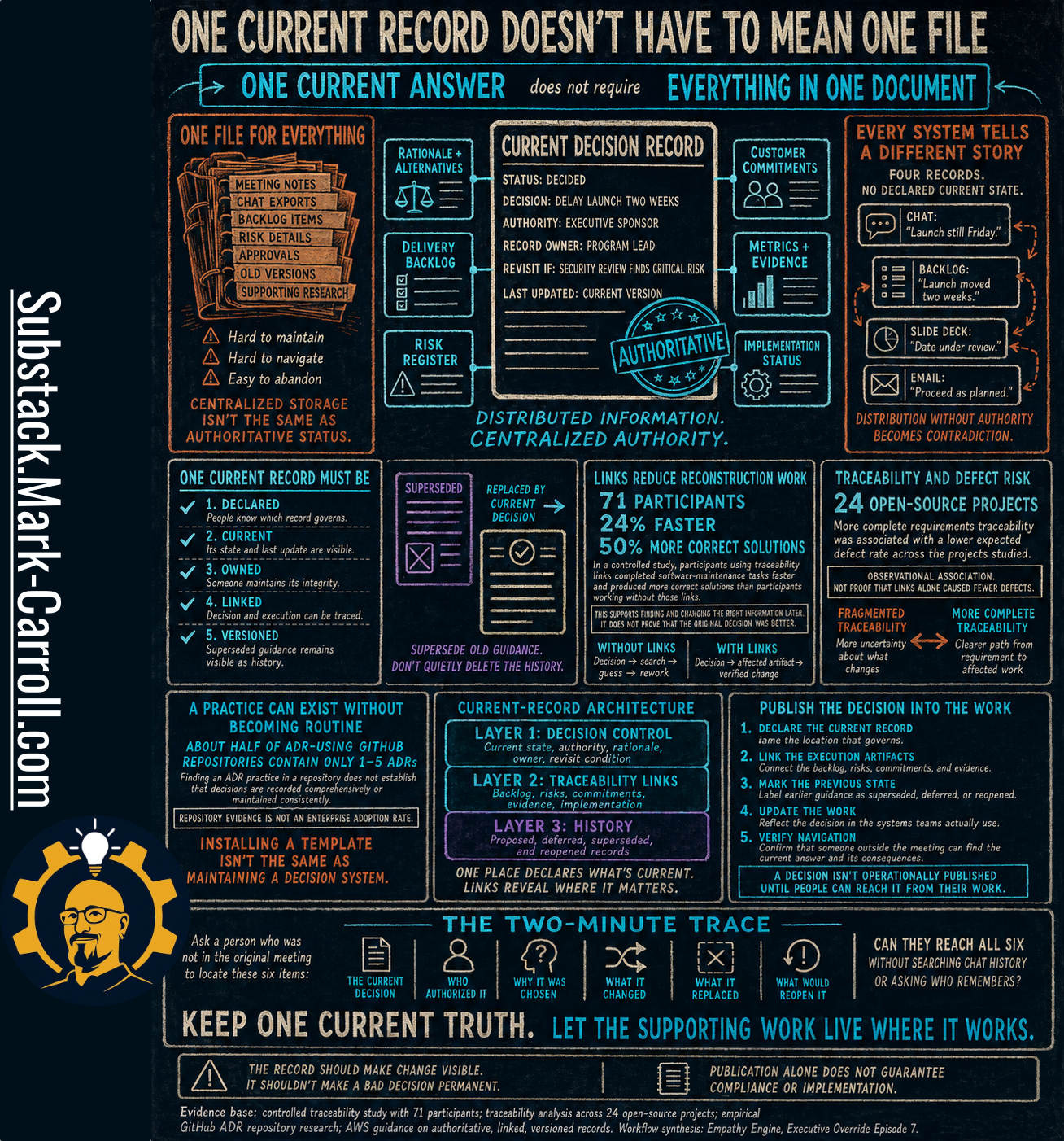
One place declares what’s current. Links carry the decision out to the backlog, the risk register, the customer commitments, wherever those artifacts already live. Superseded versions stay visible as history instead of quietly disappearing. In a controlled study, 71 participants using traceability links completed maintenance tasks 24 percent faster and produced 50 percent more correct solutions than participants working without them (Rempel and Mäder). That’s evidence for finding and changing the right thing later. It is not evidence that the original decision was good. The record should make change visible. It shouldn’t make a bad decision permanent.
Constraint: Run the sequence in the meeting or the same day. Six stages, one declared record. No seventh ceremony, even though the evidence would probably support one (verifying implementation, confirming supersession). Six is what fits on a page without losing legibility.
Done state: One current record exists, the named authority is on it, affected functions restated the consequence and had it verified, and a revisit condition is dated or conditional.
Limitation: The workflow cannot invent decision rights, repair bad faith, or make an unsafe record culture safe. It makes a decision inspectable. It does not make every inspectable decision wise.
🖊 What Holds Up Under Pressure
Primary claim label: Evidence-informed components; the full sequence is untested as a package.
Basis: Every stage above draws on something with its own track record: decision-rights conflict, documentation-effort research, closed-loop communication, traceability. What none of those sources tested is this exact six-stage sequence run together, in order, on a live roadmap decision.
Counterpoint: Clearer roles help coordination. Captured rationale saves reconstruction work. Confirmed interpretation catches misalignment before it ships. None of that proves that running all six stages, in this order, prevents relitigation or produces compliance. The confirmation stage carries the largest transfer risk in the set. It’s a design analogy borrowed from clinical and high-reliability work, not a finding about product teams.
Limitation: Use the evidence to justify the components, not the finished workflow. The six-stage sequence is how I’ve stitched the series together. That’s a design choice, and it’s labeled as one here and on the tool itself.
🛑 Do Not Use When
The change is low-stakes. Button copy, standup swaps, and harmless backlog shuffles don’t clear the materiality test in Stage 1, and running six stages on them is documentation theater.
Decision rights are missing, or the record will be used as a weapon. EO-005 already named those failure modes. A better-labeled sequence won’t repair either one.
You’re still in a real emergency. Stabilize first. Run the workflow on the planning conversation that follows the fire, not during it.
Decision Logged: The Decision Examination Board
A decision doesn’t become durable because someone announced it, everyone nodded, or work already started. It becomes durable when another person, someone who wasn’t in the room, can inspect it.
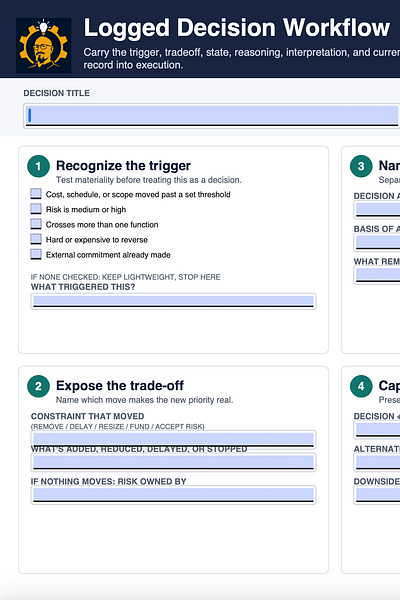
Logged Decision Workflow: Fillable Edition
Complete the six-stage workflow directly from a computer or tablet while the decision is being made or immediately afterward. The interactive fields help capture the trigger, trade-off, decision state, authority, reasoning, shared interpretation, and authoritative current record in one portable document that can be saved, circulated, and linked to execution.
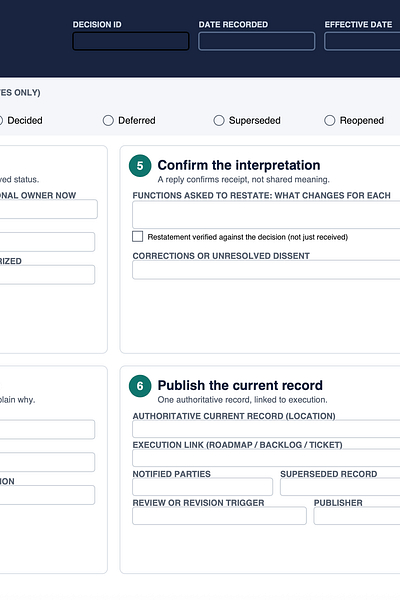
Logged Decision Workflow: Print Edition
Print this one-page edition and bring it into the room when handwriting will keep the conversation moving faster than another open application. The spacious writing areas and six-stage layout help the facilitator capture the trigger, trade-off, decision state, authority, reasoning, shared interpretation, and record location as the discussion unfolds.
The decision is finished when it can be questioned.
A decision that can’t survive inspection wasn’t finished. It was announced.
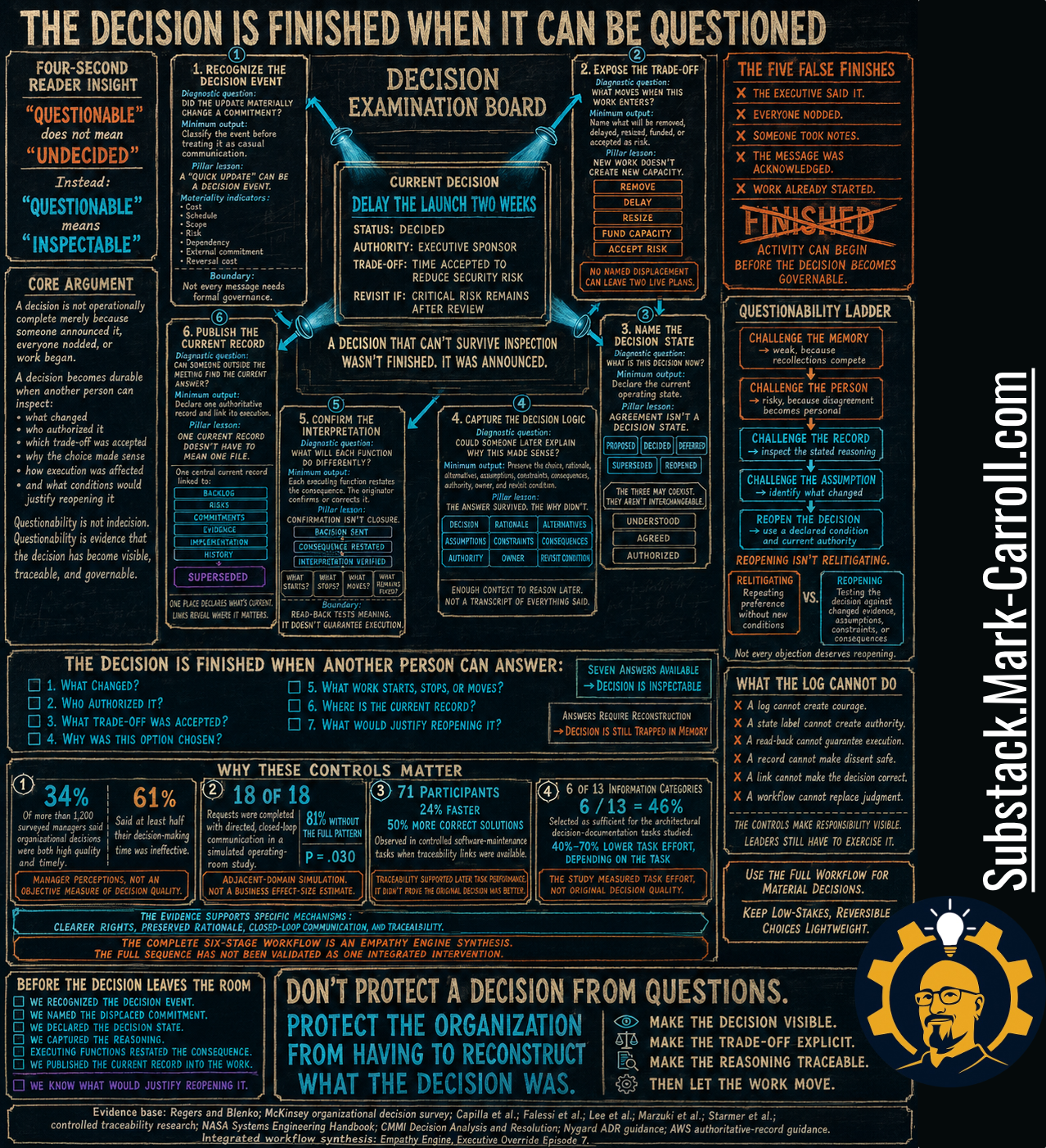
Questionable does not mean undecided. It means inspectable. A decision that can absorb “why did this option win?” three months later without anyone treating the question as an attack is a decision that actually held. One that can’t is a decision that only looked finished on the day it was made.
This Week
As a coach, I listen for the moment a room says, ‘We’re aligned.’ That’s usually when I ask each function to describe what starts, stops, or moves next.
One action for the team: Before the next material roadmap review, write the six stage names at the top of your notes. Don’t let the meeting close until the trade-off, the state, and the record location each have a stated answer.
One action for the leader in the room: Before anyone stands up, say the decision state out loud, proposed, decided, deferred, superseded, or reopened. Not “we’re aligned.”
One definition of done: The decision has traveled when its state and authority are declared, its trade-off and reasoning are recorded, affected functions have restated the consequence, one current record is findable, and the reopening condition is named.
The series, in working order
EO-001 taught the receipt. EO-002 taught the pushback. EO-003 taught the alignment agenda. EO-004 taught the durable record. EO-005 taught where templates break. EO-006 taught the commercial escalation. EO-007 is the order those tools run in when they all have to fire in one room, on one clock.
📎 Forward This
A decision is not finished when the room agrees. It is finished when the trigger was tested, the trade-off was named, the state was declared, the reasoning was captured, the interpretation was confirmed, and one current record was published where execution can find it.

That same operating belief sits at the heart of my upcoming book, Collaborate Better, because better collaboration is not louder agreement. It is the discipline of making tradeoffs, ownership, and next steps visible enough for people to move together. Learn more at CollaborateBetter.us.
⬅ Closing
The meeting can close. The decision still has to travel.
If execution cannot inspect one current record, the fight is not over. It only changed rooms.
Next week, Empathy Engine launches a brand-new series: The Judgment Layer. AI made generating work cheap, but someone still has to decide what’s true, useful, safe, and worth acting on. This series follows the professionals quietly inheriting that burden, then gives them practical ways to reclaim judgment before speed outruns understanding.
Regards,
Mark 👋
Research notes
Rogers, P., and Blenko, M. (2006). Who Has the D? Harvard Business Review. Gilboa, S., et al. Role ambiguity meta-analysis. CMMI DAR SP 1.1; NASA Systems Engineering Handbook 6.5, 6.8. Falessi, D., Briand, L., Cantone, G., Capilla, R., and Kruchten, P. Simula Research Laboratory. Lee, et al. British Journal of Anaesthesia 135(5). Marzuki, et al. Paramedic closed-loop communication observation. Rempel, P., and Mäder, P. IEEE Transactions on Software Engineering. Full citations live in the Research Binder attached to this issue.
Previous:
Commercial Urgency Is a Signal. It Doesn't Finish the Decision.

What to Say When Sales Calls It a Deal Breaker
More Content to Discover:

Half Your Team Is Using AI. You Don't Know Which Half.

Intro If you read the piece we published last week on Leadership in Change, you saw the structural diagnosis: mandate pressure, decision collapse, intake collapse. Three failures that sit underneath almost every AI pilot that goes sideways. That piece mapped the architecture. What it did not cover is what happens on the human side of the same problem, wh…

The most dangerous roadmap meeting may be the one where everyone agrees. “We’re aligned” can hide 3 different decisions until Product, Engineering, and Sales begin executing them.
Before the room closes, ask each function what starts, stops, or moves, then share below: which phrase has created the most expensive confusion in your organization?