


The Stakeholder Alignment Agenda for meetings where everyone agrees, then leaves with a different decision
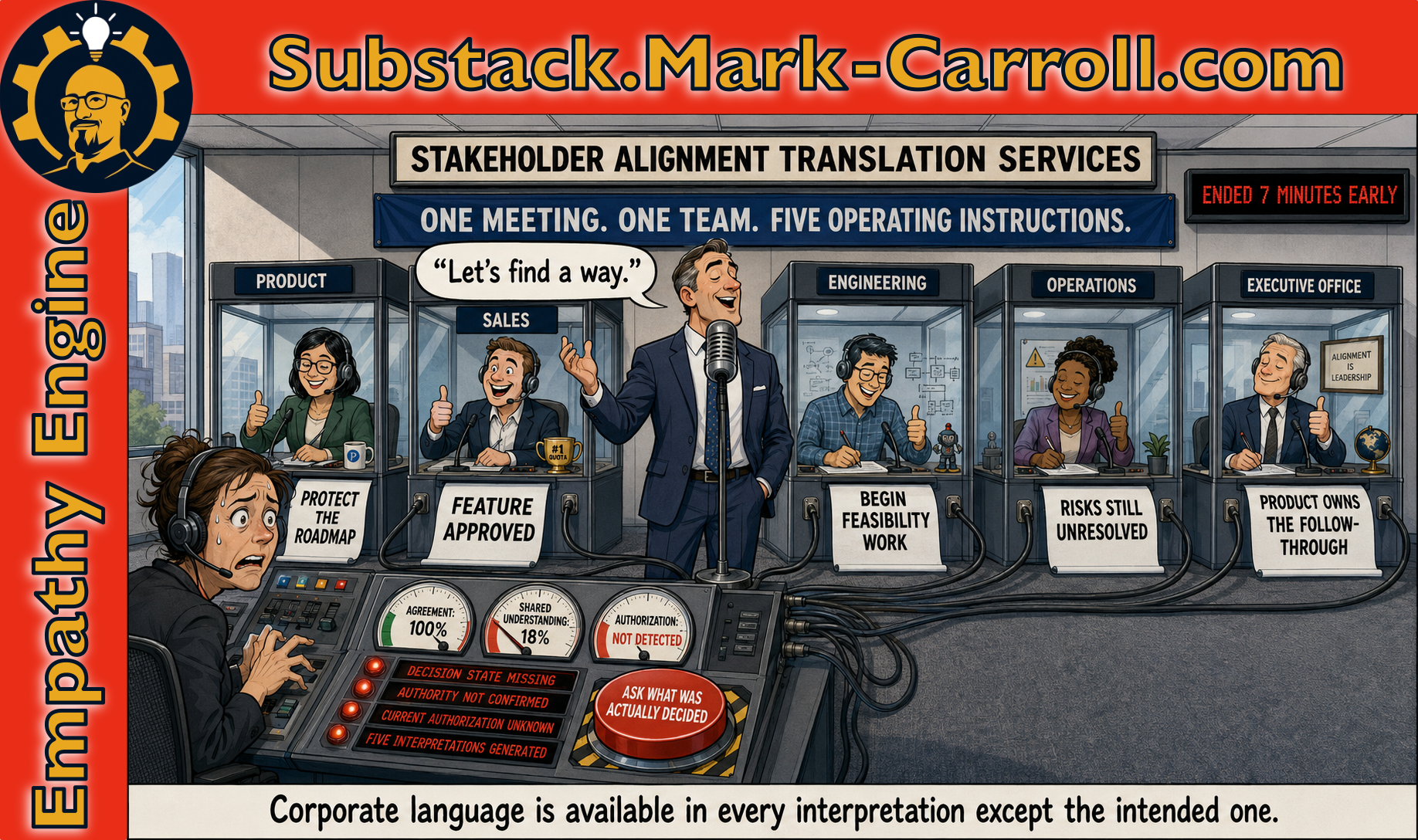
Plain-English premise: A stakeholder meeting isn’t closed when the arguing stops. It’s closed when the room can state what was decided, what’s authorized, who holds the authority, who carries it next, and when it returns — or can explicitly admit it doesn’t know yet.
👋 Welcome to this week’s edition of Empathy Engine. Every Wednesday, I publish a new article for paid subscribers first, then unlock the full piece for everyone late Thursday morning. Each week, I turn product leadership friction into practical tools, sharper language, and more defensible decisions.
Research Binder: the receipts (citations + source notes) are compiled in a PDF at the bottom of this post.
Episode 2:

⚠ Tension
Everyone in the room nods. The meeting ends on time.
Every function walks out carrying a different version of what was just decided.
🎯 Payoff
Inside: the Stakeholder Alignment Agenda and the Meeting Capture Strip; a decision-centered structure and a six-field record that make the current decision state explicit before anyone disperses.
I did not learn this from a meeting that exploded. I learned it from one that ended politely, on time, with everyone nodding, and still sent five people away carrying five different instructions.
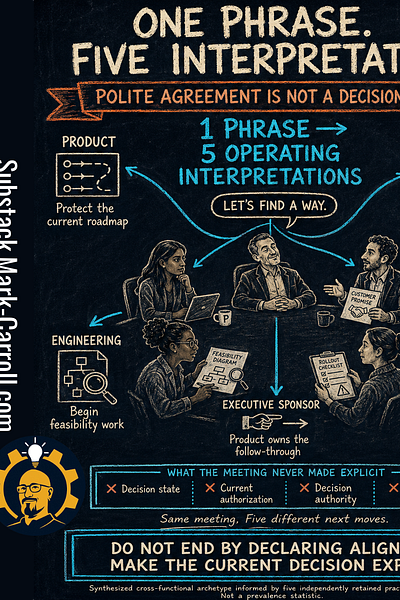
The details change, but the pattern repeats. Product, Sales, Engineering, Operations, and an executive sponsor debate a consequential request. People raise constraints, defend commitments, and make their cases. Then, near the end, the sponsor leans back and says some version of, “Let’s find a way.”
The room nods. The meeting ends on time. Everyone leaves feeling like something happened.
It did. Just not the same something for everyone.
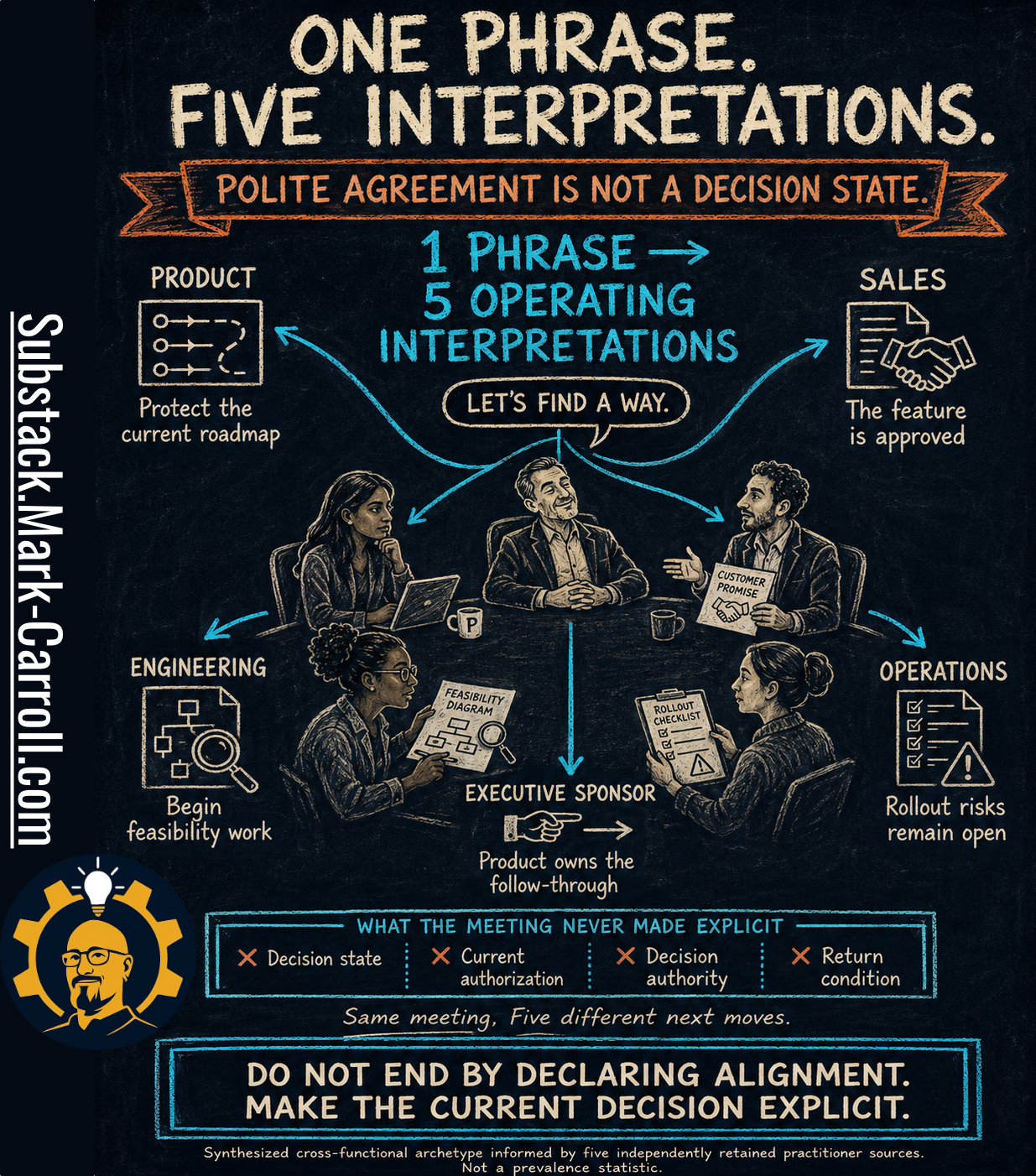
Product hears: protect the current roadmap. Sales hears: the feature is approved. Engineering hears: begin feasibility work. Operations hears: rollout risks remain unresolved. The sponsor assumes Product now owns the follow-through.
Five functions leave the same room carrying five operating instructions. Nothing in the meeting made that split visible before it happened. Nobody was acting in bad faith — each person translated the same vague phrase through the obligations of their own role.
Polite agreement is not a decision state.
“Let’s find a way” is not a decision. It’s an unfinished one, handed back to the room to complete privately, in several different directions.
🎒 The Move: The Stakeholder Alignment Agenda
This structure began with a mistake I made as a facilitator. I summarized a difficult meeting as if the room had reached a decision, when I had really combined agreement, shared understanding, and authorization into one neat sentence nobody had actually confirmed.
The Stakeholder Alignment Agenda grew out of that failure. It is designed to keep those three conditions separate long enough for the room to state what is actually understood, what is actually authorized, and what remains unresolved.
It doesn’t guarantee agreement. It doesn’t force approval. It doesn’t make a weak decision strategically sound. Its purpose is narrower: make the current decision reconstructable before everyone leaves with a different version.
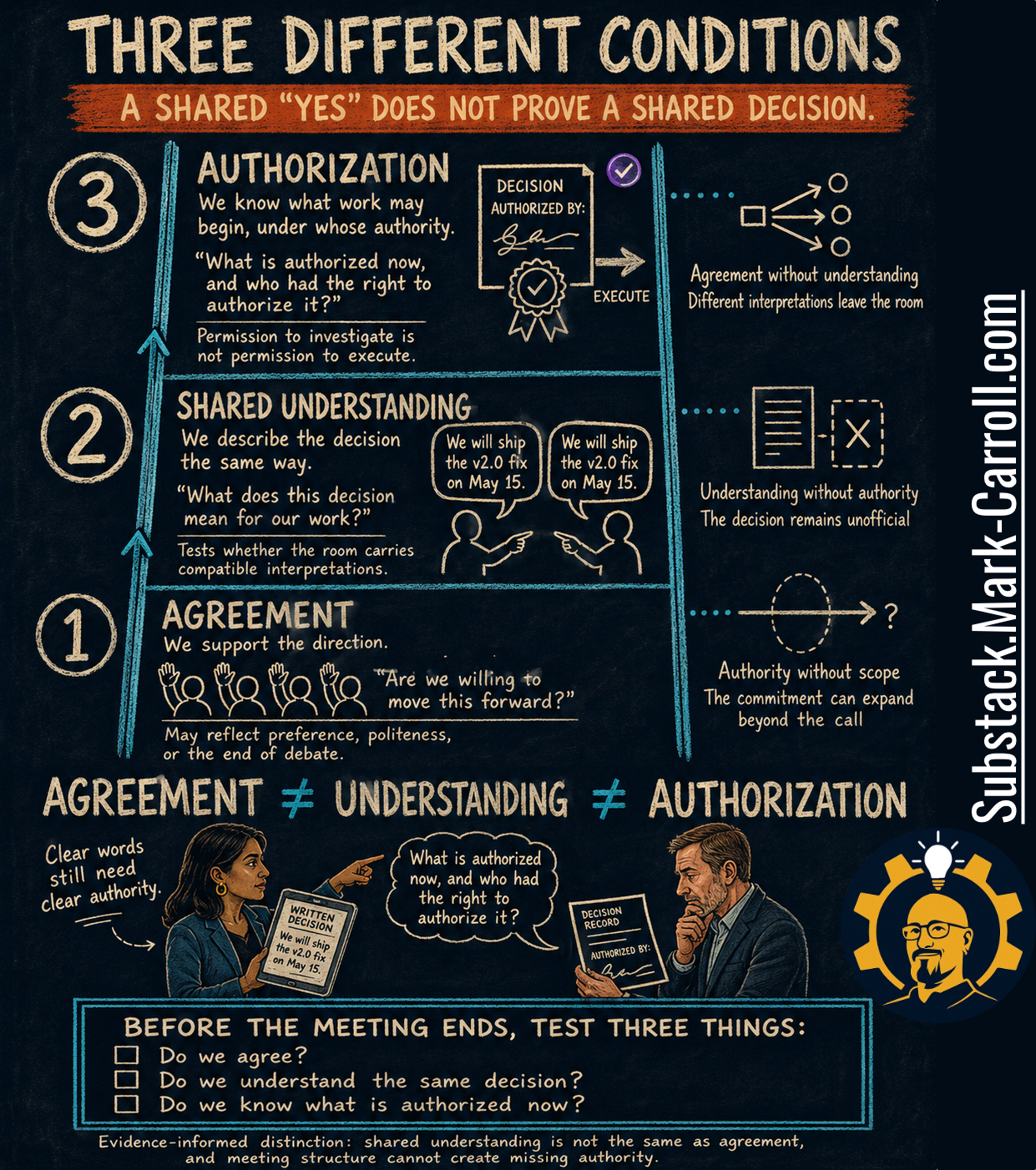
Agreement, understanding, and authorization are three different conditions. A show of hands is not shared understanding. Shared understanding is not authorization. A meeting can satisfy one and still fail on the other two.
Agreement asks: are we willing to support this direction? A “yes” may reflect conviction or politeness, hierarchy, or the end of a debate nobody wants to continue. Shared understanding asks: what does this decision mean for our work? Two people can both say “we’ll ship the fix on May 15” while picturing different scopes. Authorization asks: what is authorized now, and who had the right to authorize it? A sponsor may authorize investigation without authorizing delivery.
Three predictable failures follow: agreement without understanding lets different interpretations leave the room; understanding without authority leaves the decision unofficial; authority without scope lets the commitment expand beyond what was approved. Permission to investigate is not permission to execute.
A shared “yes” does not prove a shared decision.
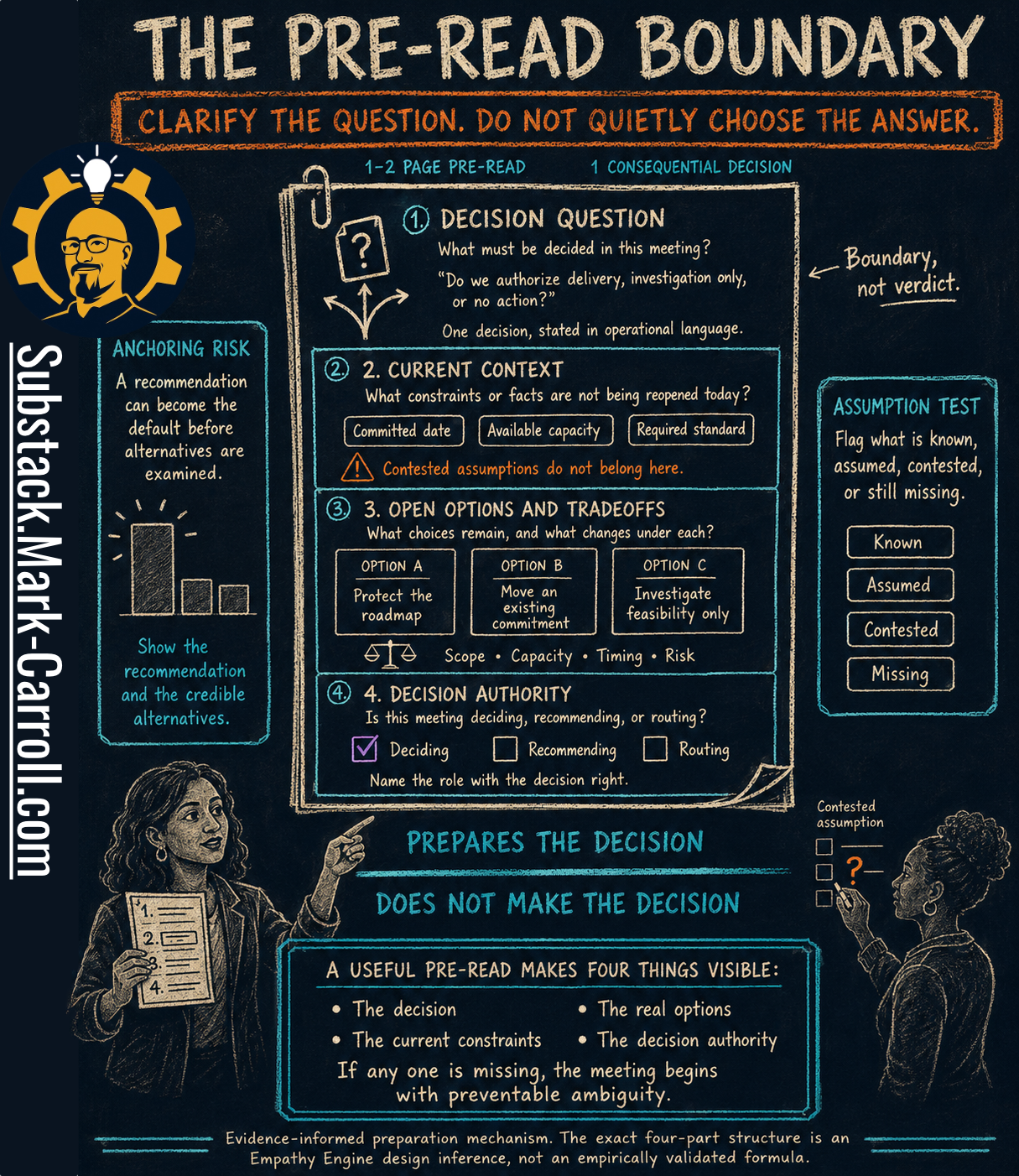
Before the meeting, send a focused pre-read (one or two pages, built around one decision. State the decision question in operational language: not “should we prioritize this,” but “are we authorizing delivery, investigation only, or no action?” Name the current context) the commitments and constraints not being reopened today, honestly labeled if contested. Show the open options and tradeoffs, credible alternatives included, not buried behind a preferred one. Name the decision authority. Is this meeting deciding, recommending, or routing?
The pre-read prepares the decision. It does not make it.
Clarify the question. Do not quietly choose the answer.
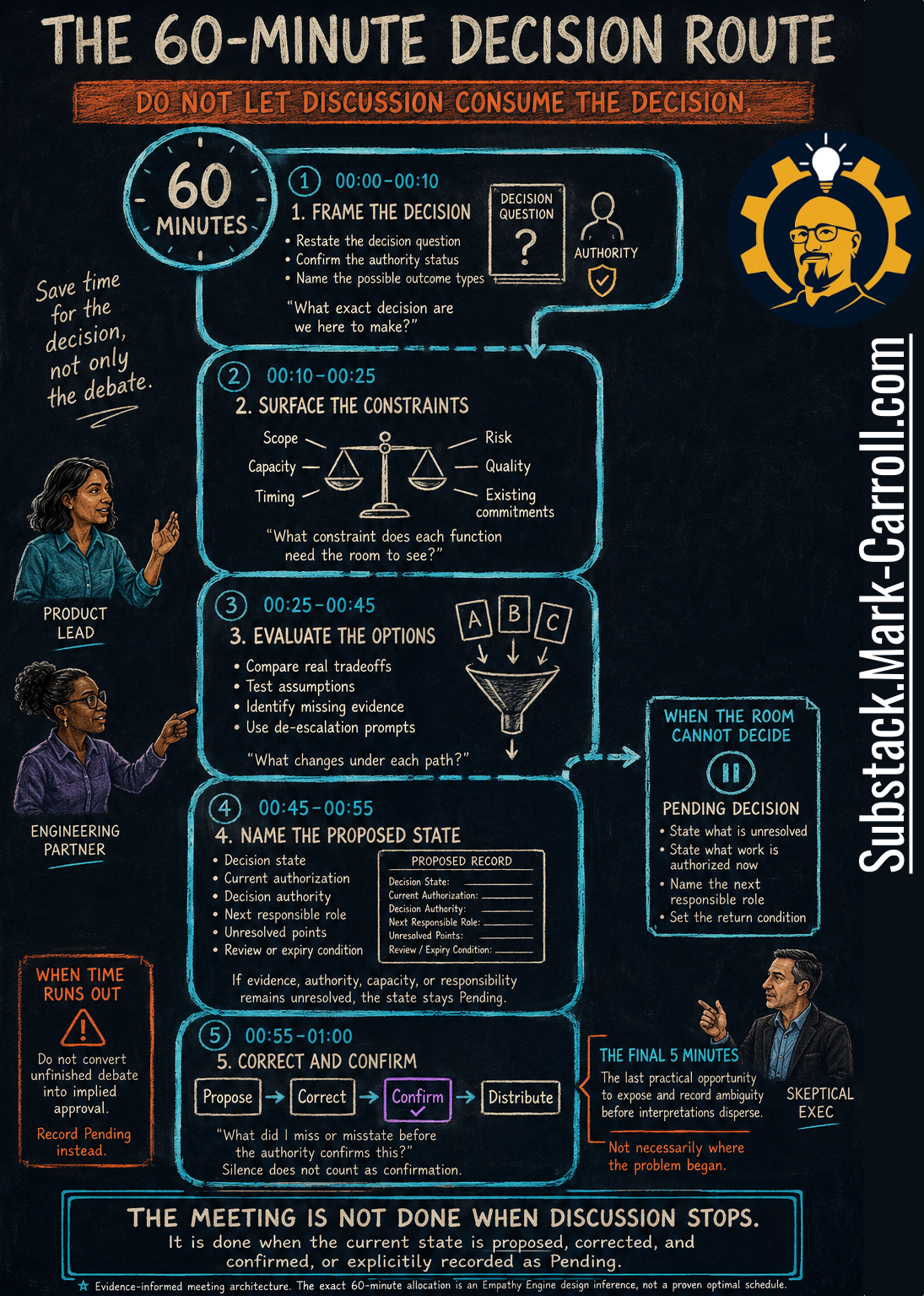
In the meeting, run five stages inside 60 minutes. The exact split will vary, but protect time for the decision itself, not just the debate. Use a timebox structure similar to the following. Frame the decision and confirm authority status (00:00–00:10). Surface each function’s real constraint, not its preference (00:10–00:25). Evaluate the options and name what evidence is missing (00:25–00:45). Name the proposed state; decision state, current authorization, decision authority, next responsible role, unresolved points, review condition (00:45–00:55). Then correct and confirm: propose, correct, confirm, distribute (00:55–01:00).
If evidence, authority, capacity, or responsibility is still unresolved at minute 55, the state stays Pending. That’s not a failed meeting. It’s a more truthful one.
Do not let discussion consume the decision.
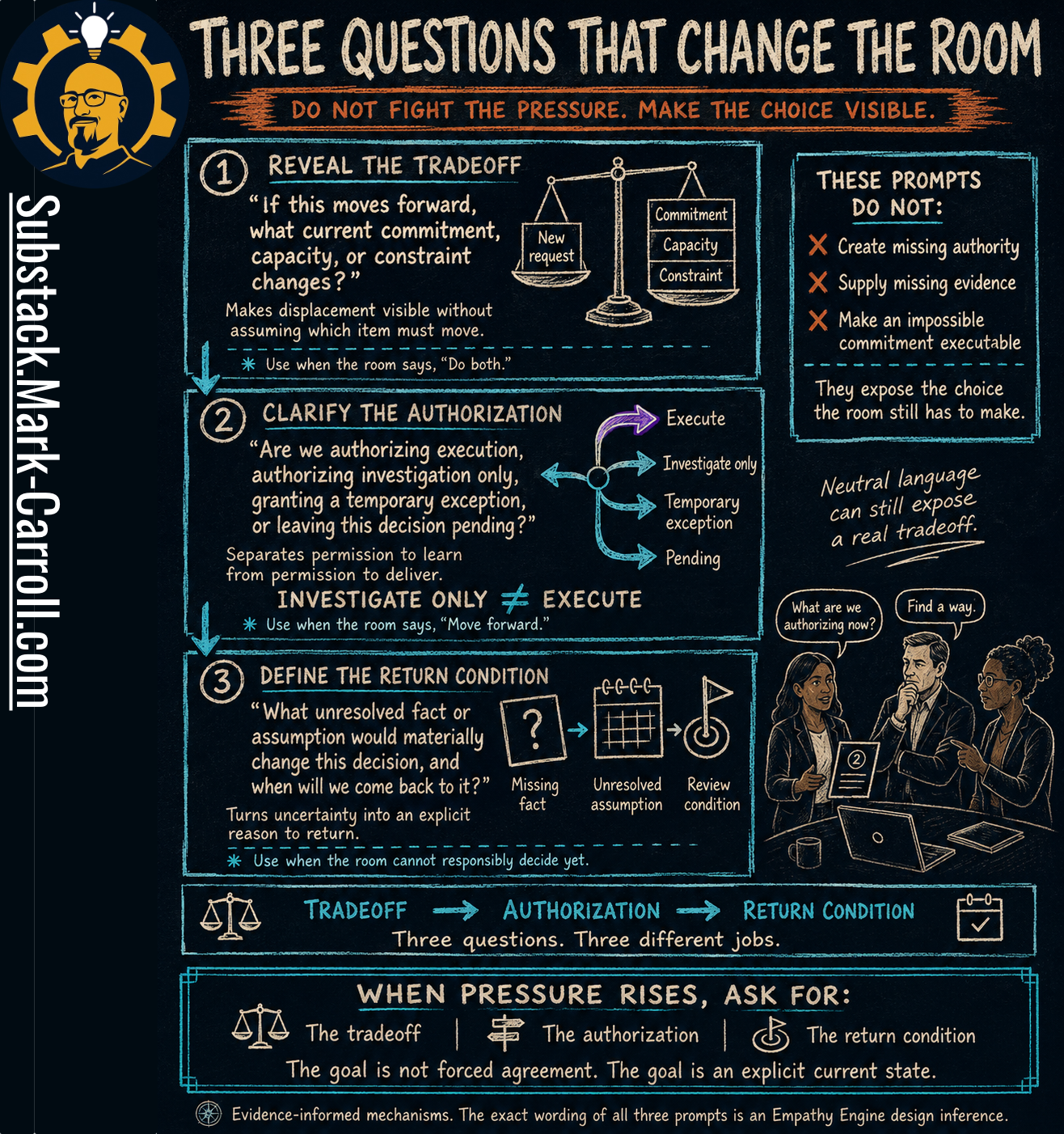
Three questions reopen a stalled room without forcing a fight. When the room says “do both,” ask: “If this moves forward, what current commitment, capacity, or constraint changes?” When it says “move forward” without saying what that means, ask: “Are we authorizing execution, investigation only, a temporary exception, or leaving this pending?” Investigate only is not execute. When it can’t responsibly decide yet, ask: “What unresolved fact would materially change this decision, and when do we come back to it?”
None of these create missing authority, supply missing evidence, or make an impossible commitment executable. They expose the choice the room still has to make.
The goal is not forced agreement. The goal is an explicit current state.
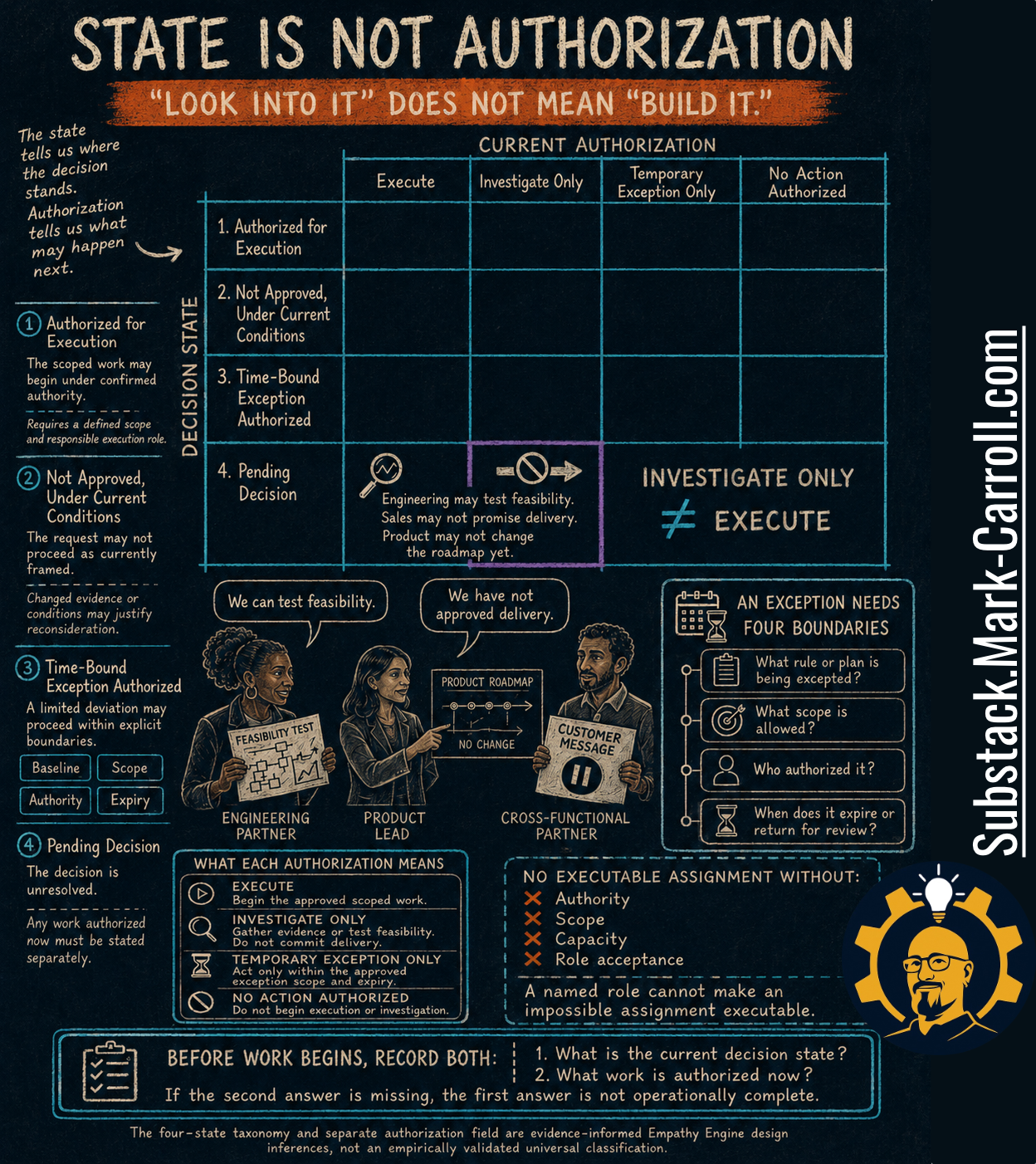
Decision state and current authorization are not the same thing. The state tells us where the decision stands. Authorization tells us what may happen next. A Pending Decision paired with Investigate Only means Engineering may test feasibility but Sales may not promise delivery, and Product may not touch the roadmap yet.
Four states: Authorized for Execution (scoped work may begin under confirmed authority), Not Approved, Under Current Conditions (may not proceed as framed, though changed evidence may justify revisiting), Time-Bound Exception Authorized (a limited deviation within a defined baseline, scope, authority, and expiry), and Pending Decision (unresolved; any work authorized now must be stated separately). Four authorization values: Execute, Investigate Only, Temporary Exception Only, No Action Authorized.
I once recorded “investigate the option” without also recording what was not authorized. The person asked to explore it quietly became the person expected to deliver it, even though the authority, scope, and capacity were still missing.
A named role doesn’t make an assignment executable. If authority, capacity, or role acceptance is missing, the state stays Pending; the room escalates, reduces scope, or reassigns, rather than recording execution as authorized.
“Look into it” does not mean “build it.”
🖊 What Holds Up Under Pressure
Basis: Research on goal clarity and shared understanding links explicit decision framing to fewer divergent interpretations across cross-functional teams — the mechanism behind Phases 1 and 2 above. Separately, closed-loop communication research from safety-critical domains supports repeating a message back and confirming it: in one study of 55 pediatric trauma activations, closed-loop orders were completed 3.6 times sooner than orders that weren’t.
Counterpoint: That result supports repeat-and-confirm in its original clinical setting. It does not prove the same effect in a corporate stakeholder meeting, and this agenda hasn’t itself been empirically validated as a protocol. A well-structured meeting can still produce a confidently wrong commercial decision if the assumptions underneath it are bad.
Limitation: This framework can expose ambiguity, clarify authorization, and create a shared reference. It cannot create authority nobody in the room holds, supply capacity nobody allocated, guarantee execution, or make an unsafe reporting culture safe. Authority confirmation is context-dependent — where it can’t happen, the record stays Pending and Provisional rather than pretending closure.
🎒 Capture, Correct, Confirm
A record nobody had the chance to correct isn’t a record of the meeting. It’s one person’s account, wearing the meeting’s authority.
What matters to me is not whether a meeting looked successful. It is whether the people expected to carry the work leave knowing what the room actually decided, what it authorized, and what remains unresolved.
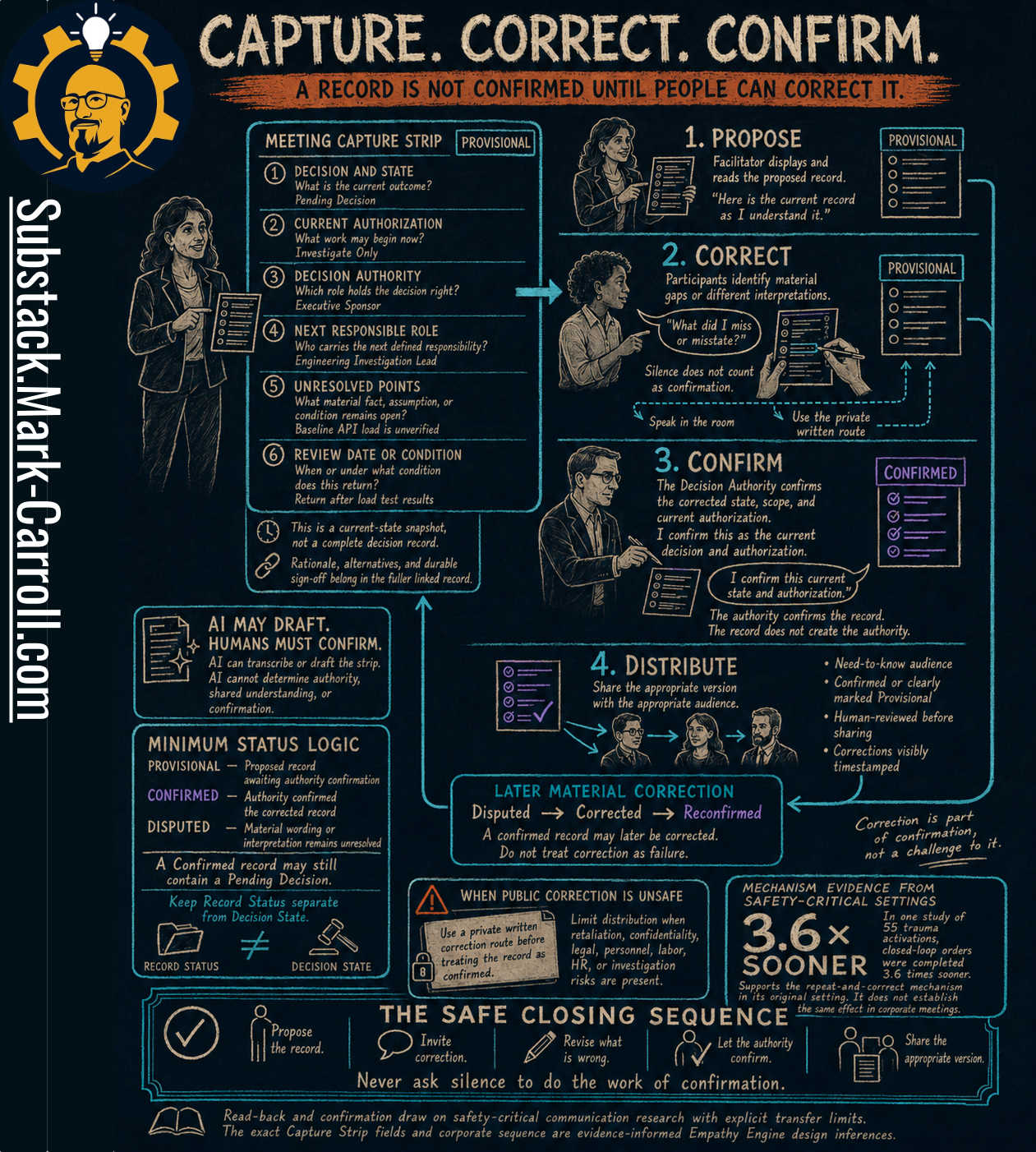
Use a Meeting Capture Strip (six fields: Decision and State, Current Authorization, Decision Authority, Next Responsible Role, Unresolved Points, Review Date or Condition). A current-state snapshot, not the full decision record; rationale and evidence history live in EO-004’s fuller record.
Propose: the facilitator displays the strip and says, “Here is the current record as I understand it.” Provisional. Correct: “What did I miss or misstate?” in the room or through a private written route. Silence doesn’t count as confirmation. Confirm: the decision authority confirms the state and authorization aloud. Only then is it Confirmed. The authority confirms the record. The record does not create the authority. Distribute: the appropriate version, to the appropriate audience, status clearly marked.
A Confirmed record can still contain a Pending Decision. A later material correction moves the record from Disputed to Corrected to Reconfirmed. That’s maintenance, not failure. AI may draft the strip. It cannot determine authority, shared understanding, or confirmation.
The meeting is not done when the discussion stops. It is done when the current state has been proposed, corrected, and confirmed, even when the state being confirmed is Pending.
A record is not confirmed until people can correct it.
🛑 Do Not Use When
Public correction could trigger retaliation or the matter involves legal, personnel, HR, or investigative concerns. Use a private written route.
The actual decision authority is absent. Don’t manufacture certainty by asking an unauthorized room to confirm a decision it can’t make. Record Pending and route the authority question separately.
The meeting is routine and low-stakes. Backlog swaps and status syncs don’t need a six-field record.
Decision Logged: The Six-Question Decision Closure Test
Before the room disperses, ask: What is the current decision state? What work is authorized now? Who had the authority to make that call? Which role carries it next? What remains unresolved? When or under what condition does it return?
Then: Propose. → Correct → Confirm → Distribute.
The completed record should be readable aloud in under one minute; a design target, not a proven threshold. If the room can answer all six, close the meeting. If not, record Pending and record why. All three outcomes (proceed, remain Pending, or use a safer route) can be responsible.
Make the current decision reconstructable.
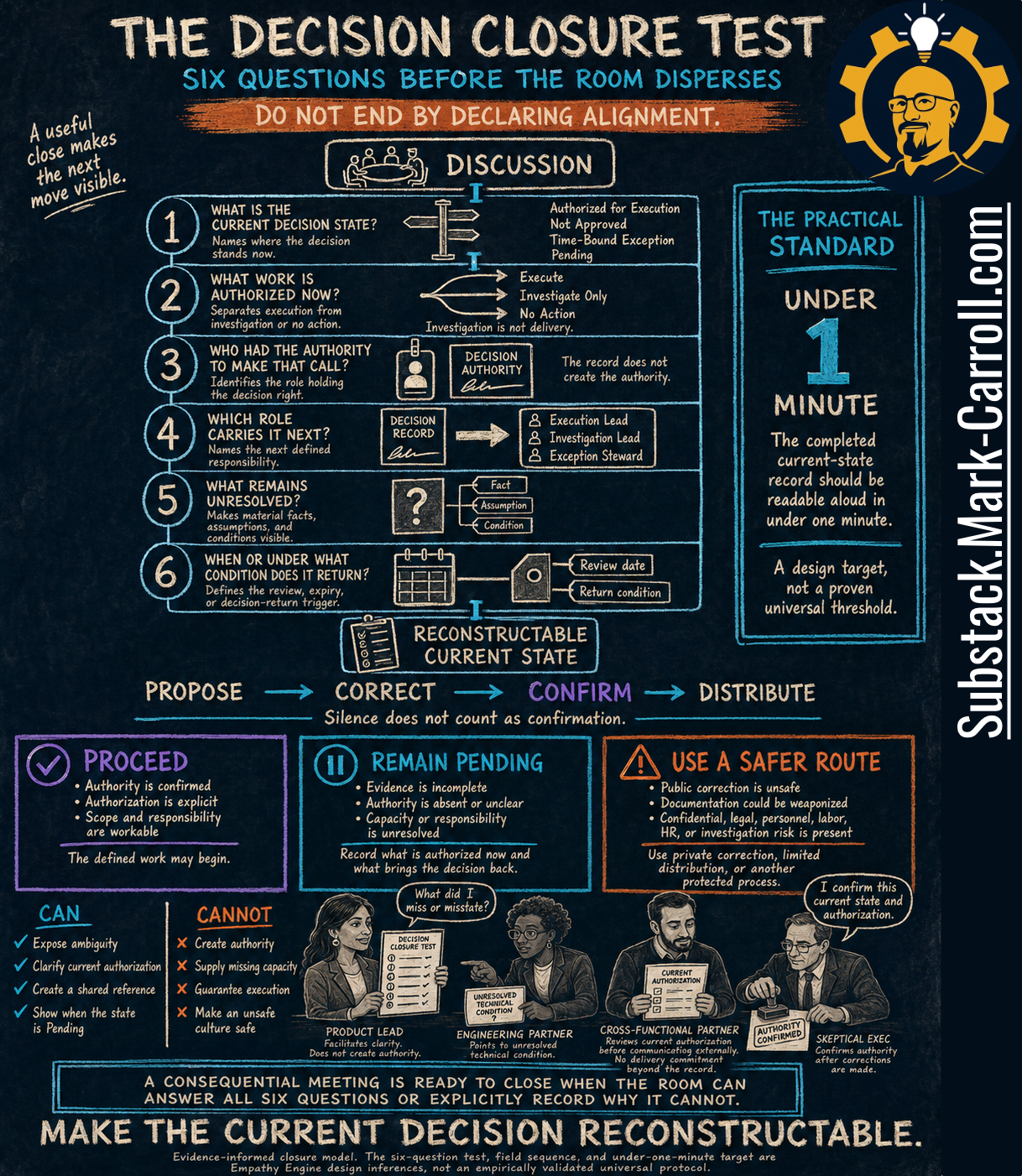
Three things to remember from this: Agreement ≠ Understanding ≠ Authorization. The Meeting Capture Strip. The six-question closure test. Everything else in this framework exists to support those three.
This Week
3 actions for the product lead: Send a focused pre-read framed around the decision question, current context, and decision authority. Reserve the final five minutes for correction and confirmation, not more debate. Read the Capture Strip aloud before anyone disconnects.
1 action for the leader in the room: Confirm the corrected state and authorization in your own words — don’t let the facilitator infer authorization from a nod or silence.
1 action for decision traceability: Attach the confirmed strip to the primary work artifact. The record should travel with the work it governs.
Stakeholder Alignment Field Kit
The Stakeholder Alignment Field Kit is the third unlock in the Decision Memory Field Kit, the free seven-part toolkit this series builds one asset per issue. It bundles the Pre-Read Boundary skeleton, the three de-escalation prompts, the 60-minute decision route, and the six-field Meeting Capture Strip; screenshot-safe, Slack-portable, built to travel into the room and into the channel where the team already works. It doesn’t preserve rationale, alternatives, or long-term decision history. That’s EO-004’s job.
📎 Forward This
Do not end a meeting by declaring alignment — make the decision state, authorization, authority, and return condition explicit before the room disperses.
Next week, Executive Override moves from the live meeting close to the durable record. EO-004 introduces the One-Page Decision Record, giving the confirmed current state a fuller home for rationale, evidence, alternatives, and later revision.

That same operating belief sits at the heart of my upcoming book, Collaborate Better: better collaboration isn’t louder agreement, it’s the discipline of making tradeoffs, ownership, and next steps visible enough for people to move together. Learn more at CollaborateBetter.us.
⬅ Closing
I believe a decision should survive the room that made it. People shouldn’t be held accountable for commitments the room never clearly authorized, scoped, or confirmed.
The meeting is not done when the discussion stops.
It is done when the current state has been proposed, corrected, and confirmed, even when that state is Pending.
Regards,
Mark 👋
Previous:
Urgent Work Is Not a Priority Until Something Moves

The Executive Pushback Script for When Urgent Work Lands Without Naming What Moves
More Content to Discover:

Half Your Team Is Using AI. You Don't Know Which Half.

Intro If you read the piece we published last week on Leadership in Change, you saw the structural diagnosis: mandate pressure, decision collapse, intake collapse. Three failures that sit underneath almost every AI pilot that goes sideways. That piece mapped the architecture. What it did not cover is what happens on the human side of the same problem, wh…

The most dangerous meeting outcome isn’t open disagreement. It’s a room full of nods that quietly turns one vague sentence into five different operating instructions.
Which failure shows up most often in practice: unclear authority, implied execution, or a recap nobody actually confirmed?