


The Executive Pushback Script for When Urgent Work Lands Without Naming What Moves
Plain-English premise: When a senior leader adds urgent work to the roadmap, we still need to name what changes, who decided, and where the record lives before the meeting ends.
👋 Welcome to this week’s edition of Empathy Engine. Every Wednesday, I publish a new article for paid subscribers first, then unlock the full piece for everyone late Thursday morning. Each week, I turn product leadership friction into practical tools, sharper language, and more defensible decisions.
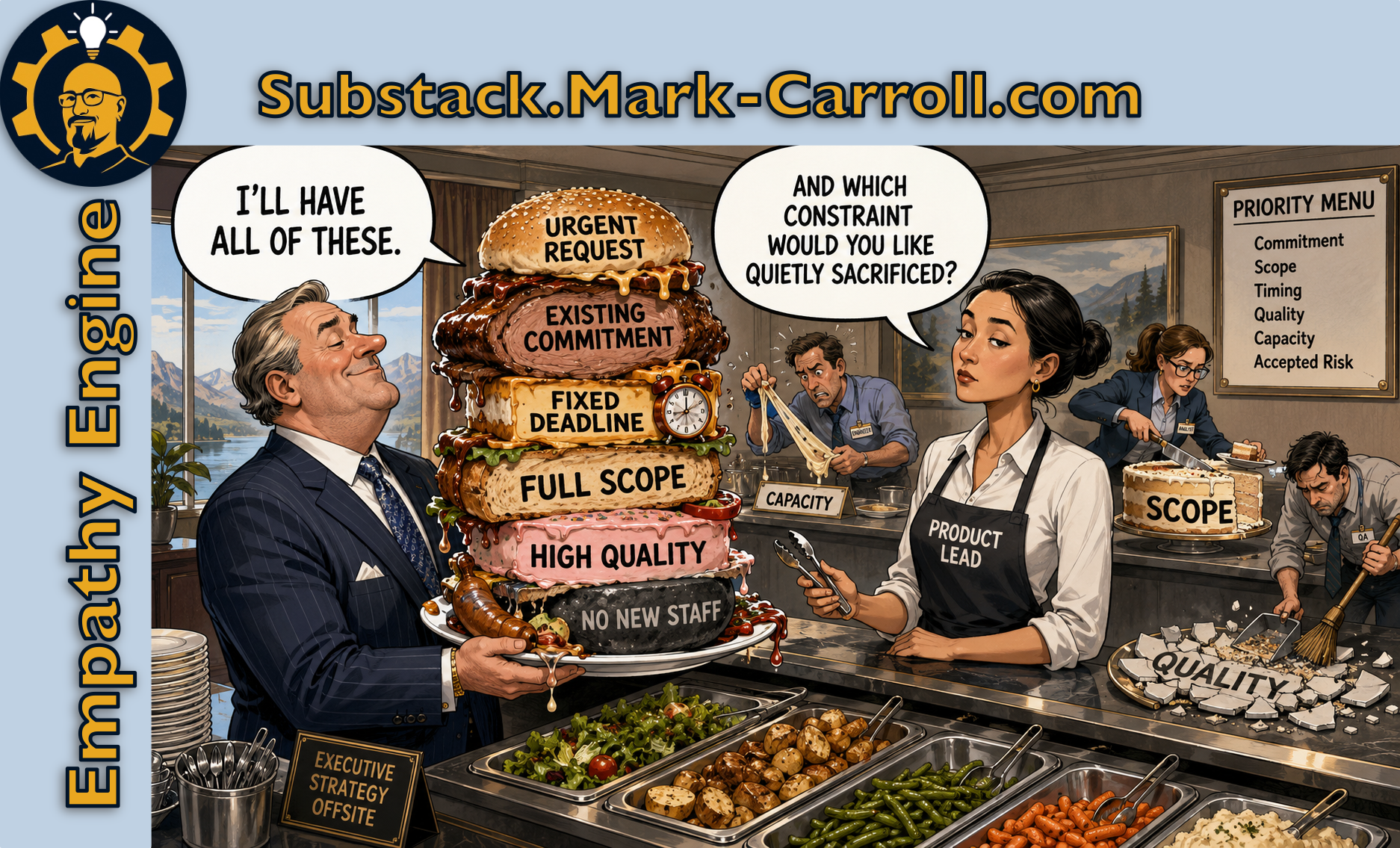
An urgent executive request can be entirely legitimate and still create an incomplete decision. Every roadmap is a finite set of promises about what ships, when it ships, the quality expected, and the team available to deliver it. An urgent ask from above does not erase that finite set. It competes with it.
The danger begins with the missing tradeoff.
This is the second unlock in the Decision Memory Field Kit, the free seven-part toolkit this series builds one asset per issue. Last week’s Override Receipt captured a decision after it changed. This week’s asset catches the moment before it changes, while the tradeoff is still negotiable.
Research Binder: the receipts (citations + source notes) are compiled in a PDF at the bottom of this post.
Episode 1:

⚠ Tension
A senior leader adds urgent work to the roadmap without naming what must shift, and nobody names the cost.
🎯 Payoff
Inside: the Executive Pushback Script, a five-step sequence that names the tradeoff, routes the decision, and leaves a record before the room disperses.
Trigger Moment: When an Executive Adds Urgent Work Without Naming What Moves
I have watched this scene play out more than once in executive planning meetings. A senior stakeholder introduces a new priority that is genuinely urgent, everyone understands why it matters, and the product lead responds with the most cooperative sentence available:
“We’ll make it work.”
The room moves on as though a decision has been made. But the existing commitment is still active, the new request is now active, and nobody has named what changes in scope, timing, capacity, quality, or risk.
A few weeks later, the conflict returns in a less polite form. One group is asking why the original commitment slipped, another is asking why the urgent request is not moving faster, and the delivery team is caught between two versions of what leadership believes it approved.
The request landed. The tradeoff never did.

The executive may reasonably believe the team accepted a new priority. The product lead may reasonably believe the tradeoff will be sorted out later. The delivery team inherits both interpretations.
Call this what it is: an agreement that acknowledged the request while leaving the decision unfinished. The request was heard, yet nobody converted it into an operating decision that answered what changes, who owns the choice, and what the team should now execute against.
An urgent request enters the system as an input. It becomes an operating decision only after someone names the affected commitment, the owner, and the direction the team will execute.

🖊 What Holds Up Under Pressure: What Research Says About Role Ambiguity, Task Switching, and Decision Rights
Primary claim label: Mechanism (evidence-informed; intervention untested)
Basis: The pressure in this scene is not mysterious. It appears across decades of organizational research under several durable names. Role ambiguity and role conflict, holding two live and competing expectations without resolution, are associated with lower performance across workplaces.
At the individual level, dividing attention across simultaneous priorities fragments the workday. Studies of software developers and large-scale activity data connect frequent task switching and interruption with lower perceived and observed productivity.
When the ambiguity concerns authority rather than workload, clearer role definition and decision rights are associated with smoother coordination and fewer stalled decisions. The Research Binder contains the full citations and source notes.
Counterpoint: The five-step sequence itself remains untested. The cited studies examine underlying mechanisms rather than this script as an integrated intervention. No controlled trial has evaluated “acknowledge, name the tradeoff, offer paths, route the decision, confirm,” so this piece makes no outcome guarantee.
Limitation: Treat the Executive Pushback Script as an evidence-informed pattern whose mechanisms come from research on role clarity, fragmentation, and decision rights. The script itself has not been studied. The evidence supports a restrained conclusion: new work added without clear reprioritization can create goal and role conflict. The sequence responds to that diagnosis; its effectiveness in any one room remains uncertain.
🎒 The Move: The Executive Pushback Script for Urgent Leadership Requests
I started building a version of this after an early attempt at pushback went badly. I knew the new request collided with existing work, but instead of naming the tradeoff, I led with the constraint:
“We do not have the capacity.”
That sentence was accurate and strategically useless. It sounded like resistance, invited a debate about effort, and left the decision itself untouched. I needed a better sequence, one that acknowledged the urgency first, made the operating tradeoff visible, and returned the choice to the person with the authority to make it.
Most pushback advice gets the fight wrong. It treats the executive as the obstacle when the unresolved tradeoff is often the real problem. Resisting the ask only delays the same unfinished decision until a worse moment.
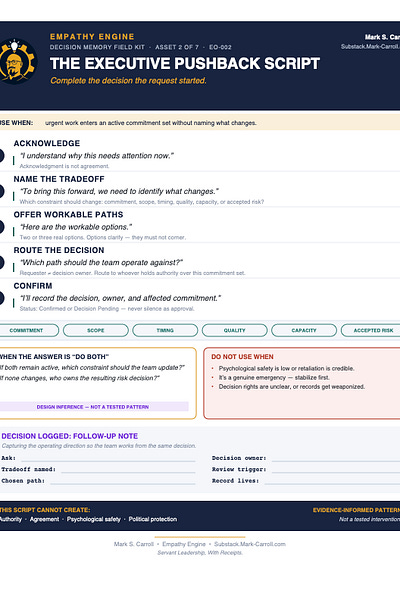
Orienting sentence: When an executive adds urgent work without naming what it displaces, treat the request as an unfinished operating decision and run five steps before the room moves on. Acknowledge the request, then complete the decision it started.
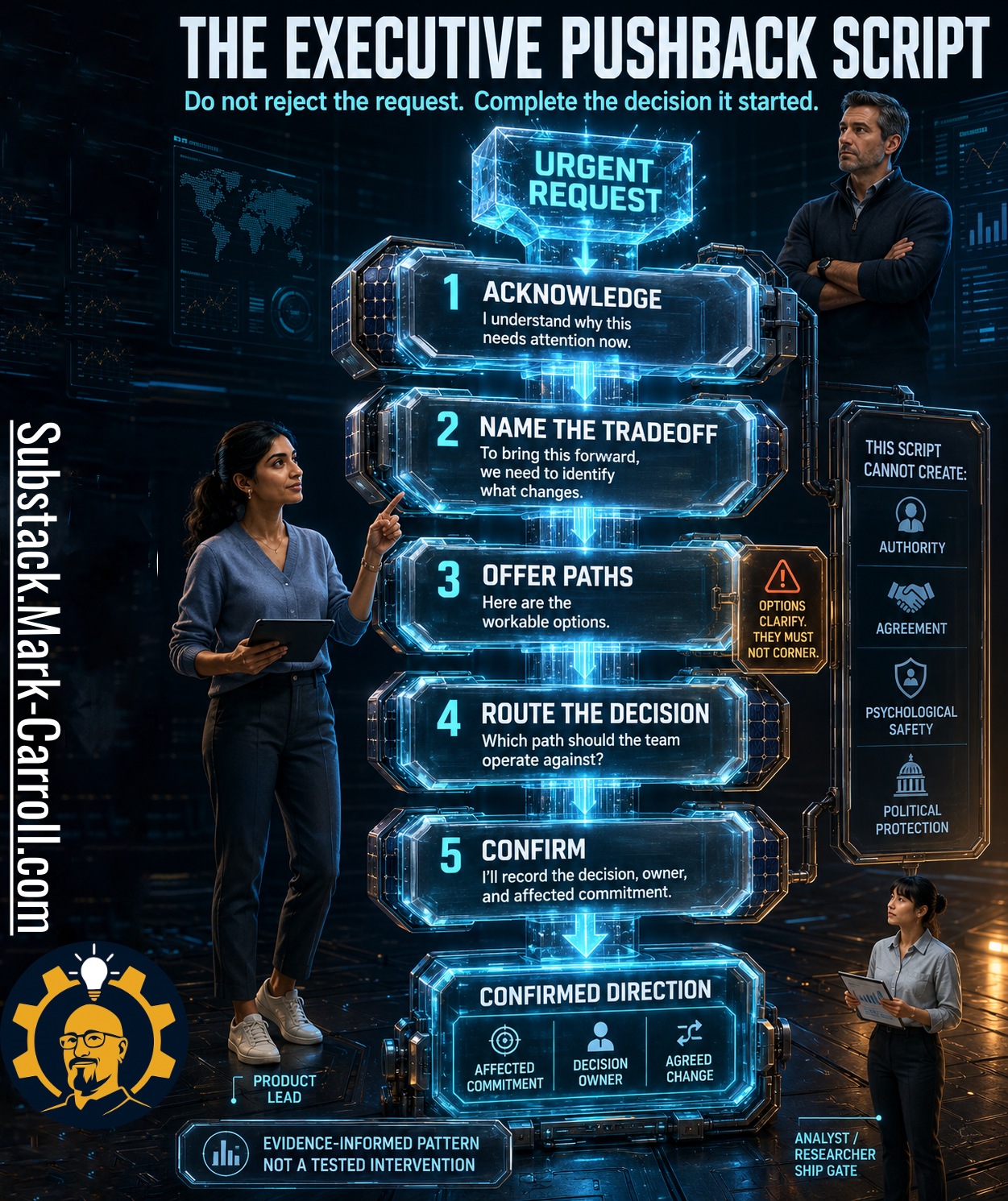
Five steps, all possible without saying no. Each move solves a different part of the operating problem. Together, they make the missing decision visible while leaving the room’s political conditions exactly as they are.
1. Acknowledge the Urgency
Start by recognizing the purpose behind the request, out loud, before you say anything else:
“I understand why this needs attention now.”
This keeps the conversation on the business need and away from a contest over authority. It also prevents an accidental commitment before the operating consequences are understood. Acknowledgment opens the conversation; agreement sets direction.
2. Name the Tradeoff
Next, make the missing consequence visible:
“To bring this forward, we need to identify what changes.”
That sentence shifts the conversation away from a vague capacity objection. The focus moves from whether the team is busy to which operating consequence must change as new work enters the existing commitment set. A priority becomes real only when its operating consequences become visible.
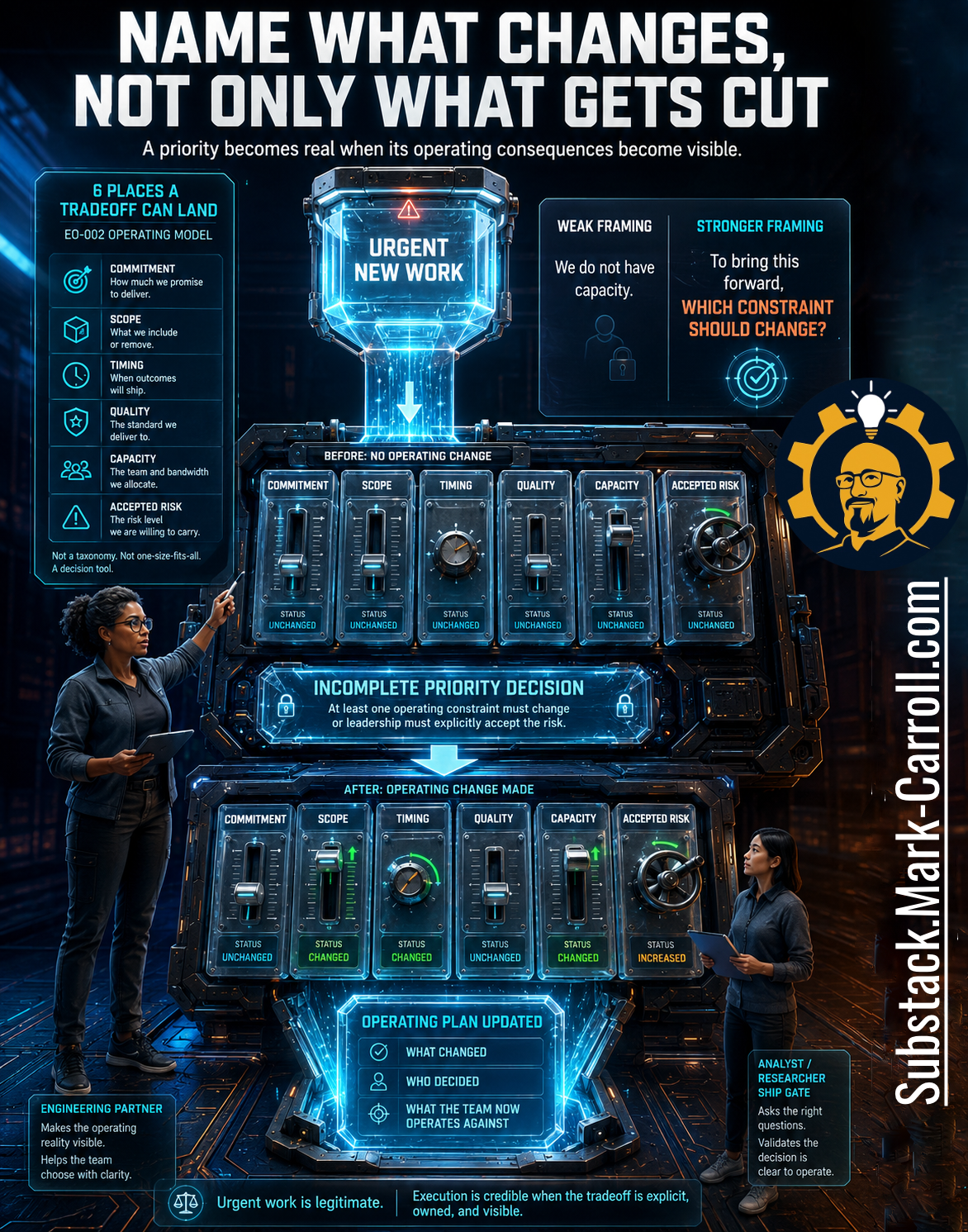
The tradeoff can land in commitment, scope, timing, quality, capacity, or accepted risk. A real operating decision changes at least one of those constraints, or leadership explicitly accepts the risk of leaving all six untouched. When every constraint remains formally unchanged, the priority decision remains incomplete.
A weak response sounds like this:
“We do not have capacity.”
A stronger response sounds like this:
“To bring this forward, which constraint should change?”
The first statement presents a barrier. The second presents an operating decision.
3. Offer Workable Paths
Leadership usually needs more than a warning. It needs usable choices:
“Here are the workable options.”
Bring two or three real options built to be used. Options clarify without cornering. When only one viable path exists, say so plainly and avoid manufacturing false choices.
4. Route the Decision
Leave authority with its owner:
“Which path should the team operate against?”
That question returns the tradeoff to the appropriate decision owner. This is the step most scripts skip, and it is the one that matters most.
I learned this step the hard way by taking ownership of a tradeoff that did not belong to me. Two major commitments were competing for the same people and the same delivery window, and I tried to solve the collision myself through sequencing and scope adjustments.
That created motion. Authority was still missing. When the consequences surfaced, I was left defending a decision that nobody with formal ownership had actually made.
I should have stated the tradeoff clearly and routed it to the person accountable for the broader commitment set. Step 4 matters because the product lead makes the tradeoff visible and the decision owner approves what changes.

The senior leader who raised the request introduced the need. Decision ownership still depends on who controls the commitment set. The requester may have influence, while the decision owner holds the authority to change that set. Depending on the organization, it may belong to Product, Portfolio, Program, an executive sponsor, or a governance body.
Influence can introduce the need. Authority determines what changes. Ask, “Who holds the decision for this specific tradeoff?” Clearer roles and decision rights are associated with less ambiguity and smoother coordination. The finding is associative, and it still beats guessing.
5. Confirm the Direction
Once the decision is made, capture it:
“I’ll record the decision, owner, and affected commitment.”
The written confirmation should reflect what was actually agreed. Silence creates no approval, the writer creates no new authority, and the note should never read like a threat. Send it as soon as reasonably practical, ideally the same day. The purpose is shared operating memory.
What if the answer is “do both”? Leadership is allowed to say that, and sometimes it is the right call.
I have seen “do both” decisions where nothing changed on the roadmap, but several things changed in practice. The team split attention, sequencing became informal, scope narrowed quietly, and quality absorbed pressure that nobody had named.
By the time the consequences surfaced, leadership remembered keeping both priorities active. The team remembered being left to decide which constraint would give.
That is why this branch asks a harder question than “Can we do both?” If both priorities remain active, which constraint changes, and who owns the risk if none of them do?
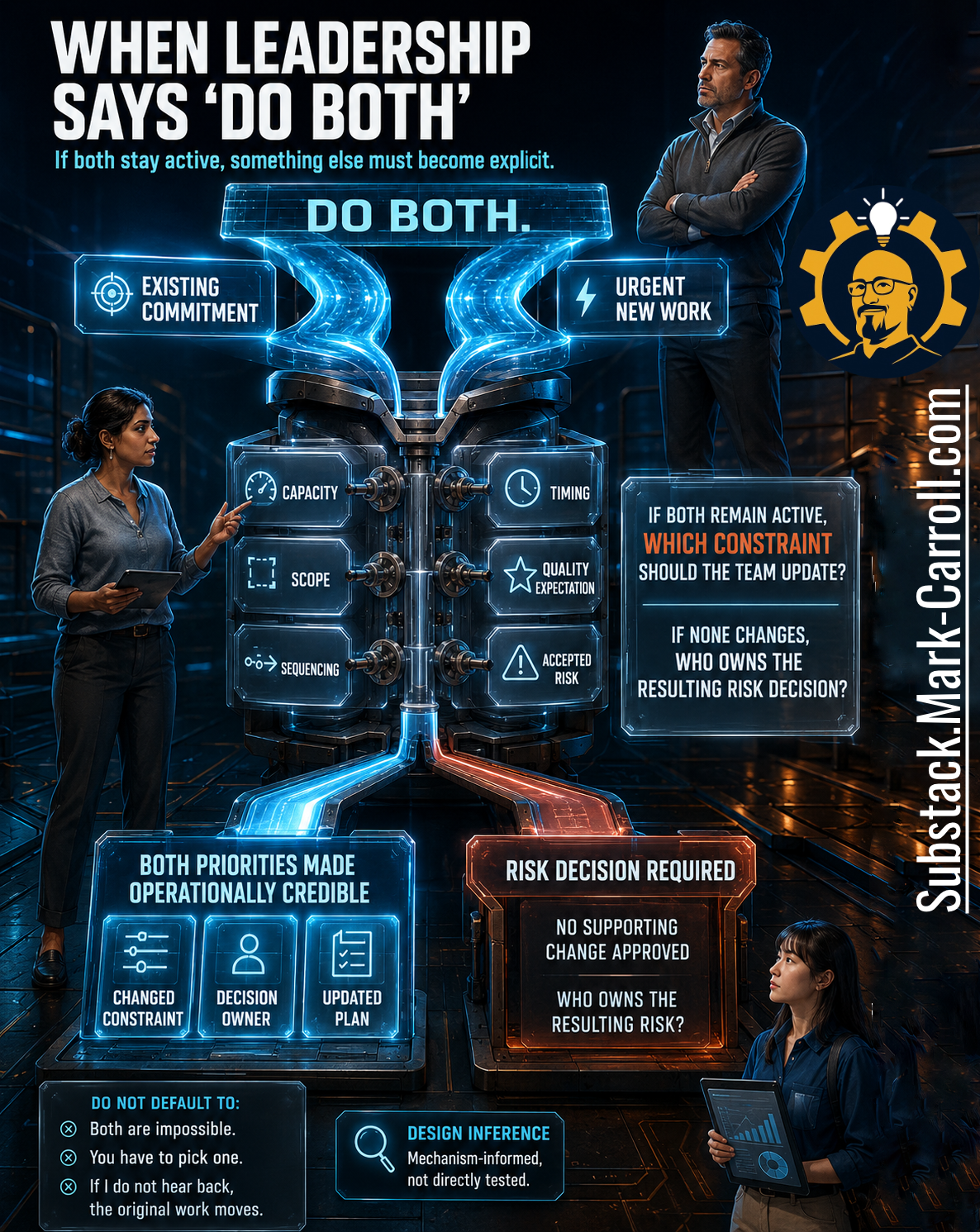
Capacity, scope, sequencing, timing, quality expectation, and accepted risk remain available as explicit choices. If leadership keeps both priorities active, the sequence asks which constraint the team should update. If none can move, it asks who owns the resulting risk decision.
This branch is a design inference drawn from decision-rights and coordination research. Use it as one way to keep constraints explicit rather than as a universal rule for every “do both” moment. Avoid declaring impossibility, forcing a binary choice, or moving original work through silence. The decision owner approves the change or explicitly owns the unresolved risk.
Guideline: Keep the spoken sequence under two minutes in the room, or one page as a written follow-up. Capture it while the decision is still fresh; its value drops sharply when everyone must reconstruct the tradeoff weeks later.
Done state: The tradeoff is named, a path is chosen or the risk is explicitly accepted, the decision owner is confirmed, and a short record exists where the team already works.
Limitation: This script leaves our formal authority, psychological safety, and political protection unchanged. Its purpose is to make a decision visible. The outcome may still go against us.
🛑 Do Not Use When: When the Executive Pushback Script Is Unsafe or Misapplied
A polished script leaves the safety of upward voice unchanged.
Psychological safety is genuinely low, or retaliation is a credible risk. Use this only with explicit backing from someone above the requester, if at all.
It’s a real emergency. Stabilize first. Save the sequence for the planning conversation that follows the fire.
Decision rights are unclear, or the record culture treats documentation as a weapon. A receipt written for self-defense may be understandable. Shared decision memory serves a different purpose.
Decision Logged: How to Record an Executive Priority Decision
Ask: [Senior request + stated rationale]
Tradeoff named: [What changes]
Chosen path: [Option A/B, or risk explicitly accepted]
Status: [Confirmed / Decision pending]
Owner now: [Name]
Review trigger: [Date / condition]
Record lives: [Link to doc / ticket]
A record like this supports traceability and reconstruction. Its job is shared operating memory. Writing it primarily for self-defense turns it into something else.
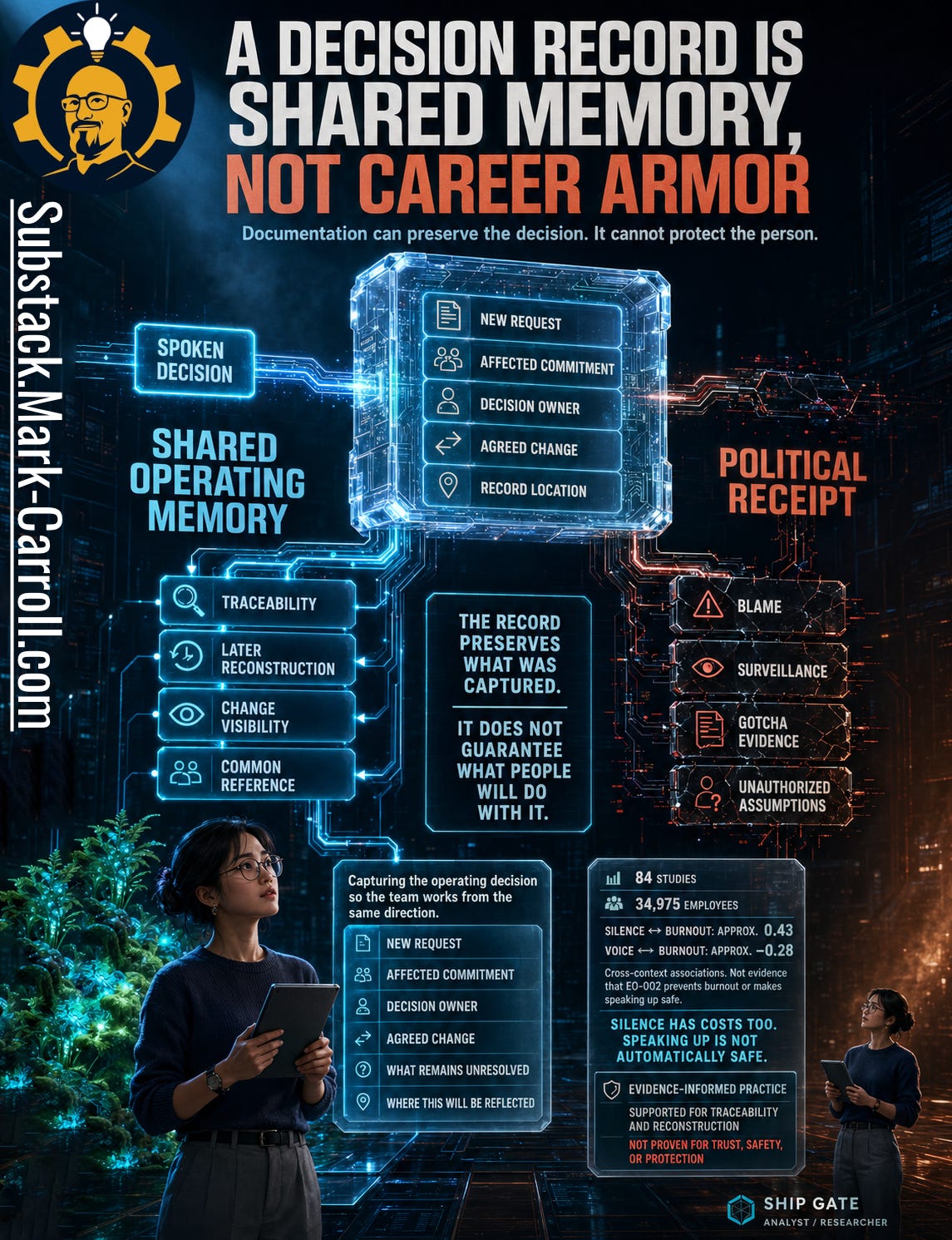
I have seen decision records used both ways. At their best, they captured what changed, who owned the decision, what remained unresolved, and where the updated commitment would appear, with access for the people expected to act on it.
At their worst, records became private receipts cataloging who had been warned, who had objected, and who might be blamed later. The facts may have been accurate. The framing still pulled the record into the conflict.
Intent, access, and language made the difference. Shared memory helps people operate from the same direction. Career armor asks a document to provide protection it cannot deliver.
The record preserves what was captured. Future behavior remains outside its control. Used well, it gives the team traceability, a way to reconstruct what happened later, visibility into what changed, and a common reference everyone can point to. Used badly, the same fields become a political receipt: evidence for blame, a surveillance log, gotcha material, or a base for assumptions nobody authorized.
The evidence cuts both ways. Across 84 studies covering nearly 35,000 employees, Lainidi and colleagues (2025) found that silence was associated with higher burnout (ρ = .43), while voice was associated with lower burnout (ρ = −0.28). These individual-level, cross-context correlations say nothing definitive about whether a decision record prevents burnout or makes speaking up safe. Research linking authoritarian and abusive leadership with suppressed employee voice reinforces political safety as a firm boundary.
Keep the record’s job narrow: traceability and reconstruction. The evidence supports that purpose. Trust, safety, and protection remain outside the reach of any template.
This Week: How to Practice the Executive Pushback Script
Three moments to practice:
Before the meeting: Write a version of the five-step script for the urgent request most likely to land this week, then practice saying it once out loud.
In the meeting: Ask which constraint changes and who owns the decision. If no path is approved, say “decision pending” rather than treating silence as confirmation.
After the meeting: Record the affected commitment, decision owner, agreed change, unresolved risk, and record location as soon as reasonably practical, ideally the same day.
Urgency can remain exactly where it entered the room. The tradeoff now has to become visible.
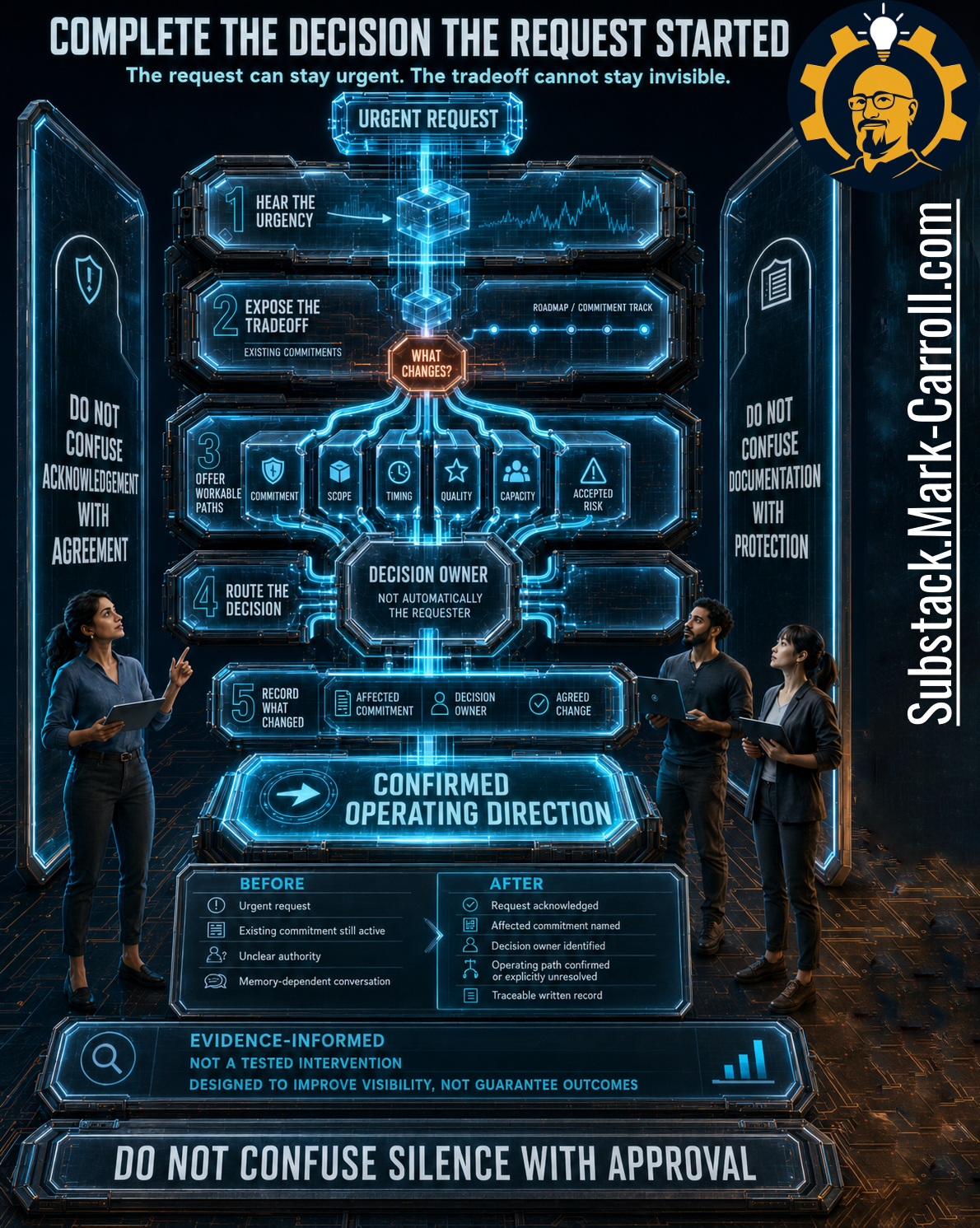
Acknowledgement opens the discussion. Agreement sets the direction. Documentation preserves the record. Explicit approval confirms the decision. This evidence-informed script improves visibility while leaving outcomes uncertain.
The result is modest and useful: a named tradeoff, a routed decision, and a record that replaces the polite yes and its two active roadmaps.
📎 Forward This
When a senior ask lands as pure addition, acknowledge it and keep the operating consequences in the room. Name what changes, offer real paths, route the decision to its owner, and record the agreement.
That same operating belief sits at the heart of my upcoming book, Collaborate Better. Better collaboration depends on making tradeoffs, ownership, and next steps visible enough for people to move together. Learn more at CollaborateBetter.us.

⬅ Closing
The next urgent request will probably arrive before the roadmap has room for it.
The question is whether the tradeoff stays in the room long enough for someone with authority to own it.
Regards,
Mark 👋

Previous:
Do Not Ban Executive Overrides. Make Them Traceable.

The Executive Override Was Not the Failure. The Missing Trail Was.
More Content to Discover:

Half Your Team Is Using AI. You Don't Know Which Half.

Intro If you read the piece we published last week on Leadership in Change, you saw the structural diagnosis: mandate pressure, decision collapse, intake collapse. Three failures that sit underneath almost every AI pilot that goes sideways. That piece mapped the architecture. What it did not cover is what happens on the human side of the same problem, wh…

The dangerous moment isn’t when leadership says “do both.” It’s when the room nods and the delivery team quietly decides which constraint will fail.
Which hidden tradeoff have we seen absorb the cost first: scope, timing, quality, capacity, or risk?
Great article, Mark. The devil is certainly in the unsaid, reminds me of a the study done on teams stronger on paper that don't communicate well still beaten by the teams who do communicate well! The ability to push back enough to discuss the hidden tradeoff is definitely an under-explored communication skill