


The Executive Override Was Not the Failure. The Missing Trail Was.
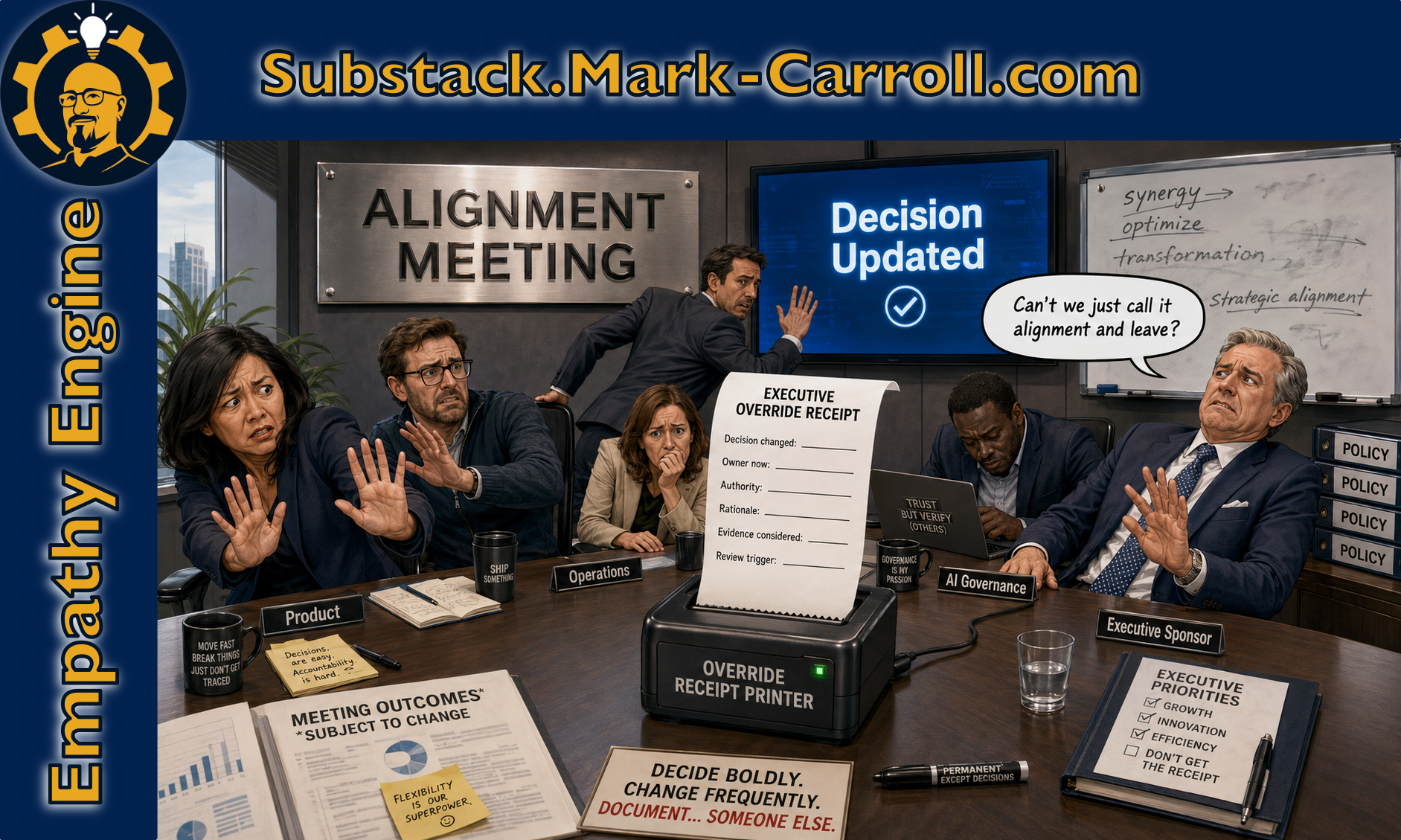
Plain-English premise: When leadership changes a consequential decision, you must still be able to show who owns it, why it changed, and when it will be reviewed.
👋 Welcome to this week’s edition of Empathy Engine. Every Wednesday, I publish a new article for paid subscribers first, then unlock the full piece for everyone late Thursday morning. Each week, I turn product leadership friction into practical tools, sharper language, and more defensible decisions.
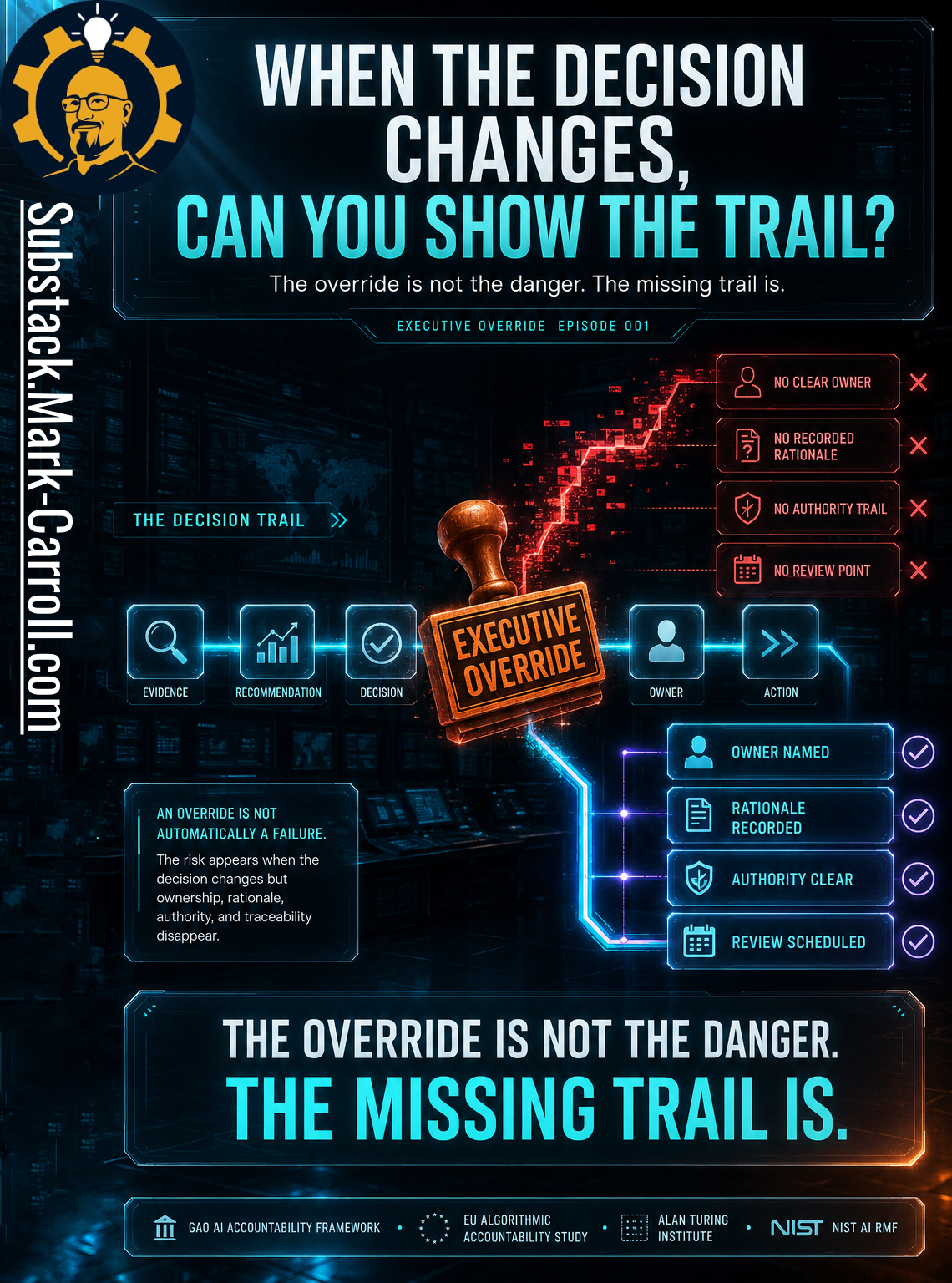
Every consequential decision travels a trail: evidence gathered, a recommendation made, a decision taken, an owner named, action shipped. An executive override enters that trail with a stamp of authority. An override is not automatically a failure. The risk appears when the decision changes but ownership, rationale, authority, and traceability disappear. The override is not the danger. The missing trail is.
Research Binder: the receipts (citations + source notes) are compiled in a PDF at the bottom of this post.
⚠ Tension
Direction just changed above you, and nobody can show who owns the new call or why it happened.
🎯 Payoff
Inside: the Override Receipt, a six-field decision record that keeps direction changes reconstructable without slowing them down.
Trigger Moment
The moment I keep coming back to happened in a large enterprise technology program.
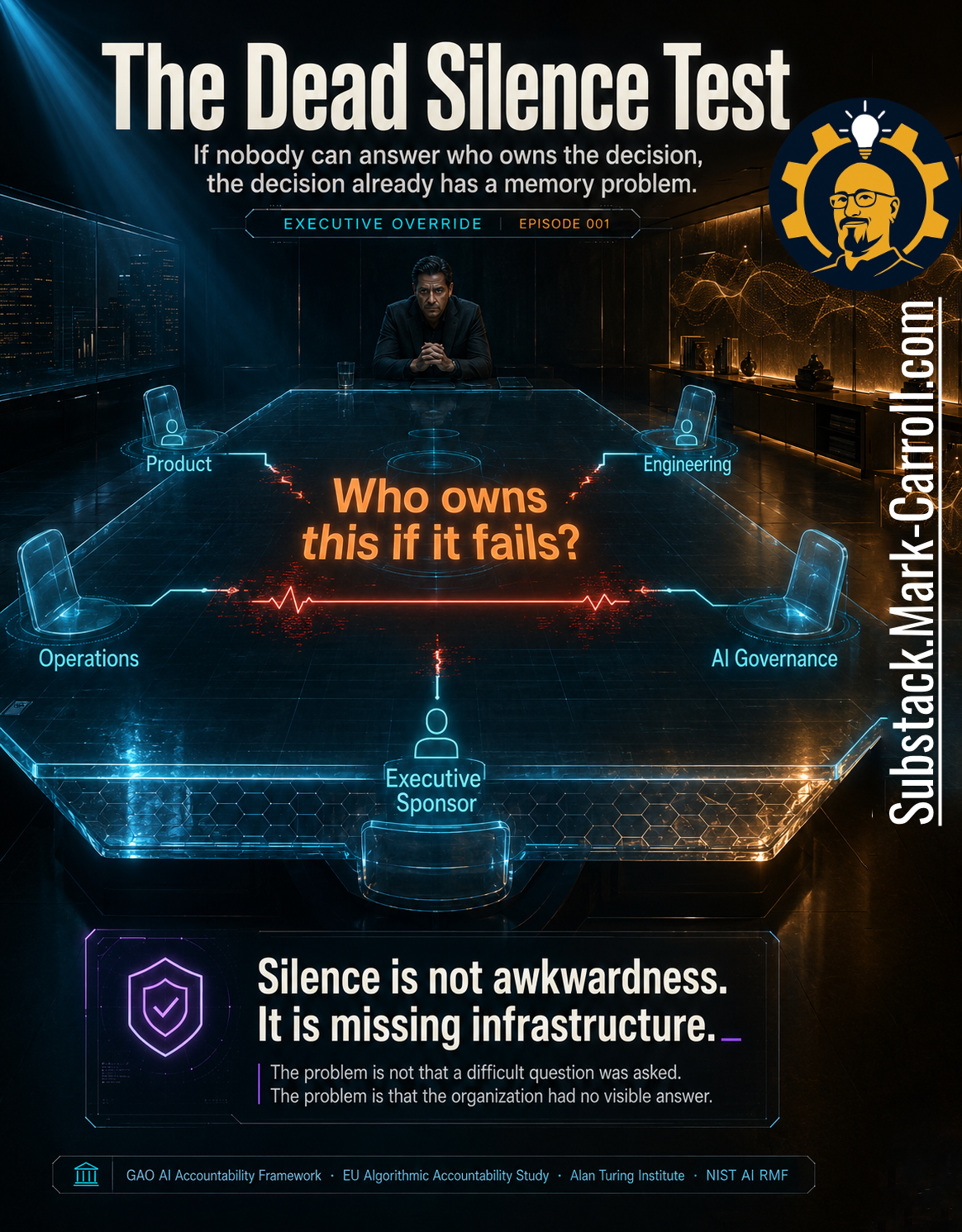
The team had worked through a decision that touched several groups. Product owned the customer promise. Engineering owned feasibility. Operations owned rollout impact. AI Governance owned risk and oversight. Everyone had a defensible claim on part of the decision, but no one clearly owned the whole thing after direction changed.
Then a senior stakeholder changed the call.
The hard question came from the executive sponsor, the leader trying to make the decision operational. It was their version of the question every team eventually faces, who owns this if it fails? “If this goes sideways, who owns the decision now?”
Nobody answered immediately.
The silence did not feel like confusion. It felt like recognition. People understood the decision had moved, but they also understood that ownership had not moved with it. The room had agreement, but not accountability. That silence is not awkwardness. It is missing infrastructure.
A few weeks later, the decision came back as a relitigation. People remembered the change differently. The team had the work, but not the recorded rationale. The conversation shifted from “what are we doing?” to “who said we decided that?”
That was the lesson. The override was not the failure. The failure was that ownership and rationale did not travel with the change. If nobody can answer who owns the decision, the decision already has a memory problem.
Decision Memory Is Not Documentation Theater
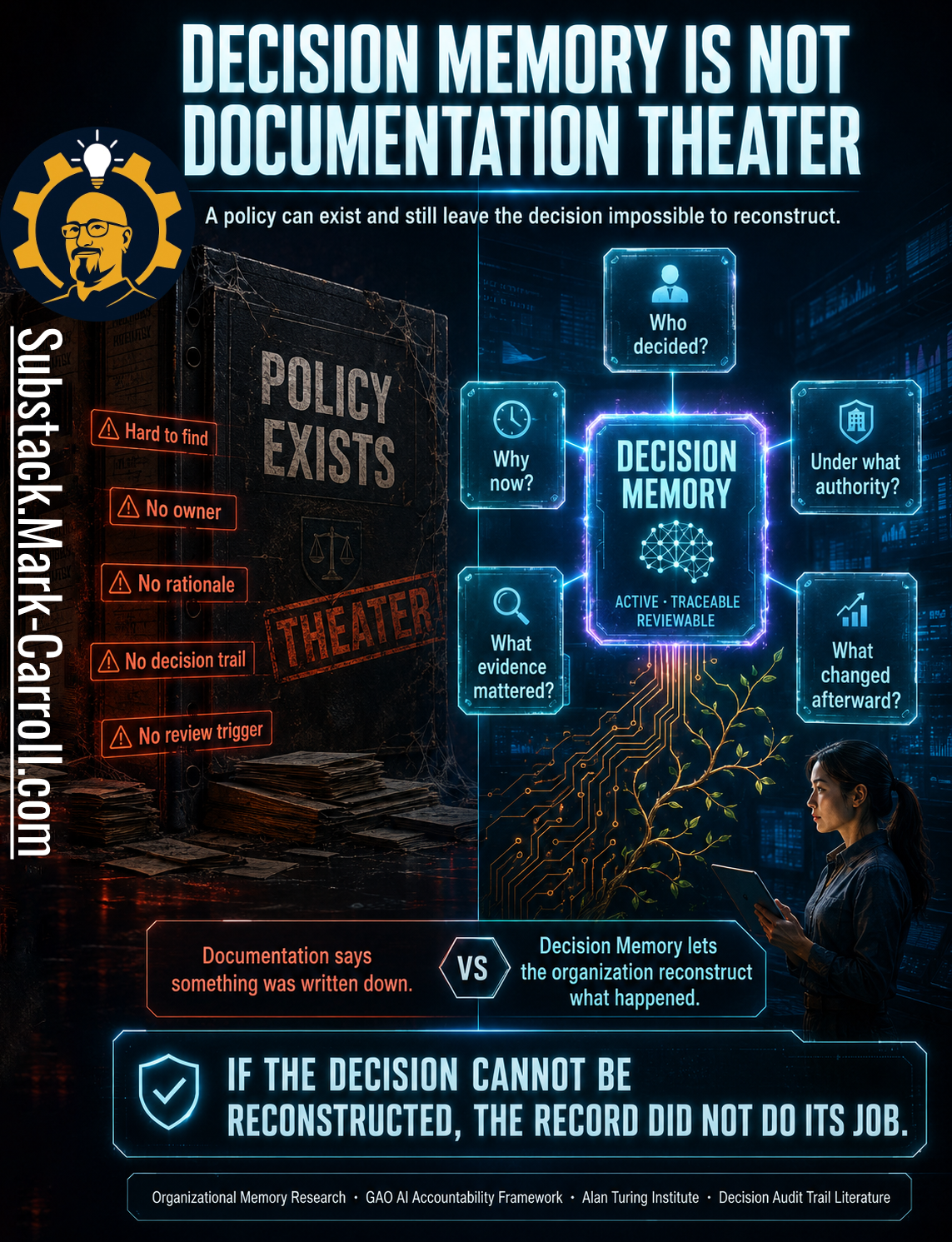
Call the missing infrastructure Decision Memory. The term is Empathy Engine shorthand (a synthesis lens drawn from organizational memory research and audit-trail practice, not a formal metric). It names one capability: can the organization reconstruct who decided, why now, under what authority, on what evidence, and what changed afterward?
Most organizations do not fail this test for lack of documents. A policy can exist and still leave the decision impossible to reconstruct. The binder is hard to find. It names no owner. It records no rationale, no decision trail, no review trigger. That is documentation theater: proof that something was written down, with no way to explain what actually happened. This is rarely about intentional hiding. It is what happens when governance artifacts grow faster than decision trails.
Documentation says something was written down. Decision Memory lets the organization reconstruct what happened. If the decision cannot be reconstructed, the record did not do its job.
The Ownership Hand-Off Moment
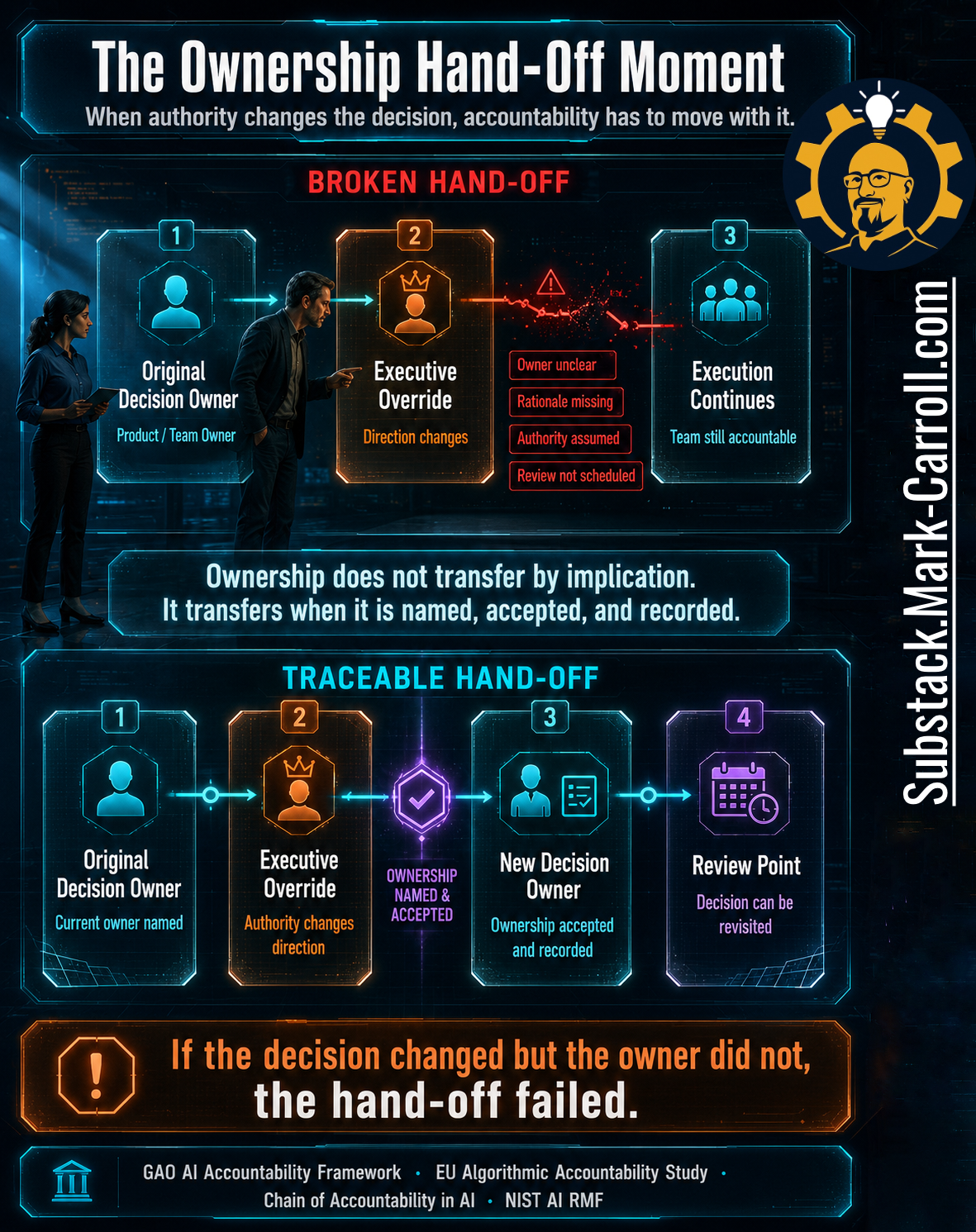
The riskiest moment is rarely the disagreement. It is the hand-off. When authority changes the decision, accountability has to move with it.
In the broken hand-off, the original decision owner (the product or team owner) watches the executive override change direction, and then execution simply continues. Owner unclear. Rationale missing. Authority assumed. Review not scheduled. The team is still accountable for a decision it no longer owns. That is exactly what happened in the program above: the call moved, the ownership did not, and the gap surfaced weeks later as a memory fight.
In the traceable hand-off, the same override happens, but ownership is named and accepted on the spot. A new decision owner records the change, and a review point is set so the decision can be revisited.
Ownership does not transfer by implication. It transfers when it is named, accepted, and recorded. If the decision changed but the owner did not, the hand-off failed.
🖊 What Holds Up Under Pressure
Primary claim label: EVIDENCE
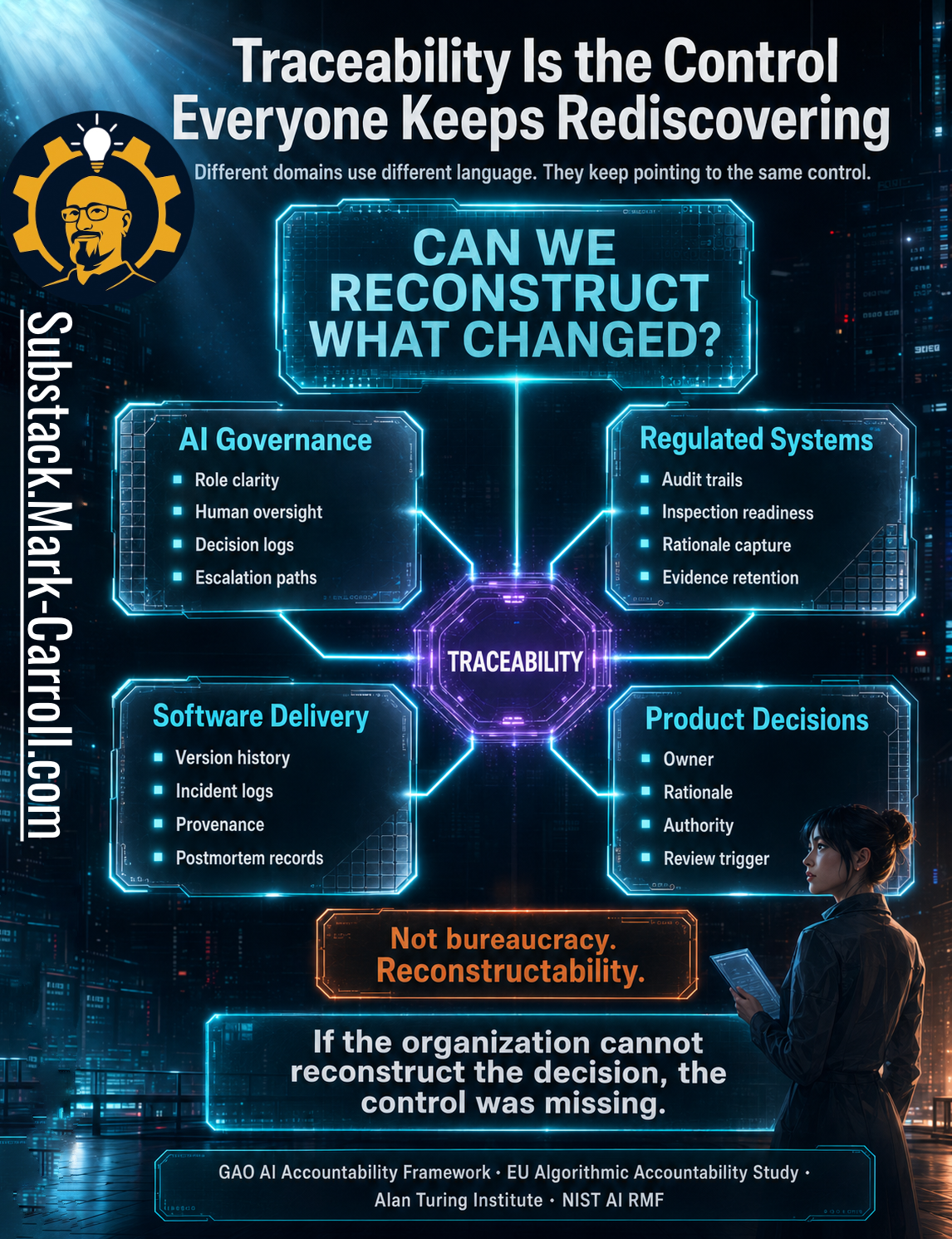
Claim: Serious governance domains consistently treat traceability (the ability to reconstruct what changed) as a core control for consequential decisions.
Basis: The GAO AI Accountability Framework, the EU’s algorithmic accountability study, Alan Turing Institute guidance, and the NIST AI Risk Management Framework (the sources credited on this issue’s visuals) repeatedly emphasize traceability, documented roles, and accountable oversight. You can hear the same control under different vocabularies. AI governance asks for role clarity, human oversight, traceable decisions, and escalation paths. Regulated systems ask for audit trails, inspection readiness, rationale capture, and evidence retention. Software delivery asks for version history, incident logs, provenance, and postmortem records. Product decisions need the same four anchors: owner, rationale, authority, review trigger. Different domains keep pointing to one question: can we reconstruct what changed? Not bureaucracy. Reconstructability.
Counterpoint: These frameworks are normative, not experimental. They recommend traceability as a control; they do not prove that decision logs prevent failure, guarantee compliance, or reduce rework by any measurable percentage. And in practice, I have seen traceability fail in two opposite ways. Sometimes it exists only in the framework and never reaches the actual decision. Other times it exists as a record but gets used as a blame artifact instead of a learning artifact.
Limitation: That is why the point is not more documentation. The point is a decision trail people can use, trust, and revisit when pressure returns. The evidence supports traceability as a widely recommended control when stakes are high. It does not size the payoff, and low-stakes decisions do not need this machinery.

The AI Bridge: A Click Is Not Judgment
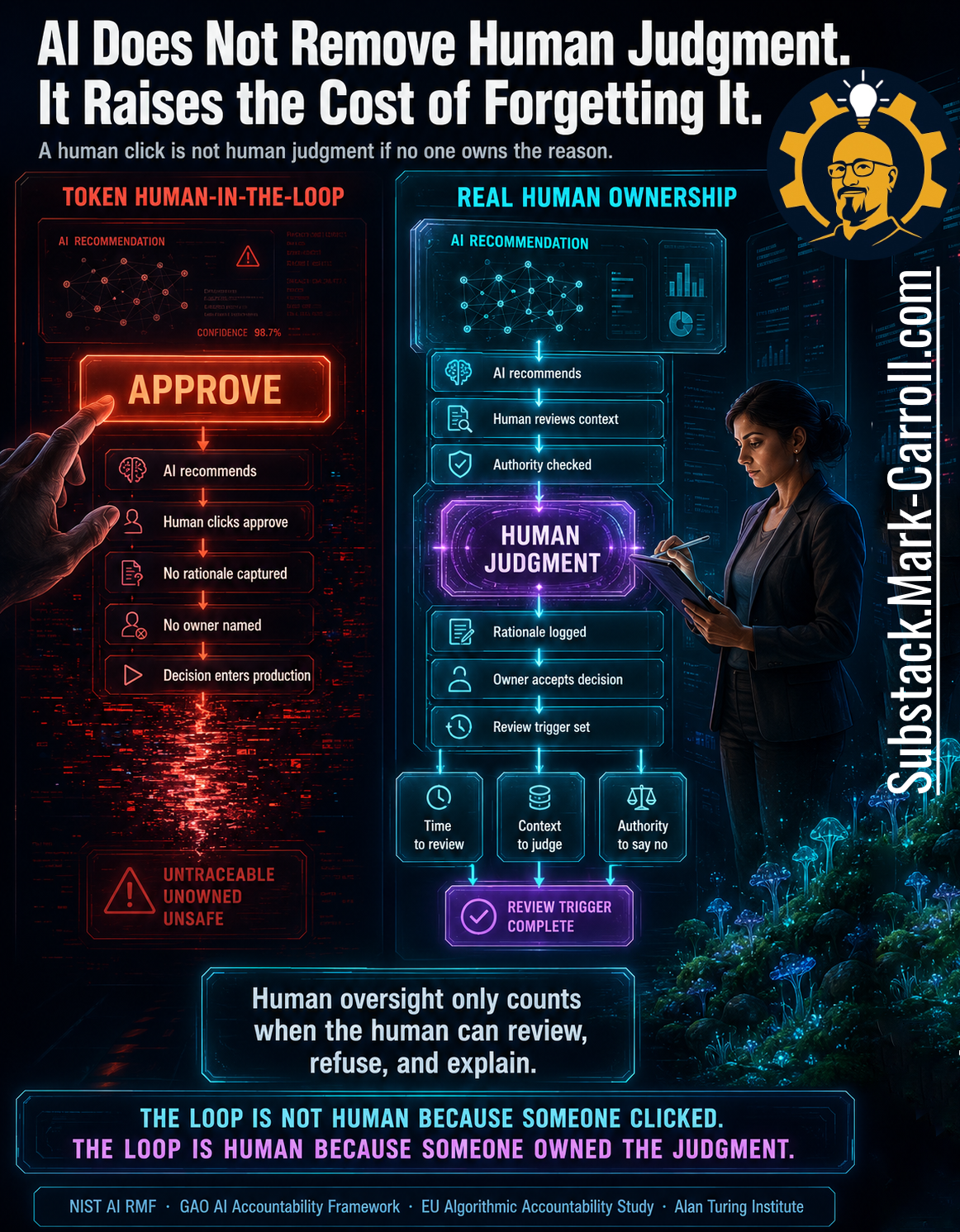
AI raises the stakes because it raises the speed. A token human-in-the-loop looks safe on paper: the AI recommends, a human clicks approve, no rationale is captured, no owner is named, and the decision enters production. Untraceable. Unowned. Unsafe (with a record that says a human was involved). A human click is not human judgment if no one owns the reason.
Real human ownership runs the same loop differently. The AI recommends. A human reviews the context. Authority is checked. Judgment is exercised — with time to review, context to judge, and authority to say no. Rationale is logged. An owner accepts the decision. A review trigger is set.
Human oversight only counts when the human can review, refuse, and explain. The loop is not human because someone clicked. The loop is human because someone owned the judgment. AI does not remove human judgment. It raises the cost of forgetting it.
🎒 The Move: The Override Receipt
I started using a version of this after one too many decisions came back as a memory fight.
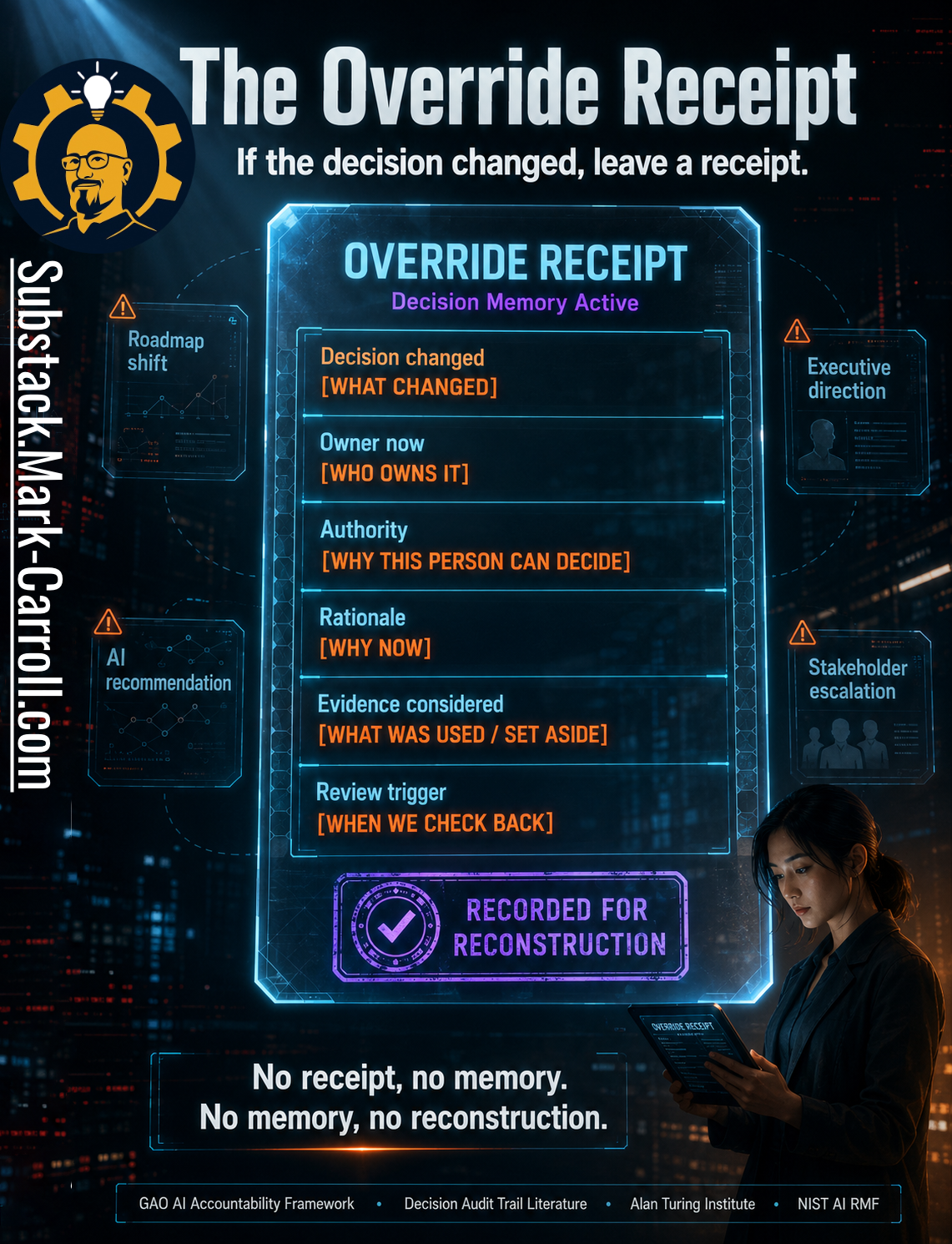
When a consequential decision changes direction, capture six fields before the room disperses — a design inference built on audit-trail principles, not a compliance framework.
Step 1: Decision changed. Write down what changed from the previous recommendation, plan, or roadmap.
Step 2: Owner now. Name who owns the changed decision from this point forward.
Step 3: Authority. State why this person or group can make or accept the change.
Step 4: Rationale. Record why the change is being made now.
Step 5: Evidence considered. Note what evidence, recommendation, or tradeoff was used — and what was set aside.
Step 6: Review trigger. Set when, or under what condition, the decision gets revisited.
Constraint: One page maximum, completed before the meeting ends. A receipt written three weeks later is a memory fight with formatting.
Done state: The receipt lives where the team already works, the named owner has accepted it in writing, and affected stakeholders were notified. Recorded for reconstruction.
Limitation: The receipt cannot supply missing decision rights, fix leadership bad faith, or guarantee compliance. In many teams, capturing these six fields is enough to make the decision reconstructable in practice (it is a memory tool, not a shield). It also protects the leader: a recorded rationale makes executive judgment easier to defend when scrutiny arrives.
If the decision changed, leave a receipt. The series shorthand: no receipt, no memory; no memory, no reconstruction. Treat that as a risk pattern, not a law of physics but treat it.
🛑 Do Not Use When
The change is low-stakes: button copy, meeting times, harmless backlog swaps. Receipts there are governance theater.
You lack decision rights entirely. A receipt records ownership; it cannot create authority you do not have.
The record culture is broken. If the organization uses records to isolate blame instead of preserve context, the receipt will become a weapon. People will stop writing what happened and start writing for self-defense. The receipt only works when the record is safe enough to tell the truth. That is an EO-005 problem, and this series will get there.
Decision Logged: Rewrite Risk Check
Scan your last three changed decisions:
Decision: ____________
Owner today: named / assumed / unclear
Rationale: recorded / verbal / disappeared
Reopen risk: low / medium / high
Two or more answers of “unclear,” “disappeared,” or “high” means the next memory fight is already scheduled.
This Week
This week, try the practice I trust most.
3 actions for the product lead steward of decisions, guardian of traceability:
Before a consequential meeting ends, ask: “What changed, and who owns it now?”
Capture the changed decision, the rationale, and the review trigger where the team already works.
Not in a private notebook. Not in a buried governance deck. Put it in the place people will look when the decision comes back under pressure.
1 action for the leader in the room (the override initiator): Say the owner and the review trigger out loud before the meeting moves on.
1 action to improve decision traceability today (for whoever keeps the record, the keeper of records, the verifier of integrity): Keep the receipt close to the work. A decision note no one can find is just documentation theater with better intentions.
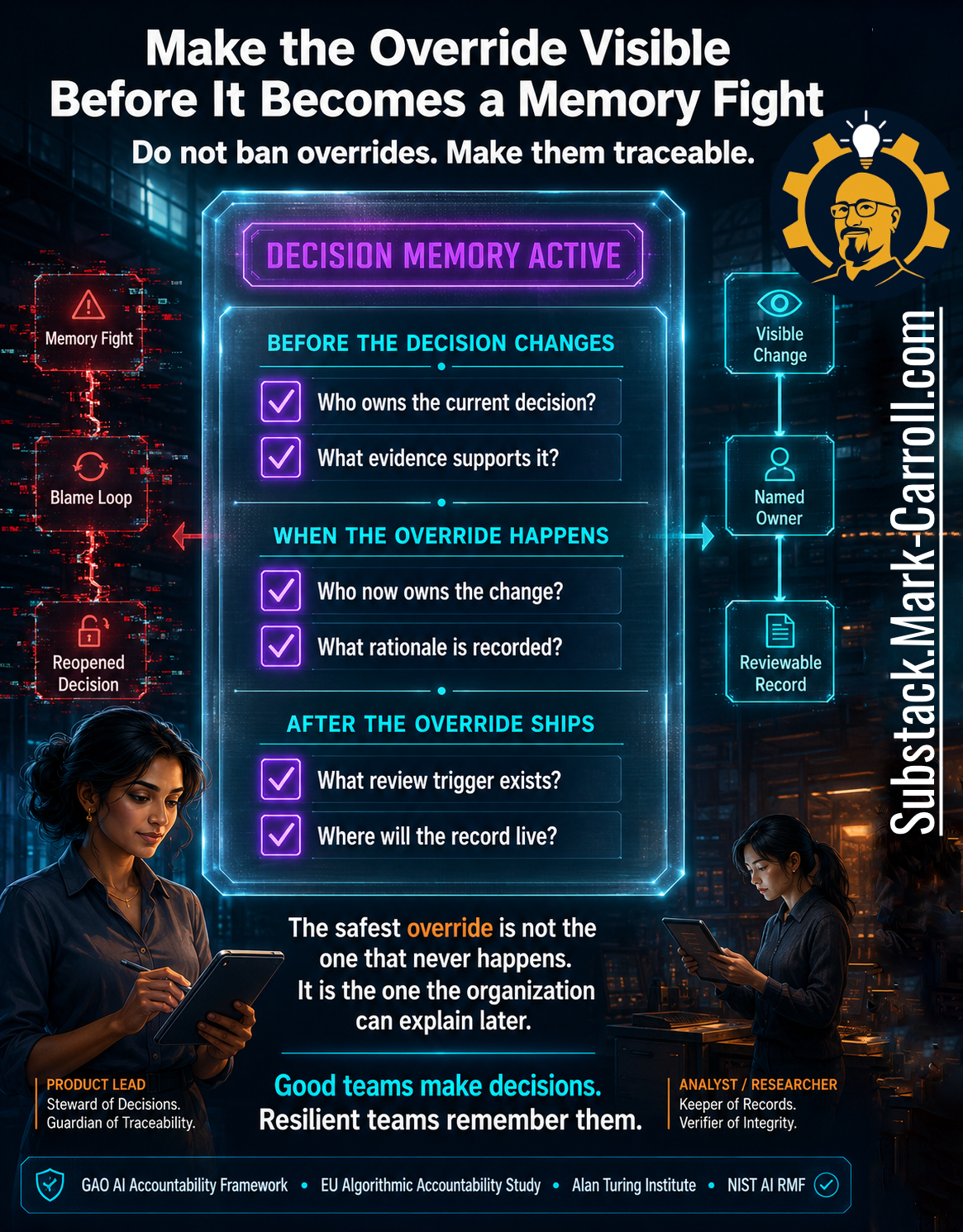
Before the decision changes: who owns the current decision, and what evidence supports it? When the override happens: who now owns the change, and what rationale is recorded? After the override ships: what review trigger exists, and where will the record live? Six questions. One receipt. Decision memory, active. The safest override is not the one that never happens. It is the one the organization can explain later.
📎 Forward This
Do not ban overrides. Make them traceable. The safest override is not the one that never happens. It is the one the organization can explain later.
Next week, Executive Override moves from decision memory to the harder moment: what to say when the senior ask lands in the room and every polite instinct tells you to fold. EO-002 introduces The Executive Pushback Script, a meeting-ready way to acknowledge the ask, name the tradeoff, offer the alternative, and log the path before the decision gets rewritten later.
That same operating belief sits at the heart of my upcoming book, Collaborate Better, because better collaboration is not louder agreement; it is the discipline of making tradeoffs, ownership, and next steps visible enough for people to move together. Learn more at CollaborateBetter.us.

⬅ Closing
Good teams make decisions. Resilient teams remember them.
If the decision matters enough to change direction, it matters enough to record the reason.
Regards,
Mark 👋

Previous:
The Route That Survived Pressure

👋 Welcome to this week’s edition of Empathy Engine. Every Wednesday, I publish a new article for paid subscribers first, then unlock the full piece for everyone late Thursday morning. Each week, I turn product leadership friction into practical tools, sharper language, and more defensible decisions.
More Content to Discover:

Half Your Team Is Using AI. You Don't Know Which Half.

Intro If you read the piece we published last week on Leadership in Change, you saw the structural diagnosis: mandate pressure, decision collapse, intake collapse. Three failures that sit underneath almost every AI pilot that goes sideways. That piece mapped the architecture. What it did not cover is what happens on the human side of the same problem, wh…

Most executive overrides aren’t where the damage starts.
The real failure shows up later, when nobody can reconstruct who owned the changed decision, why it changed, what evidence moved, or when it should be reviewed.
That’s why the practical question isn’t “How do we stop overrides?” It is: can this decision survive the next memory fight?