


Intro
If you read the piece we published last week on Leadership in Change, you saw the structural diagnosis: mandate pressure, decision collapse, intake collapse. Three failures that sit underneath almost every AI pilot that goes sideways. That piece mapped the architecture. What it did not cover is what happens on the human side of the same problem, when the structure is missing and the team adapts by going quiet.

Joel Salinas is the person I would call for that conversation. He runs fractional Chief AI Officer engagements with mid-market teams and coaches individual leaders through AI adoption at the point where strategy meets behavior. His newsletter, Leadership in Change, is one of the few places I have found where the advice sounds like someone who has actually sat in the room when the reaction went wrong, because he has.
What Joel wrote here names the part most leaders skip: the moment your team stops telling you the truth about what they are using, and why both of your natural reactions (excitement and panic-policy) make it worse. If my work gives you the intake funnel and the decision circuit, Joel’s work gives you the leadership posture that makes people willing to use them honestly.
I will let Joel take it from here.
TL;DR - Shadow AI usage spreads inside most organizations because leaders react to discovery with either excitement or panic-policy, and both reactions train teams to hide further. Closing the gap takes leader literacy before policy and a three-tier risk sanctioning system. Process alone never closes it.
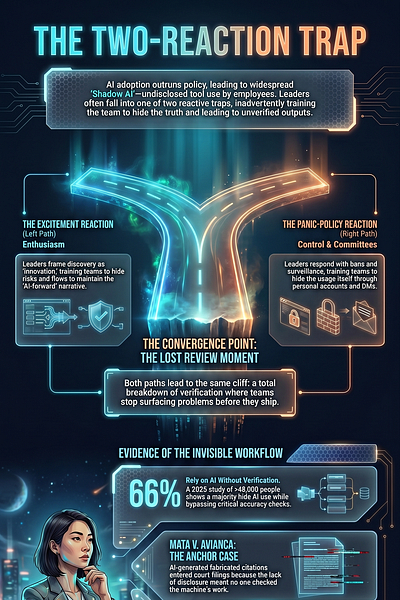
In June 2023, a New York attorney named Steven Schwartz filed a legal brief built on six court cases that didn’t exist. He hadn’t invented them. ChatGPT had. He filed them anyway because he hadn’t told anyone he was using it, including the partner at his firm who signed off on the work. The judge sanctioned the lawyer, the firm took the public hit, and the story ran for weeks.
Here’s the thing, the story isn’t really about a lawyer who got lazy with a chatbot, because the more interesting question is what was happening above his head, in a firm where AI had quietly entered the workflow and nobody had created a place where saying “I’m using ChatGPT to draft this” sounded like anything other than a confession. The visible failure was one filing, but the pattern underneath it is running silently across most teams right now.
The pattern beneath the headlines
As you read this on Mark S. Carroll’s substack (Empathy Engine) you’ve probably already seen his recent diagnostic over at Leadership in Change where he mapped the structural failures sitting under most failed AI pilots in the guest post he wrote for me. He gave you the architectural view. This piece is what I’d add from the behavioral side, because once the architecture is in place, you still have to deal with the very human reasons your team keeps defaulting to the broken pattern.
Here’s what I keep seeing when I sit with leadership teams… people on the team are already using AI, not in the sanctioned way, not in the official rollout, not in the tools listed on the IT inventory.
Your staff has quietly built dependencies on ChatGPT, Claude, Perplexity, and a dozen tools you’ve never heard of, into work that touches your clients, your contracts, and your internal reports.
The first time leadership learns the dependency exists is usually when something breaks: a hallucinated stat in a board deck, a bad source in a client memo, a fabricated quote in a press release that’s already out the door.
By the time you find out, the credibility cost has already cleared.
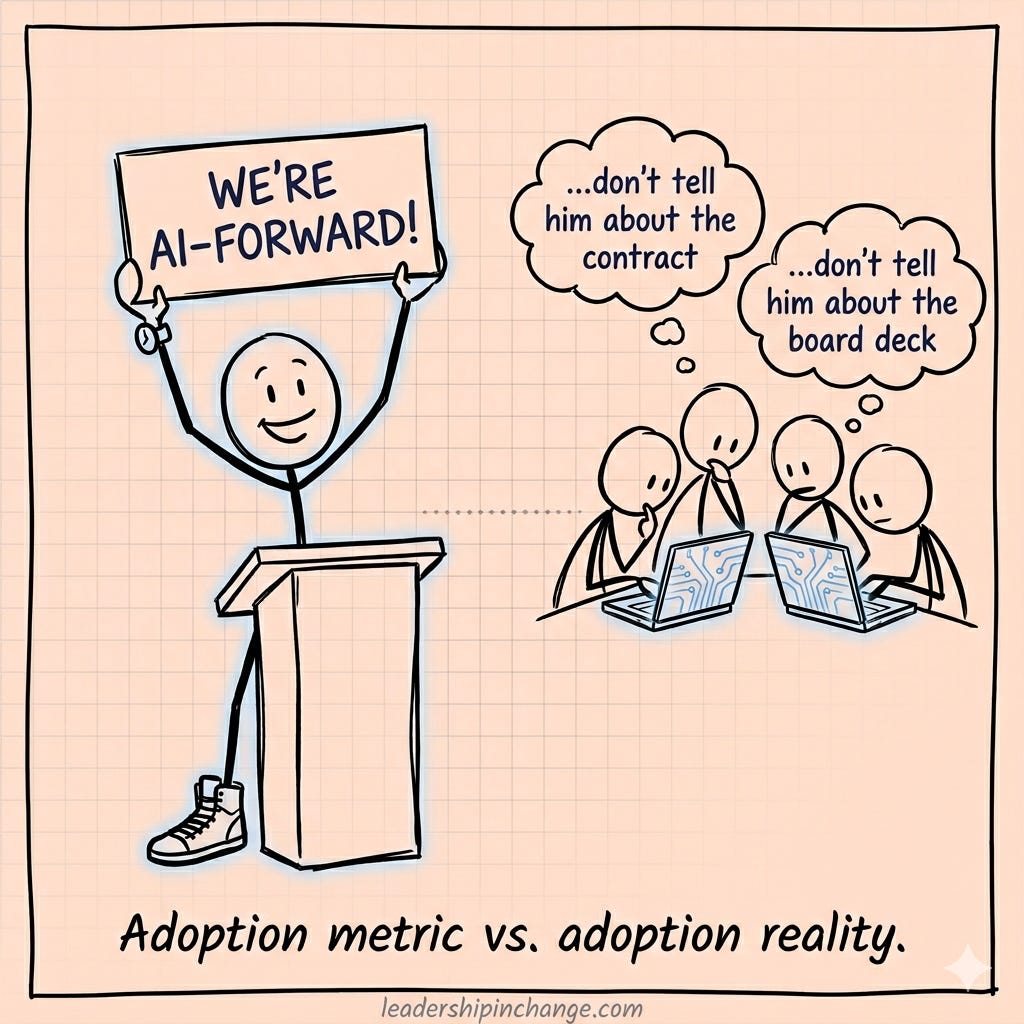
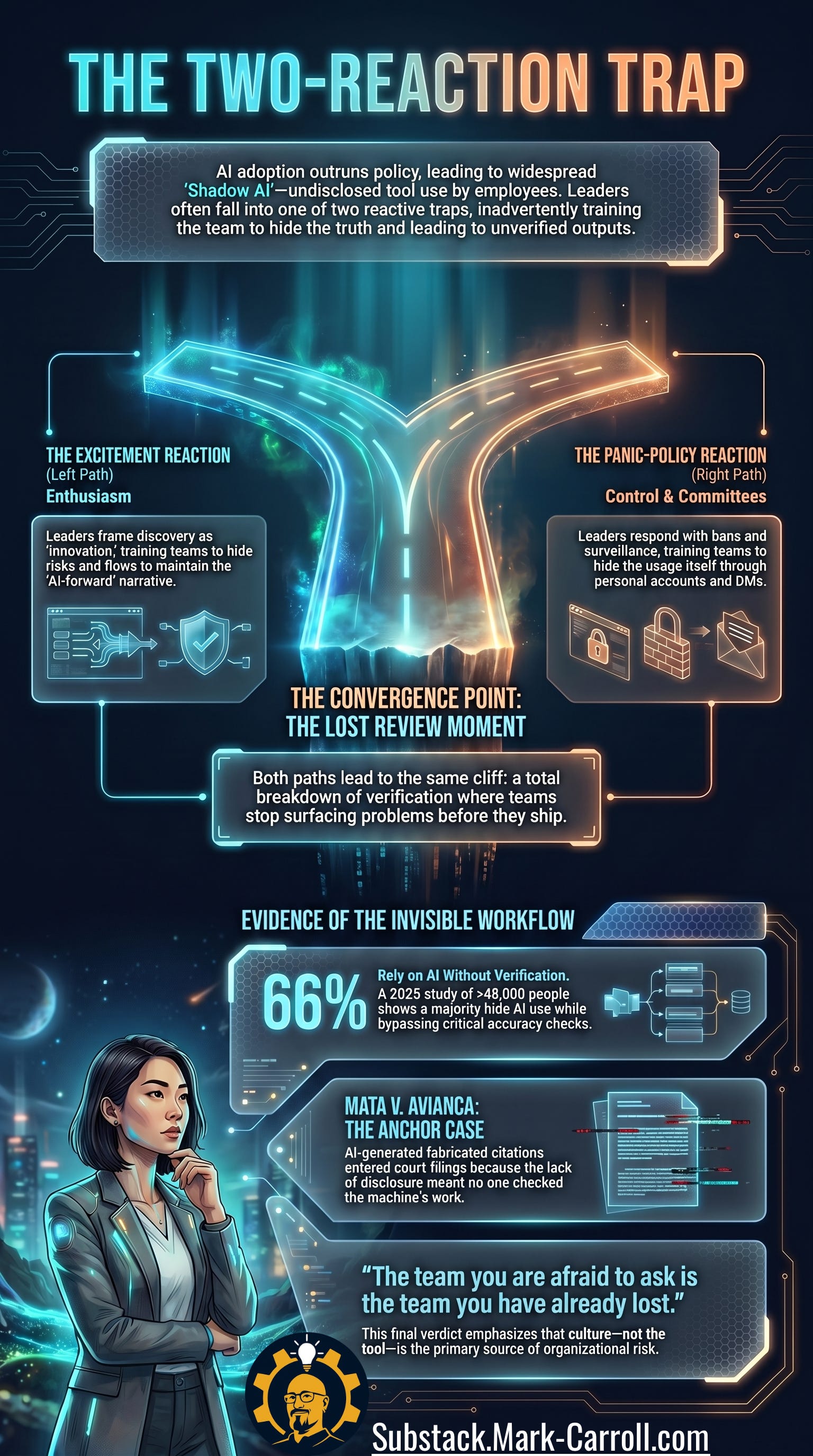
The leader frames the discovery as a sign of bottom-up adoption, posts about it on LinkedIn, and mentions it to the board as proof that the org is AI-forward. And the team reads that reaction in about ten seconds. The signal back to them is: don’t bring me the risk stuff. Don’t tell me the contract you drafted used a model that’s known to fabricate citations. And please don’t mention that the marketing copy went out without anyone checking the source attribution. The excitement is a vibe, and a vibe is the worst possible environment for somebody trying to say “actually, I’m a little worried about what I just sent.”
The second reaction is panic-policy. “We need a committee. We need an approval process. We need a sign-off workflow.” A memo goes out. Anyone using AI without sanctioned access gets called into a meeting. The next people who get caught become the cautionary tale at the all-hands. And the team reads that reaction in about ten seconds too. The signal back to them is: hide harder. Usage doesn’t stop, it just goes one layer deeper, into personal accounts, into Slack DMs instead of email, into “I just typed this myself” disclaimers on work the model actually wrote.
Both reactions train your team to stop telling you the truth. That’s the actual cost.
The literacy gap nobody names
Underneath both reactions sits the part nobody wants to name out loud. The leader is usually more ignorant of the tool than the people using it.
I mean it. The person on your team who quietly figured out that Claude is better at long-form drafts and ChatGPT is faster at code, who knows which prompts produce hallucinations and which ones don’t, who has been using these tools for hundreds of hours, has more practical literacy than the executive deciding what the policy should be. And the executive often hasn’t sat down and personally used the tool past a couple of curious afternoon sessions.
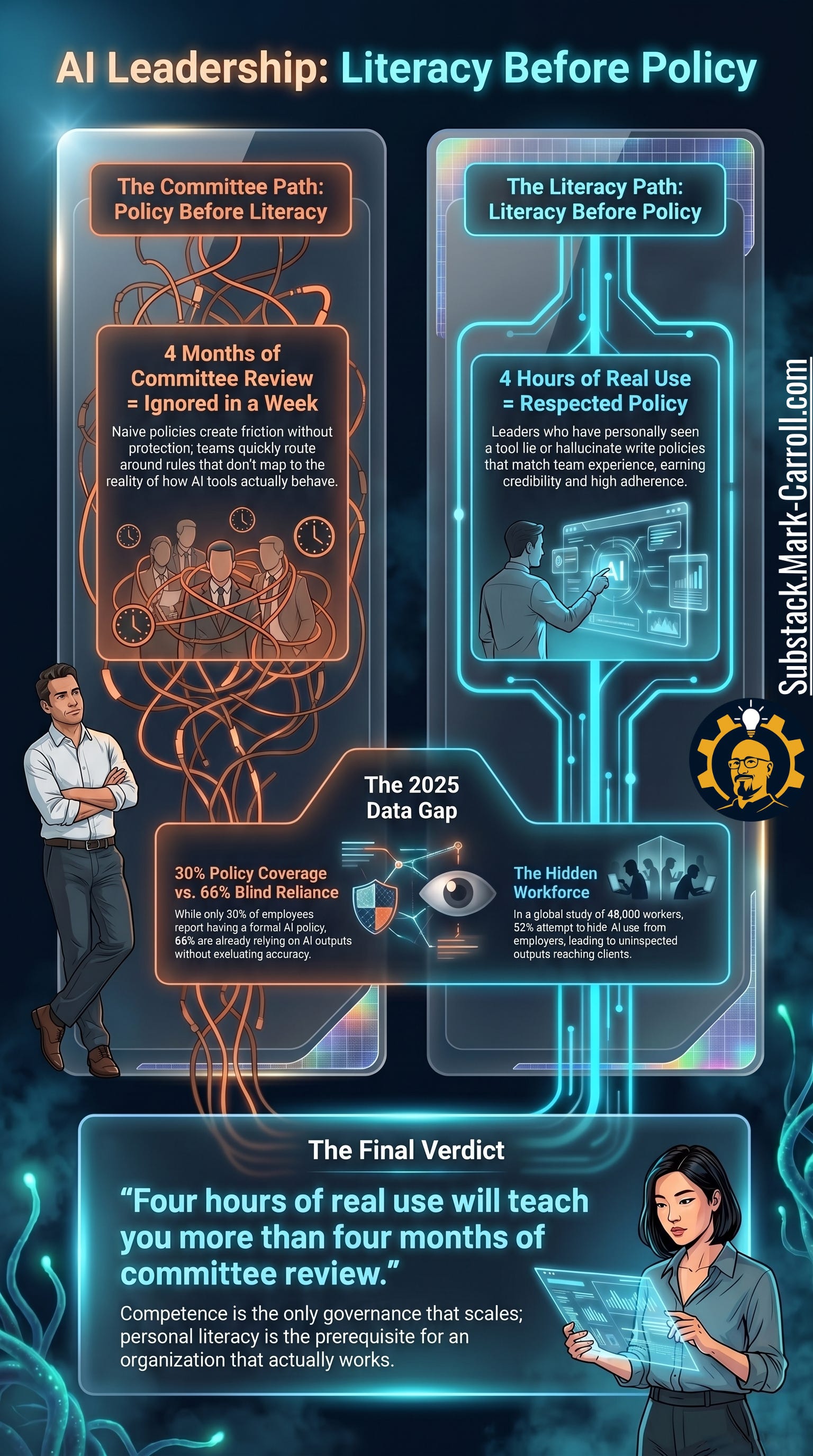
That’s the real problem with the “more discussion, more stakeholders, more alignment” reflex. Adding people to the conversation doesn’t add competence. It adds a room full of leaders who all share roughly the same incomplete picture of the tool, who then collectively write a policy that the team can immediately tell was written by people who’ve never used it. The policy gets routed around inside a week, not because the team is malicious, but because the policy is naive, and naive policy is friction without protection.
The honest version of “we need to talk about AI in this org” usually starts with the leader admitting they’re 12 months behind their own people. That admission is the most expensive sentence in the room. It’s also the only one that gets anything moving.
Two moves that actually work
So what do you do instead? Two moves. I’d give you a long list, but two is what a leader can actually do this month, and a list of ten is the same as a list of zero.
Move one: leader literacy before team policy. Before you write a policy about a tool, you personally use that tool for at least four hours of real work. Not a demo, not a vendor walkthrough. Pull up your own deliverables and put the tool through them. After four hours, you’ll know things you didn’t know. You’ll have a list of failure modes you watched it produce. And you’ll have a feel for where it’s strong, where it lies, where it needs supervision. Then you write the policy. The policy will be shorter, sharper, and the team will recognize within two paragraphs that someone who actually used the tool wrote it.
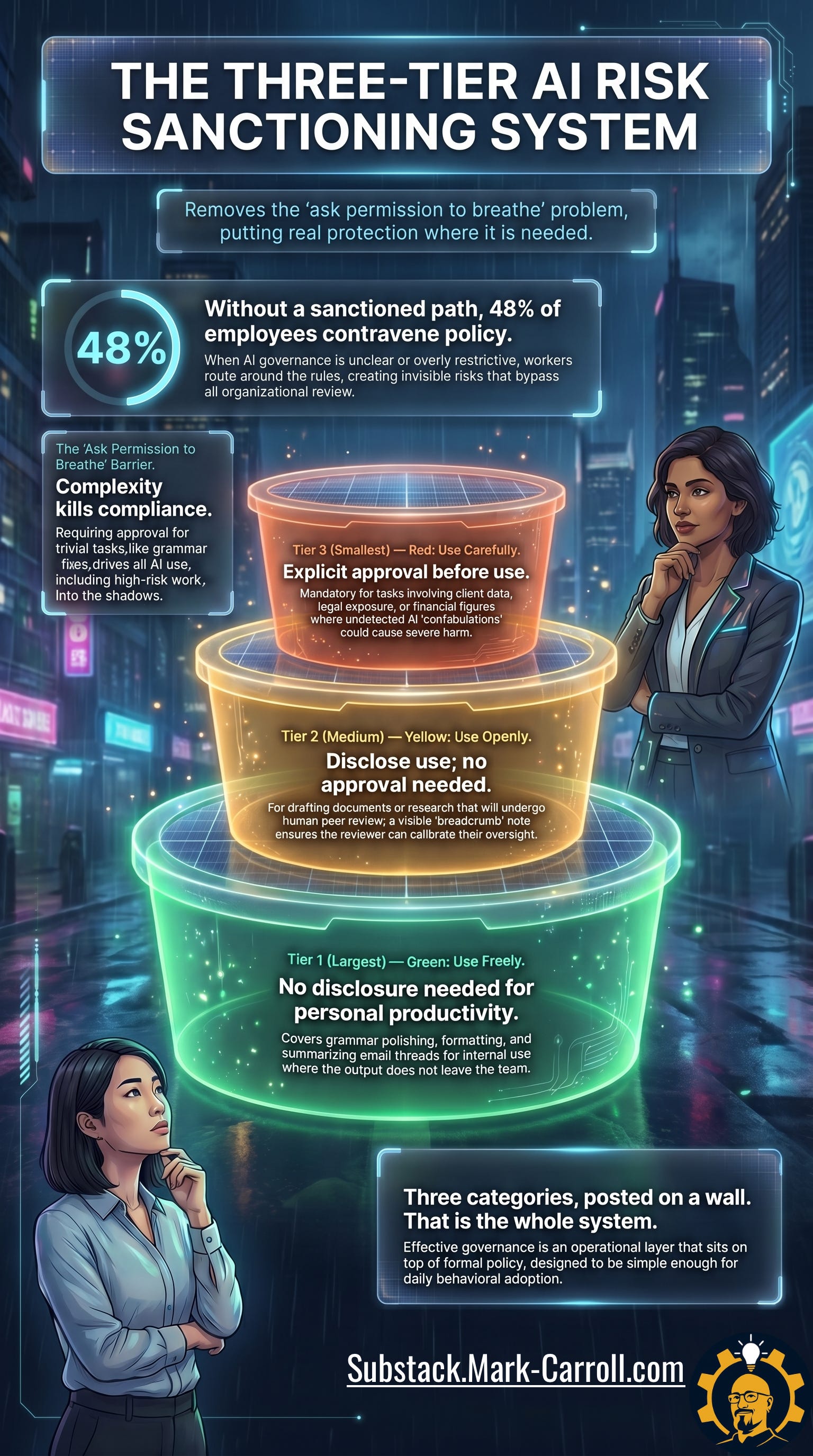
Move two: a three-tier risk sanctioning system. Three buckets, posted somewhere visible.
Green: anything goes, no disclosure needed. Grammar polishing, formatting cleanup, and summarizing an email thread for personal use. Use what you want, no tracking.
Yellow: disclose what you’re using, no approval needed. Drafting documents, summarizing research, anything that gets human review before leaving the team. Light disclosure in the doc or the project tracker.
Red: explicit approval before use. Anything touching client data, legal exposure, financial figures, or anything externally facing that won’t get another human pass. Approval, sourcing, named reviewer.
Three categories, posted on a wall. That’s the whole system. It removes the “ask permission to breathe” problem that kills sanctioned adoption, and it puts real protection where real protection is needed.
The parenting version
Here’s the analogy I keep coming back to. I have a seven-year-old and a two-year-old. In about eight years, my older one is going to show up at the dinner table using AI tools I don’t fully understand yet. And I’ll have the same two failure modes that show up in your conference rooms. Option one, I get excited. “She’s so smart, look at her using these tools!” and she stops bringing the harder questions to me. Option two, I panic. “You’re not allowed on these tools without my approval,” and she just uses them in her room with the door closed. Either way, I lose the conversation that actually matters.
The only version that works is me doing the work now, before she gets there, so I’m literate enough to be useful when the real conversation shows up. That’s the same job you have as a leader. Same playbook, lower stakes.
Where this lands
So here’s where I’d land this. The shadow AI in your org isn’t a technology problem you can policy your way out of. The team is bypassing you because at some point, you signaled you weren’t a safe place to bring the truth. That signal happened in a meeting you don’t remember, in a reaction you didn’t think mattered, in a hallway conversation where someone tested the waters and you fumbled the response.
The fix is slower than installing a new approval workflow, because you’re working on a relationship, and relationships don’t respond to policy memos. That work starts with literacy. It continues with tier systems that don’t humiliate people for using tools. And it ends with the leader who can sit across from a junior associate and say, “show me what you’re actually running, no consequences, I just want to learn.”
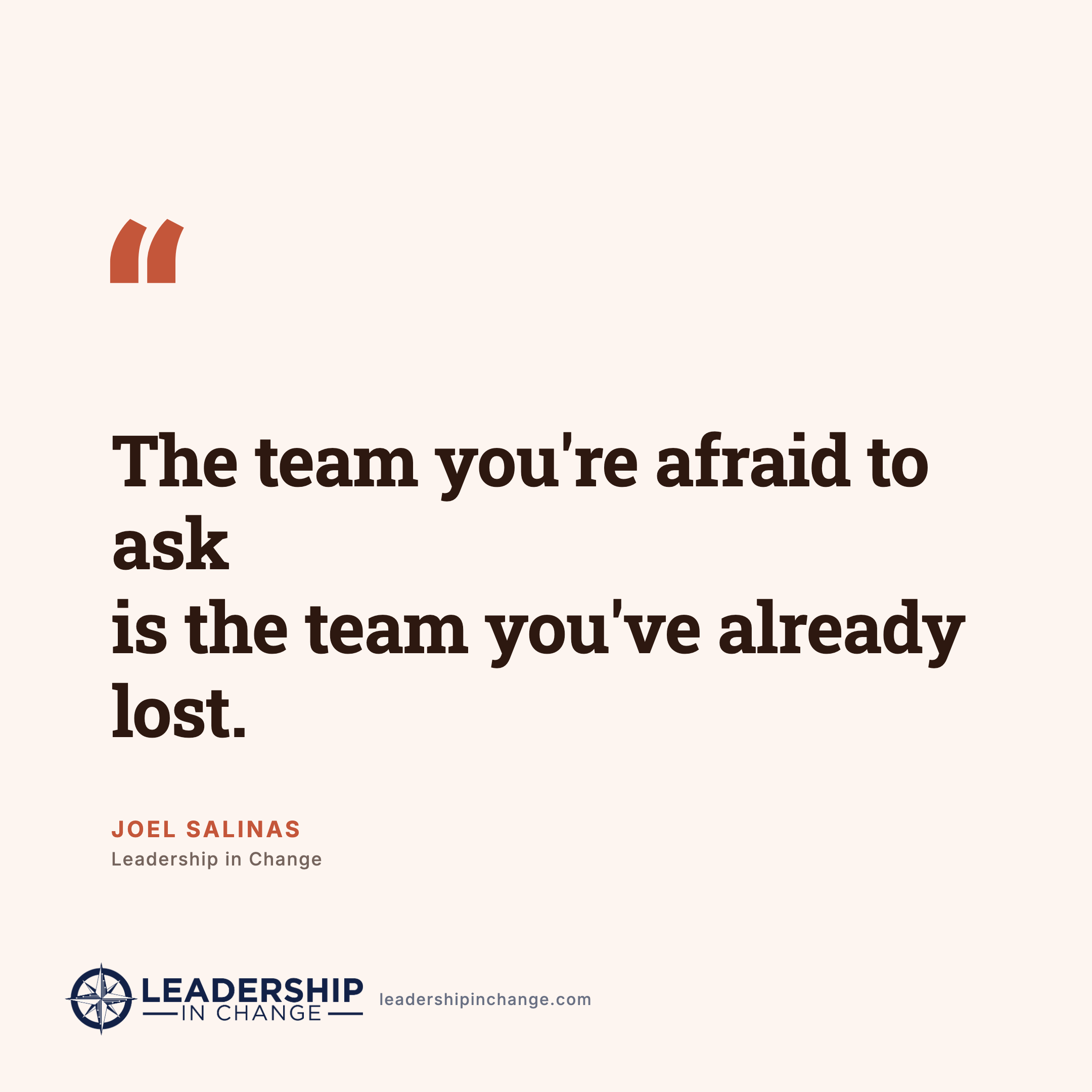
The team you’re afraid to ask is the team you’ve already lost.
When was the last time you asked one of your people to show you exactly what AI they’re using, with no policy consequences attached? Reply in the comments. The honest answers will tell you more about your team than any audit will.
About the author
Joel Salinas is an Executive AI Coach for leaders at small and mid-sized businesses and nonprofits. 1:1 coaching, team workshops, and AI strategy work built around amplifying what your team is already good at. Creator of the AI Leadership Triad. He writes Leadership in Change.
If this piece landed, the deeper version of this work shows up weekly in Leadership in Change, a free newsletter for leaders navigating AI without losing their teams.
SEO Metadata
Meta title (≤60 chars): Half Your Team Is Using AI. You Don’t Know Which Half.
Meta description (≤155 chars): Shadow AI is spreading in your org because both your natural reactions, excitement and panic-policy, train your team to hide. Two moves that fix it.
Primary keyword: shadow AI
Secondary keywords: AI policy, AI adoption, leader literacy, AI governance, shadow IT
Closer
Thank you, Joel!
This piece lands where mine deliberately stops. Structure without trust is a form teams route around in a week. Joel names exactly why, and the three-tier sanctioning system he offers is the simplest operational bridge I have seen between “we need a policy” and “we need people to actually follow it.”
If your team is already using AI and you are not sure how honestly they would tell you about it, that is not an audit problem. It is a relationship problem. Joel’s newsletter, Leadership in Change, is where that conversation continues.
And if the next AI mandate is already moving toward your team, I built the AI Intake OS Toolkit for that exact moment.
It is a multi-page field guide for product leads, delivery leads, and anyone who has watched an AI pilot quietly become a permanent obligation. Inside, you get ready-to-use scripts for introducing the decision map to executives, peers, and your team; a five-field charter that forces every experiment to prove it is ready before work begins; a conservative financial argument you can forward to a VP without embarrassment; and one hard rule that stops zombie pilots before they consume a sprint.
Pick it up thirty seconds before the mandate hits, and you will know what to say, what to document, and what decision to leave the room with.
Regards,
Mark 👋 (and thanks to Joel Salinas!)
Previous:
More Content to Discover:


The problem is not that your team is using AI without permission.
The problem is that permission may be the thing driving the work underground.
In this collaboration with Joel Salinas, we look at shadow AI, intake collapse, disclosure fear, and the awkward truth leaders need to face:
If every AI use case has to ask permission to breathe, people stop asking.
Then the trivial work disappears first.
The risky work follows.
Restack this if your team needs better AI intake before “just one pilot” becomes a permanent unpaid job.