


What to Say When Sales Calls It a Deal Breaker
Plain-English premise: A commercial escalation is a legitimate input into a product decision, but the number alone doesn’t tell you the signal, the tradeoff, the authority, or the record, and until it does, the decision isn’t finished.
👋 Welcome to this week’s edition of Empathy Engine. Every Wednesday, I publish a new article for paid subscribers first, then unlock the full piece for everyone late Thursday morning. Each week, I turn product leadership friction into practical tools, sharper language, and more defensible decisions.
Research Binder: the receipts (citations + source notes) are compiled in a PDF at the bottom of this post.
Episode 5:

⚠ Tension
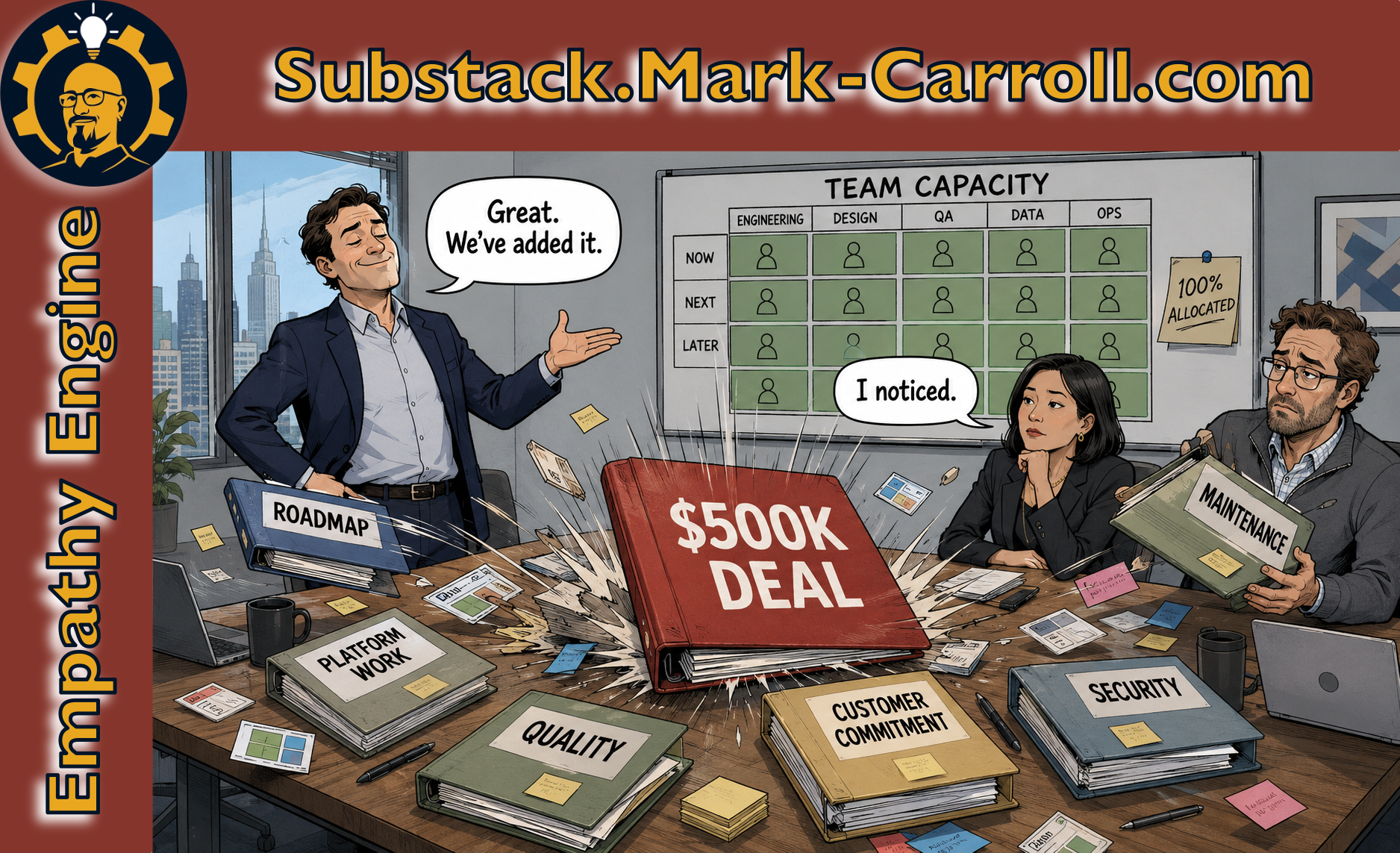
A commercial stakeholder says the deal breaks without this feature, and the room treats the number as the whole decision.
🎯 Payoff
Inside: the Escalation Receipt, a five-field record that finishes a commercial escalation instead of just absorbing it.
Trigger Moment
I’ve seen this pattern in real prioritization conversations: a commercially important request arrives with a number attached, and suddenly the room is reacting to the consequence before it has finished defining the decision.
Picture a Friday-afternoon review. A commercial lead opens with a number: a marquee account, six figures of ARR, and a feature that isn’t on the roadmap. The product lead says so. The commercial lead doesn’t blink.
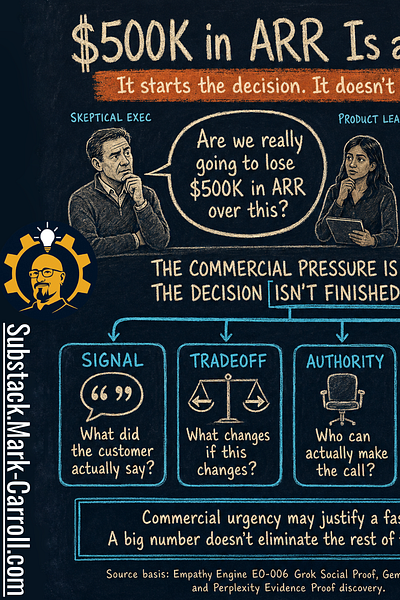
“So you’re telling me you’re okay losing $500K in ARR on a million-dollar account?”
The room goes quiet in the specific way rooms go quiet when a number has just done the talking a decision was supposed to do. The feature that wasn’t important Monday becomes existential by Friday. Engineering gets pulled into feasibility questions nobody scoped. Sales hears resistance. Leadership hears revenue exposure. Everyone reaches for the same two doors: build it, or lose the deal.
That’s not a rejection problem. It’s an unfinished decision wearing a price tag. A big number tells the room the stakes. It doesn’t tell the room what the customer actually said, what changes if the ask is accepted, who can actually make the call, or what needs to survive after everyone leaves. $500K in ARR is a signal. It starts the decision. It doesn’t finish it.
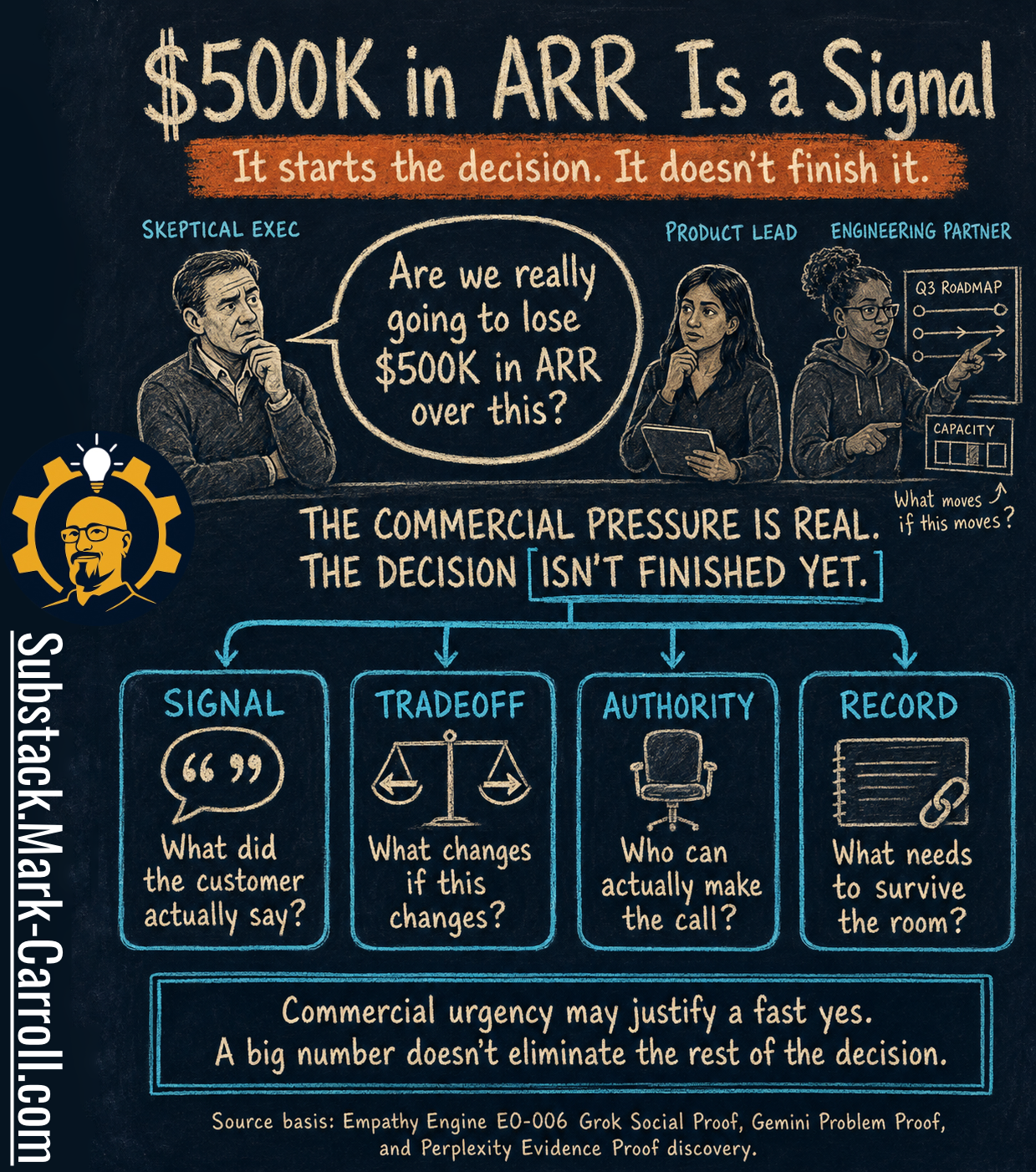
Preserve the Signal Before We Debate the Solution
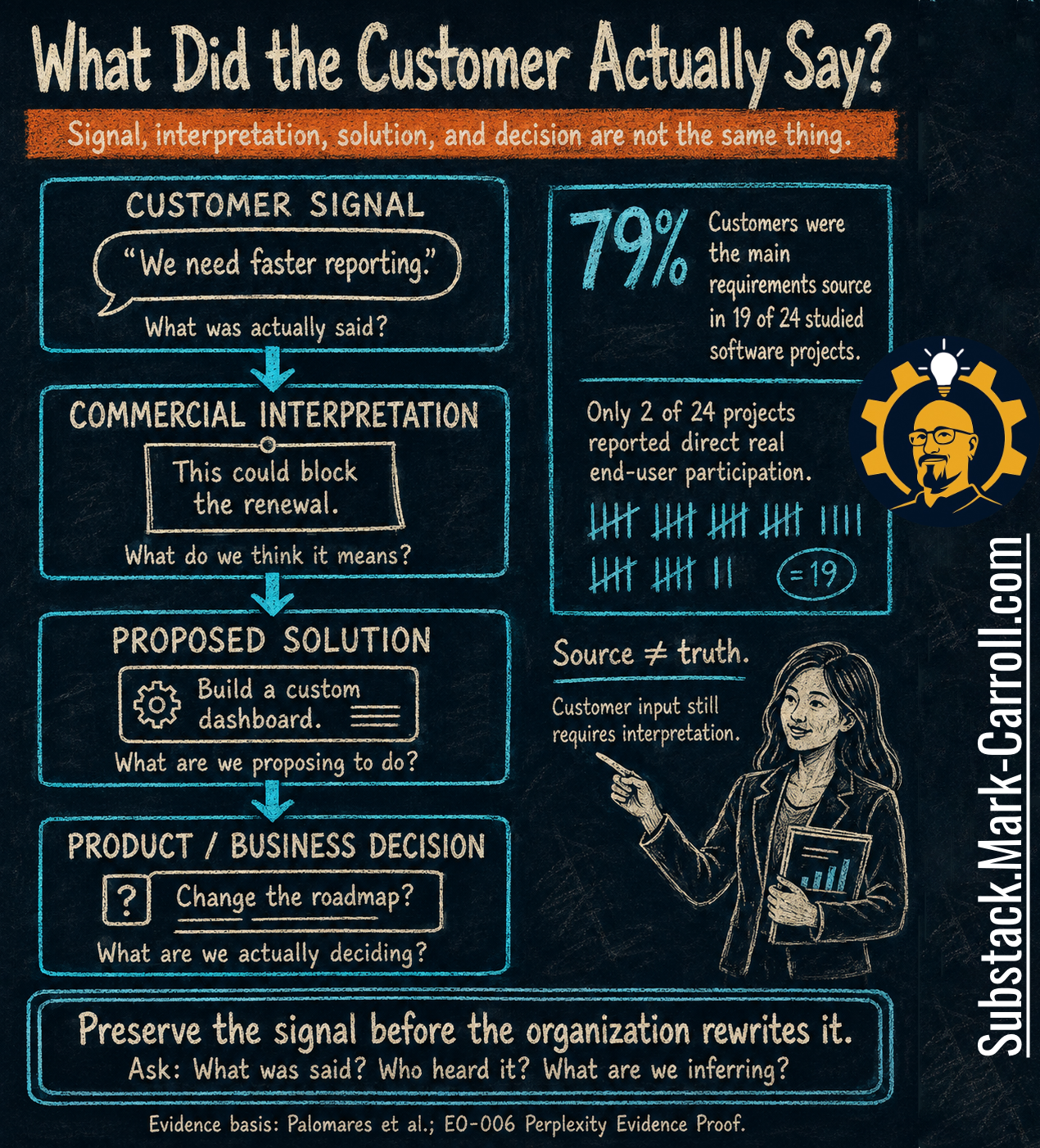
Commercial pressure almost always arrives compressed. “The customer needs SSO.” “They won’t renew without the dashboard.” Those sentences sound like customer facts. Usually they’re several layers folded into one: a customer reports a problem, an account team interprets what it means commercially, someone proposes a solution, and the organization decides whether that solution belongs in the product. Skip the distinction, and the proposed solution quietly stands in for the original need.
Say the actual customer statement was “we need faster reporting.” By the time it reaches a roadmap review, it may have become “this could block the renewal,” and by the time it reaches an engineering estimate, “build a custom dashboard.” None of those translations is dishonest. Each is a reasonable act performed by someone doing their job. But a translated request is not the same evidence as the original one. Customers were the main requirements source in 19 of 24 studied software projects, 79%, while real end-user participation showed up directly in only 2 of those 24. Source is not the same thing as truth. What did the customer actually say? Signal, interpretation, solution, and decision are not the same thing.
No One Function Has the Whole Picture
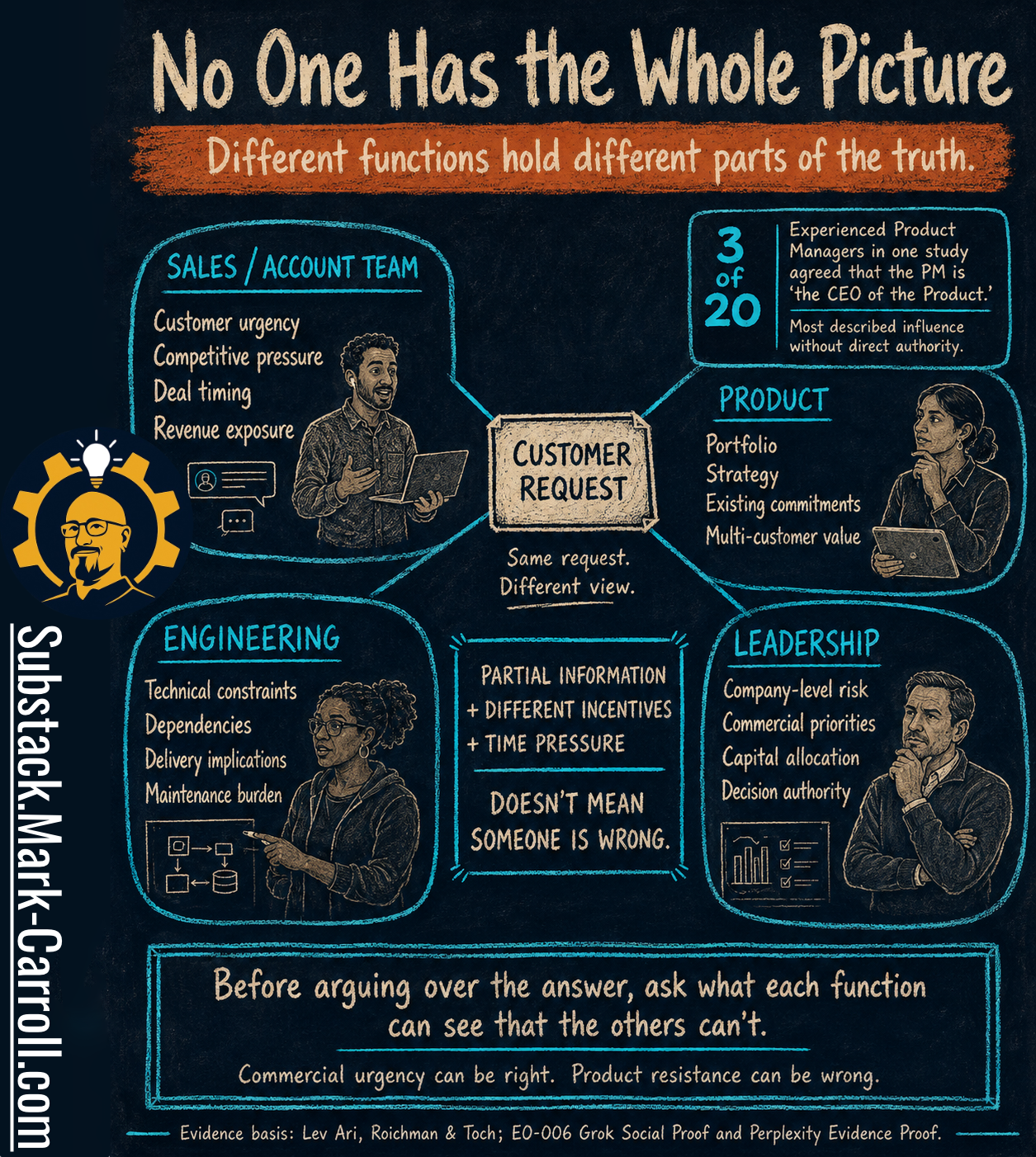
Once the request is in the room, it doesn’t get decided by one person holding the full picture. It gets decided by several people, each holding a real piece of it, and each piece looks more complete from the inside than it actually is.
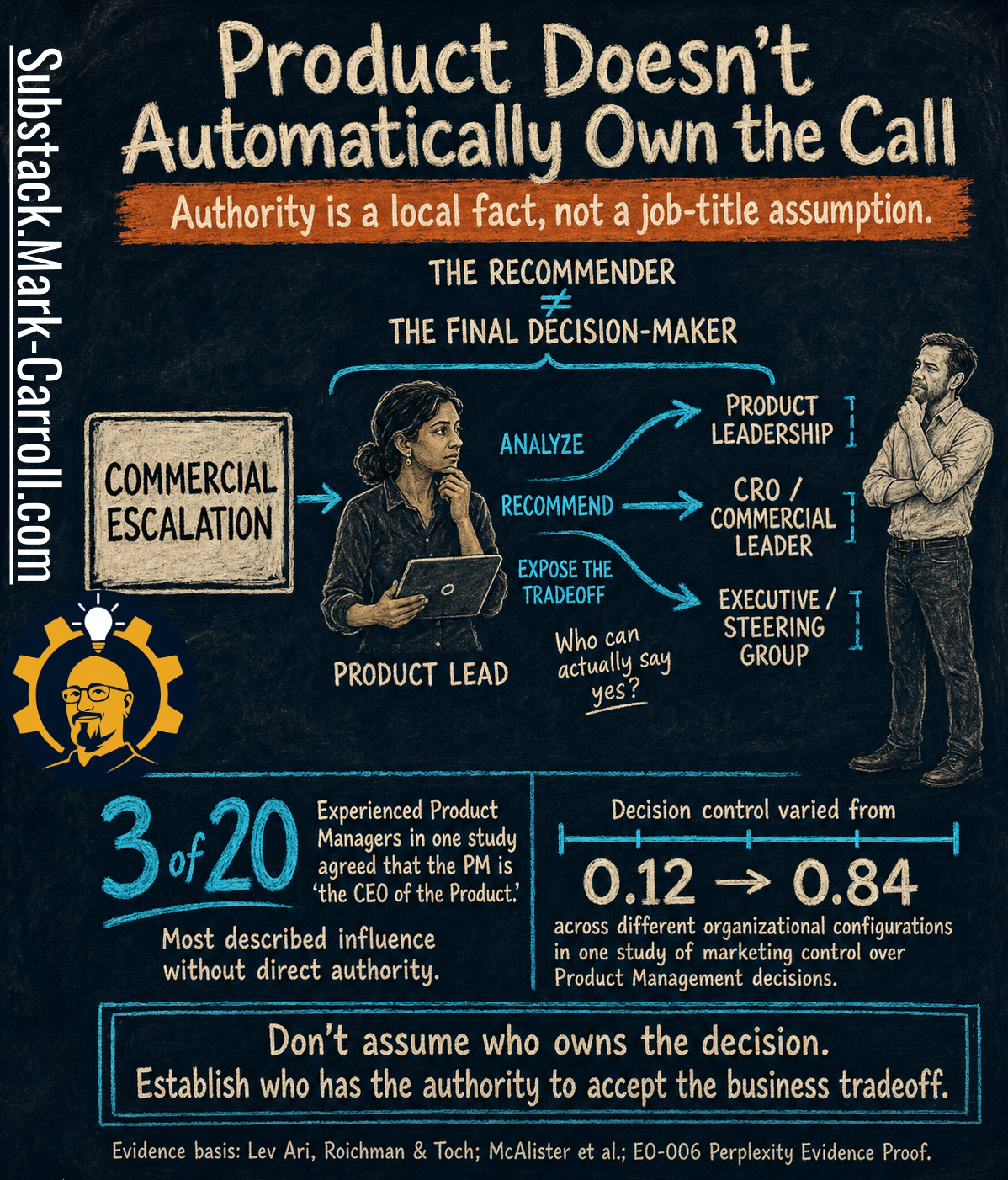
Sales sees customer urgency, competitive pressure, and revenue exposure up close. Engineering sees the dependencies and the maintenance burden a “yes” would create. Product and leadership are supposed to see the portfolio and the company-level risk, but the authority to act on what they see doesn’t always match the title. In one study of experienced product managers, only 3 of 20 agreed that the PM is “the CEO of the Product.” Most described real influence without formal authority to match it.
Partial information, different incentives, and time pressure stacked together don’t mean someone in the room is wrong. They mean the room has to ask what each function can see that the others can’t, before it argues over the answer. Commercial urgency can be right. Product resistance can be wrong. No one has the whole picture. Different functions hold different parts of the truth.
If This Moves, Something Else Moves
Say the signal is verified and the room agrees on what’s being asked. The next question rarely gets asked out loud: what happens to the plan that was already running?
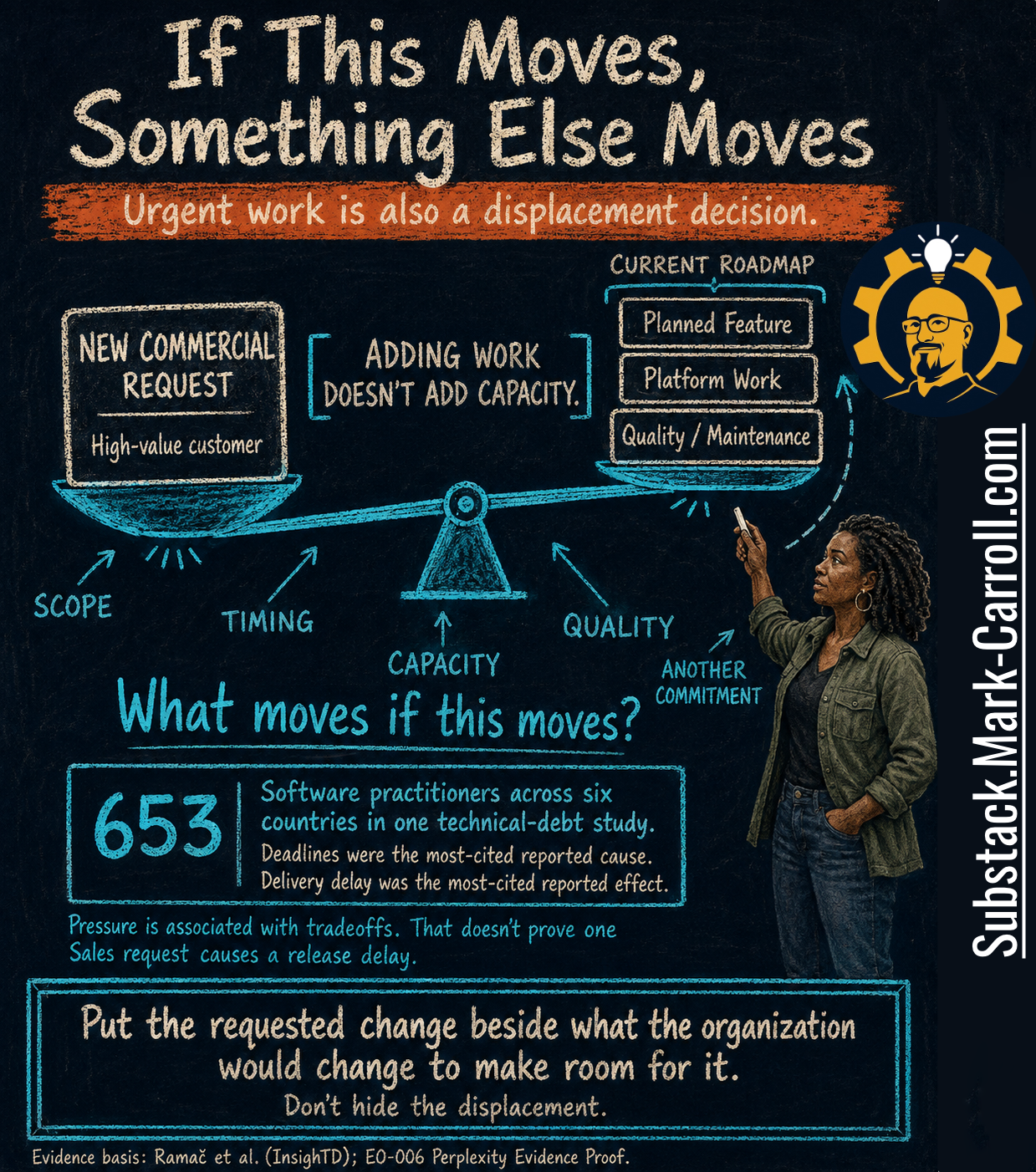
Adding work doesn’t add capacity. A new commercial request has to come from somewhere (scope narrows, timing slips, quality absorbs the difference, or another commitment gets bumped). The $500K account is easy to name in the room. The roadmap item that moves two months later is quieter.
In a six-country survey of 653 software practitioners, deadline pressure was the most-cited cause of technical debt and delivery delay was the most-cited effect. That doesn’t prove any single commercial request causes a specific delay. Re-prioritization is often a normal, healthy response to new information rather than a symptom of dysfunction. What it does show is that pressure and tradeoffs travel together often enough to name out loud instead of absorbing quietly. If this moves, something else moves. Urgent work is also a displacement decision.
Product Doesn’t Automatically Own the Call
Even a fully scoped, fully understood tradeoff still needs someone with the standing to accept it. That person is not automatically the product lead, and assuming it is the fastest way to end up owning a decision nobody actually authorized. A product lead can analyze the request, recommend a path, and expose the tradeoff, all without holding the authority to say yes on a six-figure commercial exception.
In one study of marketing’s control over product-management decisions, that control ranged from 0.12 to 0.84 depending on the organization. A wide enough spread that no single org chart describes how this works everywhere. Don’t assume who owns the decision. Product doesn’t automatically own the call. Authority is a local fact, not a job-title assumption.
🎒 The Move: Complete the Decision
I kept noticing the same gap in commercial escalations: everyone could explain why the request mattered, but nobody could clearly say what would move, who owned the tradeoff, or what decision had actually been made.
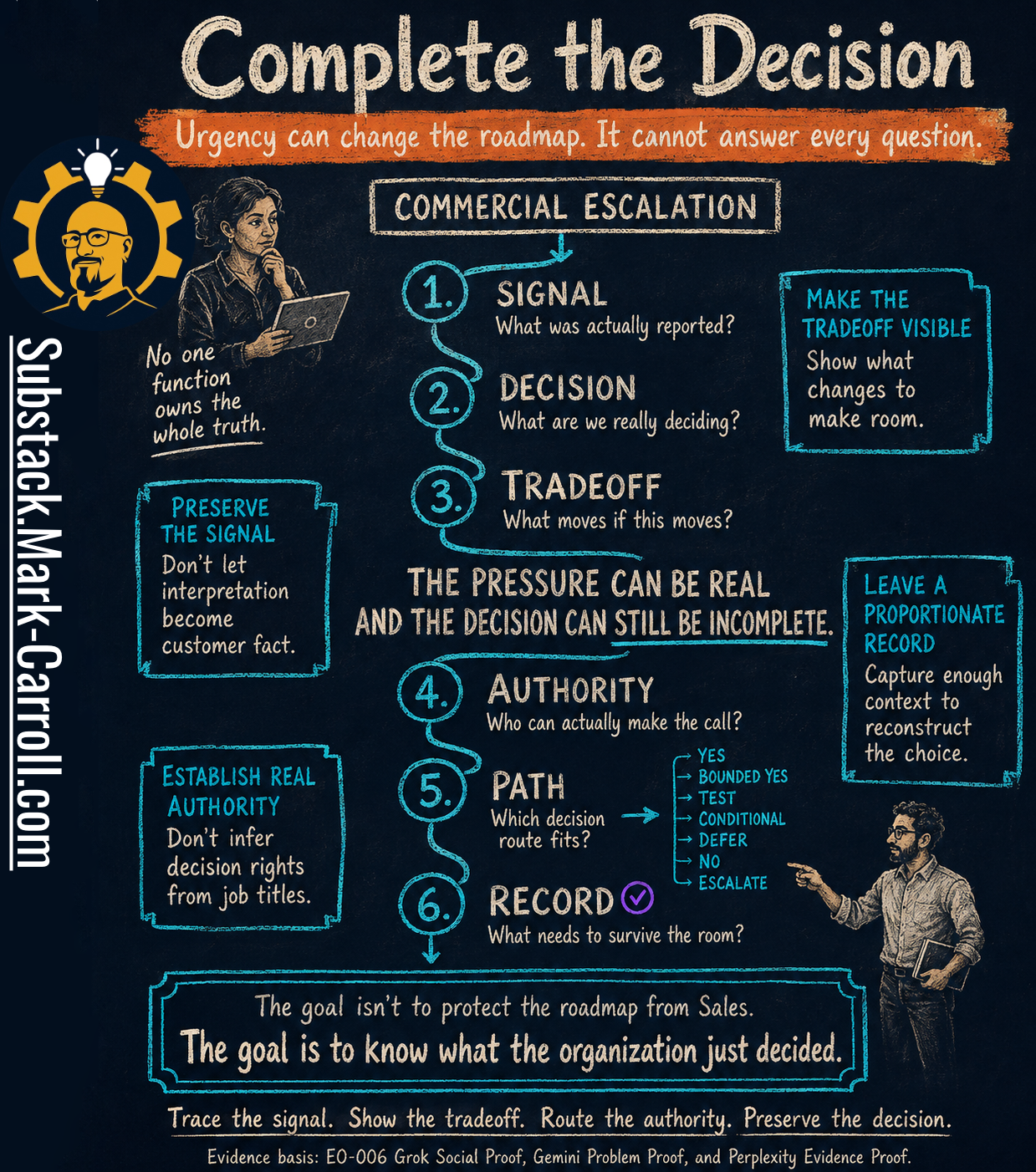
When a commercial escalation lands as an ultimatum, run it through six questions before the room agrees to anything, so urgency can change the roadmap without also skipping the questions urgency can’t answer on its own.
Orienting sentence: the pressure in the room is real. The decision isn’t finished until these six questions have answers.
Step 1: Signal. What was actually reported, by whom, and is it first-hand or secondhand by the time it reached this room?
Step 2: Decision. What are we actually deciding right now (whether to build something, whether to investigate it, or whether to accept a defined risk)?
Step 3: Tradeoff. What moves if this moves? Name the specific scope, timing, quality, or commitment that changes to make room.
Step 4: Authority. Who can actually make this call, separate from who is asking for it and separate from who is recommending it?
Step 5: Path. Which response fits the evidence, the tradeoff, and the authority actually in the room?
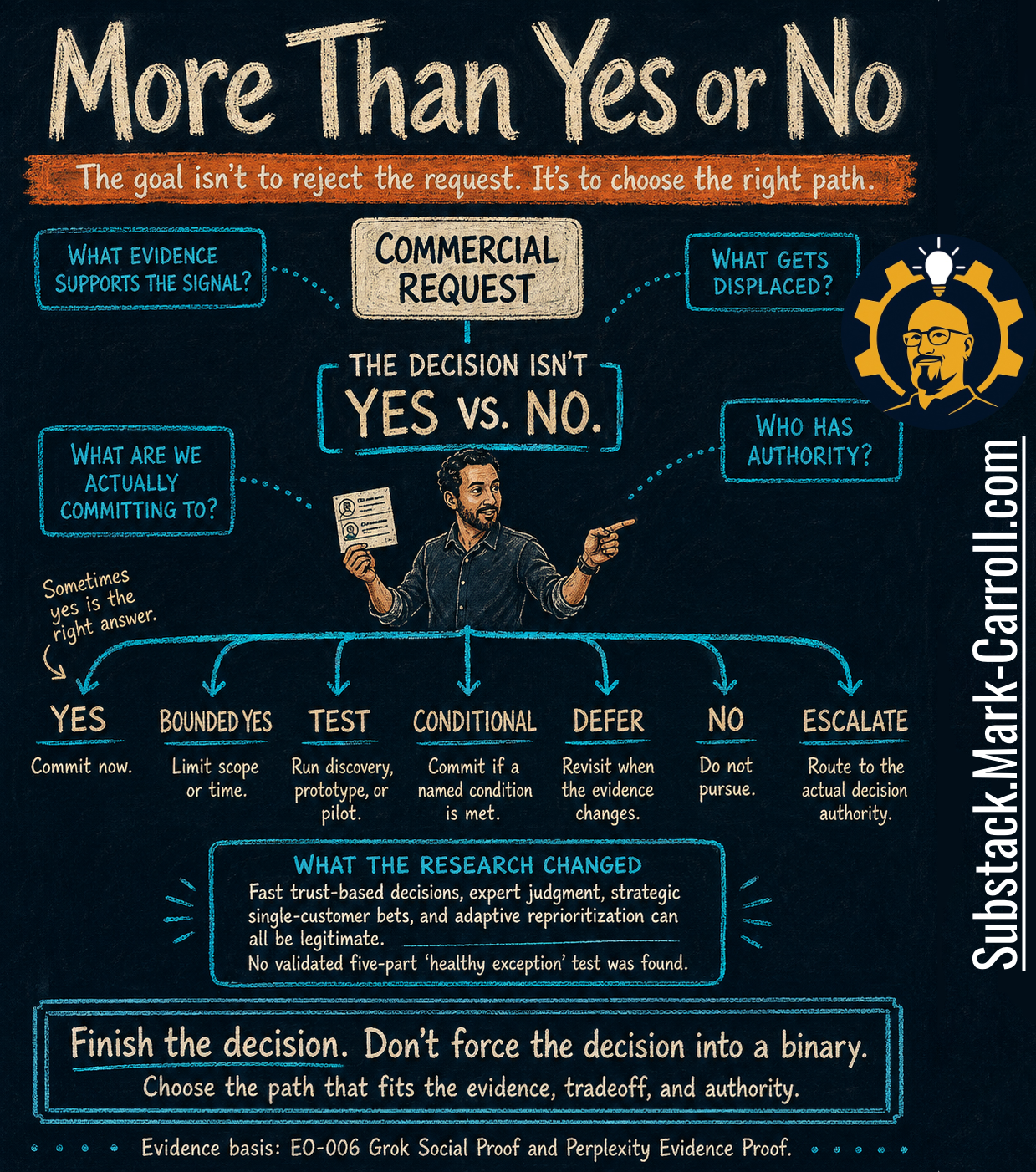
Once the signal, the tradeoff, and the authority are visible, the room can stop pretending there are only two doors. Yes commits now. Bounded Yes limits scope or time so a temporary exception doesn’t quietly become the default architecture. Test runs discovery or a prototype before committing further. Conditional commits if a named condition is met. Procurement signs, a dependency clears, a defined scope holds. Defer revisits the question when the evidence changes. No declines. Escalate routes the call to whoever actually holds the authority this room doesn’t.
Fast, trust-based calls, expert judgment, and a deliberate single-account bet can all be legitimate paths depending on what the room actually knows — no validated checklist exists to sort a “healthy exception” automatically, and none of the above is a pass/fail test for whether an exception is morally pure. These seven paths are a menu the room chooses from deliberately, not a formula it runs. More than yes or no. The goal isn’t to reject the request. It’s to choose the right path.
Step 6: Record. What needs to survive the room, in a place the team will actually find it again?
Constraint: Answer all six questions before the meeting ends, not after — a path chosen without a named authority is provisional, not confirmed, and a provisional decision is just next month’s relitigation with better attendance.
Done state: The signal is preserved, the tradeoff is named, the authority is confirmed, one of the seven paths is chosen, and a record exists where the team already works.
Limitation: This sequence can’t supply decision rights nobody in the room holds, and it can’t verify a customer claim on its own or guarantee the chosen path was the right one. It doesn’t guarantee the decision was correct. It does mean the room can point to what it actually decided, and why, instead of five different memories of a meeting that ended on a number.
🖊 What Holds Up Under Pressure
Primary claim label: Practitioner Observation and Design Inference (sequence), with select Evidence components
Basis: The pieces of this sequence rest on uneven ground, and treating them as equally proven overstates the case. Layer separation (signal, interpretation, solution, decision) is standards-consistent: decision records are conventionally expected to identify information sources, and requirements are traced to a parent or flagged self-derived. Authority variability is directly observed: product-management decision control ranged from 0.12 to 0.84 across organizations in one study, and only 3 of 20 experienced PMs in another agreed the role carries CEO-level authority. Selective record-keeping has one direct field test: a three-month action-research intervention in two agile teams raised guideline clarity from 2.0 to 2.9 and satisfaction from 2.5 to 3.1 on a 4-point scale, and the authors described dependence on individual memory as eliminated, though scattered storage remained unsolved.
Counterpoint: No source tests this six-step sequence as an integrated instrument, and no study measures whether running an escalation through it changes what gets decided, how fast, or how often it gets re-litigated. The evidence for layer separation improving outcomes is genuinely absent . Several adjacent studies found blurred boundaries between roles helped rather than hurt. The record-keeping evidence comes from one Swedish company, 14 employees, no control group. Expert prerogative has real support too: in one study of software architecture decisions, 9 of 10 practitioners relied on experience and 7 of 10 on intuition rather than any formal method, and “less documentation” was itself cited as a process benefit.
Limitation: Treat this sequence as an evidence-informed reflective tool, not a validated protocol. It draws real support from decision-authority research and one direct record intervention. It draws no support from any study of commercial escalations specifically, and it does not prove that any one of its six steps improves the eventual business outcome.
Decision Logged: The Escalation Receipt
The record this sequence produces isn’t meant to prove anything happened. It’s meant to survive the room. More documentation does not automatically mean a better decision.
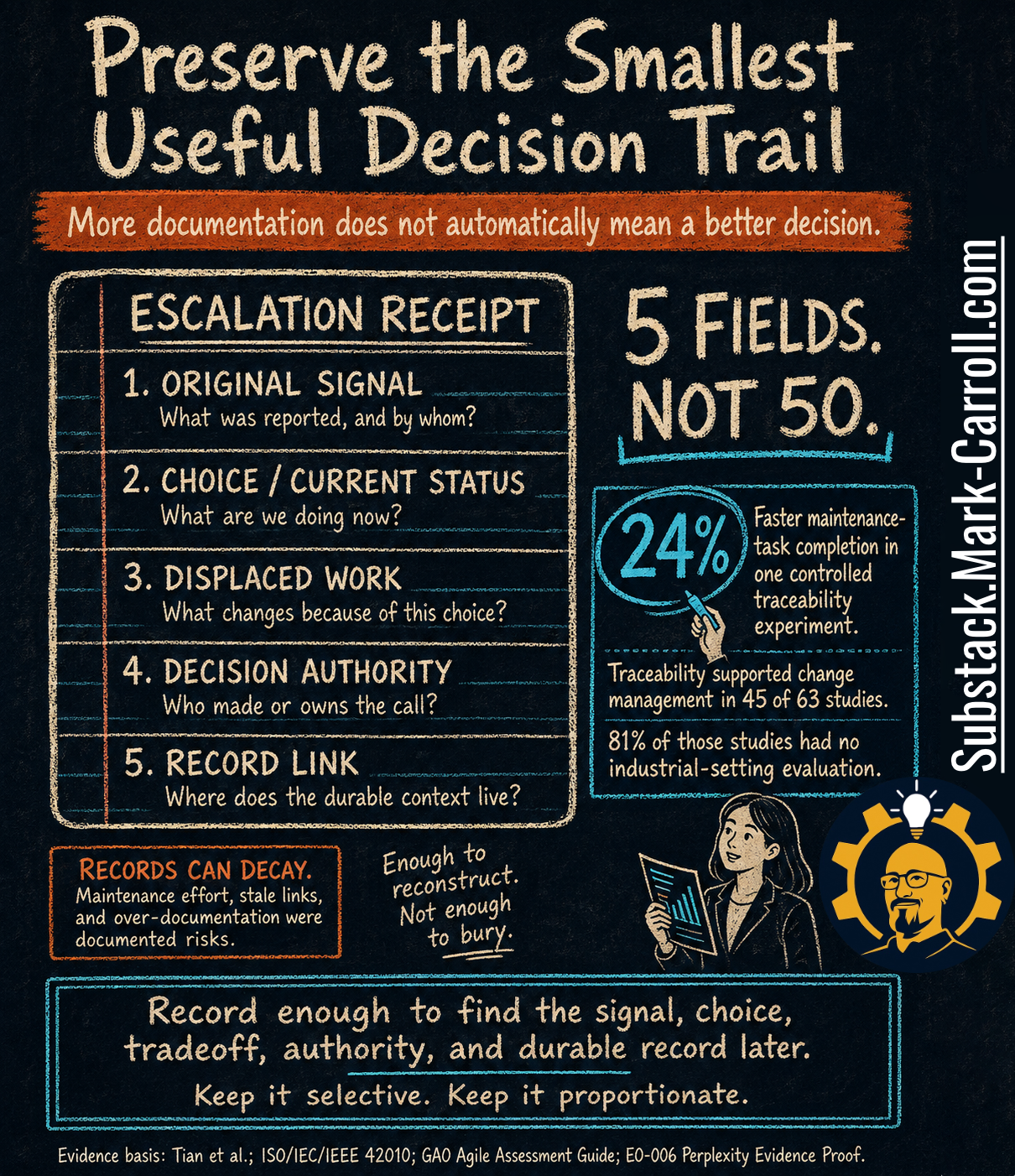
Original signal: what was reported, and by whom? ________
Choice / current status: what are we doing now? ________
Displaced work: what changes because of this choice? ________
Decision authority: who made or owns the call? ________
Record link: where does the durable context live? ________
Five fields, not fifty. Traceability supported change management in 45 of 63 studies reviewed, and one controlled experiment found practitioners using traceability completed maintenance tasks 24% faster. Though 81% of the studies in that same review had no industrial-setting evaluation at all. Records can decay: maintenance effort, stale links, and over-documentation are documented risks, not hypothetical ones. Record enough to reconstruct. Not enough to bury.
🛑 Do Not Use When
The request is low-stakes. A minor configuration change or a backlog reprioritization doesn’t need six questions and a receipt. That’s governance theater.
The actual decision authority is absent from the room. Don’t let a room without the authority to say yes talk itself into believing it just decided something. Route the authority question and mark the record Pending.
The record culture treats documentation as ammunition. A receipt written to preserve the record is different from one written to build a case against a colleague later. If the record can’t be written straight, that’s an EO-005 problem before it’s an EO-006 problem.
This Week
3 actions for the product lead (the one completing the decision, not the one blocking it):
The next time a commercial ask arrives as an ultimatum, run it through the six questions before agreeing to anything, out loud if the room allows it.
Ask for the customer’s original words before accepting anyone’s interpretation of what they meant.
Name the specific tradeoff, the specific thing that moves, before naming a position on the request.
1 action for the leader in the room (whoever holds the authority the escalation is actually testing): State out loud whether you are the decision authority for this specific tradeoff, or whether it needs to route further.
1 action to improve decision traceability today (whoever keeps the record): Pick one live commercial ask and fill out the five-field Escalation Receipt for it before the next meeting where it comes up again.
Commercial Escalation Pack
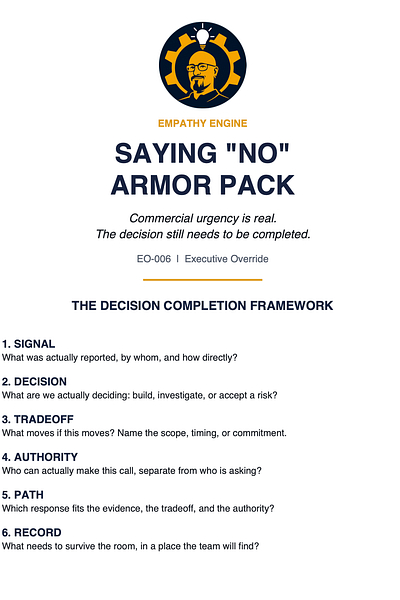
The Commercial Escalation Pack (or Saying “No” Armor Pack) is the sixth unlock in the free seven-part Decision Memory Field Kit. It turns the six questions into a live-meeting aid: preserve the signal, expose the displacement, establish authority, choose a response path, and leave a five-field Escalation Receipt where the team can find it again. It doesn’t tell Product to say no to commercial urgency. It gives the room a way to finish the decision the urgency started.
Commercial pressure can be real. The account may genuinely walk. Sales may have information Product doesn’t. A mature product organization doesn’t respond to that by defending the roadmap as sacred, and a mature commercial organization doesn’t respond by treating a revenue number as a substitute for the rest of the decision. The goal isn’t to protect the roadmap from Sales. The goal is to know what the organization just decided. Complete the decision. Urgency can change the roadmap. It cannot answer every question.
The Commercial Escalation Pack, or Saying “No” Armor Pack, is a compact field tool for the moment a revenue-heavy request starts pressuring the roadmap.
It helps teams separate the original customer signal from interpretation, make the displacement visible, establish who actually has authority, choose among more than yes or no, and leave behind a lightweight record of what was decided.
The goal is not to make Product better at saying no. The goal is to help the room complete the decision before urgency starts masquerading as clarity.
📎 Forward This
A commercial ultimatum is a signal, not a finished decision. Name what was actually said, what moves if this moves, who can actually say yes, and where the record lives, before the room agrees to anything.
Next week, Executive Override reaches its capstone. EO-007 synthesizes the full operating sequence (trigger recognition, pushback, alignment, capture, confirmation, and distribution) into one Logged Decision Workflow.
That same operating belief sits at the heart of my upcoming book, Collaborate Better. Better collaboration isn’t louder agreement; it’s the discipline of making tradeoffs, ownership, and next steps visible enough for people to move together. Learn more at CollaborateBetter.us.

⬅ Closing
The number on the table was never the decision. It was the opening bid.
Finish what the urgency started.
Regards,
Mark 👋
Previous:

More Content to Discover:

Half Your Team Is Using AI. You Don't Know Which Half.

Intro If you read the piece we published last week on Leadership in Change, you saw the structural diagnosis: mandate pressure, decision collapse, intake collapse. Three failures that sit underneath almost every AI pilot that goes sideways. That piece mapped the architecture. What it did not cover is what happens on the human side of the same problem, wh…

The fastest way to mishandle a commercial escalation is to argue about whether the request is important. The more useful question is: “What moves if this moves?” If the answer is unclear, the decision probably isn’t finished yet.