


Clear in the Room. Unclear Everywhere Else.
Plain-English premise: A decision can pass every tool in this series (receipted, pushed back on, captured, recorded) and still fall apart later, because none of those tools were built to test whether it actually closed, whether its reasoning survives, whether it was made through the route it claims, or whether a later change was reconsideration or relitigation.
👋 Welcome to this week’s edition of Empathy Engine. Every Wednesday, I publish a new article for paid subscribers first, then unlock the full piece for everyone late Thursday morning. Each week, I turn product leadership friction into practical tools, sharper language, and more defensible decisions.
Research Binder: the receipts (citations + source notes) are compiled in a PDF at the bottom of this post.
Episode 4:

⚠ Tension
Everyone in the room agreed. Weeks later, no one agrees on what was actually decided, why, or by whom.
🎯 Payoff
Inside: the Decision Reflection Card, a four-question sequence (status, reasoning, route, revision) for finding exactly where a decision stopped holding.
Trigger Moment
I once watched two credible leaders point to the same written decision and describe two different commitments. One remembered approving a full product launch; the other remembered approving only a three-customer pilot contingent on security review, and the difference cost us six weeks of rework and several external commitments we had to retract.
“We already decided this.”
That sentence usually shows up after the meeting everyone thought had already settled the matter. It wasn’t about whether a document existed. It was about which parts of the decision had actually survived outside the room.
Someone opens the project board. Someone checks the shared drive. Someone searches Slack.
The record might answer the first question: what was chosen, its status, a named owner. It’s far less likely to answer why that choice made sense at the time, which constraints shaped it, or whether the route that produced it was the one the org chart says should have produced it.
Four tools already exist in this series for exactly this kind of moment. The override gets a receipt. The urgent ask gets a pushback script and a routed decision. The stakeholder meeting closes with a confirmed capture strip. The decision gets a full One-Page Record, downside accepted, Revisit-If condition attached.
All four can fire correctly. The decision can still not hold.
This is a different kind of failure than documentation. It’s the gap those four tools were never built to close. They can confirm a decision got written down. They can’t confirm it was ever actually settled, whether the reasoning behind it can still be found, whether it was made through the route it claims, or whether what happened next was honest reconsideration or something else wearing its clothes.
Four Questions, Not One Diagnosis
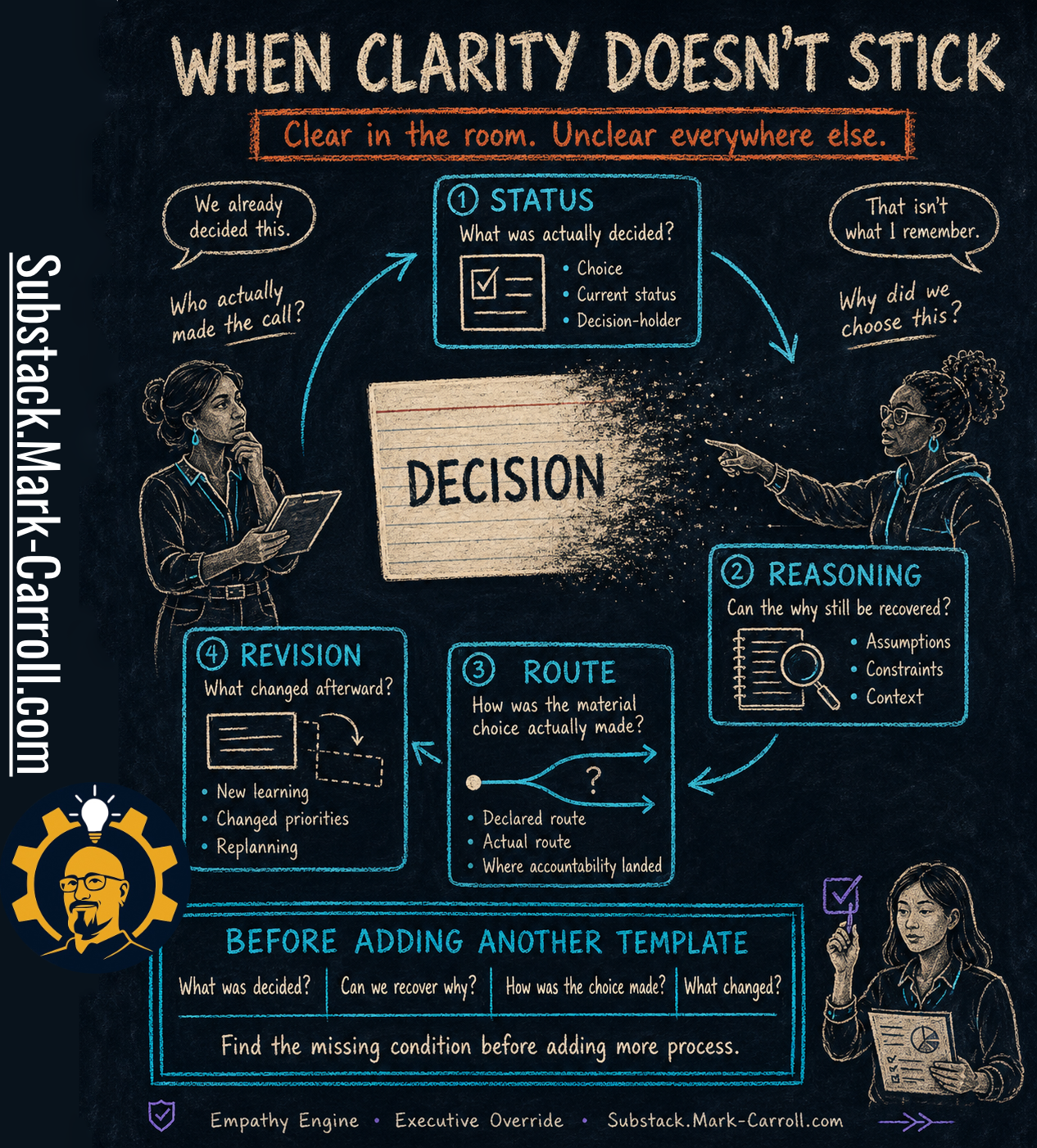
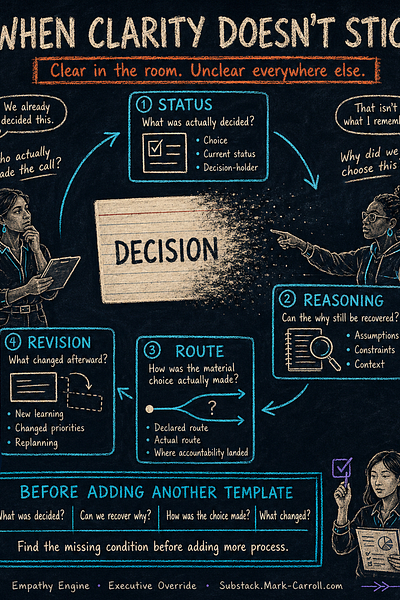
The temptation at this point in the series is to reach for a fifth template. Resist it. Before adding another form, run the room through four questions instead: what was actually decided, whether the why can still be recovered, how the choice was actually made, and what changed afterward. These aren’t four versions of the same question. Each can fail while the others stay intact. When clarity doesn’t stick, it’s rarely one failure. It’s one of these four: clear in the room, unclear everywhere else.
Condition One: A Discussion Is Not Yet a Decision
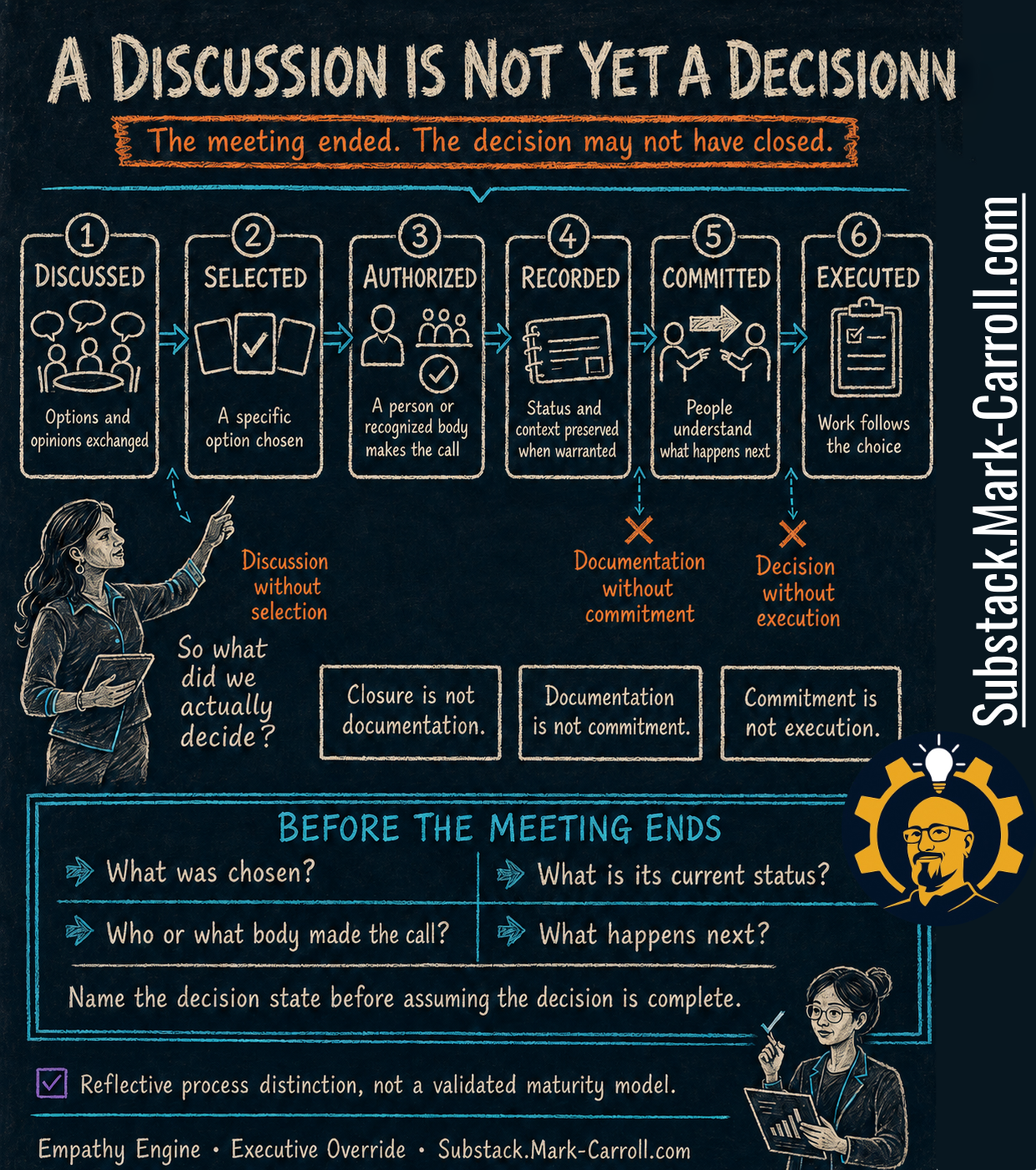
Meetings create a strong illusion of closure. The invite disappears, the notes go out, someone says “great, we’re aligned,” and the room walks out believing something that may not actually be true.
Six conditions separate a discussion from a decision that’s actually ready to travel: discussed, selected, authorized, recorded when warranted, understood by the people affected, and followed by the work. This is a reflective distinction, not a validated maturity model. Skip the gap between any two of those conditions, though, and the room walks out carrying several different versions of what just happened.
Two gaps deserve particular attention, because both can look like closure. Discussion without selection is early: the meeting surfaces options but never lands on one, and everyone privately assumes their preferred option won. Documentation without commitment, and decision without execution, are late: a record exists, but nobody has actually committed to it and no work has followed. A discussion is not yet a decision. The meeting ended. The decision may not have closed.
Condition Two: The Decision Survived. The Reasoning Didn’t.
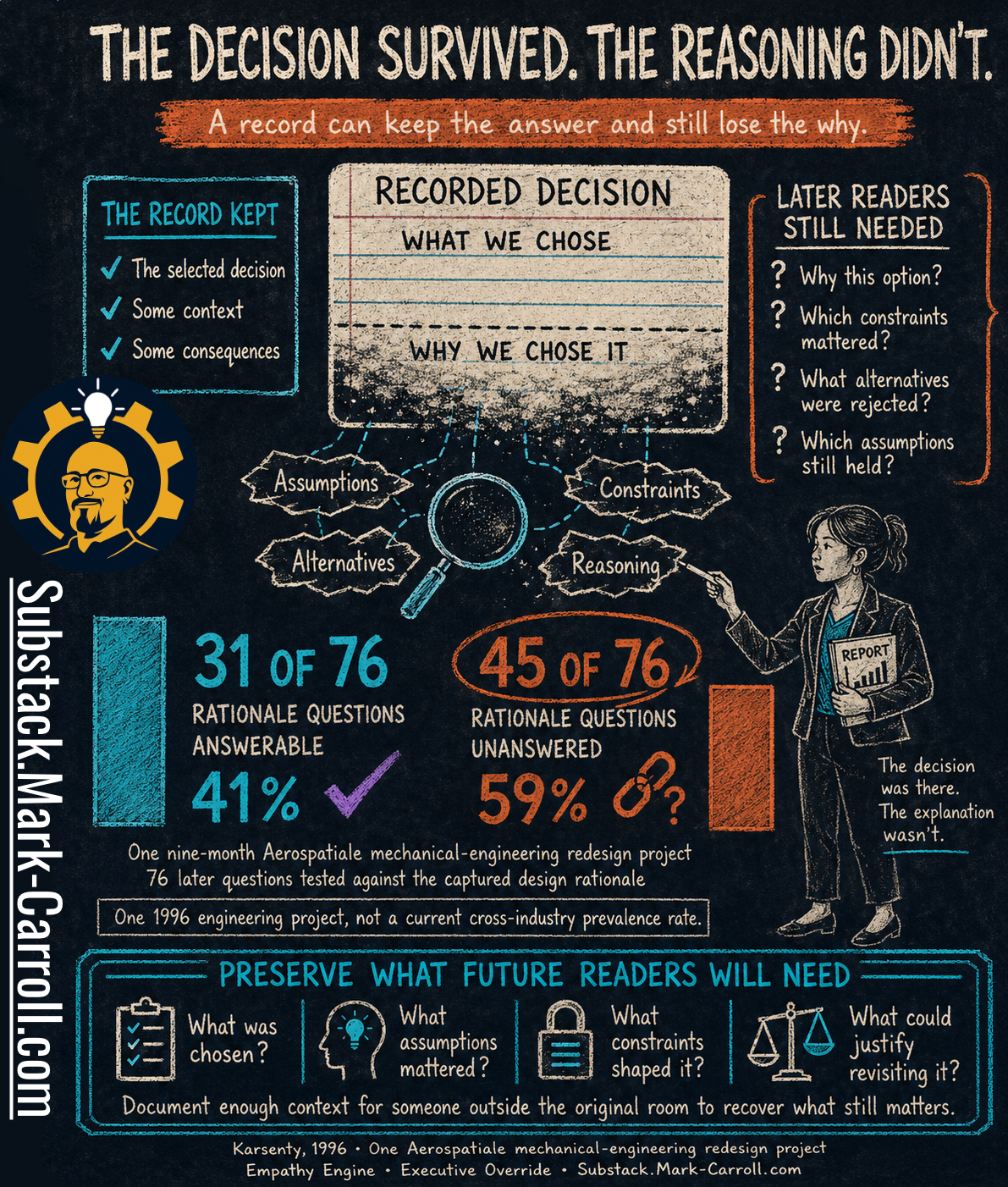
Say the decision did close. It got selected, authorized, recorded. Even then, a record can keep the answer and still lose the why.
This risk shows up in practice. In one nine-month aerospace mechanical-engineering redesign project, researchers went back to a captured design rationale and tested it against 76 questions a later reader actually needed answered. Only 31 of those 76, 41%, could be answered from the record. The other 45, 59%, could not.
That’s one 1996 engineering project. I’m using it as a direct example of what a captured record can still leave out. It shouldn’t be read as a percentage to expect in your own decisions. The shape of the failure travels well outside aerospace, though: the record kept what was chosen, some context, some consequences. It didn’t reliably keep why this option, which constraints mattered, what alternatives were rejected, or which assumptions still held. The decision survived. The reasoning didn’t. A record can keep the answer and still lose the why.
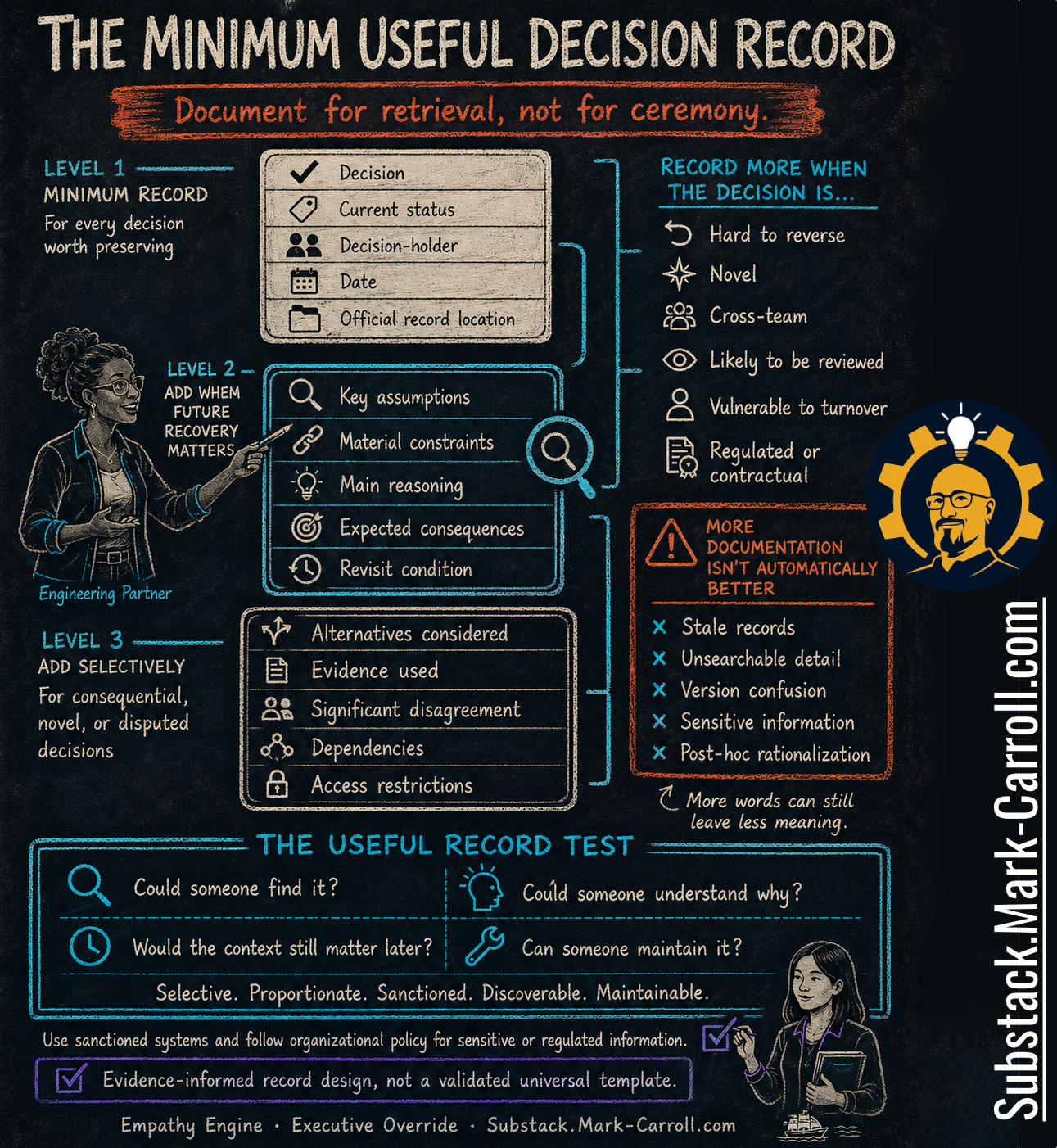
The Minimum Useful Decision Record
That gap gets fixed by writing down the right things, at the right depth, for the decision in front of you. Different decisions earn different depths.
Every decision worth preserving earns a minimum record: the decision, its current status, the decision-holder, the date, and where the official record lives. Add a second layer, key assumptions, material constraints, the main reasoning, expected consequences, a revisit condition, when future recovery actually matters. Add a third layer, alternatives considered, evidence used, significant disagreement, dependencies, access restrictions, only selectively, for decisions that are consequential, novel, or disputed. Record more when a decision is hard to reverse, novel, cross-team, likely to be reviewed, vulnerable to turnover, or regulated or contractual.
The opposite failure is just as real. Documentation has a ceiling too. Stale records, unsearchable detail, version confusion, misplaced sensitive information, and post-hoc rationalization dressed up as contemporaneous reasoning all get worse the more you pile on. The answer to weak organizational memory is always a sanctioned system. Personal-device archives, covert recording, forwarding internal records to an external account, and shadow files built to dodge retention rules all fail that test. Document for retrieval, not for ceremony.
Condition Three: The Org Chart Isn’t the Decision Route
Even a decision that closed cleanly and kept its reasoning can still unravel over a third question: whether it was actually made the way the chart says it was made.
Every org chart describes a declared route: a role chart, an identifiable decision-holder, a formal decision, accountability. Material choices often pass through additional forums and relationships the chart never shows. Facilitating a conversation toward a choice doesn’t always mean deciding it. Both routes can be legitimate on their own. The question is whether they match, and if they don’t, where the difference actually sits.
The role chart named one person as the decision-holder, but by the time the meeting began, funding and executive conversations had already narrowed the available choice. I had to name that the formal decision was happening in the room, while the material decision had largely happened before it.
Ask whether the difference was known in advance, and whether the actual route was itself authorized. If the answer to either is unknown or disputed, read that as information about how the decision actually happened, worth investigating calmly rather than treated as proof of wrongdoing. The org chart isn’t the decision route. The declared route and the actual route may not match.
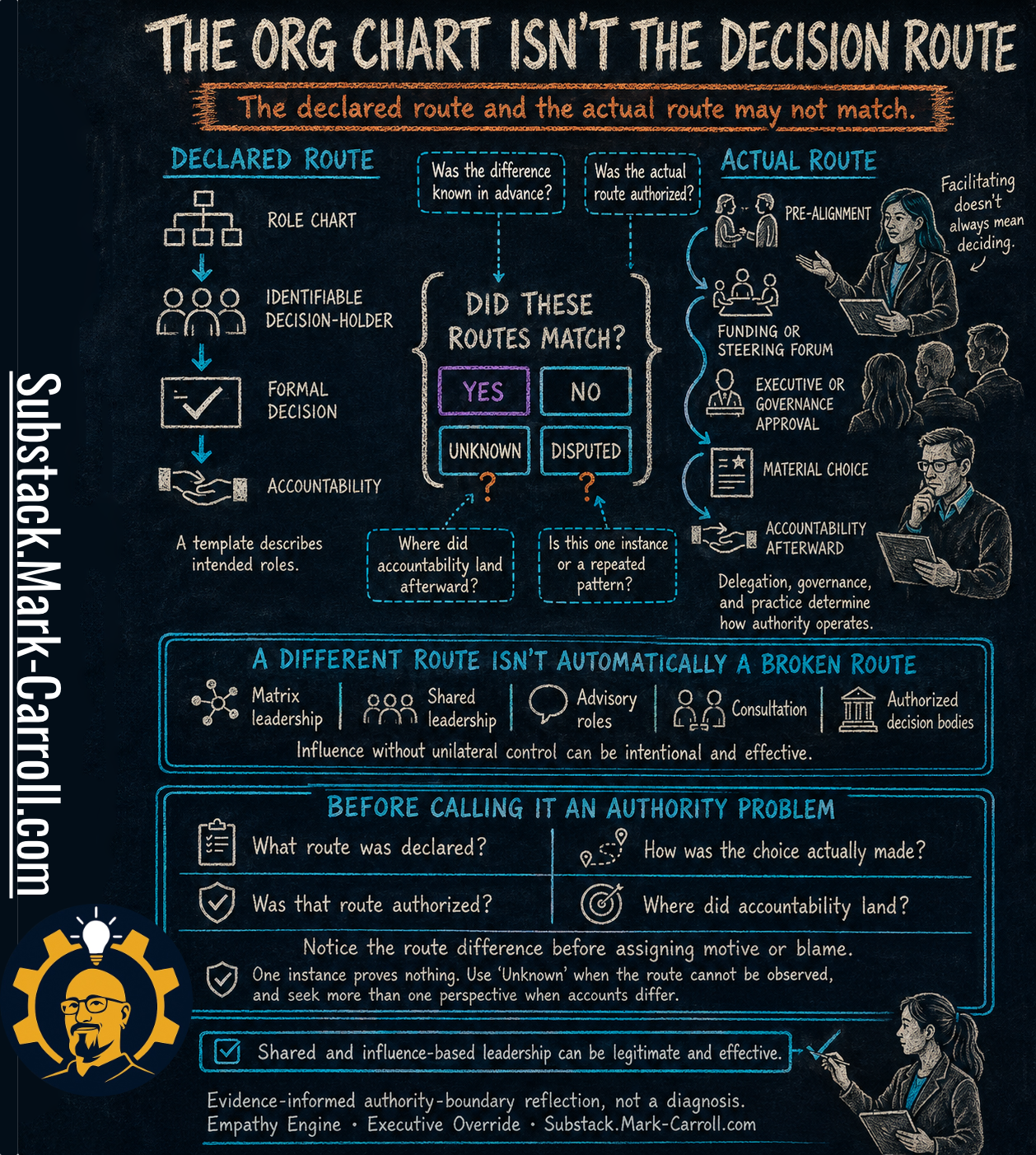
A different route is not automatically a broken one. Matrix leadership, shared leadership, advisory roles, consultation, and authorized decision bodies are all legitimate ways for influence to operate without a single unilateral decision-holder. Two independent meta-analyses covering thousands of teams found shared leadership has a moderate, positive association with team effectiveness, a real counterweight to treating shared authority as evidence of dysfunction. The finding is correlational; it weighs against the assumption that a decision needs one person with unilateral control to be legitimate, without proving that any specific shared-authority design works.
Before calling it an authority problem, ask what route was declared, how the choice was actually made, whether that route was authorized, and where accountability landed afterward. One instance proves nothing. “Unknown” is a complete and expected answer when the route isn’t visible from where you sit, not a sign something was hidden. Get more than one perspective before treating a single account as settled fact.
Condition Four: Reconsideration Is Not Relitigation
The first three conditions ask whether a decision closed correctly. The fourth asks something different: when a closed decision changes, was that responsible, or was it something else wearing responsibility’s clothes?
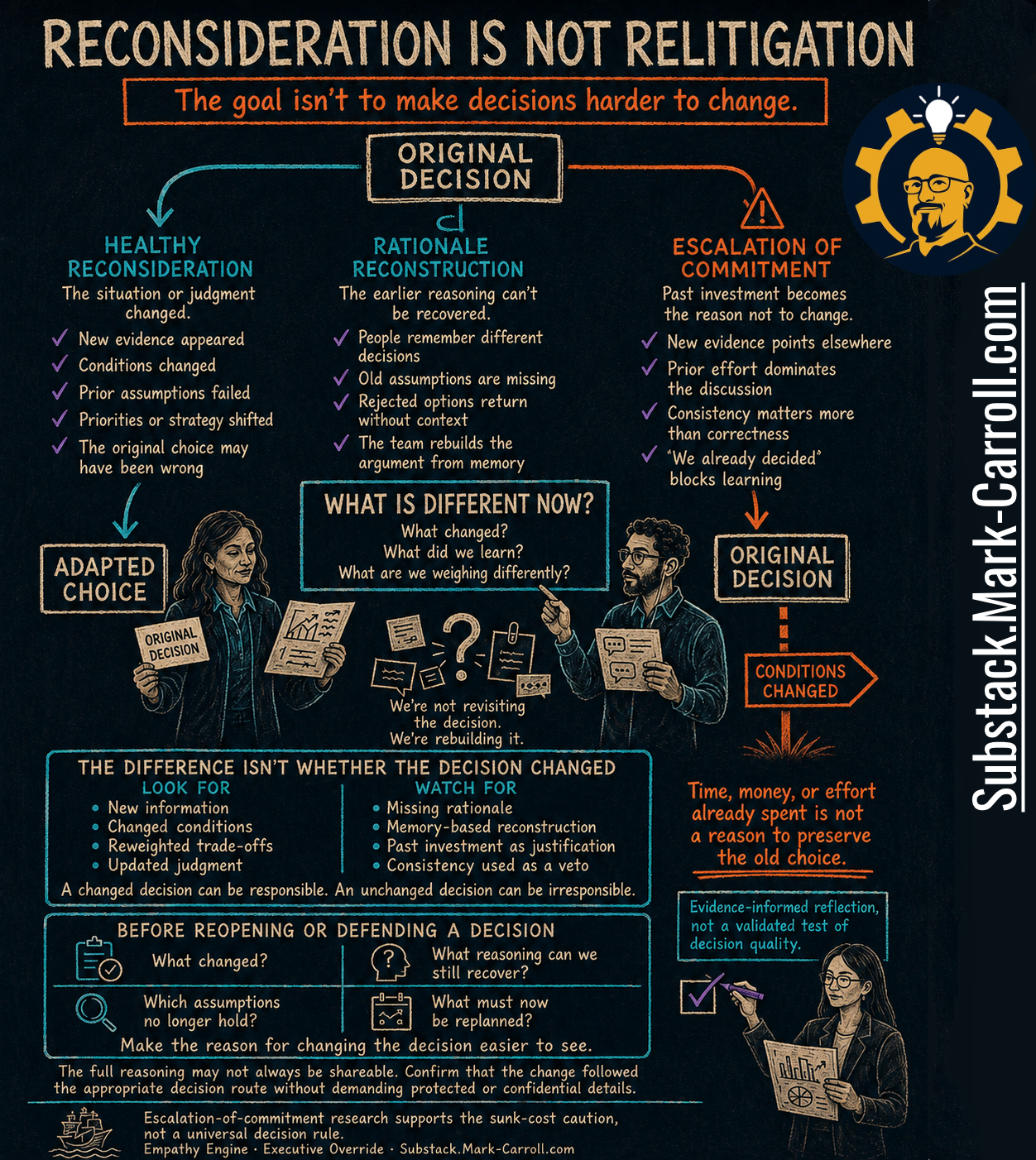
The goal was never to make decisions harder to change. Healthy reconsideration is real: new evidence appeared, conditions changed, prior assumptions failed, priorities or strategy shifted, or the original choice may simply have been wrong. Any of those can justify reconsidering the choice openly.
Relitigation dressed as diligence looks different: the earlier reasoning can’t be recovered, people remember different decisions, old assumptions are missing, rejected options resurface without their original context, and the team quietly rebuilds the argument from memory instead of revisiting the actual record. And on the far end of the same spectrum sits its opposite failure, escalation of commitment, where past investment becomes the reason not to change even after new evidence points elsewhere, where prior effort dominates the discussion, where consistency starts to matter more than correctness, and where “we already decided this” gets used to block learning rather than protect it.
I watched a team keep defending a roadmap initiative because we had already spent months designing, staffing, and socializing it, even after customer evidence had moved in another direction. The turning point came when I realized we were no longer arguing that it was the best choice. We were arguing that abandoning it would make the prior work feel wasted.
The first useful question is why the decision changed. Look for new information, changed conditions, reweighted trade-offs, and updated judgment. Watch for missing rationale, memory-based reconstruction, past investment used as justification, and consistency used as a veto. A changed decision can be responsible. An unchanged decision can be irresponsible. Before reopening or defending a decision, ask what changed, what reasoning can still be recovered, which assumptions no longer hold, and what now has to be replanned. Reconsideration is not relitigation. The goal isn’t to make decisions harder to change.
Replan the Future. Don’t Defend the Past.
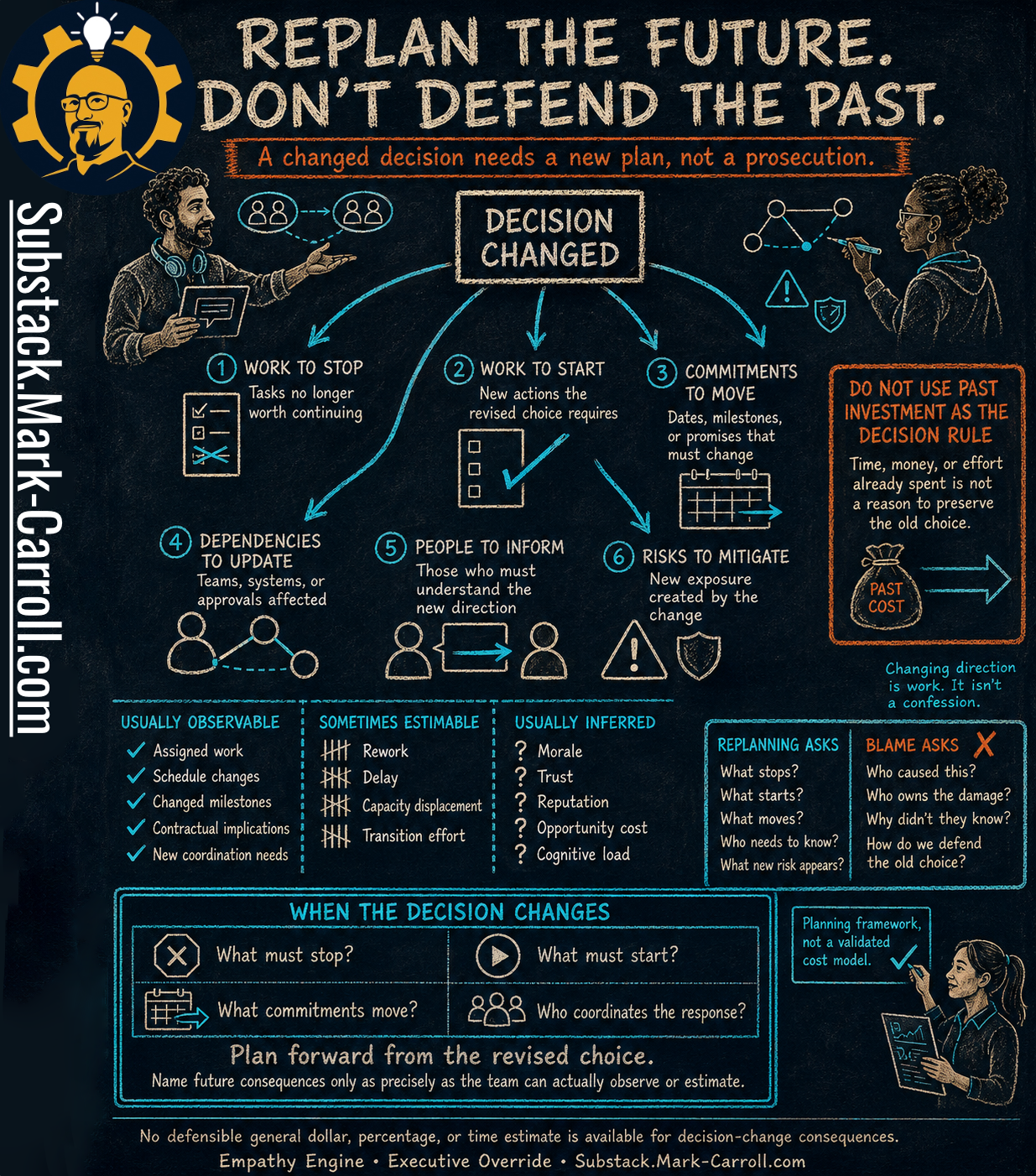
Say reconsideration passes that test and the decision actually does change. The next mistake is treating that moment as a trial instead of a plan. A changed decision needs a new plan, not a prosecution.
Six things typically need attention once a decision changes: the work to stop, the work to start, the commitments that have to move, the dependencies that need updating, the people who need to be informed, and the new risks that need mitigating.
Some of the consequences are usually observable directly: assigned work, schedule changes, changed milestones, contractual implications, new coordination needs. Others are only sometimes estimable: rework, delay, capacity displacement, transition effort. Others are usually inferred rather than measured, morale, trust, reputation, opportunity cost, cognitive load, and shouldn’t be asserted as hard numbers they aren’t. No defensible general dollar, percentage, or time estimate exists for what a changed decision costs; any precise figure would depend on the specific work, organization, and counterfactual.
What should never enter the conversation is past investment as the decision rule. Time, money, or effort already spent is not a reason to preserve the old choice. Replan the future. Don’t defend the past. Changing direction is work.
It isn’t a confession.
🖊 What Holds Up Under Pressure
Primary claim label: Evidence, unevenly distributed across the four conditions / Design inference for the sequence as an integrated tool
Basis: The four conditions don’t rest on the same strength of evidence, and treating them as equally supported would overstate the case.
Reasoning: strongest direct support. The Karsenty 1996 aerospace study is a real, if narrow, measurement of how much design rationale survives in a captured record.
Status and closure: moderate support. Organizational memory research, going back to Walsh and Ungson, treats an organization’s memory for why it decided something as fragmented and dependent on active preservation, which supports treating closure, documentation, commitment, and execution as meaningfully different conditions, without validating one universal six-stage sequence.
Route: most interpretive. Role ambiguity has a real, moderate negative association with performance, but role conflict’s association is weak and inconsistent enough that it shouldn’t be presented as a settled finding, and none of this literature validates a practical-authority-mismatch construct on its own. What it does support is caution in the other direction: two independent meta-analyses find shared leadership positively associated with team effectiveness, real counterevidence against treating every non-unilateral decision as suspect.
Revision: established caution, synthesized taxonomy. Escalation of commitment, the tendency to keep defending a losing course of action because of what’s already been invested, is a long-established finding in behavioral decision research, though the direct evidence traces to a 1976 laboratory study with a mixed replication record since. The three-way split between healthy reconsideration, rationale reconstruction, and escalation of commitment is this series’ own synthesis. It hasn’t been independently validated as a taxonomy.
Counterpoint: None of these literatures were built to validate this specific four-question sequence as an integrated instrument, and no controlled study has tested whether running a decision through Status, Reasoning, Route, and Revision changes downstream outcomes, latency, or rework. The Karsenty figures come from one nine-month aerospace project audited once in 1996; treat the 41/59 split as illustrative of a failure pattern rather than a rate to expect elsewhere. Route remains the weakest link: role theory only partly explains why declared and actual authority diverge, and the shared-leadership evidence is correlational; it doesn’t prove that any specific shared-authority arrangement is healthy.
Limitation: Treat all four conditions as an evidence-informed reflective guide. They aren’t a validated diagnostic instrument. It can name where clarity broke down. It cannot certify that a decision was correct, prove bad faith, or substitute for whatever formal review, HR process, or protected reporting channel a given situation actually requires. Four domains, financial controls, board and fiduciary matters, collective bargaining and works councils, and clinical decisions, are excluded here as a matter of precaution rather than because any direct authority was checked in this research.
🎒 The Move: The Decision Reflection Card
I built the Decision Reflection Card after watching a decision survive every artifact I had created for it and still fail when the room had to explain it later. The paperwork held, but the status, reasoning, route, and revision did not, so the answer was not another template. It was four questions.
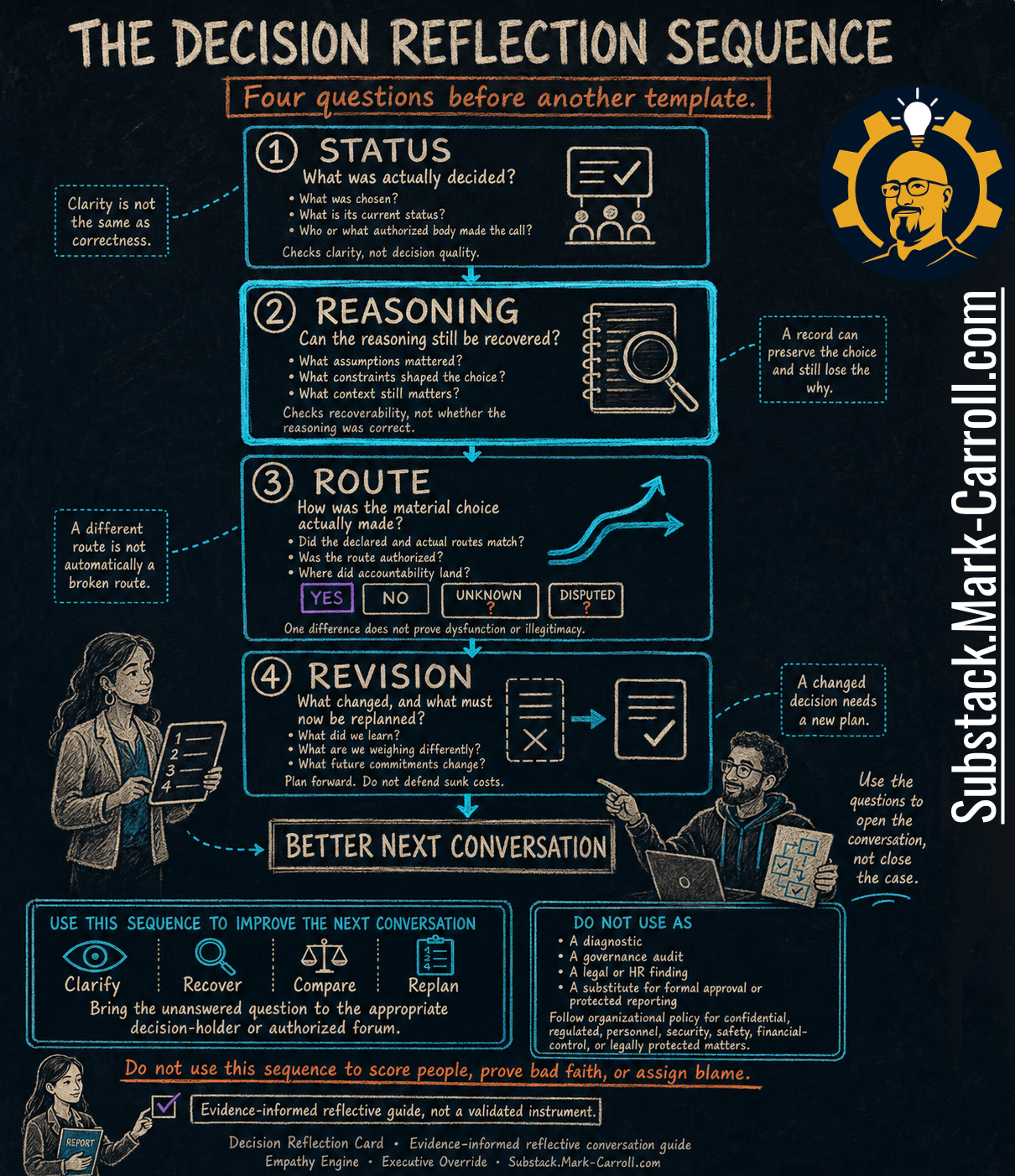
The four conditions above form one tool, run together, in order: the Decision Reflection Sequence.
Orienting sentence: When a decision that looked settled comes apart later, run it through four questions in order (status, reasoning, route, revision) before writing a single new form.
Step 1: Status. What was actually decided? Confirm what was chosen, its current status, and who or what authorized body made the call. This checks clarity, not decision quality. Clarity is not the same as correctness.
Step 2: Reasoning. Can the reasoning still be recovered? Ask what assumptions mattered, what constraints shaped the choice, and what context still matters now. This checks recoverability, not whether the original reasoning was right.
Step 3: Route. How was the material choice actually made? Ask whether the declared and actual routes matched, whether the actual route was authorized, and where accountability landed. Answer in a sentence, not yes or no alone: matched, differed, unknown, or disputed. “Unknown” is a complete and expected answer when the route isn’t visible from where you sit, not a sign that something was hidden. Don’t draw a conclusion from one vantage point alone; where only one perspective is available, the answer stays unknown or partial. One difference does not prove dysfunction or illegitimacy.
Step 4: Revision. What changed, and what must now be replanned? Ask what was learned, what’s being weighed differently, and which future commitments change as a result. What’s already been spent in time, money, or effort is excluded from this question entirely; it may be worth understanding separately, but it isn’t a reason to continue or stop. A change in judgment or priorities is a complete answer on its own, no new fact required. Plan forward. Do not defend sunk costs.
Constraint: Use the sequence to open the conversation, not to close the case. It exists to get an unanswered question in front of the right decision-holder or authorized forum, not to score people, prove bad faith, or assign blame on its own.
Done state: All four questions have an answer, or an explicit “unknown” where the answer genuinely can’t be recovered, and the result leads to a better next conversation with the actual decision-holder rather than a verdict delivered without one.
Limitation: The Decision Reflection Card cannot supply missing decision rights, prove that deliberation actually occurred, or substitute for formal approval, a governance audit, or a protected reporting channel. It is an evidence-informed reflective guide. It hasn’t been validated as an instrument, and it hasn’t been tested with a practitioner yet. Keep any notes from it in your organization’s own sanctioned system, never a personal device, a personal account, or an outside tool.
🛑 Do Not Use When
As a diagnostic, a governance audit, or a legal or HR finding. The sequence surfaces an unanswered question. It doesn’t adjudicate one.
As a substitute for formal approval or protected reporting. Not at all if the matter involves whistleblowing or protected reporting of any kind: use your organization’s or regulator’s designated channel instead, never this card, and never as a step before it. Not at all if the matter is or may become part of litigation, an investigation, an audit, or a legal hold, involves classified information, or carries a retaliation concern. Follow your organization’s actual policy for confidential, regulated, personnel, security, safety, financial-control, or legally protected matters. The card defers to those processes; it doesn’t replace them.
To score people, prove bad faith, or assign blame. The card is not designed for that purpose.
This Week
3 actions for the product lead (the one who runs the reflection rather than rendering the verdict):
Before adding a fifth template to any decision that unraveled, run it through the four-question sequence first, status, reasoning, route, revision, as a conversation opener rather than a finding, and never for anything that belongs in a protected reporting channel.
Where the answer to any question is genuinely unknown, say “unknown” rather than guessing, and take that specific gap to the person or forum that can actually close it.
If a decision did change, spend the next conversation on what stops, starts, and moves, rather than relitigating whether it should have changed at all.
1 action for the leader in the room (whoever holds the authority the route question is actually testing): Say out loud how the choice was actually made, and whether any difference from the declared route was recognized or authorized. “I don’t know” and “I can’t say, it’s confidential” are both complete answers; the point is to stop the gap from being filled by inference.
1 action to improve decision traceability today (whoever keeps the record): Pick one existing decision record and run the Minimum Useful Decision Record test against it: could someone find it, understand why, still find the context useful later, and maintain it. Add only what that test says is missing. This is one I use myself now, and one I wish I had learned earlier: document only enough for someone outside the original room to find the decision, recover what still matters, and know when it should be revisited.
Decision Reflection Card Field Kit
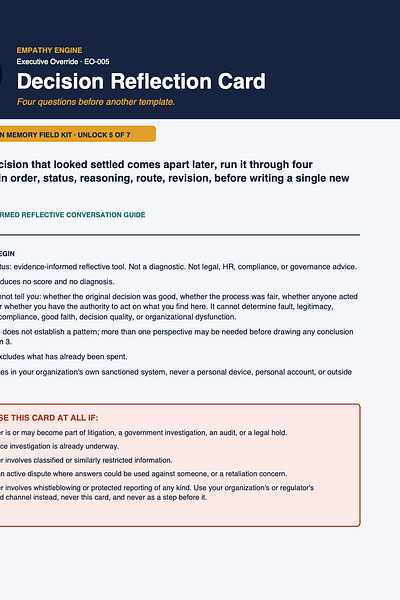
The Decision Reflection Card is the fifth unlock in the free seven-part Decision Memory Field Kit. It combines the closure chain, minimum-useful-record guidance, declared-versus-actual route caution, and reconsideration prompts into one reflective sequence for finding where clarity stopped holding. It is designed to open the next conversation with the right decision-holder, not close the case on its own.
📎 Forward This
A decision can pass every documentation tool you own and still not hold. Before writing a new template, ask four questions instead: was it closed, is the reasoning recoverable, was the route authorized, and was the change reconsidered or relitigated.
Next week, Executive Override moves from diagnosing why decisions come apart to the moment Sales calls a tradeoff a deal breaker. EO-006 introduces the Saying No Armor Pack, concrete language for separating demand from evidence, naming the tradeoff, and documenting the exception or the refusal.

That same operating belief sits at the heart of my upcoming book, Collaborate Better. Better collaboration isn’t louder agreement; it’s the discipline of making tradeoffs, ownership, and next steps visible enough for people to move together. Learn more at CollaborateBetter.us.
⬅ Closing
The meeting happened. The recap went out. The role chart existed. The decision may even have been real.
Clarity still failed to stick, because one part of it didn’t travel with the others. Its status got remembered differently by different people. Its reasoning couldn’t be recovered. Its actual route stayed invisible. Or the plan never changed when the decision did.
The template was never the problem. The unasked question was.
Find out which one before you build a fifth.
Regards,
Mark 👋
Previous:

More Content to Discover:

Half Your Team Is Using AI. You Don't Know Which Half.

Intro If you read the piece we published last week on Leadership in Change, you saw the structural diagnosis: mandate pressure, decision collapse, intake collapse. Three failures that sit underneath almost every AI pilot that goes sideways. That piece mapped the architecture. What it did not cover is what happens on the human side of the same problem, wh…

The most dangerous decision isn’t always the one that changes. Sometimes it’s the one everyone keeps defending because the paperwork says it already survived. Which of the four breaks first in real organizations: status, reasoning, route, or revision?