


👋 Welcome to this week’s edition of Empathy Engine. Every Wednesday, I publish a new article for paid subscribers first, then unlock the full piece for everyone late Thursday morning. Each week, I turn product leadership friction into practical tools, sharper language, and more defensible decisions.
Research Binder: the receipts (citations + source notes) are compiled in a PDF at the bottom of this post.
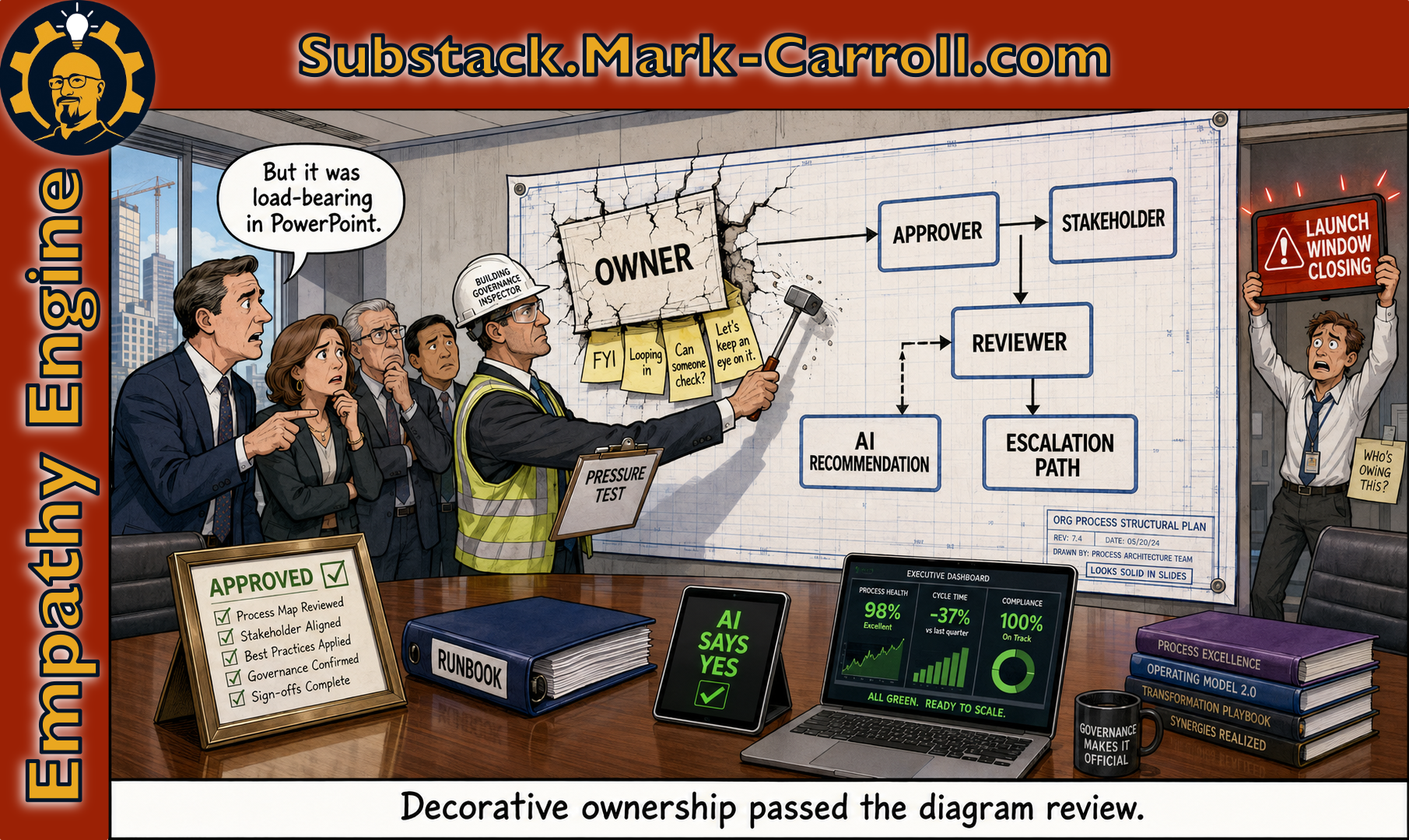
The alert fired ninety minutes before the launch window closed. Not a vague warning, not the kind of message that can be parked until tomorrow’s standup. A real signal. The kind that changes the air in the room even when the room is a distributed channel and a few people pretending their heart rate did not just move.
The incident channel lit up first. Someone dropped in the alert, someone else pasted the dashboard, a third person started typing a theory. That is where a lot of routes fail, not because people are lazy or the team lacks process, but because everyone sees the signal and no one owns the next move. In Episode 1, that exact gap let a warning age in a channel for fourteen days.
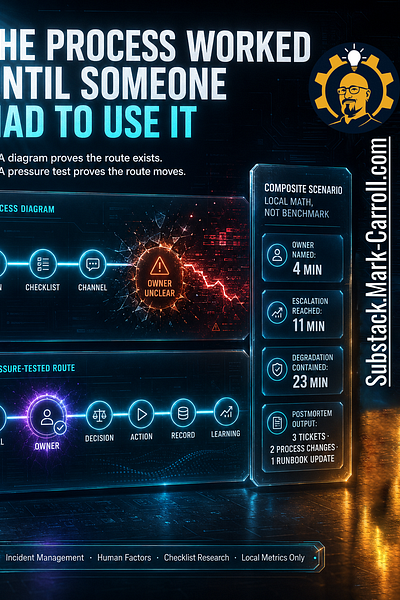
This time it did not happen. Four minutes after the alert, the owner was named. Not “someone should look at this,” not “engineering is checking,” not “let’s keep an eye on it.” A named person had the next move and the authority to make it. Somebody caught the baton, and said so out loud. Seven minutes after that, escalation reached the right stakeholder. Twenty-three minutes after the alert, the degradation was contained before the window closed.
The postmortem did not begin with forensic archaeology. The living record already had the route: owner named, escalation reached, decision made, action taken. It produced three tickets, two process changes, and one runbook update.
Those numbers are not benchmarks. They are composite scenario details; do not copy them into your model and call them a standard. The point is not the four minutes. It is that this team did not need calm in order to function. The route had been built before pressure arrived.
A diagram proves a route exists. A pressure test proves it moves.
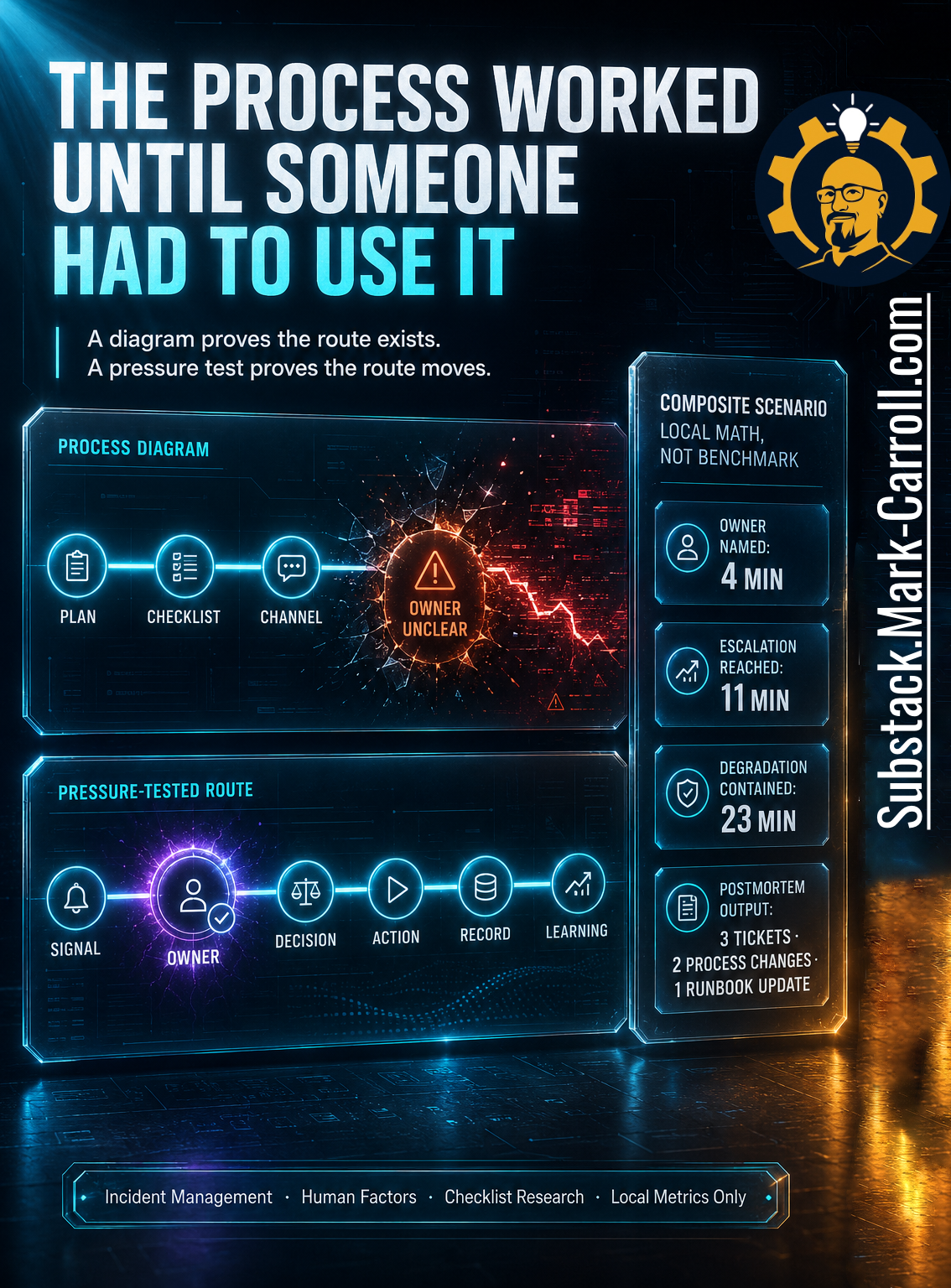
Many teams only discover the weakness in their operating model during pressure, not during planning. The dashboard looked fine, the runbook existed, the checklist was approved, and the AI recommendation looked confident. Then the route had to move. That is the moment process theater separates from operational reality.
This is the sixth and final episode of Route Rebuilder Season 1. The first five were failure modes: the route that buried bad news, made ownership optional, trained override behavior, confused speed with progress, and outsourced judgment to the tool. This one is the route that survived, not because it was perfect, but because it had the three properties most operating routes only claim to have.
Everything else flows from those three. The route model and the Pressure-Test Checklist are practitioner tools. They are not validated diagnostics, compliance frameworks, or resilience certifications, and they do not guarantee outcomes. They help a team ask better questions before pressure exposes the gap. In most organizations, that alone would be an improvement.
If You’re Skimming
A route that survives pressure has three properties: named ownership at the handoff, a decision tool usable under load, and a living record that exists before the postmortem.
Season 1’s five broken routes each failed one or more. This one passed all three, and not by accident.
The difference is not headcount or talent. It is whether ownership can bear load.
The Pressure-Test Checklist (digital product) turns the three properties into a twelve-check pre-flight.
Run it on your next event. Circle what is not yet true. That is your first repair.
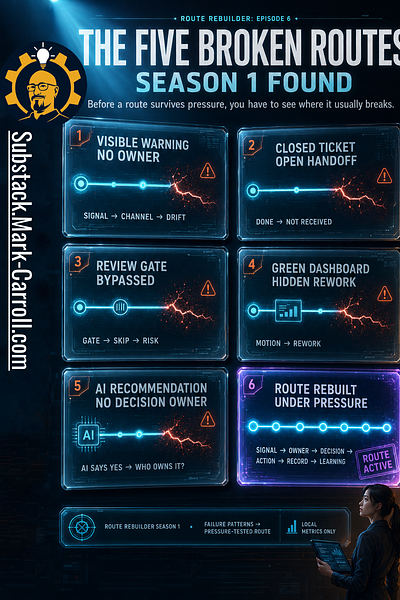
The Five Broken Routes Season 1 Found
Season 1 kept finding the same problem wearing different clothes: a signal existed, but the route did not move.
Episode 1 Parts A and B:


Episode 2:

In Episode 1, the warning was visible and the route buried it anyway. People saw enough to be concerned and still had no clean next move. In Episode 2, the handoff happened without a receiver. The ticket moved and the work looked complete, but responsibility did not transfer. The route treated closed as owned. In Episode 3, the review gate existed and everyone knew how to route around it. The formal process looked healthy while the behavior taught the opposite lesson. The organization did not remove the gate. It trained the bypass. In Episode 4, the dashboard was green, and that was the problem. The visible numbers showed motion while the hidden route carried rework. In Episode 5, the tool said yes. The decision looked easier, and no one owned the judgment. A recommendation is an input. A decision is owned.
Episode 3:

Episode 4:

Episode 5:

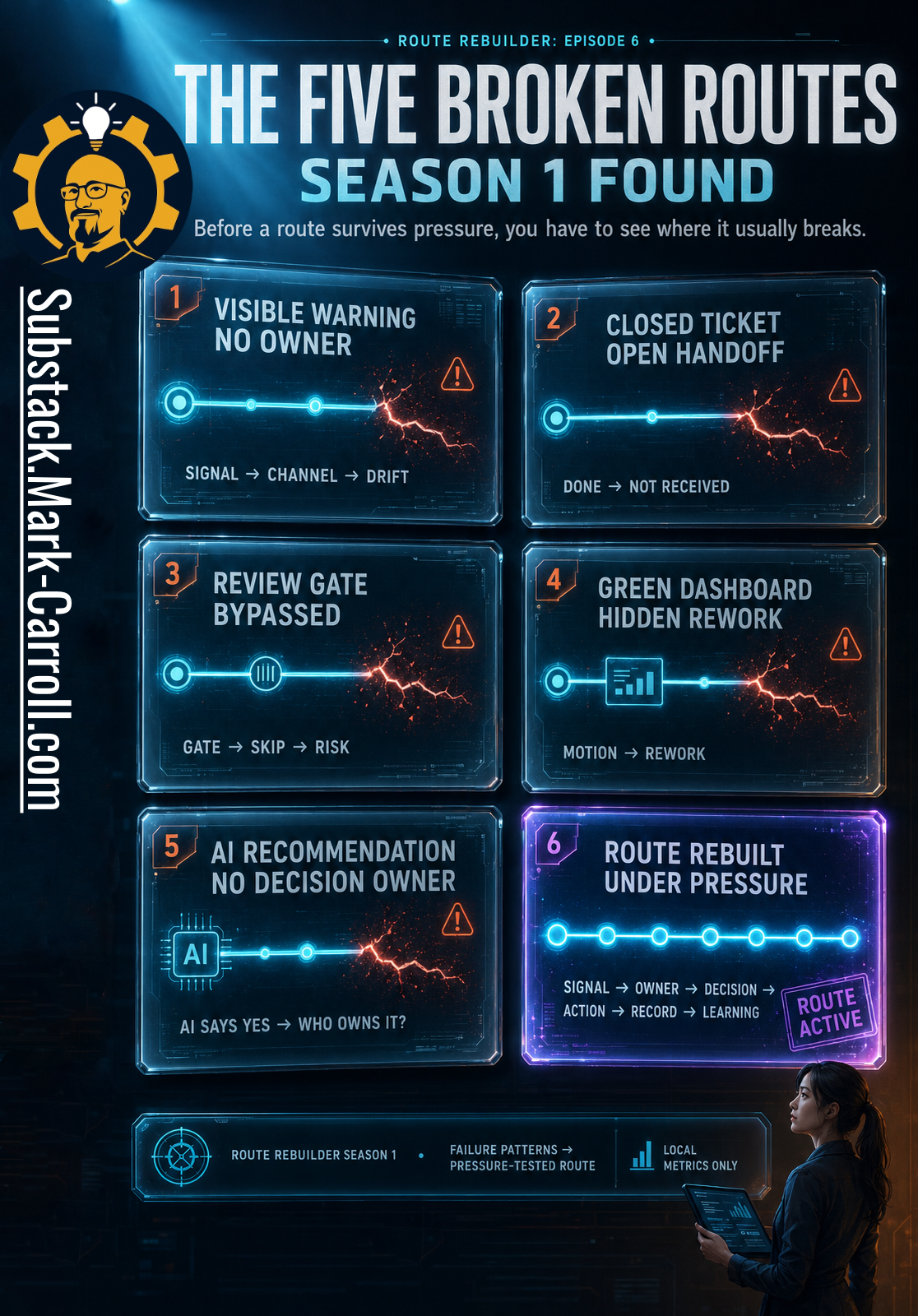
Five episodes, five broken routes, each one exposing a place where signal, handoff, gate, metric, or recommendation failed to become owned action. Episode 6 is the constructive turn. The question is no longer where the route broke. It is what the route looks like when it holds. The working route does not fix those five by adding ceremony. It fixes them by making the next move unmistakable, and that starts before the runbook or the postmortem. It starts when a person owns the next move.
MTTO: Mean Time to Ownership
Most teams measure how long it takes to resolve an incident. Fewer measure how long before it becomes owned. That gap matters, because a warning can be visible for hours, days, or weeks without becoming routed.
Visibility is not ownership. Acknowledgment is not ownership. Neither is a comment thread, a meeting mention, or a reaction. The route starts when someone has the next move and the authority to make it. That is why I treat Mean Time to Ownership as a useful local lens: the interval from a signal becoming visible to a named owner with authority claiming it.
MTTO is not a perfect metric, and it should not become another surveillance device. Used badly, it ranks responders for working inside a route the organization designed poorly. Used well, it asks a better question: how long does ownership take to form after a signal appears? Track the route, not the person. If an issue drifted for fourteen days before someone owned it, the team may not have a responsiveness problem but a route problem: unclear intake, visibility without authority, or everyone assuming the warning belonged to someone else.
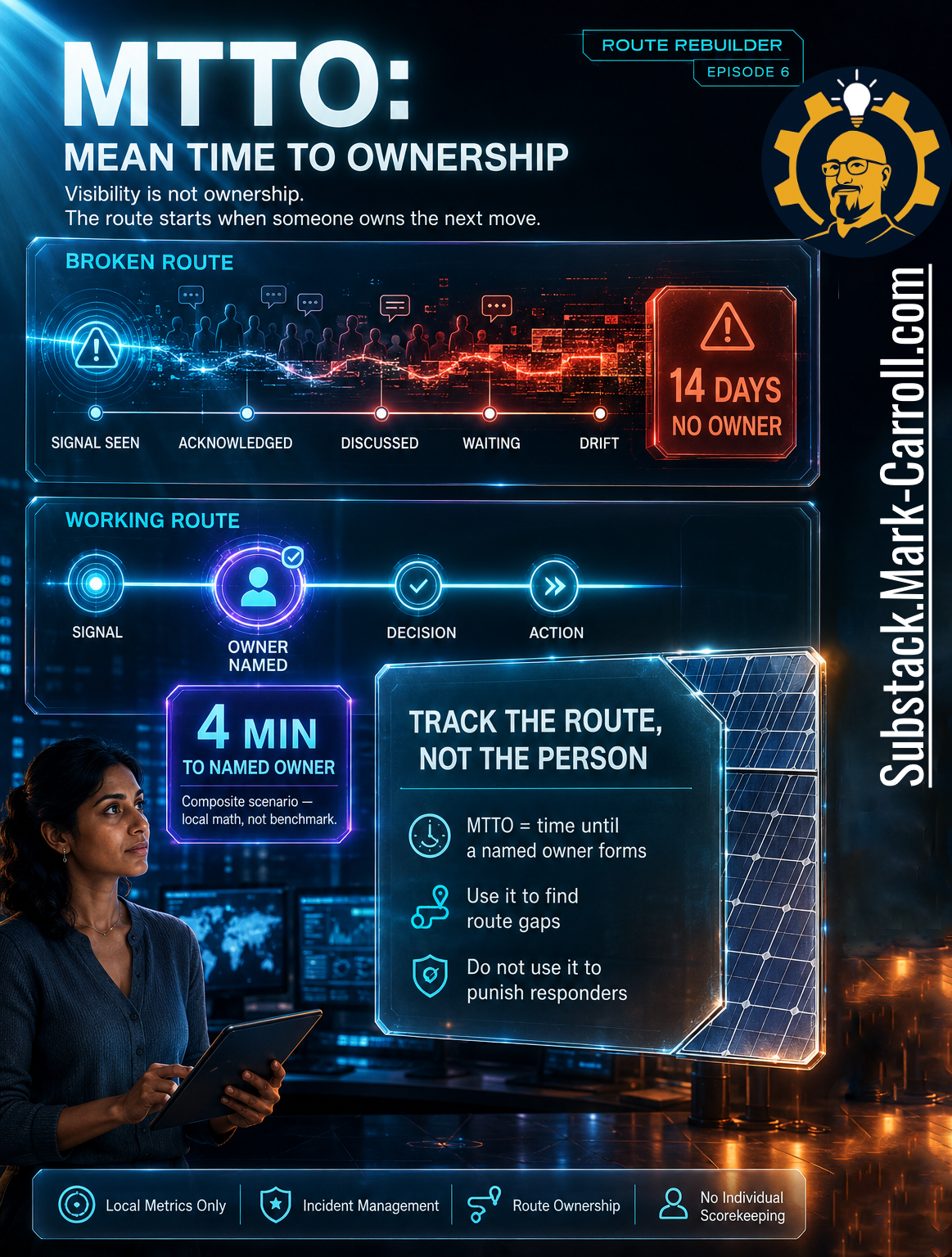
MTTO does not solve that by itself. It makes the drift visible, because most broken routes hide in polite ambiguity. “We were looking into it.” “Everyone knew it was a concern.” Those sentences can sound responsible. They can also describe a route with no owner.
This is the difference the whole season has circled. Every broken route had ownership on paper: a name in the assignee field, a box on the diagram, a reaction under the warning. What none of them had was ownership that could carry weight when the load arrived. Call the working version load-bearing ownership: a named person, with real authority, who has said the next move is theirs and can be seen saying it. Decorative ownership looks identical right up until pressure hits, and then it does what decoration does. It stays where it is while the work moves on without it.
I have absolutely made this mistake as a coach: I improved visibility and mistook it for ownership. Cleaner Azure DevOps boards, sharper ceremonies, better blocker language, more consistent reporting: all useful, all defensible, and all capable of making an unowned decision easier to admire. The system got better at showing where the work was stuck, but it still did not always name the person with authority to unstick it. That is when I learned that a better-lit room around the same missing owner is still a missing owner.
A Checklist Is Not a Route
A checklist sitting in a runbook is not readiness. A launch checklist nobody opens when the alert fires is not readiness. A tool only matters if people can use it when the room gets loud.
This is where organizations confuse possession with capability. They have the checklist, the escalation path, the template, the runbook. Good. Now ask the operating question: where is it when the alert fires? Who is expected to use it? Is it short enough to use under pressure? Does it survive the first person who says, “We do not have time for that right now”? That is the real test. Not whether the tool exists, but whether it still has authority when urgency starts negotiating. Under pressure, people do not rise to the level of the documentation they once approved. They fall to the route they have practiced.
I have skipped tools I believed in, including tools I helped defend. That is not my favorite professional confession, but it is a useful one. Under pressure, the bypass is not always a discipline failure; sometimes it is a design verdict. If a checklist only works when the room is calm, the checklist was built for the meeting where we approved it, not the moment where we needed it.
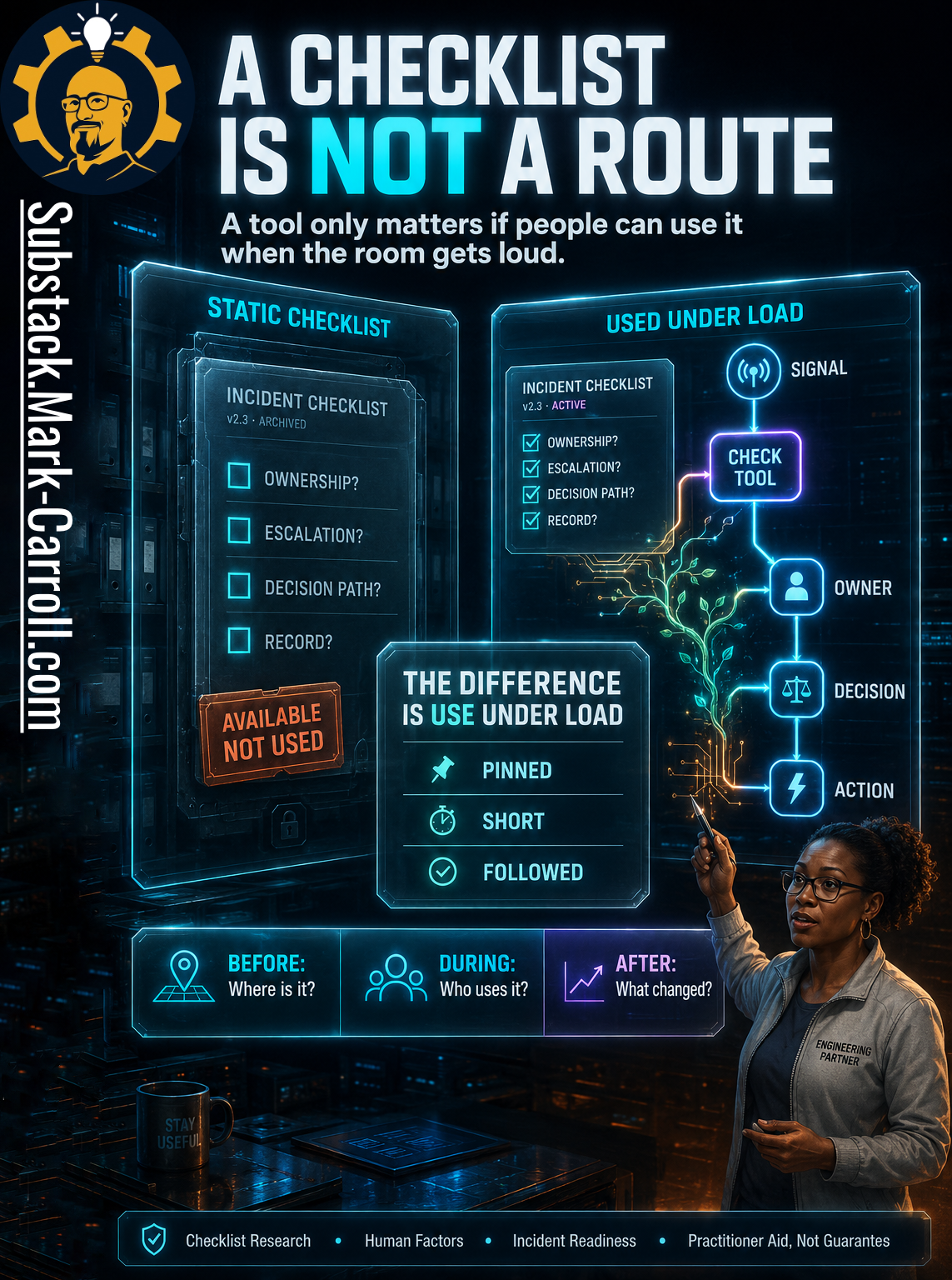
A route-ready decision aid has a different job. It does not contain everything. It preserves the next move. Pinned. Short. Followed. In the launch scene, the decision aid worked under load because it had been rehearsed in a table-top exercise before the window opened, so running it was muscle memory rather than a first read.
The danger is over-claiming. Checklists and cognitive aids can support consistency, reduce missed steps, and help teams act under pressure. No checklist prevents incidents, certifies readiness, or replaces practice, judgment, or escalation. A checklist can become part of a route: if it sits outside the work, it is documentation; if it shapes the next move under load, it is operational.
The Living Record Starts Before the Postmortem
If the record begins after the incident, the team is already reconstructing. That is when the postmortem becomes archaeology. People search the channel, scroll timestamps, and debate whether the decision changed before or after the stakeholder joined. Often they produce a version that is socially survivable and operationally incomplete. Memory under pressure is not a logging system.
I have been in postmortems where the room was blameless, respectful, and still not quite honest. Not dishonest in a malicious way. Just human. Without a living record, the room negotiated a version of events everyone could survive: communication was messy, the handoff was unclear, the timing was unfortunate. The harder truth was that no one could prove when ownership formed, when the decision changed, or why the route stalled, so the learning came out softer than the failure that produced it.
A living record changes the work: the route needs to remember while it is moving. The record is not the paperwork. The record is the route remembering. During the event, the team captures the minimum useful truth: who owns the next move, what decision was made and why, when escalation happened, and what needs updating after.
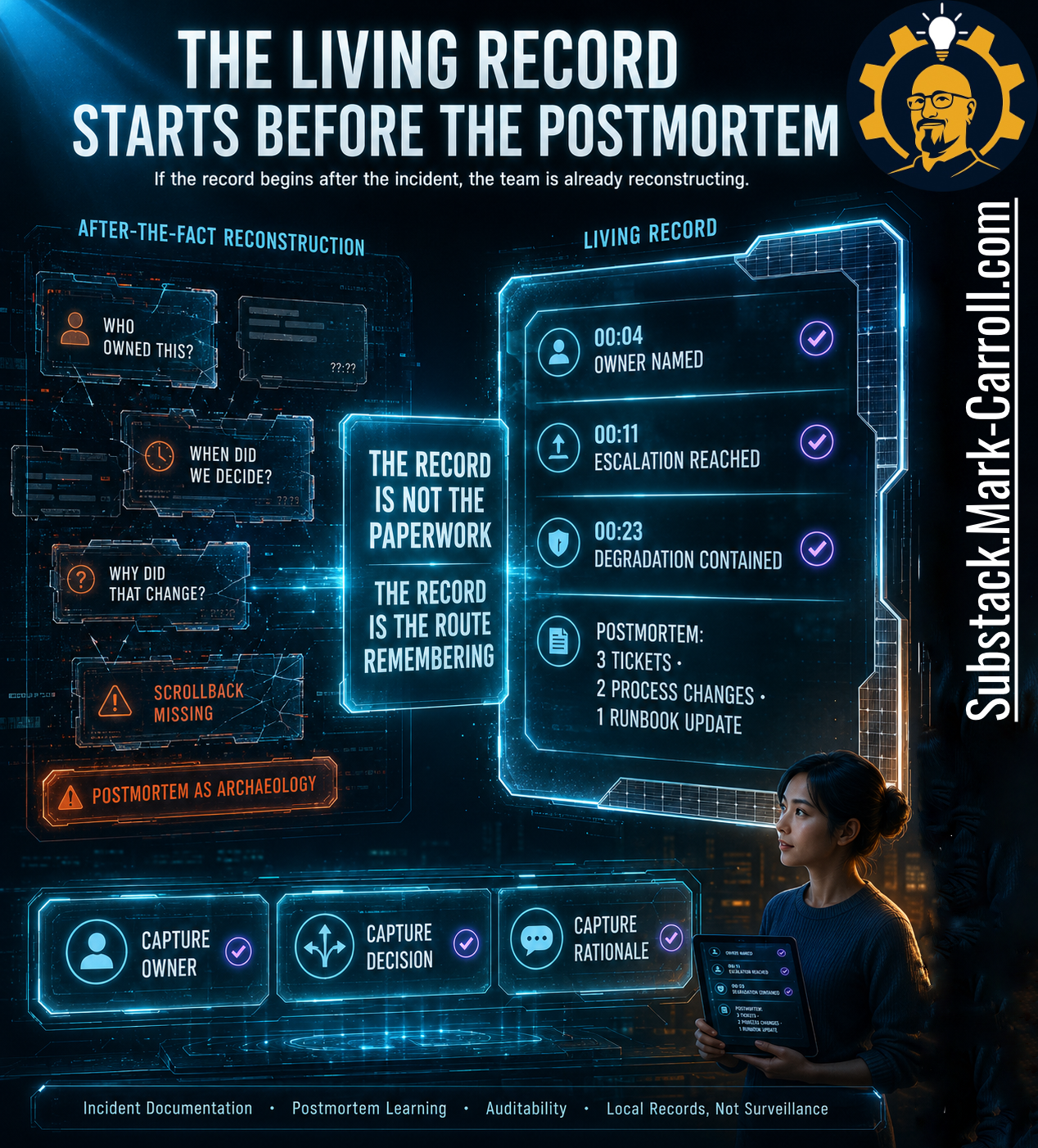
That is not bureaucracy. It is future visibility. It makes the postmortem less theatrical: the team does not perform memory. It examines the route instead of relitigating the people.
This only works if the record is politically safe. If it becomes a blame weapon, people sanitize it and stop writing the truth the route needs. A route-focused record asks where ownership formed and where it stalled. A blame record asks who to attach to the failure. Those are different questions, and they build different organizations. In the launch scene, the postmortem produced three tickets, two process changes, and one runbook update because the record already existed. It was not starting from fog, which let the learning be specific. Not “communicate better.” A ticket, a process change, a runbook update.
The Local Cost of Drift
The expensive part is not always the incident. Sometimes it is everything no one owned afterward: the issue that waited in a channel, the meeting where everyone discussed it and no one took it, the rework from a decision that was never really made, and the incident that repeated because it was never repaired.
I am careful with financial claims. It is tempting to borrow large industry numbers. They create drama and false precision. Your route does not need someone else’s benchmark to prove drift has a cost. No borrowed benchmarks. Use your own logs, your own calendar, your own rework.
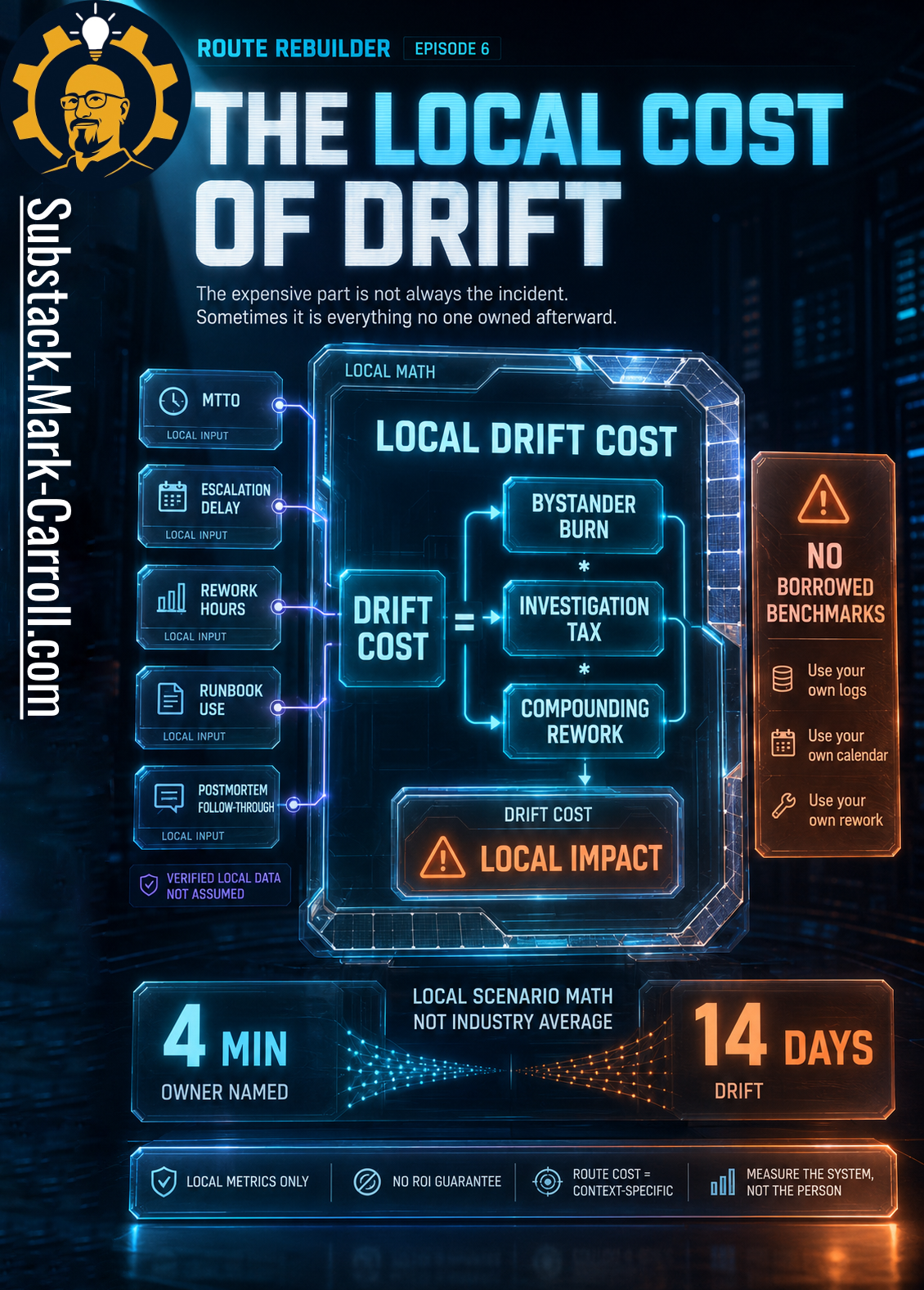
A useful local formula: drift cost equals bystander burn plus investigation tax plus compounding rework. Bystander burn is the energy spent watching an issue no one owns. Investigation tax is the time reconstructing what the route should have captured. Compounding rework is the cleanup an ambiguous decision keeps spawning. Feed it with inputs you already have: MTTO, escalation delay, rework hours, runbook use, postmortem follow-through. The output is a local impact number, not an industry average and not an ROI guarantee.
I have learned to distrust the phrase “let’s wait and see” when nobody names who owns the waiting. Waiting can be prudent, but unowned waiting is just drift wearing a reasonable outfit. The cost rarely arrives as one dramatic line item. It shows up as calendar tax, rework, stakeholder churn, and people outside the original room paying for a decision they never got to make.
Drift hides inside normal work: a half-hour here, a reopened ticket there, a second meeting. No single item looks expensive. Together they are the cost of a route that does not move cleanly. Measure the system, not the person. The moment people believe a metric exists to punish them, they manage the metric instead of improving the route. Local metrics should make the system more honest, not more afraid. This matters everywhere, and especially in AI-assisted workflows, because AI can make a broken route look clean.
Human-in-the-Loop Only Counts If a Human Owns the Decision
Human-in-the-loop sounds responsible. Sometimes it is. Sometimes it is theater. The difference is ownership.
An AI recommendation can make the route feel modern, fast, and defensible. The model answers, the workflow shows a confidence score, a human reviews, a button gets clicked. Approved. Done. That can look like oversight. It may only be a rubber stamp. An approval click is not oversight if the human cannot say no.
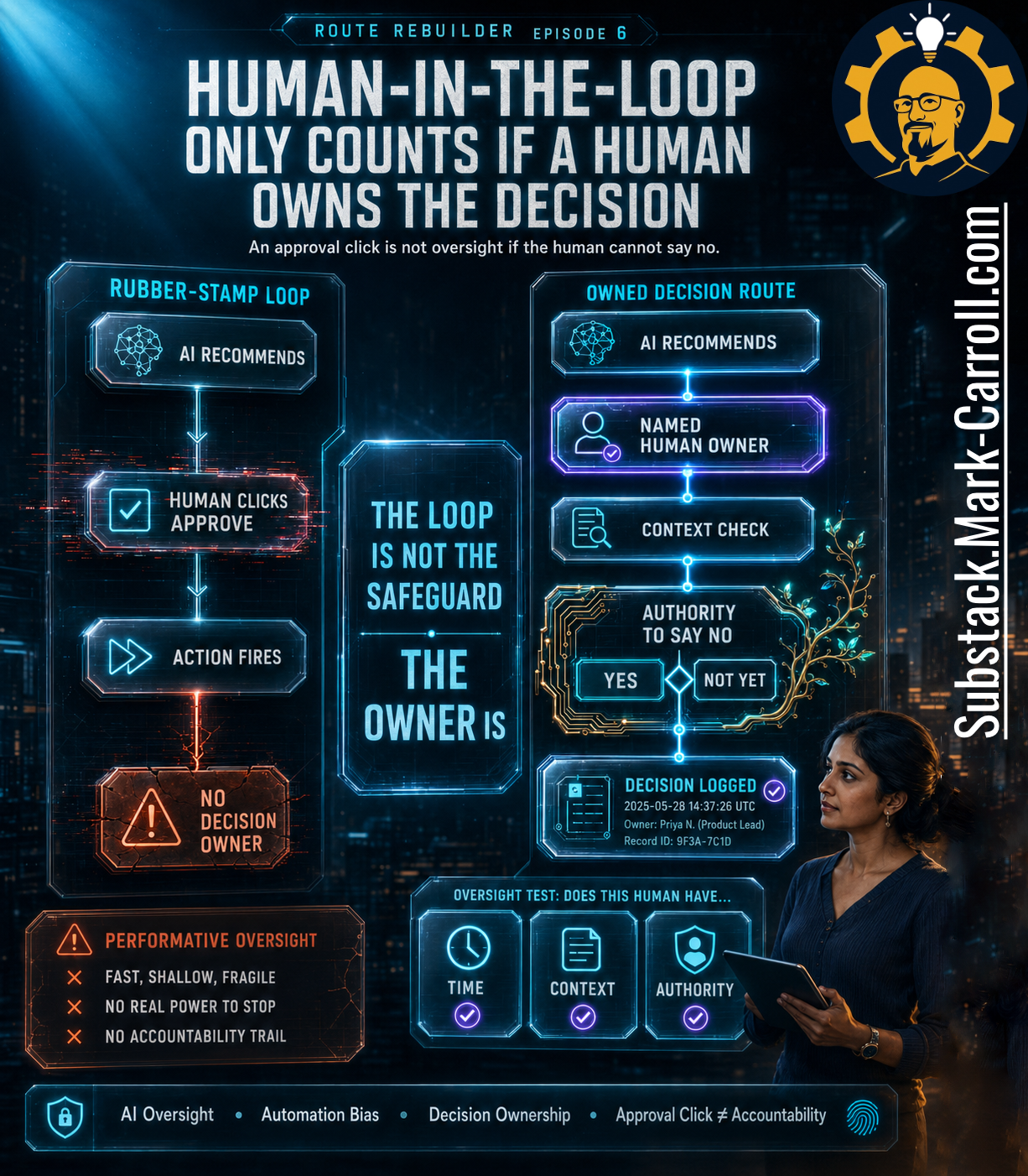
A human-in-the-loop step only counts when the human has enough time to evaluate it, enough context to judge what is at stake, enough authority to say not yet, and enough record to show why. Without those, the route has not created oversight. It has attached a human name to an automated yes. A person was involved. Technically yes. Operationally, maybe not.
I have been fully present for decisions I could not meaningfully stop. That is a strange kind of powerlessness because it looks like inclusion from the outside and feels like decoration from the inside. You can see the risk, understand the context, and still have no real off-ramp except becoming the person who makes the room uncomfortable. That is exactly the gap weak human-in-the-loop workflows can automate: a human close enough to absorb responsibility, but not empowered enough to change the decision.
The rubber-stamp version has a plain name: performative oversight. Fast, shallow, fragile, with no real power to stop and no accountability trail.
The owned decision route runs the same recommendation through a named human owner, a context check, and the authority to say no, then logs the decision with an owner and a timestamp so the yes is real and reconstructable. The test is three questions: does this human have the time, the context, and the authority? If any answer is no, the loop is not the safeguard. The owner is. An approval click is not accountability. For this episode, AI is the bridge, not the center. The center is the route: signal, owner, decision, action, record, learning.
The 12-Check Pressure Test
The Pressure-Test Checklist will not prevent incidents, certify resilience, or do the work for you. Good. That means we can use it honestly. Its one job: help a team notice where the route is weaker than the diagram suggests.
The checklist runs twelve checks across three moments: before pressure, is the route ready? During pressure, is it moving? After pressure, did it learn? One purpose: find the first place the route is pretending.
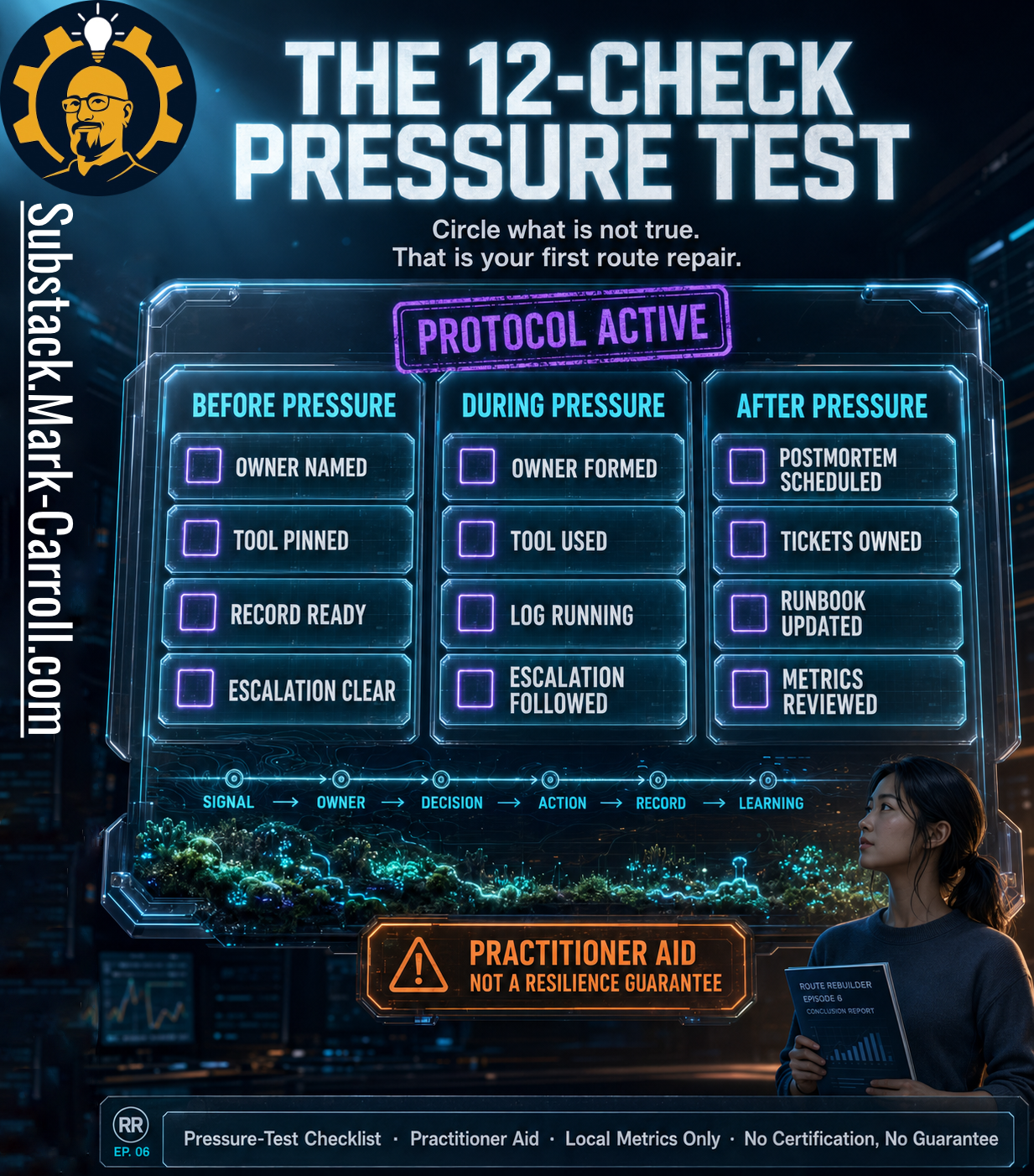
Run it as the Five-Window Field Test. Take your next five high-stakes windows, launches, migrations, deployments, releases, and walk each through the twelve checks before it opens. Circle what is not true. That is your first route repair. If “owner named” is not true, fix ownership before building a bigger dashboard. The checklist is not the answer. It is the mirror: under pressure it shows what the route is really doing, not what flatters the team.
Find here the Pressure-Test Checklist. It captures, in one place, the questions that separated this working route from the five that broke. It asks things like: is a named owner in place, is the tool pinned where the owner will see it, and is the record ready before the window opens? It is a practitioner aid, not a resilience guarantee, and the full set of Route Rebuilder decision tools from the season is here:
The route lens does not stop at the incident channel. The same discipline runs through my book, Collaborate Better. Better collaboration is not softer language or more cheerful meetings. It is making work, ownership, decisions, and durability visible enough for people to act on them together. You can learn more at CollaborateBetter.us.

The Route That Holds
A route that survives pressure is not perfect. It does not eliminate surprise or turn every incident into a clean case study. It does something more modest and more useful. It gives the signal a place to go, ownership a name, the owner a tool, the decision a record, escalation a path, and the postmortem something real to learn from.
That is what held in the launch scene. Not heroics, not vibes, not a brilliant last-minute save. A route. The process worked only because someone could use it. The checklist mattered only because it was followed under load. The record mattered only because it started before memory had to rebuild the story. The human mattered only because the decision was owned.
Season 1 was not really about incidents, dashboards, handoffs, gates, or AI. It was about whether work can move through an organization without losing ownership on the way. Every organizational failure is a routing problem. Every routing problem has a rebuild.
Season 1 is complete. Next Wednesday, Empathy Engine begins Executive Override, a free 7-part field guide for product leads trying to survive executive overrides, sales escalations, and decision relitigation without turning every meeting into process theater.
P.S. Pull the last high-pressure event your team ran and run the three checks in your head. Was there a named owner with authority? Was the decision tool actually used? Did the record exist before the postmortem? Reply and tell me which one was missing. I read every one.
Regards,
Mark 👋
Previous:
The Route That Outsourced Judgment to the Tool

👋 Welcome to this week’s edition of Empathy Engine. Every Wednesday, I publish a new article for paid subscribers first, then unlock the full piece for everyone late Thursday morning. Each week, I turn product leadership friction into practical tools, sharper language, and more defensible decisions.
More Content to Discover:

Half Your Team Is Using AI. You Don't Know Which Half.

Intro If you read the piece we published last week on Leadership in Change, you saw the structural diagnosis: mandate pressure, decision collapse, intake collapse. Three failures that sit underneath almost every AI pilot that goes sideways. That piece mapped the architecture. What it did not cover is what happens on the human side of the same problem, wh…

The process usually looks strongest right before it fails.
A green dashboard, an approved checklist, a polished runbook, or a confident AI recommendation can all make a team feel ready, even when nobody has actually tested whether ownership, escalation, and the living record can move under pressure.
This final Route Rebuilder episode is about the difference between a documented process and a working route, plus the free Pressure-Test Checklist you can use before your next launch, migration, deployment, or incident window exposes the gap.
“Many teams only discover the weakness in their operating model during pressure, not during planning.” I find this line important since problems are noticed when they become obvious.