


Part A: The Orphaned Alert
👋 Welcome to this week’s edition of Empathy Engine. Every Wednesday, I publish a new article for paid subscribers first, then unlock the full piece for everyone late Thursday morning. Each week, I turn product leadership friction into practical tools, sharper language, and more defensible decisions.
Research Binder: the receipts (citations + source notes) are compiled in a PDF at the bottom of this post.
Episode Zero argued that bad news is often buried by a broken route, not by a lack of visibility. This is what that looks like before anyone knows they are inside the failure.

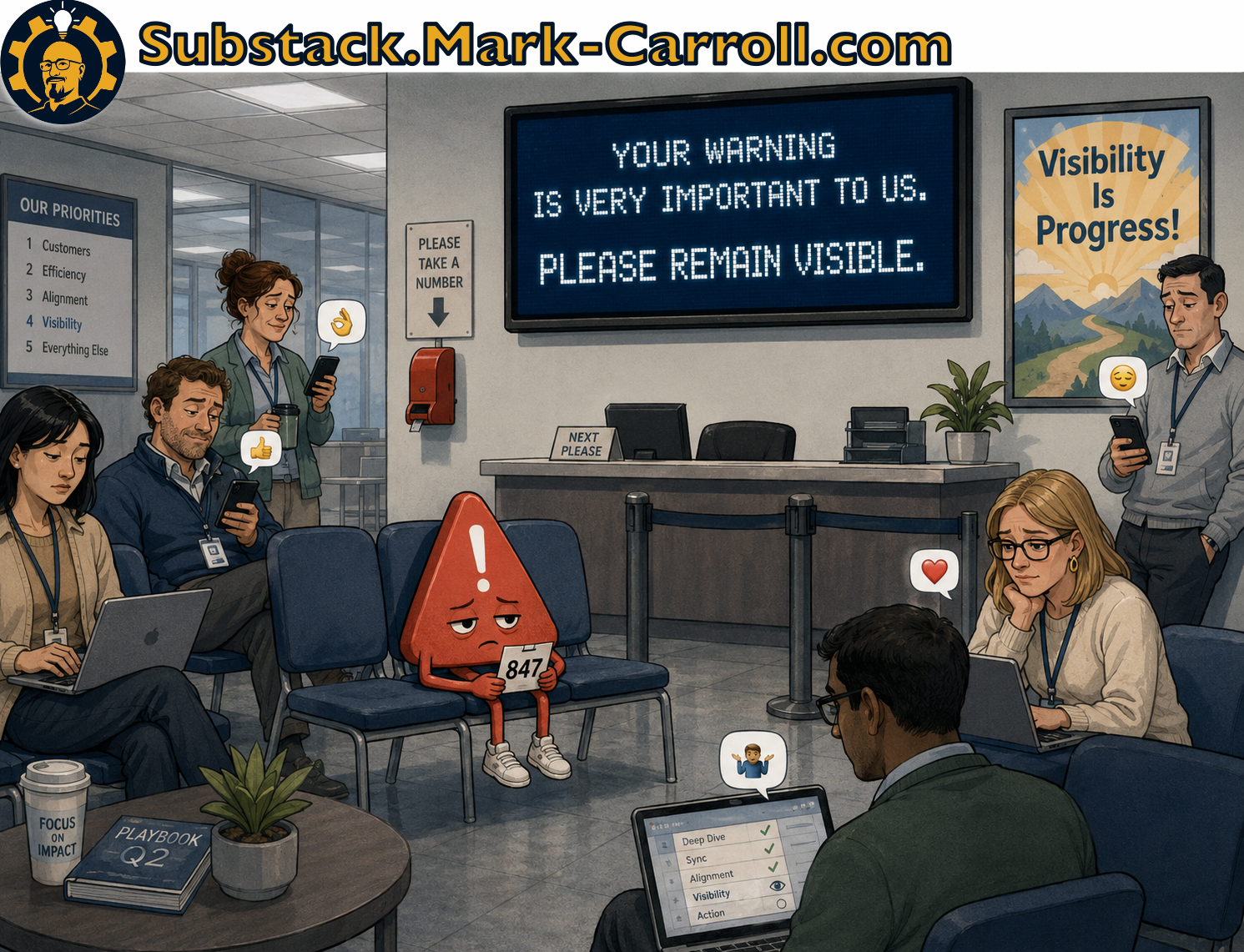
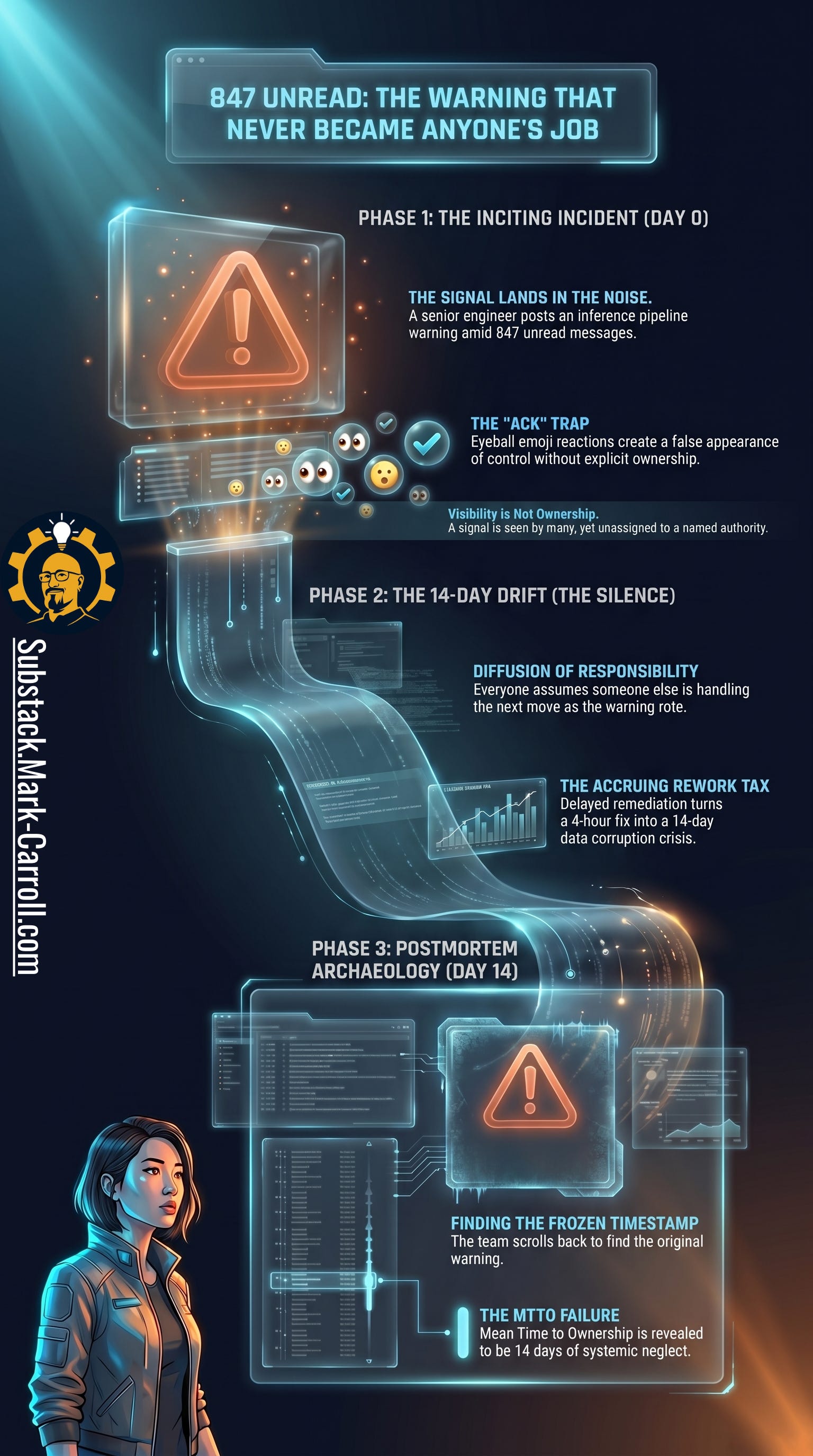
A senior engineer flags an intermittent failure in the inference pipeline. The warning goes into the incident channel, which already has 847 unread messages. Someone reacts, someone says something brief, and the day moves forward. The warning sits in the channel with a timestamp and an emoji, which in many organizations can feel like proof that the system is working.
Fourteen days later, the failure is no longer intermittent.
The team enters the postmortem. Someone shares their screen and scrolls back through the channel. The original warning is right there, with all the clarity that only hindsight provides. The room does not go quiet because nobody saw the signal. The room goes quiet because multiple people saw the signal, and nobody can say when it became someone’s job.
I have had my own version of that moment. In a standup or review, someone would mention a shaky dependency or a flaky environment — significant but not yet urgent. I would hear it, recognize the shape of it, and let the meeting move forward because I was focused on the timebox or the next planning commitment. I was not being careless. I was doing the thing competent people do in busy systems: deciding, often unconsciously, that a visible problem must already belong to someone closer to it.
When the issue resurfaced later, the realization was not “I caused this.” The realization was worse: I was one of the people who saw the signal and accepted visibility as enough.
I call that failure an Orphaned Alert. An Orphaned Alert is a visible warning that receives attention but never forms into explicit ownership. The phrase is a practitioner metaphor, not a formal industry term, and that distinction matters. The goal is to make a pattern easier to discuss, not to pretend the label arrived with a certification and a conference badge.
A warning does not need to be hidden to get buried. Sometimes the warning is right there, sitting in the same channel where everyone claims the team is keeping an eye on things. The dangerous part is not silence. The dangerous part is a noisy room where enough people can see the problem that everyone assumes someone else must be moving it forward.
For readers who want the receipts, the evidence notes and source citations for this article are compiled in a research binder linked at the bottom of this piece.
The reporting channel was built to receive warnings. Nobody built it to route them. Receiving and routing are different jobs. The channel only ever had one of them.
Receiving is not routing
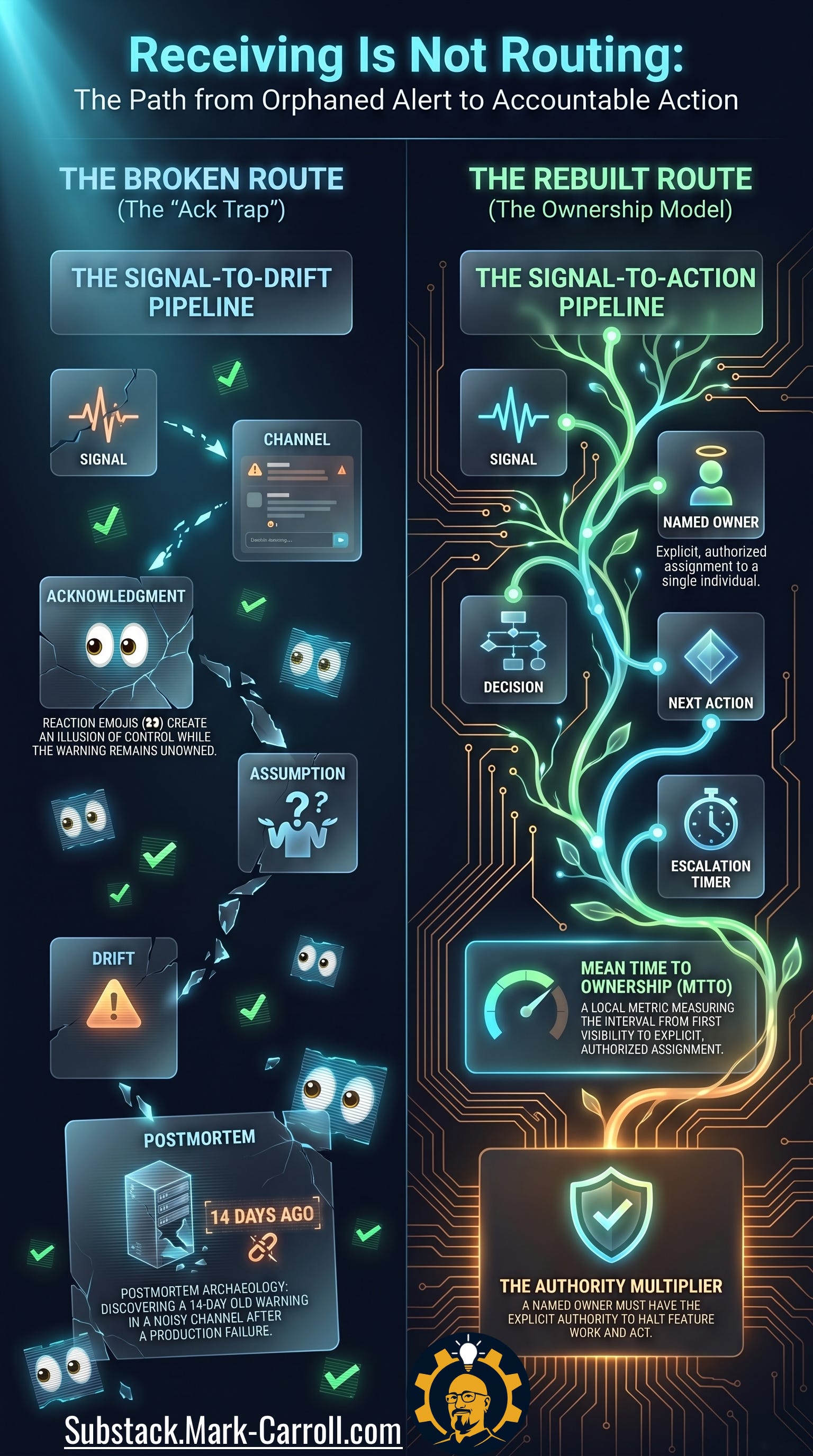
Receiving a signal means the warning arrived somewhere people can see it. Routing a signal means the warning has moved to a named owner with authority for the next move. Those are different operating states, and confusing them is how a busy incident channel becomes a very polished waiting room for bad news.
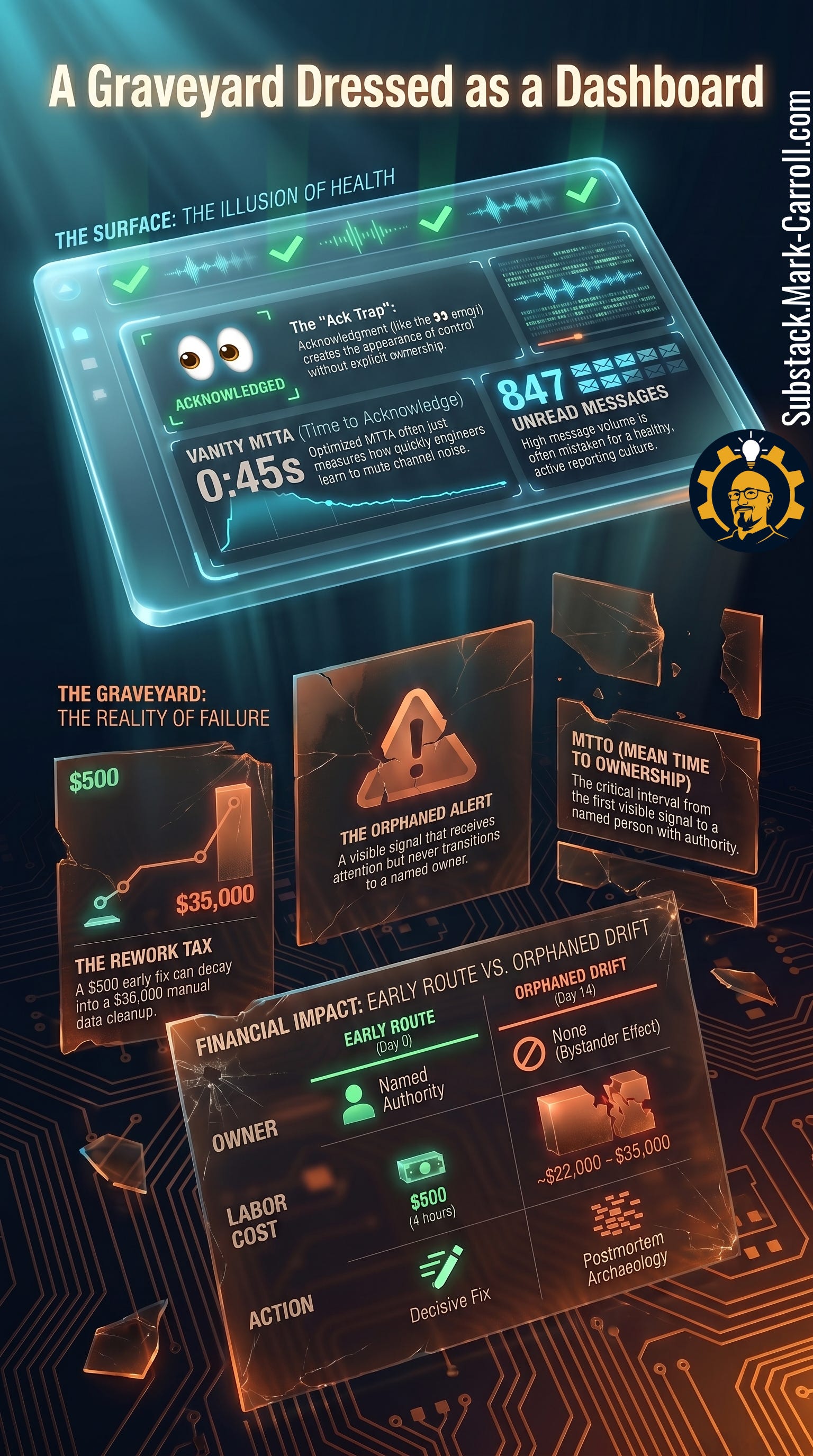
The broken route looks like this: signal → channel → acknowledgment → assumption → drift → postmortem.
The rebuilt route does something different: signal → named owner → decision → next action → escalation timer.
The broken route often feels active because people are reacting, checking, discussing, and assuming. The rebuilt route feels less dramatic because it asks four plain questions: what kind of signal is this, how severe is it, who owns the next move with authority, and when does escalation happen if ownership remains unclear? Those plain questions are the difference between “everyone saw it” and “someone is driving it.”
The Ack Trap
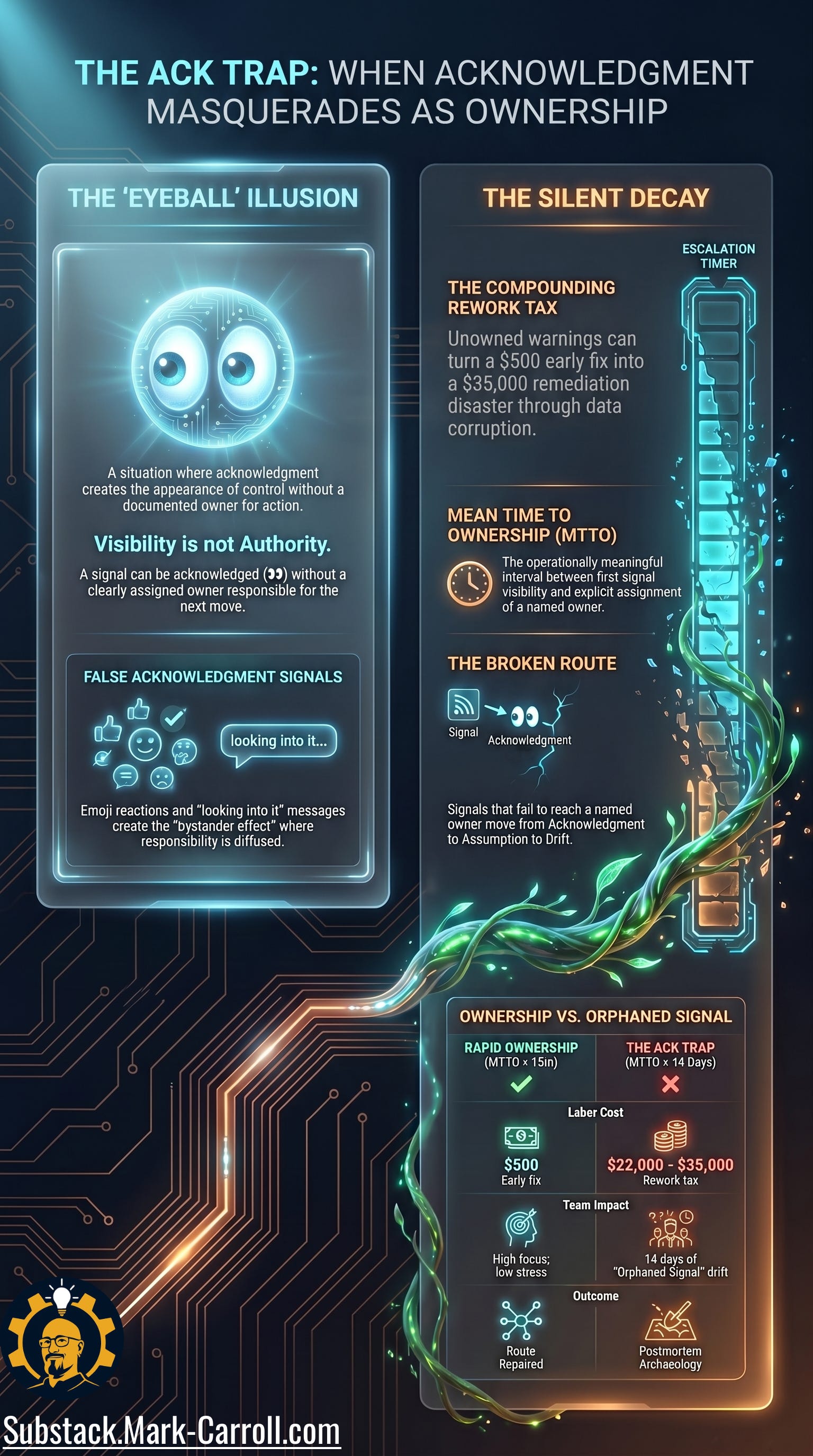
The Ack Trap happens when acknowledgment creates the appearance of control. A responder clicks acknowledge, a teammate drops an emoji, or someone says “looking into it,” and the system relaxes. The warning has reached attention, but attention is not the same thing as ownership.
A useful acknowledgment tells the team that someone has seen the signal, and that can reduce duplicated noise in the first few minutes. The problem begins when acknowledgment becomes a stopping point instead of a handoff point. Without a named owner, authority to act, and an escalation path if the issue stalls, the acknowledgment becomes operational wallpaper. Everyone sees it, everyone feels slightly safer, and the warning keeps aging behind the scenery.
I have been fooled by “we’re tracking it.” In a dependency conversation, that phrase sounds wonderfully responsible — as if the issue has been escorted into a mature operating system with a clipboard and sensible shoes. I felt reassured. I moved the conversation forward because I did not want to micromanage the team that supposedly owned the work. The problem resurfaced later as a blocked story or a review conversation where the same concern had somehow become new again. “Tracking” had meant awareness, not ownership. Nobody had named the next decision, the person with authority, or the timer for escalation. The issue had not been routed. It had been given a place to sit.
Alert fatigue belongs in this conversation because noisy channels make weak handoffs easier to miss. But alert fatigue and ownership failure are not the same problem. Alert fatigue can increase the chances that a weak handoff gets buried in noise. It does not explain why a visible, credible warning never became a named person’s next move. A quieter channel without ownership rules is just a tidier place for bad news to wait.
The architects of the broken route
This is not a validated taxonomy. It is a practical lens for inspecting how a broken route gets built by reasonable people doing reasonable things. Some roles build intake — they give signals a place to land without building a path for the signal to travel. Some roles monitor volume without holding the authority to halt work or redirect priorities; they can see the warning but may not be empowered to move it. And some roles, especially leaders reading from the outside, interpret quiet or a lack of formal escalation as evidence of stability — when from the outside, no escalation can look like no problem, especially when leaders are trained to read exception reports as reality. When visibility exceeds authority, the route is already fragile.
I have been both the builder and the monitor in this pattern. As a consultant, I have helped teams make work more visible: cleaner boards, clearer ceremonies, better intake, more explicit blockers. That work mattered. But I have also learned that better visibility can seduce you into thinking you have built a better route. I could see impediments, hear dependency risks, and notice when the same warning kept reappearing in different meetings with slightly different nouns. I could ask better questions and help the team name the risk, but I did not always have the authority to change priorities or force a cross-team decision. The system had given the role visibility and responsibility language, but not enough authority to make the route move. Changing the actor would not fix that script.
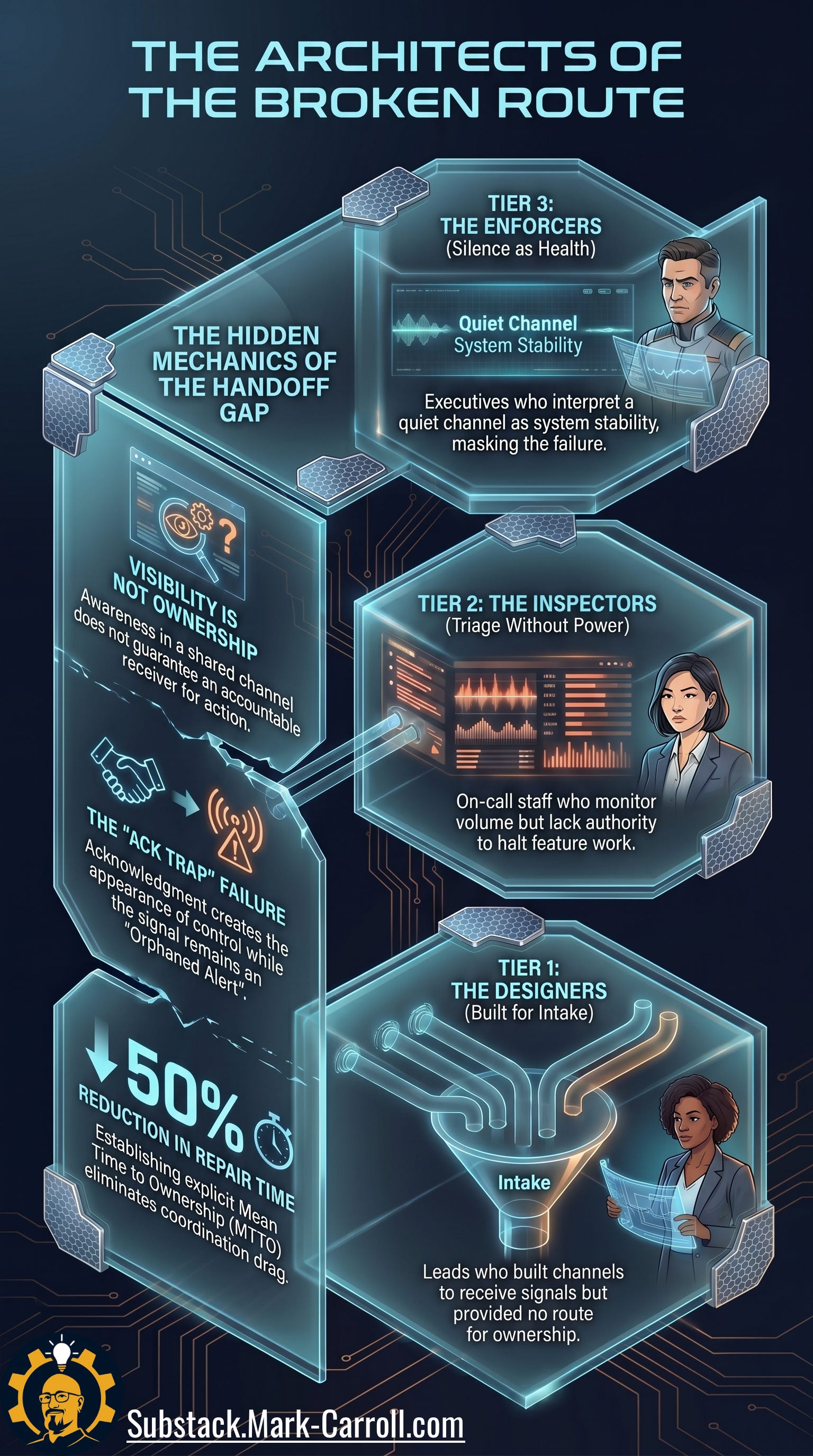
A graveyard dressed as a dashboard
This is the turn.
The system is optimized for signal volume, not signal routing. High message counts look like high engagement. High engagement looks like a healthy reporting culture. A busy dashboard can look like control. A thread full of reactions, status fragments, and unread-message counts can create the impression that the team is processing risk when the team may only be stacking risk in chronological order.
That illusion is where this article’s central failure hides. The channel did not fail because it was silent. The channel failed because it was active enough to look like a route while functioning only as a destination. The activity was real. The movement was not.
I have seen this happen on an Azure DevOps board. The work items had assignees, tags, comments, and enough activity history to make the board look alive. Nothing looked abandoned. Then the question landed: “For the blocked items, who owns the next decision?” For a few seconds, everyone looked back at the screen as if the answer might be hiding in a field we had not expanded yet. That silence did not mean people were careless. It meant the dashboard had been answering a different question. It could tell us that an item existed, that someone had touched it, and that the status had changed. It could not tell us whether the next decision had an owner with authority. The dashboard still looked green, but the room no longer believed it.
Some teams find a local metric useful here. I use MTTO — Mean Time to Ownership — as a practical lens for one specific question: how long did the signal remain visible before explicit ownership formed? MTTO is not an industry-standard SRE metric. It is a local operating measure I use to inspect the interval between visibility and ownership. Used carefully, that interval reveals the route gap. Used carelessly, it becomes a tool for scoring individuals instead of inspecting systems.
MTTO does not ask how fast someone clicked acknowledge or how long the fix took. It asks how long the signal lived in the gap between those two moments.
MTTA, Mean Time to Acknowledge, can be useful but can mislead when used alone. Acknowledgment can look like progress while the route underneath remains empty. MTTR, Mean Time to Resolve, can flatten the timeline so much that the team loses sight of where the delay actually began — and the expensive rework that accumulated in the gap. MTTO does not replace either metric. It sits between them and asks the question neither was designed to answer: when did visibility become ownership?
Here is the exercise I wish I had run when I was trying to be a good facilitator and accidentally became a good witness instead. I kept the meeting moving, but I did not make sure the signal could move. These four questions are the pause I did not take.
Quick route check
Pick one warning from your last postmortem, retro, or incident review and ask four questions:
Where did the signal first become visible?
Who owned the next move?
Did that person have authority?
What timer should have escalated it?
If the team cannot answer those four questions quickly, the problem was not just communication. The route was missing.
That is the failure this series is built to repair. The warning was visible. The channel received it. The room acknowledged it. The route never formed.
This is also why I am writing Collaborate Better. The book is built around the same conviction behind Route Rebuilder: collaboration does not improve because people care harder in broken systems. It improves when teams build clearer routes for trust, ownership, decisions, and action.

Once you can see that pattern, the next question becomes harder to avoid: what does the route need to make the next warning move?
Part 2 answers that question. We will trace the local cost of a broken route, then rebuild the path with the Incident Triage Decision Aid: signal type, severity, named owner with authority, escalation timer, and MTTO as a local learning lens.
Next: Part 2 — The Rebuilt Route

Previous:

More Content to Discover:


The most dangerous warning is not always the one your team misses 🚨
Sometimes it is the one everyone sees, acknowledges, and quietly assumes has become someone else’s job.
In Part A of The Route That Buried Bad News, I unpack the Orphaned Alert, the “Ack” Trap, and the strange reason green dashboards can dangerously hide bad news in plain sight.
♻️ Restack this if your team has ever confused visibility with ownership.
Love the framing here Mark. Band news gets buried by a chain of perfectly normal handoffs where everyone assumes someone else has the ball. Really useful framing. 🩷🦩