Workflow Pain Isn’t Market Demand: How to Validate a Business Opportunity Before You Build
The spreadsheet can be real. The delay can be measurable. The business can still be imaginary.
👋 Welcome to my paid subscriber-only edition of Empathy Engine (🔒 Leader’s Dispatch). Each week I build evidence-forward tools for product leads who need to say no, defend tradeoffs, and lock in decisions before they get rewritten later.
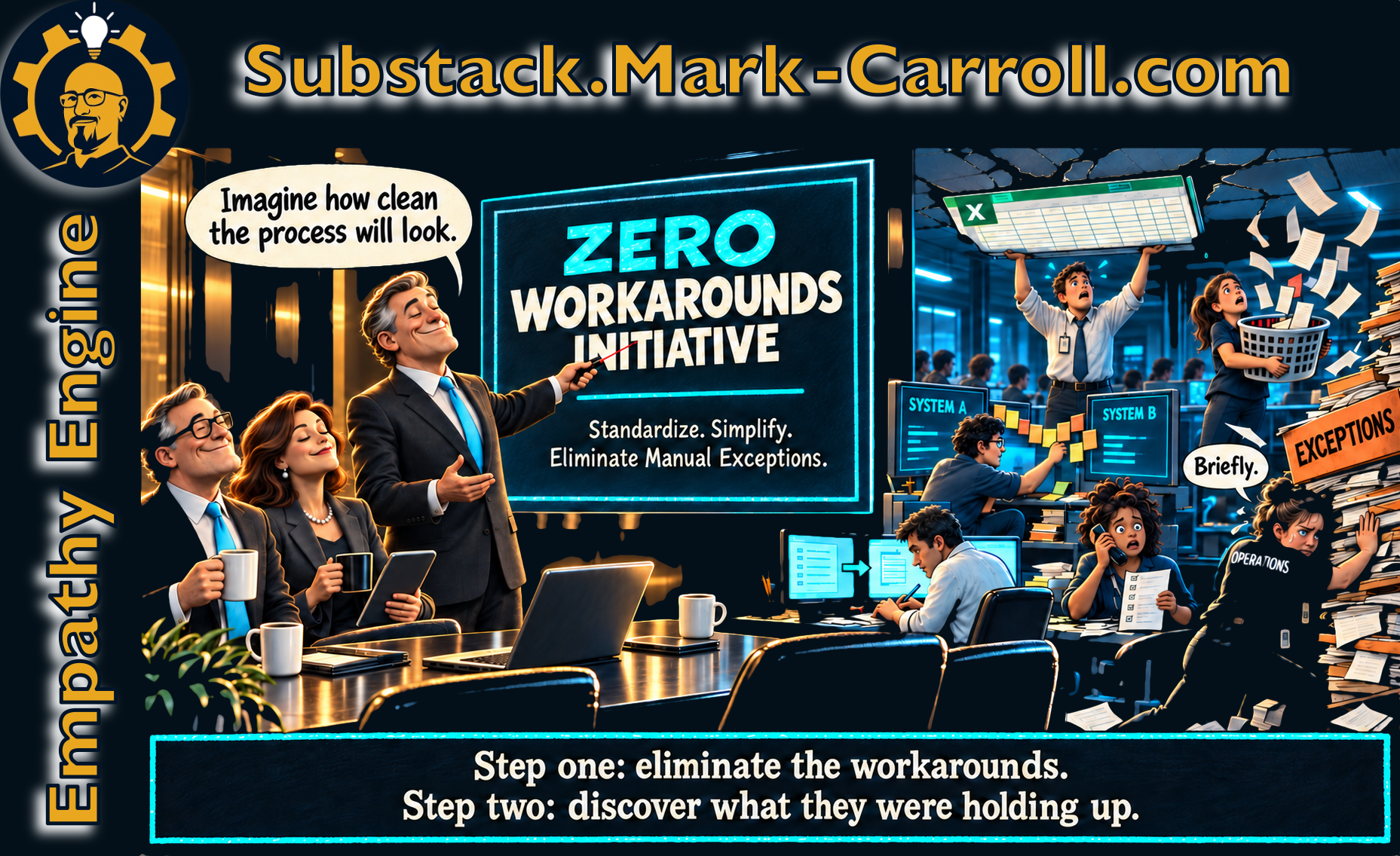
The spreadsheet was ugly. That wasn’t the signal btw
The signal was that the same work kept traveling through it, people had built behavior around it, and a mistake could escape the workflow and reach a customer.
Twelve tabs. Estimates in one place. Crew assignments somewhere else. Warranty notes copied because the official system doesn’t quite carry them where they need to go. Customer follow-up divided among software, memory, text messages, and whatever somebody remembered to write down before leaving for the day.
Episode 1 Part A:

Episode 1 Part B:

A few weeks ago, Nina would have loved this. She had already paid for the expensive lesson of starting with a fashionable category and working backward toward a problem. Episode 1 taught her that a category can feel validated before a single buyer has validated anything. Episode 2 taught her that a business can hand off nearly every task and still keep every hard decision in one head.
Episode 2 Part A:

Episode 2 Part B:

Now she has a harder problem. Too many ugly workflows, and no defensible way to know which ones deserve another question.
So she builds a filter instead of a shortlist.
That distinction, between a workflow that has earned inspection and a workflow that has earned a business, is the reason this third episode became more complicated than expected.
The series premise stays intact. Boring itself creates nothing. We’re looking for repeated paid pain, not beige industries.
Episode 3 spends its time on the word we’re most likely to rush past: repeated. Before anyone can ask whether someone will pay to remove a pain, we need to know whether we’re looking at a recurring workflow at all, what consequence follows it, who actually carries the work, whether the same ritual shows up somewhere else, what the workaround already accomplishes, and whether the design that looks broken might already be rational.
That’s what I’m calling the Workflow Pain Index.
The name stays. The score doesn’t.
This isn’t a 0 to 100 instrument. Nothing here deserves weighting, traffic lights, a high opportunity label, or a threshold that quietly converts annoyance into demand. The useful version is a qualitative inspection filter. It helps decide whether a workflow has earned another question, nothing more.
Research Binder: the receipts, methodology notes, and source boundaries are compiled at the bottom of this post.
Ugly Isn’t the Opportunity
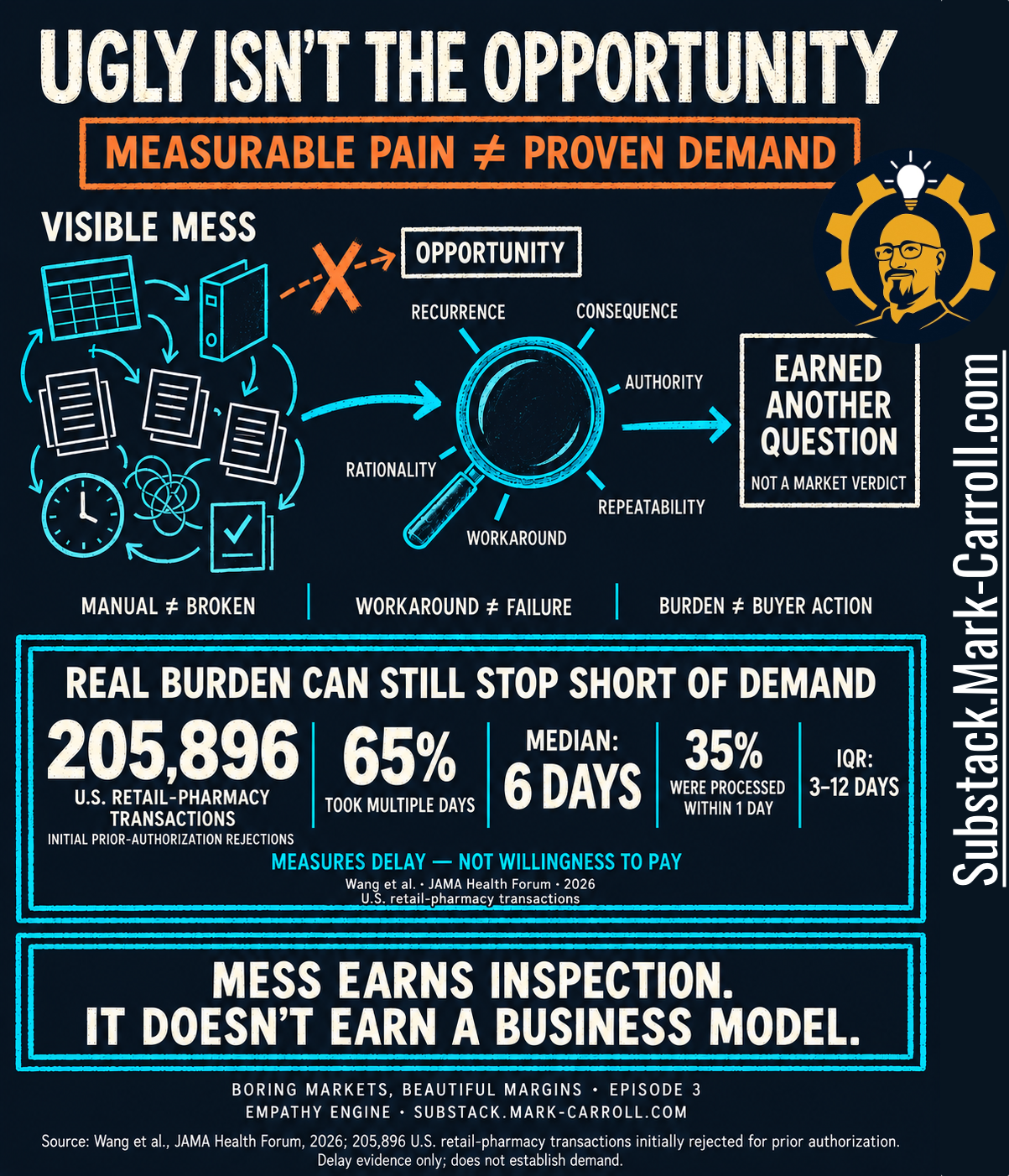
MEASURABLE PAIN ≠ PROVEN DEMAND
Consider prior authorization, a workflow with nothing to do with HVAC. A 2026 JAMA Health Forum analysis examined 205,896 U.S. retail-pharmacy transactions initially rejected for prior authorization.1 Thirty five percent were processed within one day. The other 65 percent took multiple days, with a median of six days and an interquartile range of three to twelve.
That is a measurable consequence. Delay happened. It can be counted and described. It still cannot be leapt from to therefore somebody will buy our solution.
Mess earns inspection. It does not earn a business model.
1. A Bad Day Isn’t a Pattern
The first question is recurrence, and it starts smaller than most builders want it to. A missed handoff, a late invoice, a bad Friday: those are incidents. Memorable is not the same thing as recurring.
Three questions separate a story from a pattern. What exactly repeats. How often. Over what period. If we can’t answer those three, we don’t yet have recurrence evidence, no matter how vivid the story is.
Medicare Advantage gives us a cleaner example of what countable recurrence looks like. KFF’s analysis of CMS administrative data found 52.8 million Medicare Advantage prior-authorization determinations in 2024, equal to 1.7 determinations per enrollee across 33 million people.2
Those figures don’t say whether prior authorization is commercially attractive to an outside builder, how consequential any single determination was, or whether anyone has permission to intervene. They say something narrower: the workflow has a countable recurring unit. That is enough for this pillar, no more.
One bad Friday is memorable. Friday after Friday is a ritual. A messy office is a tour. A weekly ritual with a name is a clue.
Nina tries this on Dave’s business first. He tells her exceptions land on his phone every Friday, and he has a hunch it gets worse in busy season. When she actually tries to name the unit and the period, she can’t, not yet.
That gap is not a failure. It is the next thing to go find out.
2. Frequent Doesn’t Mean Consequential
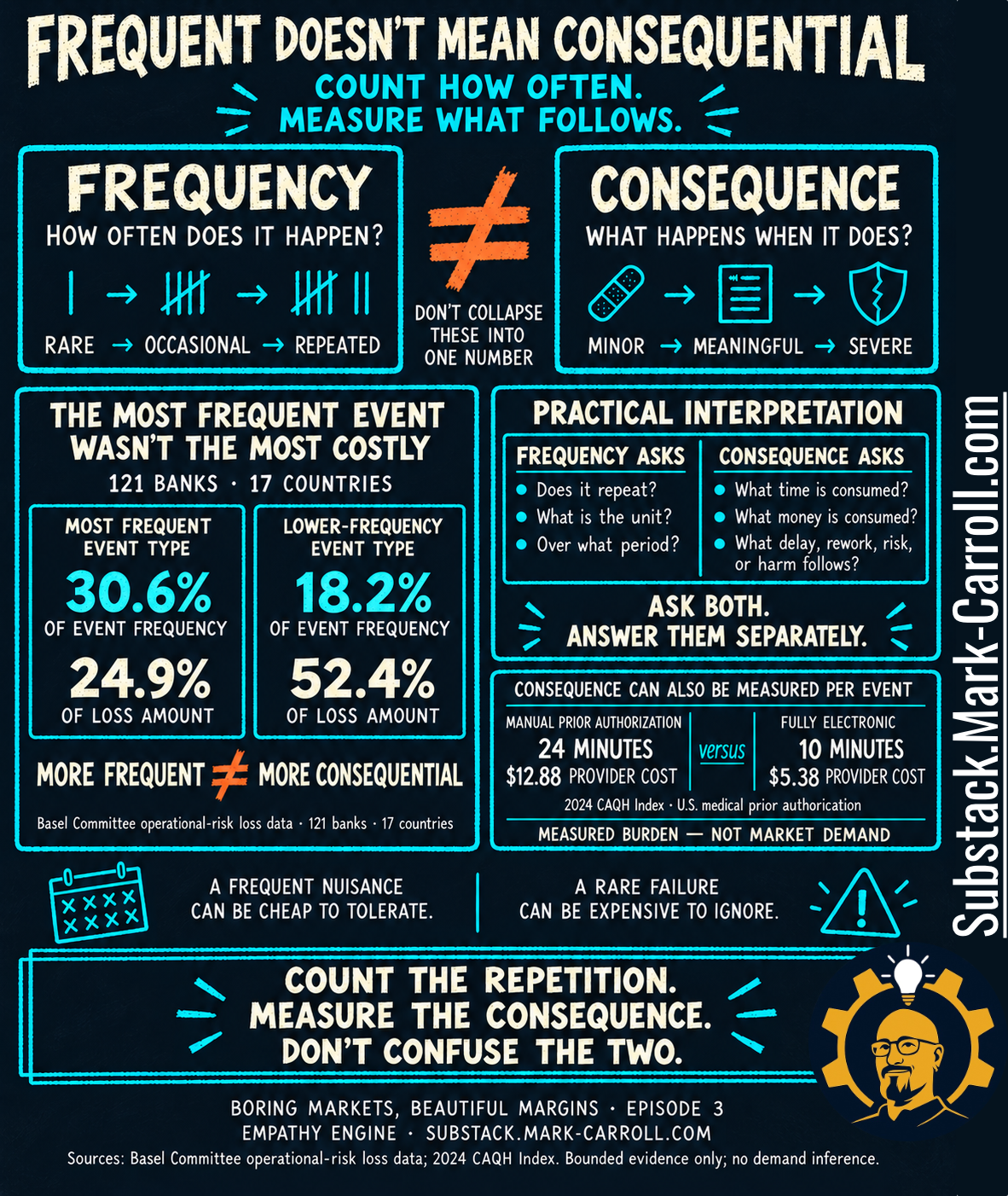
Frequency asks how often something happens. Consequence asks what happens when it does. Those two questions have to stay separate. Adding them together in your head, instead of asking them one at a time, is how an ugly-looking workflow gets promoted into a false opportunity.
An analysis of operational-loss events across 121 banks in 17 countries found the single most frequent event type accounted for 30.6 percent of all events but only 24.9 percent of total loss. A lower-frequency event type accounted for just 18.2 percent of events and 52.4 percent of loss.3 The thing that happened more often was not the thing that produced the larger share of loss.
Consequence can also be measured cleanly, per event, when the transaction is well defined. The 2024 CAQH Index put the provider cost of a manual medical prior authorization at roughly 24 minutes and $12.88, versus 10 minutes and $5.38 fully electronic.4 That’s a real, bounded, per-event number. It still measures burden, not market demand.
Ask both. Answer them separately. A frequent nuisance can be cheap to tolerate. A rare failure can be expensive to ignore.
3. The Person Doing the Work May Not Control the Fix
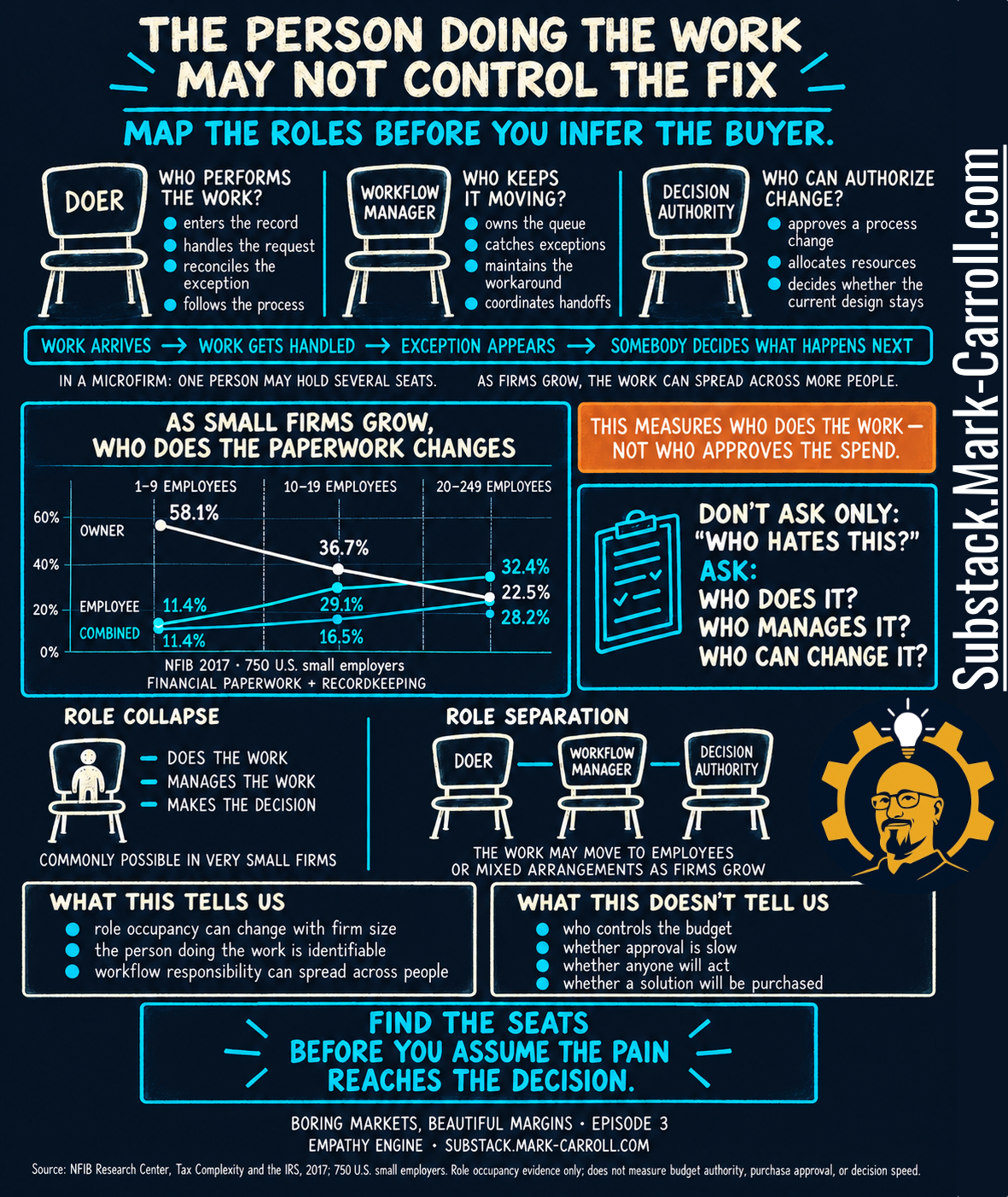
Three chairs, not one. The doer enters the record, handles the request, reconciles the exception. The workflow manager owns the queue, catches exceptions, maintains the workaround. The decision authority approves a process change, allocates resources, decides whether the current design stays. In a microfirm, one person can hold all three chairs. As firms grow, the work spreads, and the three chairs stop being the same person.
A 2017 NFIB survey of 750 U.S. small employers found that owners personally performed financial paperwork and recordkeeping 58.1 percent of the time in firms with 1 to 9 employees. That share fell to 36.7 percent at 10 to 19 employees, and to 22.5 percent at 20 to 249 employees, while employee and combined execution rose to fill the gap.5
That measures who does the work. It says nothing about who controls the budget, whether approval is slow, or whether a solution will ever get purchased. Don’t ask only who hates this. Ask who does it, who manages it, and who can change it, and expect three different names, not one.
Nina has been asking Dave’s dispatcher how she feels about the Friday scramble. That was the wrong first question. The dispatcher is the doer. Dave is the decision authority. Nobody has told Nina yet who the workflow manager even is.
4. One Company Is a Story. Repeated Rituals Become Evidence.