


Why a growing team can look like distributed authority without proving that authority actually moved.
👋 Welcome to my paid subscriber-only edition of Empathy Engine (🔒 Leader’s Dispatch). Each week I build evidence-forward tools for product leads who need to say no, defend tradeoffs, and lock in decisions before they get rewritten later.
Nina finds the company through a referral chain three people long. A regional electrical and facilities service provider, branded fleet, three estimators, six field crews, and a reputation the community trusts. On paper it looks like the opposite of the AI category she chased in Episode 1. It looks earned.
Episode 1 Part A:

Episode 1 Part B:

She spends a Friday with the founder, Dave, expecting to watch a business run itself. What she watches instead is a phone that never stops.

A pricing exception comes in before ten. A vendor dispute lands before lunch. A long-standing commercial customer texts Dave’s personal cell about a scheduling change the team still sends to him for approval. Dave handles each one fast and well. That is exactly what worries Nina.
Three estimators. Six crews. One phone that everything still routes through.
She does not conclude anything yet. She just starts asking a different question than the one she asked in Episode 1. Not “is this market exciting.” Instead: does this business generate value because the system works, or because the owner never stops working?
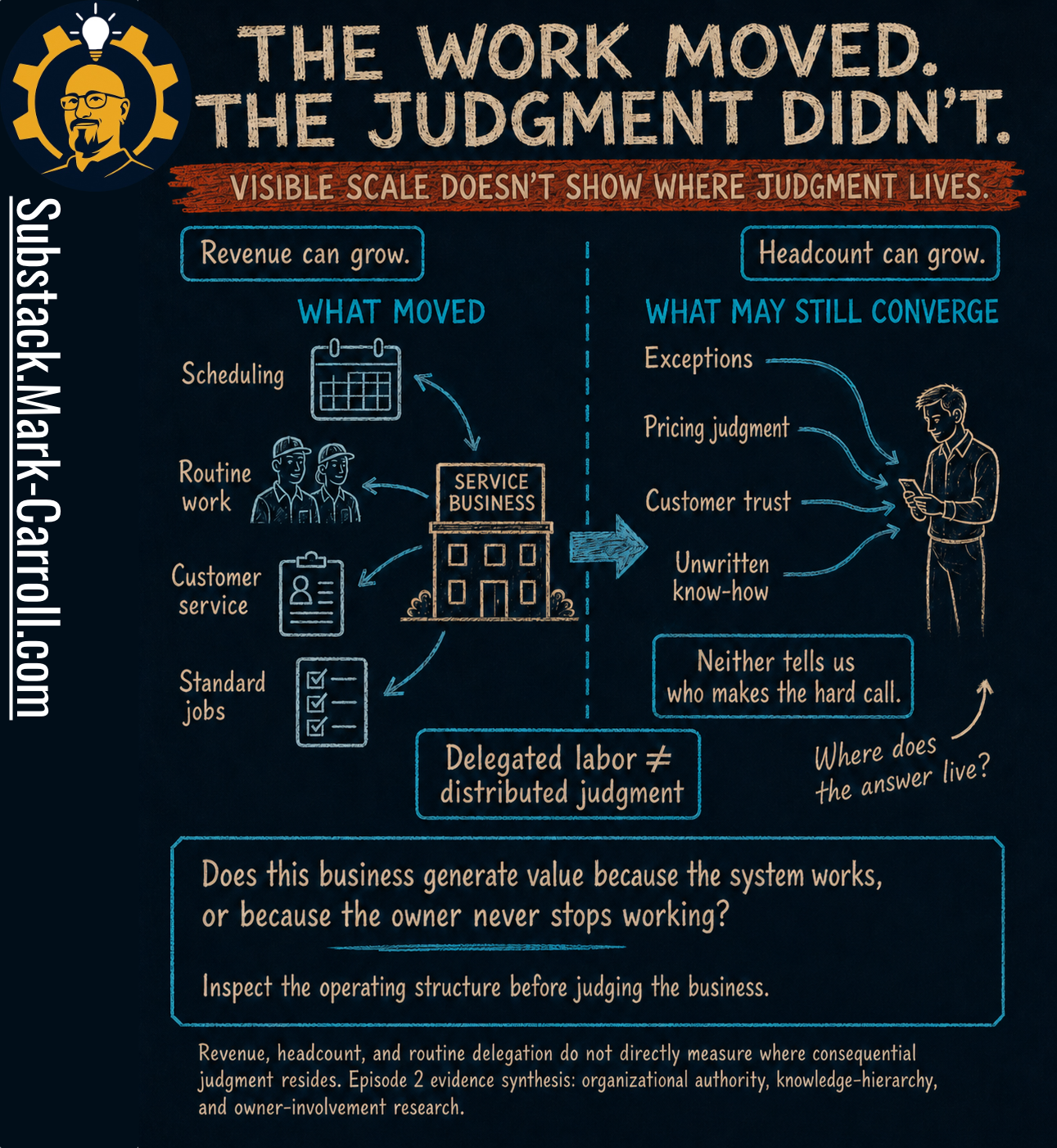
The Work Moved. The Judgment Didn’t.
Dave has done what every growth playbook tells an owner to do. He hired. Scheduling moved to a dispatcher. Routine service calls moved to the crews. Customer service moved to an office coordinator. Standard jobs move through the shop without Dave touching them.
What did not move is smaller and harder to see. Every exception, every pricing judgment call, every moment a customer needs to feel confident somebody in charge is paying attention, still converges on one person holding one phone.
Delegated labor is not the same thing as distributed judgment. A business can hand off nearly all its tasks and still keep every consequential decision in a single head. Neither the revenue nor the headcount tells you which one happened here. Only watching where the hard call actually lands tells you that.
Research Binder: the receipts (citations + source notes) are compiled in a PDF at the bottom of this post.
Revenue Can Grow Before Independence Does
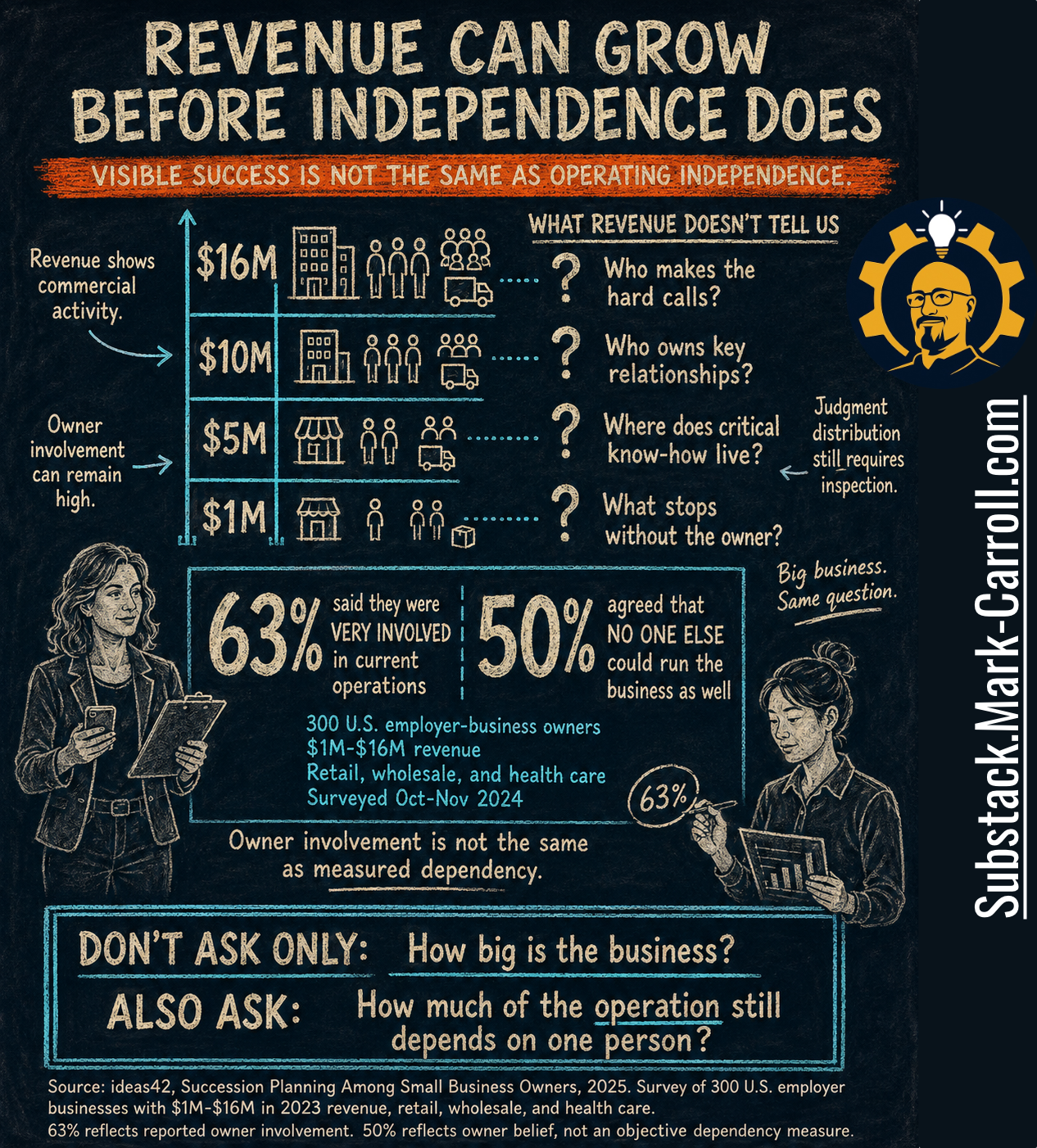
Nina almost made this mistake by looking at the wrong number. $3.2 million sounds like a business that has outgrown its founder. It has not, and there is no revenue threshold where that outgrowing becomes automatic.
A recent survey of 300 U.S. employer-business owners with $1 million to $16 million in revenue, across retail, wholesale, and health care, found that 63 percent described themselves as very involved in current operations. Half agreed that no one else could run the business as well as they could.1
Those numbers describe owner belief, not a measured, objective dependency score. But the pattern holds a caution Nina needed. A $16 million company and a $1 million company can carry the same open question. Revenue shows commercial activity. It does not show who makes the hard calls, who owns the key relationships, or what stops working the day the owner does not answer.
Big business. Same question.
Hiring People Is Not the Same as Moving Decisions
Dave has a team. The team executes. That is real, and Nina does not want to take it away from him in her own head just to make a tidier story.
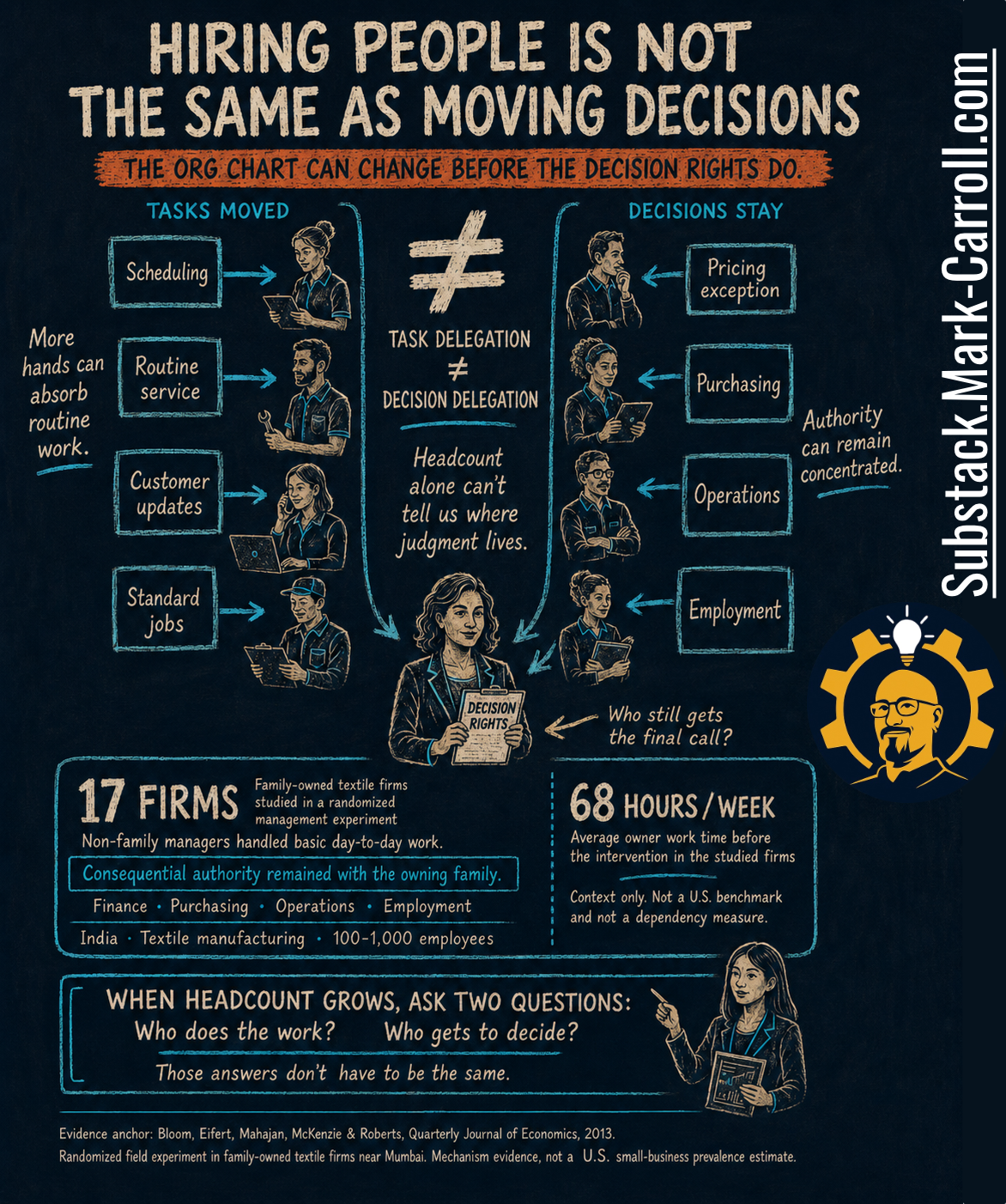
But hiring changes who does the work far more reliably than it changes who gets to decide. A randomized management experiment across seventeen family-owned textile firms in India found that once non-family managers were installed to handle day-to-day operations, the owning families kept consequential authority over finance, purchasing, operations, and employment decisions. The org chart changed. The decision rights mostly did not.2
That study measured Indian textile manufacturers, not a twelve-person U.S. service firm, and its finding is a mechanism, not a claim about how often this happens on Main Street. But the mechanism is the exact shape of what Nina is watching. Dave’s dispatcher owns the calendar. Dave still owns the pricing exception. Task delegation and decision delegation are two different transfers, and one can happen without the other.
During my Agile coaching work, I watched teams get handed nearly everything associated with delivery except the authority that made delivery meaningful. They ran standups, refined backlogs, estimated work, tracked dependencies, and kept Azure DevOps updated. The system looked decentralized because activity was everywhere. Then a real tradeoff appeared and the decision climbed right back up the organization. That was always the tell for me. Work had moved. Judgment had not.
Not Every Escalation Is a Bottleneck
Here Nina has to slow down, because the tempting conclusion is also the lazy one. Every time something lands on Dave’s desk, it would be easy to mark it as evidence he is the problem. That is not automatically true.
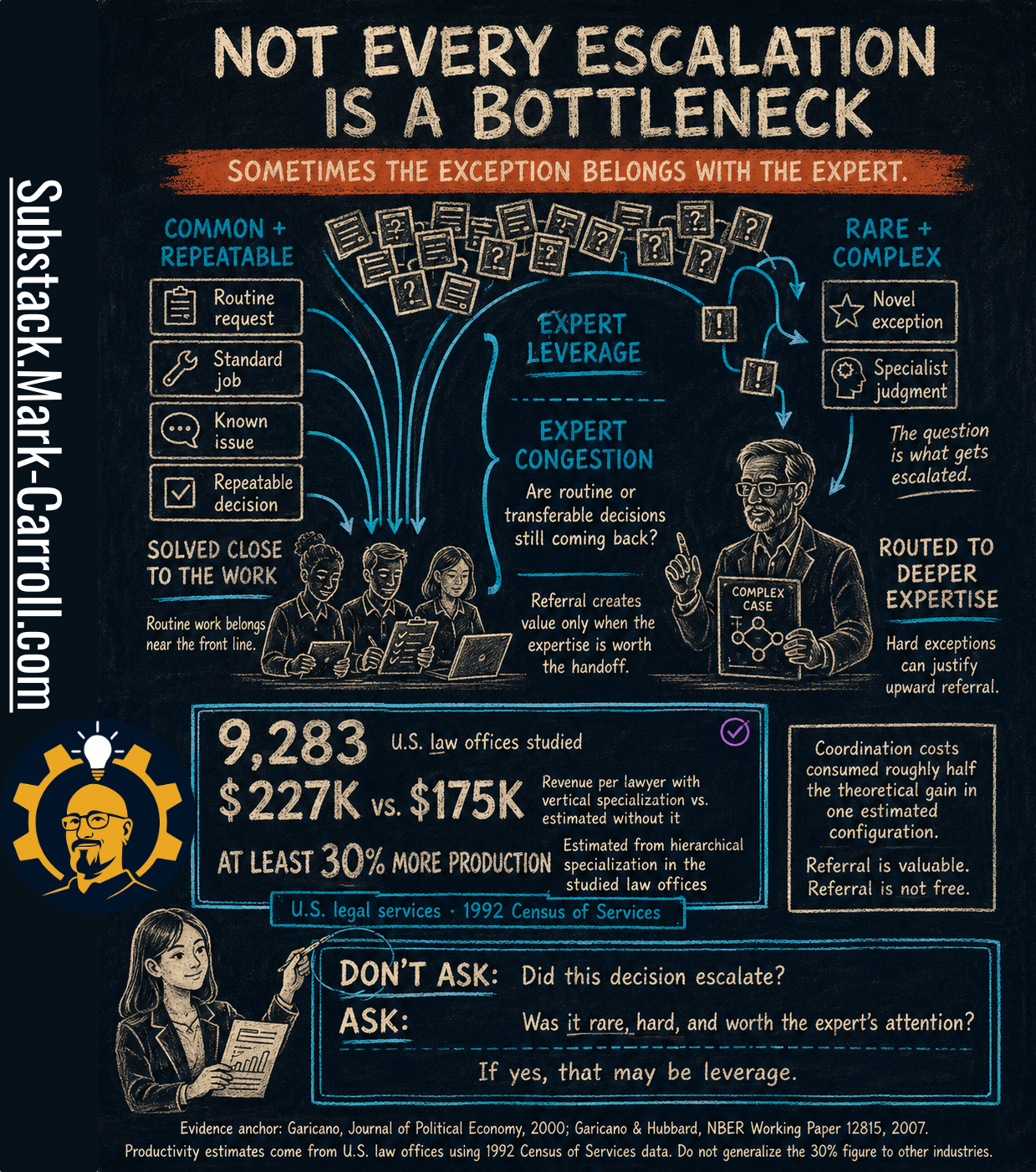
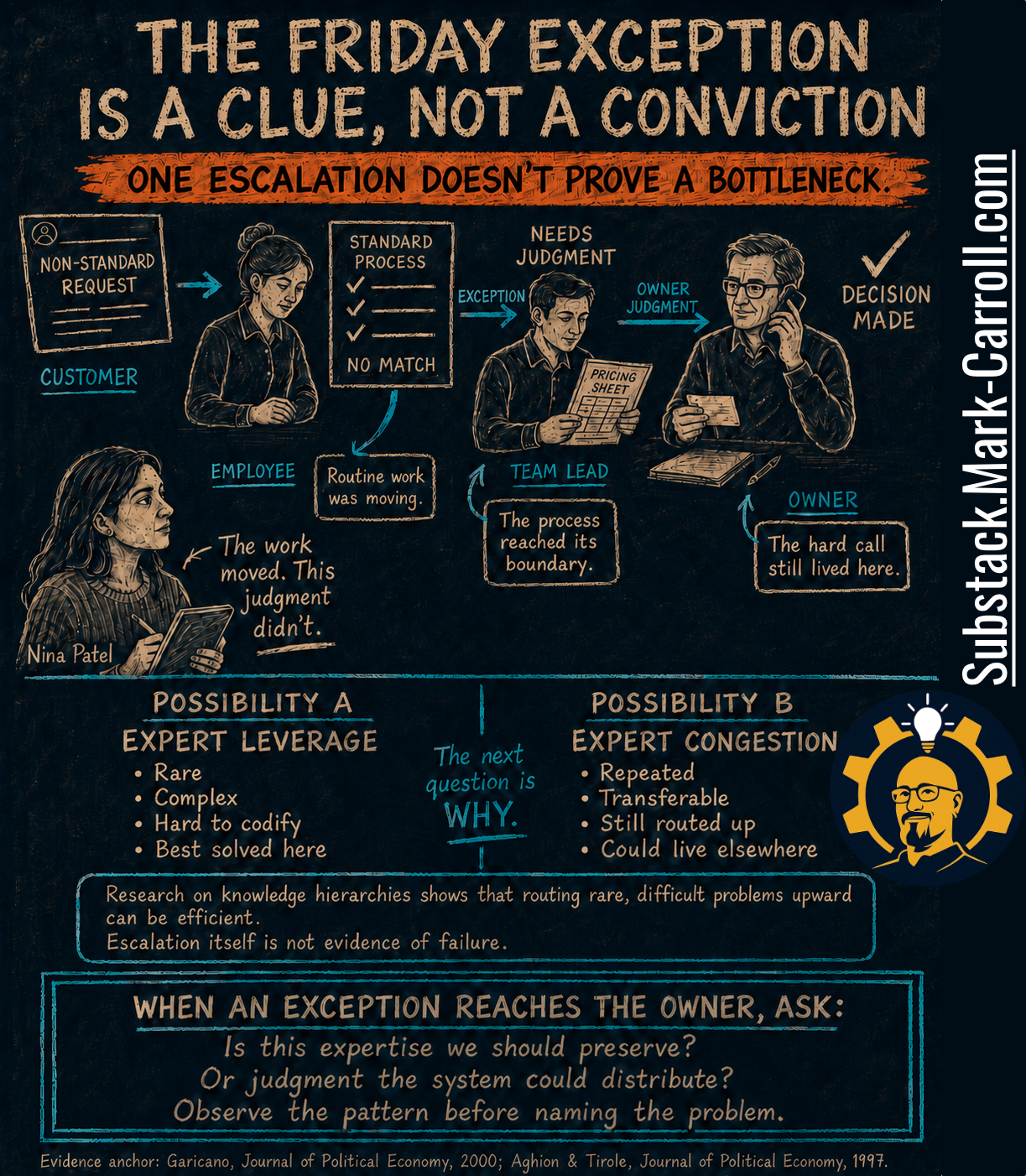
Research on knowledge hierarchies in professional services offers a cleaner way to sort it. A study of 9,283 U.S. law offices found that firms using vertical specialization, routing common problems to the front line and rare, hard problems up to the most experienced person, produced meaningfully higher revenue per lawyer than firms that did not, an estimated 30 percent production advantage from that structure alone.3
That number comes from 1992 U.S. legal services data and should not be stretched onto HVAC dispatch or facilities scheduling as if it transfers directly. What does transfer is the underlying question. Routing a rare, complex, hard-to-codify exception to the person best equipped to solve it is not dysfunction. It is expert leverage. Possible expert congestion starts to become worth investigating when the exceptions reaching the top are repeated and potentially transferable, decisions that could live somewhere else but still climb the ladder out of habit, fear, or missing infrastructure.
The Friday Exception Is a Clue, Not a Conviction
So Nina watches one exception all the way through, instead of reacting to the volume of them.
A customer calls with a non-standard request, a repair outside the normal scope, a timeline the crew can’t promise. The employee who takes the call checks it against the standard process. No match. She hands it to the team lead. He pulls the pricing sheet, and it still doesn’t resolve cleanly, a genuine exception. He calls Dave. Dave, on the phone in his truck, makes the call in under two minutes.
The decision got made well. That is not the question Nina is answering.
The question is why it had to travel that far to get made.
Two honest possibilities sit in front of her, and she resists picking one before she has more than a single Friday to go on. Possibility A is expert leverage: the request was genuinely rare, genuinely complex, hard to reduce to a rule, and best solved by the person who has seen the most edge cases. Possibility B is expert congestion: this kind of request repeats, it is transferable in principle, and it is still routed up out of habit rather than necessity.
One escalation doesn’t prove a bottleneck. It’s a clue that only becomes meaningful once Nina can see whether it repeats.
I started paying attention to a different signal. Did the decision need my judgment, or did it just have my name attached to it? Those are not the same thing. Some decisions reached me because I had the experience, context, or authority to make them well. Others reached me because the organization had quietly trained itself to route uncertainty in my direction. That distinction became one of the fastest ways I could tell expert leverage from expert congestion.
The Customer May Belong to the Person Before the Firm
The commercial account that texted Dave’s cell earlier that day is not a coincidence Nina can set aside. Trust in service businesses often accumulates around a specific person long before it accumulates around a company name.
