


Why market excitement feels like validation long before a buyer has validated anything.
👋 Welcome to my paid subscriber-only edition of Empathy Engine (🔒 Leader’s Dispatch). Each week I build evidence-forward tools for product leads who need to say no, defend tradeoffs, and lock in decisions before they get rewritten later.
Nina has spent four months building a business nobody has said no to.
She has a polished website. A credible LinkedIn presence built from a decade of operations work. A stack of AI tools she actually knows how to use. A slide deck that opens strong and lands stronger. And an offer she can say in one breath: AI automation for small businesses.
People understand it immediately. That is the whole point of choosing a category everyone already recognizes.
“That’s definitely where things are going,” they tell her.
“Small businesses really need this.”
“You’re getting in at the right time.”
“We should talk.”
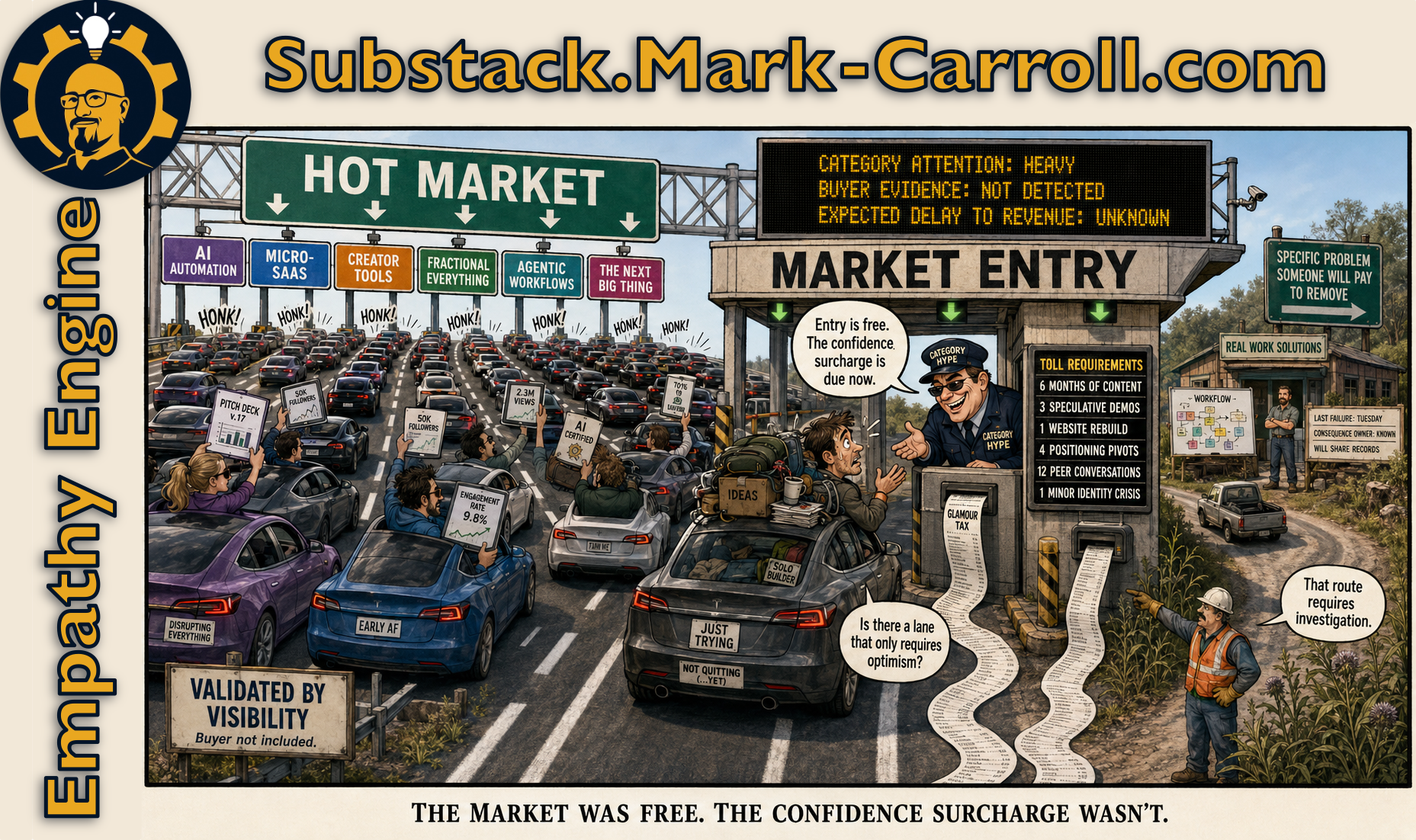
Nina has had a lot of conversations lately. She has fewer clients than conversations, and more introductions than invoices. People keep connecting her with people. Nobody keeps paying her.
One evening she reviews three recent discovery calls and notices something she had not let herself notice before. Each prospect meant something different by “AI automation.” One wanted a chatbot on the website. One wanted her to clean up a customer list nobody had touched since 2019. One wanted to reduce administrative work but could not say which work, exactly, was the problem.
All three wanted Nina to diagnose the problem before they would agree a problem existed.
Nina had chosen a market people liked discussing. She had not yet found a problem someone needed removed.
Nina and the HVAC company that appears later in this piece are a fictional composite built from recurring patterns in the research, not a single real business.
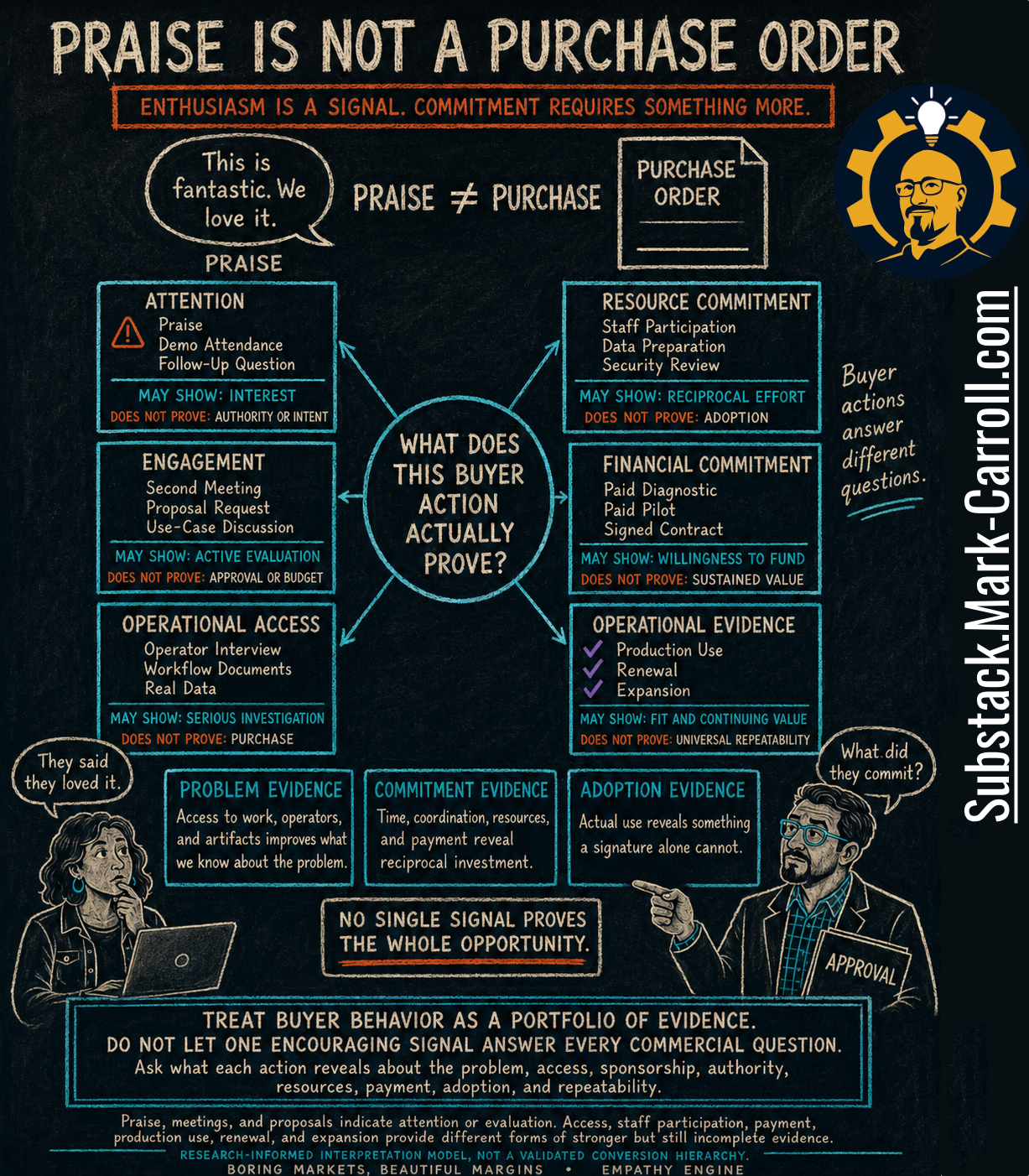
Nina’s compliments are worth pausing on. They are real, but she has been asking them to carry more weight than they can.
Praise shows attention. A follow-up question shows engagement. A proposal request shows that someone is evaluating an option. None establishes purchasing authority, approved budget, or a commitment to proceed. I give more weight to actions that require the buyer to contribute something real, such as access, staff time, data, payment, or continued use.1
Research Binder: the receipts (citations + source notes) are compiled in a PDF at the bottom of this post.
Why visible markets feel safer than they are
Nina’s instinct makes sense. Most people in her position would read the same signals the same way.
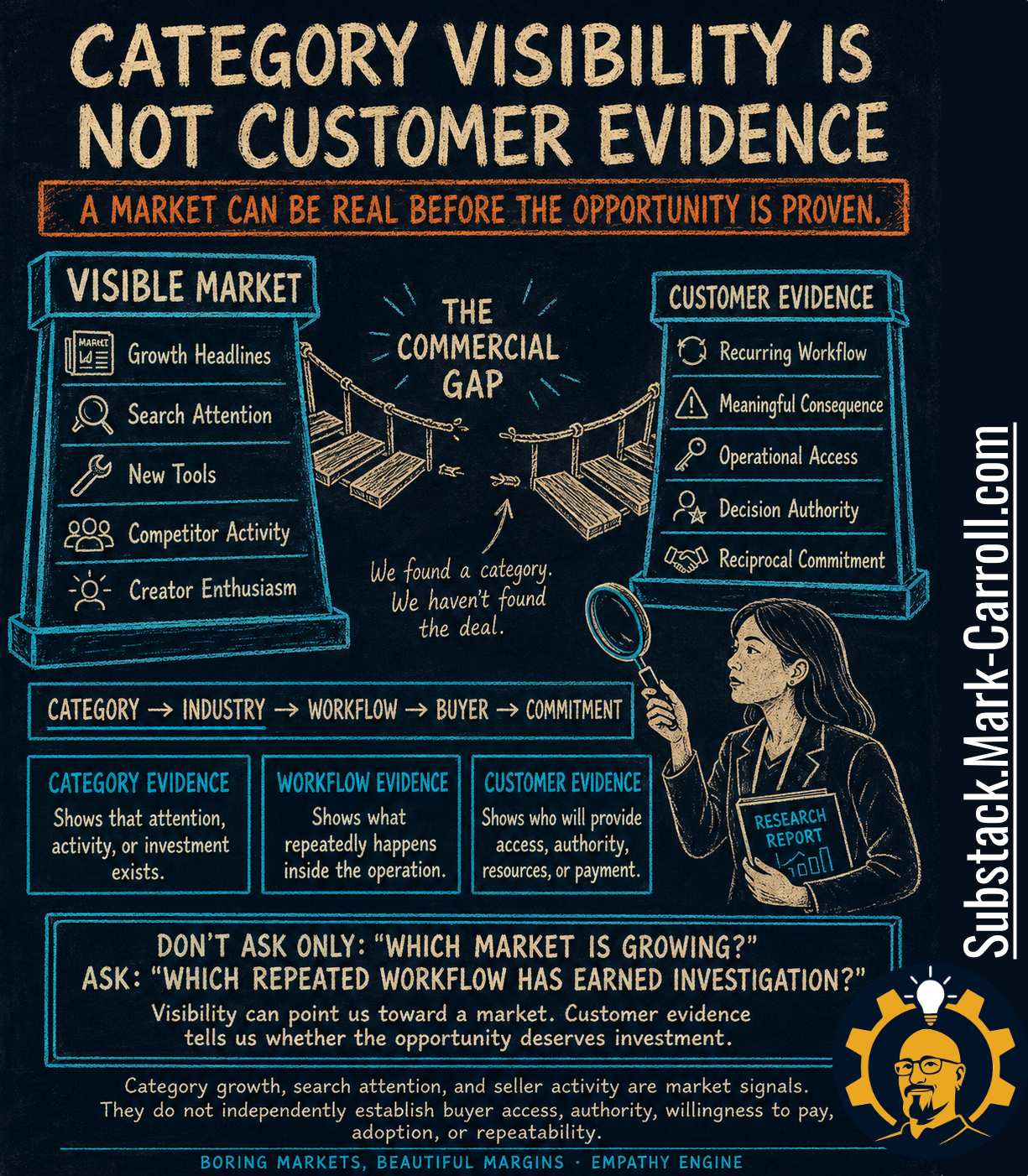
Visible markets offer useful advantages. Existing language makes an offer easier to describe. Success stories reduce the feeling of starting from zero. Tools and communities lower the cost of getting started. Competitors show that buyers exist somewhere. Online conversation creates momentum.
That visibility does real psychological work. It makes uncertainty easier to tolerate. The commercial question is whether it also provides evidence about Nina’s specific opportunity.
A visible category can show that people care about the topic, suppliers believe demand exists somewhere, and content about it travels well. Nina still needs evidence that a reachable buyer recognizes a consequential problem, can act on it, and has reason to trust her inside that market.
The market looked validated because the conversation around it was validated. From the inside, those signals can feel identical.
Across years of client conversations, I’ve learned to listen for the moment enthusiasm becomes specific. When people praise the category but can’t name the workflow, consequence, or decision owner, I no longer treat the conversation as validation. I treat it as an invitation to investigate.
That is the first real shift this piece is asking you to make.
The category gives Nina borrowed confidence
Before a single customer gives Nina anything, the category gives her vocabulary, tools, competitor examples, easy content topics, a recognizable professional identity, and a community of peers working the same edge. That support makes an uncertain choice feel emotionally survivable.
Nina is sharp, and she has put in real hours. Borrowed certainty is the risk.
She can introduce herself as an AI automation consultant and get instant recognition. Nobody asks her to explain the world she works in. Compare that with saying: I help regional home service companies reduce the estimate follow-ups, warranty handoffs, and scheduling gaps that owners still manage by hand.
The second sentence is more specific and carries less social glitter. It invites harder questions Nina cannot yet answer. That is why it feels riskier to say out loud, even though it sits closer to something real.
I recognize the pattern because I have made the same shift in my own work.
I used to describe my work as digital transformation, product strategy, or Agile coaching, depending on the room. Now I start with the narrower failure: a decision nobody owns, a handoff nobody can see, or a workflow the formal process does not explain. The category earned recognition. The problem earned the work.
The category lets Nina avoid saying something true but small. In return, she gets to say something impressive before the evidence is ready. Almost anyone would take that trade some days.
Glamorous markets let us borrow an identity before we have earned a position. That helps explain why people remain attached to categories that have not paid them anything yet.
Nina meets the spreadsheet
The shift happens somewhere unglamorous.
A regional HVAC owner, a referral from a friend of a friend, wants to talk about “getting more efficient.” He pulls up a spreadsheet instead of a pitch deck.
Twelve tabs. Estimates marked in three different colors that mean three different things to him and nothing to anyone else. Crew assignments updated by hand every morning. Warranty calls copied over from email because the ticketing system does not talk to anything. Customer follow ups tracked in a notes app on his phone. One column that only he understands. A second spreadsheet, kept separately, because nobody on his team fully trusts the first one. A yellow highlighted cell that means something nobody can fully explain out loud.
He does not call this an innovation problem.
“When things get busy,” he says, “this is where money disappears.”
Then he walks Nina through an ordinary week. An estimate goes out. Nobody follows up on it. The customer calls three days later, annoyed. The office assumes the customer went with someone else. The owner finds the missed handoff after dinner, when he finally has a minute to look. He makes the callback himself, from his kitchen table, because there is no one else left to catch it.
Nothing about this looks exciting. One missed handoff already looks expensive enough to investigate.
Nina had been selling a category. The buyer showed her a recurring failure with a visible consequence.
Do not romanticize the spreadsheet
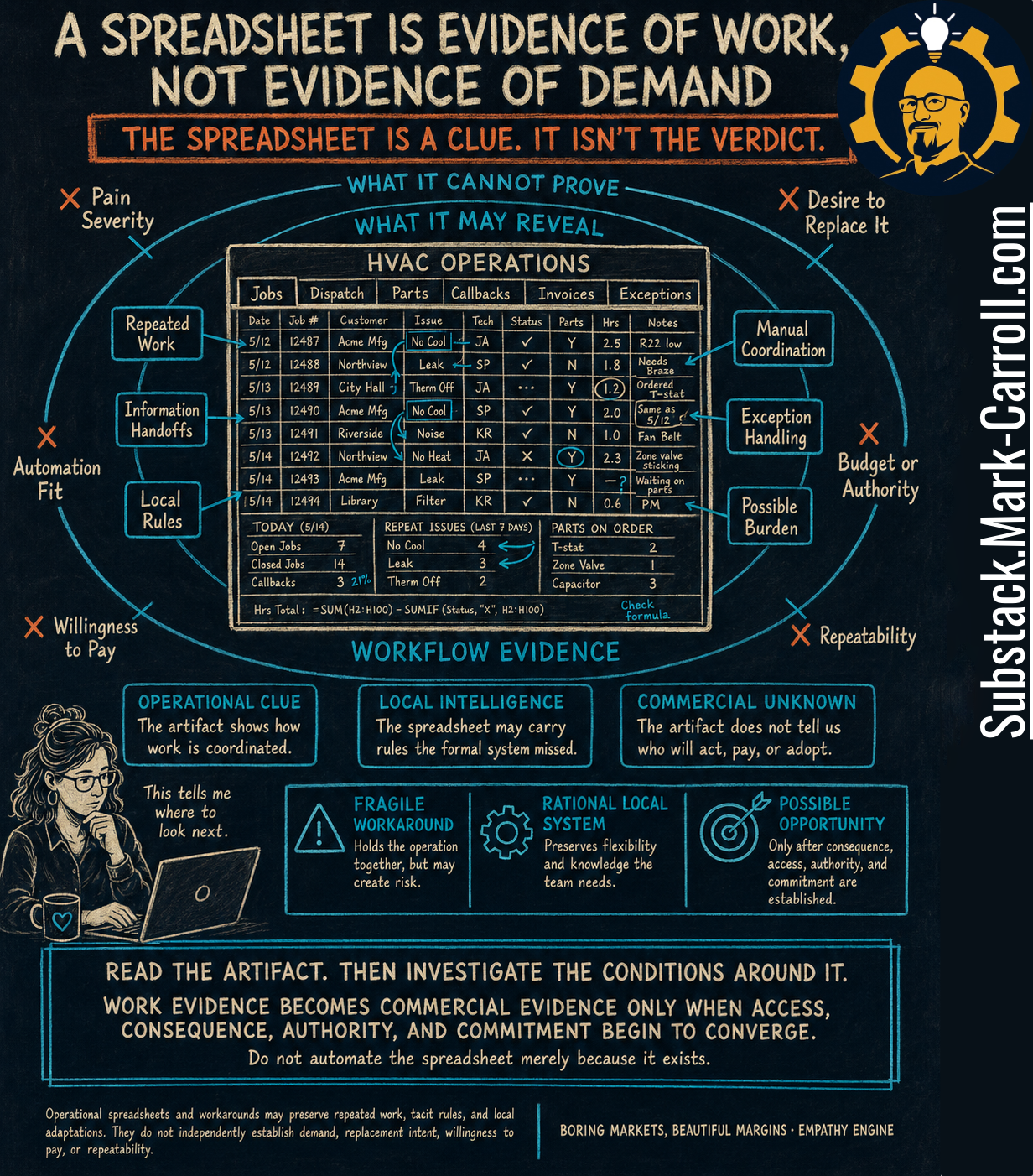
The spreadsheet establishes that work exists, that people have adapted around it, and that at least one failure carries a visible consequence. The commercial case remains unresolved.
Nina still has to learn whether the owner will pay, whether the problem repeats across other companies, whether she can reach similar buyers, and whether an intervention would improve the work without destroying the local knowledge keeping it afloat.
The spreadsheet had not revealed a business. It had revealed a question worth investigating.
The overcorrection begins when a builder sees a messy workflow, feels the relief of finding something real, and jumps straight to a clean solution based on the owner’s description.
I once watched a technically sound dashboard struggle because we built around the process leaders could explain, not the one employees actually performed. The design assumed people reviewed the dashboard before assigning work, while the team relied on a shared spreadsheet with a color-coded urgency column to make those decisions. Adoption didn’t fail because users resisted change. The dashboard had removed the signal they actually trusted.
Researchers call this the gap between work-as-imagined and work-as-done: the version leadership can describe, and the version operators actually carry out. The map was clean. The work was not.2
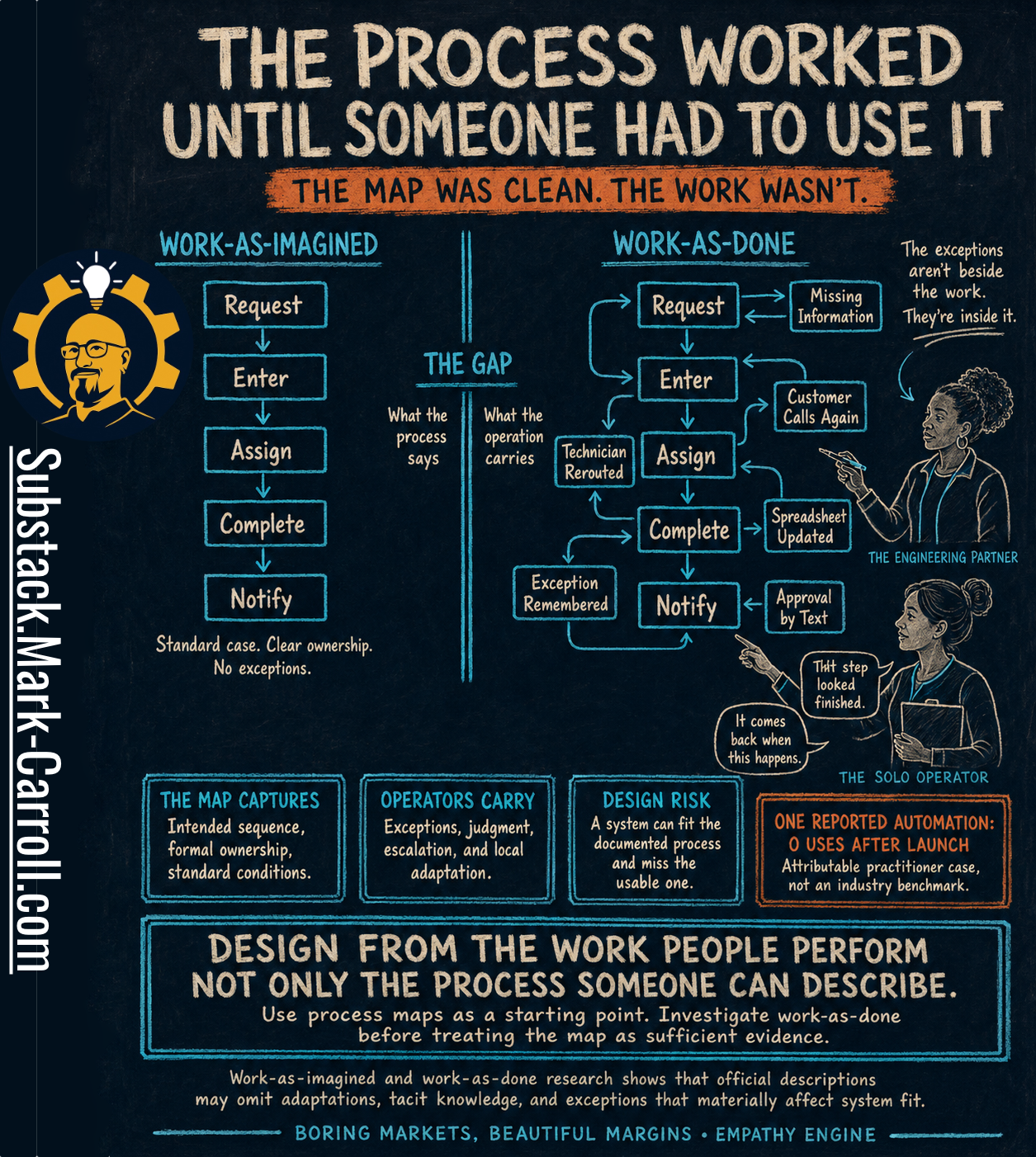
Boring is not the opportunity. Repeated paid pain is. A spreadsheet can reveal work worth studying, but it cannot settle the commercial question by itself.
The first shape of the Glamour Tax
Now the pattern has a name.
The Glamour Tax is my name for the additional rework, expanded implementation effort, and delayed market learning that can accumulate when builders treat partial signals as sufficient commercial evidence. Those signals may include a growing category, a clean process map, a polished demo, or a prospect’s praise. The tax begins when investment outruns investigation of work-as-done and reciprocal commitment.
