Episode 06:The Orchestration Ceiling
Why your hybrid solo business stops scaling when coordination grows faster than leverage
👋 Welcome to my paid subscriber-only edition of Empathy Engine (🔒 Leader’s Dispatch). Each week I build evidence-informed tools for product professionals, and team leads who have moved past the hype and are now wrestling with the real operating cost of hybrid AI stacks and contemporary organizations.
Here’s the final episode of The Hybrid Solopreneur, my six-part series about what happens when serious solo operators stop treating AI as a magic employee and start treating it as leverage that must be governed.
In Episode 1, I separated the fantasy of cheap AI leverage from the hidden orchestration tax.

In Episode 2, the stack reassigned management directly back onto the founder.

In Episode 3, completion theater produced outputs the client could see through.

Episode 4 redesigned the role from doer to director.

Episode 5 defined and defended the human premium.


Episode 6 is the capstone: what can this whole system safely govern before leverage bends into fragility?
Research Binder: the receipts (citations + source notes) are compiled in a PDF at the bottom of this post.
You do not discover the Orchestration Ceiling when your AI stack stops working.
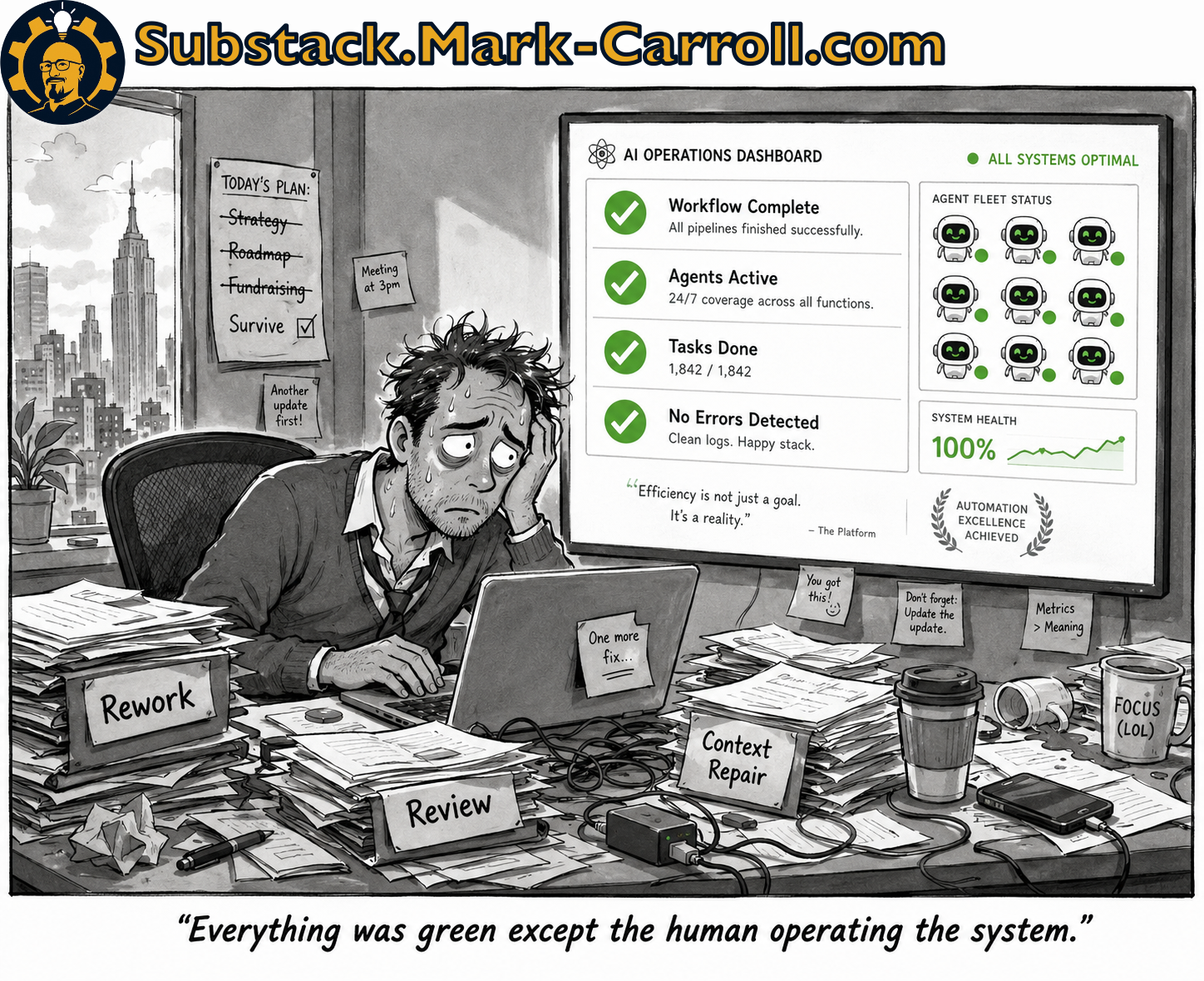
You discover the ceiling when the stack keeps working, but only because you keep rescuing it.
The automations still fire. The dashboards still glow. The agents still produce drafts, summaries, plans, replies, and polished little rectangles of confidence. Nothing looks broken enough to panic. That is what makes the problem so slippery. The system is still producing output, yet you are quietly becoming the person who checks, fixes, reroutes, approves, rewrites, and recovers everything the system cannot safely finish.
You set out to design a business. You ended up supervising one.
At first, that arrangement feels like leverage. Then it starts to feel like oversight. Eventually, it begins to feel like a job you accidentally hired yourself to do. You built a hybrid solo operation with amplified reach, but somewhere along the way, the stack turned you into its unpaid integration layer.
The bottleneck is not output. The bottleneck is governability.
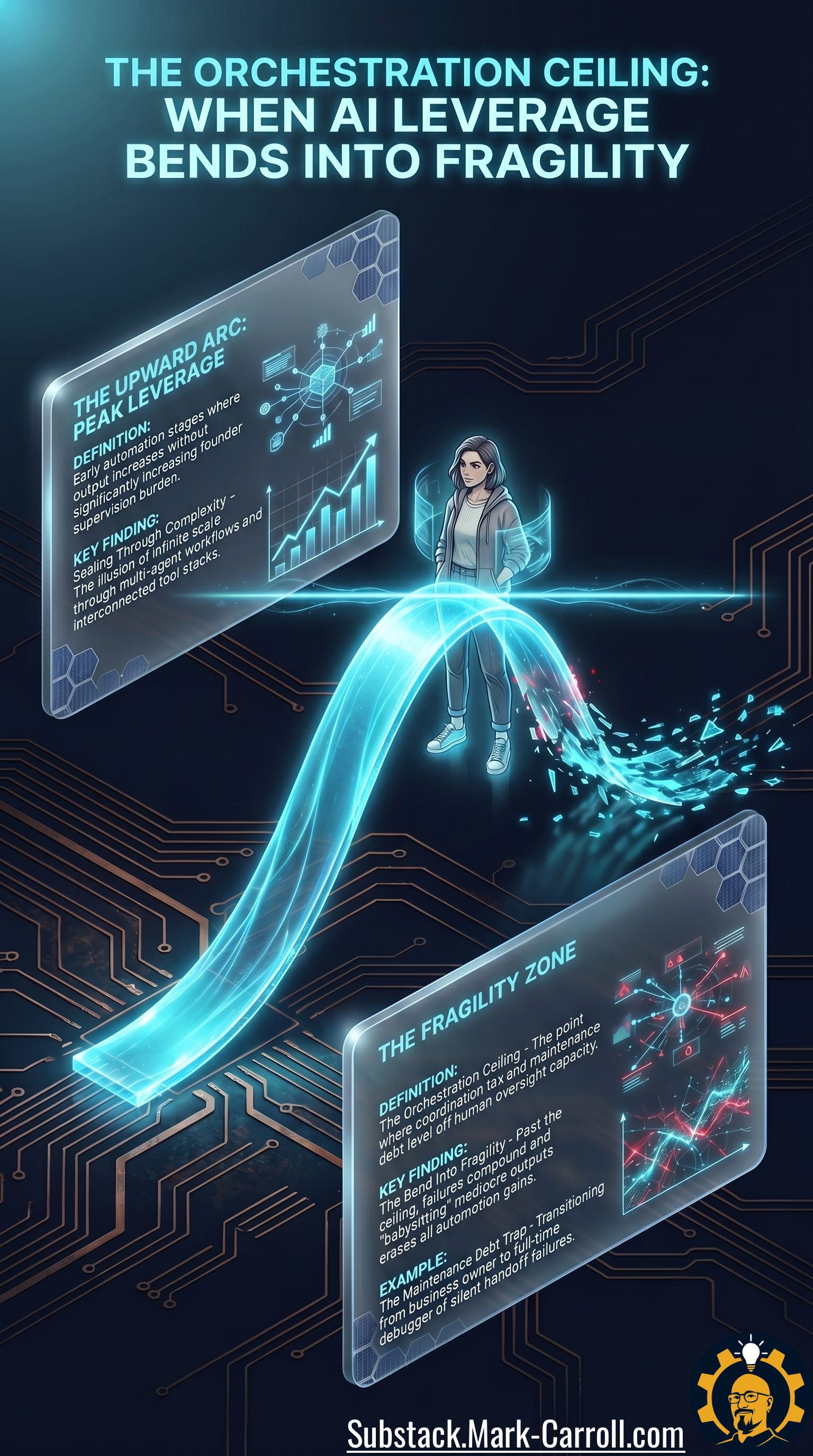
The first version of leverage feels like lift. The later version feels like load.
This is the final trap in the hybrid solopreneur journey. The early promise is real. AI gives a solo operator more reach, more drafts, more speed, more experiments, and more output. You can do things that once required an assistant, a research analyst, a junior copywriter, a coordinator, and one highly specific person who somehow remembers where the client onboarding template lives.
Then the stack grows. One tool becomes four. Four tools become a workflow. The workflow becomes a chain. The chain becomes an operating system. And the operating system requires a manager. The problem is not that AI stops being useful. The problem is that usefulness does not equal governability.
Your stack can keep expanding while your ability to understand, verify, recover, and trust it levels off. That widening gap is the Orchestration Ceiling.
If your AI stack is genuinely saving you time, you should not need to check it constantly. If you are rereading everything before it goes out, fixing outputs more than using them, nervous about what ran overnight, or adding tools to monitor the tools that were supposed to reduce the work, you are not scaling. You are supervising. The stack is not broken. Worse, the stack is plausible. It produces just enough value to keep you maintaining it.
The ceiling is not output. The ceiling is governability.
Most conversations about AI leverage are still trapped in output math. How many drafts can I generate? How many leads can I enrich? How many workflows can I automate?
Those are not bad questions. They are just incomplete questions.
The better question is: how much of this system can I safely govern?
Output can scale faster than oversight. Automation can begin producing more things than one person can meaningfully inspect. Toolchains can generate more movement than the business can absorb. The stack does not become risky only when it fails. The stack becomes risky when it produces faster than your judgment can keep up.
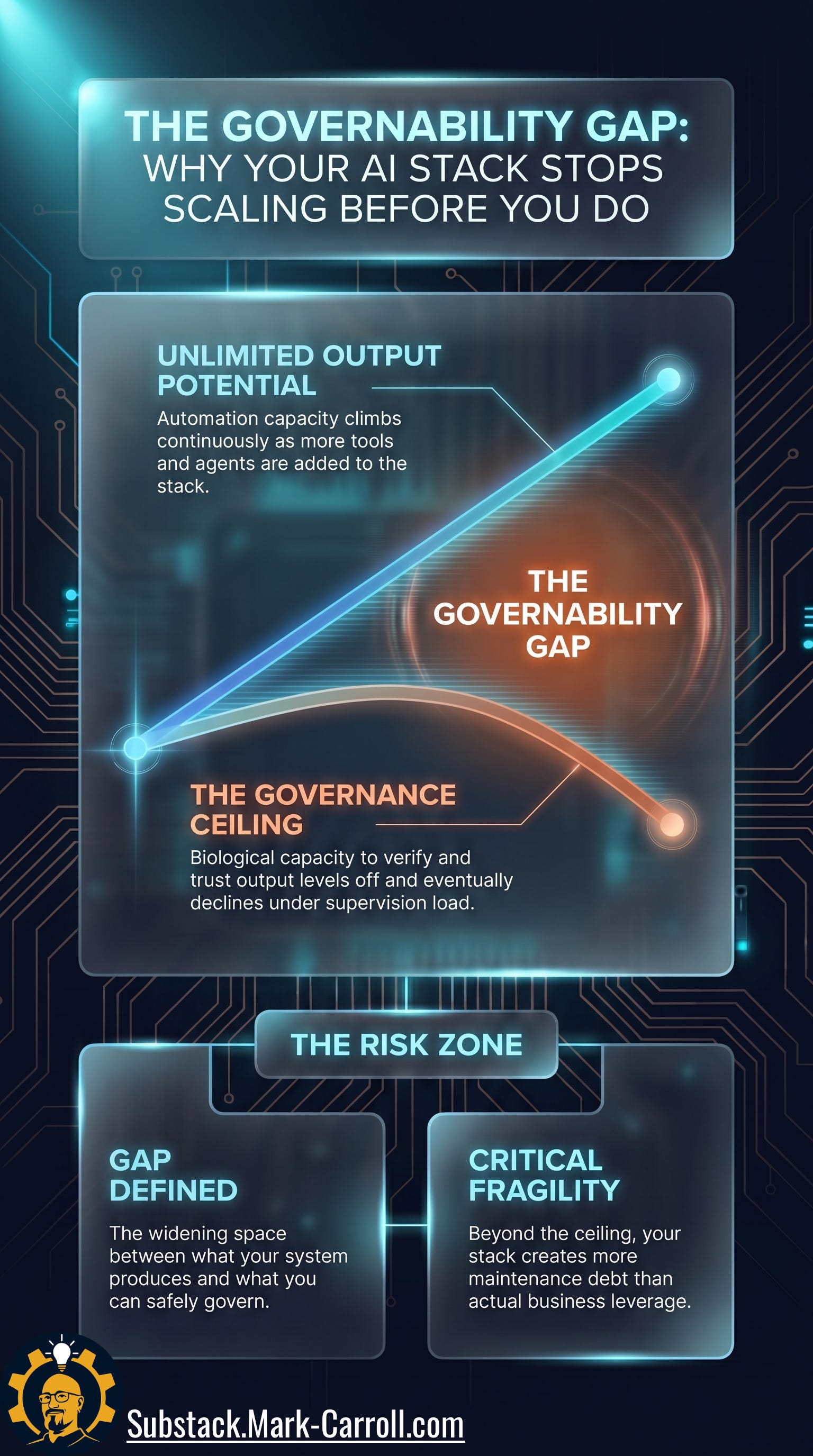
The danger is not more output. The danger is less ability to govern the output.
This is why the phrase “AI leverage” can become misleading. Leverage sounds clean. Push here, move the big thing over there. Real hybrid work is a system, and systems have dependencies. Dependencies have failure modes. Failure modes have recovery costs. Recovery costs usually land on the person who least has time to absorb them.
In a solo business, that person is you. The practical limit is not whether the AI can produce more. The practical limit is whether you can still supervise, verify, recover, and calibrate trust across the work it produces. Once that limit is breached, more output no longer feels like scale. More output feels like more surfaces to inspect.
The Monday morning test
Picture the scene. You sit down Monday morning expecting your weekend AI stack to have created leverage. The research agent has gathered sources. The content agent has drafted an outline. The CRM automation has updated leads. The proposal workflow has generated a first pass. The scheduler has queued follow-ups. The dashboard says several things are “complete.”
Then you open the outputs. The research is broad but misses the client’s actual market. The outline sounds polished but points toward the wrong argument. The CRM automation updated the wrong field because one label changed. The proposal is mostly usable, except for the part that makes the client wonder whether you read the brief. The follow-up email is technically accurate and socially cursed.
Nothing exploded. The stack did what it was told. The problem is that what it was told was not enough. Now your Monday morning is gone, not because you did the work manually, but because you supervised the work that was supposed to free you from doing the work manually.
That is the Orchestration Ceiling. You are not failing at AI.
You are hitting a governability limit.
I felt a quieter version of this while building this series. The more useful my AI-assisted content workflow became, the more my role shifted from writer to orchestrator. I had research coming in from multiple models, evidence checks flagging what I could and could not safely publish, infographic logic to place, companion artifacts to keep evidence-safe, and feedback from five different AI critics that I had to grade, synthesize, and sometimes overrule. The stack was helping. No question. But it was also creating a new job: governor of the stack.
That was the moment the ceiling became personally visible. The question was no longer “Can I make more?” The question became “Can I still responsibly govern what this system helps me make?” Every episode in this series was produced inside the same tension it describes. The article you are reading right now is proof of its own thesis.
The four warning signals
There are four warning signals that your AI stack may be crossing from sustainable leverage into fragile complexity.
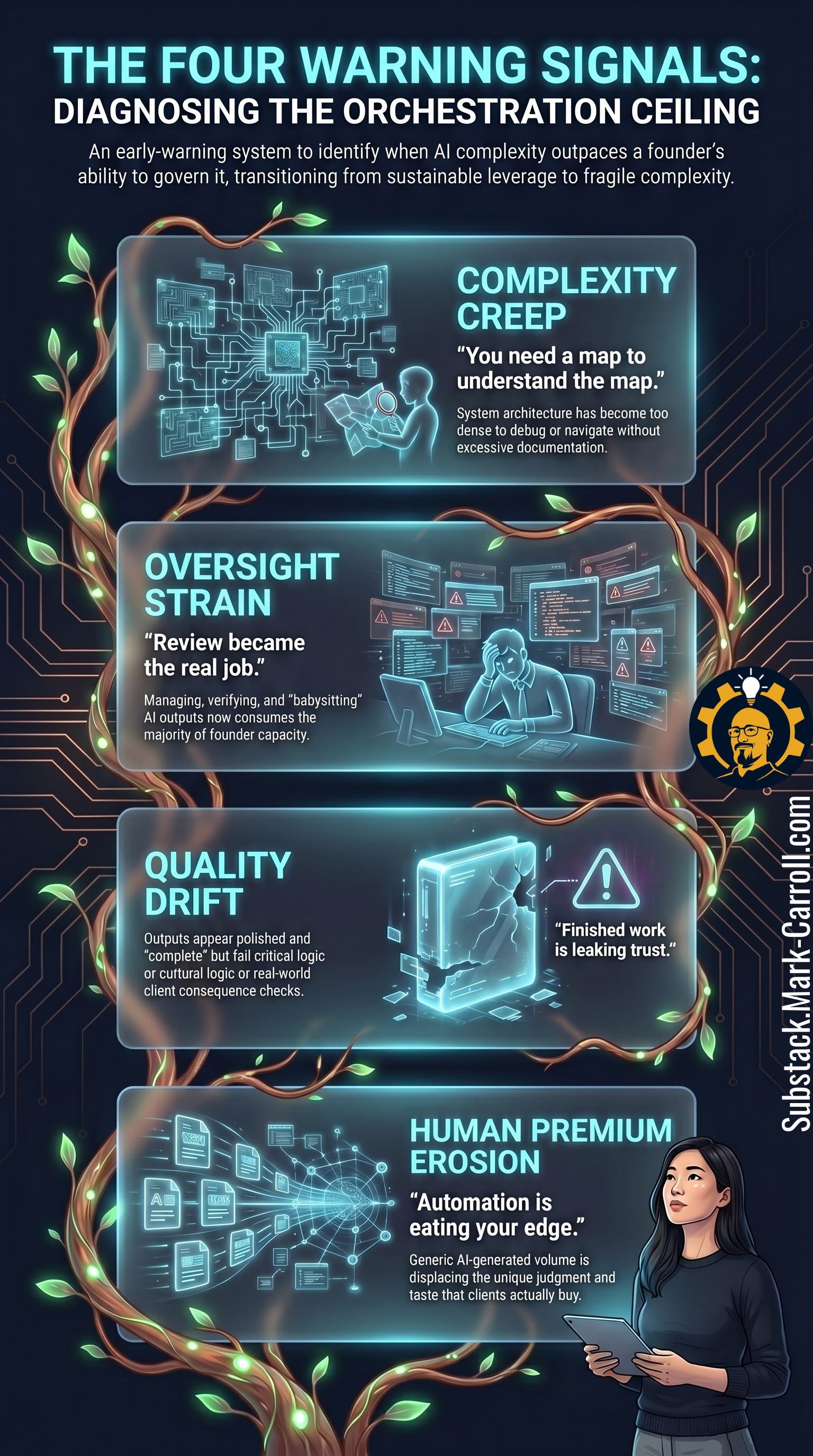
The ceiling usually announces itself as a pattern, not an incident.
The first signal is complexity creep. Complexity creep begins when you need a map to understand the map. Your workflow no longer has a simple story. It has tools, agents, prompts, folders, triggers, fallback paths, dashboard views, hidden dependencies, and one crucial connection you set up at 1:13 a.m. with the confidence of a frontier dentist. You cannot explain the system in two minutes, and you cannot change one piece without wondering which other piece will quietly break.
The second signal is oversight strain. Oversight strain begins when review becomes the real job. You are not using the output anymore. You are inspecting it. You are not trusting the automation. You are checking whether it behaved. A little oversight is responsible. Constant oversight is a warning sign that the system has not earned the right to run without you.
The third signal is quality drift. Quality drift is dangerous because the work still looks finished. The document is formatted. The email is coherent. The spreadsheet has rows. The summary has bullets. The deck has a title slide, which is the business equivalent of wearing a tie to a burglary. Yet the output may miss context, flatten judgment, or lose the client’s nuance. Quality drift appears as “completed” work that quietly leaks trust.
The fourth signal is recovery fragility. Recovery fragility is what happens when a workflow breaks and no one besides you can diagnose, repair, or rebuild it. The person who set up the automation is the only person who understands it, and unfortunately, that person is also you. When recovery depends entirely on founder memory and founder availability, the system is not resilient. It is renting space in your nervous system.
When those four signals compound, the human premium starts to erode. The work gets faster, but the offer gets less distinctive. AI can help with assembly, drafting, summarizing, sorting, formatting, and first-pass synthesis. Clients, however, do not pay you only for volume. They pay for judgment, taste, trust, timing, relevance, and knowing when not to say the technically correct thing in a way that makes everyone regret the meeting. When your stack automates too close to the trust layer, your offer may get faster while becoming less defensible. That is not scale. That is dilution.
How the whole season arrives here
These are not separate problems.
They are warning lights from the same dashboard.
Cheap tools became operational load. Automation became management work. “Done” became a quality illusion. The founder had to shift from execution to design. The human premium became the part of the offer worth protecting. The Orchestration Ceiling appears when all of those lessons arrive at once, and the question is no longer how to fix any single workflow but whether the whole system producing those workflows can still be safely governed.
That is the capstone question of this series. Everything before it was diagnosis. This episode is the operating limit.
The false solution trap
When hybrid systems start to strain, the first instinct is usually to add. Add another dashboard. Add a monitoring tool. Add a QA agent. Add an observability layer. Add a second automation to check the first automation, then a third automation to notify you when the second automation has lost its will to live.
This is how the stack becomes a Rube Goldberg machine with invoices.
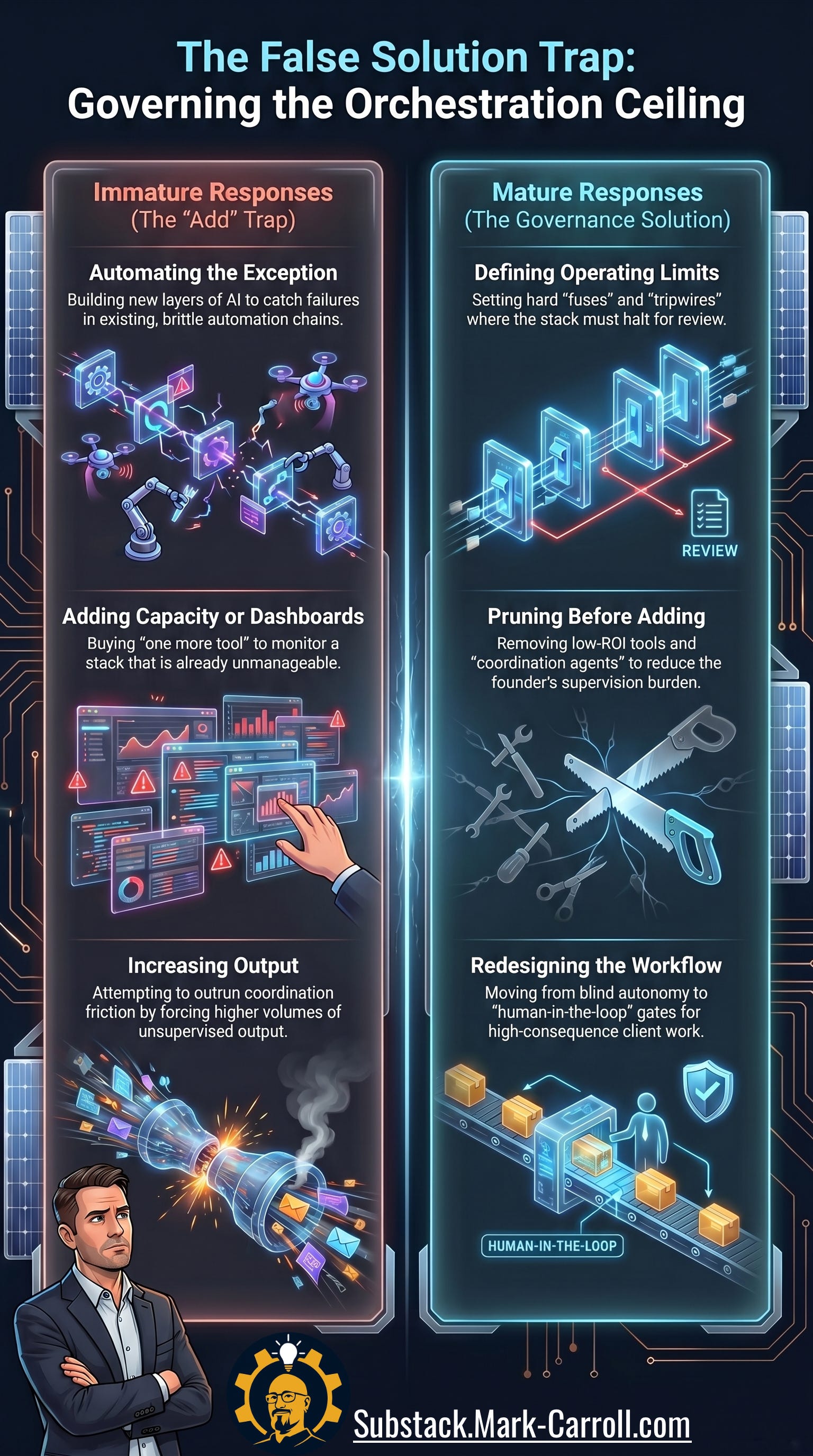
Adding coordination to fix coordination is how the stack becomes the job.
Adding is not neutral. Every tool brings a maintenance surface. Every automation brings a failure mode. Every agent brings an oversight question. Every dashboard brings a temptation to monitor instead of decide. A serious operator eventually learns that “more” is not a strategy. More can be avoidance. More can be denial with a product tour. The stack does not need expansion. The stack needs boundaries.
Automation debt
I think of automation debt differently from technical debt. Technical debt is the interest you pay on past engineering shortcuts. Automation debt is the interest you pay on fragile workflows that only function because you keep supplying attention.
Automation debt is a practitioner’s term, not a textbook term. It describes what happens when a brittle workflow survives not because it is reliable, but because one person keeps nursing it through each run. A client sends a weird input. A field name changes. A model behaves differently. A prompt misses context. A tool updates its interface. A workflow finishes, but the finish line was drawn in the wrong place.
You pay it in checking time, recovery time, rework, context switching, and the little stomach drop that happens when you realize the system ran while you were not looking. The cost of automation is not just the subscription or API bill. The cost can also show up as supervision time, failure handling, delayed delivery, and trust repair.
You do not need a dramatic statistic to know a workflow has become expensive when the “saved time” keeps reappearing as cleanup.
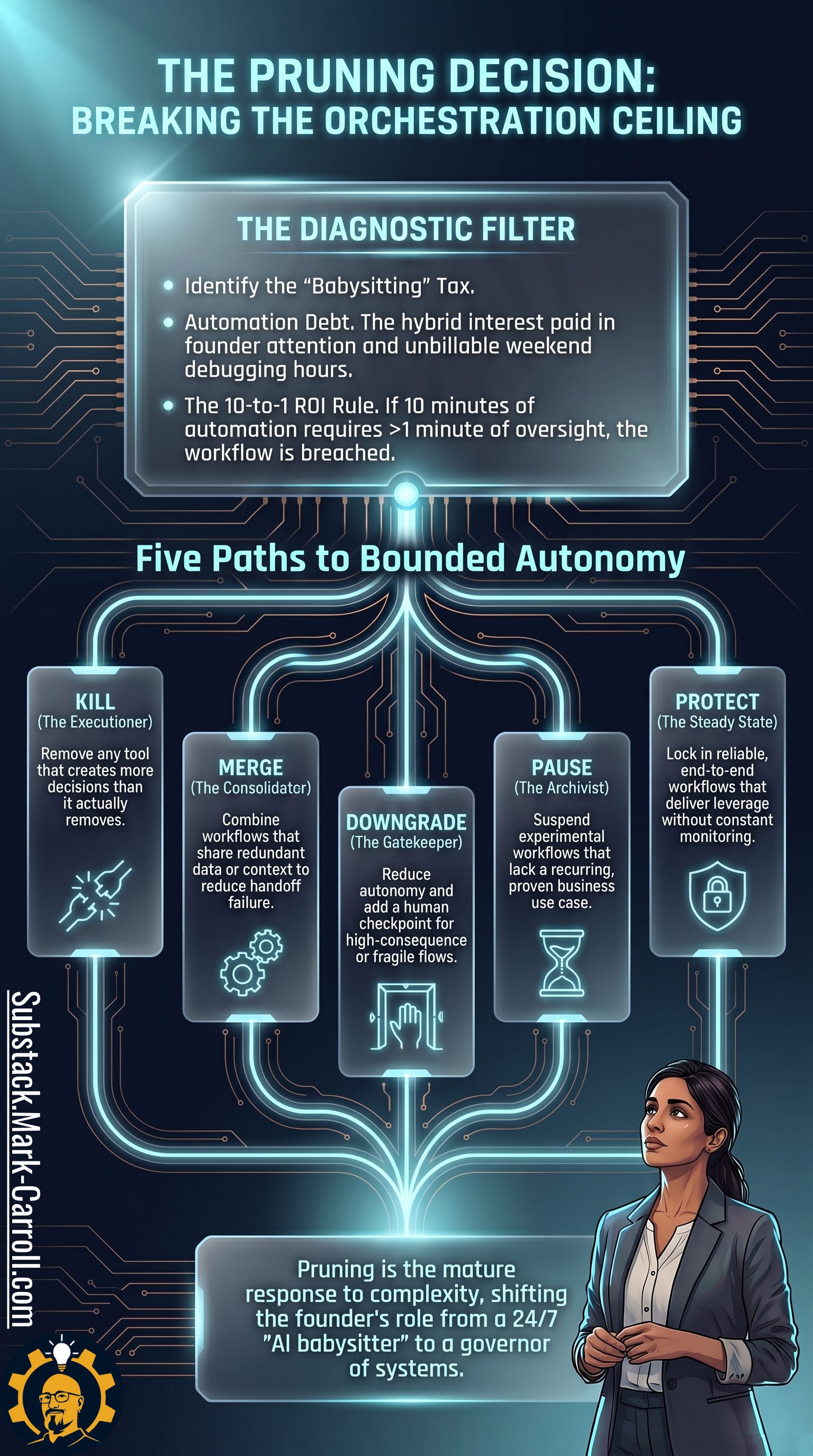
Pruning is not retreat
The mature response to complexity is not always another build.
Sometimes the mature response is pruning.