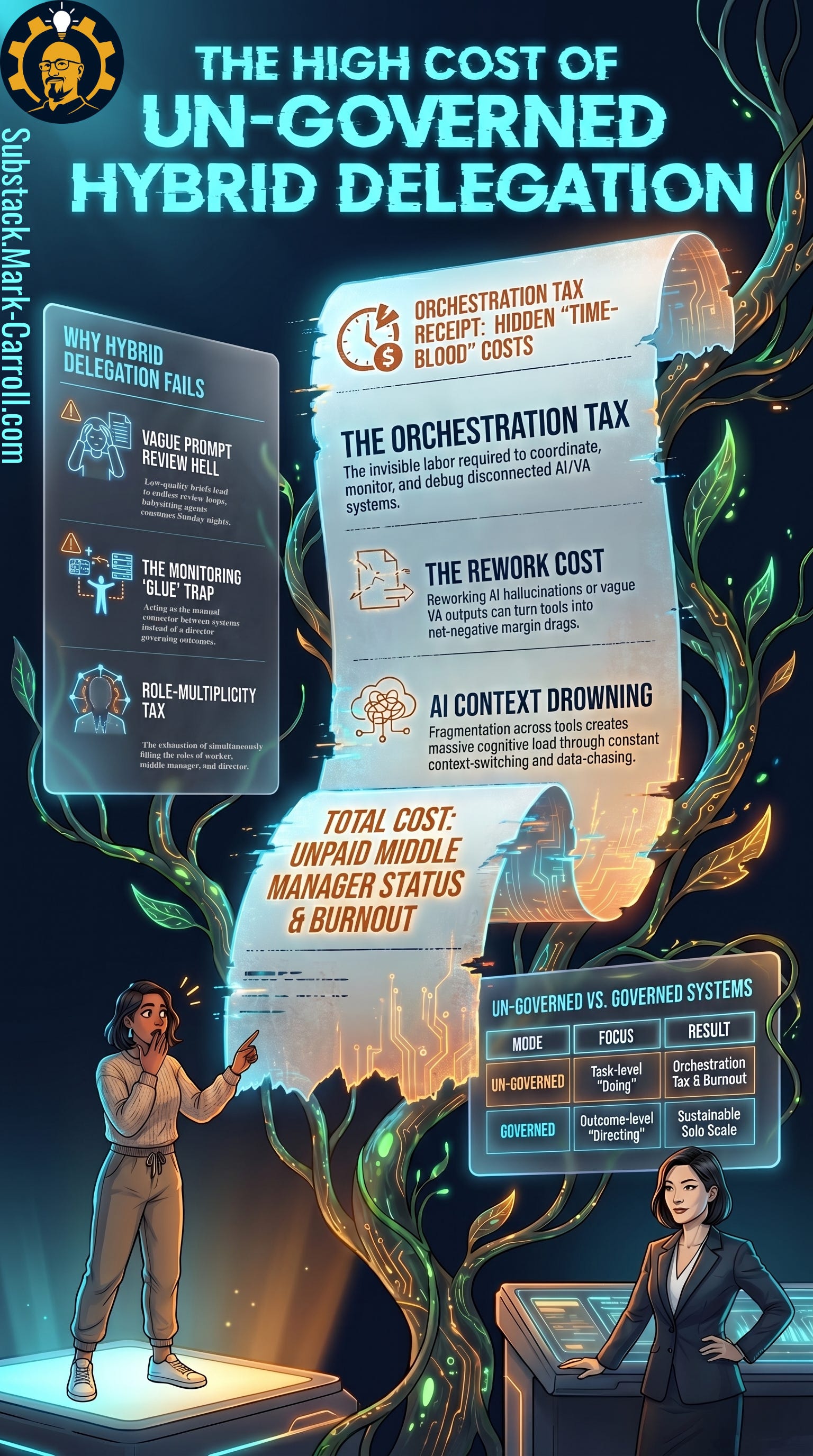
The Solopreneur Job Nobody Wants
🔒 Leader’s Dispatch: Volume 40 (Hybrid Solopreneur, Part 4 of 6 Part Series)

Episode 04: From Doer to Director
Why the skill that built your solo business is now the one holding it back
The Summer-Camp Parking Lot
👋 Welcome to my paid subscriber-only edition of Empathy Engine (Leader’s Dispatch). Each week I build evidence-informed tools for serious solo operators, leaders, and team leads who have moved past the hype and are now wrestling with the real operating cost of hybrid AI stacks and contemporary organizations.

In Episode 1, I separated the fantasy of cheap AI leverage from the hidden orchestration tax that eats your week. In Episode 2, I showed how the stack reassigned management directly back onto the founder. In Episode 3, completion theater produced outputs the client could see through. Episode 4 is where the diagnosis pivots to agency. If you can see the gaps, the next question is what role would stop producing them.

Research Binder: the receipts (citations + source notes) are compiled in a PDF at the bottom of this post.
I had already handed the task off to my VA. That should have been the end of it.
Instead, I was acting like a dad lingering too long in the summer-camp parking lot, wondering whether my precious child had enough sunscreen, remembered her water bottle, and would make friends before lunch. I was checking in, re-checking instructions, pre-answering questions nobody had asked yet, and hovering over the whole thing like the camp counselor had personally promised to ruin “my kid’s life” by Tuesday.
That was the moment it clicked. My VA was doing the work. The task had, in fact, arrived safely at camp. The only person still emotionally boarding the bus was me.
My kid was going to be just fine at camp without me. My VA was never my baby to begin with.
The work was executed. The role that produced it was never designed.
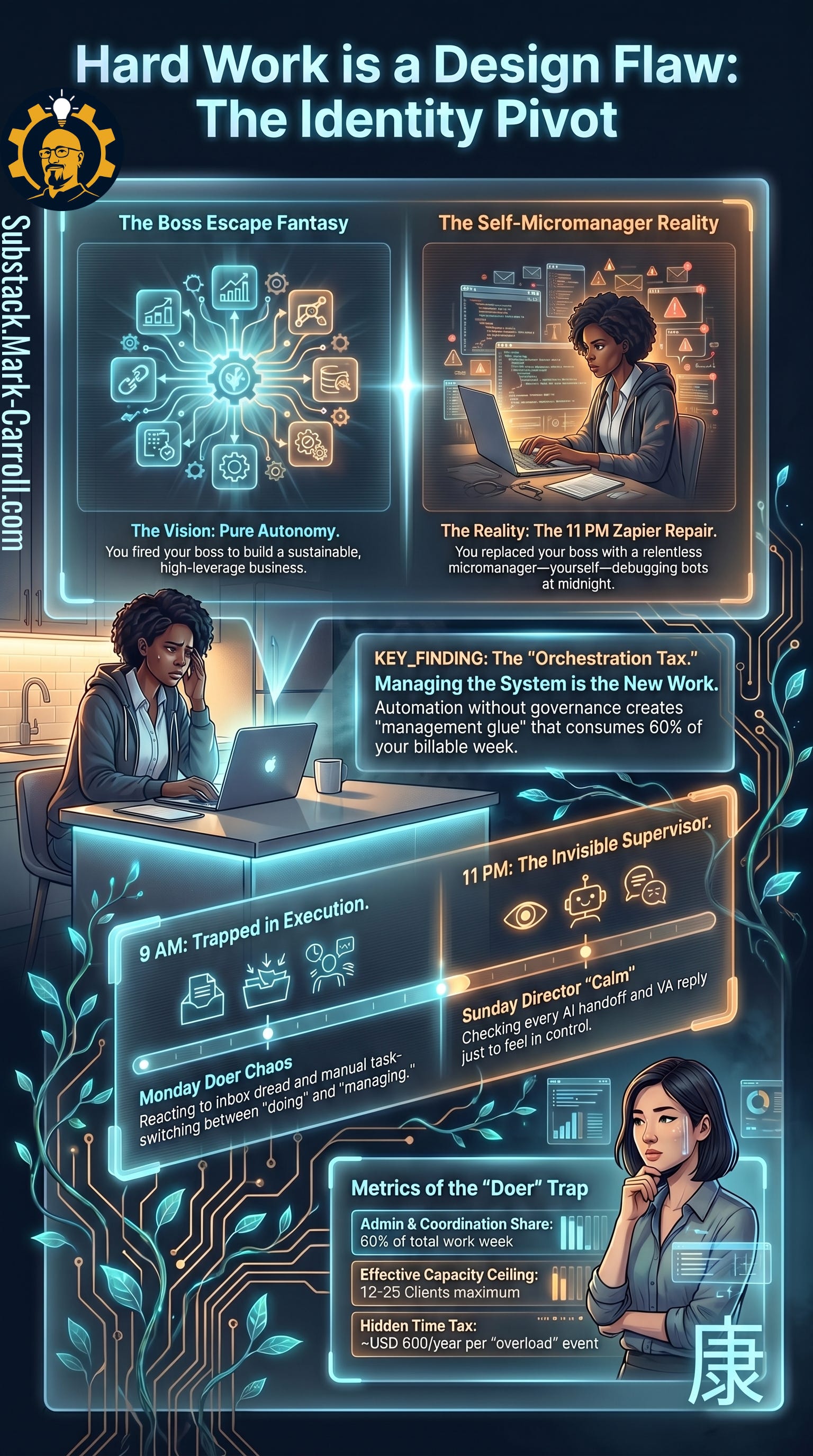
This episode is about that second sentence.
This is written for the Friday-afternoon sweeper and the Sunday-night system tinkerer: the founder who automated half their business and still spends the weekend reopening every handoff, checking every log, and rereading work already marked done just to feel like the business is coherent.
The Role That Built It Is Not the Role That Governs It
Episode 3 ended with a handoff. If you can already see the gap between completed and done, the question is no longer how to catch it every time. The question is what role would stop producing it in the first place.
Episodes 1, 2, and 3 diagnosed. This episode reframes.
The skill that built your solo business is execution. The skill that governs a hybrid business is design. They are not the same skill, and most founders discover that only after the system has trained them into becoming its backup plan.
Hard Work Is a Design Flaw
For a long time, hard work has felt like proof of seriousness. It can feel responsible to stay close to the tasks, responsible to recheck the outputs, responsible to be the person who notices what everyone else missed. In a traditional solo business, that instinct helps you survive. In a hybrid business, that instinct becomes the design flaw the system quietly depends on.
Exhaustion is not evidence of ambition. Role-conflict research suggests the strain comes less from raw hours than from carrying incompatible roles at once. The founder who is worker, reviewer, manager, and director by three in the afternoon is not weak and because of all of this. They are structurally overloaded.
That reframing changes the right next move. If exhaustion is a workload problem, you work less or you work smarter. If exhaustion is a role-definition problem, neither of those moves the needle. The only thing that moves the needle is redesigning which role produces the work in the first place.
The rest of this episode is how to stop shuttling between the fantasy and the role you actually ended up in.
The Self-Micromanager
The old fantasy was not irrational. You leave external supervision, build a lean solo operation, add tools that increase throughput, reclaim the week that used to disappear into repetitive labor. That picture is attractive because it is almost true. Research does get faster. First drafts do appear sooner. Repetitive mechanics get lighter.
The part that shows up later looks less like freedom than constant low-grade surveillance. You reopen outputs that were already approved, double-check automations that technically ran (or ran well enough), scan handoffs simply to recover the feeling that the business is still coherent. The old boss is gone. The new one is harder to argue with because the voice now sounds like prudence.
My own tell is that I reopen emails that are already queued and approved, as if the copy might have wandered off unsupervised in the last forty-five minutes and returned with a face tattoo. The copy hadn’t #SpoilerAlert. It is exactly where I left it. The only moving part is my willingness to trust that scheduled means scheduled.
That is the tell underneath the tell. I notice it in myself most clearly when I am monitoring success more intensely than I used to monitor actual failure. The workflow ran. No alert fired. No one complained. And I still find myself opening the automation log the way someone checks the pulse of a patient who just casually jogged around the block. Nothing is wrong. I am the part that has not caught up.
There is a specific kind of solo-operator absurdity worth naming. The founder has built systems, support, automations, queues, and layers of process, and still behaves like the maître d’, host, waiter, and chef for a restaurant with one table. Every task is greeted, seated, checked on twice, and personally thanked for dining with us. No tip is ever given, therefore the extra efforts earns nothing.
Operators describe the pattern consistently. One founder put it plainly: nothing moves unless I move first. The system technically runs. The founder is still the single point of coordination holding it together. That is a role description, not a workload description. It is also the self-micromanager: the founder who built a business to escape management and ended up the only supervisor in it managing everything.
What I find quietly funny about the current hybrid solopreneur discourse is how many operators claim they have built a team of five AI agents and finally escaped the grind, then proceed to describe a setup that clearly requires them to supervise all five like a substitute teacher on the last day of school. The agents have names. The workflow has a diagram. The founder still has not gone on summer break.
The best worker in the room is the bottleneck the system routes around.
Authorship, Not Consequence
Underneath the self-micromanager pattern is a distinction most founders do not name out loud. The doer protects authorship. The director protects consequence. Those sound similar. They are not.
Authorship is the feeling of having personally made the thing. Consequence is what would actually happen if the thing were slightly different. A founder who stays close to a workflow because the consequence is real is doing the job. A founder who stays close to a workflow because it still feels like the place where the business happens is protecting identity. Both feel like judgment in the moment. Only one of them is.
The distinction matters because the self-micromanager rarely knows which mode they are in. The work looks the same from the outside. The founder is present, engaged, careful. The question the director has to learn to ask is whether presence at this specific step would change the outcome if the founder stepped away, or whether it would only change how much the founder feels like the author.
That question is harder to answer honestly than it sounds. I took longer than I should have to notice I had been answering it wrong.
What does it actually cost to live inside the authorship reflex? The list runs longer than most founders track, because most of the cost hides in places no system records.
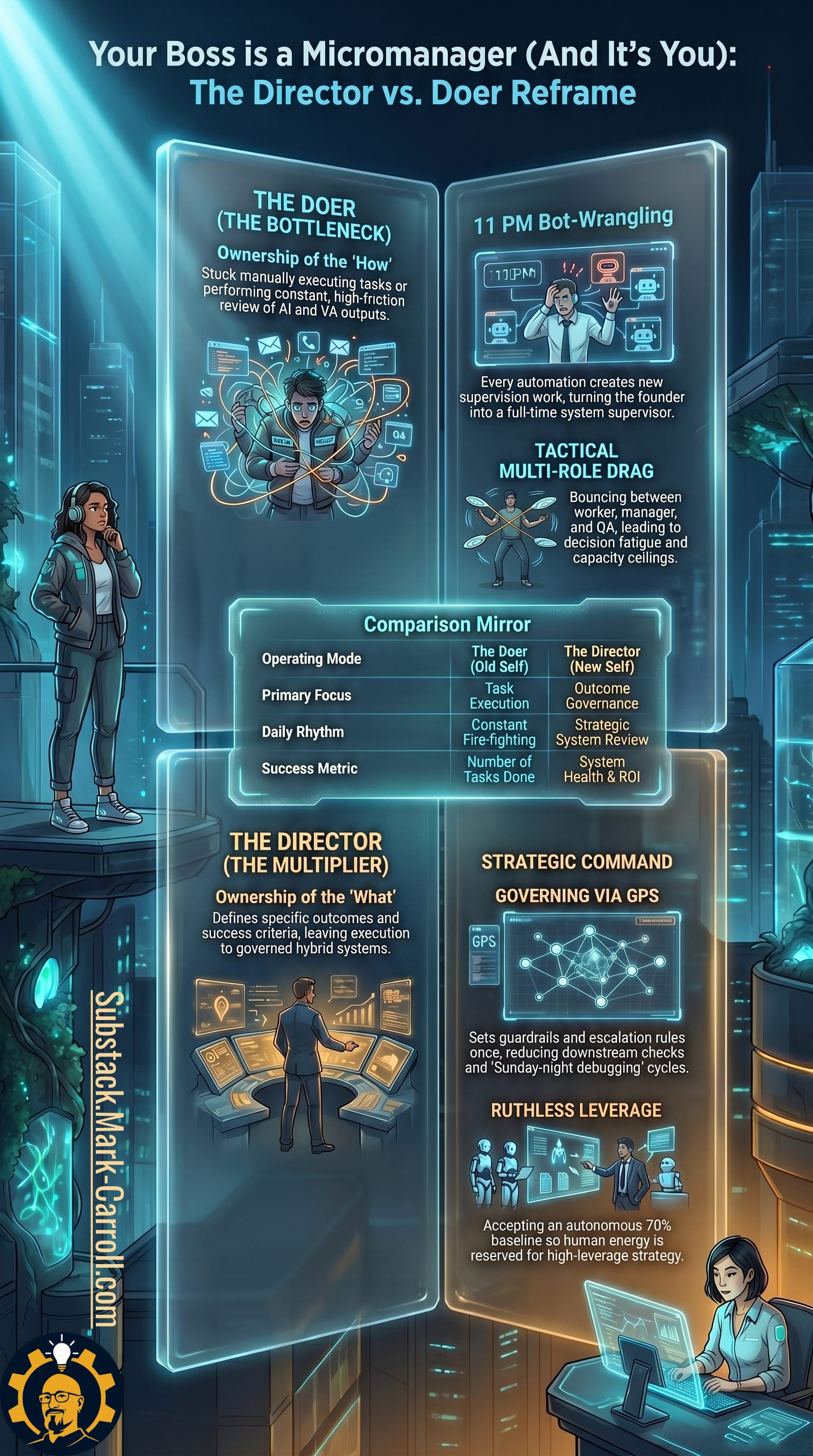
In one ordinary week, it looks like this. You fix work that was already done. You reopen logs for workflows that quietly ran. You play worker, manager, reviewer, and director before Wednesday. None of it shows up on a P&L. It only shows up when your calendar is full and your actual capacity is not.
The tool that follows in this episode is built to stop the invisible billing cycle before it compounds further.
From Doer to Director
The doer owns the how. That sounds admirable because it makes the founder look committed and close to the truth of the work. It also makes them dangerously available to every recurring task, every exception, and every quality wobble. Every system eventually learns the same lesson: if something gets weird, route it back to the founder.
The director owns something narrower and more useful. The director owns the what (What are we building?), the boundaries, the success criteria, and the conditions under which work can proceed without supervision. The shift is from authoring the work to governing the conditions the work proceeds under.
The director is not absent. The director is selectively visible: present at moments of consequence, absent from everything else.
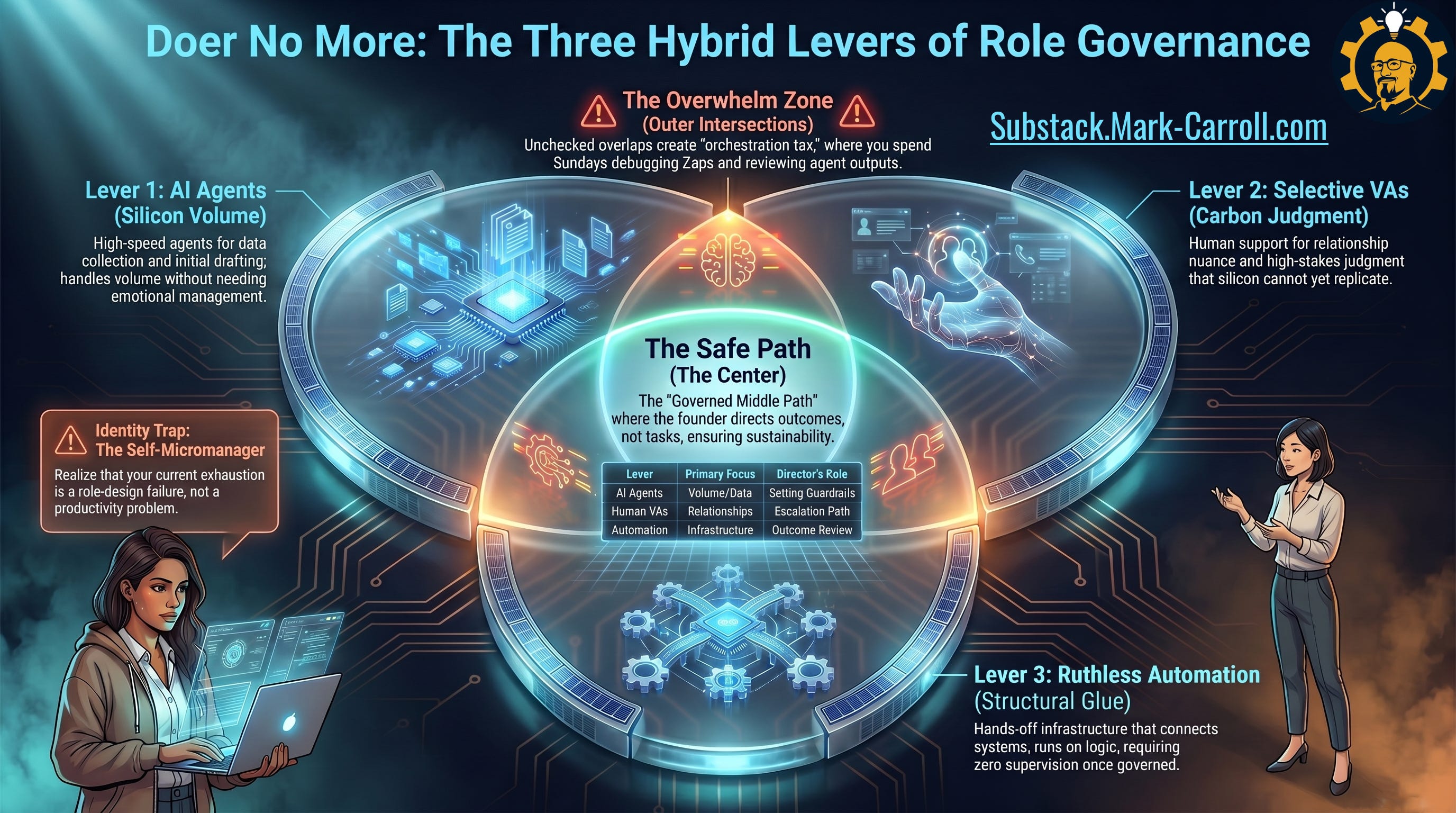
A hybrid solo business runs on three levers: system execution (what AI and automation handle reliably), human support (what a collaborator handles with outcome-level guardrails), and founder governance (what only you can decide). The trouble starts when those lanes blur. The founder becomes the integration layer, the nervous system holding the operation together because the handoff logic stayed implicit. That overlap zone is where the week disappears.
The center of that Venn (diagram so to speak …) is what a governed hybrid business actually looks like. Not any one lever dominating. Not the founder vanishing from the business. A governed middle where each lane has an owner, each owner has a brief, and the founder directs outcomes instead of executing tasks.
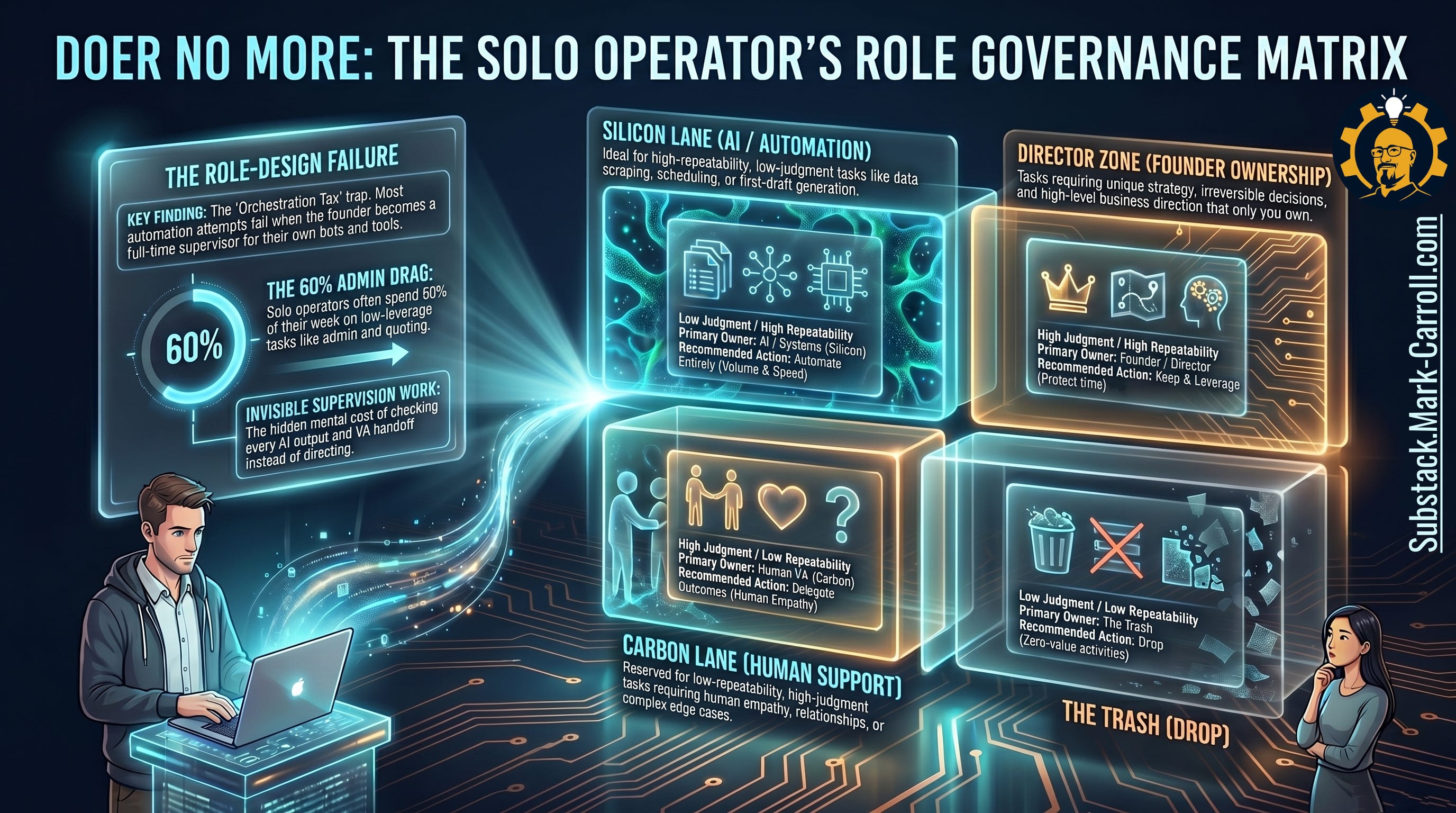
The Role Governance Matrix
Most solo operators live inside classification failure. Every recurring task is either founder-owned, system-owned, human-supported, or not worth carrying at all. If it sits in an unexamined middle, it defaults back to the founder through rework, hovering, correction, or anxious review. That default is the hidden law behind a surprising amount of hybrid-business exhaustion.
The Role Governance Matrix has four lanes.
Silicon lane. High-repeat, lower-judgment work an automation or AI can own end to end with monitoring rather than supervision. Data collection, scheduling, first-draft generation.
Carbon lane. High-judgment but trainable work a collaborator can own with clear outcome-level guardrails. Relationship nuance, edge-case judgment, human empathy.
Director zone. High-consequence judgment only you can make. Claim integrity, strategic positioning, irreversible decisions, relationship calls that shape what the business becomes.
Drop. Work that survives only because nobody audited whether it should exist. Vanity reporting. Duplicative tracking. Meetings that perform coordination more than produce it.