Needing another human is not a retreat. Sometimes it is the next layer of leverage.
👋 Welcome to my paid subscriber-only edition of Empathy Engine (🔒 Leader’s Dispatch). Each week I build evidence-informed tools for product professionals, and team leads who have moved past the hype and are now wrestling with the real operating cost of hybrid AI stacks and contemporary organizations.
What happens when the AI stack works, but the founder is still the bottleneck?
Mara shipped the dashboard on Tuesday. Not a prototype, not a mock-up, not one of those “mostly working” demos that only behaves while the founder sits beside it, whispering encouragement like a stage parent at a middle school talent show. The real customer dashboard went live. The workflow ran. The data moved. The metrics turned green.
Cursor scaffolded the logic. v0 shaped the interface. Make.com kept the workflow moving. Claude handled copy, summaries, and customer-facing drafts. Work that once needed a small team and several weeks moved through Mara’s solo stack in two focused days. That deserves respect before anyone starts shouting “scale.”
Previously:

The solo window is real in a specific way. AI has expanded what one capable founder can ship alone, especially in knowledge work, where drafting, prototyping, research, workflow design, and customer communication now move faster than the old playbooks expected. Solo is not a failure state. Staying solo can protect speed, margin, clarity, and autonomy.
This article is about what happens when that window stays open, the stack keeps working, and the real bottleneck quietly moves from execution to judgment.
Then Wednesday arrived. Three customer emails were waiting before the coffee was finished. One was from Dani Park, Mara’s best customer, asking for a pricing exception that sounded reasonable and could quietly set a precedent. Another described an edge case that technically worked but felt wrong inside the customer’s real workflow. The third asked for a small feature tweak that looked harmless until Mara pictured the roadmap bending around it.
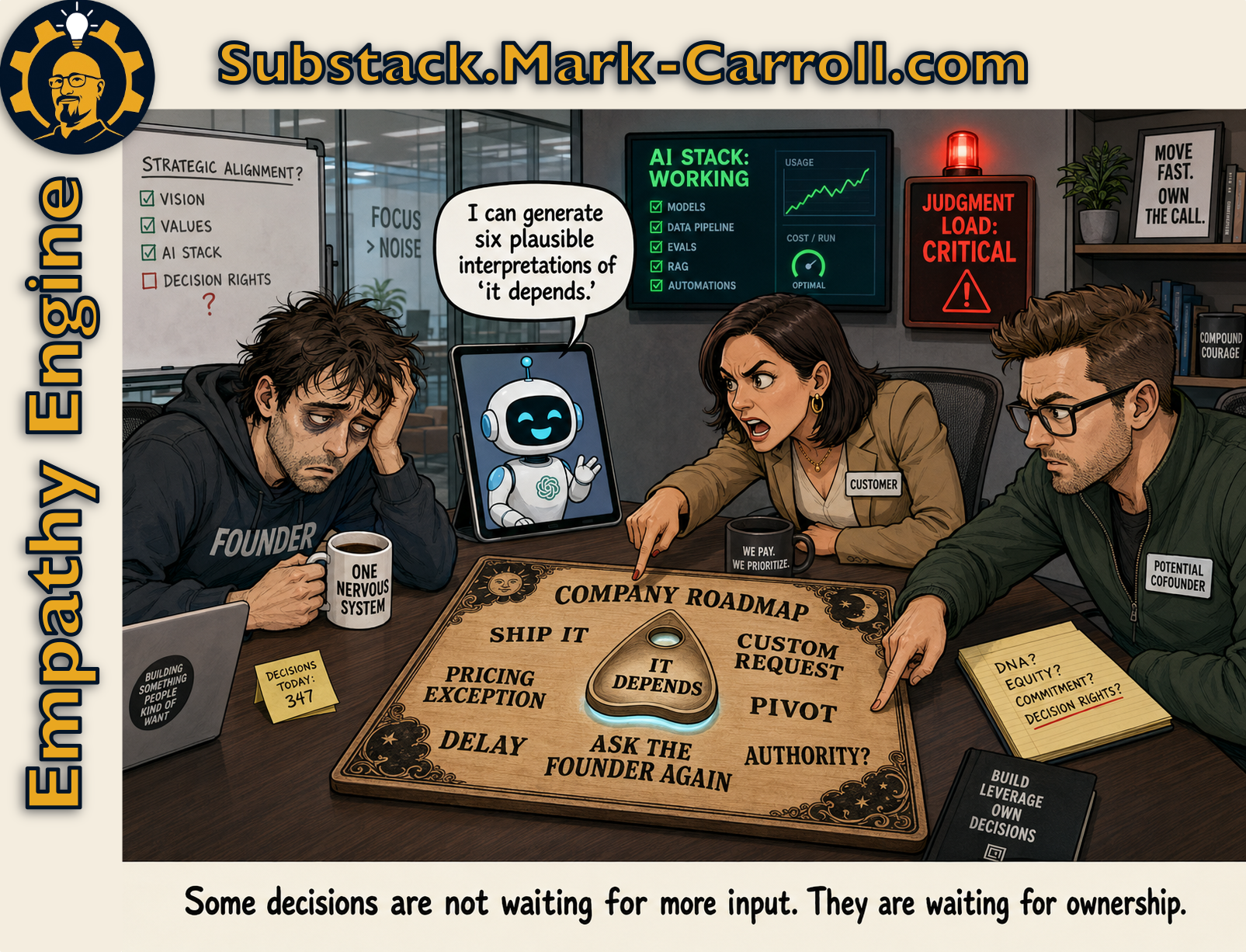
Claude summarized each thread and drafted three polite replies. The replies were logical, professional, and almost right, which made them more dangerous than if they had simply been bad. Mara rewrote all three, because the words were never the problem. The problem was that every customer-facing consequence still routed through her judgment.
I have had my own versions of Mara’s Wednesday. In my Empathy Engine workflow, the stack can organize a draft, shape the argument, help generate visuals, and prepare promotional copy before I have finished my coffee. That does not mean the final call has left my desk. I still have to decide whether the claim is fair, whether the tone respects the reader, whether a collaborator is being represented accurately, and whether the piece says something I am willing to have my name carry.
That pattern is not new to AI for me. Years of coaching, facilitation, and improv taught me the same thing in rooms full of humans: the agenda can be clean, the exercise can be smart, and the plan can look correct, while the real judgment is still reading what the room needs next. Almost-right output can move the work forward. Context decides whether the work should carry your name.
Research Binder: the receipts (citations + source notes) are compiled in a PDF at the bottom of this post.
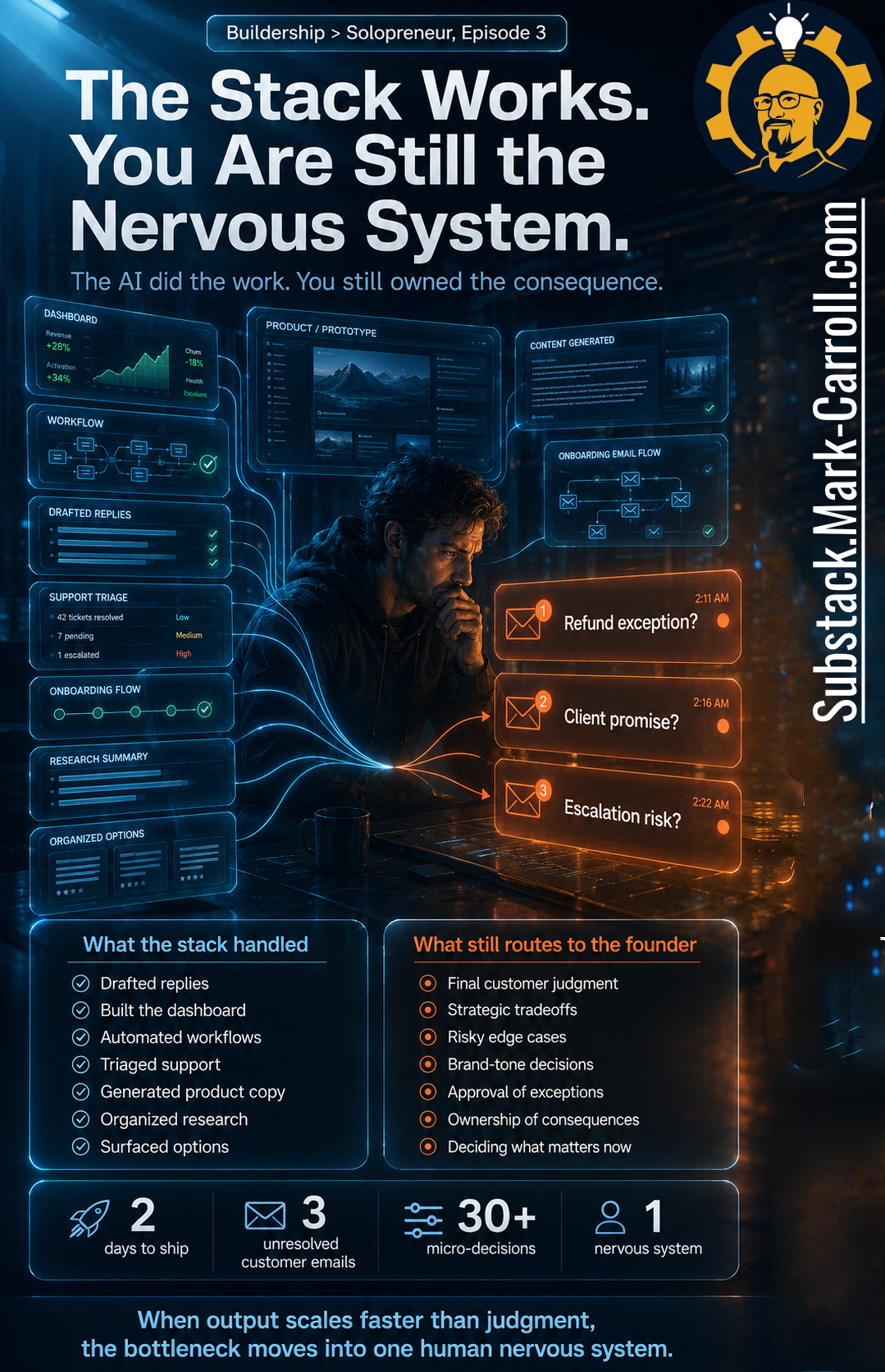
That is the uncomfortable center of this episode. The tools did not fail Mara. The stack did exactly what she built it to do. The dashboard shipped, the drafts appeared, the workflow moved, the queue thinned, and the options surfaced. The final judgment still belonged to one person.
AI can draft around the question, summarize the tradeoff, and generate plausible answers all day. What it does not do is carry the consequence of what the company promises next. That is not a knock on the tools. It is a description of where accountability lives. The work is moving, and the meaning of the work is still concentrated in one human nervous system.
Once the stack works, overload does not disappear. It hides, and it hides in more than one place. In Episode 2 I sorted the friction into three loads: execution, correction, and decision. Post-solo, those three are still here under plainer names, and two more appear the moment another human enters the picture:
Task load: the manual work AI did not remove. System load: the hand-off cost of being the one who moves context between tools. Review load: the cost of verifying almost-right output, which in Episode 2 I called the supervision tax, a specific form of the Judgment Tax. Judgment load: the consequential calls that still route to one person. Role ambiguity: a label arrives before the decision rights it implies. Control tension: another person’s input feels like both leverage and loss.
You will recognize each of these as the article goes on. Naming them now is the point, because the next move depends entirely on which load is actually heavy.
Why does the bottleneck move from execution to judgment?
In the older version of solo work, execution was the visible constraint. The founder needed more hours, more hands, more capacity, because the work piled up faster than one person could build, draft, research, support, sell, and ship. If the business felt stuck, the explanation was usually simple: too much doing, not enough time.
AI changes that equation, though not universally and not with the clean magic promised by people who use “autonomous agents” the way previous generations used “synergy,” which is to say, as a spell rather than a plan. In many founder workflows, AI does reduce task time and expand what one person can analyze, prototype, write, test, and prepare. Execution capacity gets dramatically larger.
That does not make the business lighter. Execution speeds up while judgment concentrates. The founder is no longer waiting on a draft, a mock-up, a summary, or a workflow. The founder now has to decide which draft is safe, which mock-up fits the promise, which summary changes the next move, and which workflow can actually be trusted.
Before AI leverage, the bottleneck sat inside the work. After the stack works, AI builds, drafts, triages, summarizes, and surfaces options, but the meaningful arrows still converge at one place: final judgment. That convergence is where the old advice gets sloppy.
The standard next move after solo strain is treated as obvious. Hire someone, delegate more, add a VA, find a co-founder, buy another tool. Any of those can be right in the right context. They become expensive mistakes when they are used before the founder understands which load has actually become unbearable. The better question is not whether the founder needs help in some motivational-poster sense. The better question is which decisions still require the founder every single time.
Why can AI make a solo founder feel more overloaded, not less?
The hard part is not always the big strategy call. Often the real load is smaller, quieter, and more irritating. A customer asks for an exception that seems harmless. A support reply needs a tone adjustment. A feature request looks tiny until the founder sees where it points the roadmap.
None of these feels large enough to stop the day. That is the trap. AI can generate the draft, summarize the thread, list the options, and suggest the next move. The founder is no longer staring at a blank page. The founder is staring at several plausible paths, each with a different consequence attached.
That is how speed turns into judgment load. The system hands Mara more to weigh, not because the system is broken, but because plausible options still require discernment. The work shifts from making something exist to deciding which possible thing should carry the company’s name.
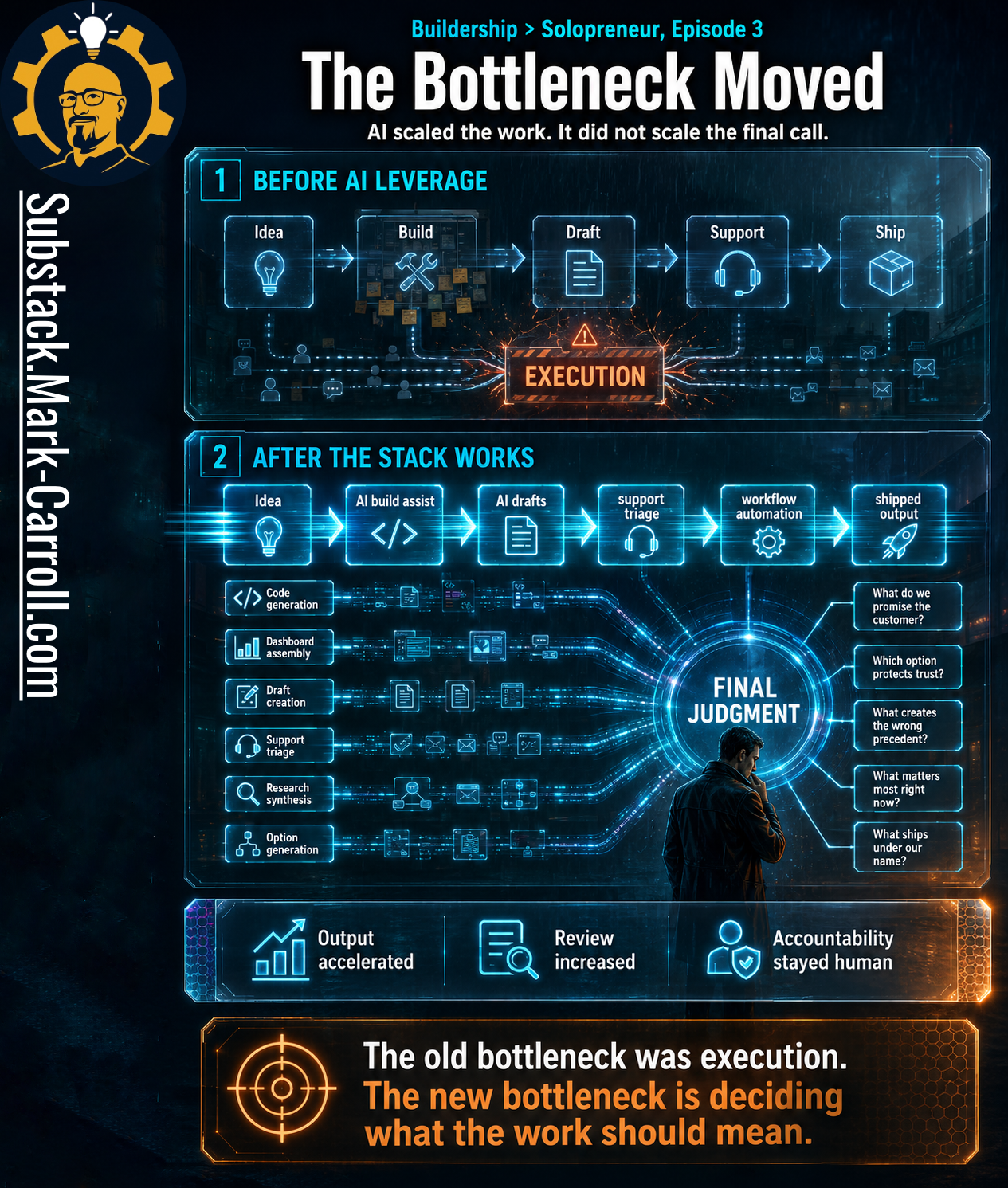
The day no longer feels blocked by labor. It feels crowded by judgment, because every small decision now carries a piece of customer trust, product direction, or future precedent.
Some founders solve this by improving their solo operating system. They batch decisions, set review windows, keep a decision log, write better prompts, and define a few principles before the next exception lands. Trust over speed. Roadmap integrity over custom requests. Clarity over cleverness. Those moves matter, because the answer is often not another person.
The real risk is misdiagnosis. If every form of strain gets called a hiring problem, the founder adds people before understanding the load. If every form of strain gets called a tooling problem, the founder keeps buying software to avoid naming the judgment at the center of the business. Neither move is brave, and both get expensive.
Why is almost-right AI output still work?
Mara’s Wednesday problem was not bad output. Bad output is easy to reject. You read it, you delete it, you move on.
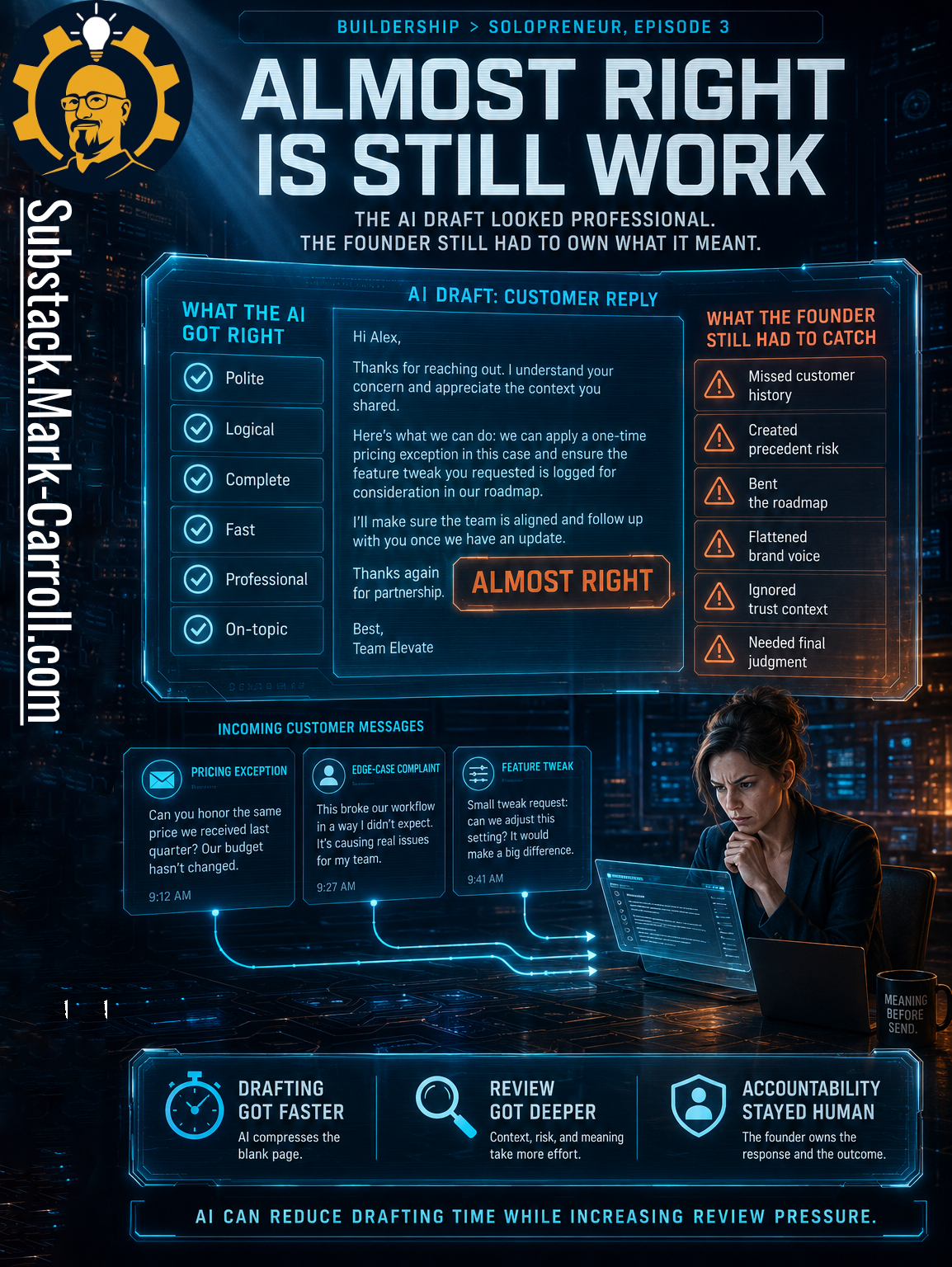
The dangerous output is almost right. It looks professional, sounds polite, and reads as competent. It hands the founder relief, because momentum has appeared, and it hides its real cost, because the founder still has to verify whether the draft fits the situation, the customer, the product, and the promise.
Mara’s draft to Dani was polished. The tone was right, the wording was clean, the summary was accurate. The draft still missed the relationship, because Dani was not just another customer in a queue. She had become a kind of product conscience for FlowPilot, the customer whose feedback mattered because she saw the product from inside a real operating environment. Granting her pricing exception might protect trust. Granting it casually might create a precedent Mara would regret. The draft could help with language. It could not know which promise mattered most.

This is review load, and it is not new. In Episode 1 I named the broad cost of carrying every high-consequence decision the Judgment Tax. In Episode 2 I named one specific form of it the supervision tax: the time and energy spent checking, correcting, routing, and approving work before it is safe to use. Almost-right output is the supervision tax at its most expensive, because the founder is not editing words. The founder is verifying meaning.
The promotional layer is where I feel this most. An AI draft can produce a clean Substack Note, a strong title, or a Pinterest description that looks ready to go. Sometimes the hook is even good, which is rude because now I have to be responsible. The problem is that a good hook can still bend the promise. It can make the article sound more absolute, more dramatic, or more certain than the piece actually earns.
That review is not cosmetic. I have had a supposedly finished promo take half an hour or more because I had to ask whether the language would bring the right reader into the right expectation. The draft understood attention. My job was to protect trust. That is the piece AI can assist, but not own.
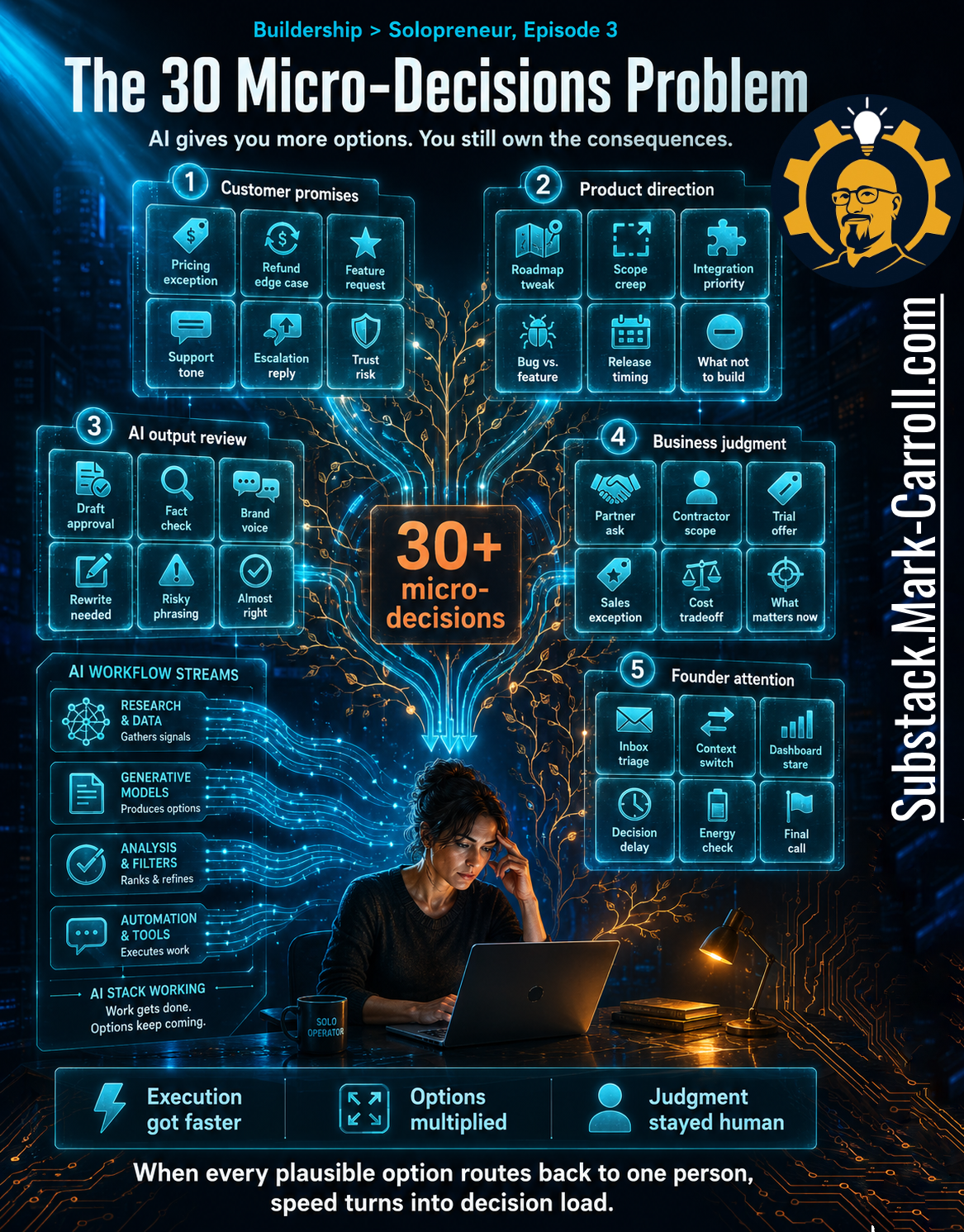
On a calm day, that can feel powerful. On a hard week, it feels like conducting an orchestra where every instrument is technically talented and none of them knows the song. The founder becomes editor, strategist, trust steward, and final signer, which is impressive right up until it stops being sustainable.
Name the judgment before you name the relationship.
The inbox is the visible version of this problem. Mara had already met the invisible version a few months earlier, and it had cost her more. The same fatigue that made Wednesday’s replies feel heavy had, months before, made a different shortcut feel reasonable.
FlowPilot had just crossed a small but real milestone. Revenue was up, customers were renewing, and the product finally felt less like an experiment and more like a business. That should have been a good week, but success has a way of making loneliness feel operational. Mara’s college friend Jess had been following the company from the sidelines. Jess was smart, warm, and interested. Over coffee, the conversation drifted from encouragement to involvement, and Mara, tired of carrying every important call alone, offered Jess a thirty percent co-founder stake. The offer felt generous, because Mara was trying to turn trust into structure.
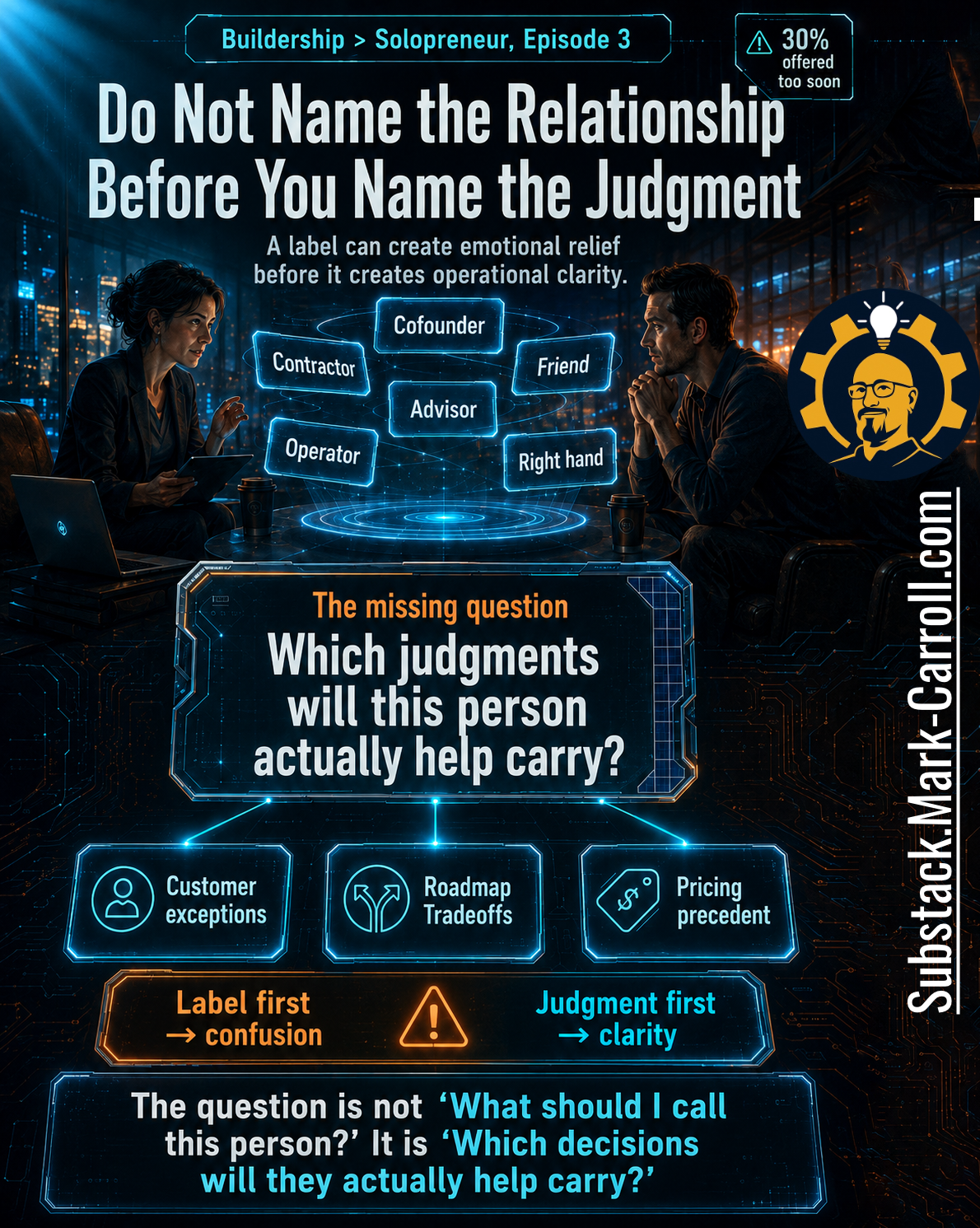
The offer skipped the most important question: which judgments would Jess actually help carry? Within three weeks, the mismatch surfaced. Jess expected a strategic voice. Mara expected execution help. Jess thought partner meant real authority. Mara still expected to make the product calls. Neither person was malicious, and neither was foolish. Both had filled an undefined space with different assumptions.
That is how vague labels create expensive confusion. Co-founder, contractor, friend, advisor, operator, right hand: each can create emotional relief before it creates operational clarity. They make the founder feel less alone, make the other person feel valued, and make the future feel more settled than it is. A label is not a strategy.
I have made smaller versions of Mara’s mistake in creative work, and I have watched larger versions happen inside organizations. The pattern is always more ordinary than the damage it creates. Someone gets called a partner, champion, lead, or right hand before anyone names the judgments attached to that word. One side hears trust. The other hears authority. Everyone thinks the relationship has become clearer because the label got warmer. Then the first hard decision arrives and the gap introduces itself.
The first post-solo mistake is not always waiting too long to add someone. Often the first mistake is naming the relationship before naming the judgment. Customer exceptions, roadmap tradeoffs, pricing precedent, product direction, sales promises, dissent rights, and decision authority are the real objects on the table. The relationship label should come after that map, not before it.
This is also where the boundary has to stay plain. Nothing here is legal, tax, employment, compensation, equity, or securities advice. A founder making structural decisions needs qualified professionals. The point is not to tell anyone what to offer another person. The point is to stop using a familiar label as a substitute for clarity. Jess did not teach Mara that needing help was wrong. Jess taught her that vague help can be worse than no help.
What is the difference between more hands and shared judgment?
After a mistake like that, the natural swing is the opposite direction: no partners, no collaborators, no more let-us-see-where-this-goes conversations over coffee. That reaction is understandable. It is also a different misdiagnosis.
The lesson is not to never involve another human. The lesson is to understand which kind of help the business actually needs. Some founders need more hands. They need someone to schedule, clear the inbox, move tasks, run repeatable processes, organize files, and take friction out of the day. That is real work, and no serious person should sneer at it.
Some founders need shared judgment. They need someone who can challenge the roadmap, pressure-test customer promises, spot precedent risk, hold product context, and push back when it matters. Those are not the same need, and confusing them is how founders end up disappointed with perfectly capable people they hired for the wrong job.