The Solopreneur Ceiling: When AI Moves the Bottleneck from Doing to Deciding
👋 Welcome to my paid subscriber-only edition of Empathy Engine (🔒 Leader’s Dispatch). Each week I build evidence-informed tools for product professionals, and team leads who have moved past the hype and are now wrestling with the real operating cost of hybrid AI stacks and contemporary organizations.
Mara shipped the dashboard redesign on Tuesday.
Not a prototype. Not a mockup. Not a private demo she could quietly bury if the thing embarrassed itself in public. The real workflow was live, customer data was moving through it, and the product looked better than she expected.
Her old team would have needed three weeks. The designer would have asked for another pass, the engineer would have warned about dependencies, and the project manager would have turned it into a multi-week plan. This time, Mara used her AI stack and shipped in two days.
Previously:

That part felt like magic.
Wednesday morning did not.
Three customer emails were waiting for her before the coffee had fully committed to being coffee. One customer wanted a pricing exception. Another had found an edge case in the new dashboard. A third, Dani Park, her most important account, wanted a feature tweak that sounded small but could quietly bend the whole product direction.
Mara asked her AI stack for help. The drafts came back quickly. They were logical, polite, and structurally useful. They were also almost right, which is the most exhausting kind of wrong.
The pricing email sounded generous but set a precedent she might regret. The edge-case response closed the ticket but missed what the bug revealed about onboarding. Dani’s reply was the most dangerous because the draft sounded confident while misunderstanding the actual trust problem underneath the request.
Mara rewrote all three.
The stack had worked. That was the strange part. AI had not failed her. The tools had done exactly what they were supposed to do: draft, summarize, route, and accelerate the work that used to consume entire days.
Research Binder: the receipts (citations + source notes) are compiled in a PDF at the bottom of this post.
The bottleneck had simply moved.
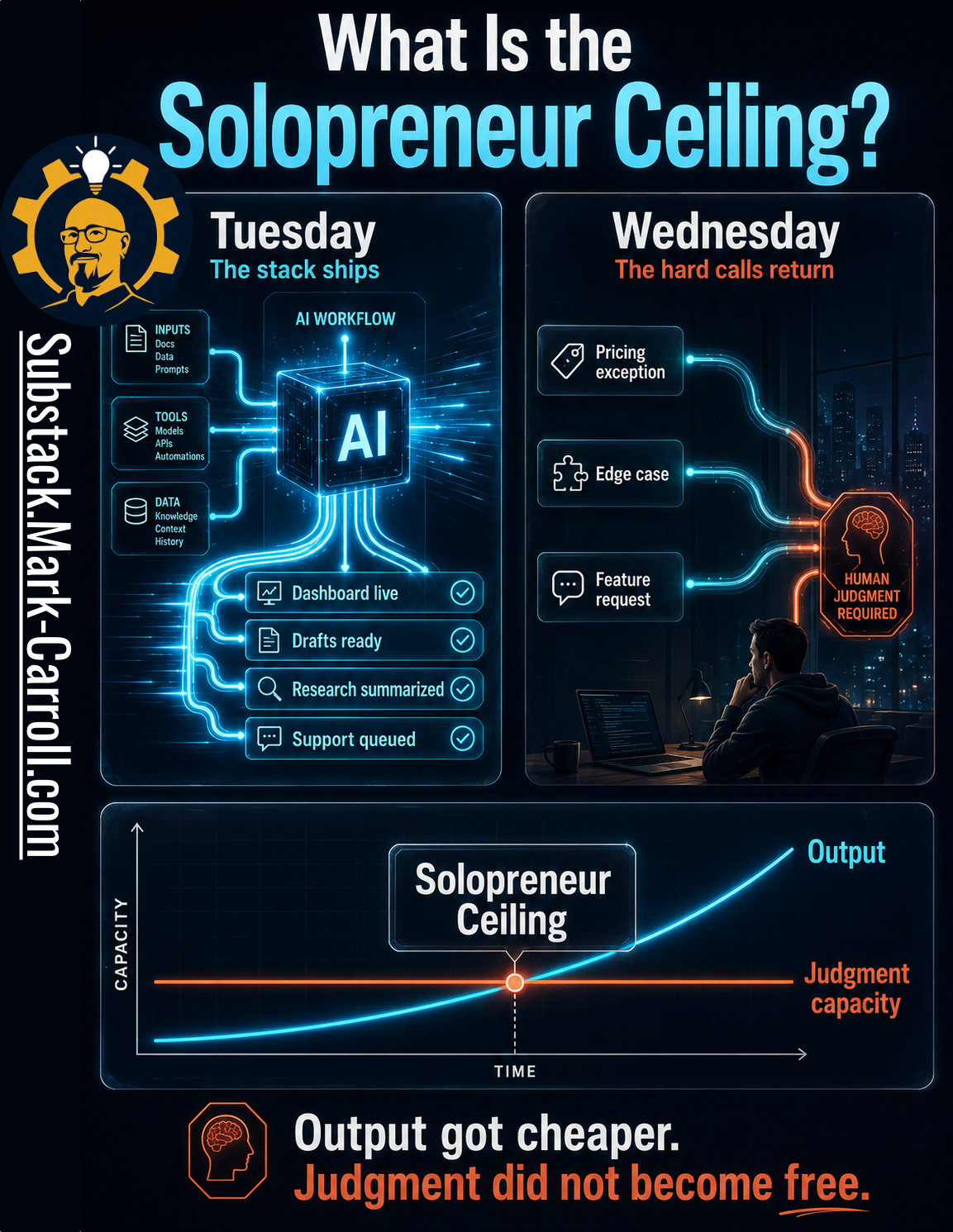
Output got cheaper. Judgment did not become free.
What is the Solopreneur Ceiling?
The Solopreneur Ceiling is the point where a solo founder’s AI stack can increase output faster than the founder can review, prioritize, and make high-consequence decisions.
The ceiling is not proof that solo work is wrong. Many founders can now build, publish, prototype, support, and sell with a level of leverage that would have seemed absurd a few years ago. The solo win is real, and pretending otherwise would be contrarian for its own sake.
The ceiling shows up when output scales faster than judgment.
A founder may no longer be writing every draft, building every screen, researching every market, or answering every first-pass support message. Still, the important calls often route back to the same place. What ships? What waits? What violates the product promise? What protects trust? What sounds right, but is quietly wrong?
Those are not typing problems.
Those are judgment problems.
Why is the solo win real?
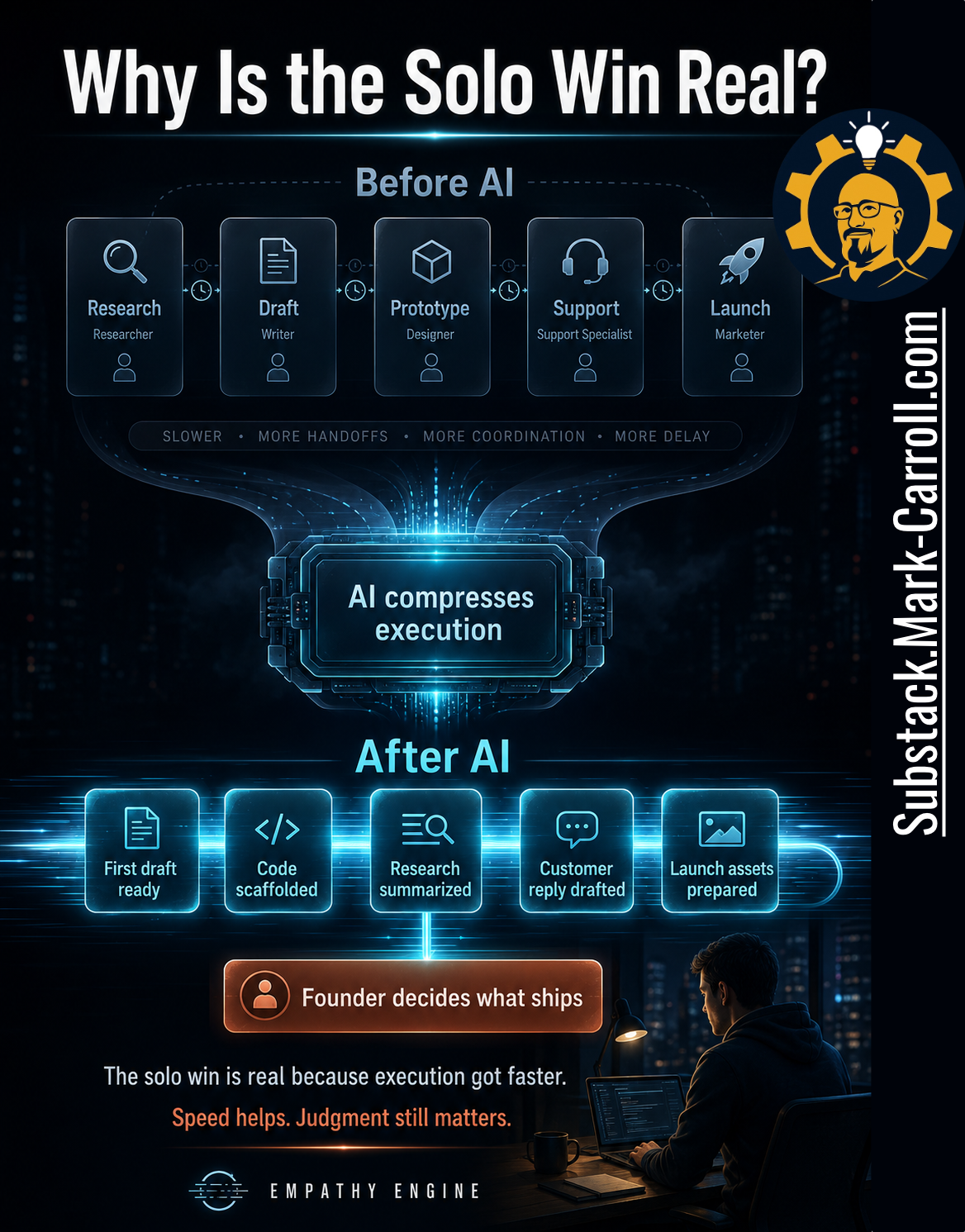
Any honest article about the Solopreneur Ceiling has to begin by saying the obvious part out loud: AI can make solo work dramatically more powerful.
In fields like software development and education, early studies have found that AI assistance can speed up specific tasks such as coding, drafting, and grading, without removing the need for human judgment on the hard calls.
Empathy Engine exists because the solo win is real. AI helps me move from research to article, from article to infographic, from infographic to Note, and from Note to a larger topic cluster without needing a full production team behind me. That has changed the practical ceiling on what I can build alone.
At the same time, the most important decisions have not left my desk. AI can help me produce options, but I still decide which one is worth trusting. It can help me sharpen a claim, but I still decide whether that claim is fair. It can help me scale the surface area of the work, but I still own the meaning underneath it.
That is the promise and the pressure of the solo win.
The practical point is simpler.
AI can make execution cheaper, faster, and more available. A solo founder who once needed a small team to test an idea can now produce an early version, write the announcement, generate the onboarding draft, summarize customer research, and sketch the sales sequence in less time than a traditional team would spend planning the work.
For many founders, the solo window has expanded.
Mara’s two-day dashboard launch is not fantasy. A modern founder with good taste, enough domain knowledge, and a strong stack can now move with stunning speed. The stack can compress weeks into days and days into hours.
The problem begins when that speed creates more outputs than the founder can safely judge.
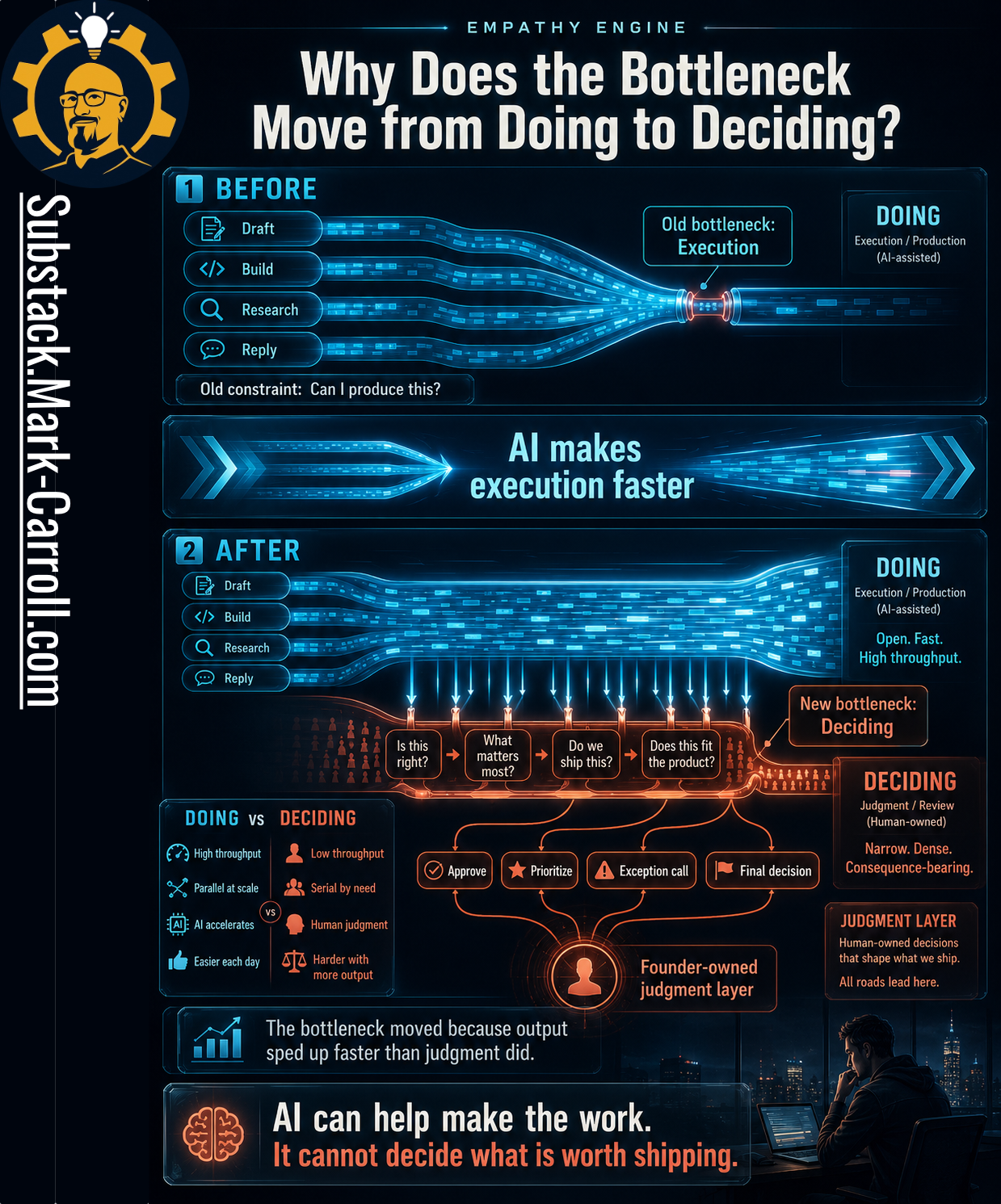
Why does the bottleneck move from doing to deciding?
AI does not remove every bottleneck. Sometimes AI moves the bottleneck.
Before the stack, the obvious constraint was execution. There were not enough hands, hours, drafts, prototypes, research summaries, support responses, or landing page variants. Work piled up because someone had to do the work.
After the stack, the visible constraint changes. The founder can suddenly generate a dozen useful options, three customer responses, five feature summaries, a new dashboard, and a product announcement in a fraction of the time. The work appears faster than the founder’s ability to decide what deserves trust.
That is when the question changes.
The old question was, “Can I produce this?”
The new question is, “Should this be the version that leaves the building?”
That second question is heavier. A machine can give you ten pricing responses, but the machine does not own the future precedent. A tool can suggest a roadmap change, but the tool does not know what kind of company the product is becoming. An agent can draft a customer apology, but the agent does not understand the relationship history hiding behind a single frustrated sentence.
That hinge, output cheap and judgment not free, is where the work changes shape.
Misread this as a productivity problem and you do not just stay busy. You may approve the wrong pricing exception, ship the polished answer that quietly erodes trust, or add help that creates more work to review. The cost is not only time. The cost is decision quality.
Which raises the only question that reliably points to the right fix: is this a tool problem, a system problem, or a judgment problem?
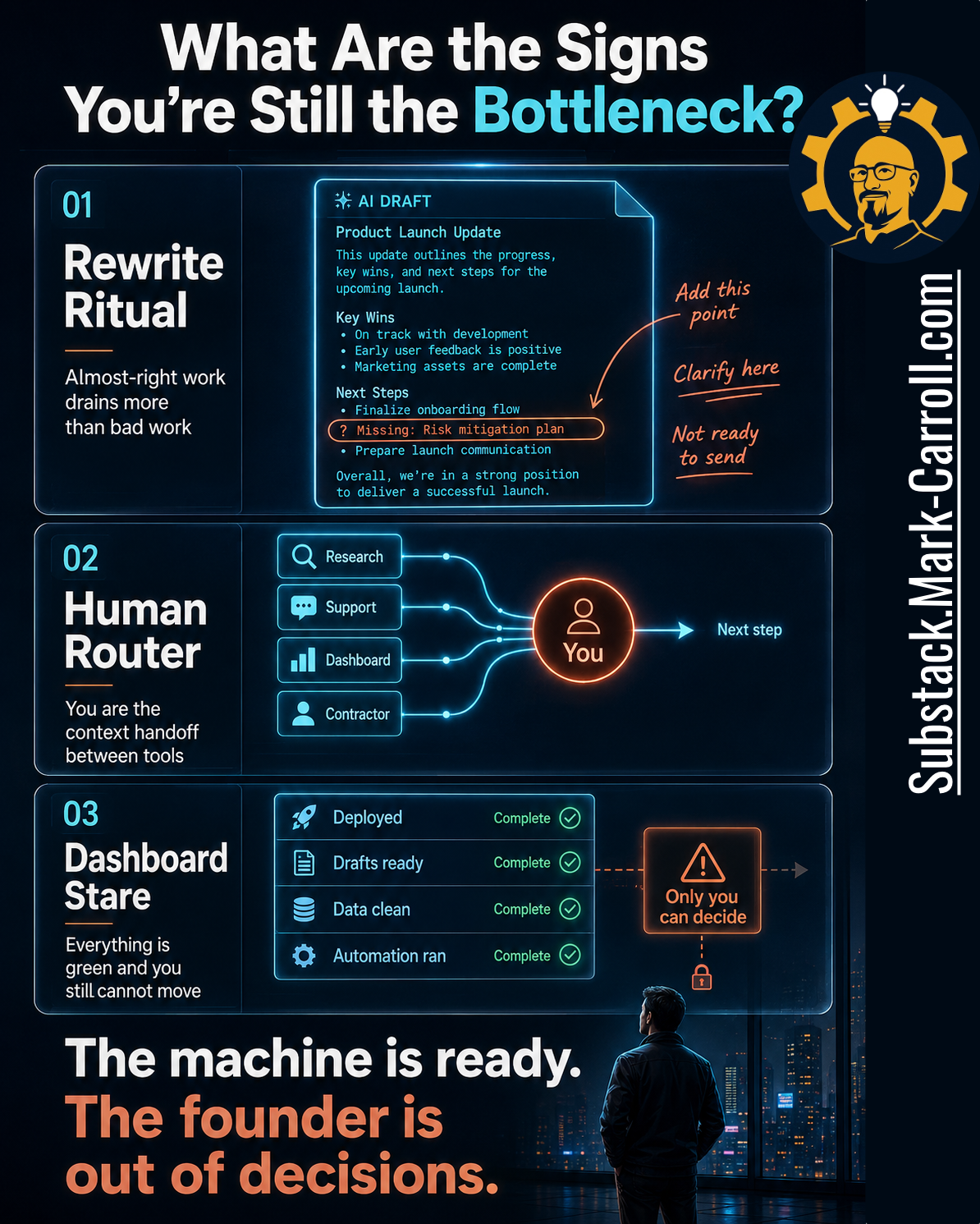
What are the signs you are still the bottleneck?
The first sign is the Rewrite Ritual.
The Rewrite Ritual happens when AI gives you a first pass, and the first pass is close enough to be useful but wrong enough to require real attention. The grammar is fine. The structure is fine. The tone is almost fine. Then you realize the draft missed the one thing that mattered.
Almost-right work can be more draining than obviously bad work. Obviously bad work can be rejected quickly. Almost-right work asks you to slow down, inspect the seams, find the hidden drift, and decide whether the output is safe enough to ship.
Mara’s customer replies were not useless. That was the problem. They were useful enough to keep, but not trustworthy enough to send. She had automated the typing, but not the judgment.
I recognize that feeling from my own work. While developing a client-recommendation example for Episode One, I got an AI draft that looked useful enough to keep. The structure was clean, the tone was professional, and the recommendation sounded reasonable.
Then I looked past the polish.
The draft had treated the client’s issue as a tooling problem. Better intake, better workflow, better software. Those ideas were not silly, which made the mistake harder to catch. The real issue was decision clarity: the team had not agreed who owned the call, what tradeoffs mattered, or what would make the decision good enough.
That is the Rewrite Ritual at its most expensive. The cost is not the typing. The cost is noticing when a polished answer solves the wrong problem.
The second sign is the Human Router.
This happens when your tools, agents, contractors, dashboards, and workflows all depend on you to move context between them. The research agent does not know what the support agent learned. The contractor does not know why the product direction changed. The dashboard knows something happened, but not why it matters.
You become the handoff.
The system looks automated from the outside. From the inside, you are the person translating meaning from one part of the machine to another. Every output still needs your context because the context was never fully externalized.
The third sign is the Dashboard Stare.
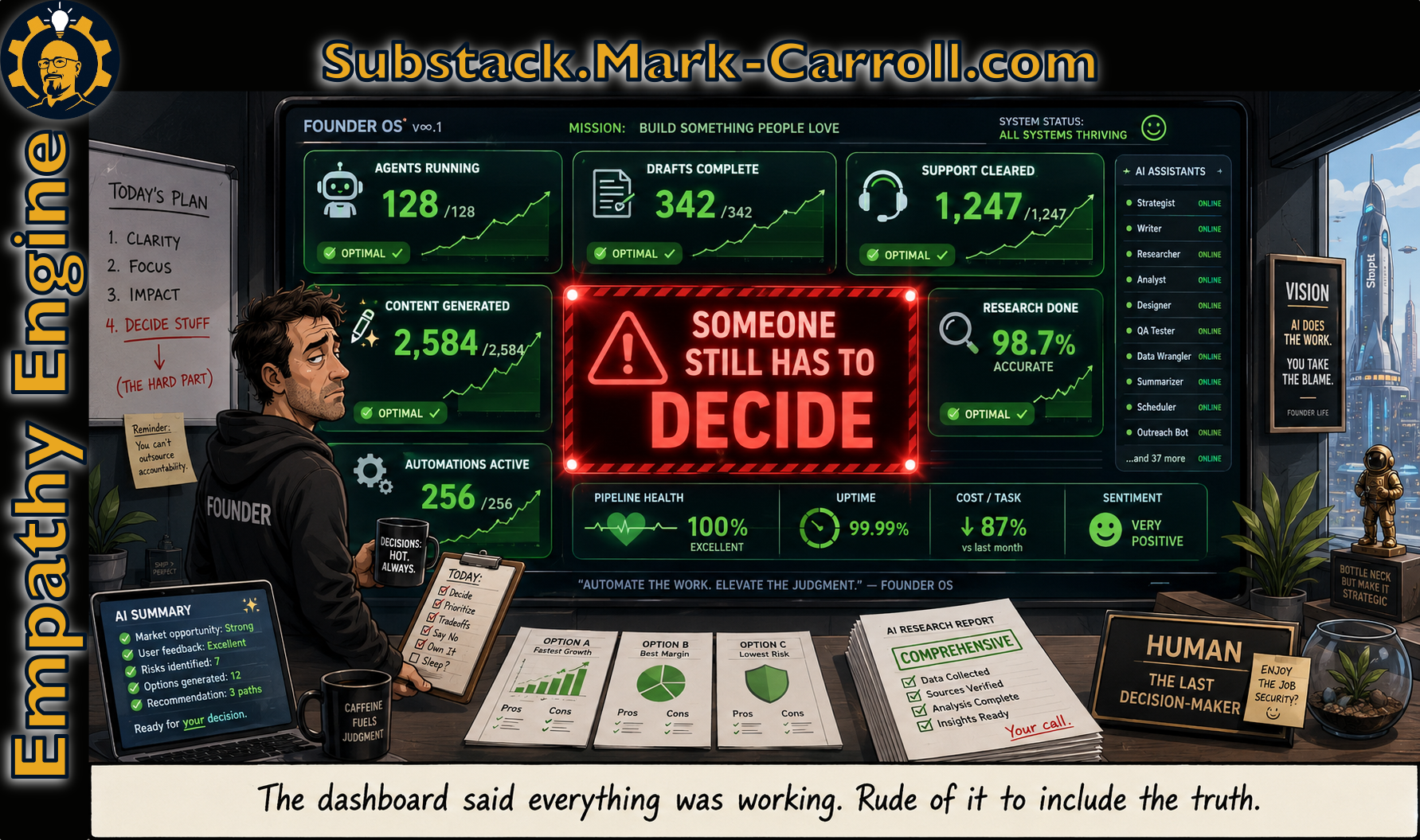
The Dashboard Stare happens when everything is green, and you still cannot move. The deployment succeeded, the automations ran, the drafts are ready, the data is clean, and the next step is one decision that only you can make. The work is not blocked by labor anymore. The work is blocked by your remaining decision capacity.
That moment can feel absurdly lonely.
The machine is ready. The founder is out of decisions.
You are probably feeling this if:
You rewrite most AI outputs before they reach a customer.
You feel slower after the stack runs, not faster.
Your day ends in unresolved decisions, not finished work.
You are considering help but cannot name what kind.
If two of these are true, you are probably not looking at a tool problem.