The Solo Window Is Real
AI can help you ship more alone. It still leaves the final call with you.
👋 Welcome to my paid subscriber-only edition of Empathy Engine (🔒 Leader’s Dispatch). Each week I build evidence-informed tools for product professionals, and team leads who have moved past the hype and are now wrestling with the real operating cost of hybrid AI stacks and contemporary organizations.
Mara shipped the customer dashboard redesign on Tuesday.
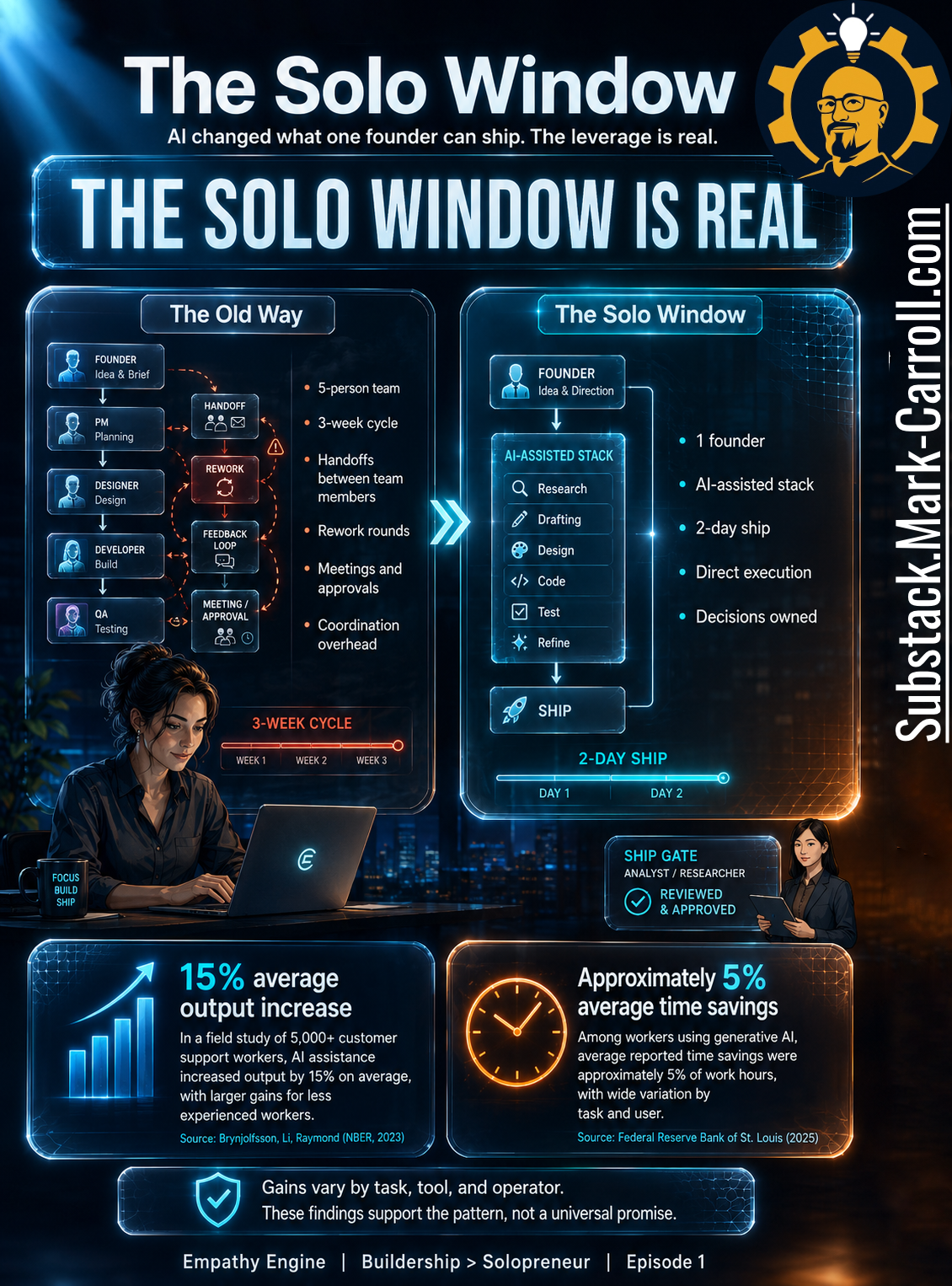
Not the prototype. Not the internal demo. The real workflow was live, data was moving through it, and customers could touch it. Her old five-person team would have needed three weeks, two rounds of handoffs, and at least one meeting where the bravest person in the room finally asked why the meeting existed.
Mara did it in two days.
Cursor helped her scaffold the code. v0 helped her get the interface moving. Her AI stack handled research, drafting, testing notes, and the kind of repetitive cleanup work that used to make a founder question every life choice between 4:00 and 4:17 p.m. Mara still made the product calls, but the distance between idea and shipped workflow had collapsed.
If you read Episode Zero, you will recognize the starting point. The stack works. You are still the nervous system.

That line was not meant as a complaint about AI. It was meant as a warning against confusing output with operating clarity. Tools can move work faster than the old system ever could, but the founder still feels the decisions arrive, stack up, and ask to be owned.
Output got cheaper. Judgment did not become free.
Mara’s Tuesday proves the first half. Episode One begins there because any honest conversation about what comes next has to start by admitting what AI has already made possible.
Research Binder: the receipts (citations + source notes) are compiled in a PDF at the bottom of this post.
The Solo Win Deserves Respect
A strange amount of commentary around solo founders skips the respect step. The commentary hears “solo” and immediately starts diagnosing the person. Too attached to control, too allergic to management, too dazzled by agents, too lonely, too stubborn, too something.
That misses the point. For many founders, staying solo is not avoidance. Staying solo can be strategy. Fewer handoffs. Fewer misaligned incentives. Fewer status meetings. Fewer people translating the founder’s intent into a slower and more expensive version of itself.
AI makes that strategy more powerful because AI reduces the cost of first versions. The blank page gets less blank. The prototype appears sooner. This article is not here to shame the solo founder. This article is here to help the solo founder see the solo stack clearly.
I am not writing about this from the press box. I work as a solo operator with AI in the stack, compressing drafts, sharpening options, and moving real client work faster, while still owning the judgment no tool can safely make for me.
What AI Changed
AI did not make Mara faster only at the margins. AI changed what one capable person can attempt before needing a full team around the work.
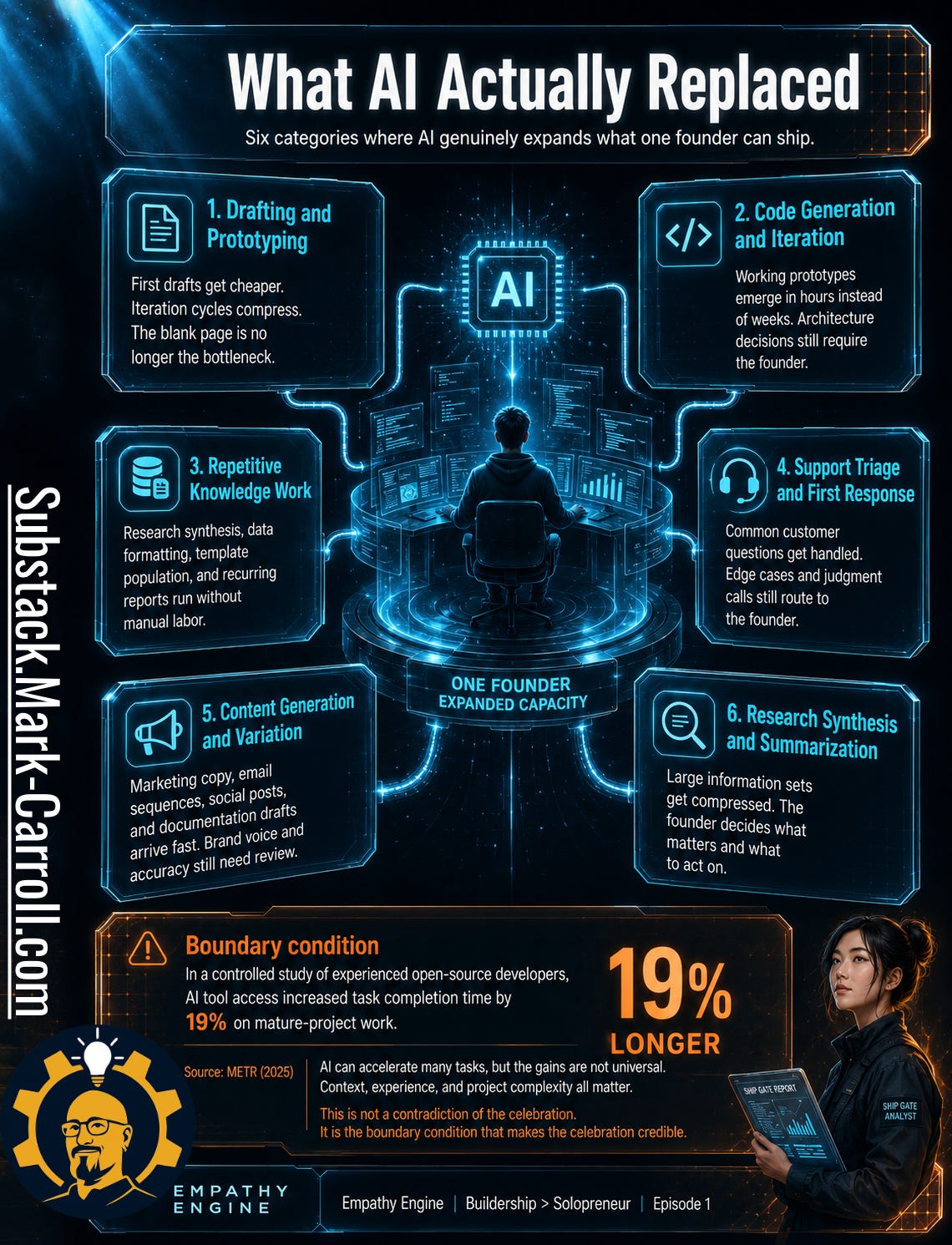
That does not mean every founder becomes magically productive the moment they open a new tab and type “act as my chief operating officer.” The evidence does not support that fairy tale, and neither does the lived experience of anyone who has ever asked an AI tool for one small revision and received a brand-new religion. Gains vary by task, tool, and operator. That boundary makes the celebration more credible, not less.
AI can expand solo execution capacity in meaningful ways, especially in drafting, prototyping, repetitive knowledge work, research synthesis, support triage, and first-pass software work. The solo window is not a universal promise, but the window is a real opening.
Mara felt the difference most on the support documentation. Before the stack, she would have spent a full afternoon writing the onboarding guide for the new dashboard: screenshots, step-by-step instructions, the FAQ section that customers actually use and the FAQ section that exists because someone once asked a question at 11 p.m. and the founder could not sleep until the answer lived somewhere permanent.
With the stack, the first draft existed before lunch. Not a good draft. Not a draft she would ship. But a draft complete enough that her afternoon changed shape entirely. She was no longer writing from scratch. She was reading, correcting, and deciding which sections matched how her product actually worked versus the product the AI imagined she had built.
That is the solo window at work: usable enough to begin thinking. AI is very good at creating the next thing to evaluate. Creating the next thing to evaluate is not the same as finishing the evaluation.
The Work That Stayed Human
Here is where the internet tends to get sloppy. Because AI can generate more work, people start speaking as if the work is done. A draft is not a decision. A prototype is not a product strategy. A polished paragraph is not necessarily an accurate paragraph, which is a deeply inconvenient fact for everyone who enjoys confidence with their hallucinations.
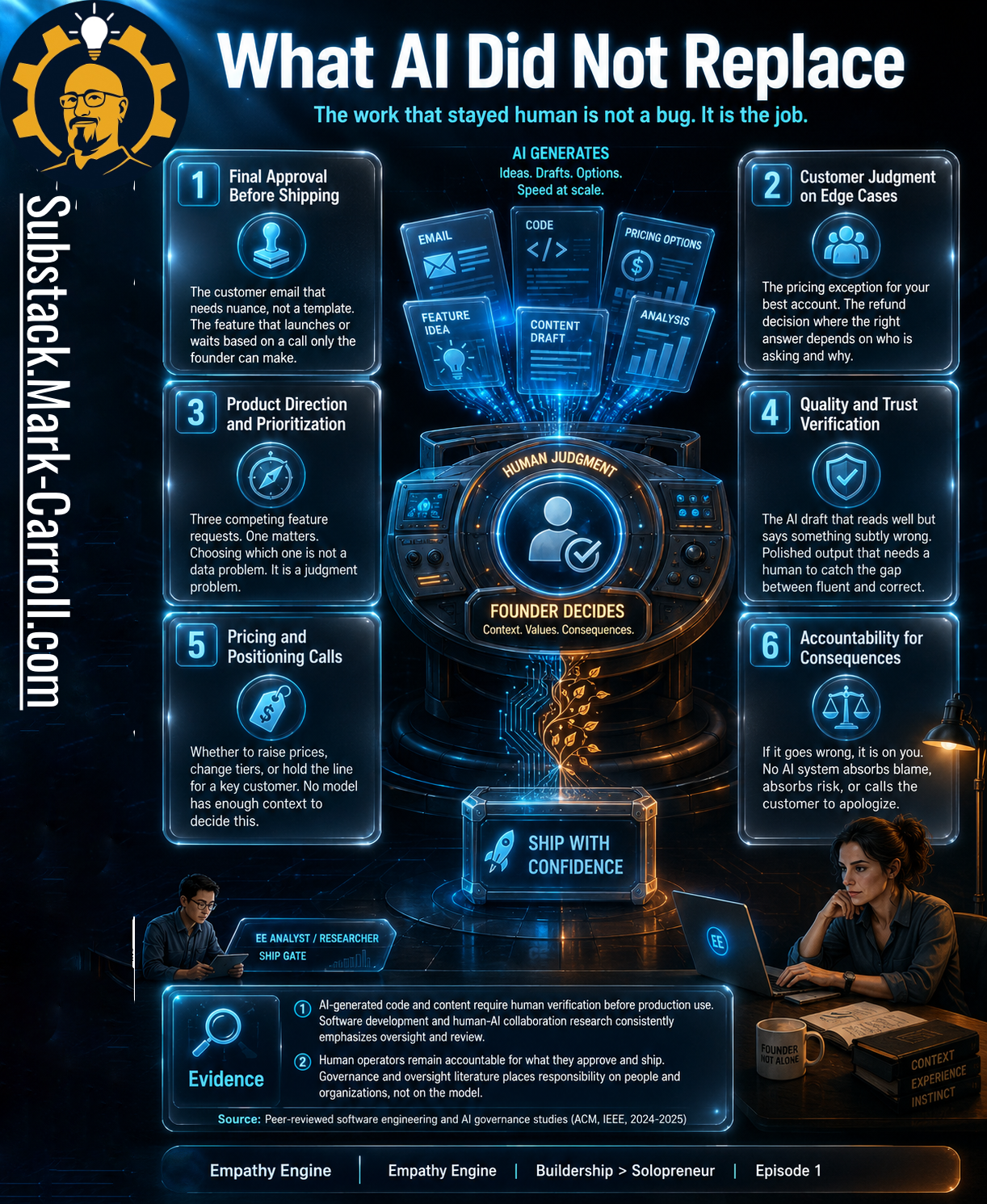
That is where Mara’s Tuesday victory becomes a Wednesday reality.
Three customers email her after the dashboard goes live. One asks for a pricing exception, one reports an edge case that technically works but feels wrong in the customer’s workflow, and one asks for a feature variant that sounds simple until Mara realizes the request could bend the product away from its original promise.
The stack did its job. The hard part still arrived.
AI can summarize those emails. AI can draft replies. AI can generate three possible pricing responses and a tidy little table of pros and cons that looks authoritative enough to make a founder suspicious. But the emails are not asking for a summary. They are asking Mara what her company believes, what it will bend on, and what it will hold.
I have had the same Wednesday moment in my own work. I asked AI to help shape a client-facing recommendation, and the first version looked polished enough to pass a casual skim. The problem was not the writing. The problem was that it treated the situation like a tooling issue when I knew, from the actual conversations, that the real risk was decision clarity. If I had shipped the polished version, it would have sounded smart and solved the wrong problem. The tool could organize the material, but it could not know what the room had taught me.
The stack cannot decide what kind of company Mara is building. It cannot know which customer exception is generosity and which one is product drift. It cannot absorb the consequence if a rushed answer damages trust with her best account. Final approval, customer judgment, product direction, quality verification, pricing calls, and accountability for consequences ((that is the work that stayed human). Evidence that the founder’s job still exists.
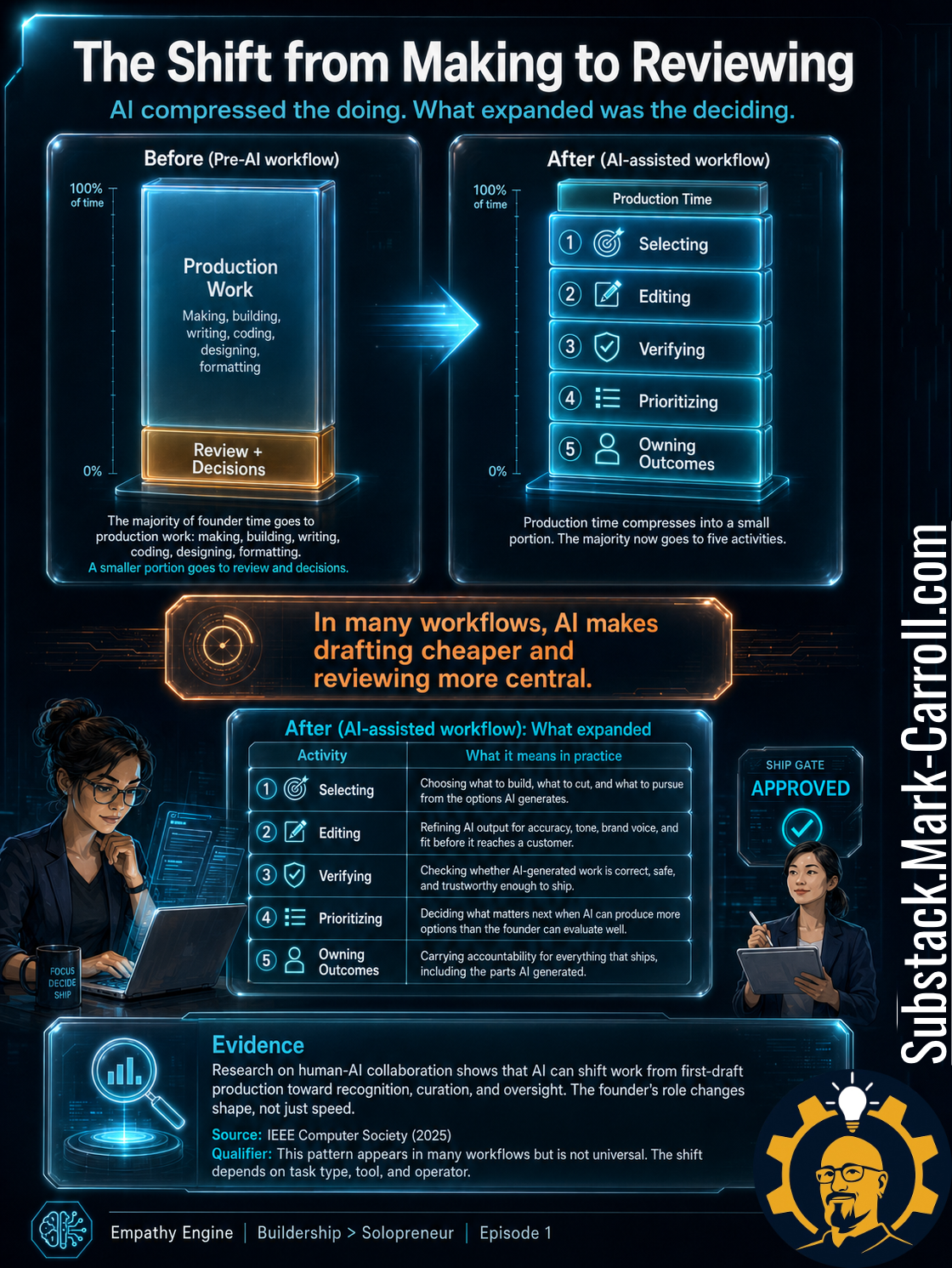
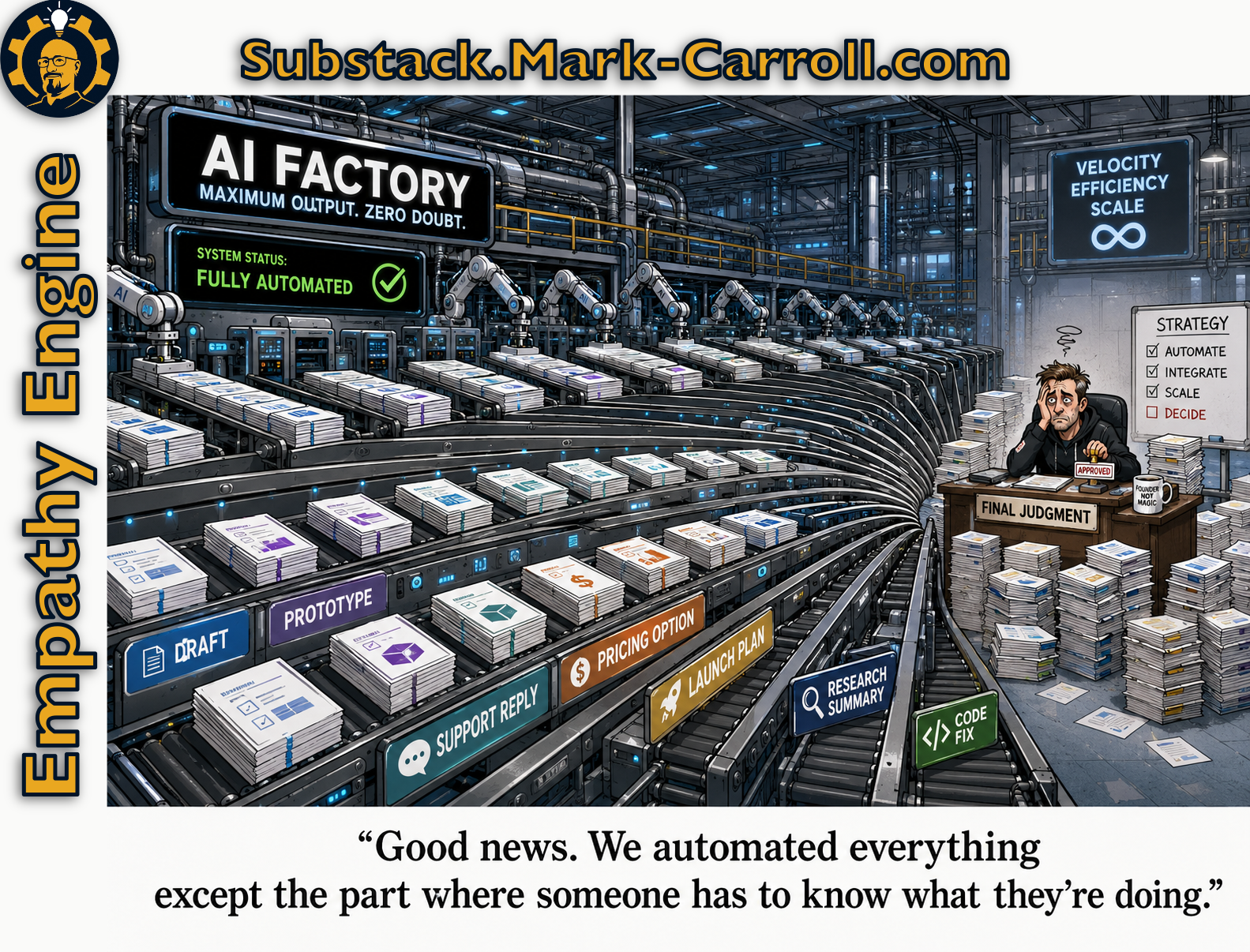
In many workflows, AI compresses the doing.
What expands is the deciding.
Before AI, much of the founder’s time went into production work. Making, building, writing, coding, designing, formatting. After AI enters the workflow, some of that production time shrinks, but the founder’s role does not shrink with it. The work changes shape. The founder selects, edits, verifies, prioritizes, and owns outcomes.
I noticed the same shift in my own week before I had clean language for it. I was producing more, but my calendar felt less like making and more like reviewing, choosing, correcting, and deciding which version was actually worth putting my name on.
Mara felt it on Thursday. She asked her stack to draft three versions of the pricing exception response for her Wednesday customer. By the time she sat down with coffee, all three were waiting. Clean formatting, reasonable logic, slightly different positioning. The old version of this task would have taken an hour of staring and drafting. The new version took four minutes to generate and forty minutes to decide.
The draft was done before Mara had finished thinking about what the answer should be. That gap (between the draft arriving and the decision catching up) is where the shift lives.
The Judgment Tax
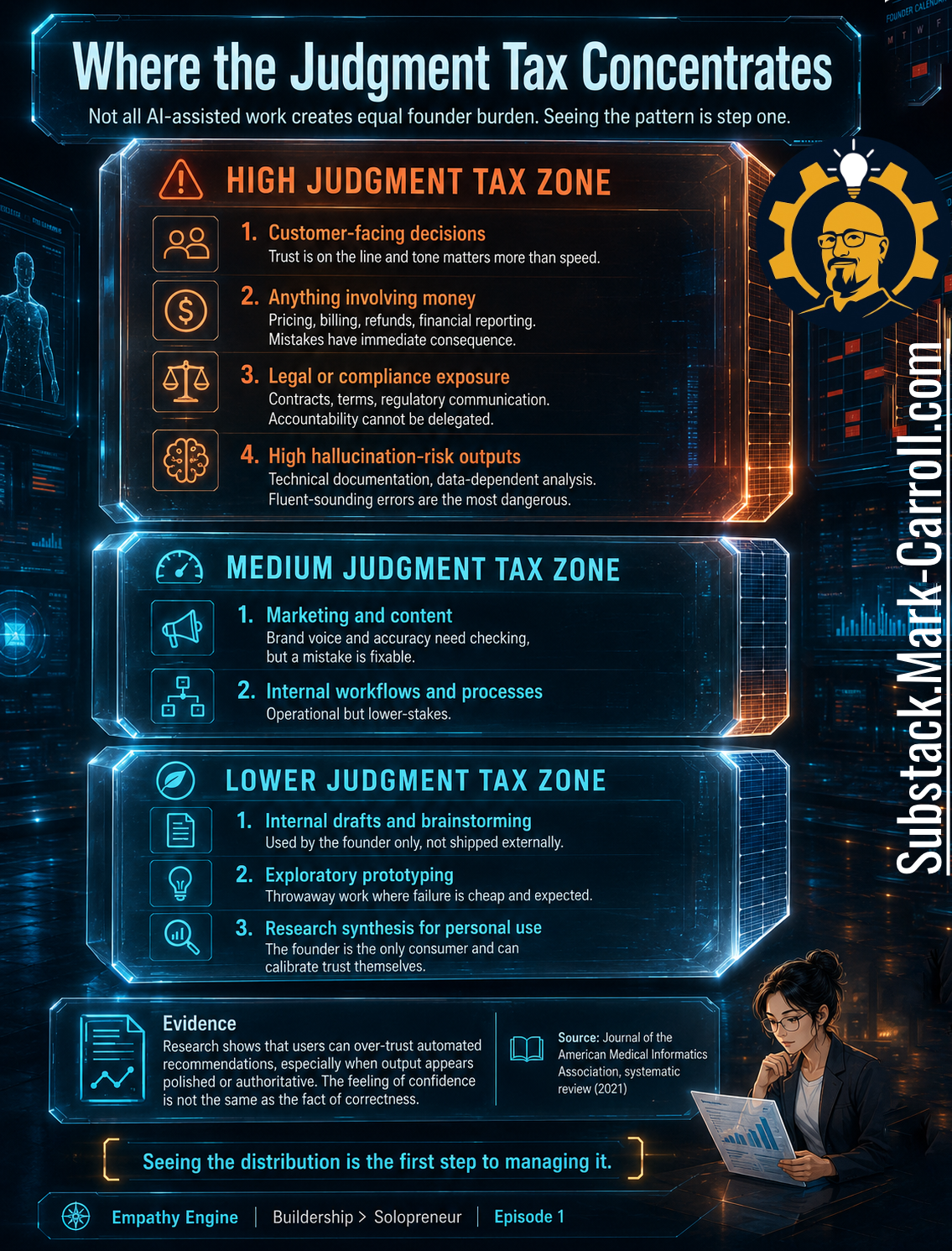
There is a name for this leftover burden: the Judgment Tax. Not a clinical diagnosis. A practical metaphor for the extra evaluation work that compounds when one person reviews everything AI produces.
I have felt this most clearly on afternoons when AI has given me exactly what I asked for: three clean outlines, two sharper titles, a stronger client-facing explanation, and a tidy set of options that all look plausible. Nothing is broken. That is almost the problem. By 3 p.m., the work is no longer generating material. The work is deciding which version deserves trust, which one misses the real context, and which one should quietly go in the folder marked “nice, but no.”

The tax shows up as review load, context switching, decision volume, accountability weight, and the slow calibration of learning when to trust each tool’s output and when to verify line by line.
This is why measuring only time saved can mislead a founder. A workflow can save time and still increase judgment load. A tool can generate more output and still leave the founder with more to approve. That does not mean the tool failed. It means the founder needs to know what kind of leverage the tool is actually creating.