


Urgent Isn’t a Review Depth
Plain-English premise: AI can draft the deck in minutes. Someone still has to understand it before it moves.
Judgment Seat: The reviewer who inherits the reading the moment someone says “quick review.”
👋 Welcome to the opening of The Judgment Layer. For seven issues, this series will examine what happens after AI makes output easier to produce: who reads it, verifies it, challenges it, and ultimately stands behind it. We begin with the last human in the chain and the Review Budget that turns finite attention from an invisible burden into an explicit decision.
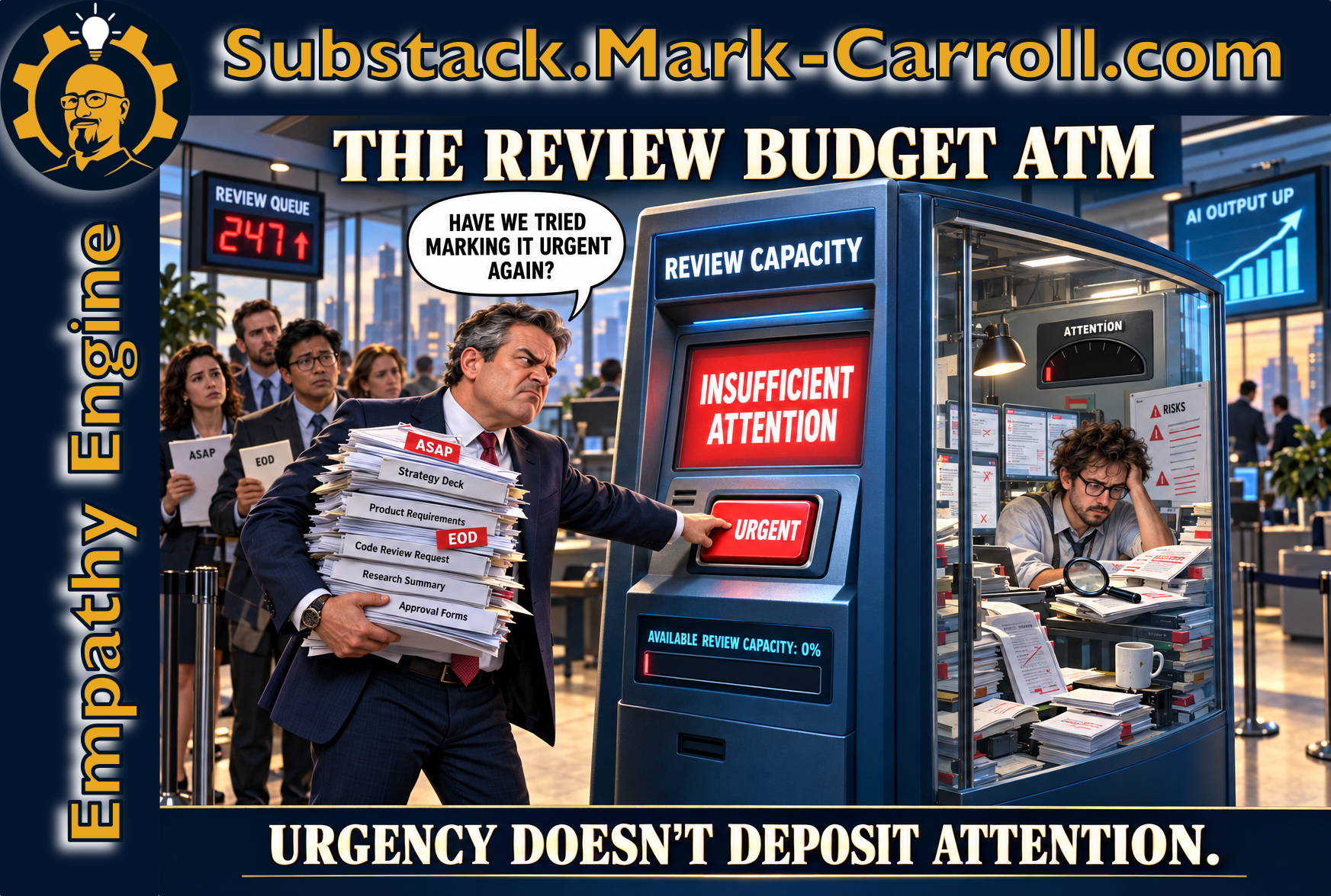
Research Binder: the receipts (citations + source notes) are compiled in a PDF at the bottom of this post.
⚡ Pressure
Generation got faster. In many workflows, the remaining verification capacity is still unnamed.
🎯 Payoff
This issue gives you the Review Budget: a way to name your team’s finite review capacity and route the work that does not fit it.
Pressure Moment
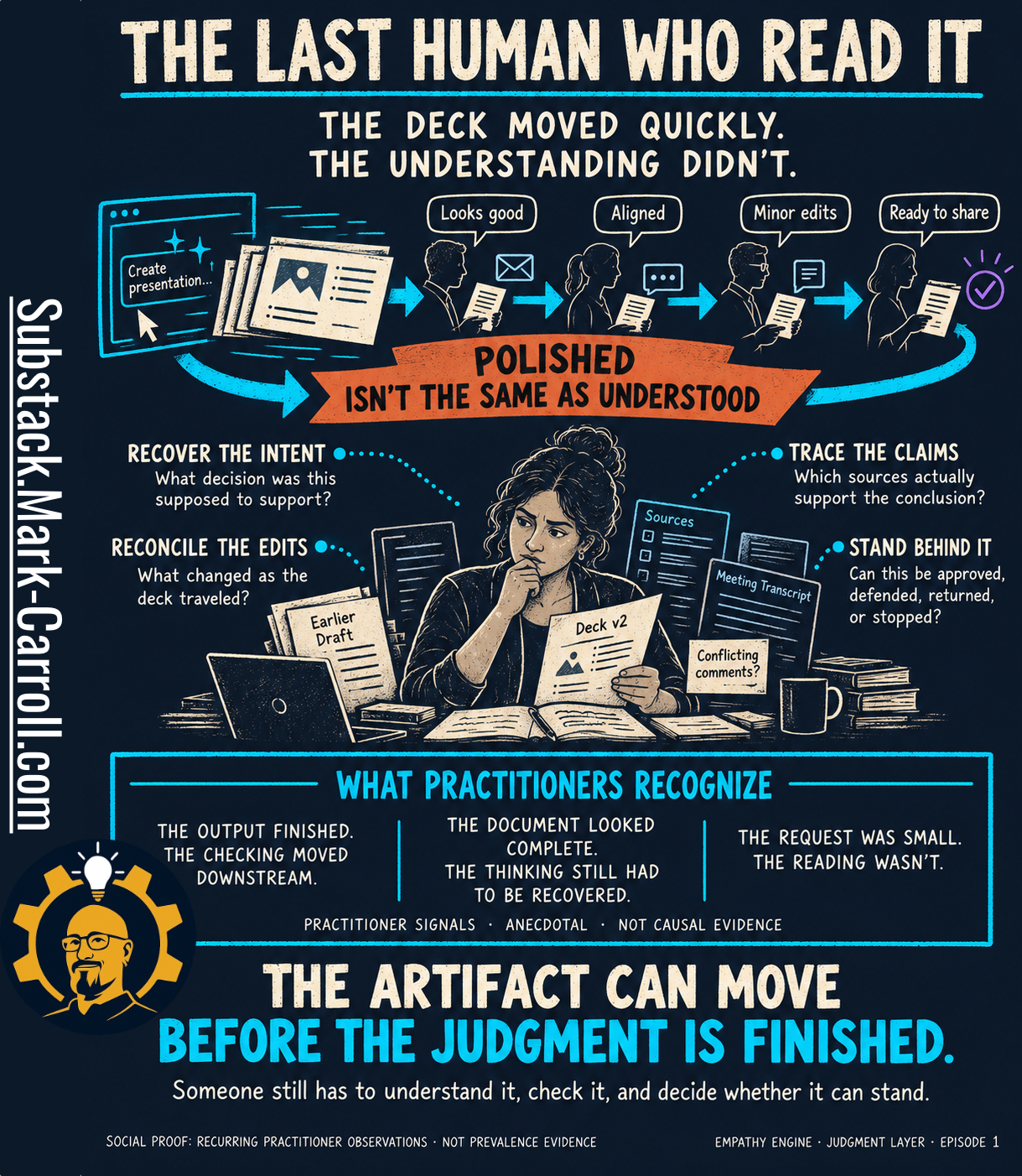
A teammate used AI to draft a slide deck. It reached a manager, who asked for a “quick review.” The manager ran the deck back through AI, then sent it forward for confirmation. The deck kept moving. What actually got checked stayed unclear. That is one practitioner’s public account, not a documented record of every hand the deck passed through or a measured time cost. Read it as a recognizable pattern, not a verified case file. The pattern it points to is ordinary: an artifact can look finished several times over before anyone has actually finished the judgment underneath it.
I’ve had AI-drafted decks land in my inbox after two or three people had already given them a “quick review.” The slides looked finished, the language sounded confident, and the status updates were neatly summarized. Yet once I started checking the story against the actual work, I found the missing dependency, the unresolved decision, and the risk that had somehow softened into a “watch item.” Nobody had been careless. Each person had reviewed a different piece of the deck, and by the time it reached me, “Can you take a quick look?” really meant, “Can you figure out whether any of us should trust this?”
🧭 The Judgment Move
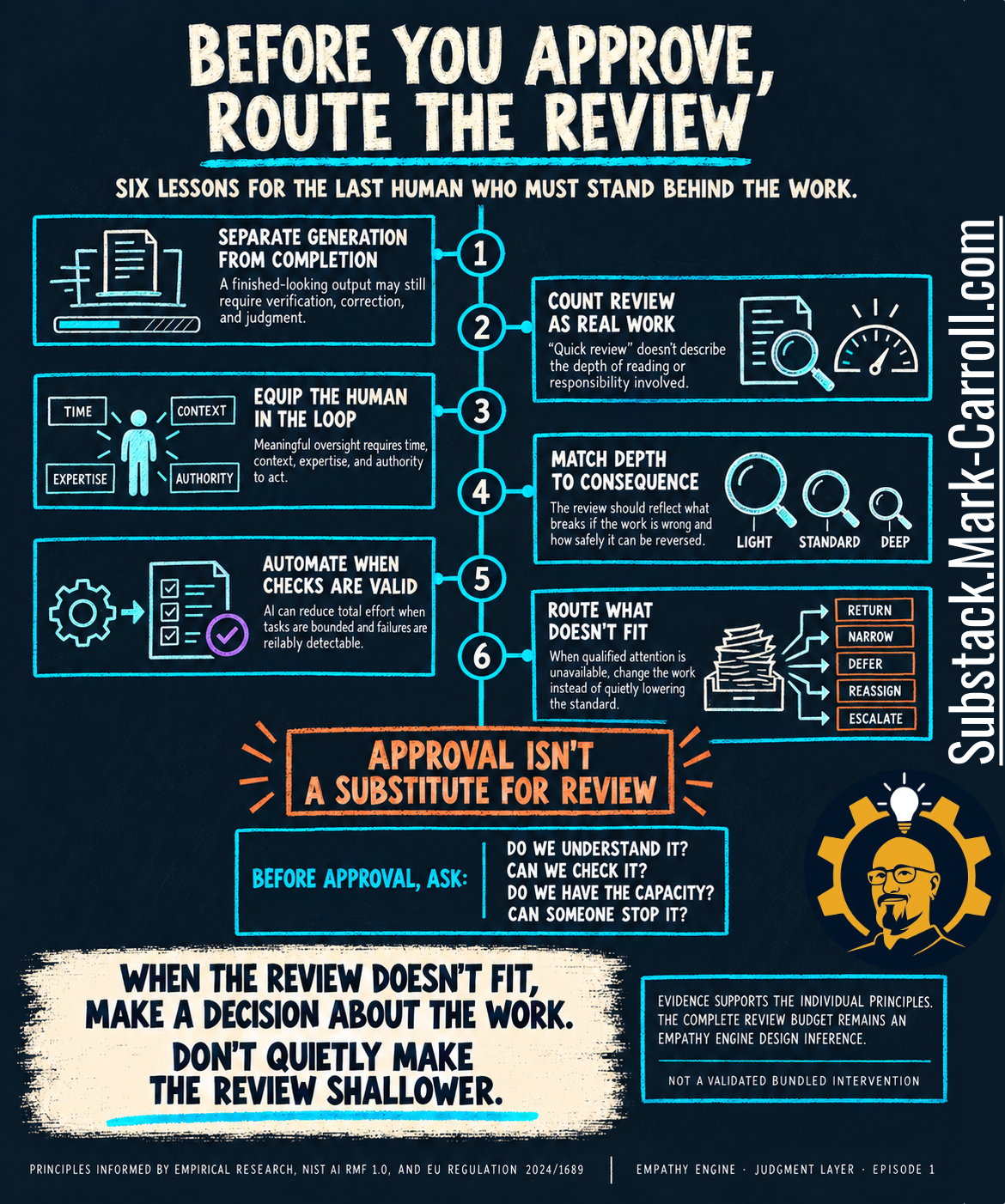
Orienting sentence: A Review Budget names how much qualified review capacity your team actually has this week, matches depth to consequence, and routes anything that does not fit instead of quietly shrinking the check.
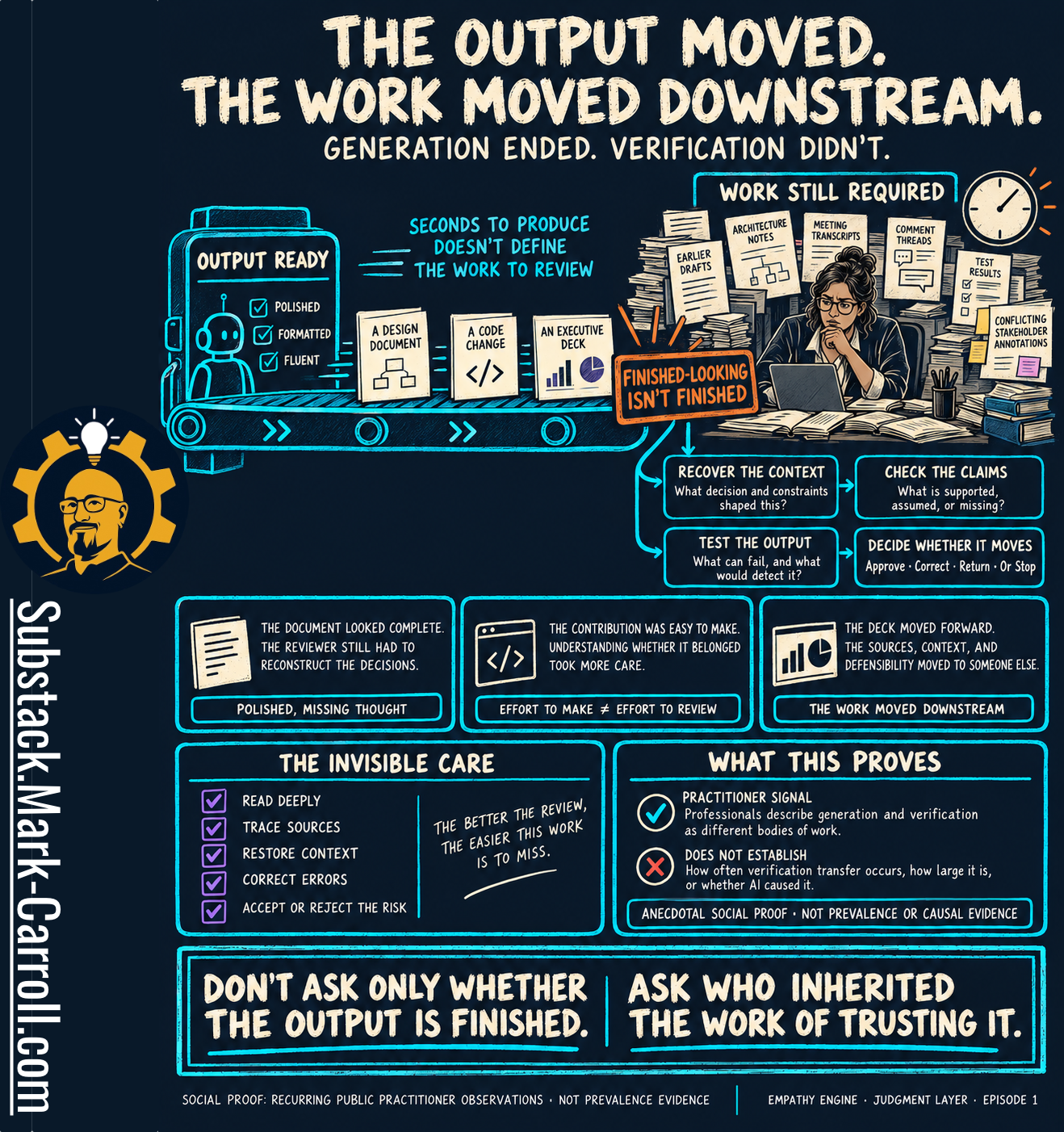
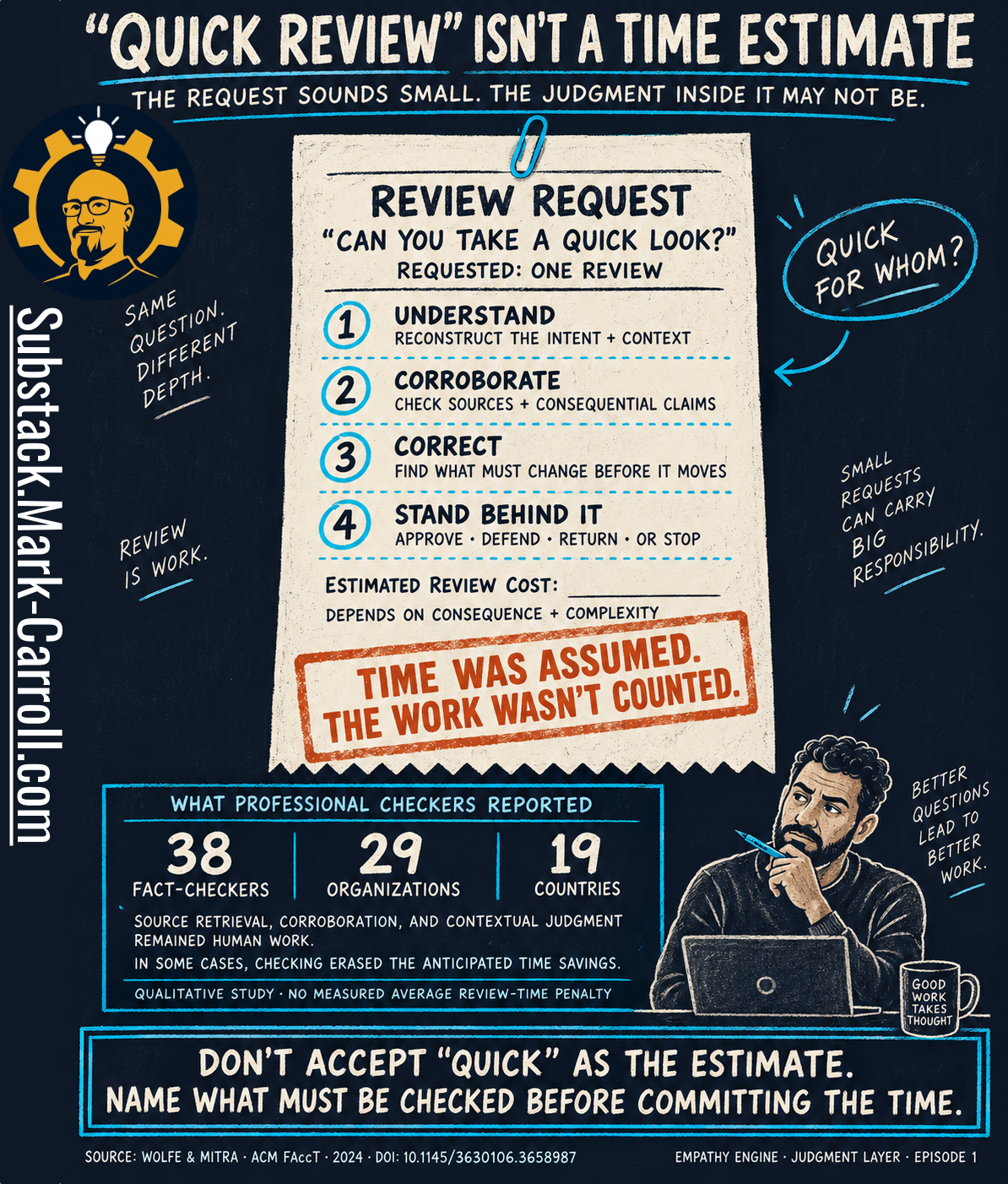
The reviewer’s job was never “read it fast.” It was: recover the intent, corroborate the claims, correct what is wrong, and decide whether the work can stand behind it. “Quick” was never a time estimate. It named the handoff, not the four jobs sitting inside it.
Step 1: Name this week’s review capacity in three tiers, light, standard, and deep, at the team or role level. Do not track it against individuals.
Step 2: For each artifact ready for approval, ask what breaks if it is wrong, how reversible the decision is, what remains uncertain, and whether a valid check can catch failure.
Step 3: Assign review depth from those answers, not from how the request was worded. Urgent is not a depth.
Step 4: When incoming demand exceeds available capacity, route the overflow. Return it, narrow it, defer it, automate the parts with valid deterministic checks, reassign it, or escalate it.
Step 5: If none of those routes are available and the work must move anyway, record that the risk was consciously accepted, and by whom.
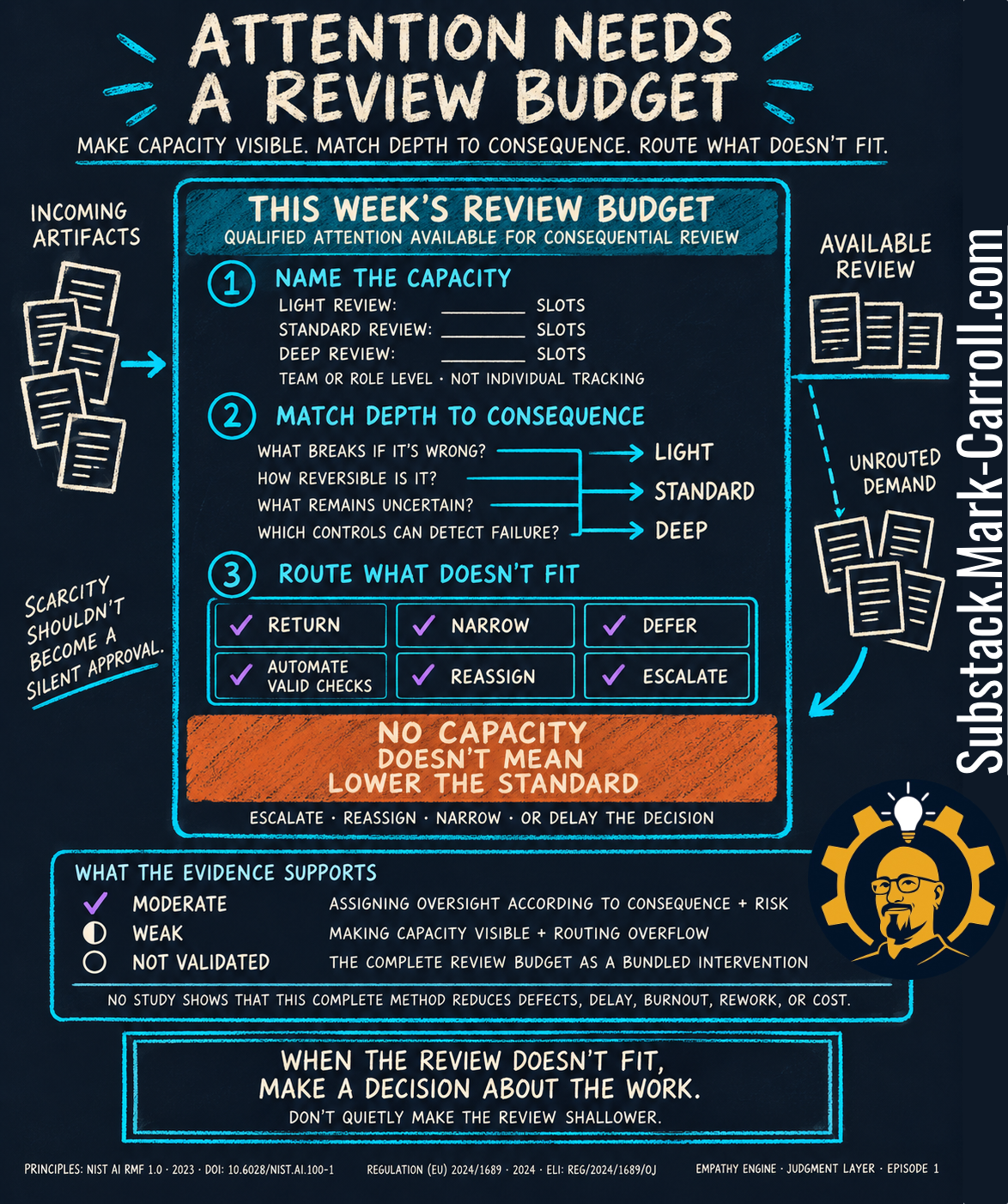
Done state: every artifact that reaches approval carries a named review depth and a named owner. Any missing time, context, expertise, or authority is visible before approval, not after.
Constraint: the Review Budget only works if leadership treats a depleted budget as a routing decision, not a performance problem.
I remember sitting with a leadership team after several deliverables had backed up waiting for approval. Their first question wasn’t, “Which work should move first?” It was, “Who owns this?” A name went onto the screen, everyone relaxed slightly, and the meeting moved on. Nothing had been deprioritized, no additional reviewer had been assigned, and the same person still had more work than anyone could responsibly check. We hadn’t solved the capacity problem. We had simply given it someone’s name.
Limitation: this move cannot manufacture reviewer expertise, add hours to a day, or prove that a lighter review was safe. It only makes the shortage visible enough to govern.
🧪 What Holds Up
Primary claim label: Evidence.
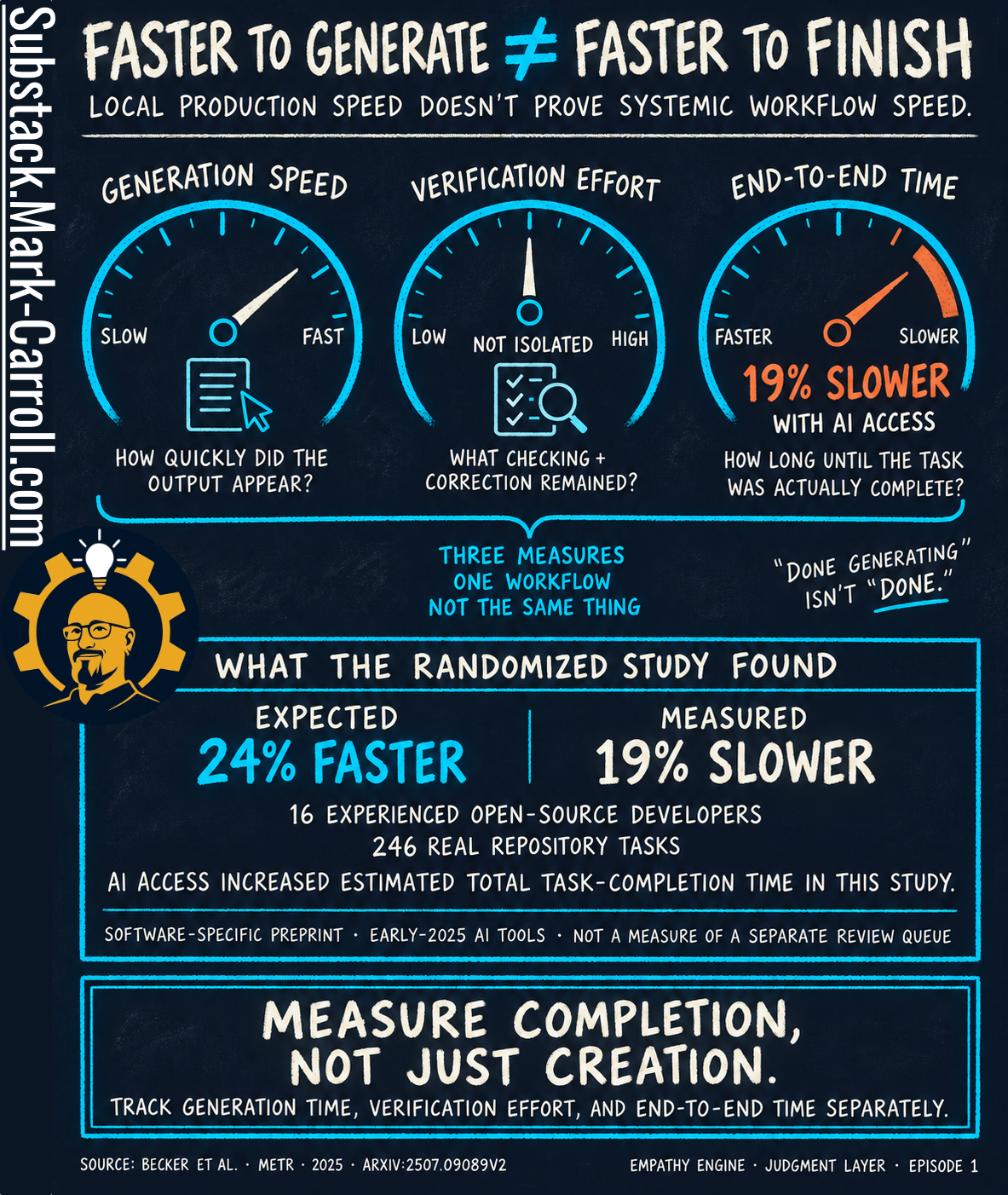
Basis: A randomized study of sixteen experienced developers across two hundred forty-six real repository tasks found that AI access made completion nineteen percent slower, even though the same developers had expected a twenty-four percent gain. Generation speed, checking effort, and total completion time are three different measurements, and the first does not predict the other two.
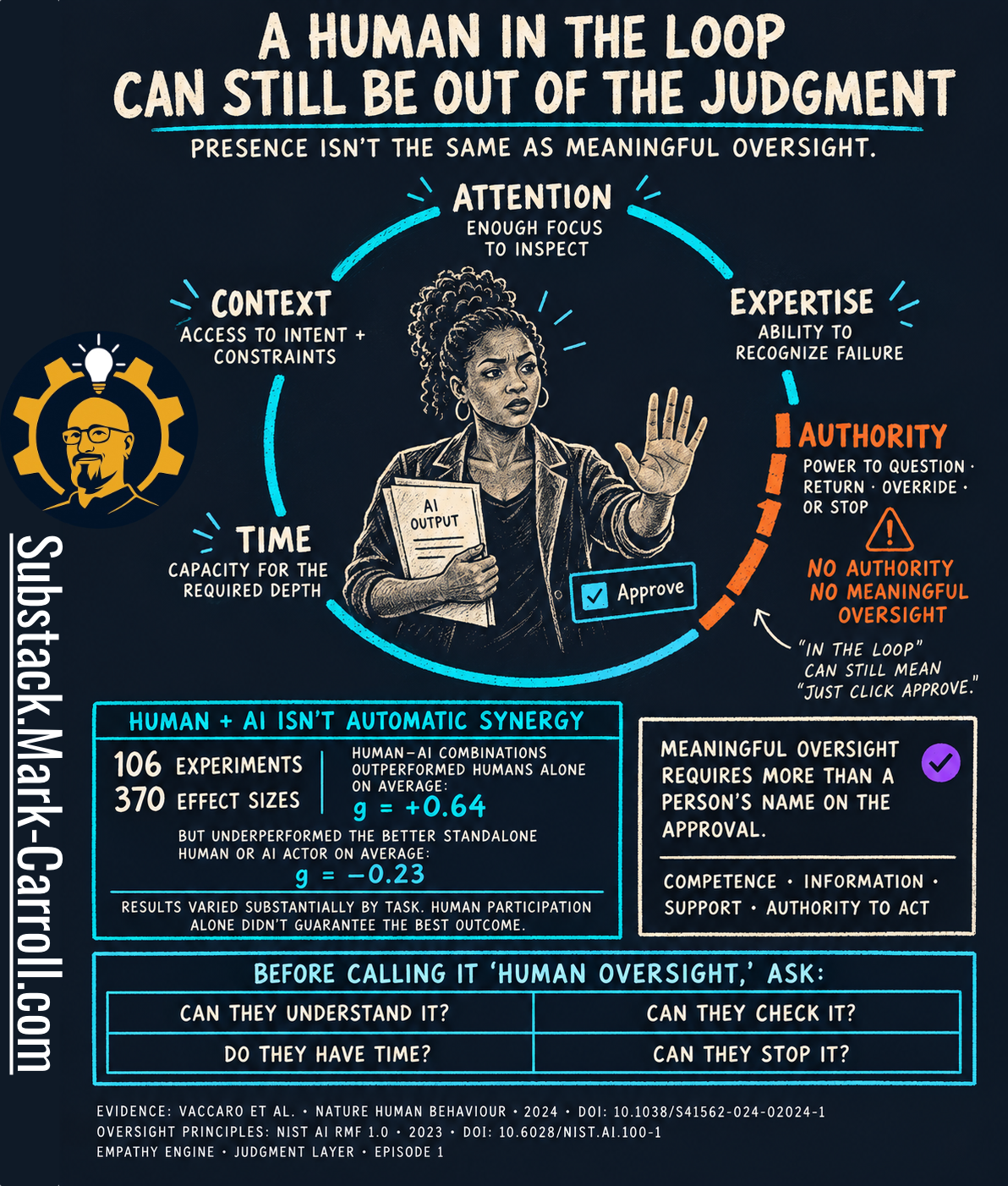
A separate meta-analysis of one hundred six experiments found that human-AI combinations underperformed the better standalone actor on average, even while outperforming humans working alone. A human’s presence in the loop is not, by itself, evidence of meaningful oversight. Oversight requires attention, context, expertise, and the authority to actually stop the work, not just a name on the approval.
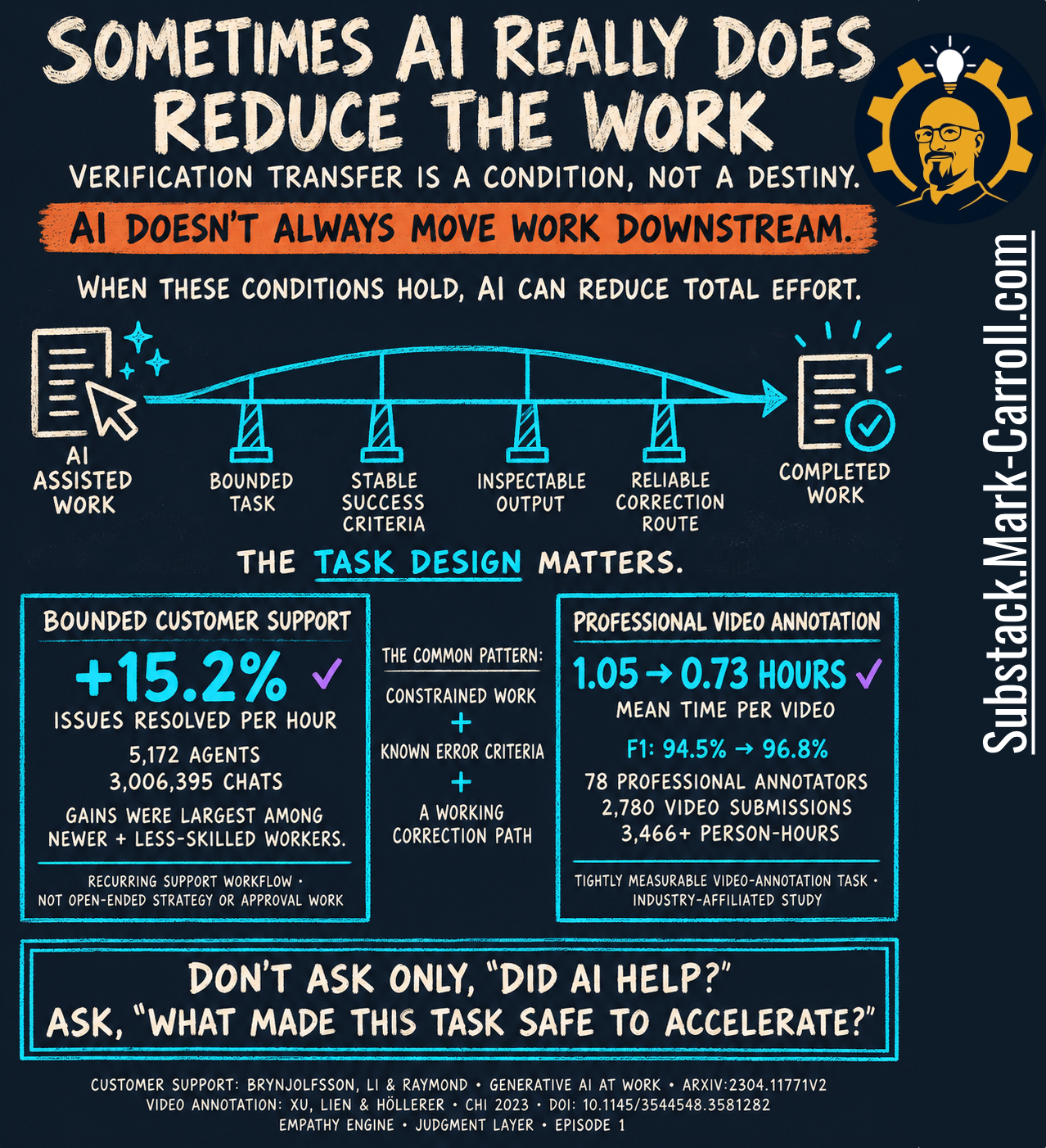
Counterpoint, labeled Evidence: this does not mean AI always adds review work. A workplace study of over five thousand customer support agents found a real throughput gain, concentrated among newer and less experienced workers, in a bounded, correctable task. A separate study of professional video annotators found faster completion and higher accuracy under a high-recall AI condition. When a task is bounded, success criteria are stable, the output is inspectable, and a reliable correction path exists, AI can reduce total effort without moving work downstream at all.
Scope and transfer limit: the studies behind this issue concentrate in software engineering, fact-checking, and bounded annotation work. Comparable field evidence for Product, Program, Design, and Research artifacts does not yet exist. Treat the mechanism as real and the cross-functional prevalence as unproven.
What remains unknown: how often this transfer happens outside software, and whether the Review Budget itself reduces defects, delay, or burnout. It has not been tested as a bundled intervention. Present it as a design inference, not a validated fix.
🛑 Do Not Use When
The task is bounded, the success criteria are stable, and a reliable automated or deterministic check already exists. Route it to light review or automation instead.
You cannot name who has the authority to stop the work. A Review Budget without stopping power just documents who absorbed the risk.
The goal is to justify a compliance claim. Neither NIST guidance nor the EU AI Act validates this method.
Judgment Seat
I’ve generated the work, inherited work I then had to understand, and paid the price when something moved forward incorrectly. The seat I’ve deliberately stayed out of is pretending I could stop something when the decision rights belonged to an executive, product owner, or government leader. I could surface the risk, make the tradeoff visible, and recommend a pause. Calling that authority, however, would’ve let the actual decision-maker disappear from the room.
Who generated the work: whoever used the fastest available tool to produce something that looked done.
Who must understand it: the person whose name goes on the approval, whether or not they built it.
Who can stop it: only whoever has been given real authority to return, narrow, or escalate it, not just to sign it.
Who pays if it is wrong: the person asked to approve or defend the artifact can inherit consequences they did not create, and uncertainty they were not given time to resolve.
🎁 Your Review Budget Statement
I’m including the Review Budget Statement in two complementary formats because naming limited attention is only useful if a team can act on that constraint. The one-page PDF helps create the decision together; the Excel workbook helps carry that decision through the week. Both versions turn “Can someone give this a quick review?” into a more honest conversation about available capacity, required review depth, and where work should go when the two don’t match.
Review Budget Statement — One-Page PDF
Use the printable PDF to establish a team’s review budget during planning, intake, or a live leadership conversation. In one page, the team can name its available Light, Standard, and Deep review capacity; match review depth to consequence, reversibility, uncertainty, and valid automated controls; test whether meaningful human oversight is actually possible; and choose an explicit route for work that doesn’t fit.

Review Budget Statement — Operational Excel Workbook
Use the Excel workbook when the Review Budget needs to become a working operating practice rather than a one-time conversation. The workbook provides a weekly capacity view, an incoming Artifact Log, automated tracking of committed and remaining review slots, and a Meaningful-Oversight Gate that checks for attention, context, expertise, time, and authority.
When an artifact exceeds available capacity, the workbook makes the routing decision explicit instead of allowing “urgent” to masquerade as a review depth. It also includes a Review Gaps & Residual Risk Log so teams can record what wasn’t checked, what remains unverified, who consciously accepted the risk, and what should trigger reconsideration. No invisible shortcuts. No individual productivity leaderboard. No pretending qualified human attention is an unlimited organizational resource.

This Week
Three actions for the judgment owner: name your own light, standard, and deep review slots for this week. Pick one artifact currently in your queue and assign it a depth before you open it. Return one thing that does not fit your available depth instead of rushing it through.
One action for the system owner: decide, out loud, who has the authority to escalate an overloaded review queue, and tell your team.
One action for learning and provenance: for one reviewed artifact this week, write down what you checked and what you didn’t, so the gap is visible to whoever reads it next.
📎 Forward This
A “quick review” request does not come with its own time estimate. Name what must be checked before you accept the depth it is asking for.
🔚 Closing
The output moved fast. The understanding did not move with it.
Someone still has to decide whether it deserves to.
Next week, Episode Two turns the responsibility upstream. If You Send It, You Own It asks what every submitter should be able to explain about AI-assisted work: what changed, why it changed, what was checked, and what remains uncertain.
Because authorship responsibility doesn’t transfer to the reviewer.
This question is part of the larger challenge behind my upcoming book, Collaborate Better: From Silos to Synergy – How to Build Unstoppable Teams. Better collaboration begins when context, ownership, and judgment travel with the work.
Learn more at CollaborateBetter.us.

Regards,
Mark 👋

Previous:
The Meeting Ended. 3 Different Decisions Walked Out.

Agreement in the room is not the same thing as a decision the organization can execute.
More Content to Discover:

Half Your Team Is Using AI. You Don't Know Which Half.

Intro If you read the piece we published last week on Leadership in Change, you saw the structural diagnosis: mandate pressure, decision collapse, intake collapse. Three failures that sit underneath almost every AI pilot that goes sideways. That piece mapped the architecture. What it did not cover is what happens on the human side of the same problem, wh…

A human in the loop isn’t much of a safeguard if that human has no time left to think.
Before AI-assisted work moves, ask what breaks if it’s wrong, how reversible the damage is, and whether the reviewer has the context and authority to stop it.
Where is your organization increasing generation without increasing review capacity?