


The Integration Penalty
How to calculate the real cost of software your teams refuse to adopt
👋 Welcome to this week’s 2nd edition of Empathy Engine. Every Tuesday, I publish a new article for paid subscribers first, then unlock the full piece for everyone late Thursday morning. Each week, I turn product leadership friction into practical tools, sharper language, and more defensible decisions.
You can learn a lot from the part of a meeting nobody writes into the notes. Not the polished answers. Not the architecture slide. The glances. The timing. The moment when the people who will actually have to live inside the workflow stop asking whether the tool is good and start calculating how they are going to survive it.
Previous article in this series: Episode 4 (The Catastrophic Cost of Looking Safe)

I once watched two engineers at the front of the room exchange the look that said they had already made peace with the workaround. The vendor said “change management” three times in twenty minutes. Nobody in the room said anything about the six workarounds already running on the team’s local machines.
The demo was excellent, btw. The rollout plan was thorough. The contract was signed. Ninety days later, most of the team is still getting the work done somewhere else.
That is the part leaders keep under-pricing. The tool is live, the licenses are active, and the dashboard says adoption is on track. Meanwhile, the engineers have already made a quieter decision. They are still delivering. They are just not delivering through the system the organization bought.
A VP of Engineering approves a six-figure developer productivity platform or greater. The evaluation is serious, procurement is careful, the vendor clears the security review, and the launch plan arrives with milestones everyone can admire without embarrassment. The first team uses it, the second team tolerates it, and by week six the workarounds begin to multiply in the usual places. A script here, a Slack handoff there, an old local ritual revived because everyone trusts it more than the official path.
By day ninety, adoption sits at twenty-two percent. The remaining seventy-eight percent of the engineering team has not stopped working. They have simply routed around the tool. The platform is still being paid for, and it is still being ignored.
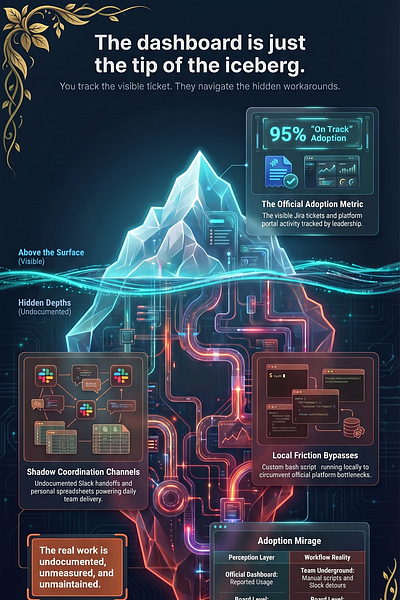
Here is what the boardroom was measuring. Here is what was already operating underneath it.
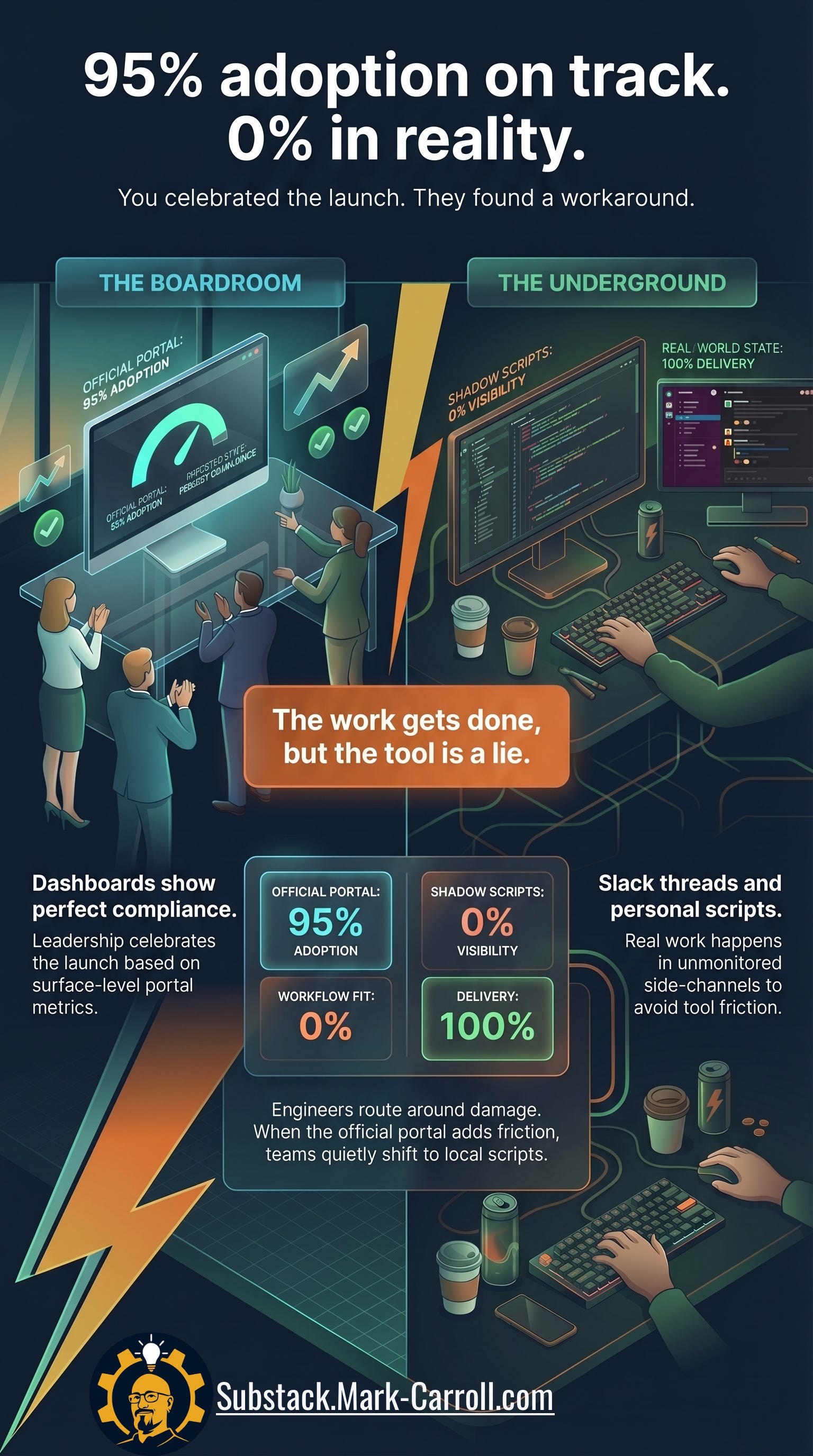
The Adoption Mirage
Most organizations read this as a soft failure. Training needed reinforcement, change management needed improvement, leadership needed to drive adoption with more conviction and cleaner messaging. That reading is too small. This is not a software success story with a communication problems hanging off the side of it. This is an operating cost story.
The organization bought a tool. The engineers kept buying time somewhere else. That gap isn’t so much awkward as it is expensive.
Most leaders think software waste begins when a tool is bad. A clumsy interface, poor reliability, weak features, obvious mismatches with real use. Sometimes that is true. More often, the waste begins when a tool is good enough to buy and too friction-heavy to adopt.
That is the Integration Penalty
The hidden cost of software is not the invoice alone. It is the gap between what the company bought and what the team actually uses. Leaders tend to treat those two things as if they should converge naturally over time, as though deployment will mature into adoption if everyone remains patient and polite for long enough. In practice, that gap often widens in silence while the budget continues to treat the purchase as settled value.
This Is Not a Change Problem
Purchase and adoption are not the same event. The purchase decision measures capability, the rollout plan measures deployment, and neither one measures whether changing the workflow is worth the pain to the people doing the work. A vendor can win the evaluation and still lose the daily route.
That is the category mistake most organizations keep making. They assume software adoption failure is a change-management problem. It isn’t.
Software adoption failure is not a change-management problem. It is a friction-measurement problem.
The workaround is not a behavioral failure. It is a measurement. It is the team’s honest accounting of where the cost-benefit calculation actually landed. The official route cost more than it delivered. The shadow route cost less and delivered more. The team made a rational decision. The organization just was not watching the right ledger.
The official workflow and the real workflow diverge at a single friction point. Here is the exact moment the ghost town is created.
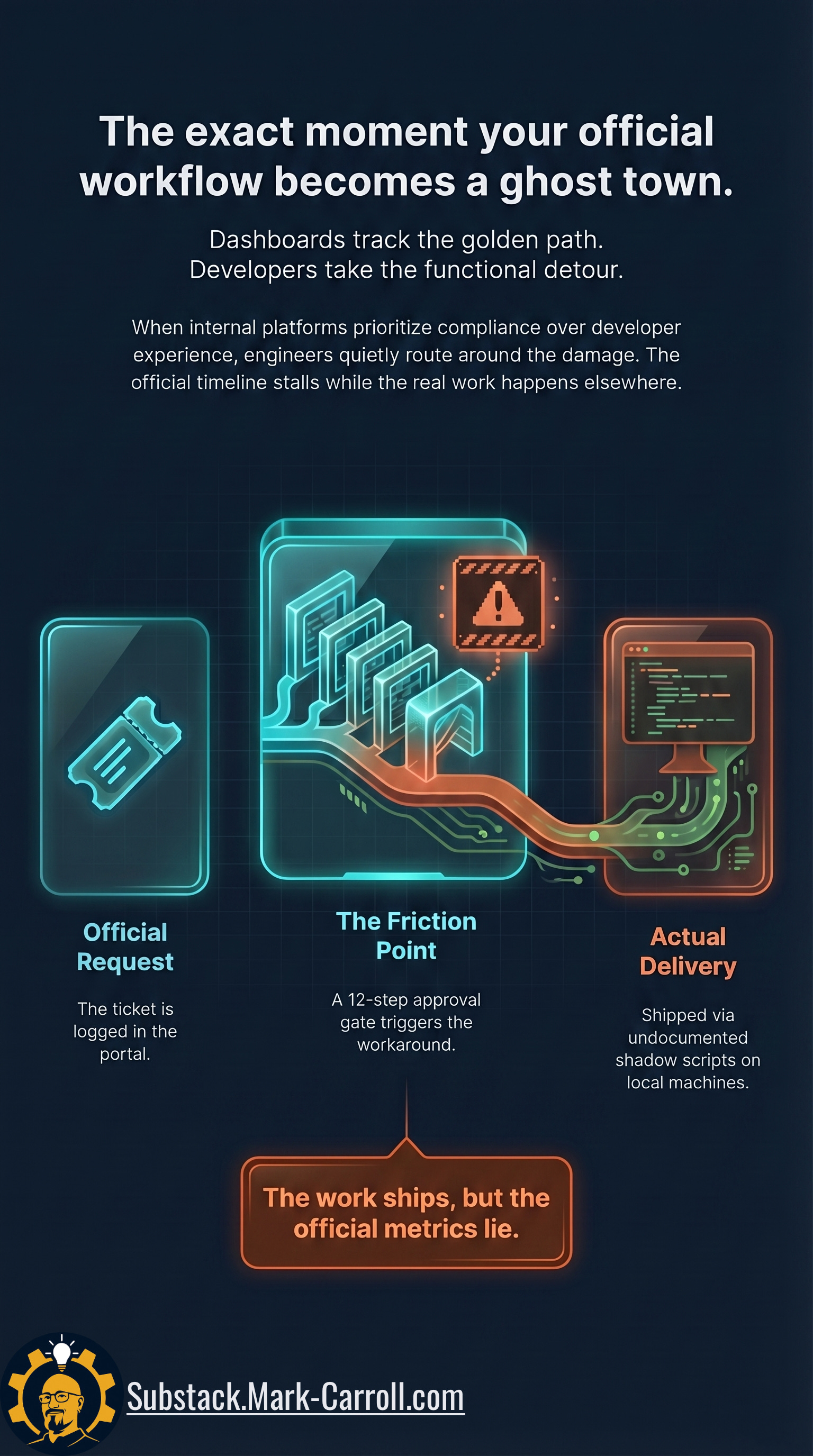
The Workaround Is the Proof
Friction is not irrational resistance. Friction is evidence. It tells you that the integration cost exceeds the perceived benefit, and it does so more honestly than a launch retrospective ever will. Teams do not quietly preserve side channels, personal scripts, duplicated tools, and manual handoffs because they enjoy administrative mischief. They do it because the unofficial route is protecting something they care about more than compliance. Usually that something is speed, clarity, or control.
That is why the workaround matters so much. The workaround is not a side effect. The workaround is the proof that the official route lost to the unofficial one. The moment the team builds a shadow path and keeps using it, the organization is no longer funding one workflow. It is funding two.
That is the penalty hiding inside the purchase. Everyone in the chain can still look competent while this happens. Procurement did its job. Engineering leadership approved the tool in good faith. IT and operations can point to deployment progress and license utilization. Finance can track contract value and renewal dates with admirable discipline. None of that is fake work. Nor does any of it answer the harder question.
The system is optimized for purchase, not adoption. Procurement ends at signature, and the adoption problem starts the day after. Vendors are strongly incentivized to sell, and almost nobody inside the organization is equally incentivized to measure whether the purchase actually changed the workflow in a way worth funding. That gap between incentives is where the penalty lives rent-free until someone decides to price it.
Your best engineers did not rebel against the platform. They did what engineers always do when a system creates more drag than it removes.
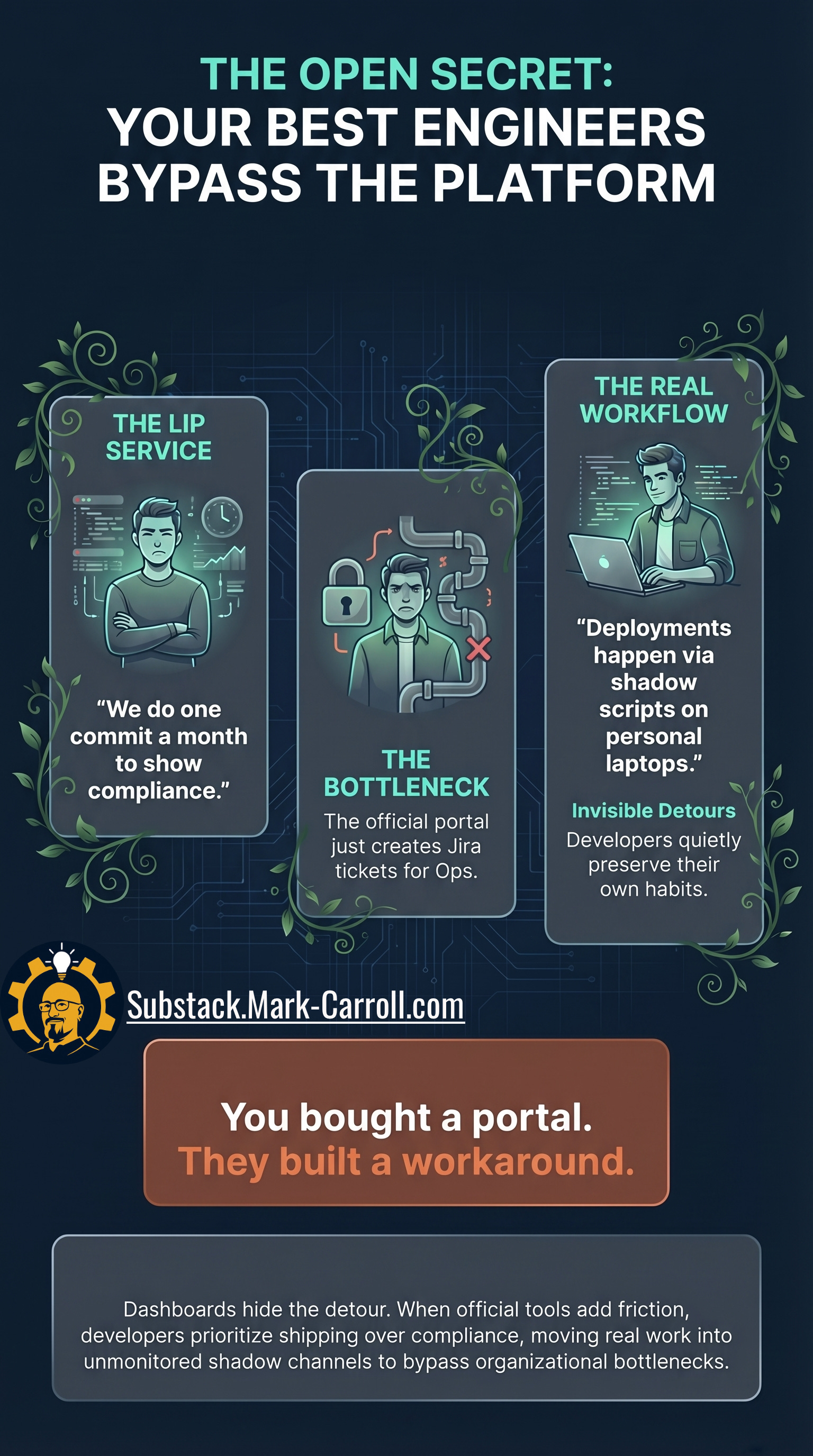
Nobody in that chain was lying. That is the part that makes it interesting.
What the Dashboard Cannot See
The organization did not buy software. It bought a second workflow and forgot to price the first one.
That is the verdict. Everything else in this article exists to help the reader make that verdict financially legible. Not universally, not theatrically, and not with fake precision dressed up as proof. Locally. Defensibly. In the language of the next renewal meeting.
The tool survives because it looks official, the workaround survives because it works, and leadership is left with a dashboard that reports one reality while the team lives inside another. The organization now has a polished surface story and an underground operating system. Both cost money. Neither is counted honestly.
The dashboard measures the visible tip. Everything that actually ships the work is living below the waterline, unmeasured and unmaintained.
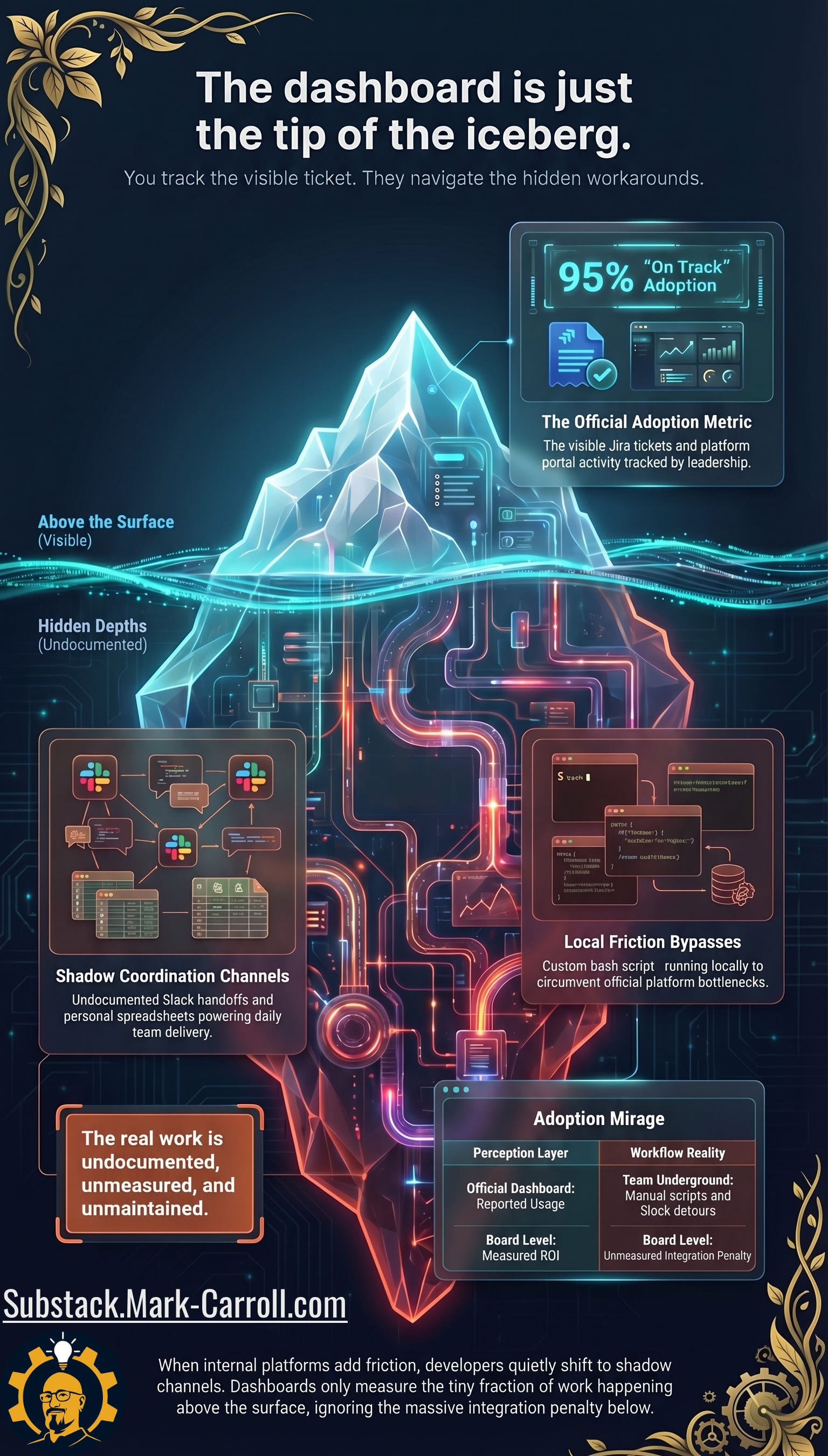
Pricing the Hidden Route
This is where the evidence posture matters. There is no clean, universal benchmark for the integration penalty as such. The research supports the existence of hidden organizational costs when work routes around official tools, especially in the form of duplicate coordination, maintenance overhead, fragmentation, and time loss. What it does not support is a neat industry-wide number you can borrow and apply to your own environment without blushing when finance asks where it came from.
That does not weaken the argument. It disciplines it. In this series called Profit With Proof, discipline is not optional. The goal is not to prove that every organization pays the same penalty. The goal is to show the reader how to estimate their own exposure using numbers they can actually defend in a room with consequences. The smarter move here is not courtroom precision. It is decision-grade honesty.
So start with the number you actually need. Not what does failed adoption cost in general, but what are we still paying because the team routed around this tool? That is the question the procurement process never answered and the renewal cycle usually avoids answering unless someone forces it into daylight.
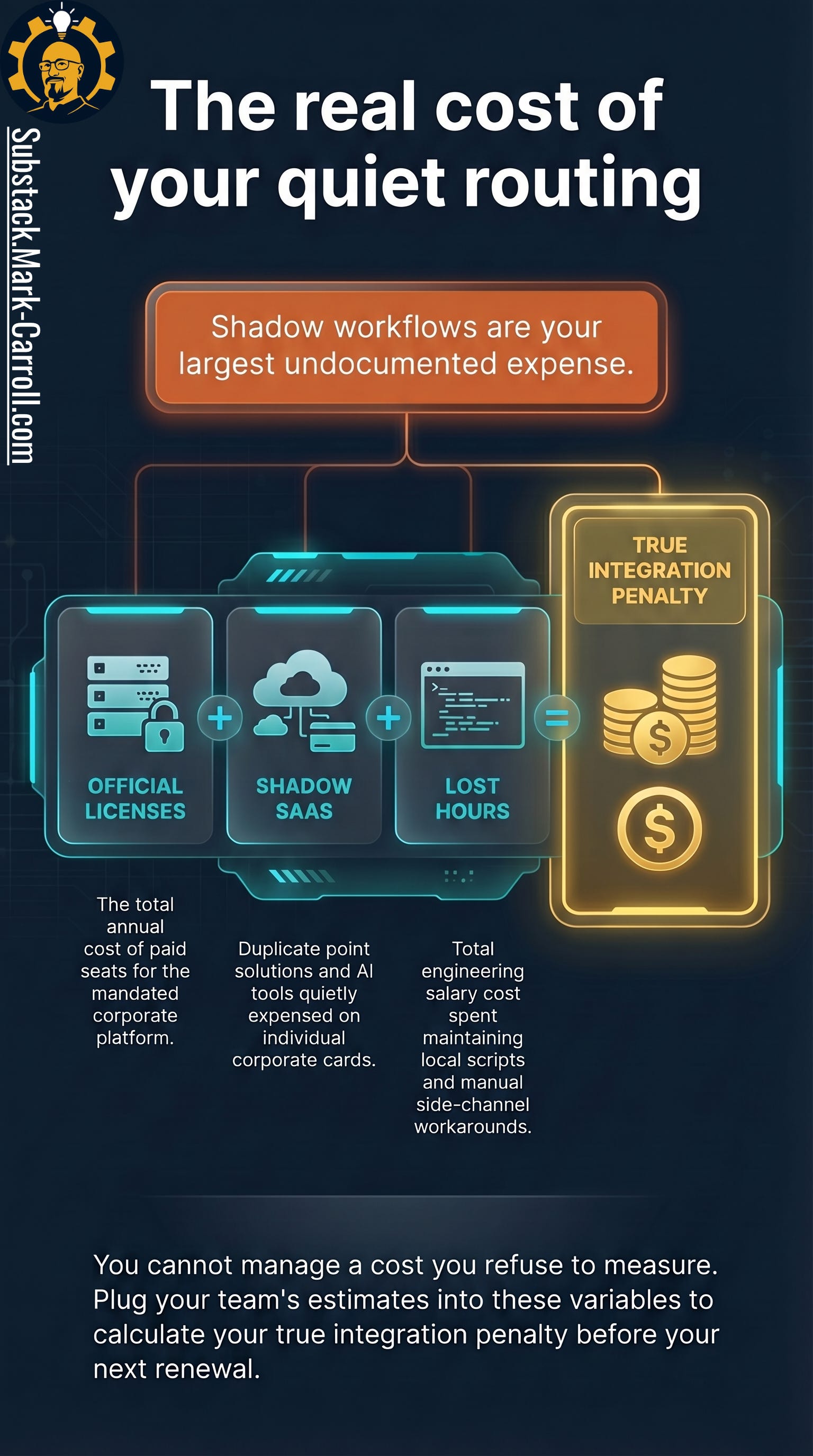
The structure can stay simple. Begin with annual license cost. Add the current adoption percentage. Estimate the engineer hours spent each week maintaining or using the workarounds that replaced the official route. Then apply an average hourly engineering cost. Those four inputs will not give you a universal truth. They will give you something more useful: a local estimate (keep reading, you’ll find my Adoption Friction Calculator below)
Shadow workflows are your largest undocumented expense.
Three variables, one honest number that your procurement process never calculated.
Three Diagnostic Checks Before Renewal
Run the math on your own numbers. Do not borrow someone else’s.
The first number is the cost of non-adoption. If the annual license cost is, say, $200,000 and actual adoption is twenty-two percent, then seventy-eight percent of that spend is not funding the workflow you thought it was funding. That is $156,000 per year paying for a route the team already abandoned.
The second number is the cost of workarounds. Ten engineers. Four hours a week. One hundred and fifty dollars an hour. That is $312,000 a year in shadow labor. Your dashboard does not contain that number. Nobody budgeted it. Nobody approved it. It arrived anyway, spread across a thousand small decisions to use the script instead of the portal.
The third number is the total integration penalty: the combined burden of paying for the official route and nursing the shadow one. In this illustration, that is $468,000 in annual exposure on a $200,000 contract. The tool did not cost $200,000. It cost the license plus the quiet labor required to bypass it.
That is why half-working tools are often more expensive than obviously failed ones. A total failure usually gets cut. A half-working tool justifies its existence enough to survive review while still pushing real work into un-tracked detours. It can remain alive in the contract long after it has died in the workflow.
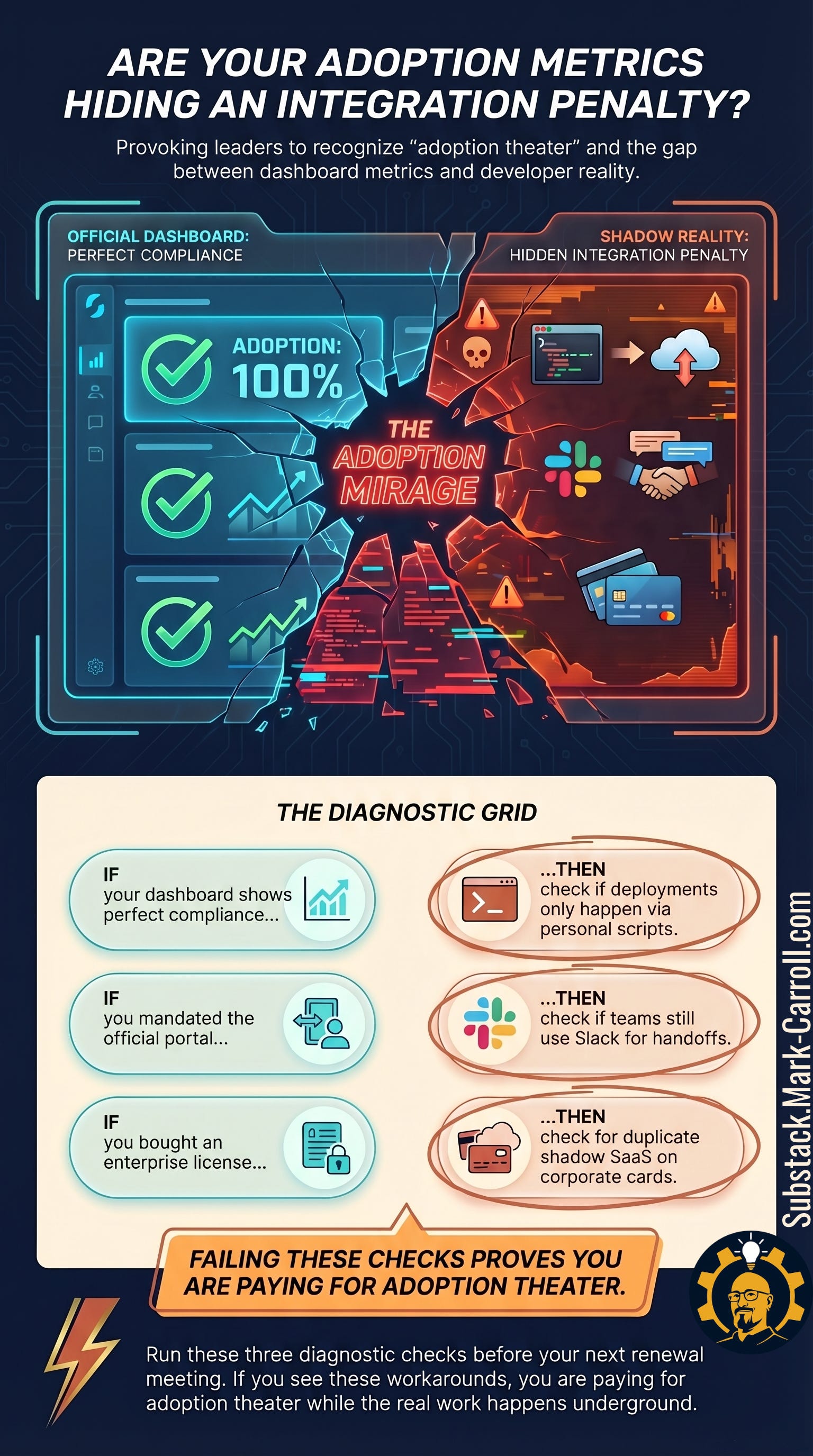
If you want a fast pre-renewal check, use three questions. What percentage of the paid route is actually being used in daily work? How many hours each week are being spent on the shadow route that replaced it? What would leadership decide differently if those two numbers appeared on the same slide? If the answer to the third question is quite a lot, then the tool has already stopped being a workflow decision and become a portfolio problem.
Run these three checks before your next renewal. If you find these workarounds in place, you are funding adoption theater while real work routes underground.
What Changes When You Stop Pretending
This is also why leaders underestimate the cost. The spend is split across categories that do not naturally reconcile. License cost sits in procurement or platform budget. Workaround cost sits in engineering time. Friction sits in nobody’s ledger at all. The organization gets three partial truths and mistakes their coexistence for visibility.
The mature question is not :Did we deploy it?” The mature question is “What are we still paying because the team routed around it?” That is the question that moves the topic out of change language and into budget language. It is also the question that gives leaders a chance to regain control of a conversation they have been losing with comforting metrics.
That is the role of the artifact in this episode. The Adoption Friction Calculator is not supposed to be a grand system of record or an executive toy with twenty inputs and a false sense of authority. It is supposed to be a board-safe numbers strip. Four core inputs. Fast completion. Clear outputs. Enough structure to help a reader enter a renewal or portfolio conversation with something stronger than frustration and something less fraudulent than a borrowed benchmark.

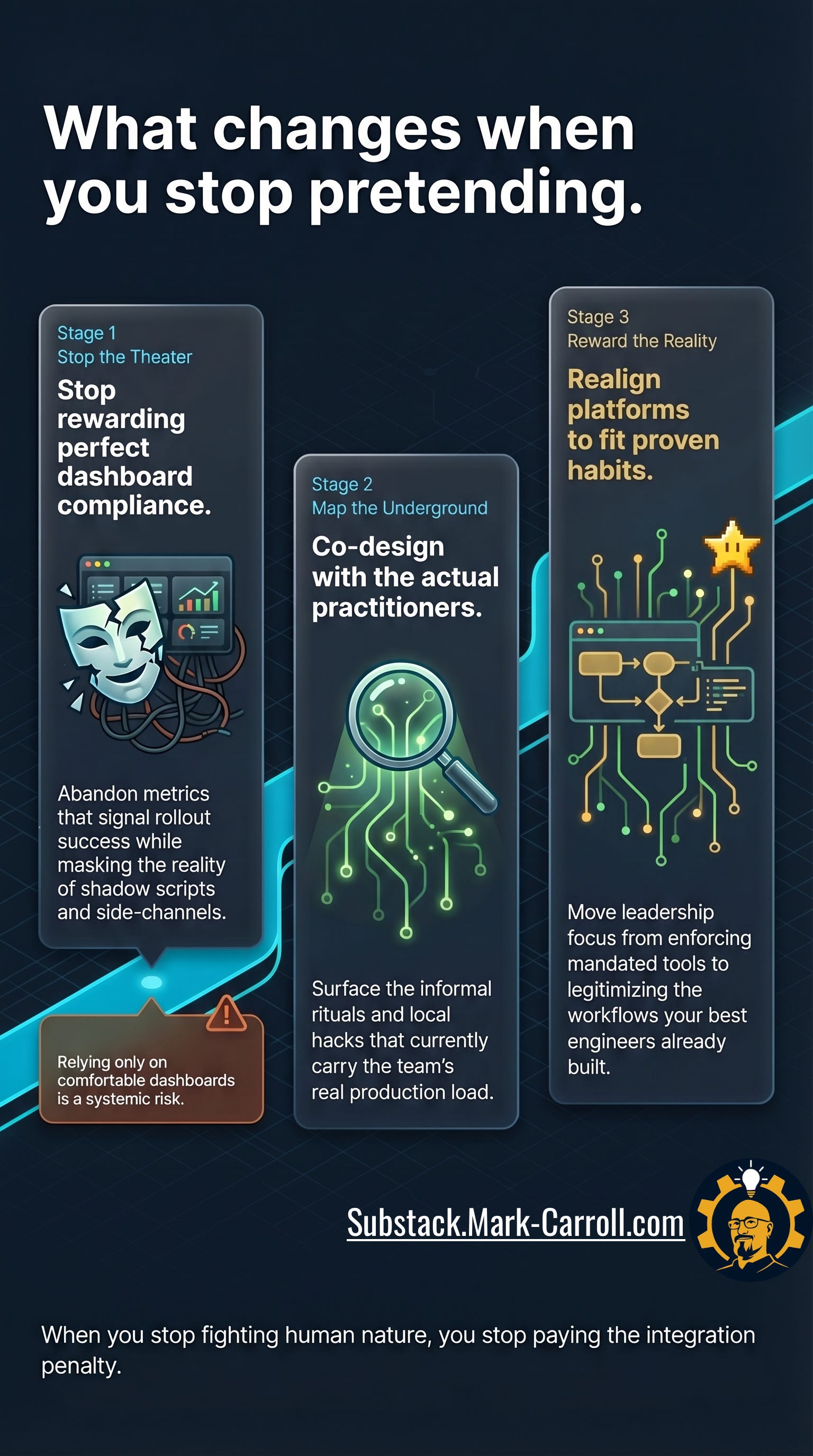
Stopping the theater is not a culture initiative.
It is three operating decisions made in sequence.
Audit the Real Workflow
The point is not to produce a definitive number. The point is to remove the organization’s ability to keep pretending the hidden route has no cost. Once that number exists, even as a bounded estimate using local inputs, it becomes harder to admire the dashboard without asking what it failed to measure. Visibility does not solve the problem by itself. It just dramatically reduces leadership’s ability to lie to itself with confidence.
That is the larger tension beneath this entire episode. The contract says the platform won. The workflow says it lost. If those two truths are allowed to diverge for long enough, the budget eventually tells the truth in a voice nobody enjoys hearing.
If your workflow changed less than your vendor narrative did, the savings are fictional until proven otherwise. A tool that lives in the contract and dies in the workflow is not a productivity gain. It is an unmeasured tax.
That is also the broader argument behind Collaborate Better (to be published later in 2026). Better collaboration is not about being nicer in meetings or admiring cleaner diagrams. It is about reducing avoidable friction before it turns into waste, delay, and preventable cost. When organizations force people to choose between the official route and the functional one, the cost never disappears. It just moves somewhere leadership is not looking yet.

If you are walking into a renewal meeting next quarter with a green dashboard and a quiet suspicion that the number on that dashboard is not the number that matters, this is the article I wish someone had handed me the first time I sat in that room. You are not imagining the gap. You are just the first person in that meeting who decided to price it.
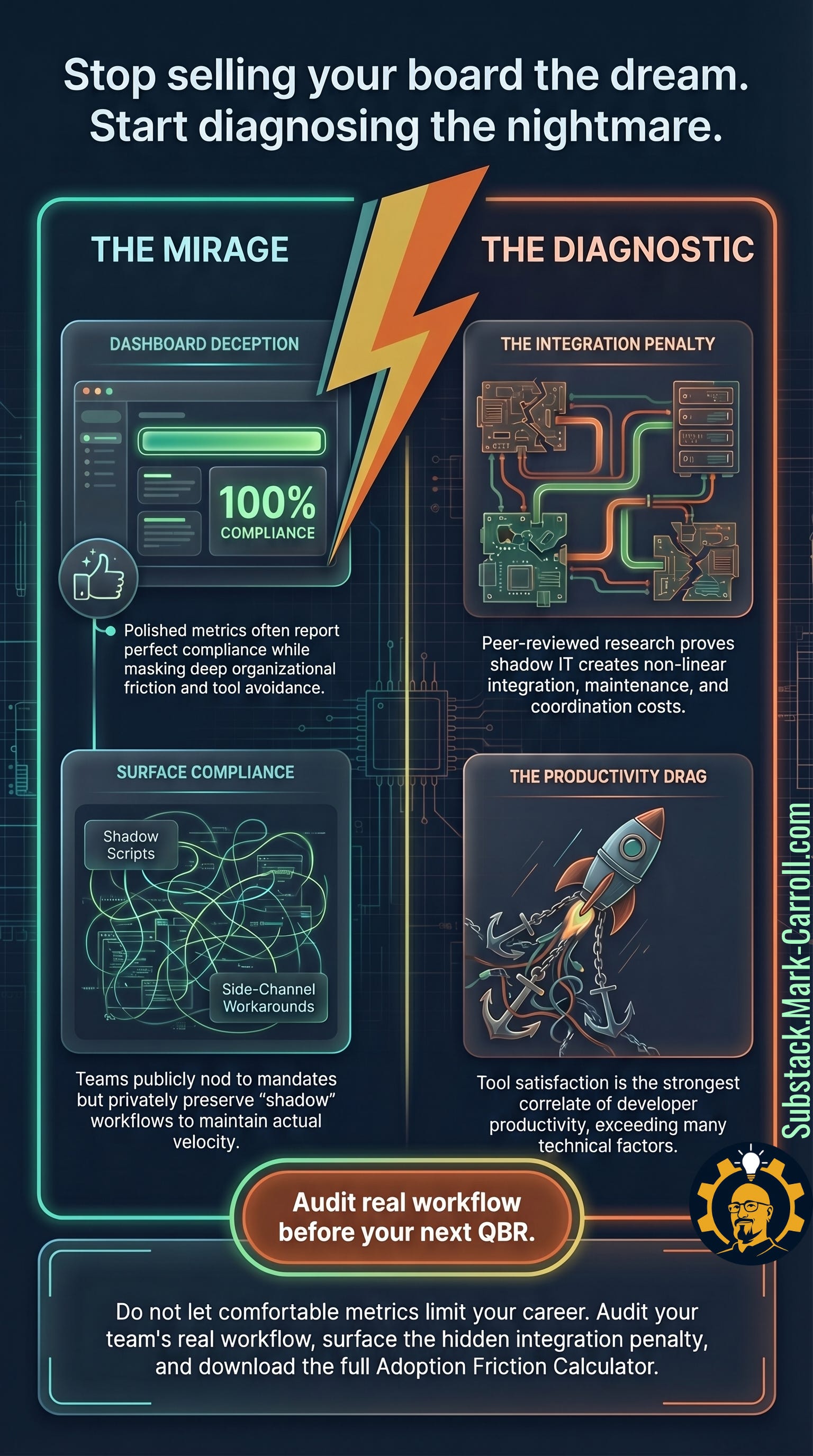
Stop selling your board the dream. Audit the real workflow before your next QBR, and bring a number they cannot dismiss.
This episode priced the gap between the tool story and the real workflow. Next week prices the gap between the ceremony story and the calendar.
A Meeting Killed Your Profits (Next article Episode 6) asks a question most organizations should have priced years ago: what exactly is your ceremony calendar buying, and what is it costing every quarter it goes un-audited? That episode moves from software non-adoption into a different kind of organizational overhead, one that people defend one meeting at a time and almost never price as a system.

P.S. If your team has routed around a tool leadership still considers adopted, what exactly made the workaround feel safer, faster, or more honest in the moment you chose it?
Regards,
Mark 👋
Empathy Engine | Substack.Mark-Carroll.com | Evidence-Forward Product Leadership
Previous:

More Content to Discover:


Roadmap Keeps Breaking? 3 Fixes for PMs and POs

Top of the Series Arc: 🔒 Leader’s Dispatch: Weight Comes After Insight
Before your next renewal or QBR, write down three numbers on one page:
- What you’re paying for the tool
- What percent of real work actually flows through it
- How many hours your team spends routing around it
Then ask one question:
What would we decide differently if all three numbers showed up on the same slide?
Curious what you find.