“Please Review” Isn’t Enough
Plain-English premise: AI can write the explanation almost as readily as it wrote the change. Someone still has to know whether either one is true.
Judgment Seat: The submitter who mistakes a fluent summary for proof that they understand what they built.
Episode 1:

👋 Last week, The Judgment Layer named the Review Budget: a team’s finite attention before it quietly runs out. That issue ended on a question: if review is scarce, who earns the right to ask for it? This week answers from the other side: before a reviewer spends that budget, the sender owes them something specific.
Research Binder: the receipts (citations + source notes) are compiled in a PDF at the bottom of this post.
⚡ Pressure
AI made fluent explanation cheap to generate, which means explanation can now arrive looking suspiciously like understanding.
🎯 Payoff
This issue gives you the Four-Part Handoff Brief: four questions a submitter answers in their own words before anyone spends review attention on the work.
Pressure Moment
The failure mode looks something like this. Earlier in this series’ research, I had a set of precise, polished statistics in front of me: +180%, +140%, +115%, +95%, each wrapped in an explanation confident enough that nothing about it asked to be double-checked. If I had treated that polish as proof, it would have crossed straight into a published piece. We checked it instead. The numbers did not hold up, and we quarantined them before they went anywhere near a reader. The presentation had already arrived finished. The verification had not, and looking at it would never have told you that.
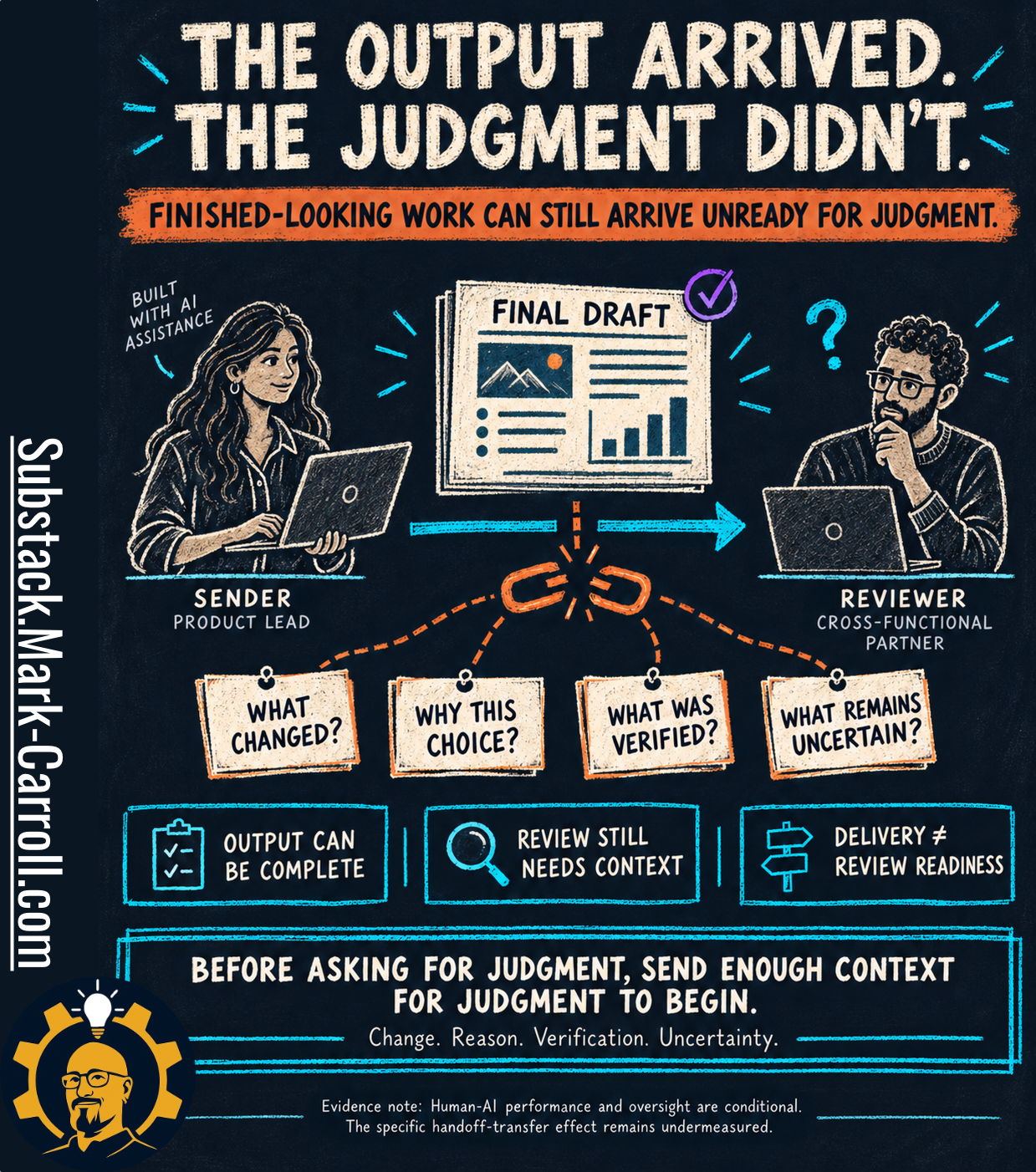
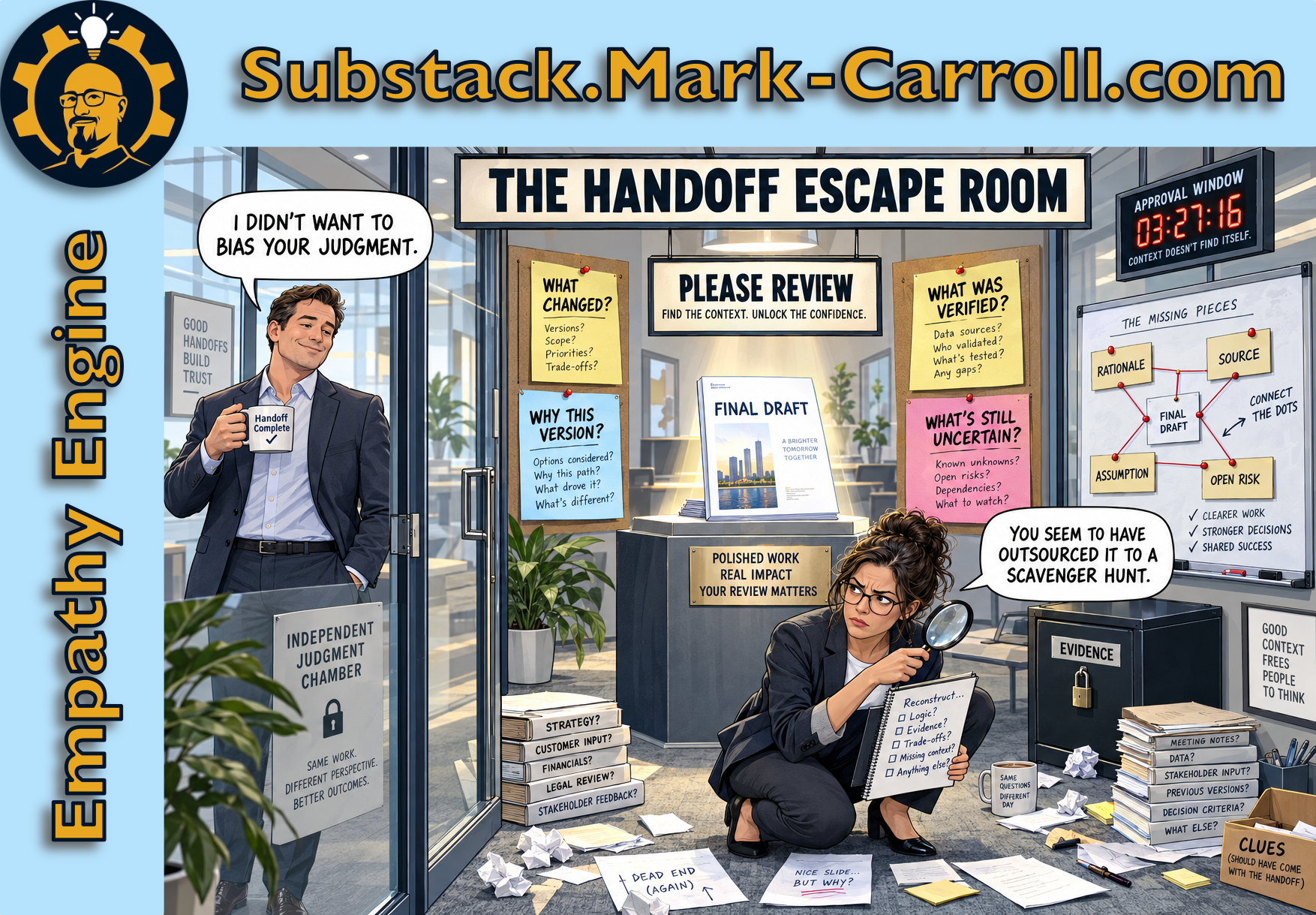
That same gap gets more dangerous once it crosses to someone who wasn’t in the room for the checking, a colleague reading a deck, a partner reading a brief, anyone whose only signal is how finished the work looks.
🧭 The Judgment Move
Orienting sentence: The Four-Part Handoff Brief separates orientation from evaluation. Before a reviewer judges the work, the submitter supplies what changed, why, what was checked, and what still is not settled, in their own words.
Step 1: Name the meaningful change, the actual decision that moved, not a restated file list. A generated cover letter listing every diff isn’t this field. If a second AI wrote the explanation of the first AI’s work, human understanding still hasn’t been demonstrated.
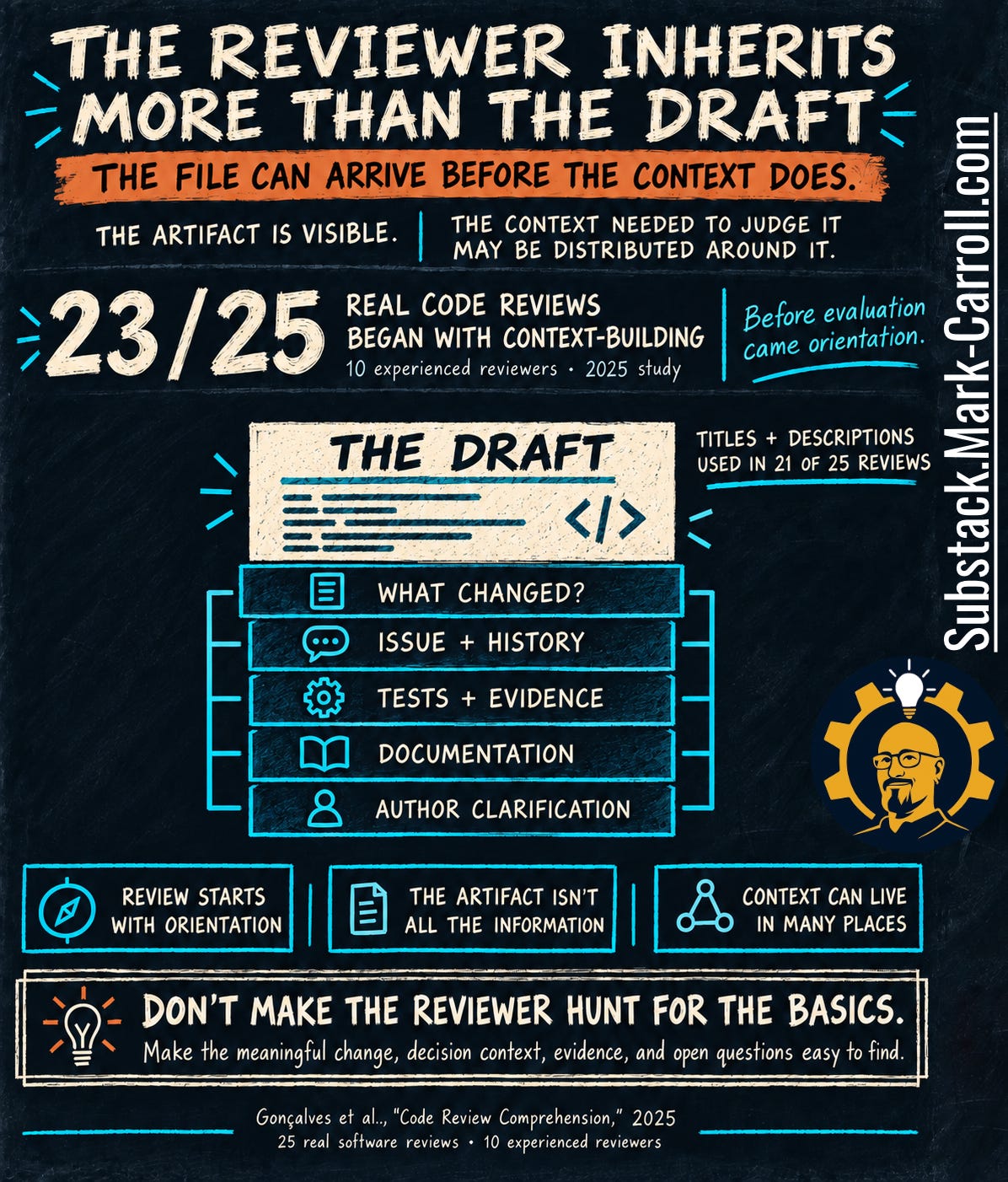
Reviewers in that study usually built context before evaluating the change. The Handoff Brief makes more of that orientation visible at send time, instead of assuming the artifact explains itself.
Step 2: State why this shape: the reason, tradeoff, or material alternative that matters. “The model suggested this structure” describes where the idea came from. It doesn’t defend it.
Step 3: Point to what was verified, and where a reviewer can inspect it themselves: a test, a source, a run, a citation. A general assertion of confidence is not this field.
Step 4: Name what remains uncertain, unverified, or disputed. For a consequential handoff, don’t bury this in fine print. Uncertainty can change how the rest of the handoff should be read.
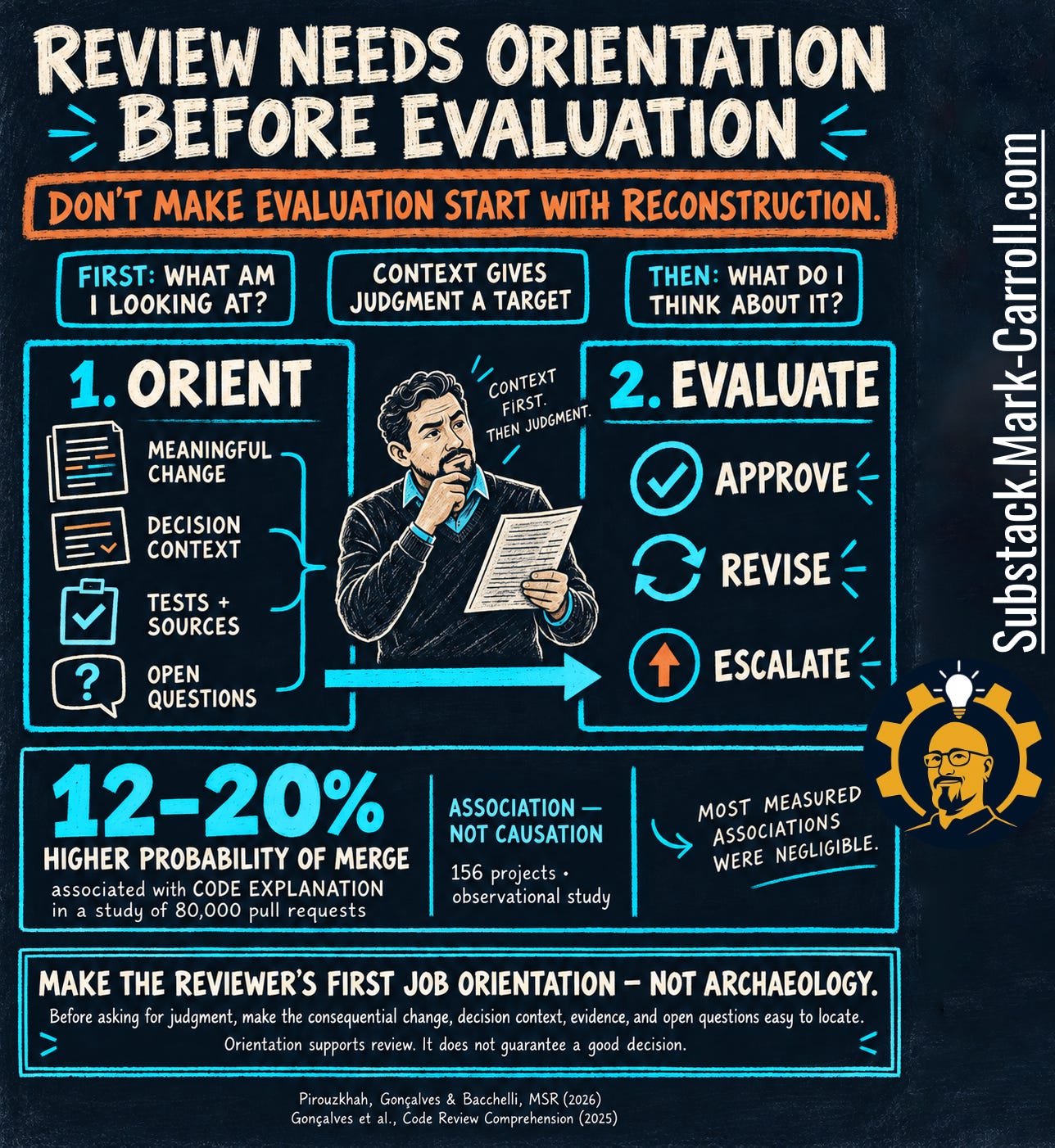
Then evaluate. Once enough orientation is visible, the reviewer can move to approval, revision, or escalation. Orientation and evaluation are two different jobs, and collapsing them is how a reviewer ends up reconstructing the submitter’s reasoning before they can begin their own.
Done state: a ready consequential handoff carries a named change, a stated reason, an inspectable verification anchor, and a named uncertainty, visible before evaluation starts.
Constraint: the four fields scale with consequence. A low-risk change may need one sentence per field. A high-stakes handoff needs real inspectable anchors, not a checklist filled in from memory.
Limitation: this move cannot prove the submitter’s stated verification happened, or that their explanation reflects real understanding rather than a second generated summary dressed as one. It only makes the absence of that information expensive to hide.
What that looks like assembled is worth seeing once the roles around it are clear.
🧪 What Holds Up
Primary claim label: Evidence, for the separable pieces; Design inference for the bundle.
Basis: Generation speed and total task completion are not the same measurement. A field study of over five thousand customer-support agents found AI access improved resolutions per hour by roughly fifteen percent in a bounded task. A separate randomized study of sixteen experienced open-source developers on two hundred forty-six tasks found AI access made completion nineteen percent slower, despite those developers expecting a gain. Same tool category, opposite result: the two studies measured different workflows.
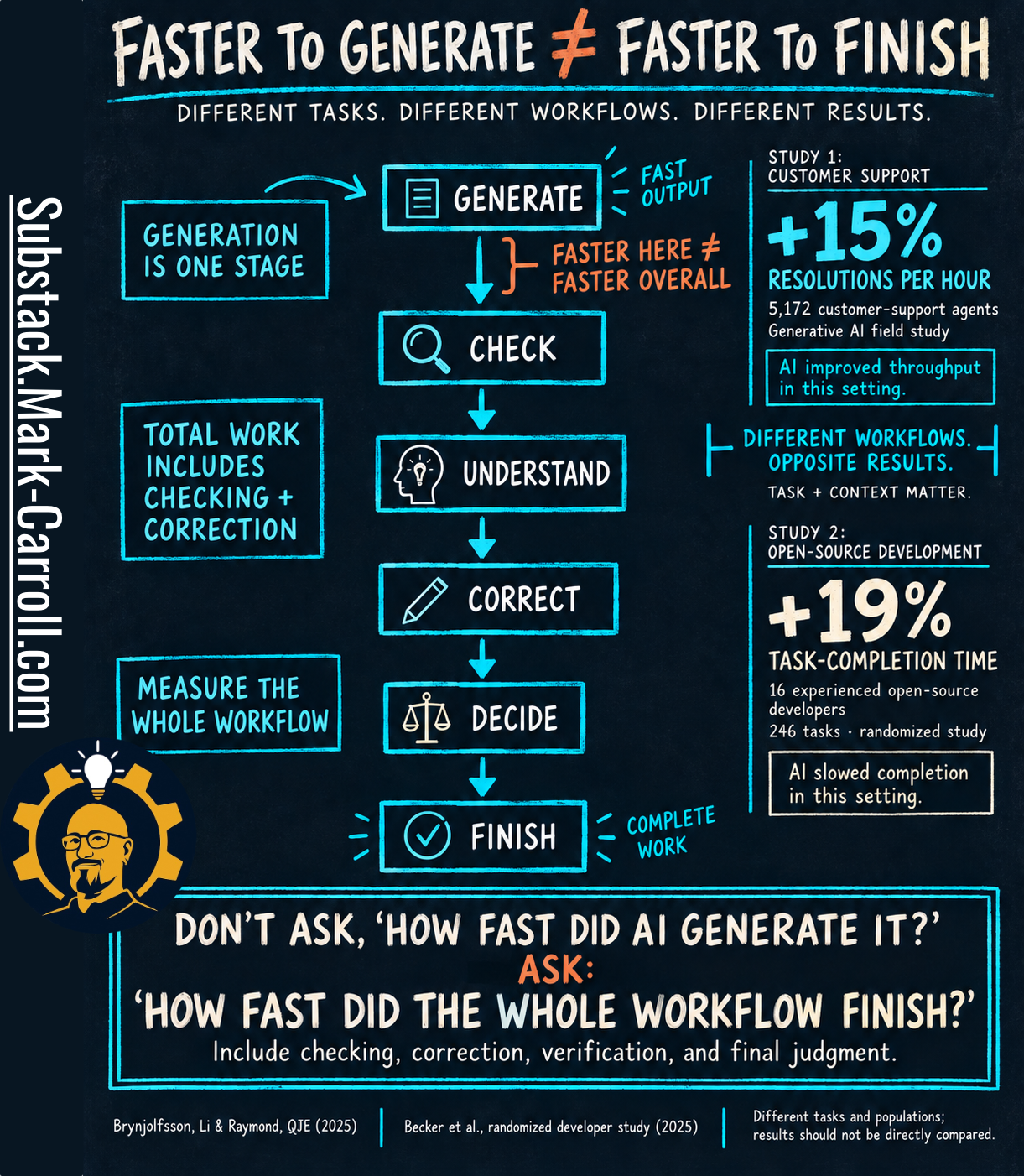
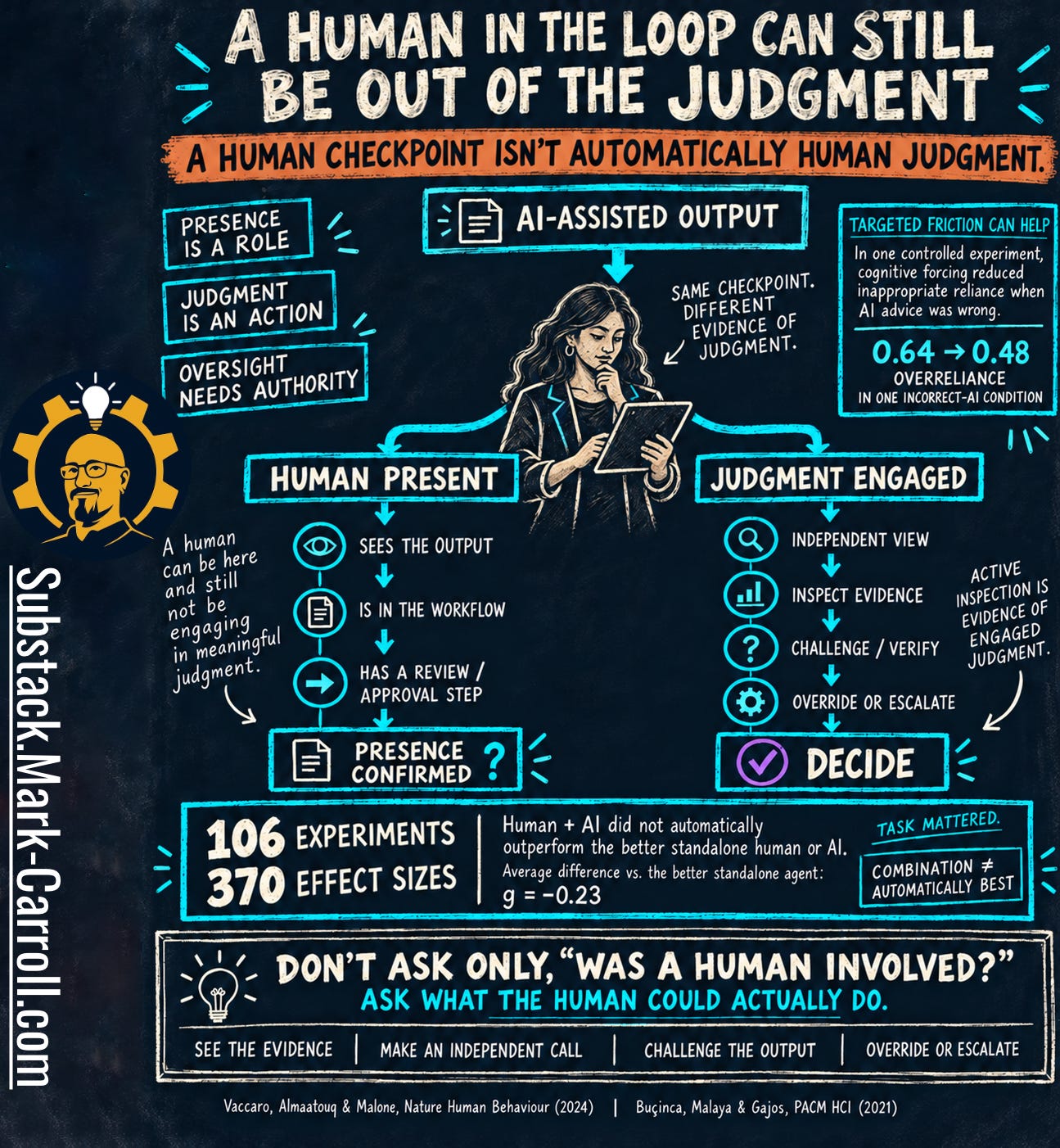
A related caution: a meta-analysis of one hundred six experiments and three hundred seventy effect sizes found human-AI combinations did not automatically outperform the better standalone human or AI. A human checkpoint is not, by itself, evidence that judgment was exercised. One controlled study did find a targeted friction step reduced inappropriate reliance on wrong AI advice, from sixty-four percent to forty-eight percent, so the direction isn’t hopeless. It just isn’t automatic.