


“Please Review” Isn’t Enough
Plain-English premise: AI can write the explanation almost as readily as it wrote the change. Someone still has to know whether either one is true.
Judgment Seat: The submitter who mistakes a fluent summary for proof that they understand what they built.
Episode 1:

👋 Last week, The Judgment Layer named the Review Budget: a team’s finite attention before it quietly runs out. That issue ended on a question: if review is scarce, who earns the right to ask for it? This week answers from the other side: before a reviewer spends that budget, the sender owes them something specific.
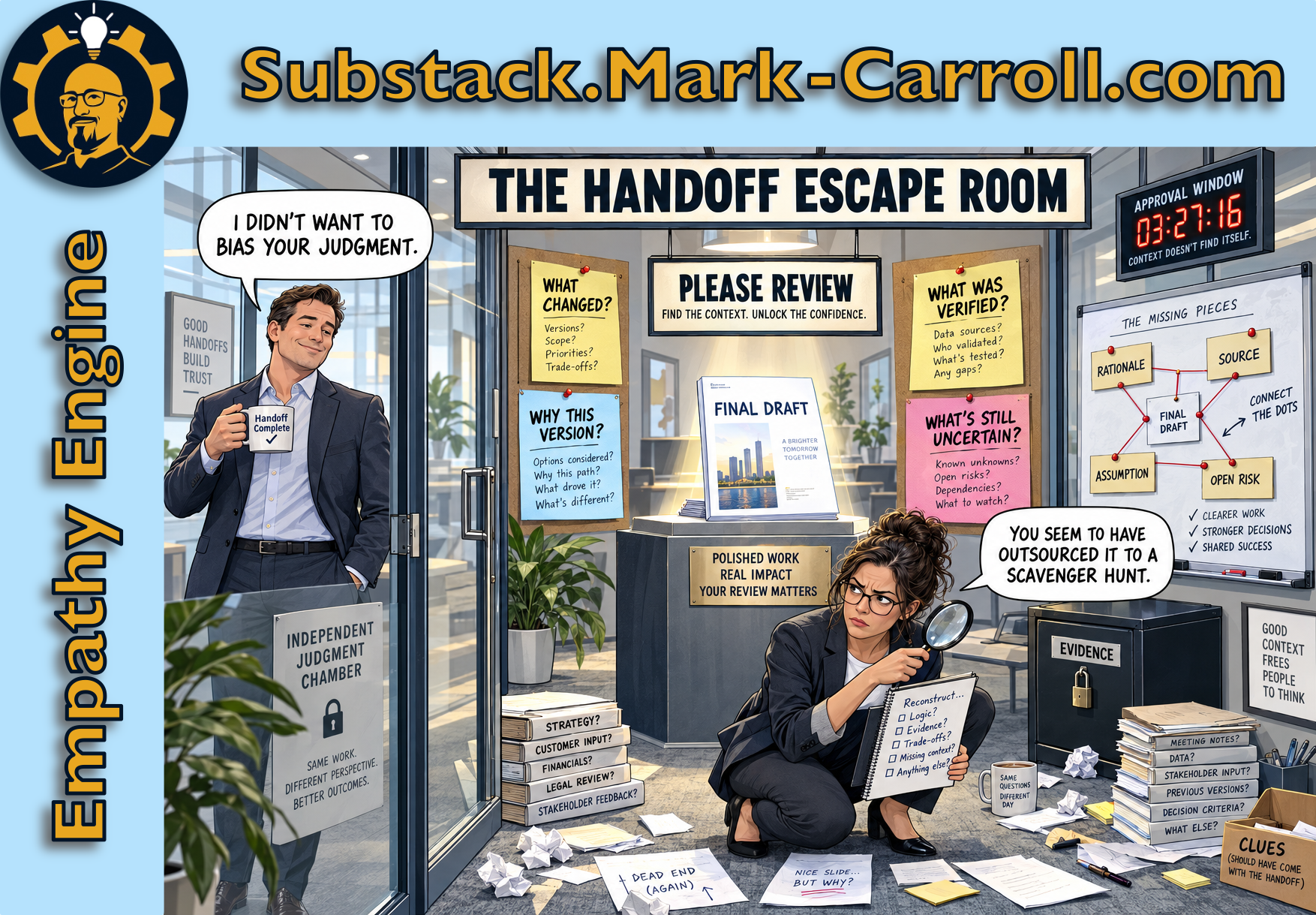
Research Binder: the receipts (citations + source notes) are compiled in a PDF at the bottom of this post.
⚡ Pressure
AI made fluent explanation cheap to generate, which means explanation can now arrive looking suspiciously like understanding.
🎯 Payoff
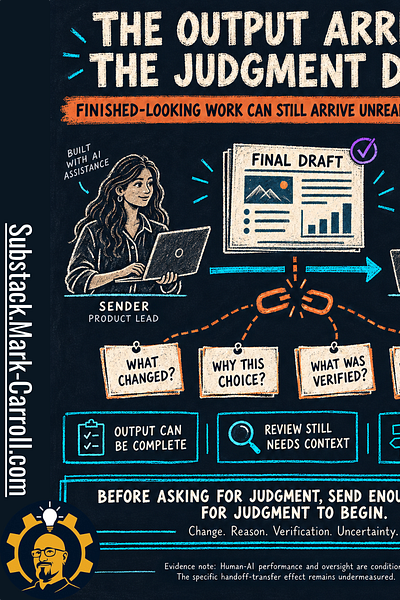
This issue gives you the Four-Part Handoff Brief: four questions a submitter answers in their own words before anyone spends review attention on the work.
Pressure Moment
The failure mode looks something like this. Earlier in this series’ research, I had a set of precise, polished statistics in front of me: +180%, +140%, +115%, +95%, each wrapped in an explanation confident enough that nothing about it asked to be double-checked. If I had treated that polish as proof, it would have crossed straight into a published piece. We checked it instead. The numbers did not hold up, and we quarantined them before they went anywhere near a reader. The presentation had already arrived finished. The verification had not, and looking at it would never have told you that.
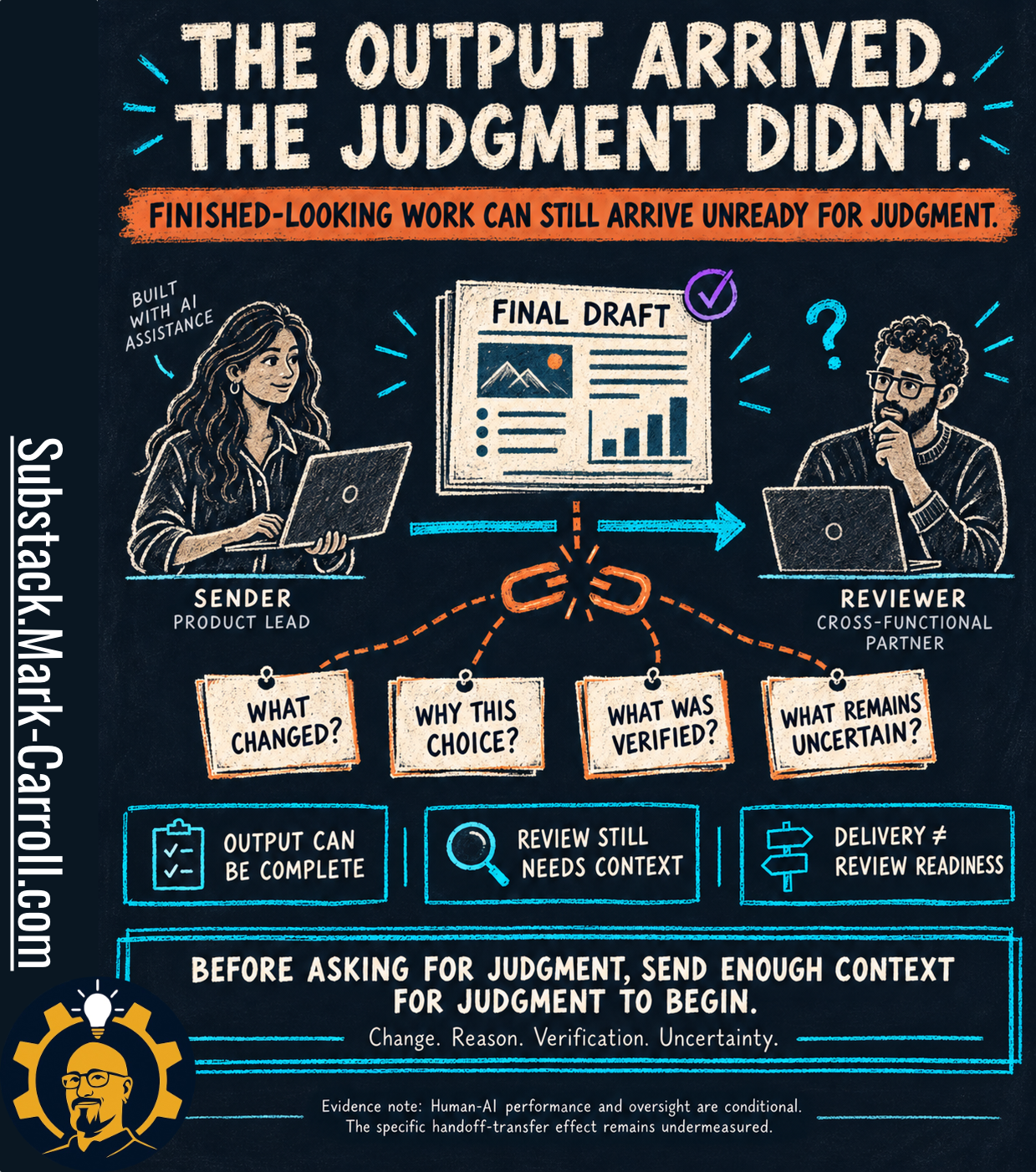
That same gap gets more dangerous once it crosses to someone who wasn’t in the room for the checking, a colleague reading a deck, a partner reading a brief, anyone whose only signal is how finished the work looks.
🧭 The Judgment Move
Orienting sentence: The Four-Part Handoff Brief separates orientation from evaluation. Before a reviewer judges the work, the submitter supplies what changed, why, what was checked, and what still is not settled, in their own words.
Step 1: Name the meaningful change, the actual decision that moved, not a restated file list. A generated cover letter listing every diff isn’t this field. If a second AI wrote the explanation of the first AI’s work, human understanding still hasn’t been demonstrated.
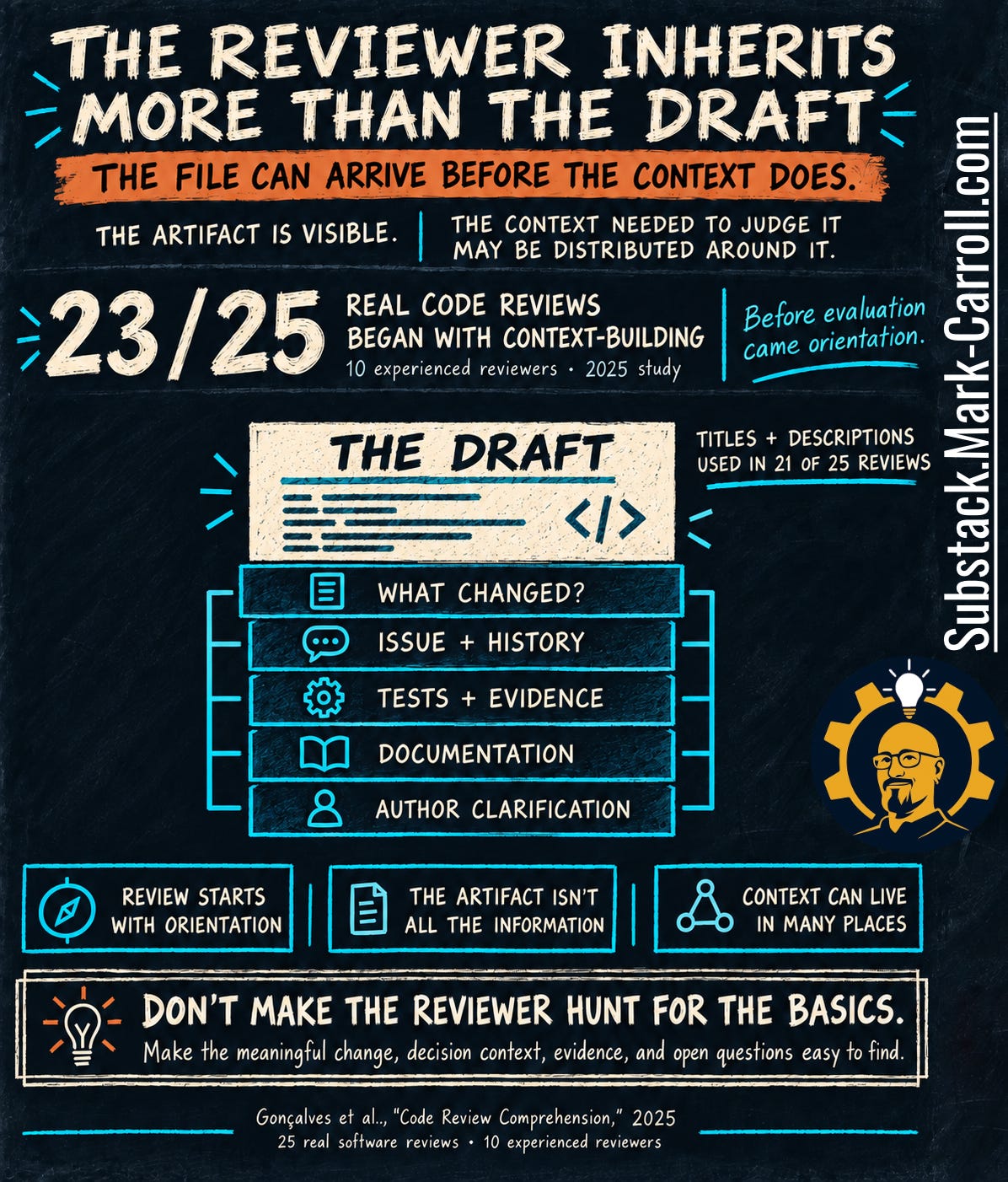
Reviewers in that study usually built context before evaluating the change. The Handoff Brief makes more of that orientation visible at send time, instead of assuming the artifact explains itself.
Step 2: State why this shape: the reason, tradeoff, or material alternative that matters. “The model suggested this structure” describes where the idea came from. It doesn’t defend it.
Step 3: Point to what was verified, and where a reviewer can inspect it themselves: a test, a source, a run, a citation. A general assertion of confidence is not this field.
Step 4: Name what remains uncertain, unverified, or disputed. For a consequential handoff, don’t bury this in fine print. Uncertainty can change how the rest of the handoff should be read.
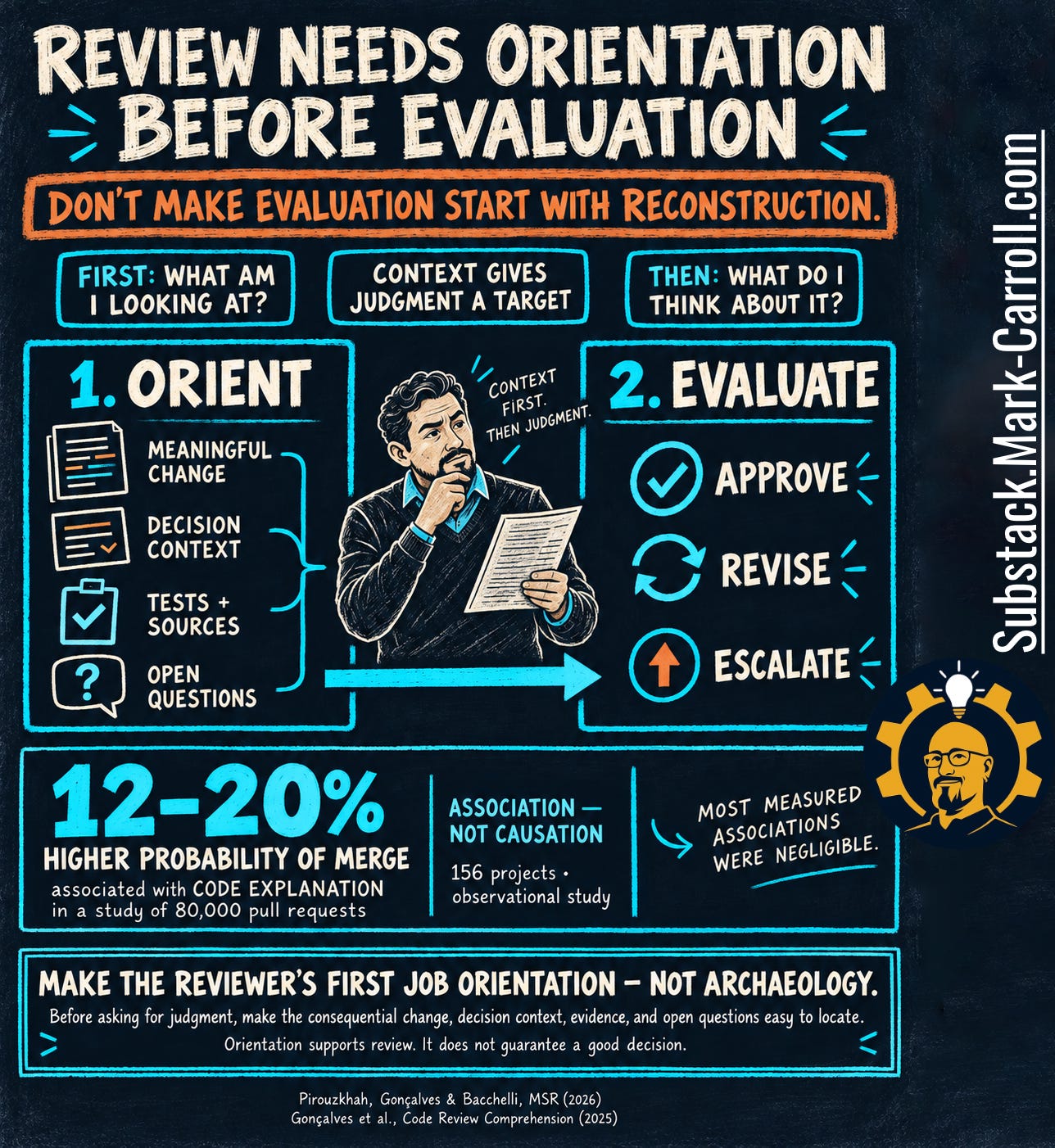
Then evaluate. Once enough orientation is visible, the reviewer can move to approval, revision, or escalation. Orientation and evaluation are two different jobs, and collapsing them is how a reviewer ends up reconstructing the submitter’s reasoning before they can begin their own.
Done state: a ready consequential handoff carries a named change, a stated reason, an inspectable verification anchor, and a named uncertainty, visible before evaluation starts.
Constraint: the four fields scale with consequence. A low-risk change may need one sentence per field. A high-stakes handoff needs real inspectable anchors, not a checklist filled in from memory.
Limitation: this move cannot prove the submitter’s stated verification happened, or that their explanation reflects real understanding rather than a second generated summary dressed as one. It only makes the absence of that information expensive to hide.
What that looks like assembled is worth seeing once the roles around it are clear.
🧪 What Holds Up
Primary claim label: Evidence, for the separable pieces; Design inference for the bundle.
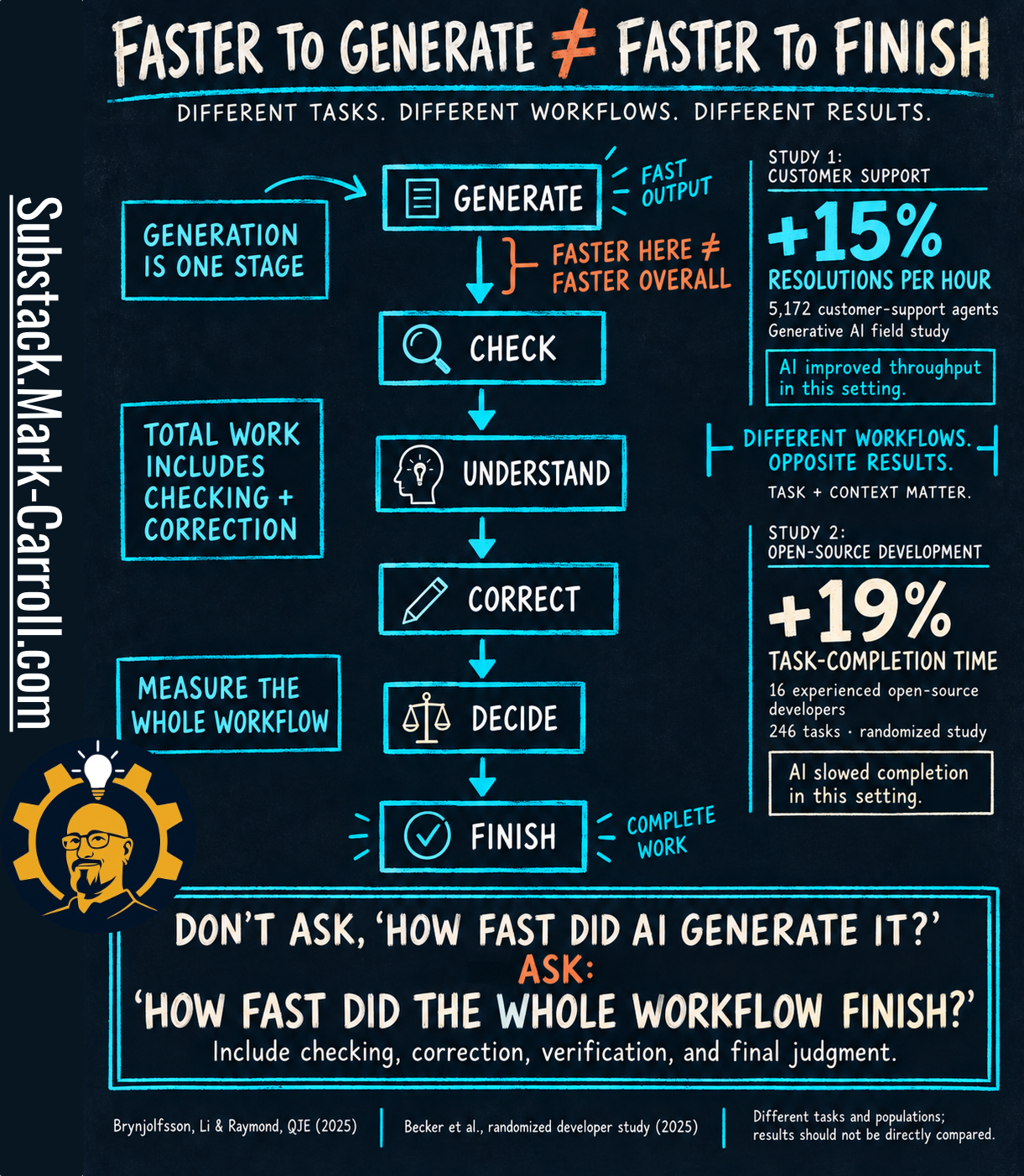
Basis: Generation speed and total task completion are not the same measurement. A field study of over five thousand customer-support agents found AI access improved resolutions per hour by roughly fifteen percent in a bounded task. A separate randomized study of sixteen experienced open-source developers on two hundred forty-six tasks found AI access made completion nineteen percent slower, despite those developers expecting a gain. Same tool category, opposite result: the two studies measured different workflows.
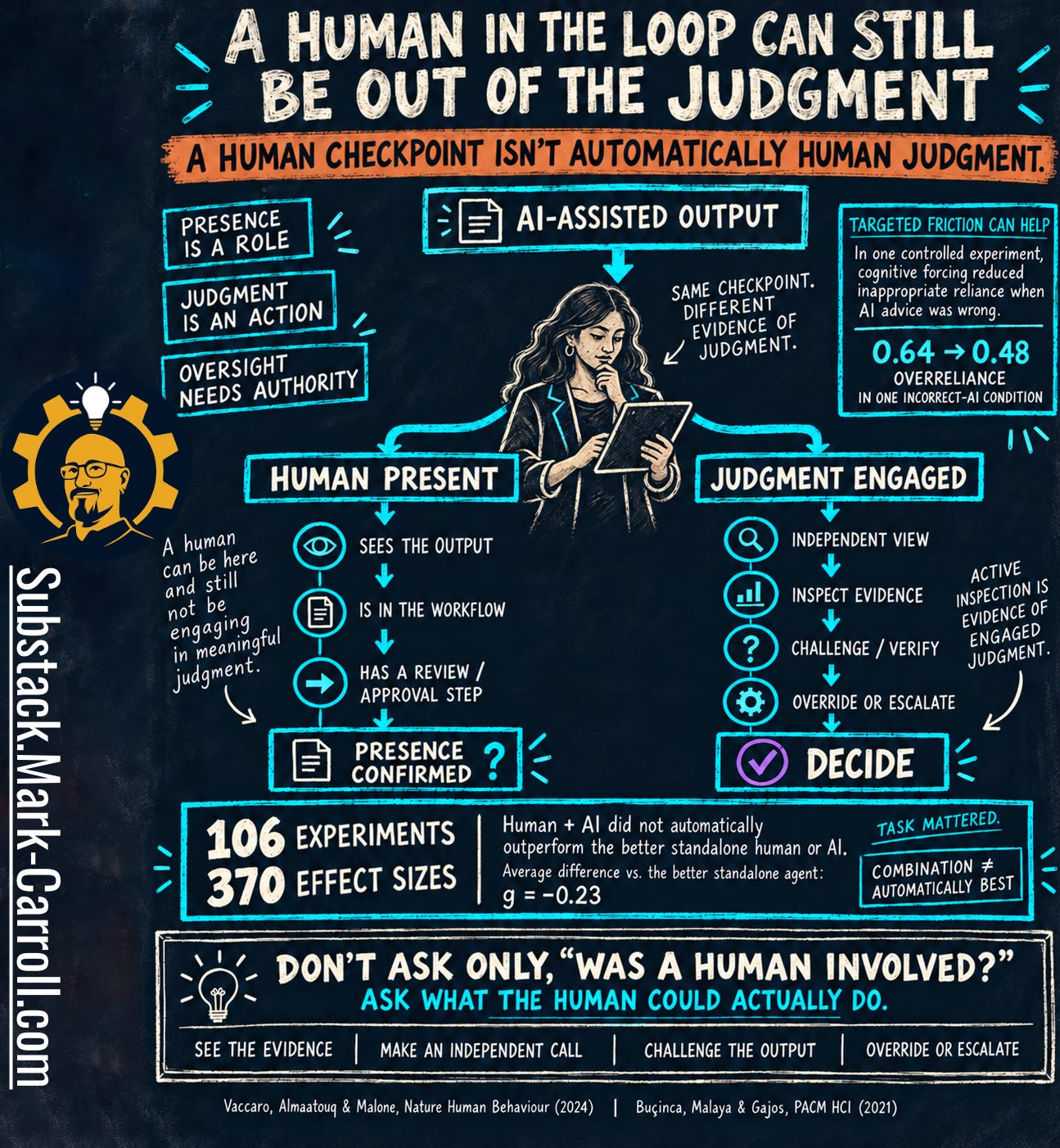
A related caution: a meta-analysis of one hundred six experiments and three hundred seventy effect sizes found human-AI combinations did not automatically outperform the better standalone human or AI. A human checkpoint is not, by itself, evidence that judgment was exercised. One controlled study did find a targeted friction step reduced inappropriate reliance on wrong AI advice, from sixty-four percent to forty-eight percent, so the direction isn’t hopeless. It just isn’t automatic.
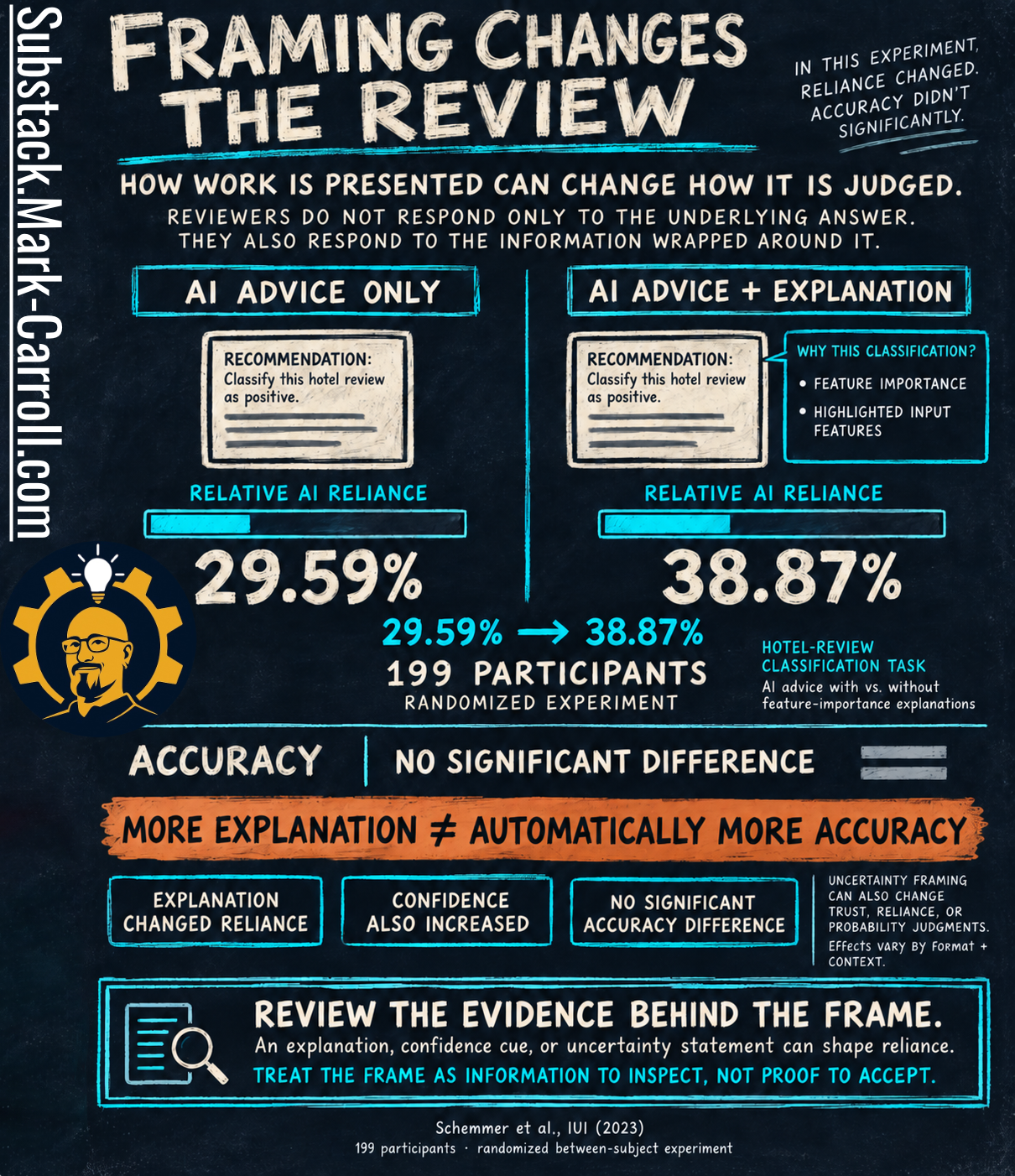
Counterpoint, labeled Evidence: in a randomized, 199-participant hotel-review classification task, adding a feature-importance explanation to AI advice raised participants’ relative reliance on it, from roughly thirty percent to thirty-nine percent, while accuracy showed no significant difference. That gives the Handoff Brief a design risk worth guarding against: a polished Field 2 or Field 3 may influence how confidently the handoff is received before its claims are independently checked.
Scope and transfer limit: no study in this evidence base directly measured this article’s specific mechanism, an underprepared AI-assisted submitter’s work creating additional downstream orientation or checking work for a distinct reviewer. That transfer is a recognized practitioner pattern, not a demonstrated cause. Treat it as the undermeasured problem it is.
What remains unknown: whether the Four-Part Handoff Brief, used as a bundle, reduces defects, review time, or reviewer burden. It hasn’t been tested that way. Treat it as a design inference assembled from adjacent, separately-supported pieces, not a validated intervention.
🛑 Do Not Use When
The task is bounded, low-risk, and a reliable automated check already covers it. Route it to light review instead.
Nobody involved has real authority to return, narrow, or escalate the work. A Brief without stopping power just documents who absorbed the risk.
It’s being used to police whether AI was used, rather than whether the work can be explained. That’s a different question, and this isn’t a detection tool.
Judgment Seat
While working on this issue, I sent the infographics for an evidence audit. Claude challenged two of the graphics because the studies behind them weren’t in the evidence inventory I had shared. The reviewer was right to push back: it couldn’t verify my explanation without seeing the actual final evidence packet. I knew those sources had entered during later gap-closure research, so my first instinct was to explain why the graphics were supported instead of just sending the packet. Once I did, the reviewer independently checked the sources and cleared the graphics.
What stayed with me was that the graphics weren’t actually wrong. My handoff was incomplete. I possessed context the reviewer needed and had assumed my explanation could substitute for making that context inspectable. My confidence wasn’t inspectable. The evidence packet was.
I didn’t own the reviewer’s judgment. I owned giving it enough to exercise it.
Who generated the work: the submitter, working with whatever tool produced a result that looked finished.
Who must understand it: the submitter, before they ask anyone else to spend attention on it.
Who can stop it: whoever has been given real authority to return, narrow, or escalate the work, not merely to sign off on it.
Who pays if it is wrong: consequences can land across the submitter, reviewer, system owner, customer, or organization. Who should carry it depends on role, authority, competence, and control, not on who happened to hit send.
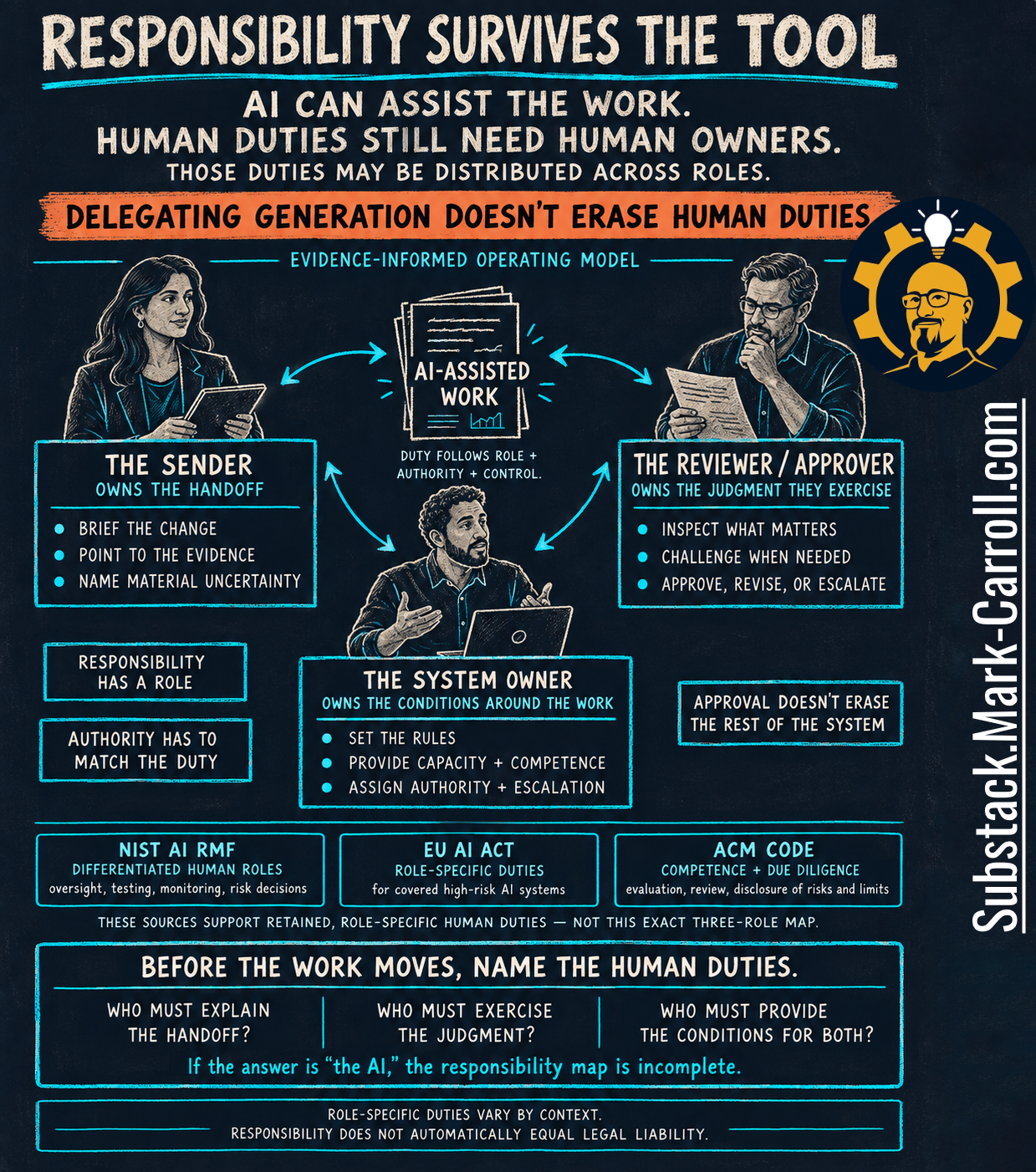
Generation, review, and system design are three different jobs, and a single AI-assisted handoff can move through all three. NIST’s AI Risk Management Framework, the EU AI Act, and the ACM Code of Ethics all support the general principle that human duties persist and stay role-specific when AI assists the work. None of the three prescribes this exact three-way split. That mapping is this series’ own operating model, built on what those sources establish, not a restatement of them.
Assembled, the four fields from earlier in this issue look like this:
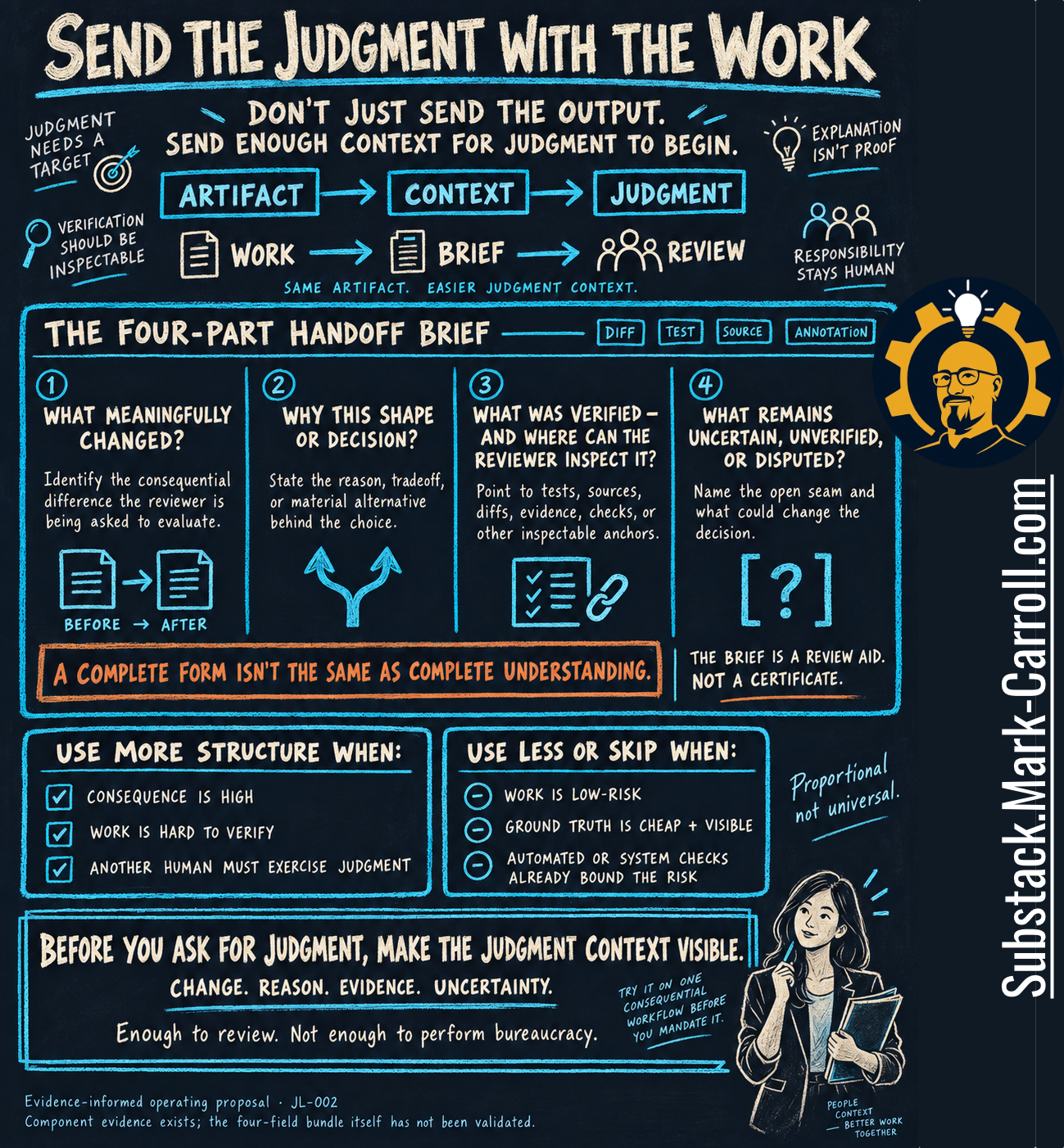
That is the whole proposal: proportional, challengeable, and honest about what it can’t prove. Use more when consequence is high and hard to verify. Use less when the risk is already bounded elsewhere.
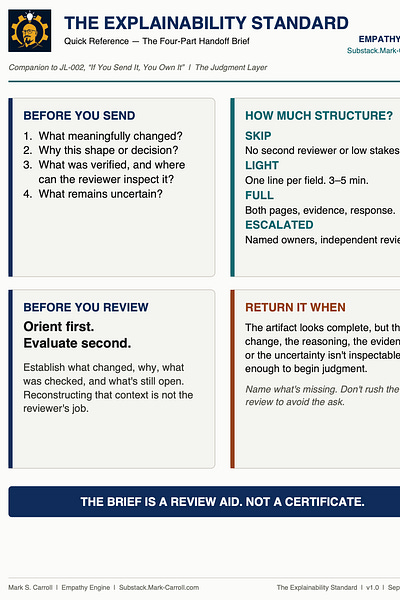
The Explainability Standard
A one-page guide for making work easier to review. It shows the four questions to answer before sending important work, how much detail to use, and when a reviewer should send the work back because key context is missing. Keep it near your desk when you need the Standard fast.
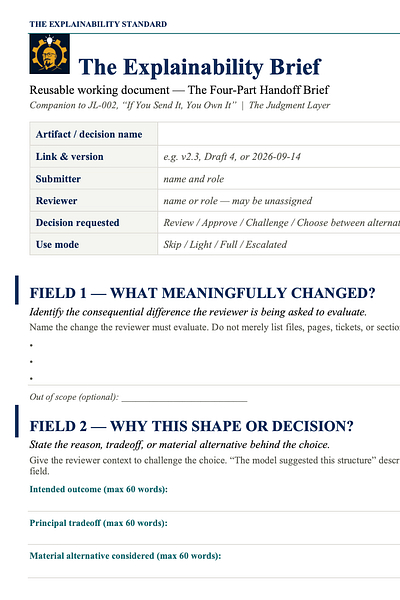
The Explainability Brief
A two-page working template for a real handoff. It helps you explain what changed, why the decision was made, what was checked, and what is still uncertain, while giving the reviewer space to ask questions or request more context. Use it when another person needs to understand the work before they can judge it.
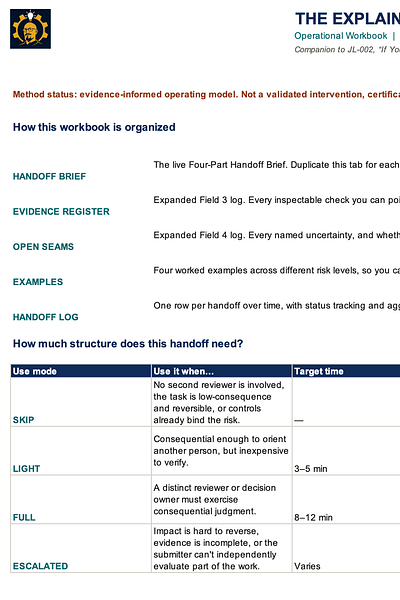
The Explainability Standard Workbook
A reusable Excel workbook for teams that want to use the Standard again and again. It includes a live Handoff Brief, an evidence log, an uncertainty log, four worked examples, and a handoff tracker, plus guidance on when to skip the process, keep it light, use the full version, or escalate. It turns the idea from the article into a system a team can actually use.
Bundle description
Together, these three tools take the Explainability Standard from idea to practice. The Quick Reference helps us remember it, the Brief helps us use it once, and the Workbook helps us build it into the way work moves across a team.
This Week
Three actions for the judgment owner: before your next handoff, write one sentence naming what you’re still uncertain about, and put it first, not last. Pick one artifact in your queue and explain the meaningful change out loud, without reopening the tool that generated it. Next time a summary turns out to be AI-generated restating a diff without reasoning, send it back before spending review time reconstructing what the sender could have made visible.
One action for the system owner: decide out loud who has standing to return an incomplete Brief unread, and tell the team.
One action for learning and provenance: on one review this week, note whether the uncertainty the submitter named in Field 4 turned out to be the uncertainty that actually mattered. Keep the answer visible to whoever reads it next.
📎 Forward This
A generated cover letter that lists every changed line is not an explanation. If you cannot say what changed, why, what you checked, and what you still don’t know, it is not ready to cost someone else’s week.
🔚 Closing
The explanation arrived exactly as fast as the work did.
Understanding still has to be built by hand.
Next week, Episode Three turns to the checkpoint itself. The Button That Used to Be a Person asks what happens when human-in-the-loop becomes an approval queue instead of a meaningful control.
Because even explainable work can overwhelm the person approving it.

This question is part of the larger challenge behind my upcoming book, Collaborate Better: From Silos to Synergy – How to Build Unstoppable Teams. Better collaboration begins when context, ownership, and judgment travel with the work.
Learn more at CollaborateBetter.us.
Regards,
Mark 👋
Previous:

More Content to Discover:

Half Your Team Is Using AI. You Don't Know Which Half.

Intro If you read the piece we published last week on Leadership in Change, you saw the structural diagnosis: mandate pressure, decision collapse, intake collapse. Three failures that sit underneath almost every AI pilot that goes sideways. That piece mapped the architecture. What it did not cover is what happens on the human side of the same problem, wh…

The reviewer doesn’t own understanding work we never handed them.
Before we hit Send, four things should travel with consequential work: what changed, why, what we verified, and what remains uncertain.
Which of those four is most often missing from the work that lands in our inbox?