


The Agile Meeting Burn Rate
Thirty-one hours out of eighty. Count it on your own calendar.
👋 Welcome to this week’s 2nd edition of Empathy Engine. Every Tuesday, I publish a new article for paid subscribers first, then unlock the full piece for everyone late Thursday morning. Each week, I turn product leadership friction into practical tools, sharper language, and more defensible decisions.
Research Binder: the receipts (citations + source notes) are compiled in a PDF at the bottom of this article.
What this article does and does not claim
Does: give you a defensible way to estimate your own meeting burn, and a one-sprint audit structure you can carry into a capacity conversation.
Does not: claim a universal benchmark for meeting overhead, guaranteed productivity recovery, or a specific percentage that applies to your team without measurement.
If you are skimming
Read three sections: The calendar stopped being a calendar, This is not meeting overhead. It is duplication spend, and Preserve the spine. Starve the sprawl. The Meeting Cost Ledger sits between them as the operational payoff.
TL;DR
Meeting cost is not a productivity complaint. It is a resource allocation fact.
When a sprint starts absorbing 26 or more meeting hours per engineer, the calendar is behaving less like an alignment tool and more like an expense structure.
The Meeting Cost Ledger turns that calendar into a number your finance partners can defend in a QBR.
Previous article in this series: Episode 5 (The Catastrophic Cost of Looking Safe)

The calendar stopped being a calendar.
A few years back, I was in a large SAFe planning cycle. RTEs, engineering managers, product managers, architects, and a director who kept returning to the importance of alignment. Someone had just finished praising the event as a success because, “all teams got on the same page.”
I asked a simple question. How many hours per engineer did this planning cycle consume once you included team planning, cross-team breakouts, dependency syncs, risk review, ART sync prep, and the follow-up re-planning sessions?
The room treated it as a harmless facilitation exercise. Then the number landed. Twenty-six hours for some teams. Thirty-one for others. More for a few. Someone started dividing against available sprint capacity. The room went quiet when they realized they had burned a third or more of the opening sprint just coordinating the right to begin work.
One PM stared at the spreadsheet like it had betrayed them personally. An engineering manager laughed once, then stopped. A voice from leadership tried to salvage it: “Well, some of that is necessary.” Which was not wrong. It just sounded a lot weaker after the total was visible.
The director stopped saying alignment. The director started asking whether everyone agreed with the math.
The calendar stopped being a calendar. It had been behaving as a budget all along. Nobody had ever read it that way.
I say that as someone who has added meetings that felt responsible at the time.
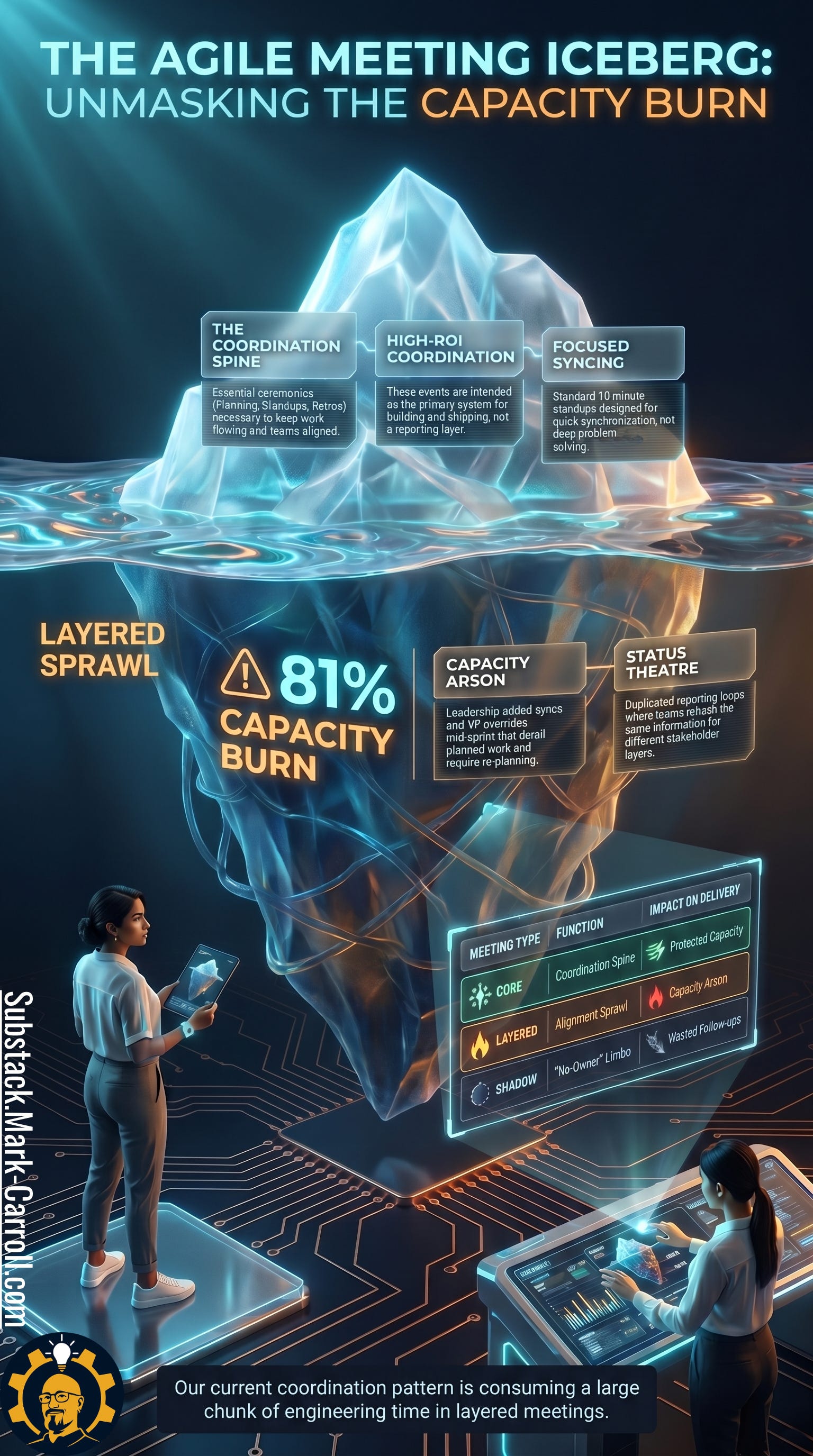
The visible ceremonies are not the cost center. The duplicated coordination accumulating beneath them is.
Teams call it alignment. It is duplicate billing.
Not every hour on the calendar is the same kind of hour. Planning, standups, refinement, retros each earn their place when they sharpen priorities and support real decisions. The trouble begins when the same conversation gets replayed across adjacent rooms because nobody trusts the first room to hold.
This is not a story about leaders who love meetings. It is a story about a visibility vacuum: when asynchronous channels fail to give executives the financial and timeline safety they need, calendar invites multiply. The extra meetings are not anxiety running wild. They are anxiety doing its job inside a system that stopped producing trust by other means.
This is not just a local gripe. Microsoft’s Work Trend Index documents a broad pattern of meetings and chat absorbing most of the professional workday, with attention fragmentation rising alongside it. Leslie Perlow’s long-running research at Harvard Business Review shows that even modest, disciplined cuts in meeting frequency produce outsized recovery in team focus. Those macro findings are the weather; your Ledger is the receipt. Full citations and source notes appear in the Research Binder attached at the end of this article.
Zoom in on any single sprint and the pattern has a shape. Monday looks like clarity. By Friday the plan is no longer the plan, and the team is re-planning instead of delivering.
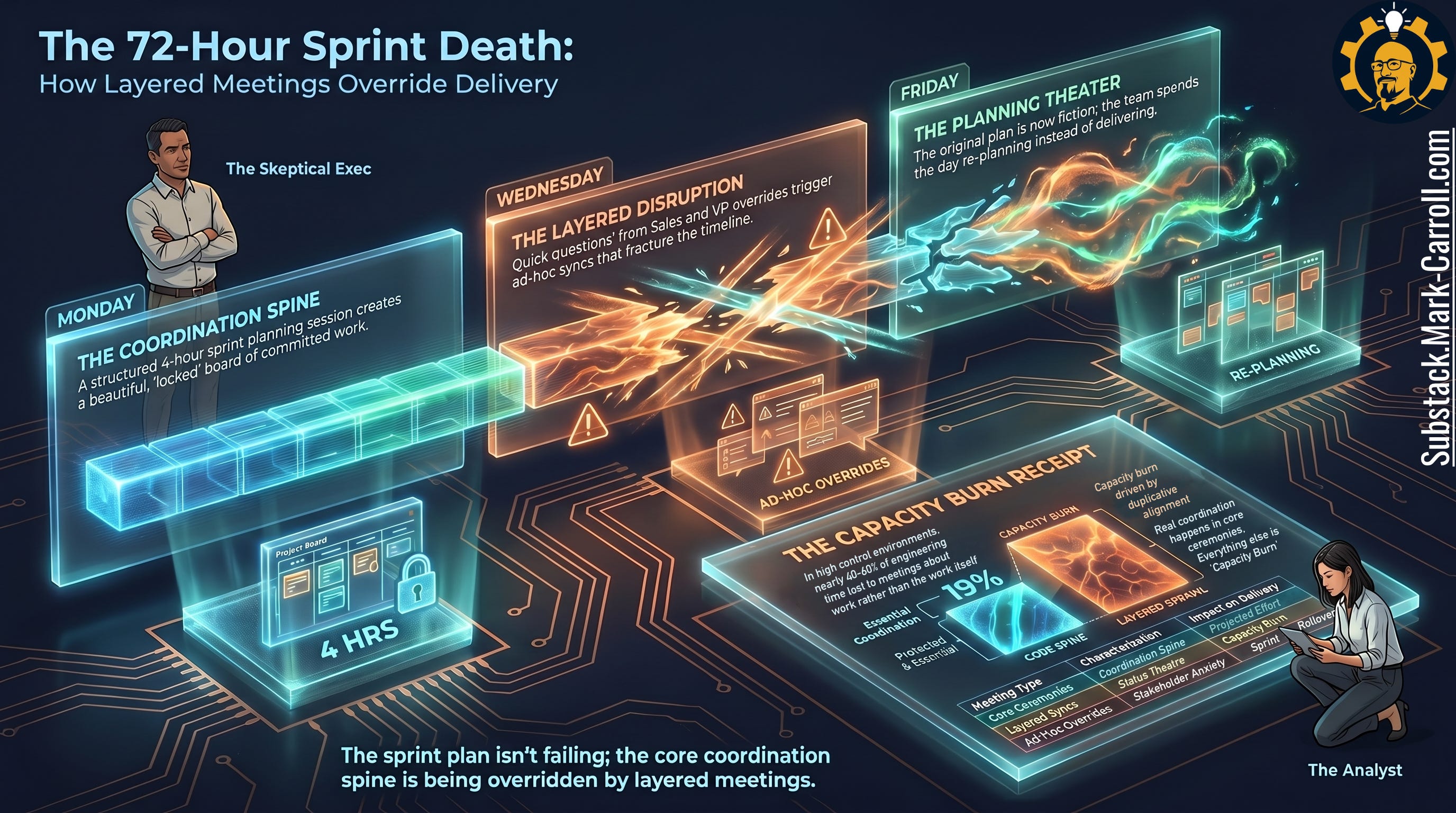
The sprint plan did not fail because the engineers missed the work. The sprint plan failed because the coordination spine got overridden by the layered meetings that formed around it.
The calendar is not a planning tool. It is an expense structure.
A team can be over-informed and under-decided at the same time. Once that happens, every hour on the calendar is a line item. Most of those line items have never been reviewed for renewal.
A meeting that outlived its reason is not tradition. It is unbilled inventory.
The most durable recurring sync in any organization is often the one nobody has the heart, the memory, or the political cover to kill. Every office has at least one agenda item that is no longer really a topic; for the longest time, it has been nothing more than a commemorative plaque. A surprising number of meetings survive on one idea alone: nobody wants to be the first person accused of being the reason the holy cow was sent to the butcher.
Each meeting made sense. Together they made a system.
Meeting one surfaces the issue. Meeting two restates it for another audience. Meeting three revisits it because the second room lacked decision authority. Meeting four exists because nobody trusts the first three to hold.
Every step feels reasonable in isolation. Put together, they create a system that rewards attendance over decision compression. Nothing says operational confidence like a pre-meeting to prepare for the meeting where nobody is going to decide anything anyway.
This is another broken route, but the one running between decision signal and owner, not between functions.
At scale the shape hardens. Frameworks that promise alignment often deliver layered sprawl instead, where the middle of the stack thickens with syncs and follow-ups that consume the capacity the core teams needed to ship.
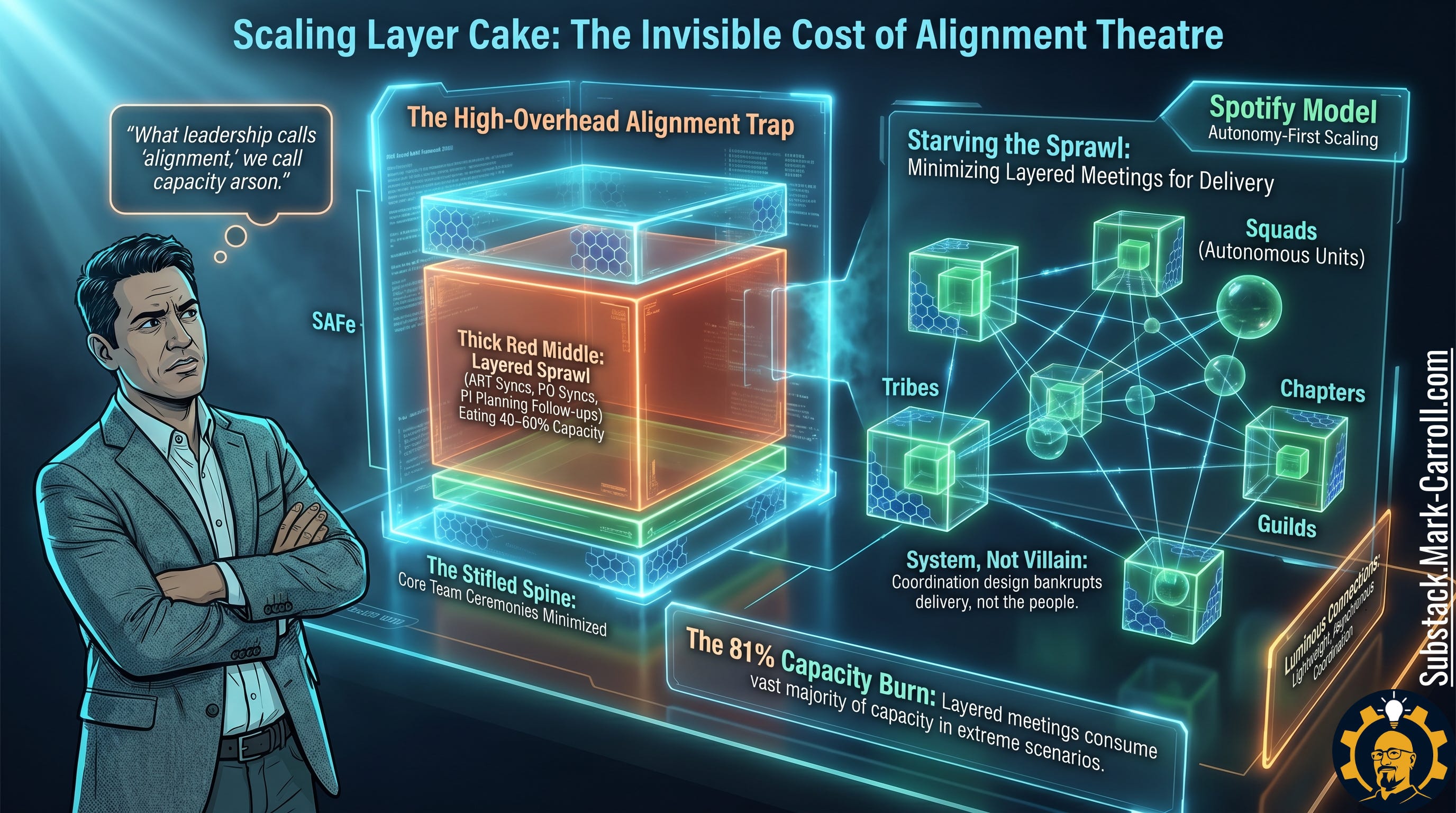
This pattern appears in any scaling structure where coordination volume rises faster than decision authority. SAFe makes it easy to see because the layers are named. The diagnosis is not framework-specific. The math that exposes it is the same math any team can run.
You bought the same uncertainty four times.
One meeting cost is easy to calculate. Duration times attendees times loaded rate gives you a number. The deeper cost begins when the same issue keeps reappearing and still does not land.
Duplicate status loops cost time. Re-planning costs time. Follow-up sessions caused by weak ownership cost time. Delayed decisions extend those costs into blocked work, stale assumptions, and duplicated labor downstream.
You’re not over-communicating.
You’re amortizing the same decision across multiple budgets.
This is not meeting overhead. It is duplication spend.
A team that discusses the same unresolved issue in four rooms is not aligned. It is billing the same coordination four times.
The Duplication Index
DI = (# of meetings where the same unresolved issue appears) ÷ (# of decisions produced).
DI > 1: you are buying repetition.
DI > 2: you are funding a parallel coordination system.
Most teams have never calculated this. That is the finding before the number is the finding.
Here is what duplication spend looks like in dollars. Consider one eight-person team, running two-week sprints, at a fully-loaded rate of $140 per engineer-hour. That rate is conservative once you include benefits, tooling, and higher than entry-level engineers who still count against delivery capacity. Most organizations run higher. Now assume 26.5 hours of recurring meetings per engineer per sprint. In the SAFe cycle I described earlier, several teams ran past 31. Twenty-six and a half is the low end of what is already common.
That math produces a sprint meeting cost of $29,680. Six sprints per quarter brings the quarterly burn to roughly $178,000. This is before rework, decision lag, or context-switching cost. The numbers are illustrative. The structure is not.
The exact figure will vary. The significance will not. A cost center that large should not remain culturally invisible just because it arrives as calendar time instead of invoices.

Once a team can produce that number from its own calendar, the conversation about meetings stops being an opinion exchange and starts being a budget review.
If procurement signed a quarterly contract for $178,000 that re-billed the same uncertainty every sprint, no leader would call that alignment. They would call it a broken vendor relationship and escalate it. The only reason meetings survive that logic is because the invoice arrives in time slices small enough to ignore.
The Budget Line Test
If this exact meeting structure appeared as a line item in next quarter’s operating budget, would you approve it without changes?
If not, which line item would you cut first?
If you cannot answer that, the calendar has escaped the budget process.
Three objections you will hear. Three answers ready.
“But coordination is necessary.”
Correct, and the Ledger is built to separate the spine that is necessary from the sprawl that is just expensive. The audit is about duplication, not ceremonies.
“We will lose alignment.”
If alignment requires four rooms and no decision owner, what the organization has is not alignment. It is duplication spend wearing better clothes.
“This is just a productivity complaint.”
It is a capacity allocation question. The calendar is a budget whether finance reads it that way or not. This article is asking finance to read it.
Put one sprint on a single page and the picture sharpens further. Spine on one side, sprawl on the other, priced in the same dollars.
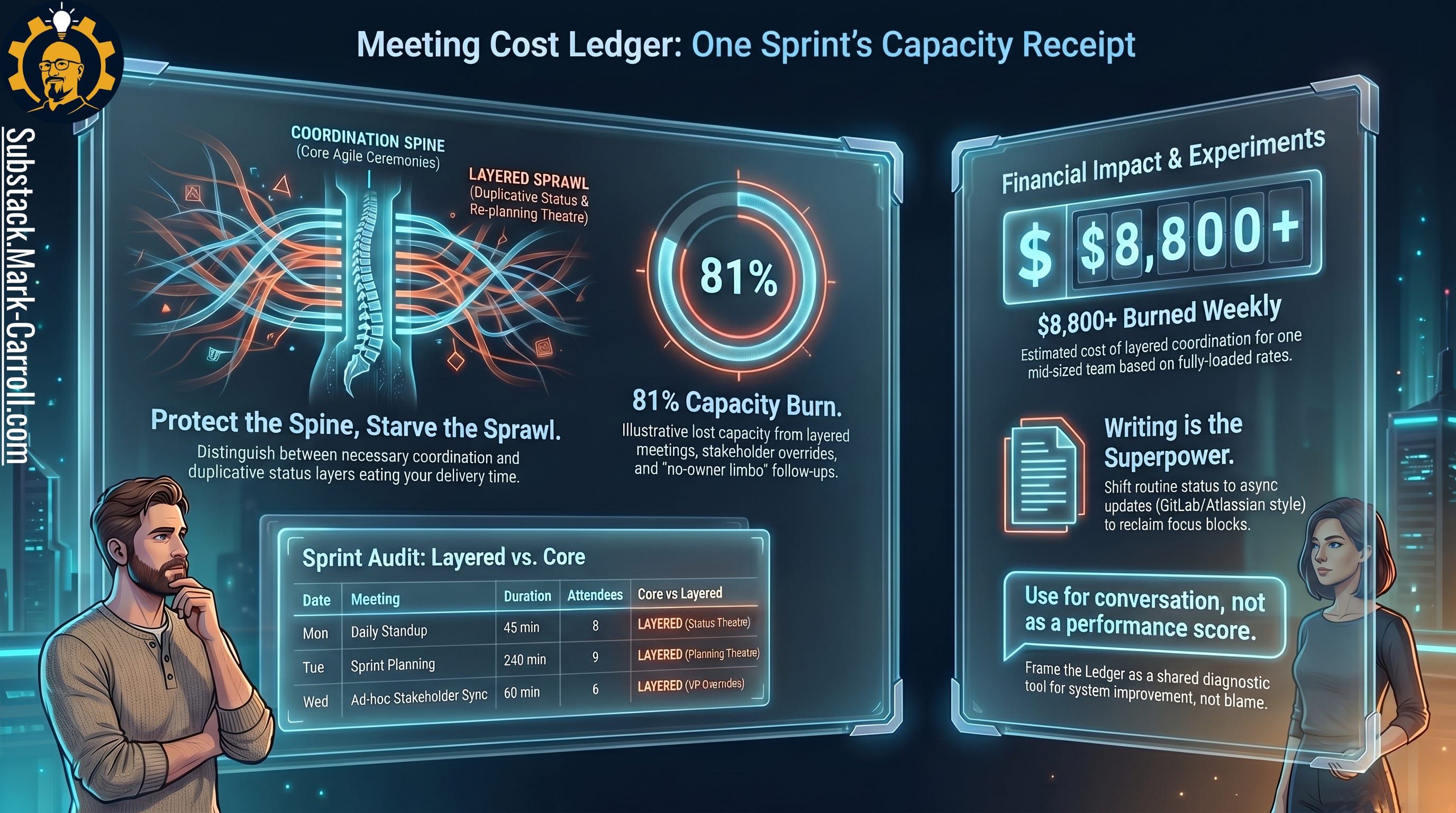
No outside number will tell you what your week costs.
No external source can tell your team its exact meeting burn rate. That should not make the exercise feel weaker. It should make it more credible. The only number that matters is yours.
How to run your one-sprint meeting audit.
One team. One sprint. Five steps. No permission slip required.
Pick one team and one sprint. Focus on meetings that touch in-flight delivery work. Skip all-hands and training.
List each recurring meeting. Name, duration in minutes, number of attendees, occurrences per sprint.
Compute total engineer-hours per meeting. (Duration ÷ 60) × attendees × occurrences. Round. Perfection is not required.
Classify Core or Layered. Core: the ceremony is doing the job it was designed for. Layered: status replay, duplicate sync, follow-up from a room that did not produce a decision.
Total each bucket. Any issue discussed twice gets marked in red. Any discussion without ownership gets marked again. Multiply layered hours by your loaded rate for a local cost range.
That is your local meeting burn receipt. One team. One sprint. No benchmark required.
Think before you sync.
The decision is not whether to coordinate. The decision is how. One filter, run before the calendar invite goes out, changes most of what follows.
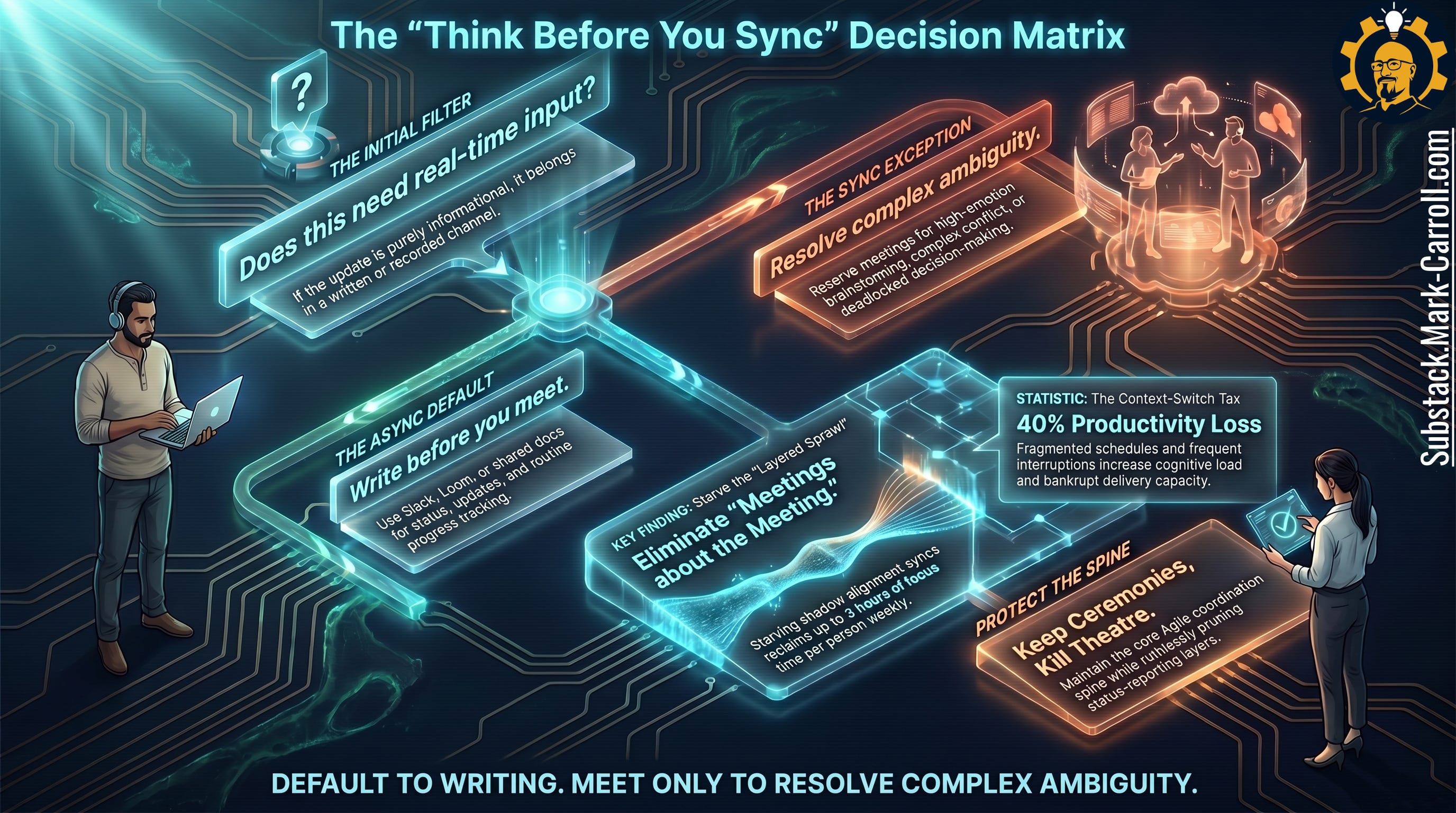
Broadcast it in writing. Meet only if ambiguity remains. End every live discussion with a named owner, or kill the recurrence. That last clause is the one most organizations skip, which is why the sprawl grows back.
The Renewal Rule
Every recurring meeting on your calendar must declare three things to keep its seat:
Decision owner. A named person with authority to act on the output.
Output artifact. A document, decision log, or ticket the meeting produces.
Expiry date. The meeting auto-cancels unless someone deliberately renews it.
If a meeting cannot name all three, it is status theater. Write it instead.
Two weeks. One team. The ledger or the excuse.
Run the experiment for two weeks on one team. Track every recurring meeting touching delivery work. Price the total. Mark repeated issues and unowned discussions. Pick one duplicated sync to cut and one room to redesign as a decision forum.

If a team cannot produce a two-week Meeting Cost Ledger by the end of the next sprint, the organization does not yet have a defensible basis for claiming it understands its own delivery capacity. Bring the ledger into the retro. Pick one meeting to cut and one to redesign. Measure the reclaimed hours next sprint. That is the difference between doing the pilot and shipping the outcome.
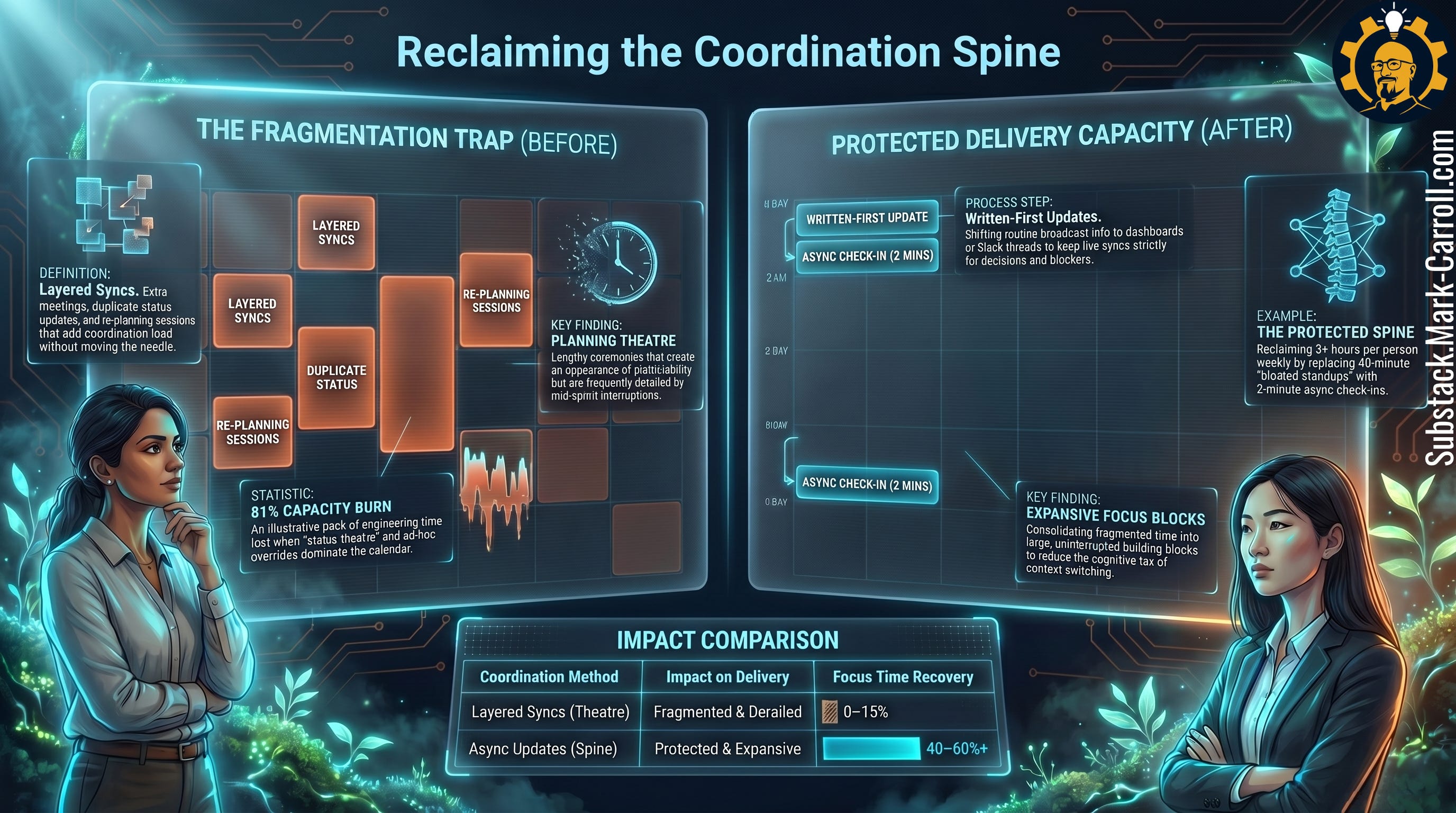
The recovery does not come from working harder. It comes from replacing synchronous status with written updates, pruning bloated standups, and routing live conversation only to decisions that require it.
Preserve the spine. Starve the sprawl.
Preserve the ceremonies that actually help work move. Become far more suspicious of repeated status layers, stakeholder reassurance loops, and ad hoc re-planning sessions that do not produce real decisions. Use the Ledger as a shared diagnostic for system improvement, not as a weapon against individuals trapped inside the system.

The same filter that decides whether a single meeting earns its hour also decides how the organization’s overall coordination pattern should be redesigned. Slack norms, documentation discipline, renewal rules, all of it downstream of the same question: does this still need a live room?
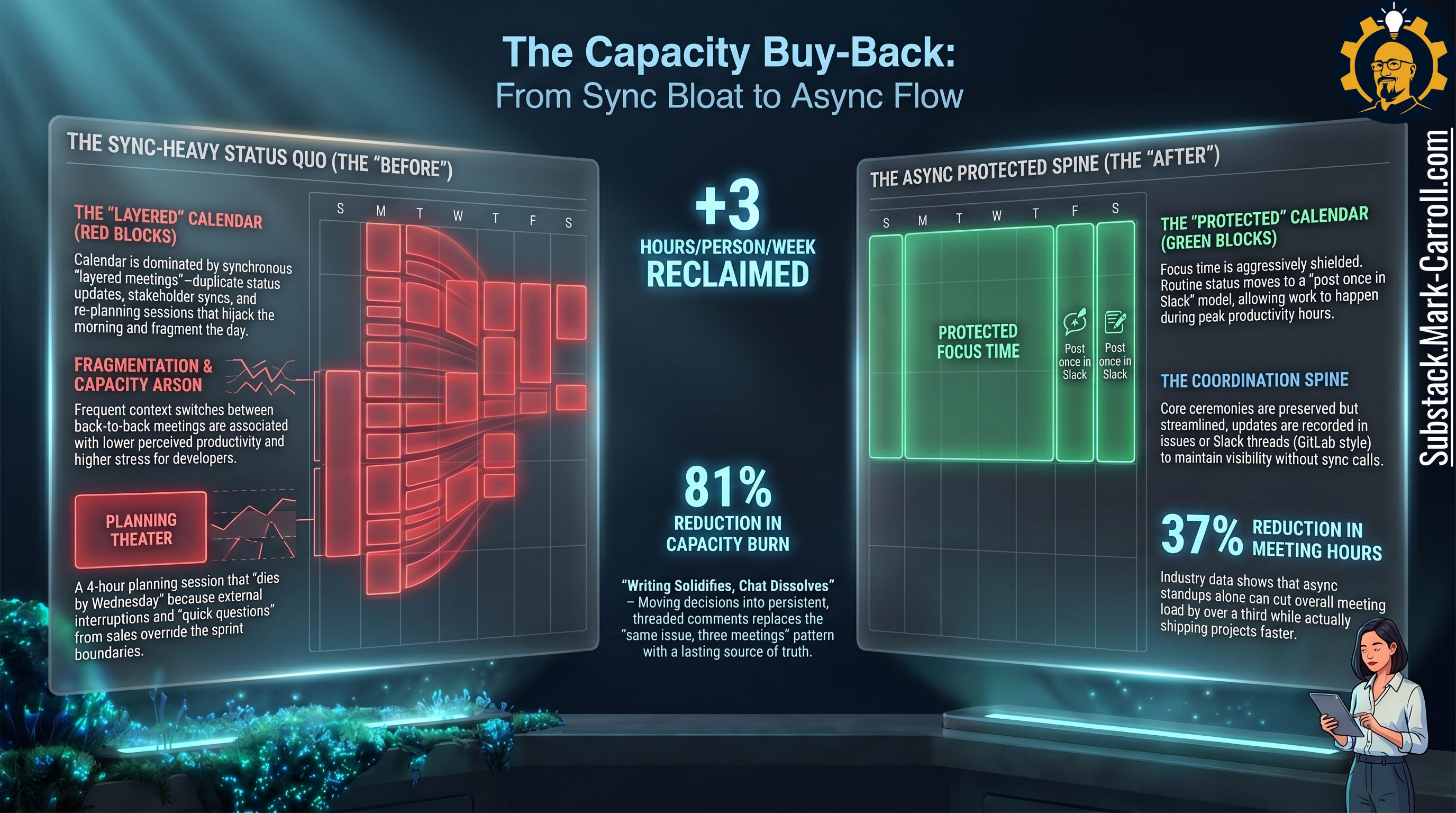
Three hours per person per week, at one eight-person team and a $140 loaded rate, works out to more than $170,000 per year. The math: 3 hours × 8 engineers × $140 × 52 weeks = $174,720. That is not a theoretical benefit. That is the budget line leadership did not know it had.
How to bring this to leadership without sounding like you hate their meetings?
The audit is only as useful as the conversation it enables. A few rules keep the Ledger a mirror instead of a weapon:
Aggregate at team level. Bring team totals and percentages. Do not screenshot individual calendars.
Lead with the audit, not the grievance. “We ran a one-sprint audit and found that X% of our meeting time is layered coordination. I want to test whether we can buy back some of that capacity without losing visibility.”
Offer experiments, not ultimatums. Propose one or two specific changes and commit to re-running the Ledger afterwards.
Treat the Ledger as a mirror. The goal is better coordination design, not blaming people for attending the meetings the system gave them.
For subscribers
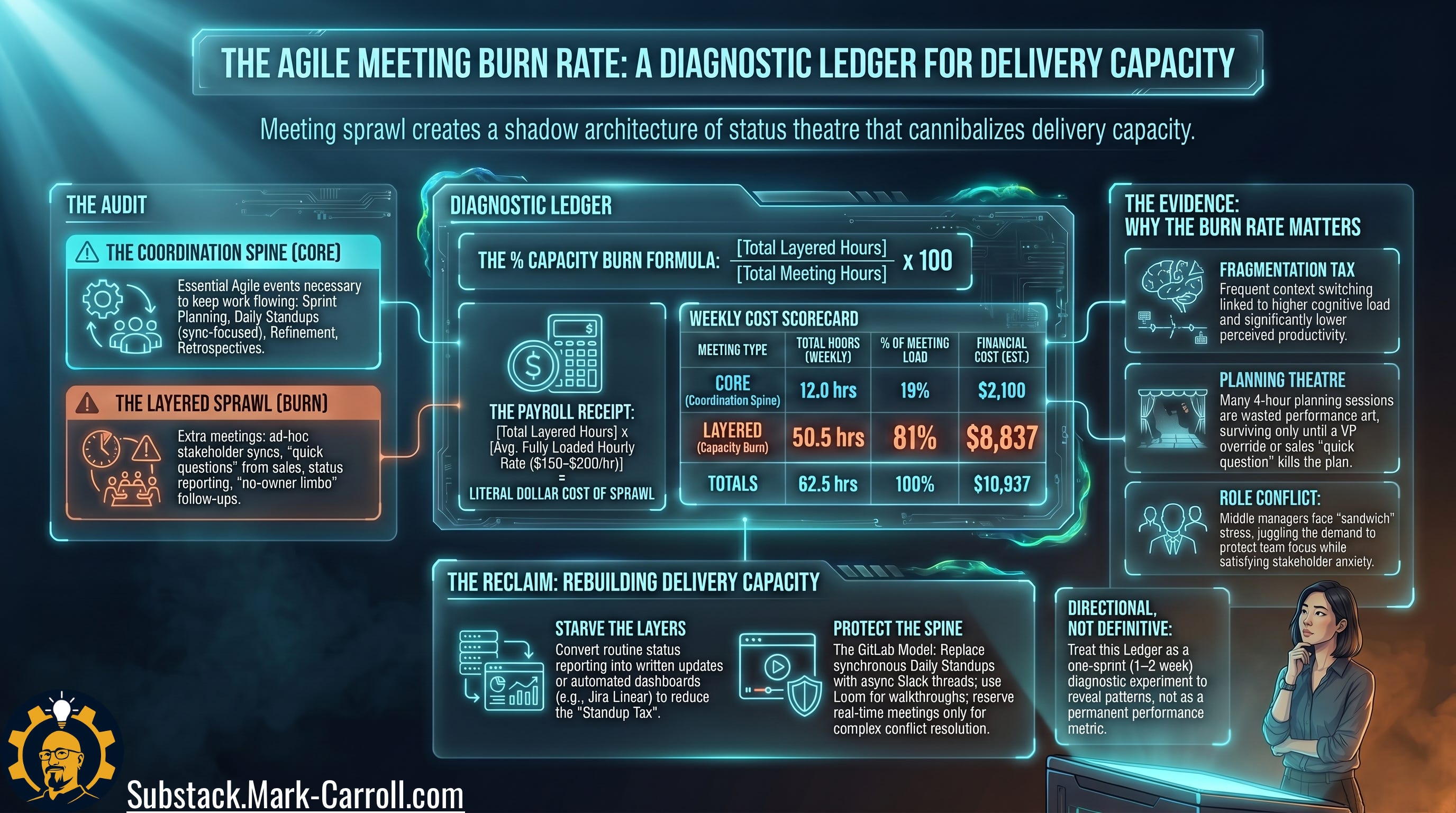
This is the one-page receipt you can screenshot into a QBR to end the meeting argument.
The Meeting Cost Ledger is a board-safe spreadsheet tool that reads your ceremony calendar as a budget line. It gives you a way to turn meeting fatigue into a number a director, finance partner, or VP can challenge, refine, and still use.
What it is. A branded Excel workbook with a Meeting Inventory tab, a Cost Summary tab, a Meeting-Type Breakdown split into decision/status/alignment, and a Priority View that ranks meetings by cost-to-value.
What it calculates. Sprint cost. Quarterly burn. Percentage of capacity absorbed by ceremony. Core-versus-layered split. A ranked list of the ten most expensive recurring meetings on your calendar.
What it answers. The one question most teams cannot currently answer: what percentage of your team’s capacity is currently going to meetings that do not close nor improve anything?
Scroll up to find your Meeting Cost Ledger just above the ‘Reclaiming the Coordination Spine’ infographic
The calendar was always a budget. You just stopped reading it that way.
I said early on that I’ve added meetings that felt responsible at the time. I would have called them visibility, alignment, or proactive communication. Looking back, some of them were at least partly about reassurance. I was managing anxiety in the surrounding system with another calendar block.
I have also watched one of those meetings grow beyond its original purpose. A few more attendees. A little more prep. Follow-up conversations because the first room did not quite produce a decision. Before long the meeting was no longer a coordination aid. It was another reporting layer.
Adding structure is easy. Pruning it, without making people feel blindsided or politically exposed, is the harder and more responsible skill. If your calendar this sprint looks like the one I described in the SAFe room, you’re not bad at meeting hygiene. You are funding the coordination system your organization forgot to cost. The Ledger is how you start reading it, and the Renewal Rule is how you keep the sprawl from growing back.

That is the larger case behind my upcoming book, Collaborate Better. Better collaboration is not about being nicer in meetings. It is about reducing avoidable friction before it turns into waste, delay, and preventable cost. You can learn more at CollaborateBetter.us.
Next week in Part 7: The Profit Your Sprint Plan Already Spent. The reason meeting burn feels survivable is because most resourcing models still pretend that time exists after coordination. Episode 7 names the cost of that lie.

P.S. If you had to justify your team’s ceremony calendar as a line item in next quarter’s budget, which meeting would you fight hardest to defend, and which one would you quietly let go?
Regards,
Mark 👋
Empathy Engine | Substack.Mark-Carroll.com | Evidence-Forward Product Leadership

Previous:

More Content to Discover:


Roadmap Keeps Breaking? 3 Fixes for PMs and POs

Top of the Series Arc: 🔒 Leader’s Dispatch: Weight Comes After Insight
If your calendar had to be approved as a budget next quarter, what gets cut first?