The team can do the work. Watching where the hard call still lands is a different inspection.
👋 Welcome to my paid subscriber-only edition of Empathy Engine (🔒 Leader’s Dispatch). Each week I build evidence-forward tools for product leads who need to say no, defend tradeoffs, and lock in decisions before they get rewritten later.
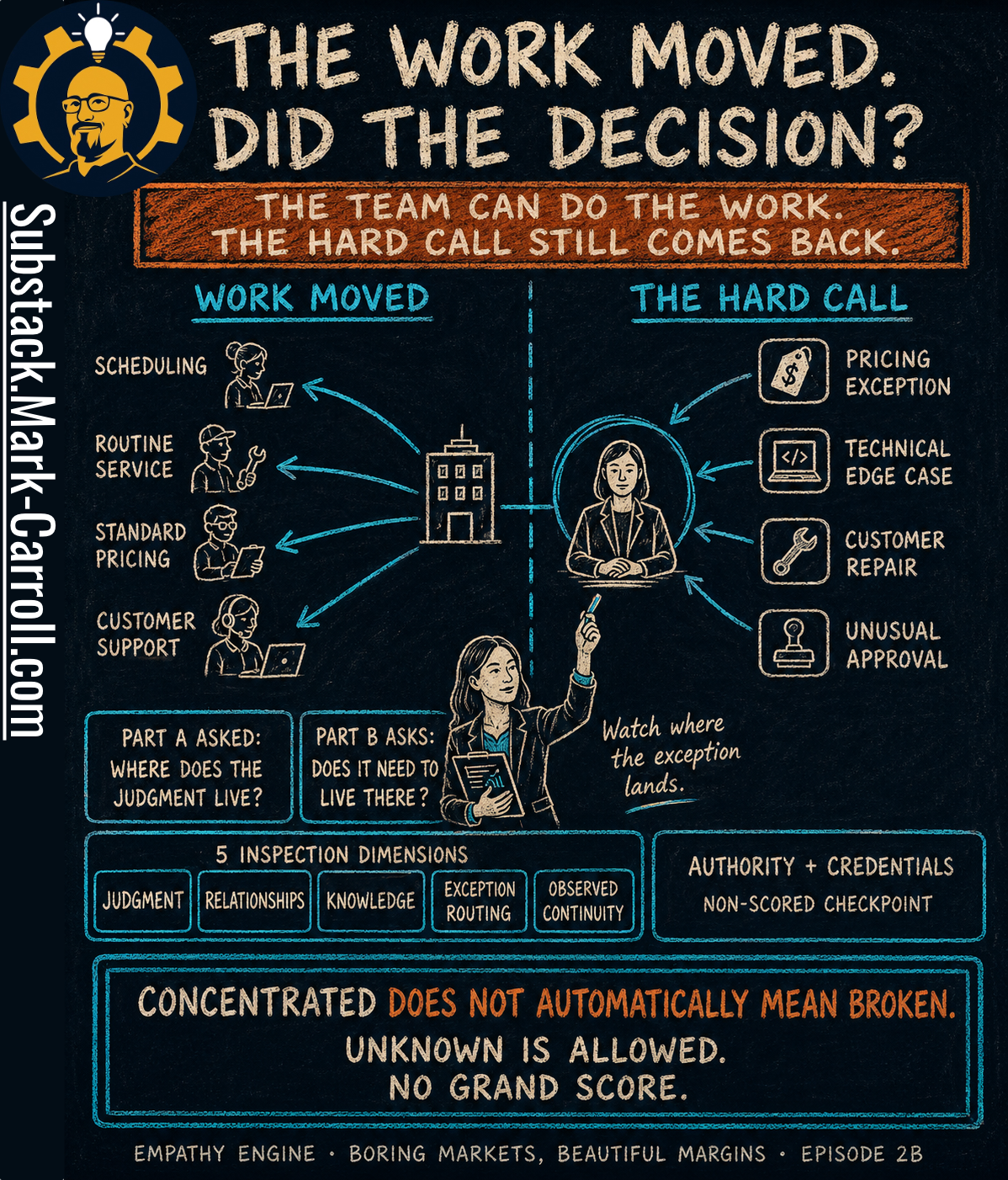
Part A watched Dave’s team absorb nearly everything. Scheduling moved to a dispatcher. Routine service moved to the crews. Standard pricing moved to an estimator. Customer support moved to an office coordinator. Then a pricing exception, a technical edge case, a customer repair, and an unusual approval all arrived at Dave’s phone in a single Friday.
Episode 2 Part A:

Part A asked where the judgment lives. Part B asks whether it needs to live there.
That question needs more than one Friday to answer honestly, so Nina builds a structured way to inspect it. Five dimensions, watched separately: Judgment, Relationships, Knowledge, Exception Routing, and Observed Continuity. One checkpoint that never gets scored: Authority and Credentials. No total. Concentrated does not automatically mean broken, and Unknown is allowed.
Research Binder: the receipts (citations + source notes) are compiled in a PDF at the bottom of this post.
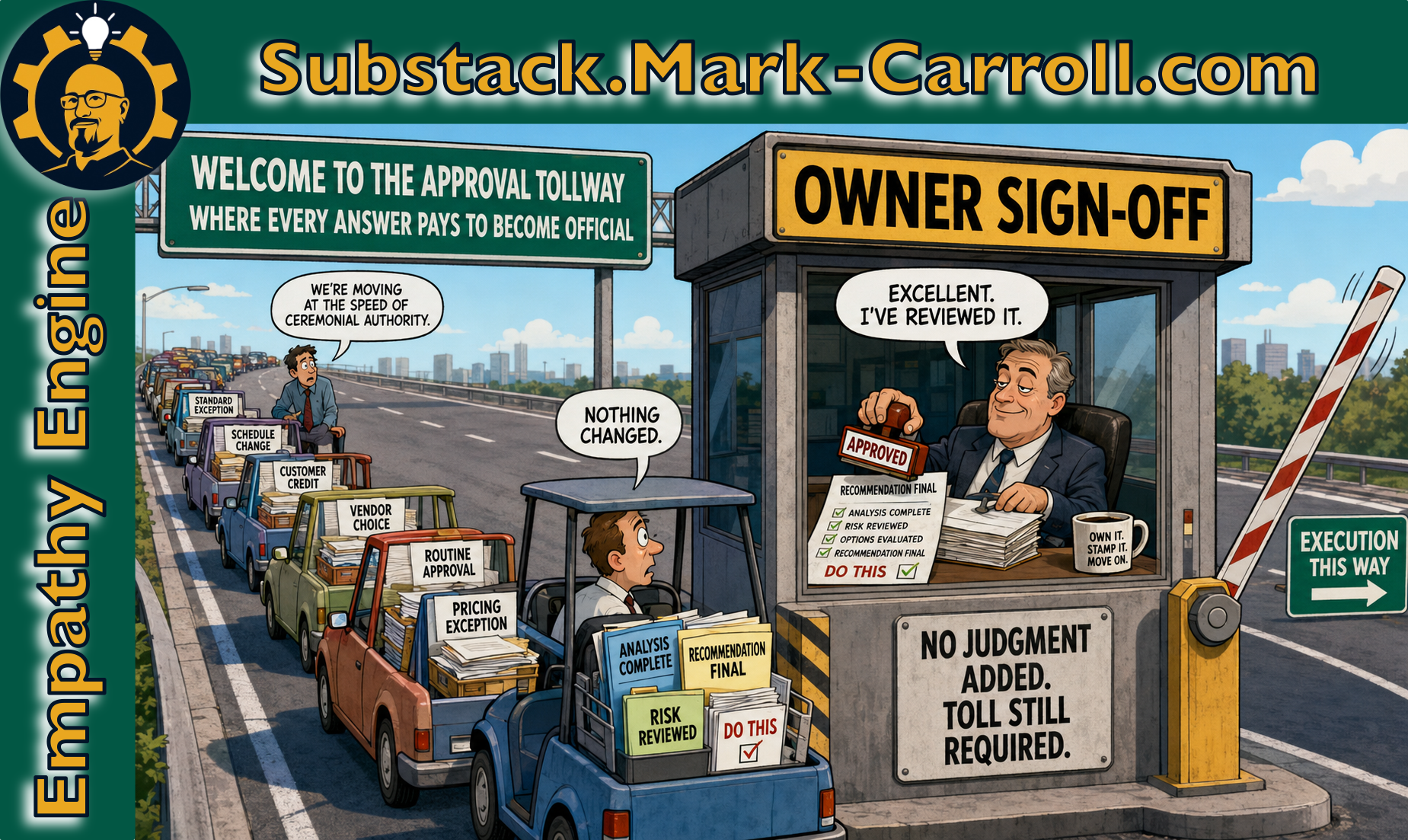
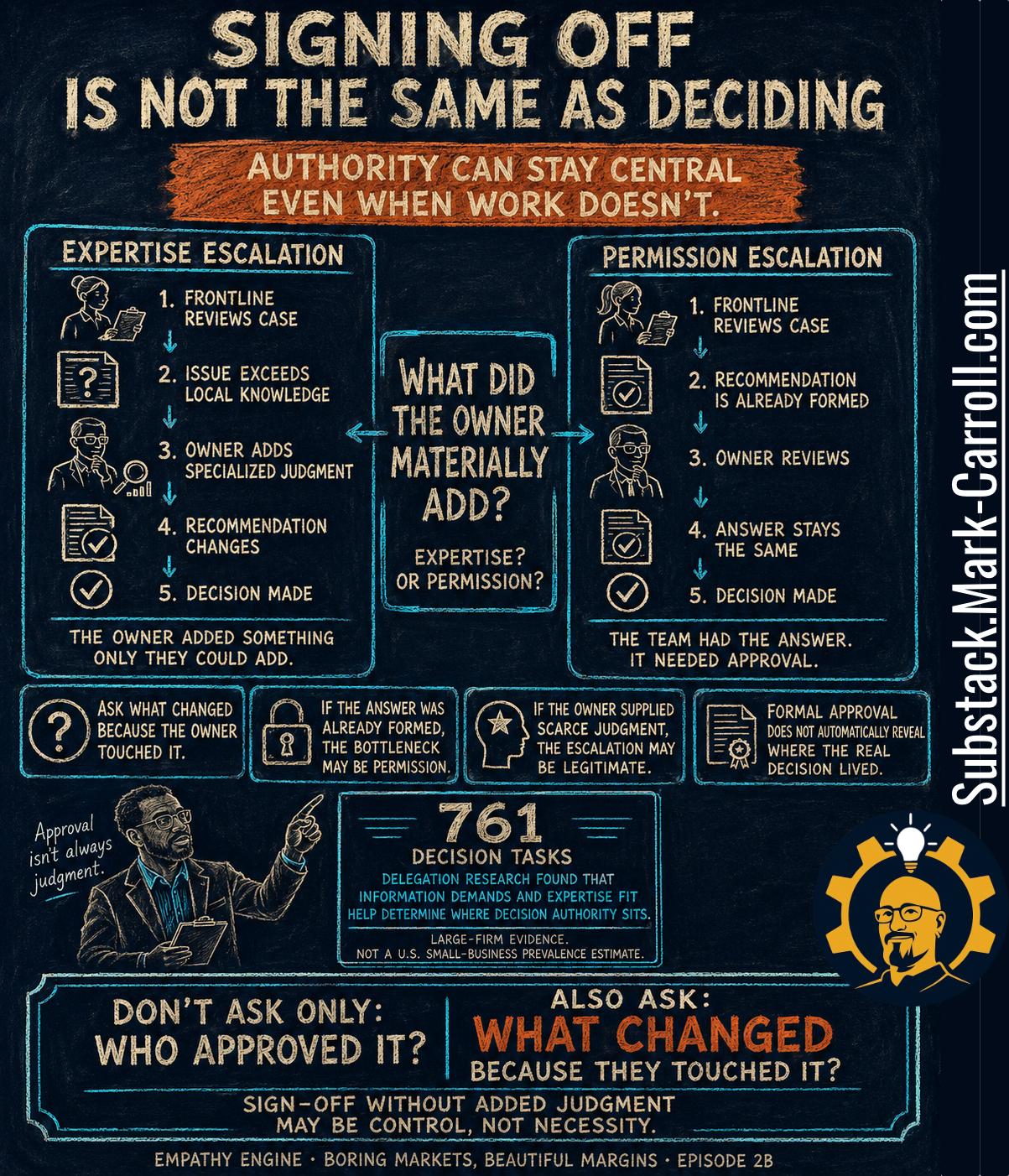
Signing Off Is Not the Same as Deciding
Nina watches two approvals move through Dave’s business in the same week.
The first is small. A dispatcher already knows a customer complaint deserves a modest fee waived. She walks it to Dave anyway. He glances up, says yes, and the conversation is over in under a minute. Nothing about his answer required anything Dave alone could supply.
The second is the pricing exception from Friday, a retrofit condition the estimator hadn’t priced before. Dave asks two questions the estimator hadn’t considered, changes the number, and takes on a liability call nobody else on the team was positioned to make.
One escalation reached Dave because the answer needed him. The other reached him because the org chart still said it had to. Micro-level evidence from 761 decision tasks inside one Fortune 50 process found that knowledge specialization and information demands, not habit alone, shape where decision authority actually lands, though that finding describes one large-firm process, not a prevalence rate for owner-led service businesses.1 Formal sign-off and substantive decision contribution are analytically separable events, and the separating question isn’t who approved it. It’s what changed because they touched it.
I’ve been in rooms where everyone knew the answer before the executive walked in. We weren’t waiting for judgment. We were waiting for permission. I’ve also been in rooms where one well-placed question from the person with the broader view changed the plan completely. That’s the difference I care about.
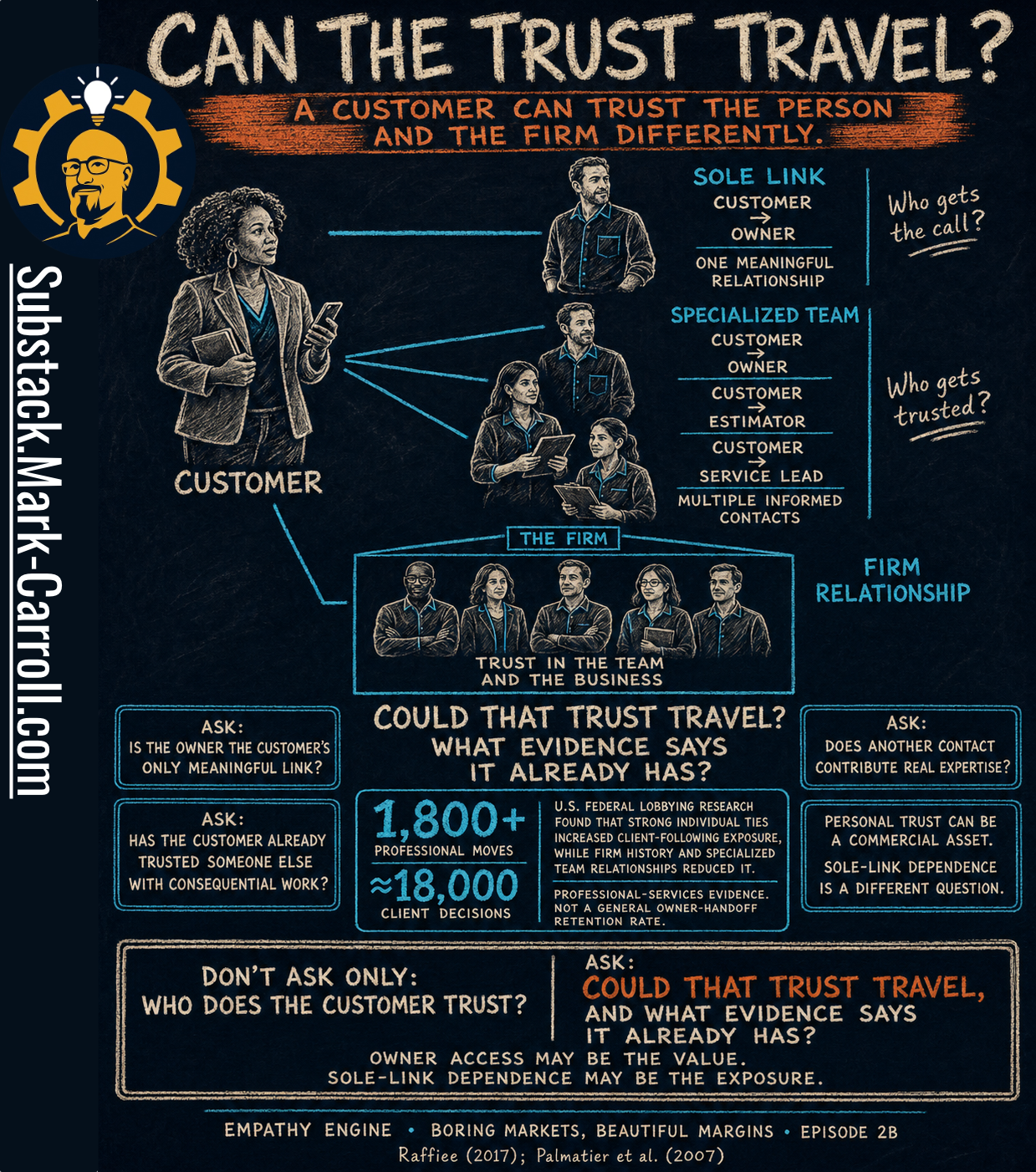
Can the Trust Travel?
The commercial customer who texted Dave’s cell in Part A hasn’t gone away. Nina still has to ask what kind of relationship that actually is.
A sole-link relationship runs entirely through Dave. A specialized-team relationship runs through Dave, the estimator, and the service lead, each contributing something the customer has separately come to trust. Those aren’t the same exposure. Research tracking roughly 1,800 professional moves and nearly 18,000 client decisions found that strong individual ties increased how often a client followed an employee to a new firm, while firm history and specialized team relationships reduced that exposure.2 That’s professional-services evidence, not a general owner-handoff retention rate, but the shape of the question transfers cleanly. Owner access may be the value here. Sole-link dependence is a separate question, and the honest way to ask it is whether that trust has already shown evidence of traveling to someone besides Dave.
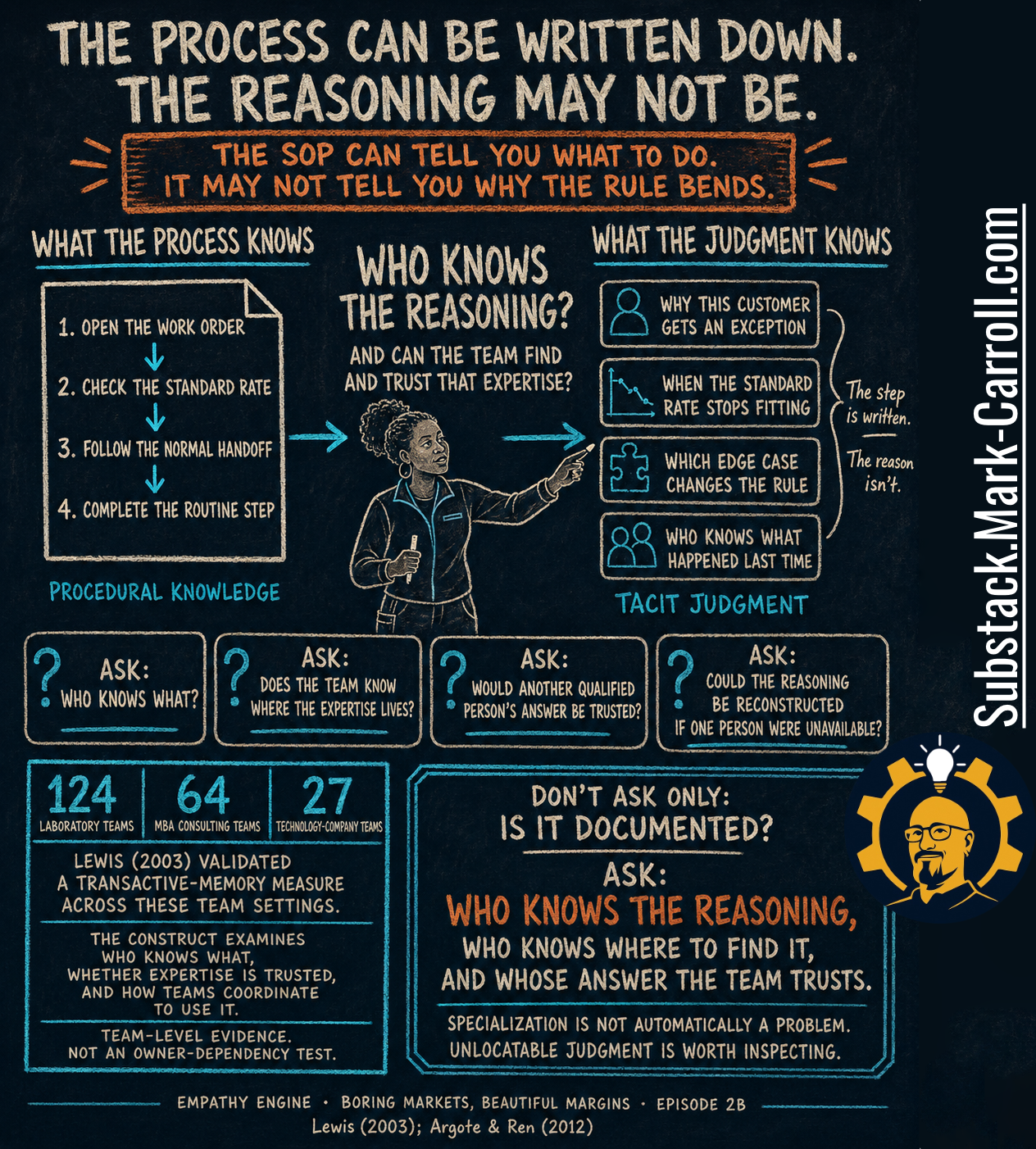
The Process Can Be Written Down. The Reasoning May Not Be.
Dave’s team has a documented rate sheet. What isn’t written anywhere is why the after-hours emergency rate sometimes bends, which customers have earned a longer grace window, and which edge case changes the standard answer. The process tells the team what to do. It doesn’t tell them why the rule bends.
Researchers call the pattern of who knows what, and whether the team trusts that expertise enough to rely on it, transactive memory. One validated measure of it has been tested across 124 laboratory teams, 64 MBA consulting teams, and 27 technology-company teams.3 None of those populations is an owner-led service business, and the scorecard doesn’t administer or adapt that instrument. It borrows the observational question. Specialization by itself isn’t a problem. Reasoning nobody besides Dave can locate is worth inspecting.
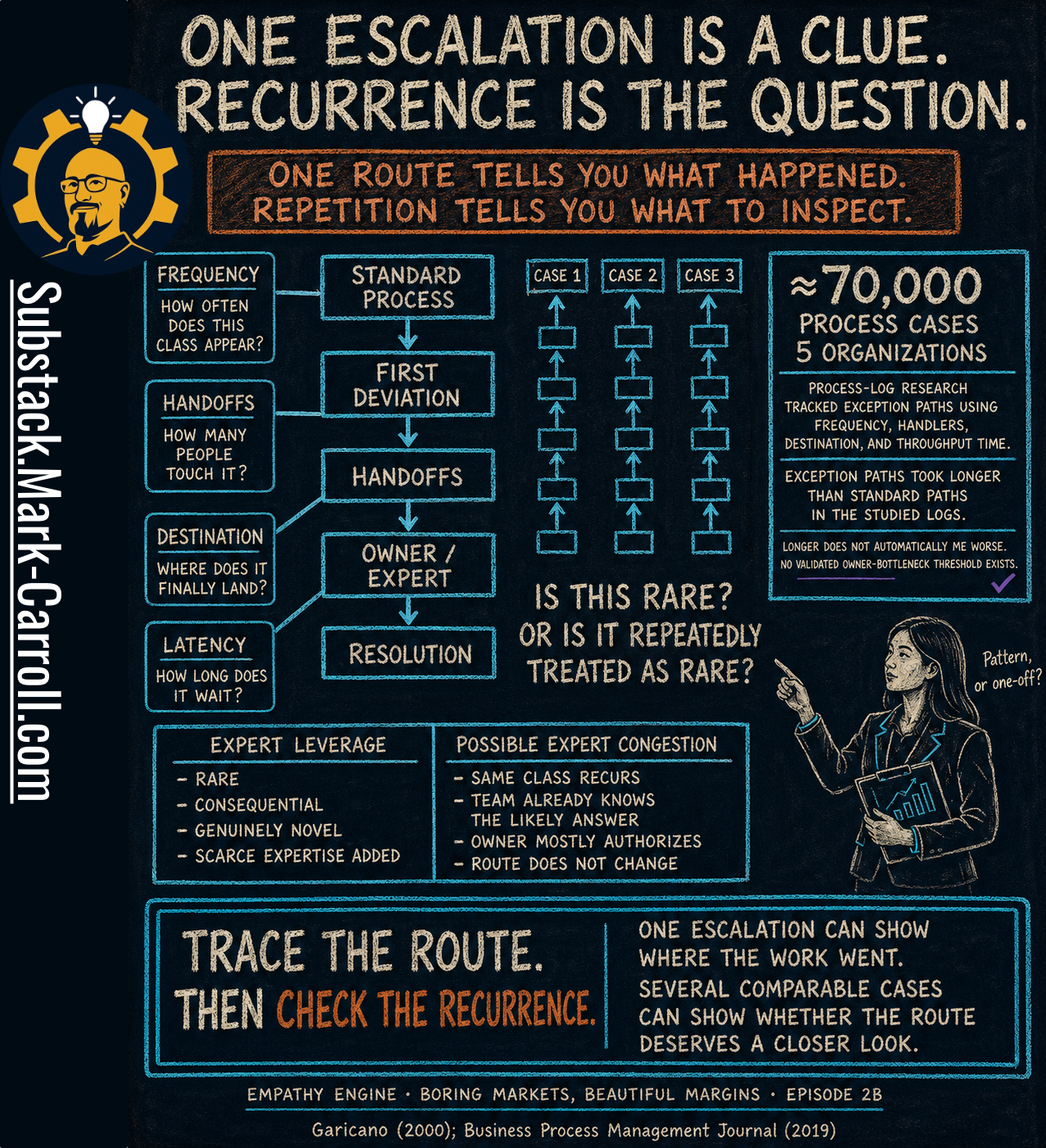
One Escalation Is a Clue. Recurrence Is the Question.
Friday’s exception traveled from the customer, to an employee, to a team lead, to Dave, and waited there before it resolved. That trace tells Nina what happened once. It doesn’t tell her whether that route is how this business works or how this one case happened to work.
Process-log research tracking roughly 70,000 cases across five organizations found that exception paths took measurably longer to resolve than standard paths, tracked by frequency, handoffs, destination, and latency.4 Longer doesn’t automatically mean worse, and no validated threshold separates a healthy escalation rate from a congested one. What separates expert leverage from possible expert congestion is whether the case was genuinely rare and consequential with scarce expertise added, or whether it’s the same class of request, repeatedly treated as if it were rare, with the team already knowing the likely answer before Dave ever says yes.
One escalation is a clue. Nina still needs more than a single Friday before she calls it a pattern.
My instinct kicks in when the room stops debating the problem and starts predicting the approval. If everyone already knows what the answer will be but the work still has to climb the same ladder, that’s usually the moment I stop calling it an exception.