


My Substack Had an Identity Crisis (And I Didn't See Mine Coming)
What the Audit Actually Changed
When Pinkie (aka AI Meets Girlboss) first offered to audit Empathy Engine, I expected a website project. I thought we would clean up the homepage, sharpen the About page, and make the publication easier for a new reader to understand. We did that. I didn’t expect the audit to end up asking harder questions than the ones about layout.
BEFORE / AFTER
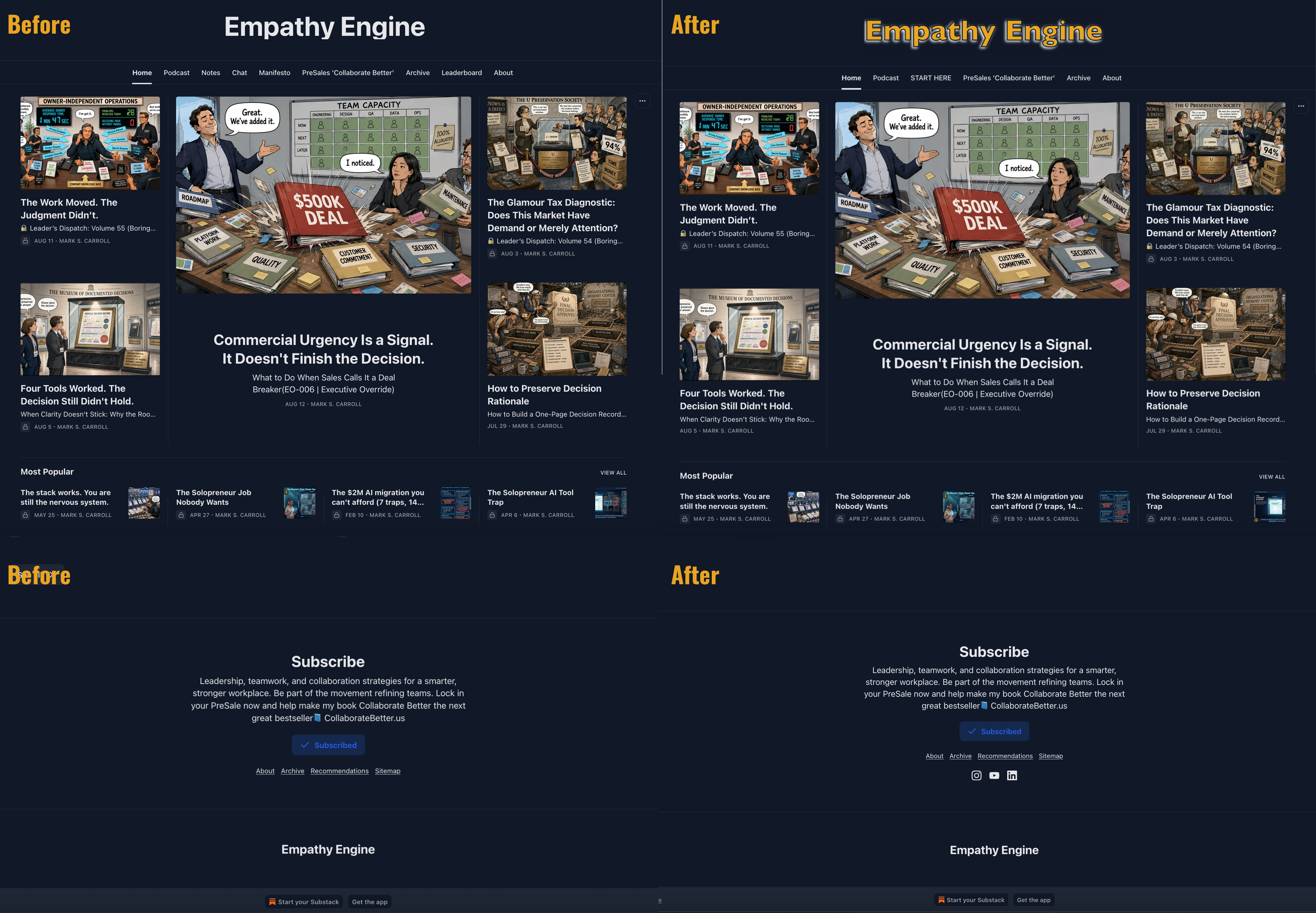
The first changes are easy to spot. The navigation bar is cleaner and more intentional. The generic publication name has been replaced with a real Empathy Engine wordmark. And the footer now gives readers a clearer path to find me elsewhere, through LinkedIn, Instagram, and YouTube.
Those may sound like small design decisions. They weren’t. Each one forced a question about what deserved to stay, what needed to change, and what kind of publication I wanted Empathy Engine to become. The old version reflected years of accumulated ideas, experiments, professional identities, and assumptions about what I was supposed to be building. The new version reflects more deliberate choices.
What should a new reader see first? What should be easy to find, and what should disappear? Those are website questions. But answering them honestly meant admitting the old site wasn’t cluttered by accident. It was cluttered because I hadn’t decided what I actually wanted it to say.
At some point, the website stopped being the only thing under review. So was I.
The new Empathy Engine is cleaner, but that’s almost beside the point. It’s more honest. I’ve spent much of my career helping organizations adapt through change, from the dot-com era to today’s AI disruption. This project reminded me that adaptation isn’t only something organizations have to do. People do, too. Sometimes that means putting away old assumptions, old ambitions, and old versions of ourselves that no longer fit. Then we get to ask a better question: what do I actually want to build now?
For me, Empathy Engine is becoming part of that answer, a place to develop useful ideas, create tools that give people a real competitive advantage, explore what human judgment means in an AI-shaped world, and build the body of work I want to be known for.
Pinkie audited my Substack. I didn’t expect my Substack to audit me back.
BEFORE / AFTER: The About Page
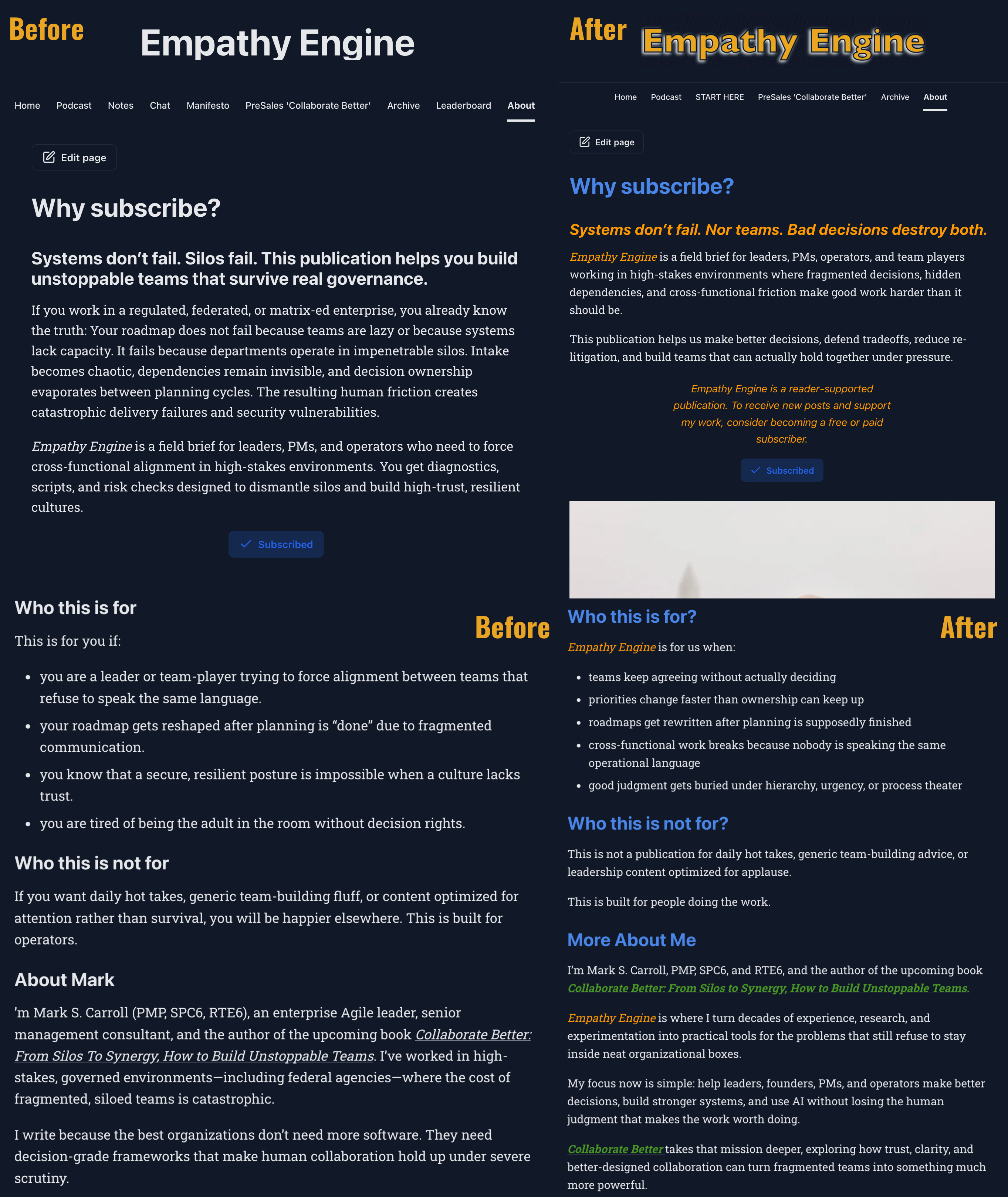
This change was less about appearance and more about clarity. The old About page had a lot to say, but it asked a new reader to work too hard to understand what Empathy Engine was really for. The new version makes the value proposition much more direct: what problems we tackle, what practical tools subscribers receive, what paid members get, and who is behind the publication.
These distinctions matters and, as I discover, are A LOT to reflect upon.
It also gave me room to explain something the old version barely touched: who I am beyond a list of credentials, what Agile actually means in plain English, and how my experience connects to the work I publish now. The result feels less like a résumé pasted onto a newsletter and more like an introduction with a point of view that matters for readers, and that distinction matters. A good About page shouldn’t merely prove that the author has experience. It should help the reader understand why that experience is useful to them.
And the before-and-after image only shows the surface. Pinkie pushed me to rethink far more than layout and copy. She inspired me to dig into the real value proposition of Empathy Engine and ask what I’m actually giving subscribers that is distinctive, useful, and worth returning for. That work led to a much more substantial About page and a completely reimagined START HERE page, which previously existed only as a vague idea in my head.
So if the screenshots make the transformation look mostly visual, they are only showing the tip of the iceberg. The real change lives in the substance.
Visit the About and START HERE pages if you want to see the full transformation.
BEFORE / AFTER: The Paid Tier
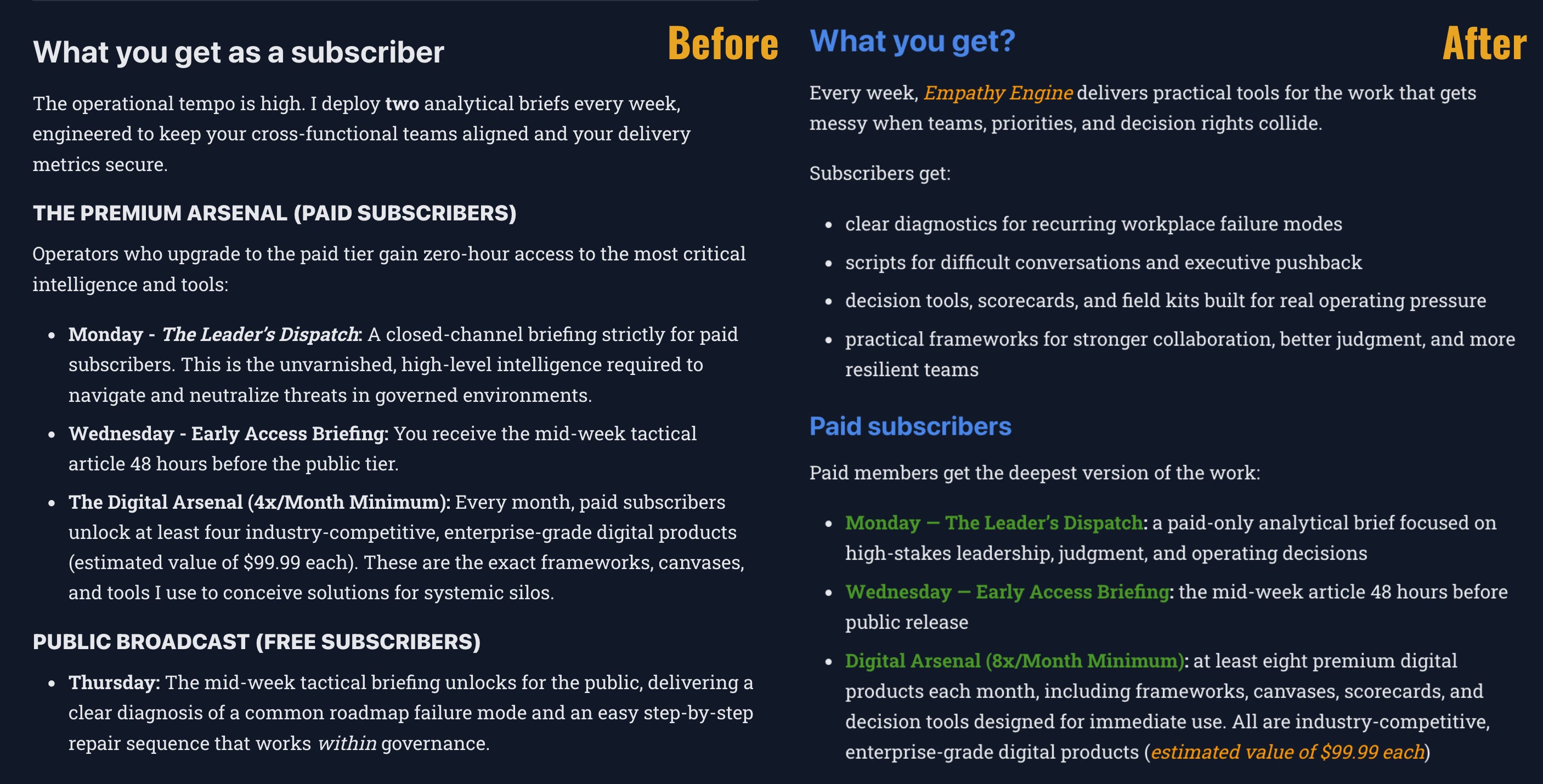
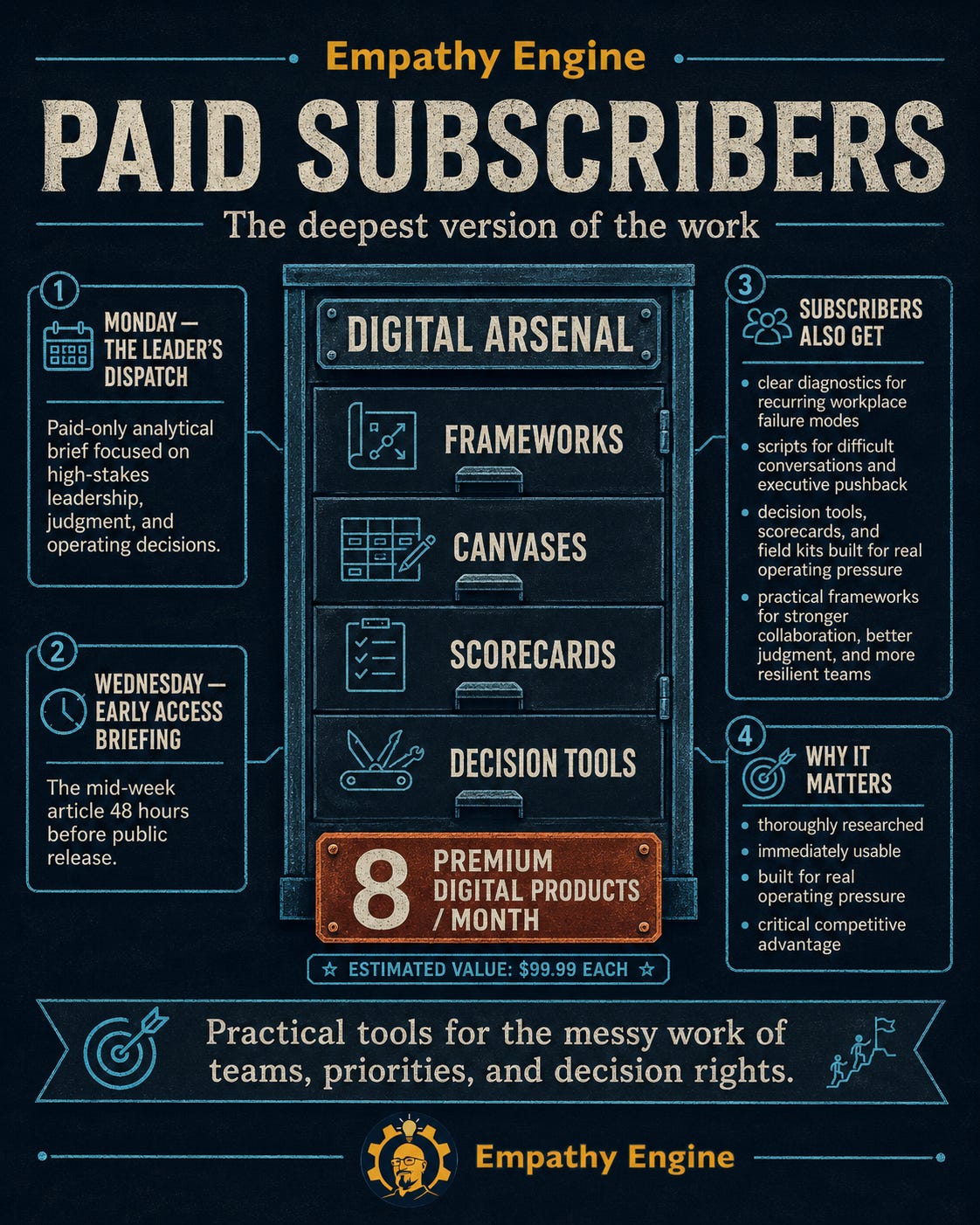
The paid offer changed just as much. Before, the benefits were there, but they read more like a schedule of what subscribers received. The new version makes the value much more explicit: paid members now see the three core parts of the offer at a glance, The Leader’s Dispatch, 48-hour early access, and the Digital Arsenal of premium tools designed for immediate use.
The biggest shift is the Digital Arsenal. I don’t want paid subscribers to feel like they’re simply buying more articles. I want them to understand that they’re receiving thoroughly researched, enterprise-grade frameworks, canvases, scorecards, diagnostics, and decision tools that can give them a real competitive advantage in their jobs and businesses. That’s a much higher standard than “bonus content,” and it’s the standard I want Empathy Engine to be known for.
START HERE: Built From Scratch
There is no BEFORE image for this one. The START HERE page didn't exist. Pinkie's audit pushed me to create it from scratch, and that turned into one of the most valuable changes in the entire reinvention. Rather than dumping a new reader into an archive and hoping they figure out where to begin, the page now gives them a deliberate path into Empathy Engine.
The greatest hits
Five cornerstone articles. I selected five of the strongest and most popular pieces in my Substack, each chosen because it gives readers a practical advantage in a different part of the work: AI adoption, judgment bottlenecks, leadership, role design, and governance.
A field briefing instead of a reading list. Each article is introduced by what the reader will actually learn, diagnose, or be able to do differently after reading it, not just a summary of what it's about.
A clearer promise. The page explains what Empathy Engine is trying to help readers become better at: using AI intelligently, leading people, making stronger decisions, and operating under pressure.
A real starting point. New readers no longer have to guess which article best represents the publication or where they should begin.
That may sound like a simple navigation improvement. It isn't. The START HERE page forced me to decide which ideas I most want associated with Empathy Engine, what kind of competitive advantage I want readers to leave with, and what the publication is ultimately trying to teach. That made it one of the clearest expressions of the new Empathy Engine.
Visit START HERE to see the full collection.
Facing the Changes
“So I turned myself to face me
But I’ve never caught a glimpse”
David Bowie, Changes
That lyric has been rattling around in my head throughout this project. I started by looking at a Substack homepage and asking what needed fixing. Somewhere between the navigation bar, the About page, the START HERE collection, and the uncomfortable business of deciding what Empathy Engine actually promises people, the question became much more personal. I had to look at some old ideas about who I was, what counted as success, and what I thought I was still supposed to be chasing.
There is something mildly ridiculous about needing a website audit to provoke that kind of reckoning, which feels appropriate. Reinvention rarely arrives with a brass band and a tasteful PowerPoint deck explaining the transformation roadmap. Sometimes somebody named Pinkie points out that your Substack could use some work, and a few weeks later you are reconsidering the architecture of your professional life. I can laugh at that now, because the exercise left me clearer about what I want Empathy Engine to become, and more importantly, about the person I want to become while building it. That’s the thing nobody tells you about a good audit: it never stays confined to the thing you asked someone to look at.
The publication on the other side is more focused, more useful, and more recognizably mine. I am, too. I still can’t claim to have figured out the destination, and perhaps that would defeat the point anyway. For now, I’m comfortable facing the direction I’ve chosen, making the next decision deliberately, and accepting that time may change me.
Thank you, Pinkie of AI Meets Girlboss, who set out to fix a homepage and ended up helping me confront my shadow self instead. Empathy Engine, and the people who read it, are better for it.
Regards,
Mark 👋
What part of your work or identity has quietly outgrown the version you’re still presenting to the world?
That was the uncomfortable question hiding underneath this audit for me. I’d love to hear what changed for you once you finally looked at it closely.
Thank you so much for doing this with me, Mark. I really enjoyed the process!
working with you and realising that we all have blind spots when it comes to our own brand was exactly the kind of insight that made building this checklist worthwhile.
You did an amazing job going through the full checklist, and seeing you question things about your brand through this process was really inspiring. I hope others see this collab and feel motivated to do the same kind of foundational work on their own pages AND brands
Great collab!! 🩷🦩