

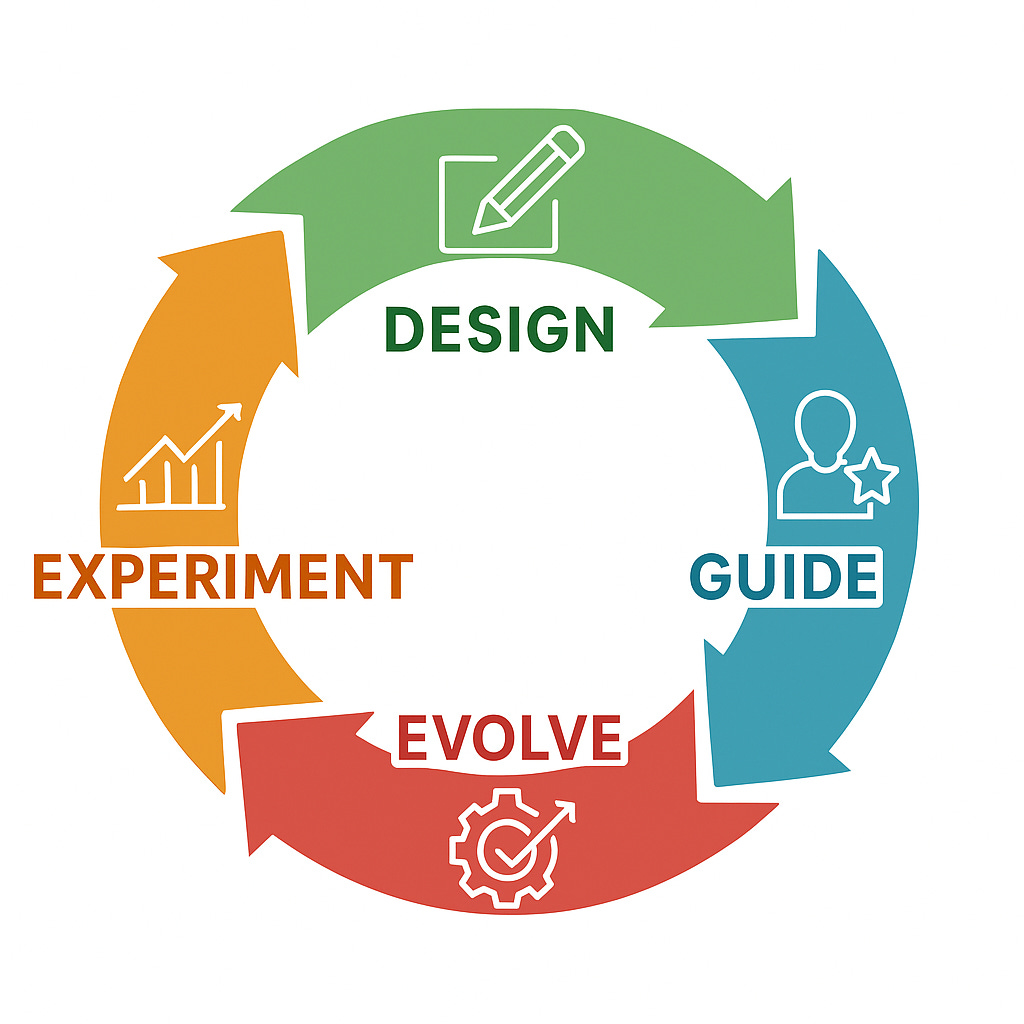
The Leader’s EDGE Cycle:
When we Experiment, we discover what works and what can be improved. That learning builds the best Designs.
A great Design then Guides our products, our people, and our customer journeys.
We Guide our teams with trust, alignment, and governance, helping our organization Evolve — growing the value we deliver.
As we Evolve, empathy and insight spark new rounds of Experimentation to delight our customers.
The cycle never ends.


Roadmap Keeps Breaking? 3 Fixes for PMs and POs

Top of the Series Arc: 🔒 Leader’s Dispatch: Weight Comes After Insight
🔒 Leader's Dispatch: The 🤫 Silence After the Decision 🧭

Top of the Series Arc: 🔒 Leader’s Dispatch: Weight Comes After Insight
🔒 Leader's Dispatch: ❄ January Is Not a Fresh Start 🥾

Top of the Series Arc: 🔒 Leader’s Dispatch: Weight Comes After Insight
🔒 Leader's Dispatch: What Is Resistance Actually Telling You?

Top of the Series Arc: 🔒 Leader’s Dispatch: Weight Comes After Insight
🔒 Leader's Dispatch: The Calm After the Foot Lands

Top of the Series: 🔒Leader’s Dispatch: Has OpenAI Lost Its Strategic Edge? (Windsurf AI ☢️Fallout🧨)
🔒 Leader's Dispatch: Weight Comes After Insight

Top of the Series: 🔒Leader’s Dispatch: Has OpenAI Lost Its Strategic Edge? (Windsurf AI ☢️Fallout🧨)
🔒 Leader's Dispatch: 2026 Is Speaking. Are You Hearing It?

Top of the Series: 🔒Leader’s Dispatch: Has OpenAI Lost Its Strategic Edge? (Windsurf AI ☢️Fallout🧨)
🔒 Leader’s Dispatch: 📝 2025 Final Exam 😰 (Secret Curriculum)⏳

Top of the Series: 🔒Leader’s Dispatch: Has OpenAI Lost Its Strategic Edge? (Windsurf AI ☢️Fallout🧨)
🔒 Leader’s Dispatch: Has Your 🪜Overhead Gone Over Your Head? 🔦

Top of the Series: 🔒Leader’s Dispatch: Has OpenAI Lost Its Strategic Edge? (Windsurf AI ☢️Fallout🧨)
🔒 Leader’s Dispatch: 📆 Your 2026 8-Step Strategic Roadmap 📈

Top of the Series: 🔒Leader’s Dispatch: Has OpenAI Lost Its Strategic Edge? (Windsurf AI ☢️Fallout🧨)
🔒 Leader’s Dispatch: 🍹The Day Efficiency Got Drunk on Its Own Code 🤖

Top of the Series: 🔒Leader’s Dispatch: Has OpenAI Lost Its Strategic Edge? (Windsurf AI ☢️Fallout🧨)
🔒 Leader’s Dispatch: 👁️ Under the All-Seeing Dashboard 🔮

Top of the Series: 🔒Leader’s Dispatch: Has OpenAI Lost Its Strategic Edge? (Windsurf AI ☢️Fallout🧨)
🔒 Leader’s Dispatch: 💀 The Frankenstack Lives 🧟♂️

Top of the Series: 🔒Leader’s Dispatch: Has OpenAI Lost Its Strategic Edge? (Windsurf AI ☢️Fallout🧨)
🔒 Leader’s Dispatch: 🧛♂️ The Undead Workflow — When Rituals Refuse to Die ⚰️

Top of the Series: 🔒Leader’s Dispatch: Has OpenAI Lost Its Strategic Edge? (Windsurf AI ☢️Fallout🧨)
🔒 Leader’s Dispatch: The Leadership Lesson We Forgot to Inherit 🌎

Top of the Series: 🔒Leader’s Dispatch: Has OpenAI Lost Its Strategic Edge? (Windsurf AI ☢️Fallout🧨)
🔒 Leader’s Dispatch: Why “Getting Things Done” Isn’t Getting You Anywhere

Top of the Series: 🔒Leader’s Dispatch: Has OpenAI Lost Its Strategic Edge? (Windsurf AI ☢️Fallout🧨)
🔒 Leader’s Dispatch: The Silent Killer Lurking in Your Calendar

Top of the Series: 🔒Leader’s Dispatch: Has OpenAI Lost Its Strategic Edge? (Windsurf AI ☢️Fallout🧨)
🔒 Leader’s Dispatch: How Slack Is Bankrupting Your Team’s Attention

Top of the Series: 🔒Leader's Dispatch: Has OpenAI Lost Its Strategic Edge? (Windsurf AI ☢️Fallout🧨)
🔒 Leader's Dispatch: We Can Be Heroes, Just for One Sprint

Top of the Series: 🔒Leader's Dispatch: Has OpenAI Lost Its Strategic Edge? (Windsurf AI ☢️Fallout🧨)
🔒Leader's Dispatch: The Illusion of Infinite Scale

Leader’s Dispatch: The Illusion of Infinite Scale
🔒Leader's Dispatch: AI Is Cheap, Trust Isn’t

Top of the Series: 🔒Leader's Dispatch: Has OpenAI Lost Its Strategic Edge? (Windsurf AI ☢️Fallout🧨)
🔒Leader's Dispatch: Is GPT-5 Dead on Arrival?!?

Top of the Series: 🔒Leader's Dispatch: Has OpenAI Lost Its Strategic Edge? (Windsurf AI ☢️Fallout🧨)
🔒Leader's Dispatch: Humans > Algorithms (Hiring Re-Surges! Why?)

Top of the Series: 🔒Leader's Dispatch: Has OpenAI Lost Its Strategic Edge? (Windsurf AI ☢️Fallout🧨)
🔒Leader's Dispatch: Is "AI-Washing" Just Smart Branding?

Top of the Series: 🔒Leader's Dispatch: Has OpenAI Lost Its Strategic Edge? (Windsurf AI ☢️Fallout🧨)
🔒Leader's Dispatch: How ChatGPT’s Agent Can Lasso 🤠 Your Job Search & Career Goals 🤑

Previous & Top of the Series: 🔒Leader's Dispatch: Has OpenAI Lost Its Strategic Edge? (Windsurf AI ☢️Fallout🧨)
🔒Leader's Dispatch: Has OpenAI Lost Its Strategic Edge? (Windsurf AI ☢️Fallout🧨)

💣 The Day the Windsurf Turned 🔥

🔒💊 Martin Shkreli: The Pharma Fiend Who Smirked Through the Scam

🕵️ Grifted: Success That Survives the Scam
🔒🪙 Grifted: Sam Bankman-Fried & the FTX Fantasy (Subscribers Only Edition)

🕵️ Grifted: Success That Survives the Scam
🔒 Grifted: 💸 Charles Ponzi — The 📊 Blueprint Behind Every Scam Since 1920💰(Subscribers Only Edition)

🕵️ Grifted: Success That Survives the Scam
🔒💀 Grifted: Lehman Brothers – Collapse So Loud It Shook the World (Subscribers Only Edition)

Top of the Series: WorldCom — The Telecom Giant That Billed Us for a Fantasy
🔒 Grifted: The Lou Pai Paradox (Subscribers Only Edition)

Top of the Series: WorldCom — The Telecom Giant That Billed Us for a Fantasy
🔒 Grifted: The Fall of Arthur Andersen LLP (Subscribers Only Edition)

Top of the Series: WorldCom — The Telecom Giant That Billed Us for a Fantasy

💡 Thinking Like an Agilist vs. Being an Agilist
Why this matters:
Agile isn’t just a methodology — it’s a mindset, a practice, and for many of us, an identity. Understanding the distinction helps leaders and teams know where they stand — and where they can grow.
1. Thinking Like an Agilist
A mindset. A set of reflexes.
Iteration over perfection.
Feedback over silence.
Transparency over politeness.
Adaptability over rigid planning.
Leaders who think like Agilists may not know the jargon, but they intuitively act with agility. They spot blockers, they seek learning, they encourage course corrections.
2. Being an Agilist
A discipline. A craft.
Certifications, frameworks, and toolkits (Scrum, SAFe, Kanban, Lean, etc.).
Coaching, facilitation, and scaling agility across whole organizations.
Turning mindset into repeatable practice, rituals, and culture change.
Being an Agilist means practicing agility deliberately — and guiding others to do the same.
3. Why the Distinction Matters
Thinking is the spark.
Being is the sustained fire.
Anyone can think with agility. But true Agilists carry it forward — teaching, scaling, and embedding it in teams so it lasts beyond individuals.
