
How to Tell Whether a Market Has Demand or Merely Attention
🔒 Leader’s Dispatch: Volume 54 (Boring Markets, Beautiful Margins Part 1b of 7 Part Series)

A practical inspection for separating category excitement from repeated paid pain
👋 Welcome to my paid subscriber-only edition of Empathy Engine (🔒 Leader’s Dispatch). Each week I build evidence-forward tools for product leads who need to say no, defend tradeoffs, and lock in decisions before they get rewritten later.
Why Nina Doesn’t Buy the HVAC Domain Before Lunch
The fastest way for Nina to repeat her mistake would be to replace one exciting category with one exciting anecdote.
She has seen one owner’s workflow. That is not a market. It is a lead.
So she does not buy an HVAC domain. She does not rewrite her LinkedIn headline. She does not build a vertical SaaS prototype over the weekend. She does not announce that she has discovered an overlooked billion dollar market. She does not call the spreadsheet proof of concept.
She asks questions instead.
How often does this happen. Who notices first. What does it delay. What happens when nobody catches it. Who currently absorbs the work. What has the company already tried. Is this problem shared by similar operators. What would solving it actually be worth. What new burden would a solution create.
None of these questions require her to pick a market. They require her to keep looking.
Research Binder: the receipts (citations + source notes) are compiled in a PDF at the bottom of this post.
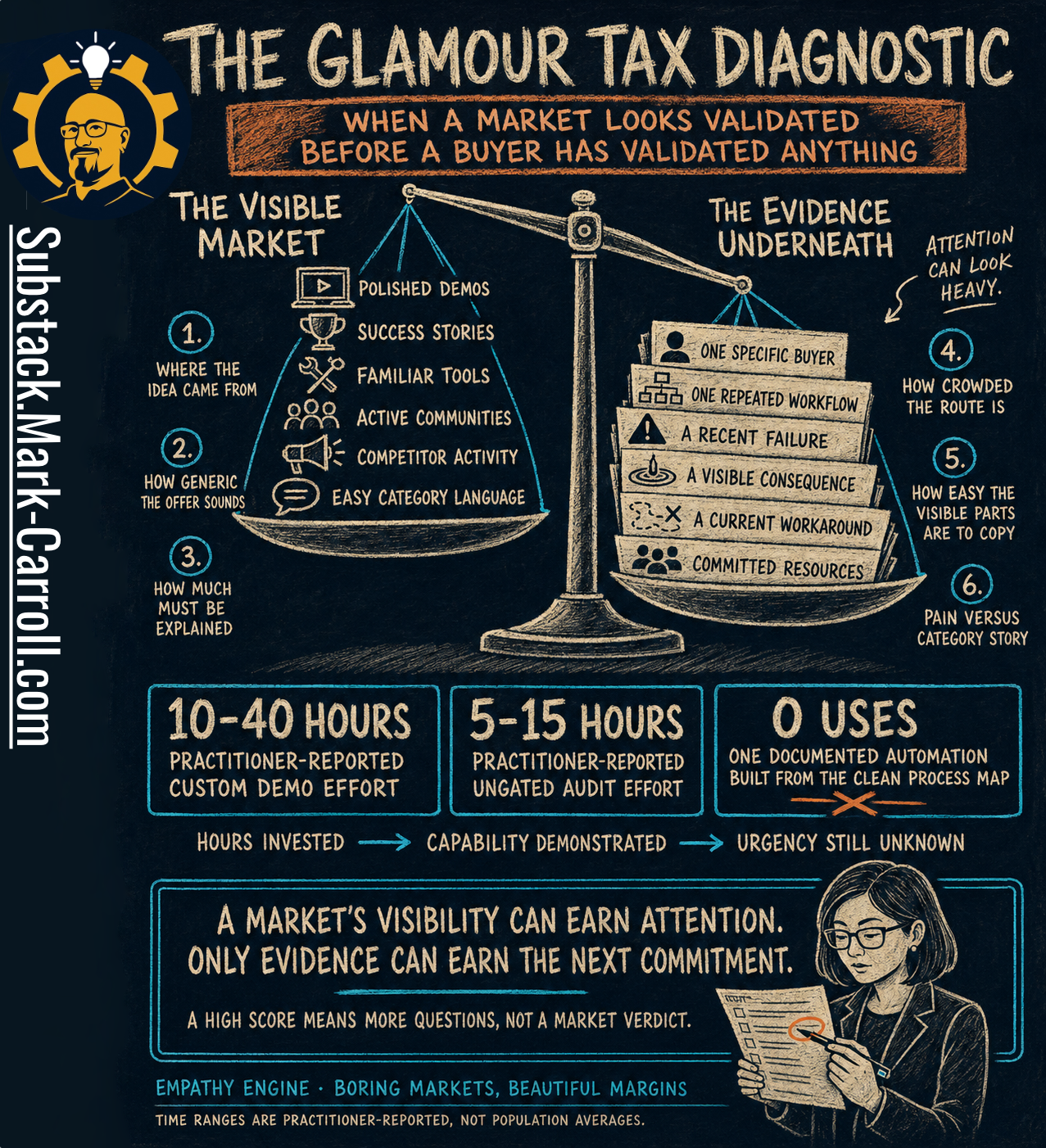
What the Glamour Tax Diagnostic Can (and Can’t) Tell You
Part A named the pattern. This is the tool for catching it while it is still cheap to catch.
Part A:

The Glamour Tax Diagnostic can help you notice when an opportunity is getting extra credit because it is popular, easy to explain, socially rewarding, tool-rich, highly visible, or surrounded by public success stories. It cannot determine market size, profitability, legal exposure, buyer access, product-market fit, regulatory suitability, personal capability, or whether the opportunity should be pursued.
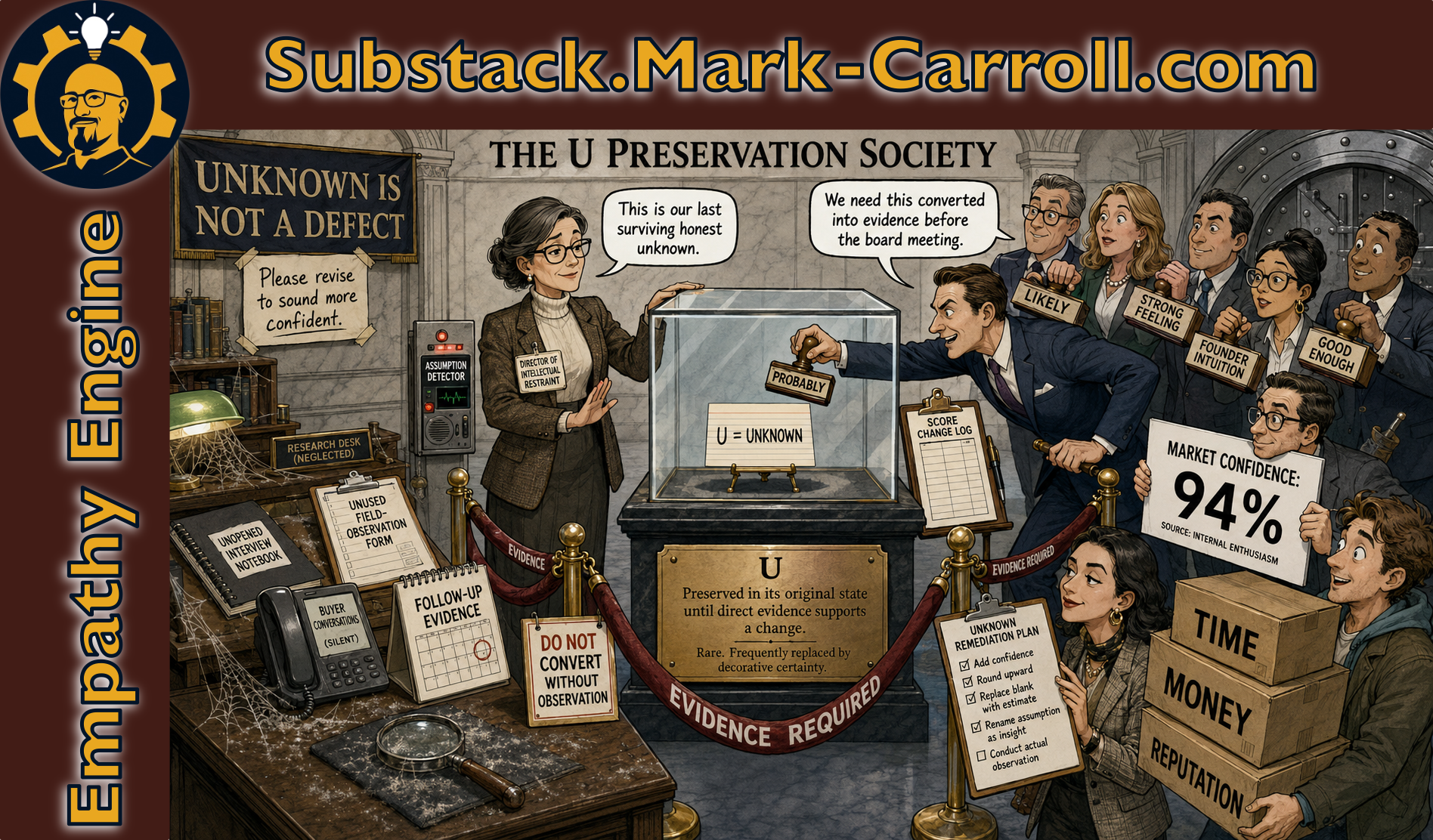
It scores six dimensions of a single opportunity, each from 0 to 2, with a fourth option, U, for unknown. U is not a low score. It is an honest one. A dimension gets marked unknown when there simply is not enough evidence yet to score it truthfully, and the diagnostic is built to say so rather than quietly guess.
A high score does not mean walk away. It means the market owes us more proof.
My rule is simple. I don’t let category excitement enter the scoring process disguised as evidence. I write down what I know, what I’ve directly observed, and what I’m still assuming before I assign a number to anything.
The Six-Dimension Glamour Tax Diagnostic, Scored Twice
Nina runs both opportunities through the same six questions, her generic AI automation offer and the HVAC estimate follow-up workflow. Five of the six dimensions are shown below. The sixth, the one that actually governs the result, gets its own section next.
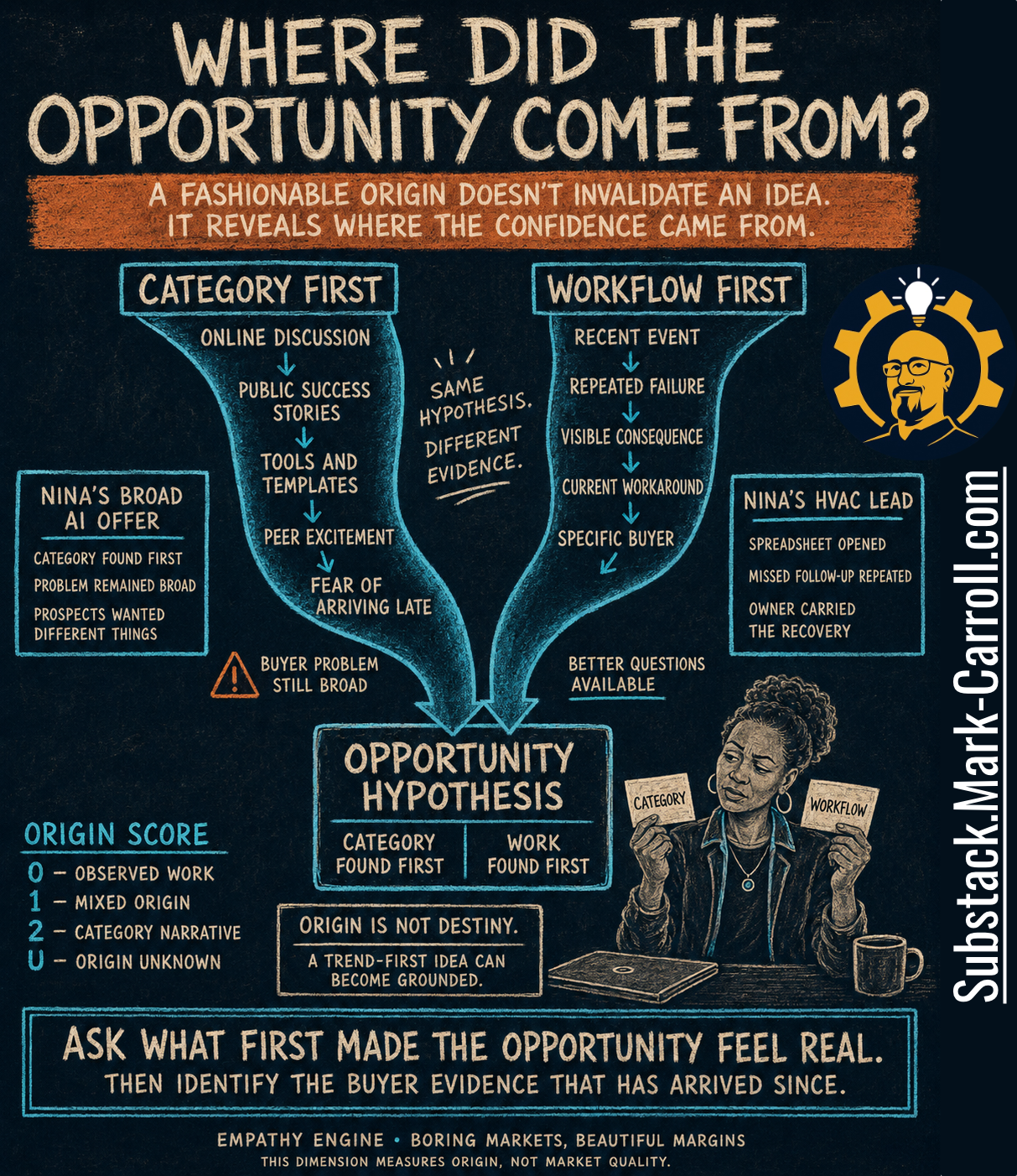
Where Did the Opportunity Come From?
Would this still interest us if nobody online were discussing it? The AI offer scores 2. The category found Nina before a specific customer problem did. The HVAC lead scores 0. It came from watching one owner’s real week, not from a trend.
These scores describe Nina’s current framing of “AI automation for small businesses,” not AI as an industry. Another builder, with a different workflow and different commitments already in hand, could score the same category very differently.
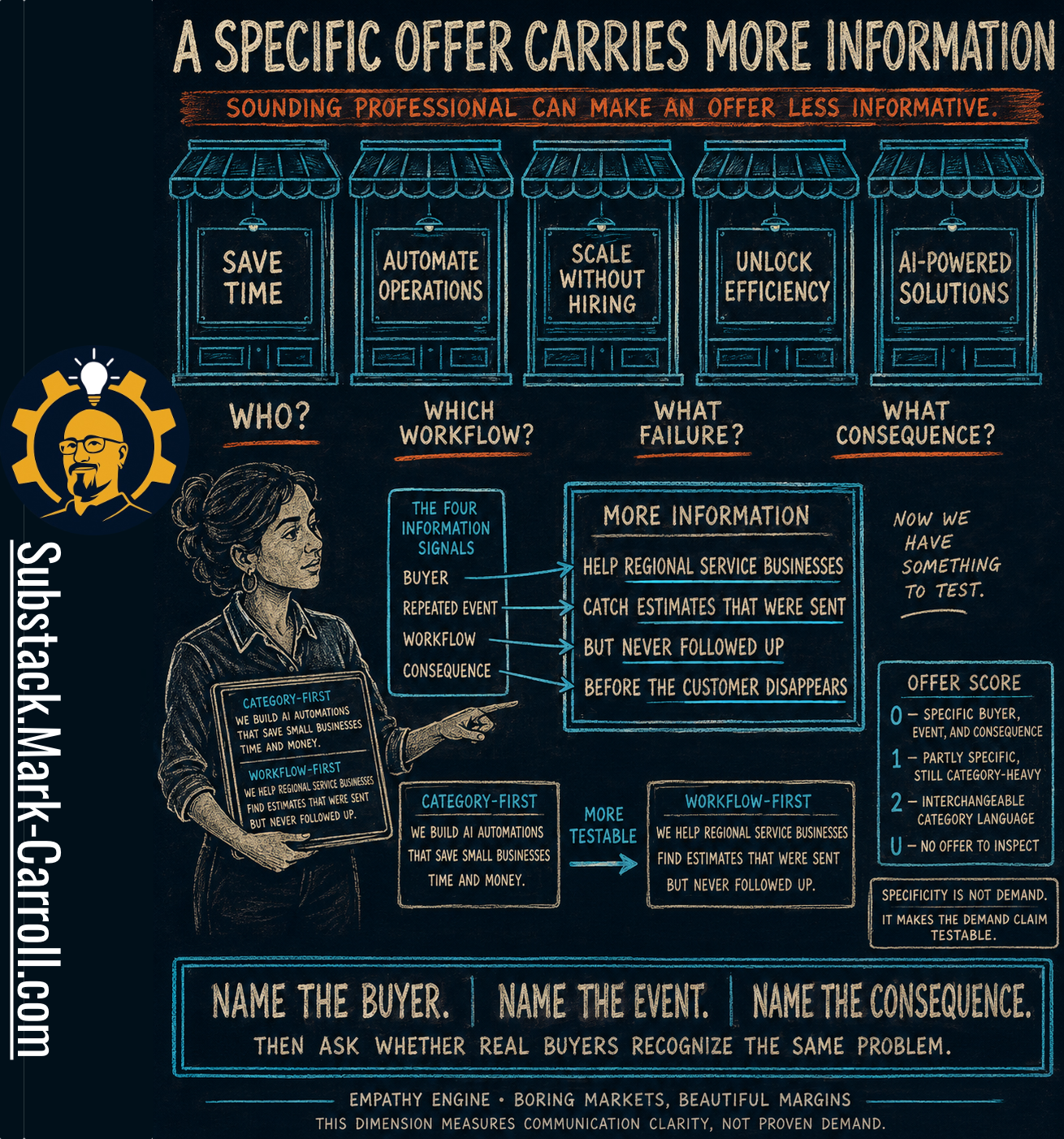
Why a Specific Offer Carries More Buyer Information
Could this description be swapped onto a competitor’s homepage without anyone noticing? The AI offer scores 2, interchangeable category language. The HVAC lead scores U. There is no offer yet to inspect, only an observation.
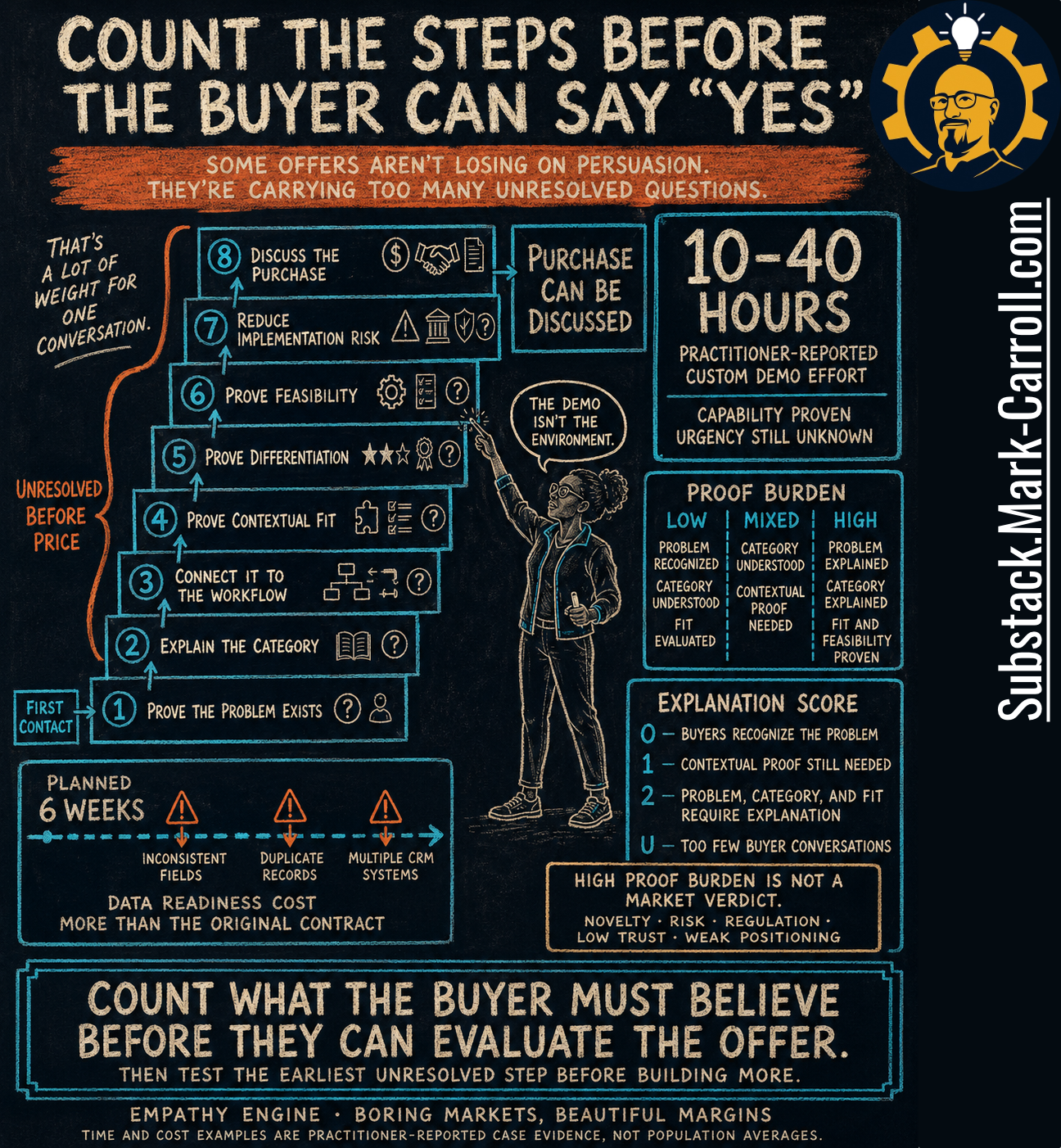
How Proof Burden Makes an Offer Harder to Buy
How much must a buyer already believe before they can evaluate this at all? The AI offer scores 2, since Nina has to establish the problem, then the category, then her distinctiveness, in that order, before price ever comes up.
A client once requested a “quick” refresh of six slides, which we initially expected to take a couple of hours. Once the real data arrived, four screenshots were unusable, three core assumptions had shifted, and two metrics needed engineering review. The work expanded to a full day because the original scope described the artifact, not the evidence required to make it true.
HVAC scores U here. Too few buyer conversations have happened to know.
I used to assume that a detailed explanation reduced uncertainty. Sometimes it only revealed how much uncertainty the offer contained. When I find myself teaching the problem, defining the category, and proving distinctiveness before the buyer can discuss price, I no longer call that a slow sale. I call it a high proof burden.
