The difference between supporting a direction and accepting the next move
A meeting can end in genuine agreement and still leave the most important questions open. Before you call it a commitment, check what was actually settled.
A note for 🪖 Veterans Day 🇺🇸
Today is Veterans Day in the United States. To everyone who has served, and to the families who served alongside them: thank you.
Military tradition has long understood something at the heart of this article. In radio procedure, “Roger” means a message was received. “Wilco” means it will be carried out. Those who serve learn early that receiving an order and committing to the mission aren’t the same thing, and that clarity about which one you have can carry real consequences. That discipline, honored across generations of service, sets a standard worth carrying into every workplace.
With gratitude and respect.
What if the biggest obstacle to collaboration isn’t the people, but what we’re overlooking between them?

My new book, Collaborate Better, explores how we can break through organizational silos, solve problems together, and turn individual contributions into shared success.
Your road to better collaboration starts here.
Get your copy today at https://CollaborateBetter.us
Research Binder: the receipts (citations + source notes) are compiled in a PDF at the bottom of this post.
Opening
The meeting ends five minutes early.
Four people, one pilot proposal, forty-five good minutes. Priya, the product lead, walks through the customer problem. Dana from Engineering thinks the build is manageable. Alex from Operations likes the timing. Sam, the director who sponsored the idea, leans back and says the pilot looks promising.
Everyone nods. Someone says, “Great, so we’re aligned.” Priya writes Direction agreed at the top of her notes and puts a checkmark next to it.
On Friday, Priya opens the project channel to see how the pilot is coming along. Nothing has moved. No brief. No environment. No calendar invite for the customer.
So she asks the room a simple question: “Where are we on the pilot?”
Three people answer three different ways. Dana thought it was approved. Sam thought the group had agreed to recommend it. Alex thought it was still waiting on Security’s review.
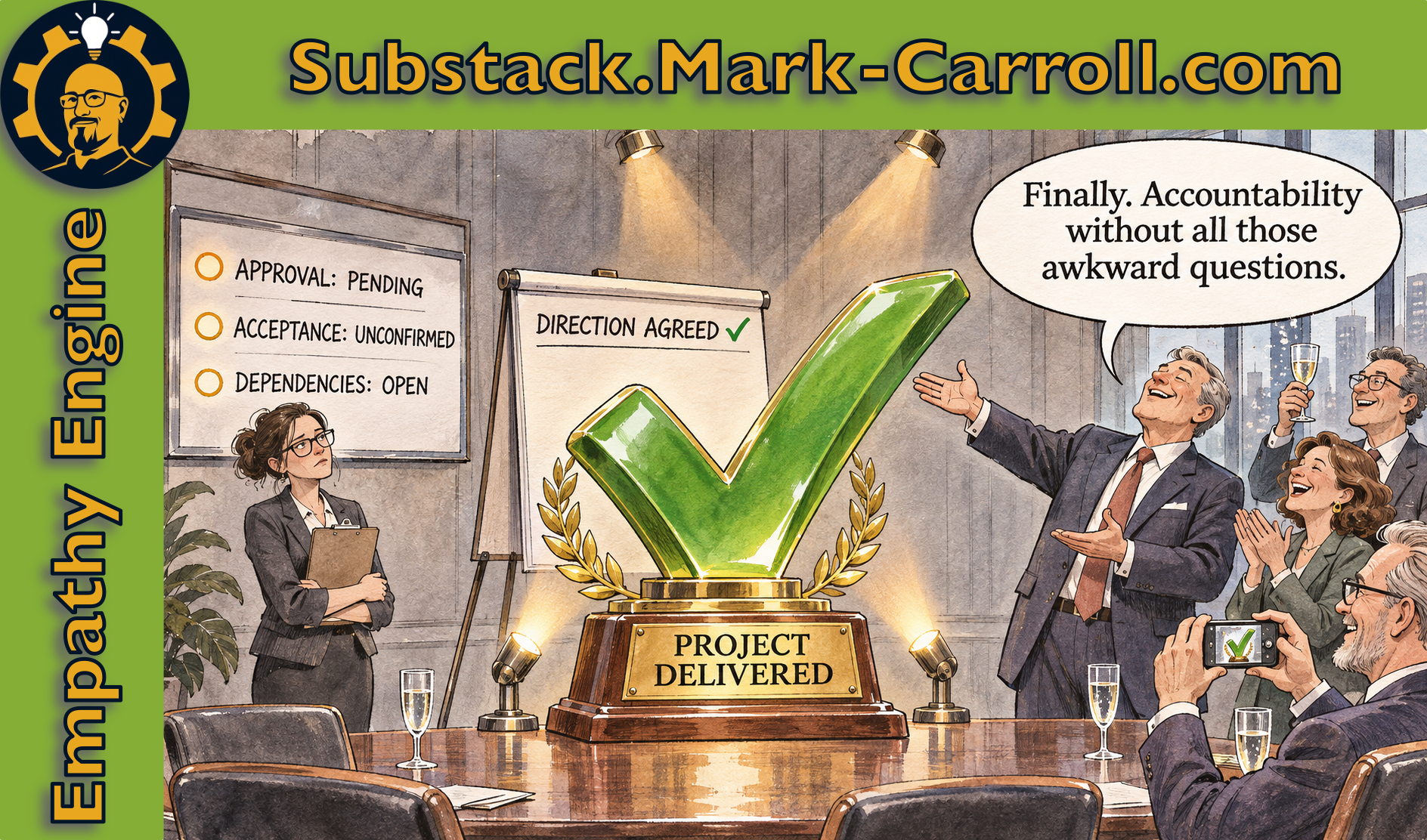
Nobody was careless. Nobody was hiding anything. Everyone left Tuesday’s meeting sincerely believing the group agreed. And the group did agree. What it agreed about is the part nobody checked.
A note on that scene before we go further. It’s an illustrative scenario, not one company’s case file, and I’m not presenting it as one. Priya, Dana, Alex and Sam are invented. The moment is one I suspect most people who coordinate cross-functional work will recognize.
Now, the honest part. Maybe the pilot stalled because Engineering got pulled onto an outage. Maybe priorities shifted on Wednesday. Maybe Security’s queue was simply long. A stalled pilot can be fully authorized, willingly accepted, well planned, and still delayed for reasons that have nothing to do with Tuesday’s meeting. Friday’s silence tells Priya that progress is missing. It doesn’t tell her why.
So Priya has two observations, not one explanation. The pilot hasn’t moved. And the team disagrees about what was authorized. Whether the second caused the first is something she would still have to find out.
But before she goes looking for a cause, there’s a smaller question she can answer right now: what did the group actually establish?
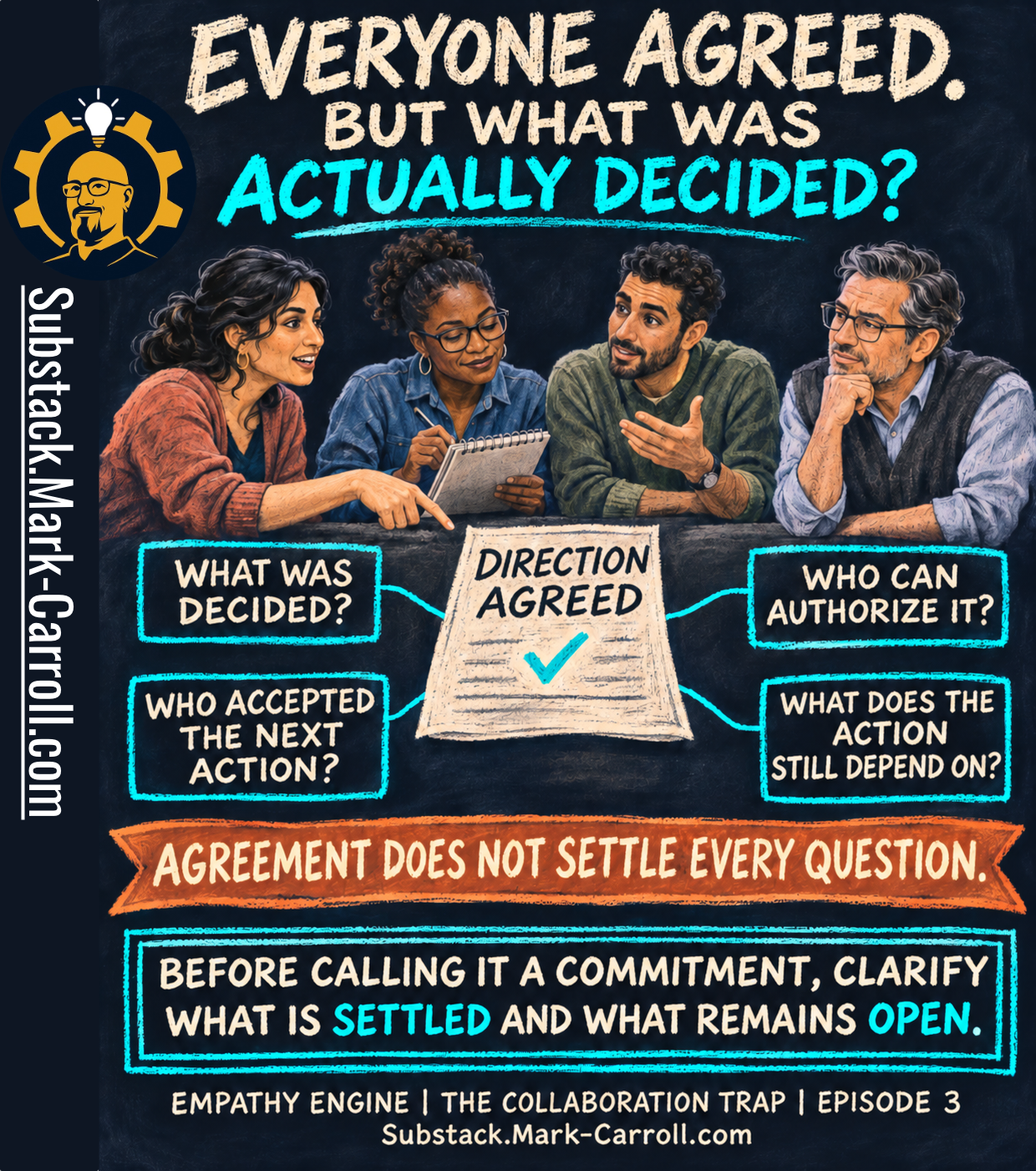
Look at the paper in the middle of the table. It says Direction agreed, with a checkmark, and that checkmark is honest. The group really did support the direction.
Now look at the four questions wired to it. What was decided? Who can authorize it? Who accepted the next action? What does the action still depend on? The checkmark answers none of them. A team can agree on where it wants to go and still leave every one of those questions open.
That’s the trap this week, and it’s a quiet one. Agreement does not settle every question. In our story, it settled one thing: the group really did support the direction. In a real meeting, even that deserves a second look, as the next section shows. Everything after that still has to be established.
Which brings me to a correction on last week’s teaser. I promised you an article called The Most Expensive Words at Work Might Be “We All Agree.” It’s a good line. I went looking for evidence that would let me keep it, a cost estimate or even a credible comparison, and I didn’t find one I’d defend in front of a skeptical executive. As I said in Part 1, unknown is not zero. It’s also not a headline. So I changed the title to the question the research actually supports.
The tool I promised is still here. The Decision Ownership Card is waiting for you at the end of this piece. It just looks a little different than I first imagined, because the evidence changed what it needed to do.
Episode 1:

Over eight Wednesdays, The Collaboration Trap chases one question: what is making capable people struggle to do good work together? Part 1 looked at the gap between finished and delivered. Part 2 looked at the gap between a meeting that happened and a meeting that did its job. This week’s piece is the gap between agreeing on a direction and committing to the next move.
Episode 2:

A nod is not a commitment
Go back to Tuesday’s meeting for a moment. When Sam said the pilot looked promising, Dana nodded. What did that nod mean?
You’d probably say it meant yes. Most of us would. A nod can feel like a clear sign of agreement, and in a friendly meeting it can feel like a signature.
But a nod can mean many things. I hear you. I agree. I’m not going to fight this today. I’m thinking. I’ll do it. Same gesture, five different states of mind. The gesture alone can’t tell you which one you’re looking at.
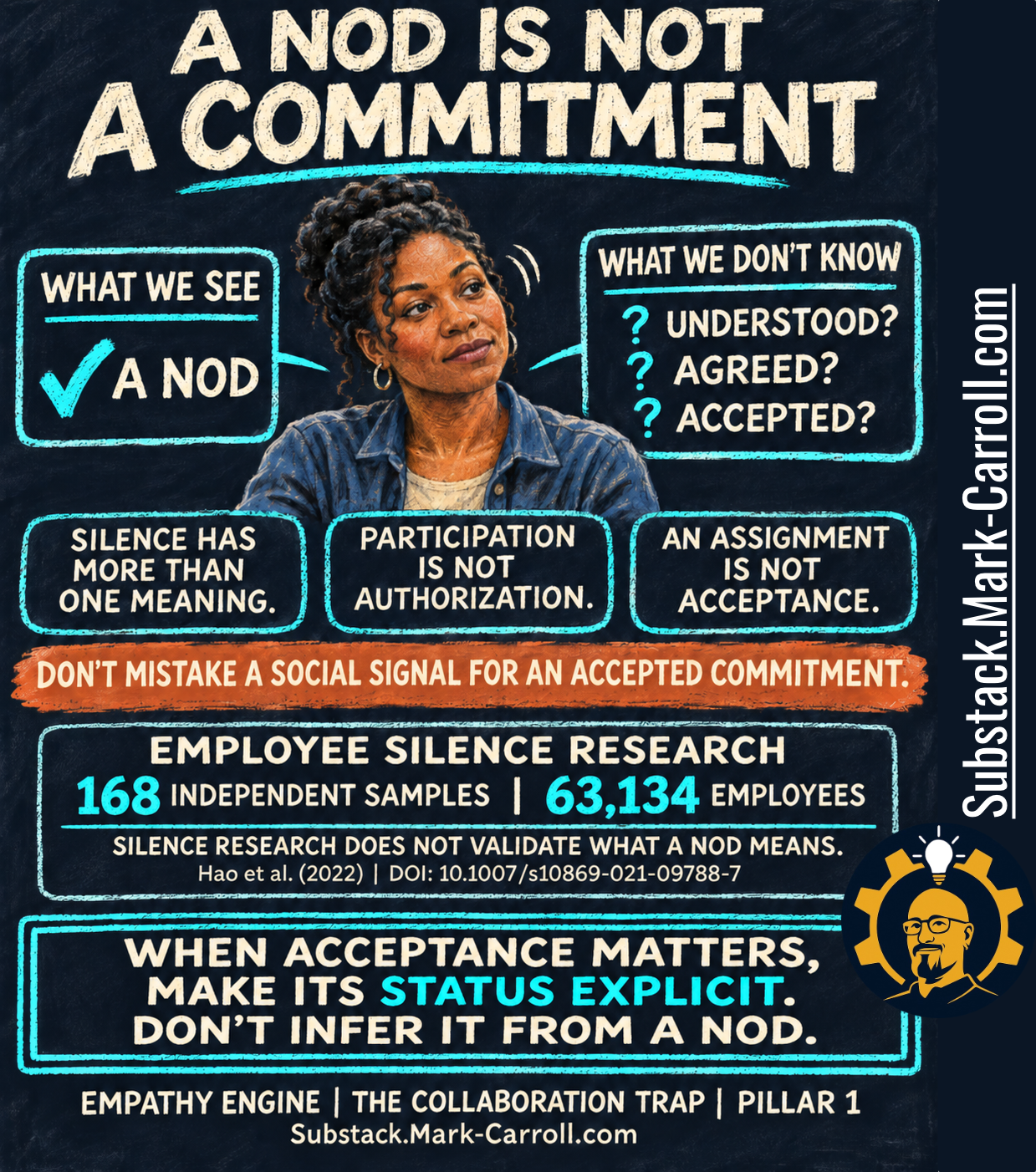
The left side of the graphic shows what we see: a nod, with a checkmark. The right side shows what we don’t know. Did she understand? Did she agree? Did she accept anything? A nod can’t answer any of those questions by itself.
The three boxes underneath hold the distinctions this whole article is built on.
Silence has more than one meaning. Not objecting is not the same as agreeing. It isn’t automatically disagreement either.
Participation is not authorization. Being in the room and contributing doesn’t give anyone the authority to approve the work. We’ll come back to this one.
An assignment is not acceptance. A name next to a task tells you someone was asked. It doesn’t tell you they said yes. We’ll come back to this one too.
Here’s what the research supports, and where it stops. Hao and colleagues pooled 168 independent samples covering 63,134 employees in a 2022 meta-analysis of employee silence. They found that silence and voice are distinguishable, and that different forms of silence have different causes and consequences. People go quiet for many reasons: fear, resignation, protecting a colleague, or simply having nothing to add.
Notice the line at the bottom of that research box: silence research does not validate what a nod means. The study is about why employees withhold their views. It doesn’t decode a particular gesture in a particular meeting, and it doesn’t say quiet people secretly disagree.
There’s one more study worth a look, because it shows the gap at the very top of an organization. James Westphal and Michael Bednar studied outside directors on corporate boards. Directors who had private concerns about strategy often underestimated how many of their fellow directors shared those concerns. That misperception was associated with less expression of concern and with firms persisting in their existing strategy. These were experienced, powerful people in a room built for candor, and the concerns still stayed unspoken.
I’m not telling you your colleagues are hiding things. I’m telling you that a quiet room can’t prove what people think, even a room full of capable adults acting in good faith.
That’s the warning in the orange banner: don’t mistake a social signal for an accepted commitment. A nod is real information. It just isn’t a yes to doing the work.
So when it matters, ask. Not “Does everyone agree?” That question invites another round of nodding. Try something closer to “Dana, is this something you’re taking on, or are we still deciding?”
And notice who’s asking. A yes given to someone who influences your workload or your review deserves a careful reading. Sometimes the better place to confirm isn’t the full room at all. It’s a quick private follow-up, where “not yet” is easier to say. The goal is accurate information, not a room full of compulsory yeses.
When acceptance matters, make its status explicit.
Don’t infer it from a nod.
Same words, different possible interpretations
Sam’s exact words on Tuesday were “The pilot looks promising.” Four words, said warmly, met with nods. By Friday they had turned into three different realities.
A project manager on Reddit put the experience in one thread title: “Stakeholders remember decisions differently and I’m always the referee.” If you’ve ever been the person refereeing what a meeting actually decided, you know that feeling. Everyone remembers the conversation. They just don’t remember the same outcome.
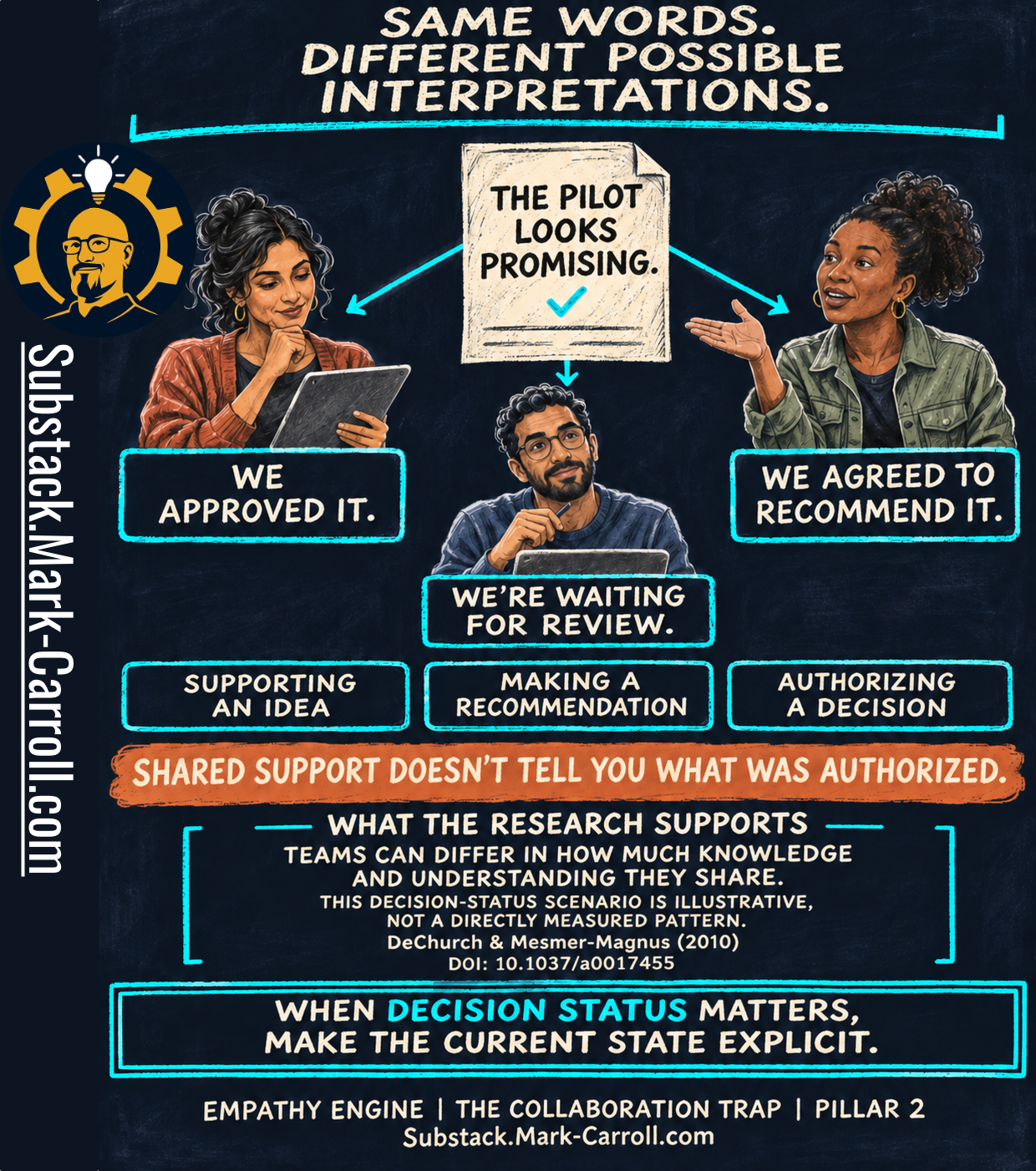
One note card sits at the top of the graphic: The pilot looks promising. Three arrows lead away from it to three people, and each one heard something different.
“We approved it.” For this person, the pilot is a go. Work can start.
“We’re waiting for review.” For this person, the pilot is promising but still pending someone else’s sign-off.
“We agreed to recommend it.” For this person, the group’s job was to send a recommendation upward. Nothing has been approved yet.
None of them is being unreasonable. The sentence supports all three readings. Underneath, the graphic names the three states those readings belong to: supporting an idea, making a recommendation, authorizing a decision. All three can sound identical in a meeting. They mean very different things the next morning.
That’s the point of the orange banner: shared support doesn’t tell you what was authorized. Everyone in the room can genuinely support the pilot while holding three different beliefs about its status.
On evidence, I want to be precise about what the research box claims. Leslie DeChurch and Jessica Mesmer-Magnus published a meta-analysis of 23 studies on shared mental models in teams. Their work supports a simple, important idea: teams can differ in how much knowledge and understanding they share, and shared understanding is associated with team performance across the ways researchers have measured it.
What that research doesn’t do is measure this scenario. The research I reviewed didn’t include a reliable estimate of how often people leave meetings with different understandings of a decision’s status. That’s why the box says this decision-status scenario is illustrative, not a directly measured pattern. The pilot story is my illustration. The idea that shared understanding can’t be assumed is what the research supports.
One more honest caveat. A meeting that ends with a recommendation instead of a decision hasn’t failed. Sometimes recommending is exactly the group’s job. The risk isn’t that the pilot was only recommended. The risk is people walking out with different labels for the same outcome, one thinking “recommended” and another thinking “approved.” That gap is worth catching whether or not it turns out to explain a delay.
So before the meeting ends, say the status out loud. “Just so we’re clear: is this approved, recommended, or still waiting on review?” It’s one sentence. It may feel slightly awkward. It’s less awkward than discovering on Friday that three people heard three different things.
When decision status matters,
make the current state explicit.
Agreement doesn’t grant authority
Suppose everyone had heard Sam the same way. Suppose all four people walked out believing the pilot was a go. Would that have made it a go?
Not necessarily. In our scenario the pilot touches customer data, so Security has to approve it. Security wasn’t in the room. Four people agreeing with each other, however sincerely, can’t stand in for an approval that belongs to someone else.
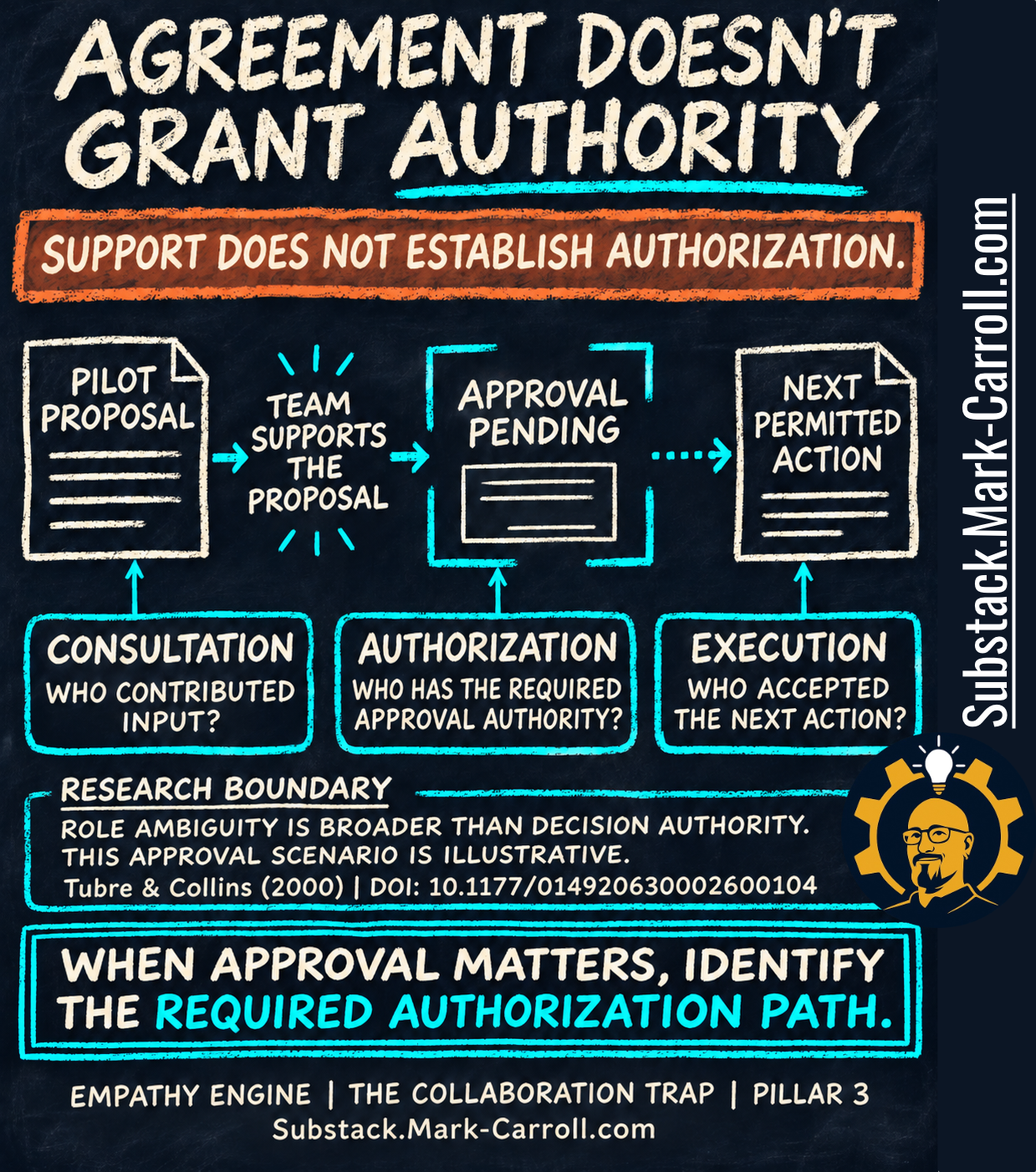
The banner at the top says it plainly: support does not establish authorization.
Follow the line across the graphic. A pilot proposal comes in. The team supports the proposal. That’s real, and it’s worth something. But the next stop is approval pending, and only after approval does the work reach the next permitted action. The arrow into that last box is dotted for a reason. Until the approval happens, the path isn’t open. That doesn’t mean everything stops. Dana can still scope the build. What waits is the part that needs Security’s sign-off.
Under each stop sits a different question, and each one points to a different person.
Consultation: who contributed input? In our meeting, all four people did.
Authorization: who has the required approval authority? In our scenario, Security, and possibly Sam for the budget.
Execution: who accepted the next action? We’ll get to that in the next section.
These can be the same person. Often they aren’t. If you sat in Part 1’s section on stalled decisions, you’ll recognize the shape: some people contribute, some review, someone decides. This week adds one more wrinkle. A group can contribute so thoroughly, and agree so warmly, that it feels like the decision has been made.
Now the research boundary, because this is a study I’ve used before. In Part 1 I cited Tubre and Collins’s meta-analysis of role ambiguity and job performance. Here’s a fuller picture of what they found. Across 74 correlations and nearly 12,000 people, the average link between role ambiguity and performance was modest and negative. But the range of plausible values included zero.
That’s why the box says role ambiguity is broader than decision authority. “Not knowing what my job is” is a much bigger idea than “not knowing who approves this pilot.” The study can’t tell you that unclear approval paths cause stalls. And as the graphic says, this approval scenario is illustrative.
One more fairness point. Being responsible for coordinating work you can’t approve isn’t a design flaw. It’s the normal job description of most product leads, project managers and program managers. Priya doesn’t need the authority to approve the pilot. She needs to know who has it, and whether they’ve used it.
You don’t need a company-wide RACI chart to find out. You need one question before the meeting ends: “Does this need anyone’s approval who isn’t here?”
And this isn’t an argument for adding an approval step to every task. Unnecessary bureaucracy is not a collaboration strategy. It’s an argument for knowing the difference between support and the authority to act.
When approval matters,
identify the required authorization path.
A name on a task is not a yes
There was one action item in Priya’s notes from Tuesday. Near the end of the meeting, someone said, “Alex, can you pull together a brief?” Alex said something like “Yeah, I can look at that.” Priya typed it in.
Alex: Draft the brief. Due: Friday.
It looks like a commitment. It has a name, a task and a date. It’s exactly what every meeting-hygiene article tells you to capture. And on Friday, there was no brief.
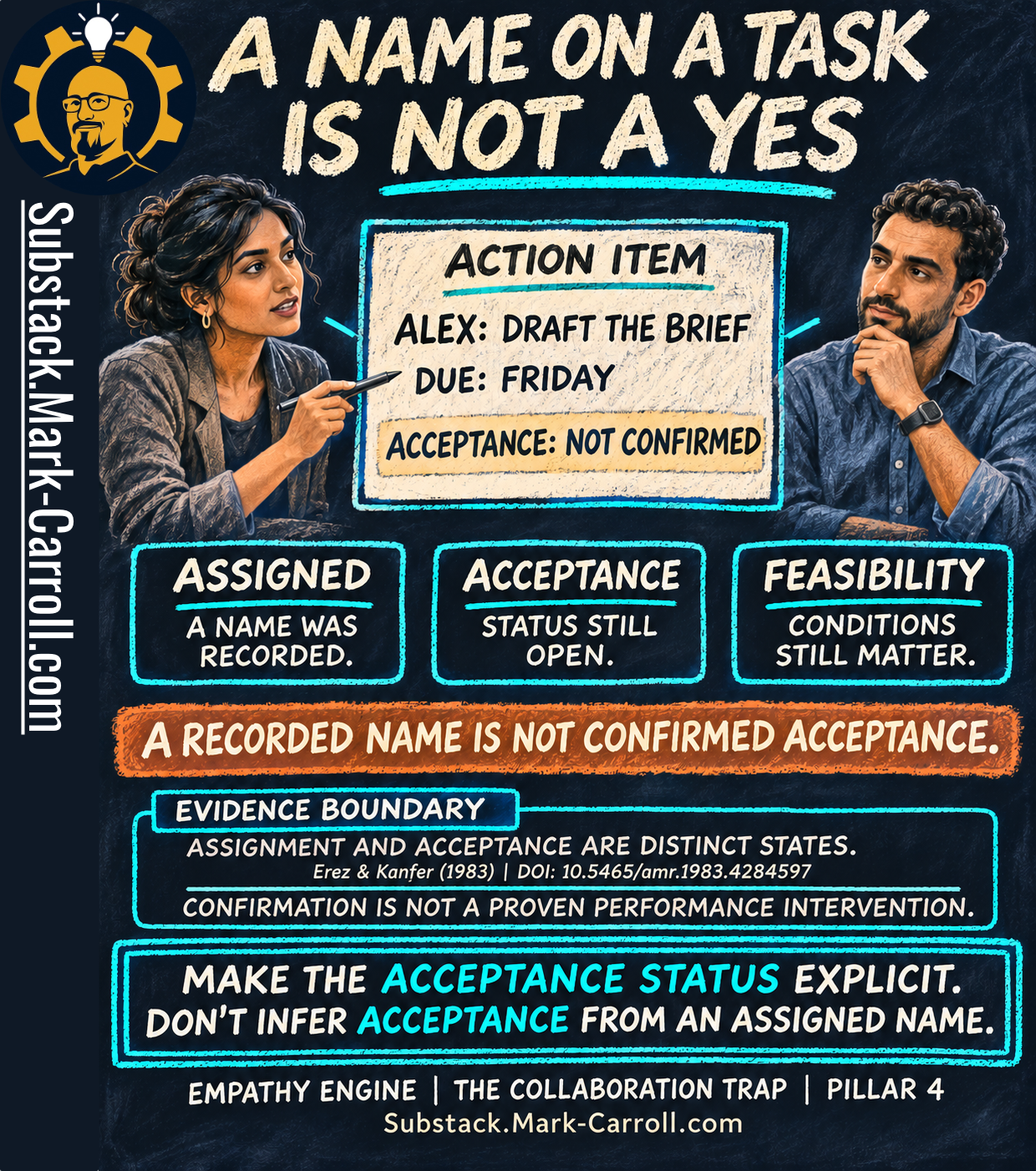
Look at the card in the middle of the graphic. Alex: Draft the brief. Due: Friday. And one more line, highlighted, that almost never appears in real meeting notes: Acceptance: not confirmed.
That line is the whole section. “I can look at that” might have meant I’ll have it done by Friday. It might have meant I’ll see if I have time. It might have meant I’ll check whether this is even mine to do. Priya recorded the first meaning. Alex may have meant the third.
The three boxes underneath separate what usually gets blurred together:
Assigned: a name was recorded. Someone wrote Alex’s name next to the task.
Acceptance: status still open. Whether Alex actually said yes is a separate question.
Feasibility: conditions still matter. Even a real yes depends on whether Alex has the time, the information and the access to do it. That’s the next section.
The orange banner puts it bluntly: a recorded name is not confirmed acceptance. This holds whether the name was typed by the meeting chair, written on a whiteboard, or extracted by an AI notetaker. A record describes what someone said. It doesn’t create the commitment. One reply in that same Reddit thread named the weak spot in the usual workaround: a decision log the project manager writes alone, after the meeting, is easy for everyone else to dispute. A record one person controls can’t establish what another person agreed to.
One boundary matters here, because this point is easy to stretch too far. Organizations can legitimately assign work, and an employee doesn’t get a veto just because they never said yes out loud. If the brief is part of Alex’s job, the obligation is real whether or not Alex confirmed it in the meeting. The question is narrower: does the record show that Alex accepted this scope, this Friday deadline, and the conditions that come with it? Legitimate assignment and evidence of acceptance are different questions, and the notes can’t answer the second one for you.
Now the evidence, and this is where I owe you a receipt on my own homework.
The research box cites Miriam Erez and Frederick Kanfer, whose 1983 conceptual paper treats acceptance as its own step between an assigned goal and performance. Assignment and acceptance are distinct states. That part is well grounded.
I also wanted evidence that confirming acceptance makes people more likely to deliver. That would have made a tidy argument for the tool I’m about to hand you. What I found was mixed. In a 1975 field study, Greg Oldham found that employees who said they accepted goals their supervisors assigned didn’t perform better than those who rejected them. But a later meta-analysis of 83 samples, by Howard Klein and colleagues, found that commitment to a goal does relate to performance, especially when the goal is hard. Researchers have also noted that early studies often measured acceptance crudely.
So commitment may well matter. But none of this research tested what I’m about to hand you: a quick check at the end of a meeting about who accepted what. I’m putting that gap in front of you plainly, the same way I did with the meeting-reflection experiment in Part 2. That’s why the box says confirmation is not a proven performance intervention. A yes doesn’t guarantee delivery. A confirmed status just means you know what you actually have.
One caution before you ask, though. Confirming acceptance can slide into pressuring people to say yes in public, especially when the person asking has authority over the person answering. A real acceptance question has to leave room for honest answers: “Yes.” “Yes, if I can drop something else.” “Not this week.” “I’m not the right person.” If only one answer is acceptable, you haven’t confirmed anything. You’ve collected a performance of agreement.
Make the acceptance status explicit.
Don’t infer acceptance from an assigned name.
Accepted doesn’t mean ready to execute
Let’s give Priya a better Tuesday. This isn’t what happened next. It’s a different version of the same meeting. This time, before the meeting ends, she asks directly, and Alex answers clearly: “Yes. I’ll prepare the pilot.” No hedging, no ambiguity, a genuine yes.
Is the pilot ready to go now?
Still not necessarily. Alex’s yes is real. But Alex’s team is already stretched this month. The test environment needs a request to Infrastructure. The customer’s data-sharing agreement hasn’t come back from Legal. And Security still hasn’t approved anything. Alex can fully intend to prepare the pilot and still be unable to start on Monday.