


62 Slides. One Meeting. The Most Important Question Went Unasked.
Last week I promised to take on a strange contradiction: your company has a communication problem, so why are there so many meetings? The evidence sent me somewhere more useful. The question isn’t how much we talk. It’s whether we know what each conversation is supposed to accomplish.
What if the biggest obstacle to collaboration isn’t the people, but what we’re overlooking between them?

My new book, Collaborate Better, explores how we can break through organizational silos, solve problems together, and turn individual contributions into shared success.
Your road to better collaboration starts here.
Get your copy today at https://CollaborateBetter.us
Research Binder: the receipts (citations + source notes) are compiled in a PDF at the bottom of this post.
The deck was sixty-two slides.
It was the writer’s first real board deck, and they built it the way conscientious people prepare for an important meeting. Thoroughly. Carefully. A slide for every question anyone might ask.
The meeting went fine. Then the writer corrected the record: “The meeting went fine. Which is another way of saying it wasn’t.”
“The board performed listening. We performed updating. And then everyone went home and nothing changed.” By the writer’s account, the board came back to the same three questions.
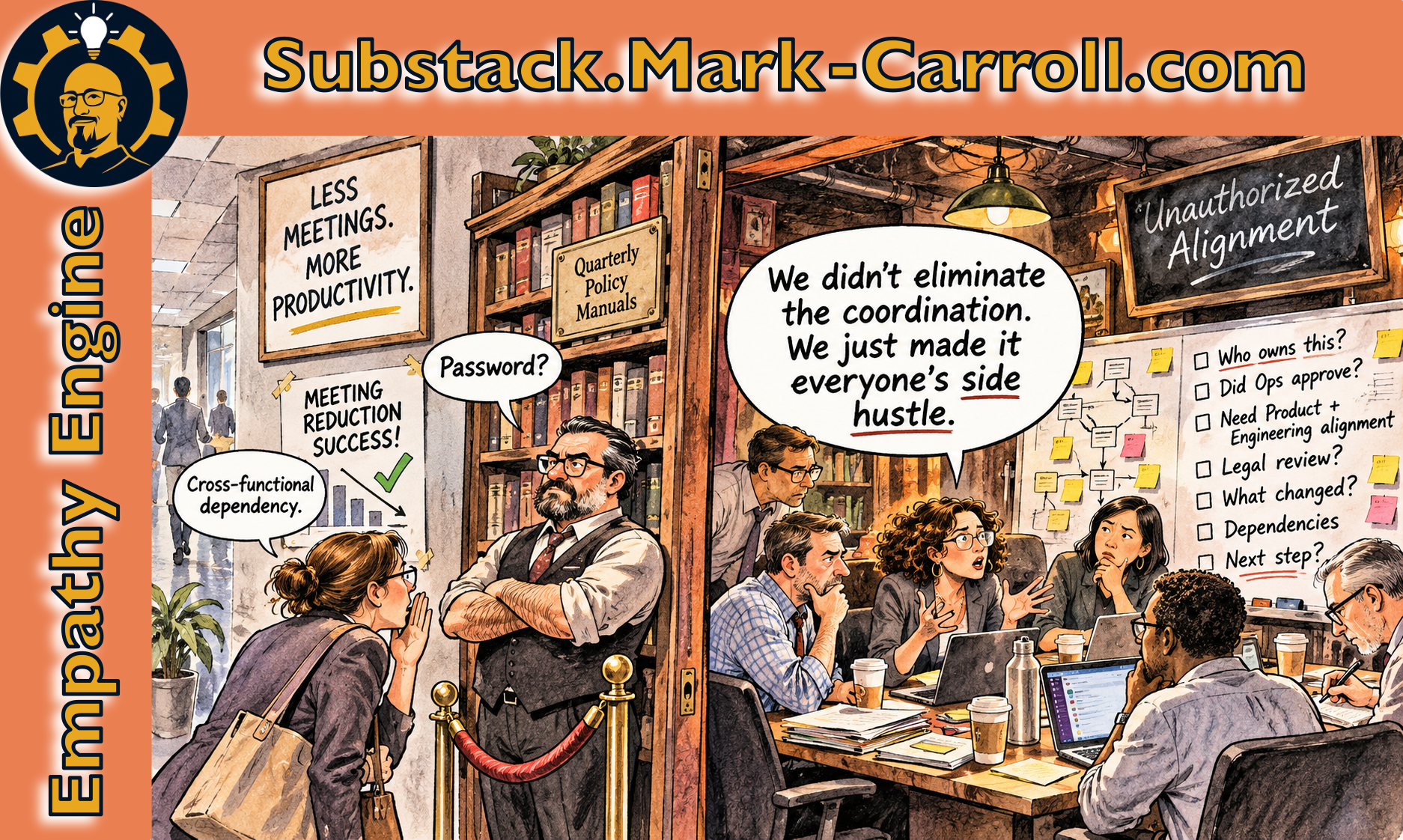
Then comes the sentence the whole story turns on:
“I’d never asked what the meeting was for.”
Sixty-two slides of preparation, and the one question that would have shaped all of it had gone unasked. The writer had worked out what the deck needed to contain. They hadn’t worked out what the meeting needed to accomplish.
A note on the source. This isn’t an illustration. It’s a firsthand account, posted in December 2025 to Reddit’s r/FPandA community as part of a series called CraftCFO. It tells us about one presenter’s preparation for one board meeting. It doesn’t tell us what the board members were thinking, and I’m not claiming it describes your company. I’m using it because that gap between preparing the material and knowing the purpose is one most of us have lived in.
Which brings me to a correction on last week’s teaser. The evidence I reviewed wouldn’t let me call meeting volume the cause of the problem. People can communicate frequently, and well, while still leaving essential work unresolved. The harder question is what those conversations were supposed to accomplish.
So here’s this week’s working question:
What if the problem isn’t that we’re having too many conversations, but that we’re preparing for conversations without knowing what work they need to accomplish?
That won’t explain every organization’s communication troubles. It explains enough of them to be worth a close look.
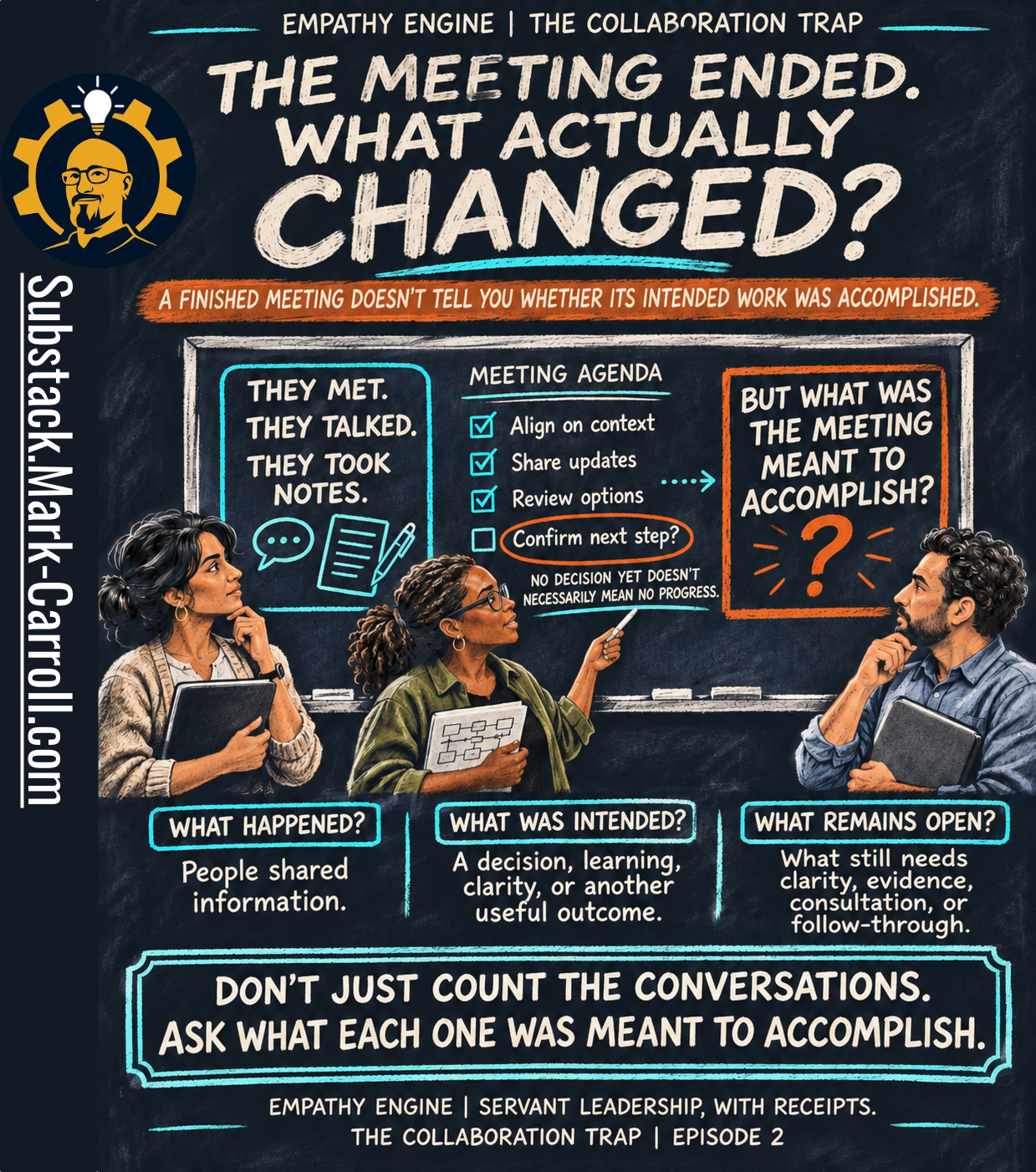
Every box on that agenda except one is checked, and the open one carries a note worth taking seriously: no decision yet doesn’t necessarily mean no progress. That’s the tension this whole article lives inside. A checked agenda can hide unfinished work. An open box can hide real progress. You can’t tell which until you know what the meeting was for.
Over eight Wednesdays, The Collaboration Trap chases one question: what is making capable people struggle to do good work together? Last week’s piece was the gap between finished and delivered. This week’s piece is the gap between a meeting that happened and a meeting that did its job.
Episode 1:

Don’t just count the conversations.
Ask what each one was meant to accomplish.
A meeting can succeed without a decision
The obvious fix for the sixty-two-slide problem is a rule. You’ve probably seen one.
There’s a sharp version circulating among practitioners on X. One writer calls it “Schrödinger’s Agenda”: the meeting exists in a superposition of having a purpose and not having one, “until someone finally asks what we’re deciding, at which point it collapses into ‘oh, this is just a sync.’” The rule that follows: “if you can’t say what decision you’re asking for, you’re not ready for the meeting.”
The instinct is right. Asking what a meeting is for before you hold it is good discipline. But one word in that rule is too narrow. Swap decision for purpose, because not every useful meeting is supposed to end in a decision.
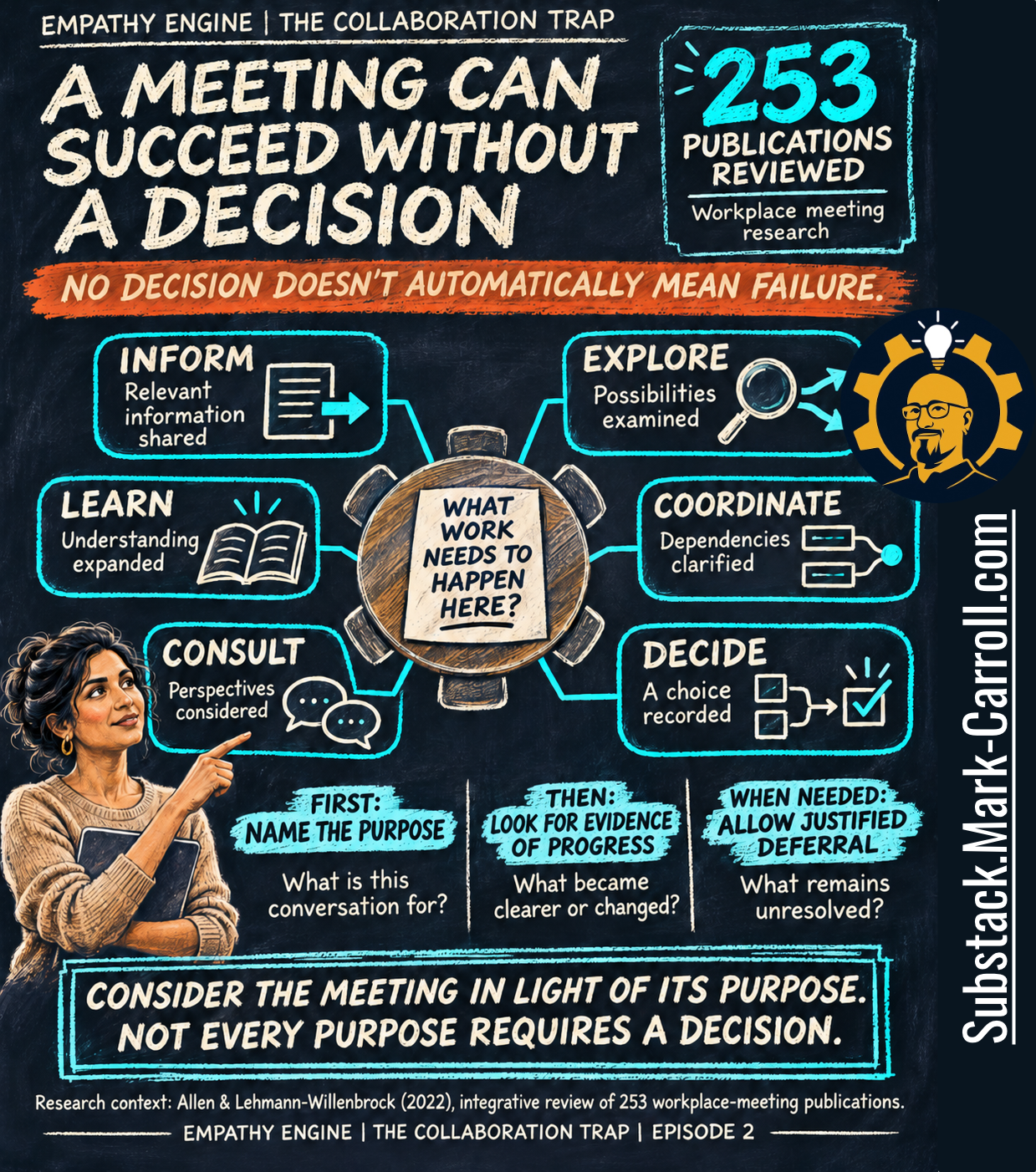
Imagine a meeting called to understand why customers keep misreading a product feature. People compare support tickets, find the confusing language, and challenge a few assumptions. Nobody picks a solution before leaving. Would a decision have made that meeting better? Probably not. A premature choice could have cut off the very learning the group needed.
Here’s the evidence, and its limits. Joseph Allen and Nale Lehmann-Willenbrock reviewed 253 publications on workplace meetings in a 2022 integrative synthesis. Their review treats meetings as multidimensional: how they’re led, how people interact, how time is managed, how people engage, and how they relate to each other. The six purposes in the graphic are my practitioner shorthand, not a taxonomy from that review. What the review supports is the broader point: meetings do many kinds of work, so “decision or no decision” is too blunt a yardstick.
Sometimes the most responsible outcome of a meeting is “we’re not ready to decide.” When nobody can say what a meeting was supposed to accomplish, though, that deserves a closer look. It’s not proof of failure. It’s a signal worth examining.
Consider the meeting in light of its purpose. Not every purpose requires a decision.
A good meeting experience isn’t the same as a verified outcome
Here’s a moment you may recognize. A developer on Reddit described what happens after large meetings with other teams: “my boss always calls me after cross team meetings to have an ‘ok so what are we actually doing now’ discussion.”
The meeting felt fine. People left on good terms. And then someone had to pick up the phone to find out what it had produced.
How a meeting felt and what it accomplished are different measurements. We often read one as if it were the other.
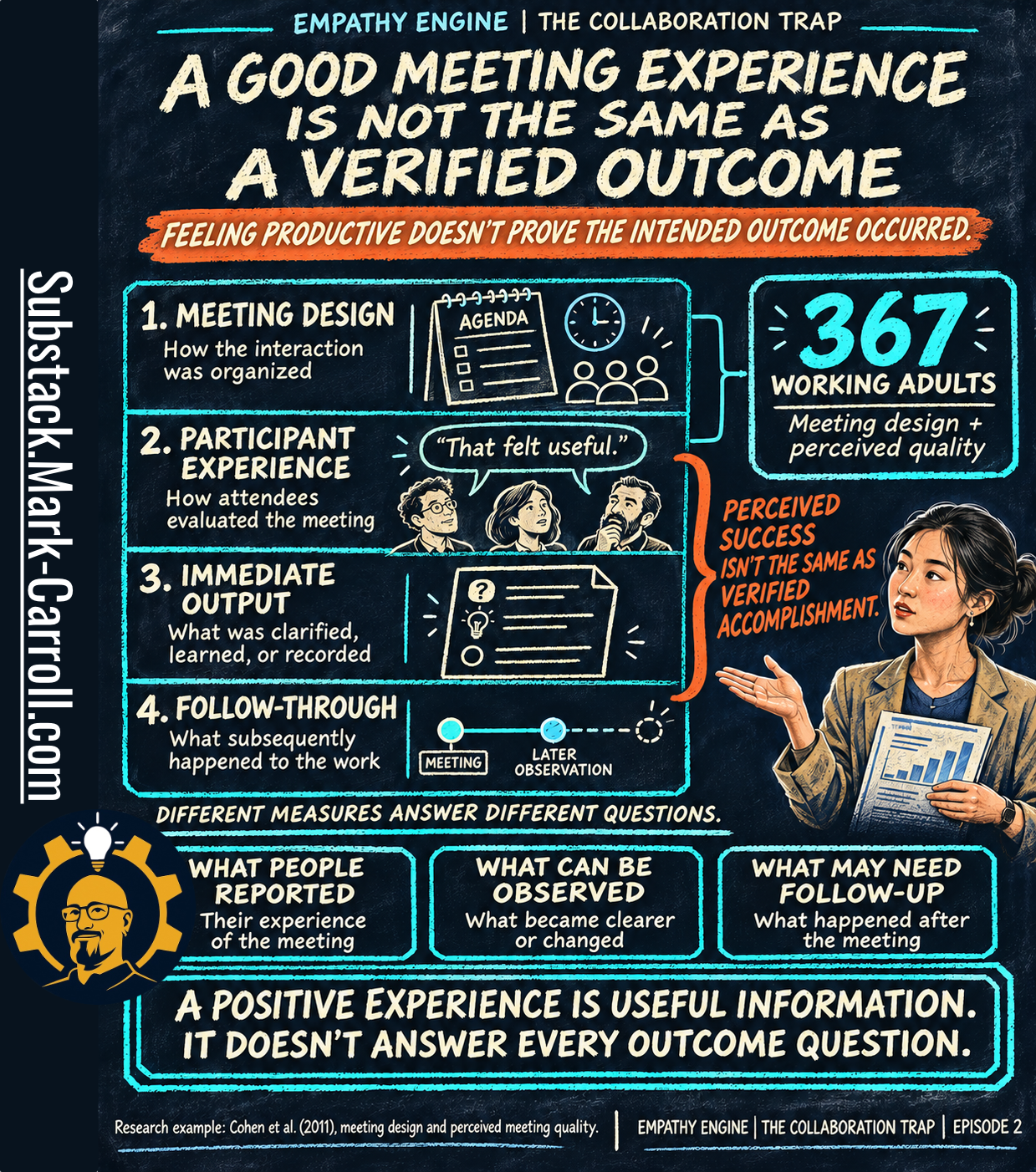
The research in the graphic covers the first two levels. Melissa Cohen and colleagues surveyed 367 working adults within 48 hours of a recent staff or team meeting. Nine of the 18 design characteristics they examined significantly predicted how attendees rated the meeting’s quality. That’s useful, and it’s honest about what it measured: perceived quality, not whether the meeting accomplished what it was called to do.
A receipt on my own homework. I looked for a field study that tracked all four levels for the same meetings: the stated purpose, how people felt, what came out, and what happened to the work afterward. I didn’t find one. The closest is a study by Simone Kauffeld and Nale Lehmann-Willenbrock that videotaped 92 regular team meetings, coded what people actually said and did, and linked those patterns to team outcomes and, for the teams they could follow, to organizational outcomes two and a half years later. Constructive problem-solving and action planning went with better outcomes. Complaining and criticizing went with worse ones. Those are associations, not proof of cause, and the study didn’t record what each meeting was meant to accomplish. But it shows what it looks like when researchers go past “that felt useful.”
None of this means ignoring how people feel. A meeting that leaves everyone drained is telling you something. It just isn’t telling you everything.
A positive experience is useful information.
It doesn’t answer every outcome question.
A crowded calendar isn’t a diagnosis
A meeting-heavy calendar can make a capable professional feel as though the day has been cut into increasingly decorative slices of work. There’s a thirty-minute update. A forty-five-minute review. A planning conversation that requires preparation for the preparation conversation. Somewhere between them, a heroic little rectangle marked Focus Time tries to survive.
It’s tempting to look at that calendar and call the problem solved: too many meetings. But the count of meetings and the value of meetings are different questions.
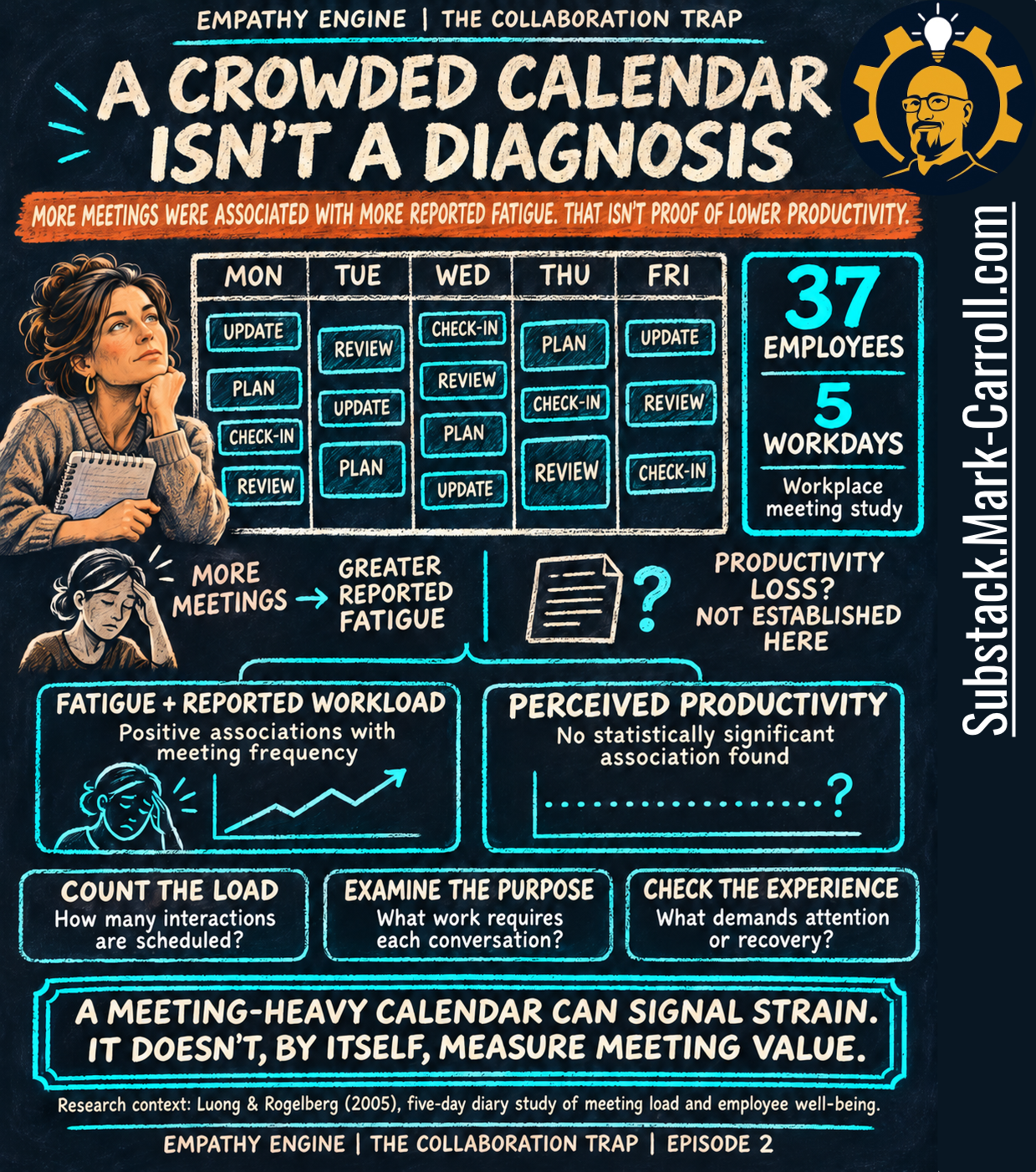
The study in the graphic is small and specific. Alexandra Luong and Steven Rogelberg followed 37 full-time employees, mostly in administrative roles at a U.S. university-based organization, for five working days: 185 person-days of diary data. On days with more meetings, people reported more fatigue and a heavier subjective workload. Meeting frequency had no statistically significant association with how productive people felt.
That null result doesn’t prove meetings have no productivity effect. It means this study didn’t detect one for that measure. And the fatigue finding matters on its own terms. How people experience their work is a legitimate concern even when it never shows up in a delivery report.
A larger, more recent study adds a twist. Willem Standaert and colleagues analyzed panel-survey data from 1,137 respondents in 2025. Meeting load was positively related to burnout, but not to engagement overall. For on-site workers, meeting load was related to both more engagement and more burnout. The same calendar can wear people down and keep them engaged at the same time.
The count can mislead in the other direction too. One manager on Reddit described a single four-hour client meeting: “Everyone showed up, lots was discussed. We walked out without deciding a single thing we came there to decide.” Six weeks of emails and calls later, by that manager’s account, the deal was gone. One meeting. A light calendar day. Still the wrong outcome.
And you won’t find a dollar figure here. Salary times hours times headcount makes a dramatic slide, but I couldn’t find a cost estimate for meetings that miss their purpose that I’d defend in front of a skeptical executive. As I said last week, unknown is not zero. It’s also not a number for your deck.
A meeting-heavy calendar can signal strain. It doesn’t, by itself, measure meeting value.
Sometimes the work needs more coordination
Here’s the part the anti-meeting crowd tends to skip. Some work can’t be done alone.
Picture a shared outcome three teams have to deliver together. This one is illustrative, not a case file. Product clarifies the need. Engineering examines feasibility. Operations examines readiness. Each holds information the other two need, and the outcome only works if those pieces fit.
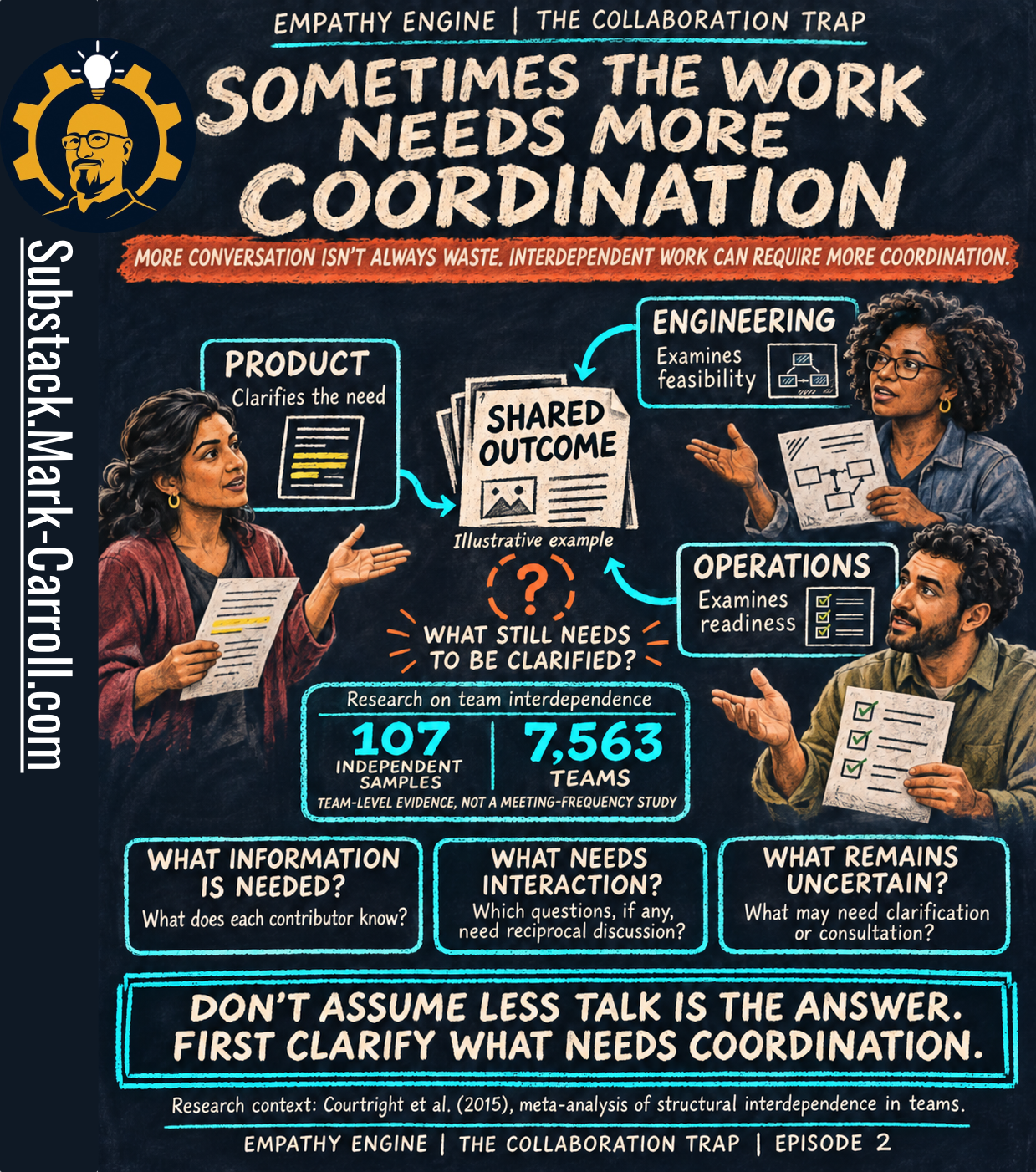
The research behind the graphic is about teams, not meetings, and the graphic says so. Stephen Courtright and colleagues meta-analyzed structural interdependence across 107 independent samples covering 7,563 teams. Two kinds of interdependence, relying on each other to do the task and sharing the outcome, had distinct relationships with how teams worked together and how they performed.
What the study doesn’t do matters as much. It doesn’t measure meeting frequency, and it doesn’t show that interdependent teams need more meetings. What transfers is the idea: when work is interdependent, coordination isn’t overhead to be eliminated. It’s part of how the work gets done.
That cuts both ways. An impulse to cancel another recurring meeting is understandable, especially when people are tired. But the underlying dependency doesn’t disappear just because its calendar invitation does. Equally, an open dependency isn’t permission to schedule another meeting without being clear about why live interaction would help. It might be resolved through documentation, a quick consultation, more analysis, or a conversation. The right choice depends on what’s still uncertain.
Don’t assume less talk is the answer. First clarify what needs coordination.
Rhythm, not red tape
In Collaborate Better, Chapter Fifteen, “Workflow Ceremonies,” I describe a tension that organizations often struggle to resolve:
Some teams get stuck in too many meetings. Others do not talk enough and end up working in circles. Strong teams find a steady beat that keeps everyone moving together.
That distinction is central to the problem. A calendar crowded with meetings doesn’t necessarily mean people are communicating effectively. And reducing the number of conversations doesn’t guarantee that the remaining communication will meet the team’s needs.
Chapter Fifteen calls this “Rhythm, Not Red Tape.” Different workflow ceremonies have different purposes. A brief standup can surface an obstacle. Planning can establish shared direction. A demonstration can make completed work visible for feedback. A retrospective can help a team examine its own practices.
The name itself makes the point. The chapter explains why I call these practices Workflow Ceremonies rather than the more familiar Scrum ceremonies: “Purpose comes first. These practices are not dogma. These practices help teams get work done.” I describe them as “the rehearsals between performances: focused, responsive, and built for teamwork.” A rehearsal earns its place by what it prepares the band to do, not by showing up on the schedule.
The chapter also draws a line that matters for this article. Workflow ceremonies and old-style approval gates can look identical on a calendar: “Some people confuse ceremonies with old-style approval processes because both show up as scheduled meetings. The purpose could not be more different. Ceremonies unlock progress. Approval gates withhold progress until a gatekeeper feels satisfied.” Formal gates have their place in regulated, mission-critical work, and the chapter says so. But two identical calendar blocks can do opposite jobs, which is exactly why counting meetings tells you so little.
The point isn’t to preserve those meetings as rituals. It’s to understand what work each interaction is intended to support.
Which raises a more useful question than whether another meeting belongs on the calendar:
What kind of communication does this work actually require?
Match the conversation to the work
There’s a useful lens for answering that, and it isn’t new. In 2008, Alan Dennis, Robert Fuller, and Joseph Valacich published Media Synchronicity Theory in MIS Quarterly. It distinguishes two communication processes: conveyance, sharing and processing information, and convergence, developing shared meaning.
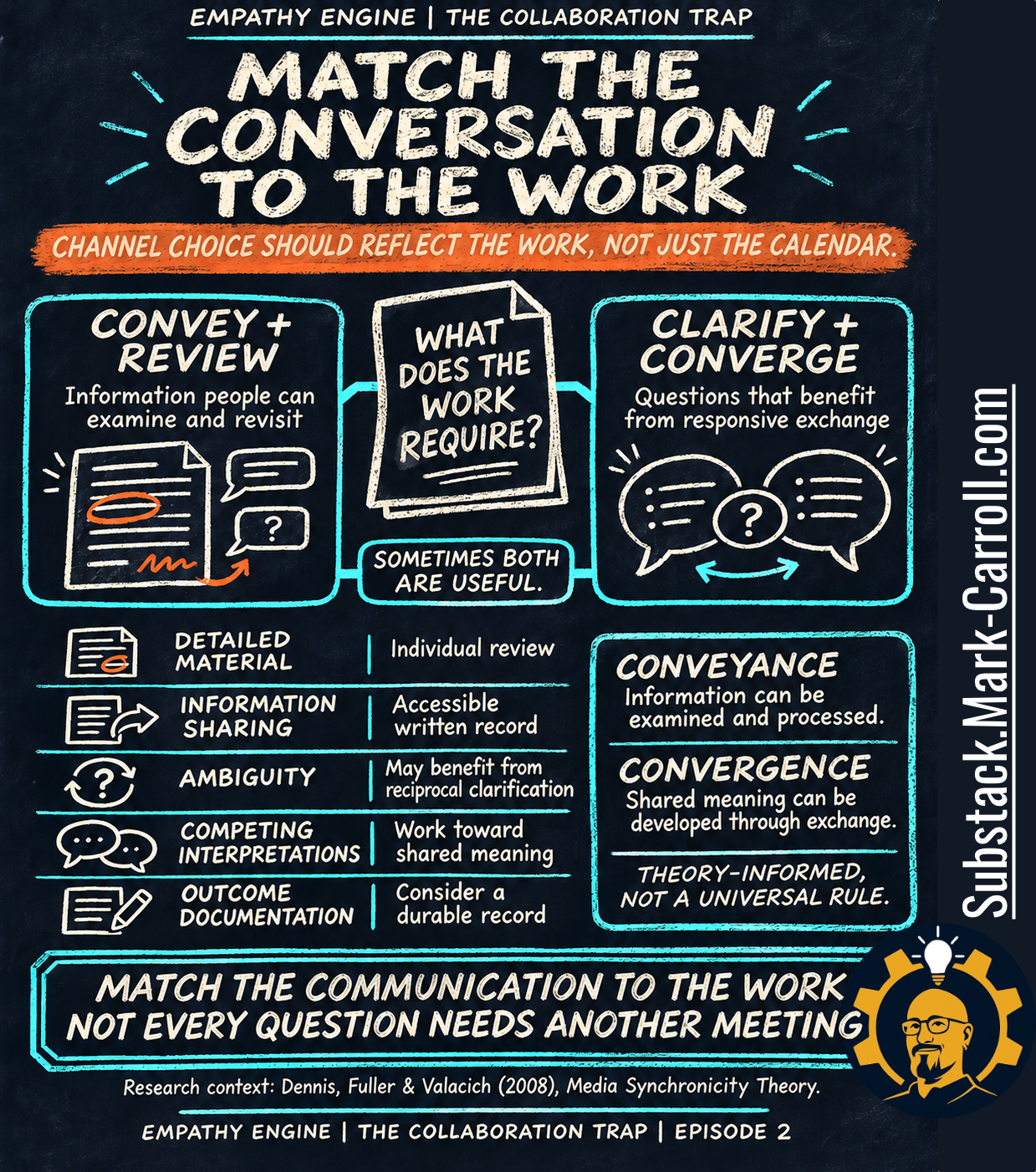
It would be easy to turn that into a slogan: written updates for simple information, meetings for complex problems. The theory is more careful than that. Written exchanges can support clarification and convergence. Live conversations can convey information. What matters is the combination of the task and what a given channel can do, and real work usually needs both at different moments.
That’s why the familiar standoff between we need another meeting and this could have been an email rarely settles anything. Either side might be right in a particular case. Neither is a substitute for looking at the work. Accessibility, urgency, confidentiality, and who must be consulted matter too.
Now go back to the sixty-two slides. A deck is a conveyance tool, built to be examined and processed. The writer had poured their effort into conveyance before answering the question that would have told them what kind of communication the meeting needed. The material arrived. The question of what the meeting was for had never been asked.
Match the communication to the work.
Not every question needs another meeting.
A useful question isn’t automatically a proven fix
You can probably see where this is heading. If the problem is preparing for meetings without knowing their purpose, the fix sounds obvious: get people to think about the purpose before they walk in.
Researchers have tested something very close to that.
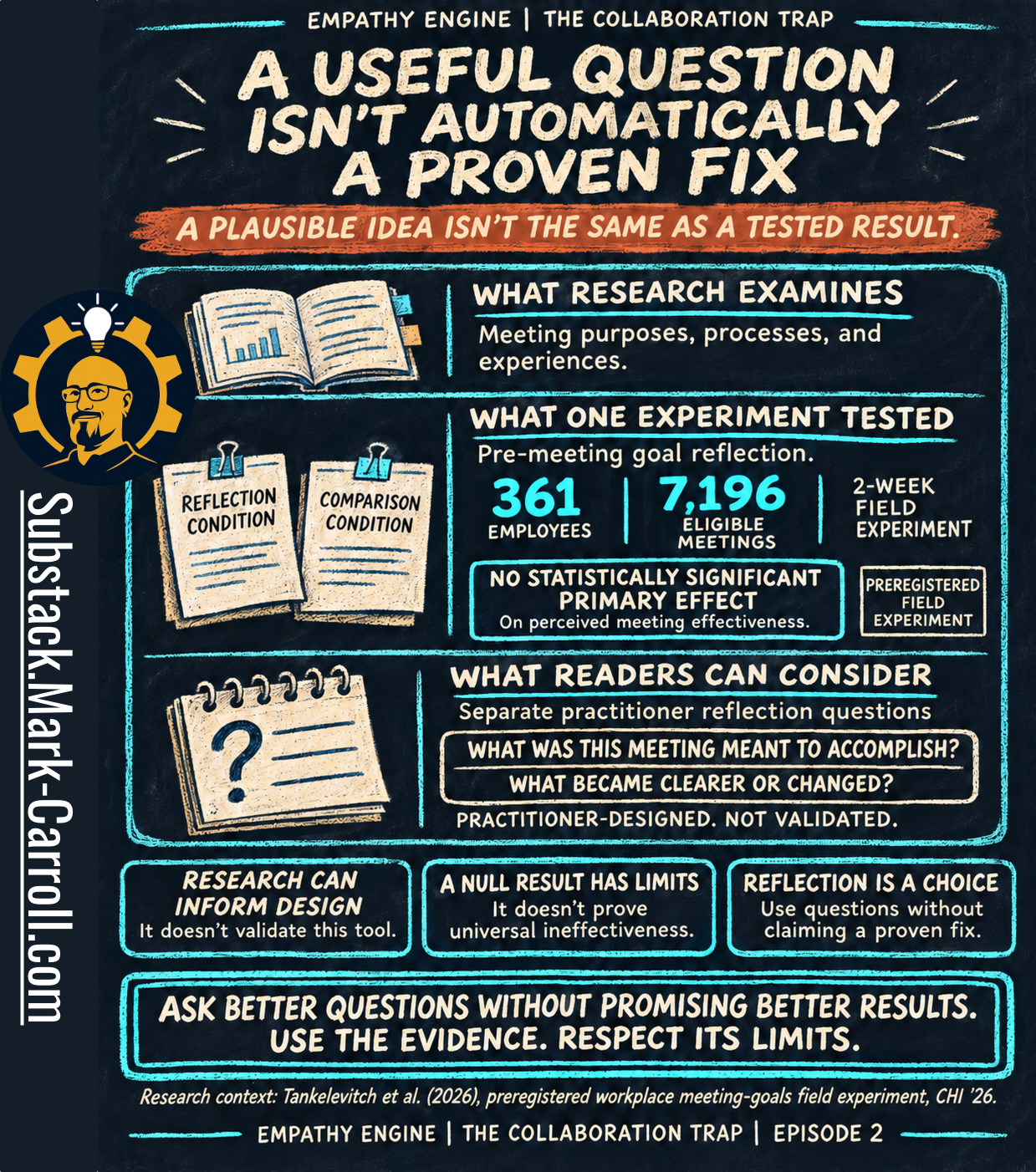
In a preregistered field experiment presented at CHI 2026, Lev Tankelevitch and colleagues studied 361 employees at a global technology company across 7,196 eligible meetings over two weeks. One group received a short pre-meeting prompt to reflect on the meeting’s goals, plus a survey afterward. The comparison group received only the survey afterward.
The study did not detect a statistically significant additional effect of the pre-meeting prompt on perceived meeting effectiveness.
There’s a wrinkle that makes this more interesting, not less. The researchers reported signs that the post-meeting surveys themselves may have prompted reflection in both groups. If so, the comparison group wasn’t a pure “no reflection” baseline, which makes the added effect of the pre-meeting prompt harder to isolate. That doesn’t rescue the intervention. It does show how hard it is to measure reflection cleanly.
That result sits close to what I’m about to hand you, so I’m telling you plainly, the same way I put my own coaching practices in the “none established” row last week. The experiment tested a specific nudge, not the questions in this article. A null result doesn’t prove reflection is useless. And it certainly doesn’t prove the questions you’re about to see improve anything. They’re practitioner-designed and not validated.
Ask better questions without promising better results. Use the evidence. Respect its limits.
🎁 Your Subscriber Gift: Meeting Purpose Reflection Kit
Ever leave a meeting wondering what actually changed? Everyone showed up, people talked, and notes were taken. But did the meeting do what it was meant to do?
The Meeting Purpose Reflection Kit helps you ask better questions about your meetings. With five simple questions, you can look at why a meeting happened, what people needed to discuss, what became clearer, and what still needs attention.
The kit includes a step-by-step guide, an Excel workbook, a fillable PDF worksheet, and a two-page quick card. Use one tool or all four, depending on what you need.
Less guessing. More clarity. A better understanding of what your meetings are meant to accomplish.
Meeting Purpose Reflection Guide
Not every meeting needs to end with a decision. Some meetings help people learn, share ideas, solve problems, or understand what still needs to happen.
This 20-page guide walks you through five questions that help you look at meetings in a new way. You’ll find real research, clear examples, tips for asking questions without blaming anyone, and a sample meeting that shows how the process works.
You’ll also learn why a full calendar doesn’t always mean progress, and why waiting to make a decision can sometimes be the right choice.

Meeting Purpose Reflection Workbook
One meeting can tell you something. Looking back at several meetings may help you notice patterns you missed.
This Excel workbook gives you a place to record meetings, note what changed, and track questions that still need answers. It includes sample entries, helpful menus, a guide to meeting purposes, and simple charts and counts that show patterns in your own notes.
You don’t need to be an Excel expert. Start with one meeting, add more when you’re ready, and use what you record to ask better questions.

Meeting Purpose Reflection Worksheet
A meeting just ended. Everyone is heading back to work. Before the details fade, take a few minutes to think about what happened.
This three-page worksheet helps you look at one meeting using the five reflection questions. You can fill it out on your computer or print it and write by hand.
Record the meeting’s purpose, the people and ideas it needed, what became clearer, and what still needs attention. There’s also space to check back a week later and see what happened to the work.

Five Questions Before Calling It Progress | Quick Card
Sometimes you don’t need another guide. You just need the right question at the right moment.
This two-page quick card keeps all five reflection questions close at hand. Use it before a meeting, right after one, or when you want to check what happened to the work.
It also includes simple questions you can ask out loud and reminders about what not to assume. Keep it open on your screen or print a copy for easy reference.

Better Questions Start Here
You don’t need to cancel every meeting, demand more decisions, or add another long process to your workday.
Start with one meeting. Use the Quick Card to remember the questions, the Worksheet to look more closely, the Workbook to keep notes over time, and the Guide when you want to understand more.
These tools aren’t a test or a scorecard, and they don’t promise better results. They’re here to help you think more clearly about the work your meetings are meant to do.
Because the goal isn’t to have more meetings or fewer meetings. It’s to understand what each conversation needs to accomplish.
Five questions before calling it progress
So where does that leave you on Monday morning, facing a week of calendar blocks you didn’t schedule and can’t cancel?
Not with a rule about fewer meetings. Not with a lecture about communication. With one meeting and five questions.
Last week I promised you a tool for reclaiming one decision from the meeting treadmill. I’m keeping that promise, with one correction the evidence forced on me. Sometimes what you reclaim is a decision. Sometimes it’s a clearer picture of what’s still open, or an honest “not yet.” The questions leave room for all three possibilities.
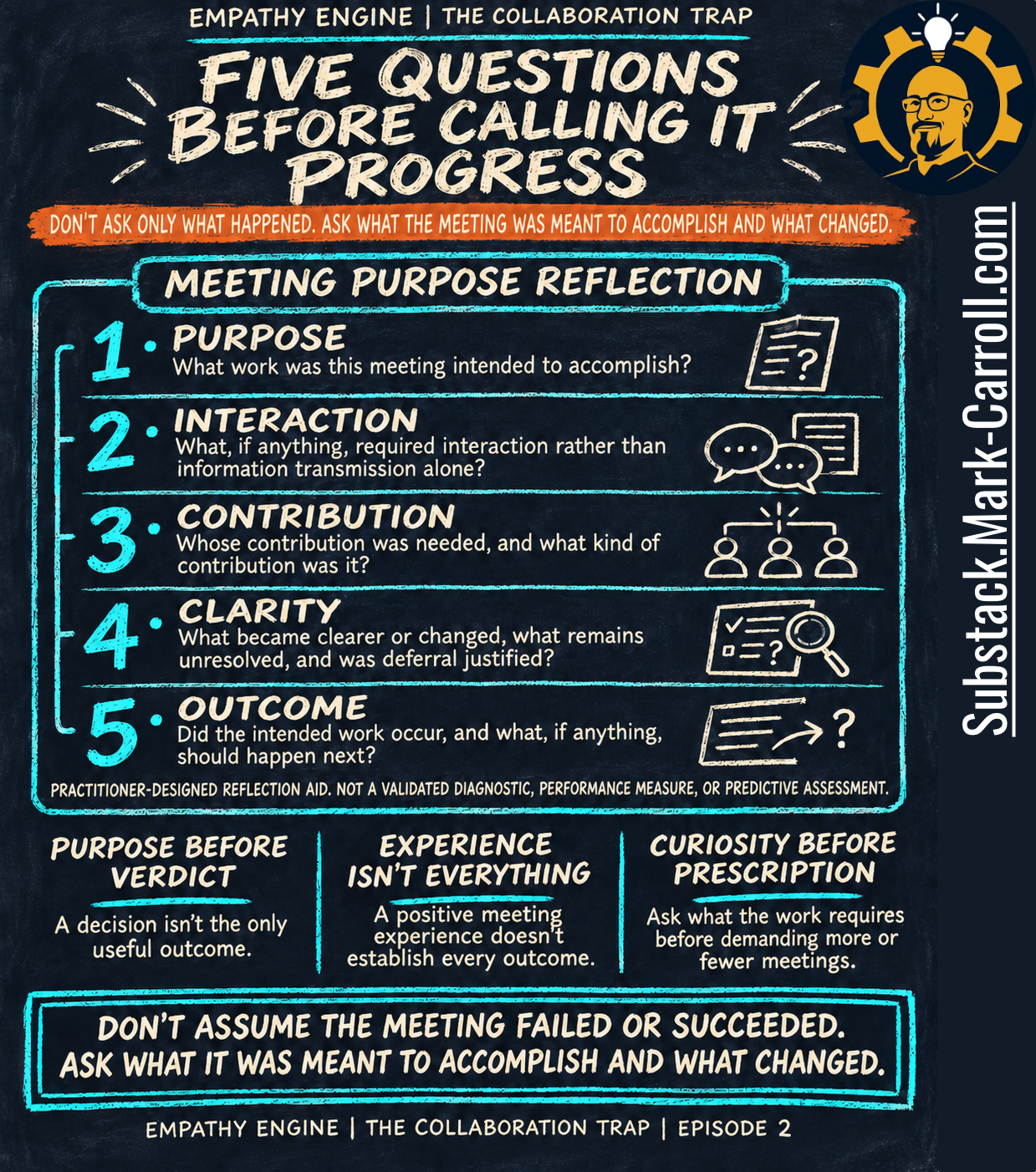
This is the Meeting Purpose Reflection:
Purpose. What work was this meeting intended to accomplish?
Interaction. What, if anything, required interaction rather than information transmission alone?
Contribution. Whose contribution was needed, and what kind of contribution was it?
Clarity. What became clearer or changed, what remains unresolved, and was deferral justified?
Outcome. Did the intended work occur, and what, if anything, should happen next?
Notice which question comes first. It’s the one the sixty-two-slide deck skipped.
These aren’t five tests every meeting must pass, and they don’t produce a score. This is a practitioner-designed reflection aid, not a validated diagnostic, performance measure, or predictive assessment. Don’t use it to grade a colleague or a facilitator, and don’t treat silence in a meeting as agreement. If you work through all five and conclude the meeting did exactly what it needed to, that’s a legitimate result.
Don’t assume the meeting failed or succeeded.
Ask what it was meant to accomplish and what changed.
The meeting ended. Now go find out what changed.
Go back one last time to the sixty-two slides.
Nobody in that story needs to be the villain. The writer didn’t fail to communicate. If anything, they communicated more than anyone asked them to. What they hadn’t done, by their own account, was ask what the meeting was for. That’s an easy step to skip when you’re busy preparing, and it’s the one that would have told them what to prepare.
That’s the trap this week. When a meeting doesn’t move the work, the reflex is to blame the talking: too much, too little, the wrong people. Sometimes that’s right. But a meeting can be full of good communication and still not do its job. Talking about the work is not the same as moving it.
Try this before next Wednesday. Pick one meeting on your calendar this week, before it happens or right after it ends, and answer the first question: what work was this meeting intended to accomplish? Then hit reply and tell me what you found. I read every response, and the best stories (shared with permission and anonymized) help shape the rest of this series.

Go deeper with Collaborate Better
The Meeting Purpose Reflection looks at one meeting. Chapter Fifteen of Collaborate Better, “Workflow Ceremonies,” looks at the whole rhythm. It walks through what each ceremony is for, from a few-minute standup to iteration planning, demos, retrospectives, and backlog refinement. It explains why ceremonies are not phase gates. And it shows how to revisit your team’s core artifacts every quarter, so flow doesn’t quietly fade. As the chapter puts it: “Let ceremonies shape your rhythm, not your red tape.”
And for the worst case I promised you last week, Chapter Six has it: the twenty-seven-person meeting “where nothing happens except the slow erosion of morale and hope.”
Collaborate Better is available now in paperback and Kindle, with the hardcover coming soon.
Get your copy at CollaborateBetter.us.
Next Wednesday
Part 3: The Most Expensive Words at Work Might Be “We All Agree.” What happens after everyone nods, and who actually owns the commitment? You’ll get a Decision Ownership Card for turning agreement into something someone can act on.
P.S. Forward this to the person who sends the most calendar invites on your team. Say it’s a compliment.
Sources
Research
Allen, J. A., & Lehmann-Willenbrock, N. (2022). “The key features of workplace meetings: Conceptualizing the why, how, and what of meetings at work.” Organizational Psychology Review, 12(4), 355 to 378. doi:10.1177/20413866221129231.
Cohen, M. A., Rogelberg, S. G., Allen, J. A., & Luong, A. (2011). “Meeting design characteristics and attendee perceptions of staff/team meeting quality.” Group Dynamics: Theory, Research, and Practice, 15(1), 90 to 104. doi:10.1037/a0021549.
Courtright, S. H., Thurgood, G. R., Stewart, G. L., & Pierotti, A. J. (2015). “Structural interdependence in teams: An integrative framework and meta-analysis.” Journal of Applied Psychology, 100(6), 1825 to 1846. doi:10.1037/apl0000027.
Dennis, A. R., Fuller, R. M., & Valacich, J. S. (2008). “Media, tasks, and communication processes: A theory of media synchronicity.” MIS Quarterly, 32(3), 575 to 600. doi:10.2307/25148857.
Kauffeld, S., & Lehmann-Willenbrock, N. (2012). “Meetings matter: Effects of team meetings on team and organizational success.” Small Group Research, 43(2), 130 to 158. doi:10.1177/1046496411429599.
Luong, A., & Rogelberg, S. G. (2005). “Meetings and more meetings: The relationship between meeting load and the daily well-being of employees.” Group Dynamics: Theory, Research, and Practice, 9(1), 58 to 67. doi:10.1037/1089-2699.9.1.58.
Standaert, W., Ulm, M., Castro, K. C., & Allen, J. A. (2025). “Unpacking the meeting load paradox: Impacts on engagement and burnout across work arrangements.” Management Research Review, 48(6), 940 to 965. doi:10.1108/MRR-05-2024-0315.
Tankelevitch, L., Scott, A. E., Challakere, N., Panda, P., & Rintel, S. (2026). “Nudging Attention to Workplace Meeting Goals: A Large-Scale, Preregistered Field Experiment.” CHI Conference on Human Factors in Computing Systems (CHI ’26). doi:10.1145/3772318.3791199.
Practitioner accounts (firsthand or secondhand reports; not evidence of prevalence)
u/PeachWithBenefits, “CraftCFO Week 24 | Every Board Meeting Has a Job (And It’s Not ‘Update the Board’).” Reddit r/FPandA, December 7, 2025. reddit.com/r/FPandA/comments/1pgr9xv
Kpaxs, “Schrödinger’s Agenda.” X, March 9, 2026. x.com/Kpaxs/status/2030854041496953307
Four-hour client meeting account. Reddit r/managers, April 27, 2026. reddit.com/r/managers/comments/1swt7tb
Post-meeting “what are we actually doing now” call. Reddit r/ProgrammerHumor. reddit.com/r/ProgrammerHumor/comments/dq1sxm

Previous:
The Tasks Were Marked Done. Why Was the Outcome Still Stuck?

The Tasks Were Marked Done. Why Was the Outcome Still Stuck?
More Content to Discover:

Half Your Team Is Using AI. You Don't Know Which Half.

Intro If you read the piece we published last week on Leadership in Change, you saw the structural diagnosis: mandate pressure, decision collapse, intake collapse. Three failures that sit underneath almost every AI pilot that goes sideways. That piece mapped the architecture. What it did not cover is what happens on the human side of the same problem, wh…

Canceling a meeting might actually make your communication problem worse. The coordination work doesn't disappear just because the calendar invitation does, and sometimes a meeting that ends without a decision has accomplished exactly what it needed to.
Here's what I'm curious about: **What's one meeting your team could cancel tomorrow, and how would the work it was supposed to accomplish get done instead?**
I'm especially interested in the meetings everyone complains about but nobody quite knows how to replace. 👇