


How AI-native founders can diagnose review burden, customer context, and Full-Stack Judgment before adding another builder
AI made output cheaper. Judgment did not become free.
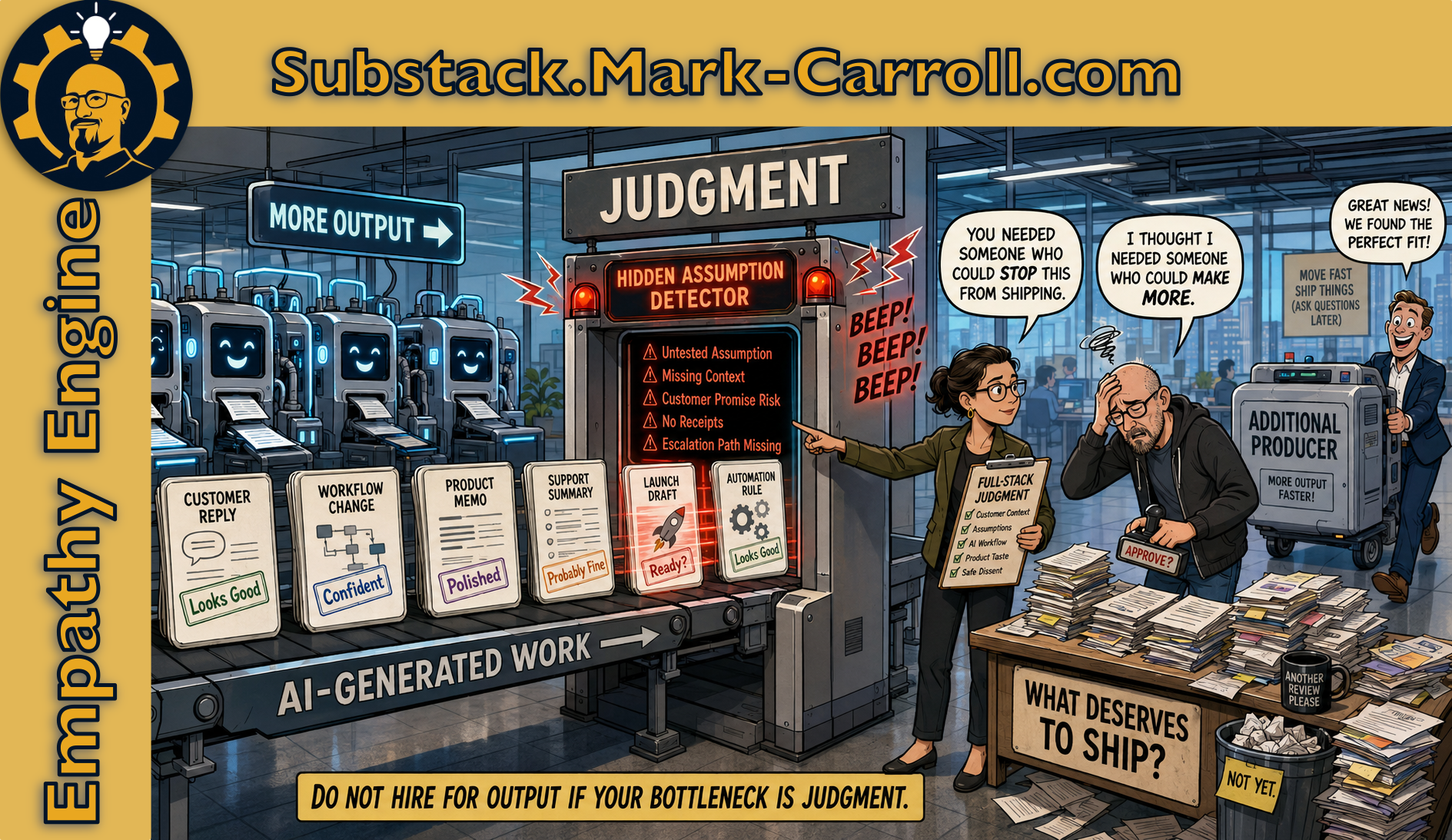
Previous Article in this Series (Episode 5):

That is the uncomfortable discovery waiting inside many AI-native workflows. A founder can now generate more drafts, replies, summaries, product ideas, and workflow changes than ever before. For a while, that feels like leverage. Then the leverage becomes a queue.
The work no longer waits for the founder to create it from scratch. It waits for the founder to decide whether it deserves to ship. The bottleneck did not disappear. It moved.
My own version of this came from a mix of Agile coaching, facilitation, and building Empathy Engine. I have spent years helping teams manage intake, clarify priorities, and decide what work should actually move forward. AI made me experience the same pattern personally.
Once the tools could generate more than I could responsibly evaluate, the constraint was no longer production. It was judgment. I had to decide what was accurate, what was useful, what was reader-true, and what deserved to ship under my name.
Research Binder: the receipts (citations + source notes) are compiled in a PDF at the bottom of this post.
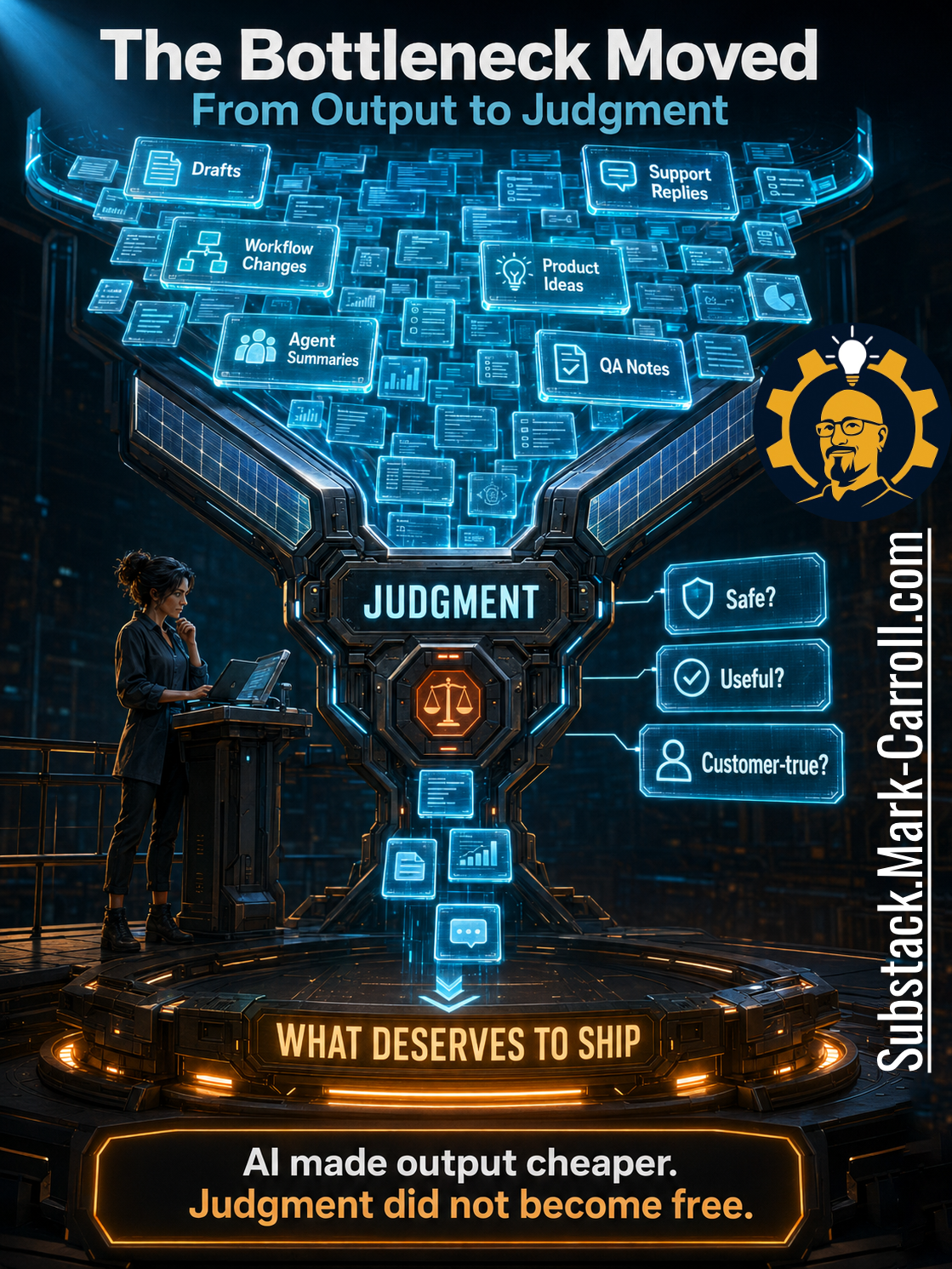
Once the AI stack can generate faster than one person can responsibly evaluate, the scarce capacity changes. The founder’s hardest work becomes deciding what is safe, useful, customer-true, and worth shipping.
That is where Mara found herself. She did not need FlowPilot’s AI stack to produce more possibilities. She needed help deciding which possibilities deserved trust.
Mara’s Hiring Problem Was Not Output. It Was Review Burden.
A founder choosing between two real strengths, not between strong and weak
Mara had two strong options in front of her. That was the problem.
FlowPilot was finally working well enough to create a new kind of pressure. The AI stack could draft onboarding sequences, summarize customer calls, generate support replies, and propose workflow changes faster than Mara could review them. Every almost-right output still needed her judgment.
One candidate was a senior full-stack engineer. He was sharp, calm, and technically deep. He looked at FlowPilot’s intake and routing system and saw real architecture problems: loose validation rules, inconsistent routing logic, and schemas that could be cleaner. His proposal was genuinely good. It would reduce ambiguity, cut manual routing, and make the system easier to scale. In plenty of companies, at plenty of moments, his plan would be exactly the right next move.
I have faced that choice in coaching rooms many times. A recommendation can be technically right and still wrong for the moment. Standardize the intake. Tighten the handoff. Clean up the board. Force the conversation into the approved template.
Those moves can be exactly right once the team has enough trust and context. But when people are still learning how to surface risk honestly, the messy ritual may be the only place the truth appears. If you remove it too soon, you do not just clean the system. You erase the signal.
The second candidate was Tariq, a no-code operations builder who had been helping Mara patch the messy edges of customer onboarding. He was not the stronger engineer. He did not speak in architecture diagrams. But he knew where the customer reality lived.
The engineer’s cleaner submission flow touched one of FlowPilot’s highest-friction customer rituals. Dani Park’s team sent a Friday Loom every week. It was not elegant, structured, or easy to parse. But inside those Looms were the edge cases, workarounds, complaints, and tiny moments where the product promise was either being kept or quietly eroded.
Tariq paused and said, “If we change the submission flow, Dani may stop sending the Loom. That Loom is where the real edge cases show up before they become support tickets.”
That was the moment Mara understood the decision differently. She was not choosing between technical and non-technical. She was not even choosing between a strong candidate and a weak one. She was diagnosing which kind of judgment the work needed closest to it right now.
The engineer saw the system, and he saw it accurately. Tariq saw the promise inside the customer ritual. FlowPilot’s bottleneck was no longer only whether the product could be built. It was whether the next person close to the work could help Mara decide what should not change yet.
More AI Output Does Not Help If Every Decision Still Routes Back to One Person
The solo window is real, and it creates a human judgment layer
The solo window is real. AI has made one-person companies more capable than they used to be. A founder can now research faster, draft faster, prototype faster, document faster, and produce three versions of almost anything before lunch.
For a while, the problem looks solved. Then the strange part begins. The work no longer waits for you to start from zero. It waits for you to judge it.
In many AI-native, customer-facing workflows, the founder bottleneck does not disappear. It moves. The founder is no longer doing all the work. The founder is reviewing all the work.
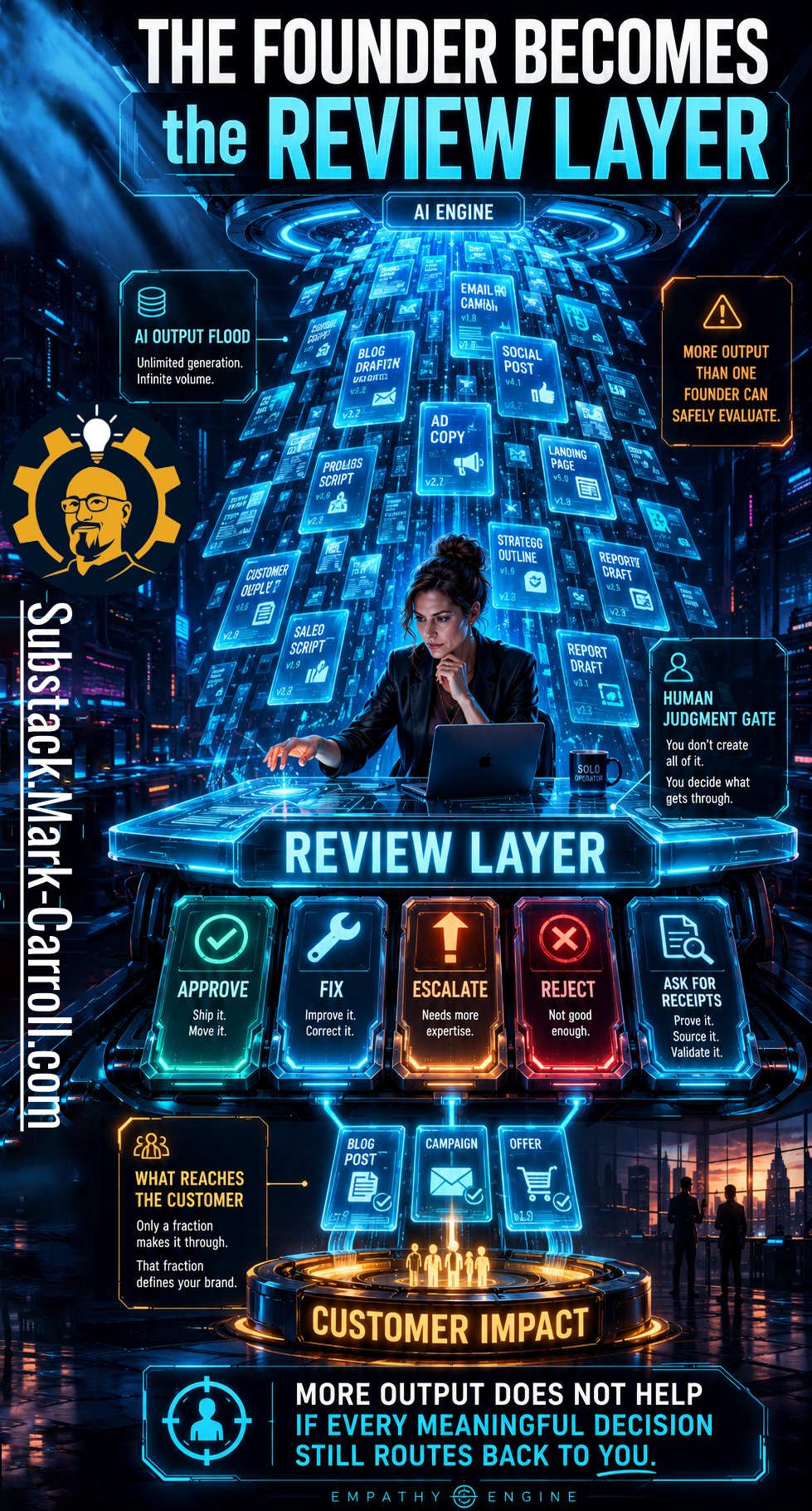
That sounds like progress until every output arrives wearing the same disguise: almost right. The AI stack produces, and the founder inspects. The AI stack suggests, and the founder asks whether this should actually reach a customer.
Approve. Fix. Escalate. Reject. Ask for receipts. Those are not small actions when they happen all day. They are judgment work, and they consume context, attention, customer memory, and responsibility. When the work is customer-facing, that review layer is not bureaucracy. It is where trust gets protected.
This is why more output can become a trap. If every meaningful decision still routes back to the founder, more generated work does not automatically create more leverage. It can create more review burden.
Almost-Right AI Output Is Where the Work Gets Expensive
Polished AI work still needs receipts, review gates, and human oversight
Almost right is expensive because obviously wrong work is easy to reject. A broken answer, a malformed message, or a hallucinated fact can be stopped quickly. It does not create much ambiguity.
Almost right is different. It looks polished, sounds confident, and uses the right vocabulary. It gives the founder the dangerous feeling that maybe it is good enough.
I have caught this in my own AI-assisted drafts. The output sounds clean, mirrors my vocabulary, and looks ready. Then I notice it has missed a constraint: a series boundary, an evidence caveat, a reader promise, or the actual distinction the piece depends on.
That is the danger. Almost-right does not announce itself as broken. It asks to be approved because it feels easy.
A support reply can be grammatically correct and still weaken trust. A workflow change can reduce manual routing and still break the customer ritual where the real edge cases surface. An internal summary can claim that most cases are handled automatically while quietly narrowing the escalation logic too far.
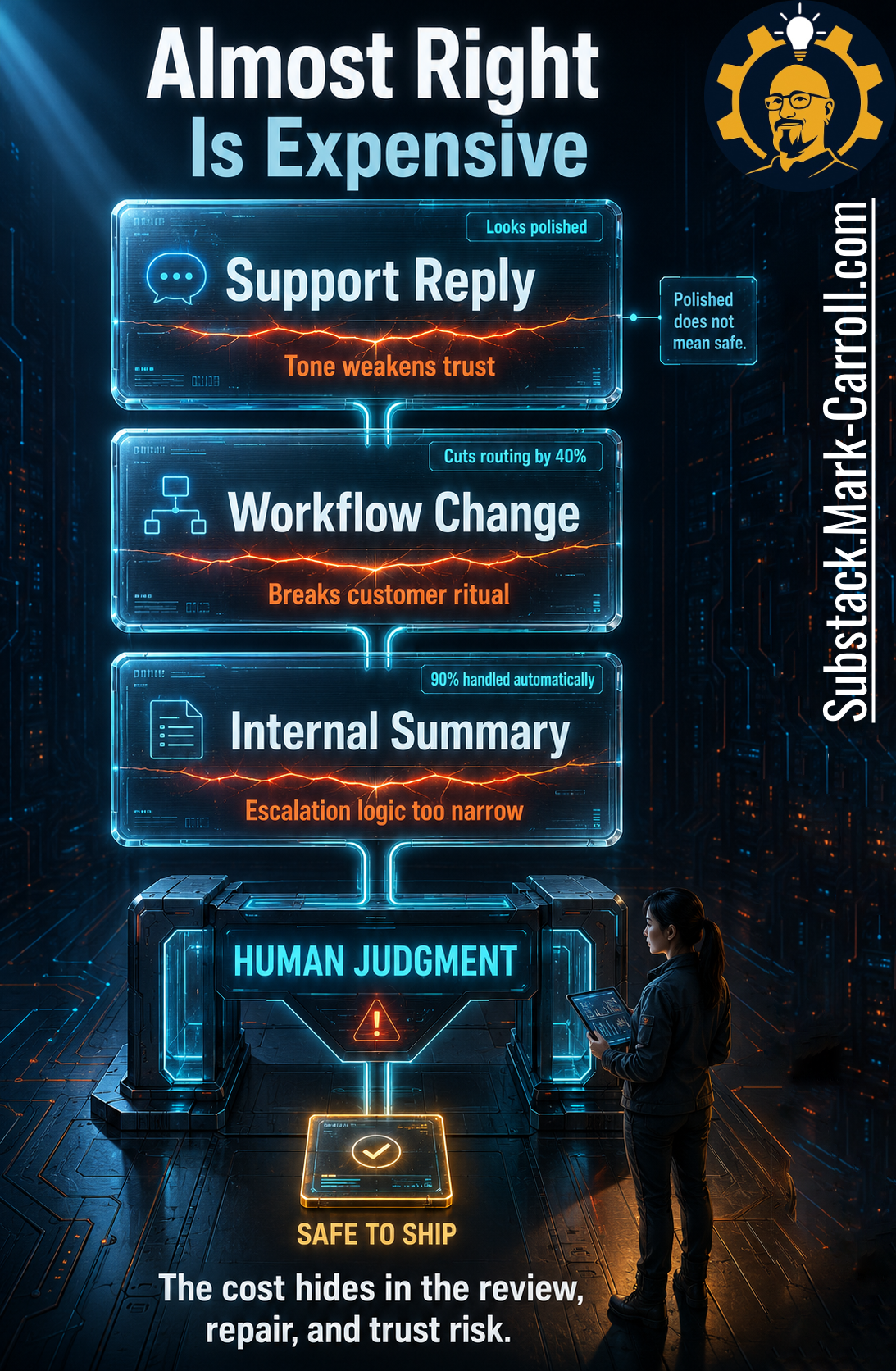
Polished does not mean safe. The cost hides in the review, the repair, and the trust risk. So the founder cannot evaluate AI work only by asking, “Does this look good?” The better questions are harder: what risk is this hiding, what assumption is this making, what customer promise does this touch, and what would break if this became the default?
This is also why receipts beat confidence. A confident answer is not enough. A polished answer is not enough. The founder needs the parts of the work that make review possible: sources, assumptions, constraints, diffs, exclusions, and escalation reasons.
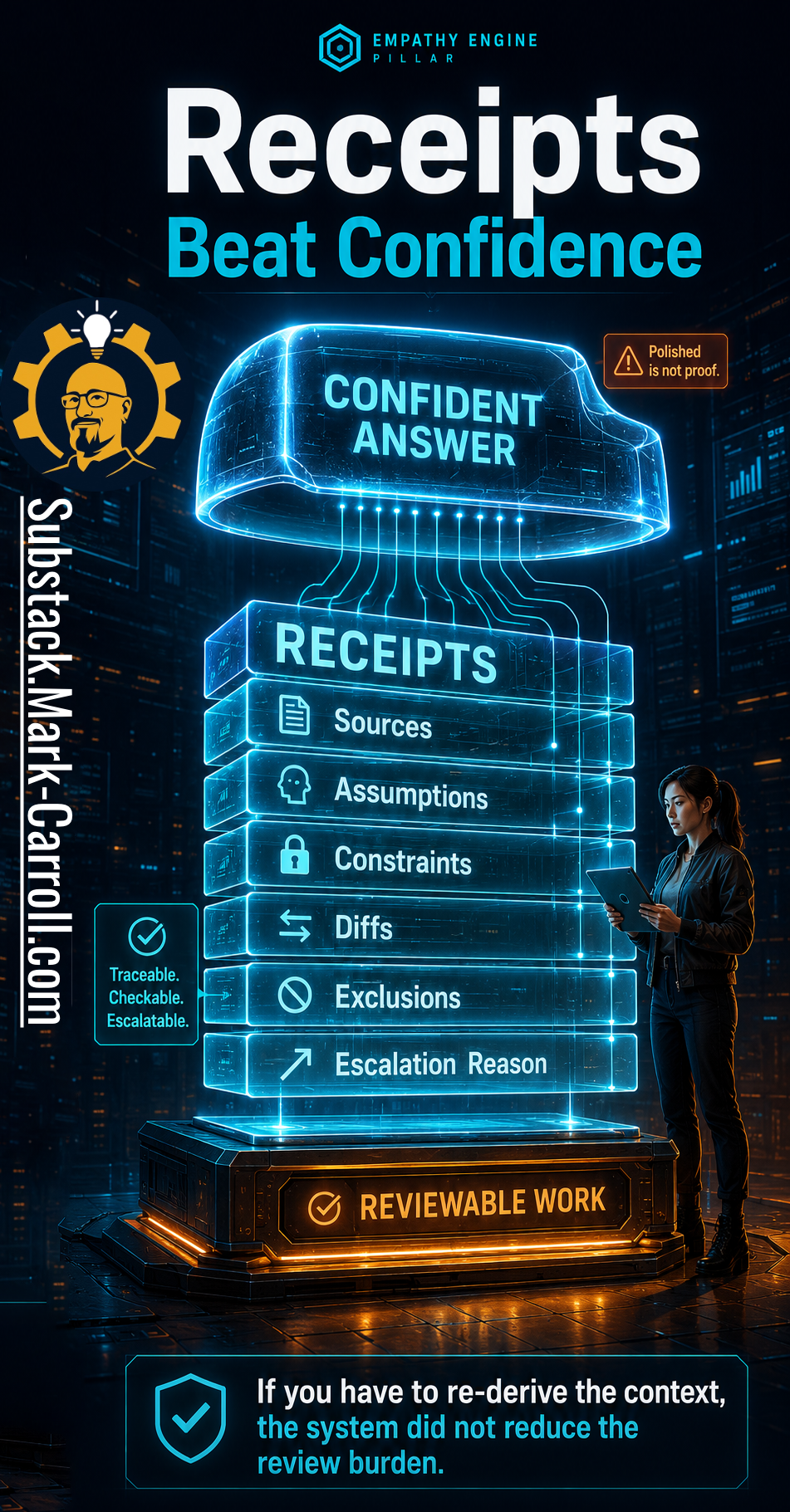
Without receipts, the founder has to re-derive the context every time. That is not leverage. That is outsourced drafting with internalized review cost.
A receipt-based workflow does not say, “Trust me.” It says: here is what I used, here is what I assumed, here is what I excluded, here is what changed, and here is when a human should step in.
Confidence asks the founder to believe. Receipts help the founder decide.
Customer Rituals Are Part of AI Workflow Judgment
Before automating a customer ritual, founders need to understand what reality that ritual carries
Return to Dani’s Friday Loom. The obvious improvement was to clean up the submission flow: structured fields, keyword routing, confidence thresholds, and auto-apply for the light changes. On paper, that sounds sensible. It might even reduce manual work.
But the key question is not whether the new flow is cleaner. The key question is what the old ritual was carrying.
Dani’s Friday Loom contained more than information. It carried operating reality: edge cases, workarounds, tone shifts, legacy-system constraints, trust signals, and unfiled friction. The messy ritual was where the customer showed how the product actually lived inside their work.
When Tariq objected, he was not defending mess for its own sake. He was protecting the signal.
