When AI Handles the Doing, Who Owns the Deciding?
Previous Article in this Series (Episode 4):

You may not have a first-hire problem. You may have a judgment-sharing problem.
This article introduces the 1st Builder as a proposed practitioner lens, not a formal job title, legal category, employment structure, compensation model, or equity framework. The goal is to help AI-native founders think clearly about judgment, decision rights, and escalation before they make larger structural commitments.
When AI Handles the Doing, Who Owns the Deciding?
Mara did not have an output problem anymore.
That was the strangest part.
A year earlier, her bottleneck had been obvious. She needed more drafts, more research, more onboarding copy, more customer replies, more everything. Every day was a contest between what the business needed and what one human could physically produce before her brain started making dial-up noises.
Then her AI stack started working.
The support triage agent sorted incoming customer issues. The onboarding assistant drafted first-pass emails. The research agent pulled together competitor notes. The workflow builder automated the repetitive steps that used to eat whole afternoons.
On paper, FlowPilot looked healthier than ever.
A few dozen paying customers. Revenue climbing every month. Agents humming. Dashboards green. No obvious fire.
Then, at 2:13 in the morning, Mara found herself staring at three customer replies her AI stack had generated for Dani Park, one of her most important customers.
None of the replies were bad.
That was the problem.
One sounded polished but too cold. One was warmer but missed the history of Dani’s account. One solved the immediate issue but created a pricing precedent Mara was not sure she wanted to set.
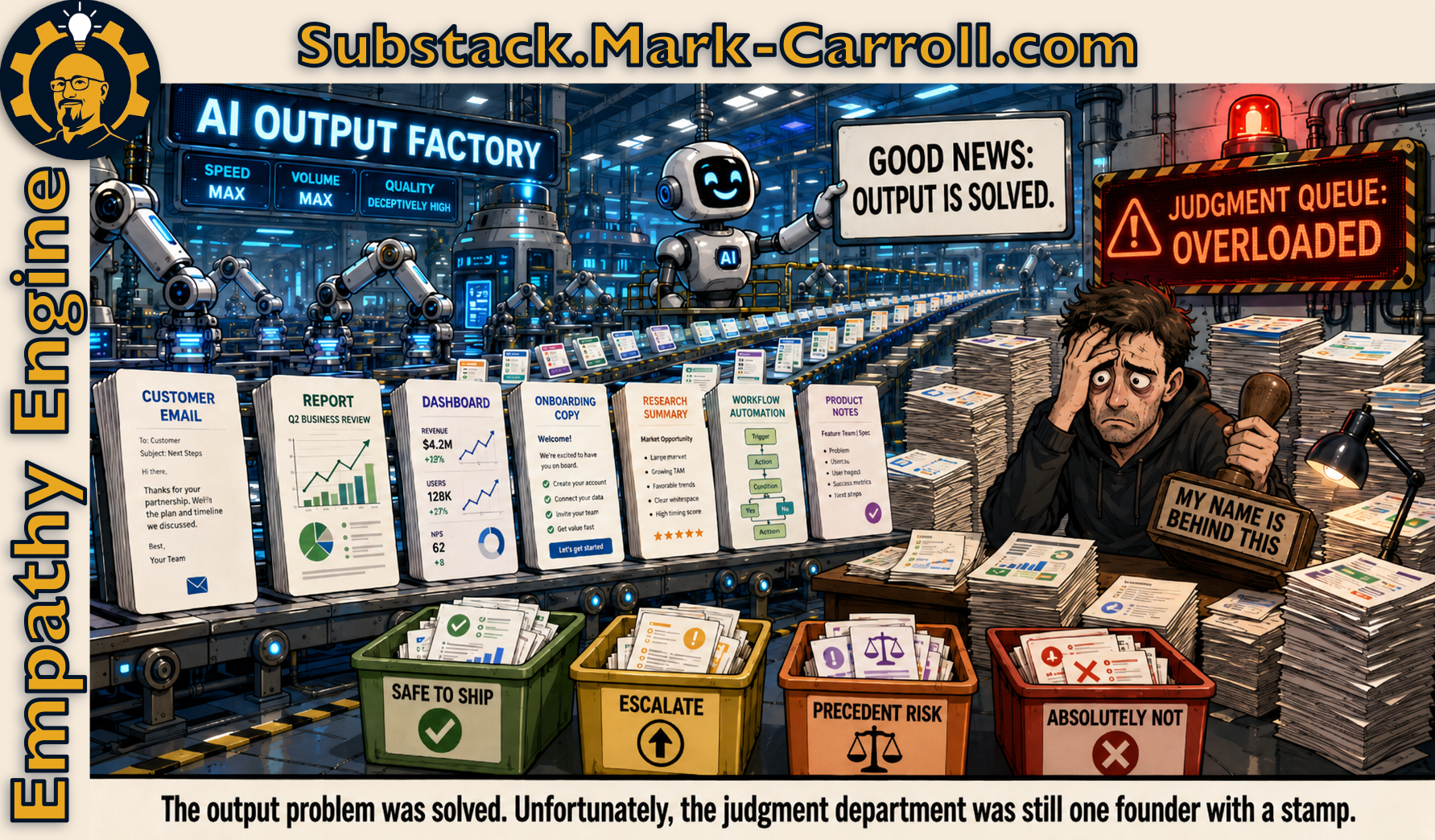
The AI had shrunk the blank page.
It had not removed the judgment layer.
Mara still had to decide what was accurate, what was safe to ship, what fit the customer, what carried precedent risk, and what needed to escalate. The agents had handled the doing. The deciding had stayed with her.
For many AI-native founders, that is where the bottleneck moves.
Not output.
Judgment.
Research Binder: the receipts (citations + source notes) are compiled in a PDF at the bottom of this post.
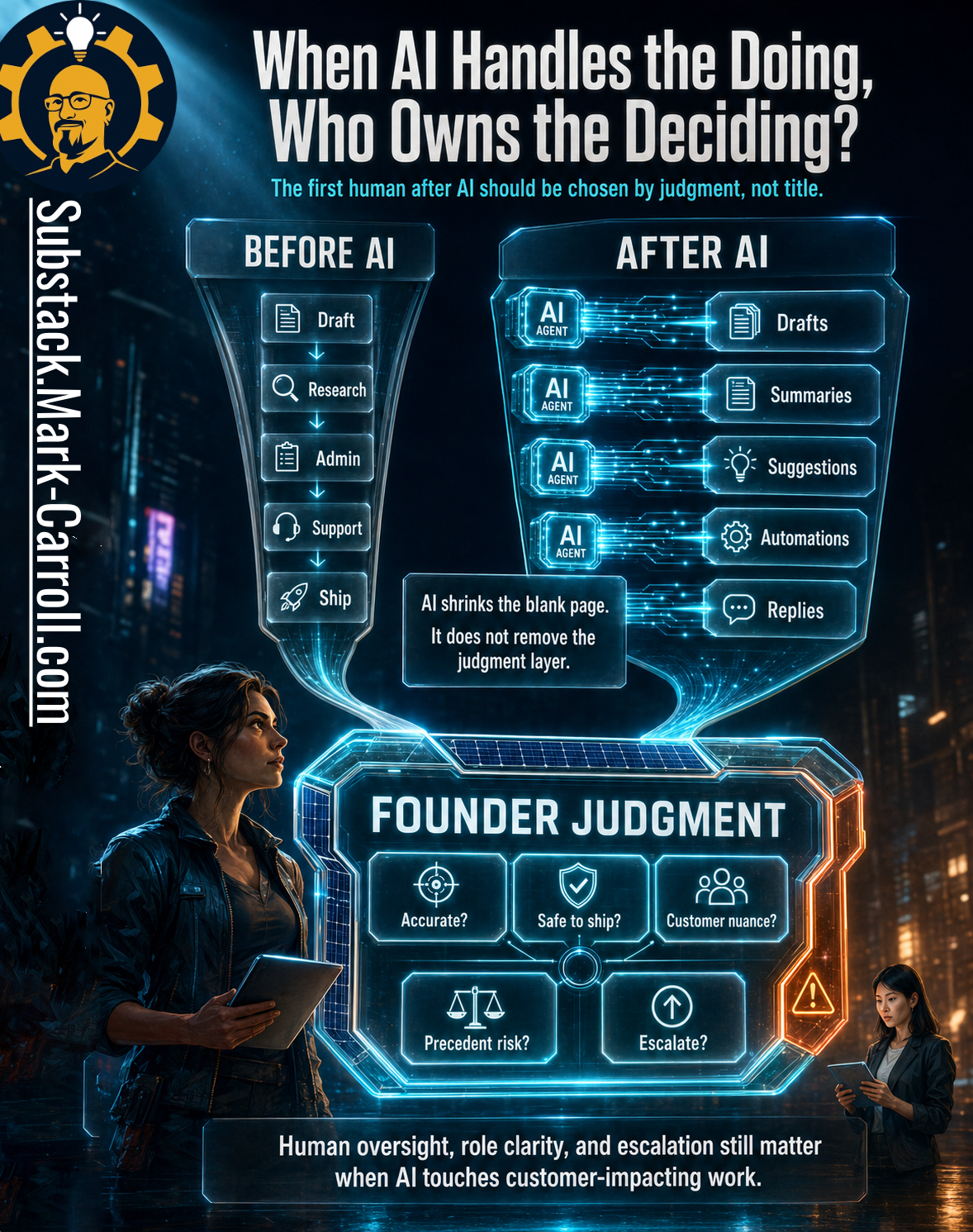
The first human after AI should be chosen by judgment, not title.
Once you see the system this way, the old hiring question feels too blunt. The better question is not only “Who do I hire first?” but “Which judgments am I ready to share?”
I see this in my own work every week.
My AI stack can help me gather research, pressure-test claims, draft infographic prompts, compare feedback, and surface patterns faster than I could alone. That leverage is real. I use it because it works.
But the final decision still lands on me.
When five AI systems give me five different opinions on a draft, the hard part is not getting more output. The hard part is deciding which recommendation protects the argument, which one makes the piece sharper, which one overreaches the evidence, and which one would make the article sound polished but less true.
The tools can help me see options.
They cannot decide what my name is willing to stand behind.
What problem does AI actually solve for solo founders?
AI solves more than skeptics want to admit. An effective stack shrinks the distance between idea and execution. The leverage is real.
I say that as someone who would be lying if I pretended AI has not changed my own operating capacity.
It has.
AI helps me move faster across outlining, citation-binder structure, Substack Notes, Pinterest descriptions, and the ugly middle where an idea is real but not yet publishable. Work that used to require multiple separate passes can now start taking shape in one concentrated session.
That is real leverage.
But the first surprise was that the saved time did not turn into empty calendar space. It turned into more review, more comparison, more quality control, and more decisions about what was actually worth publishing.
AI gave me more output.
It also gave me more things that needed my standard.
The mistake is assuming that because AI handles more execution, the human side matters less. Often the opposite happens. AI increases the volume of possible actions, and most of them are almost-right outputs waiting for approval. The founder’s job shifts from making output to judging it quickly, safely, and in context.
AI removed some busywork. It did not remove the judgment work. The bottleneck moved.
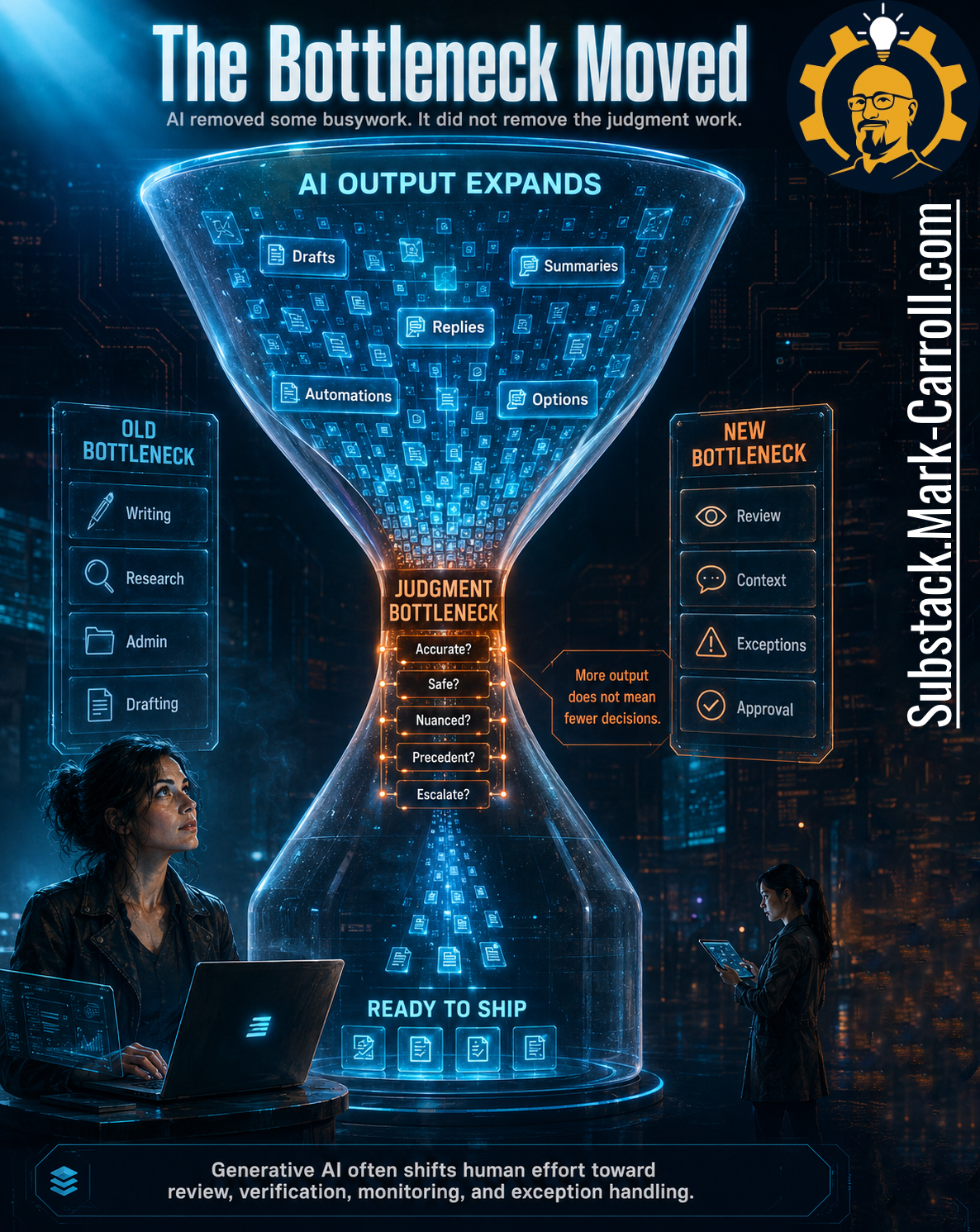
More output does not mean fewer decisions.
This is where many founders misread the problem. They think they need more hands. Sometimes they do. But often the more urgent need is another source of trusted judgment close to the work.
Why do AI-generated replies still need human judgment?
The clearest version of this problem shows up in the almost-right reply, and every founder using AI for customer-facing work eventually meets it. It looks helpful. The tone is decent, the grammar is clean, the message contains no obvious nonsense. A tired founder wants to send it and move on with life.
Then the context starts whispering.
This customer has already been through a migration issue.
This discount would create a precedent.
This sentence sounds harmless unless the customer quotes it back in six months.
That is when the founder realizes the output is not the finish line. It is the beginning of a judgment pass.
Mara’s three replies to Dani Park were not a writing problem. They were a context problem. She was not choosing the prettiest sentence. She was deciding what kind of company FlowPilot was becoming.
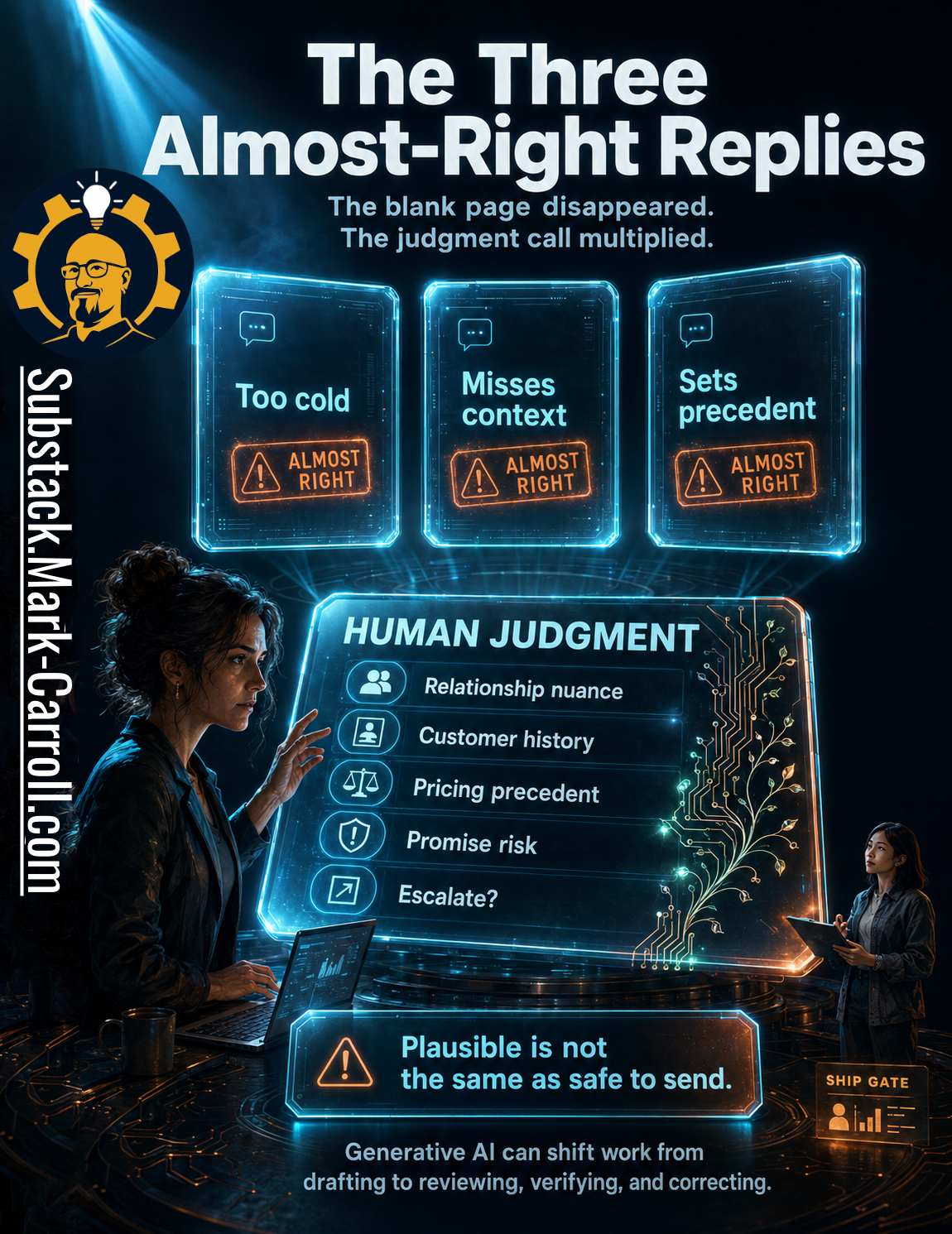
Plausible is not the same as safe to send.
This is the work AI does not fully own. Not because AI is bad, but because context is thick. A customer reply is rarely just a reply. It can be a relationship signal, a pricing decision, and a future precedent, all at once.
What is a 1st Builder?
A 1st Builder is my proposed practitioner lens for the first high-judgment human partner who helps an AI-native founder carry a bounded slice of judgment close to the work.
That sentence has several load-bearing words.
Proposed means this is a lens, not a validated academic category. Practitioner means it is built to help founders think and act, not to pretend a new profession has been formally validated.
First high-judgment human partner means this person is not doing overflow tasks. They are helping with decisions that affect customers, workflows, quality, precedent, or product direction.
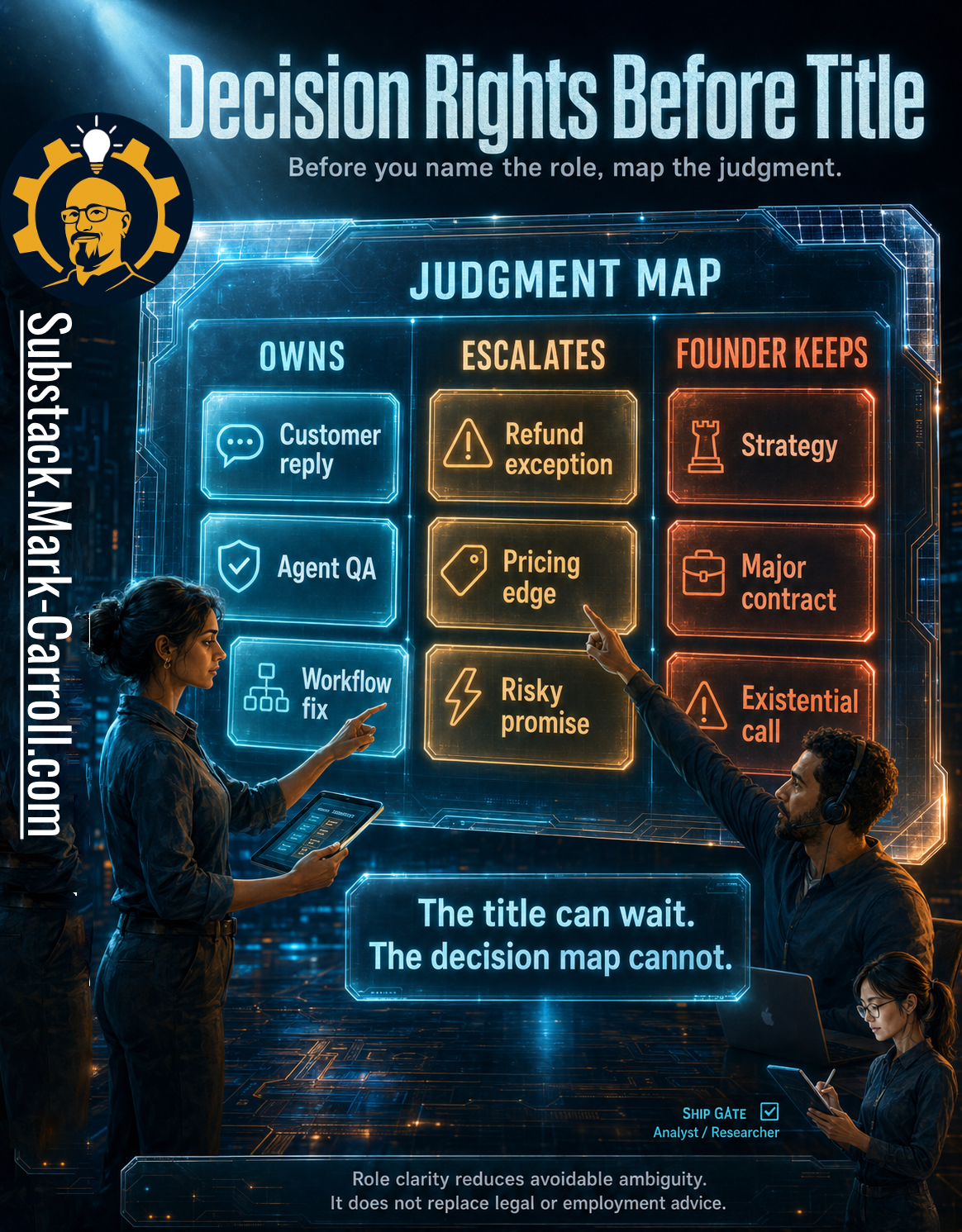
Bounded slice of judgment means they do not own everything. They own a defined domain with limits. Some decisions stay with the founder, some get escalated, and some can be made without asking.
Close to the work means they are near the operating system of the business. They see the customer messages, the workflow issues, the agent failures, and the edge cases that only appear when real customers touch real systems.
A 1st Builder is not necessarily a cofounder, an employee, a contractor, or an advisor. The lens sits upstream of those structures. It asks a simpler question first:
What judgment can this person safely own?
Not title first. Judgment first.
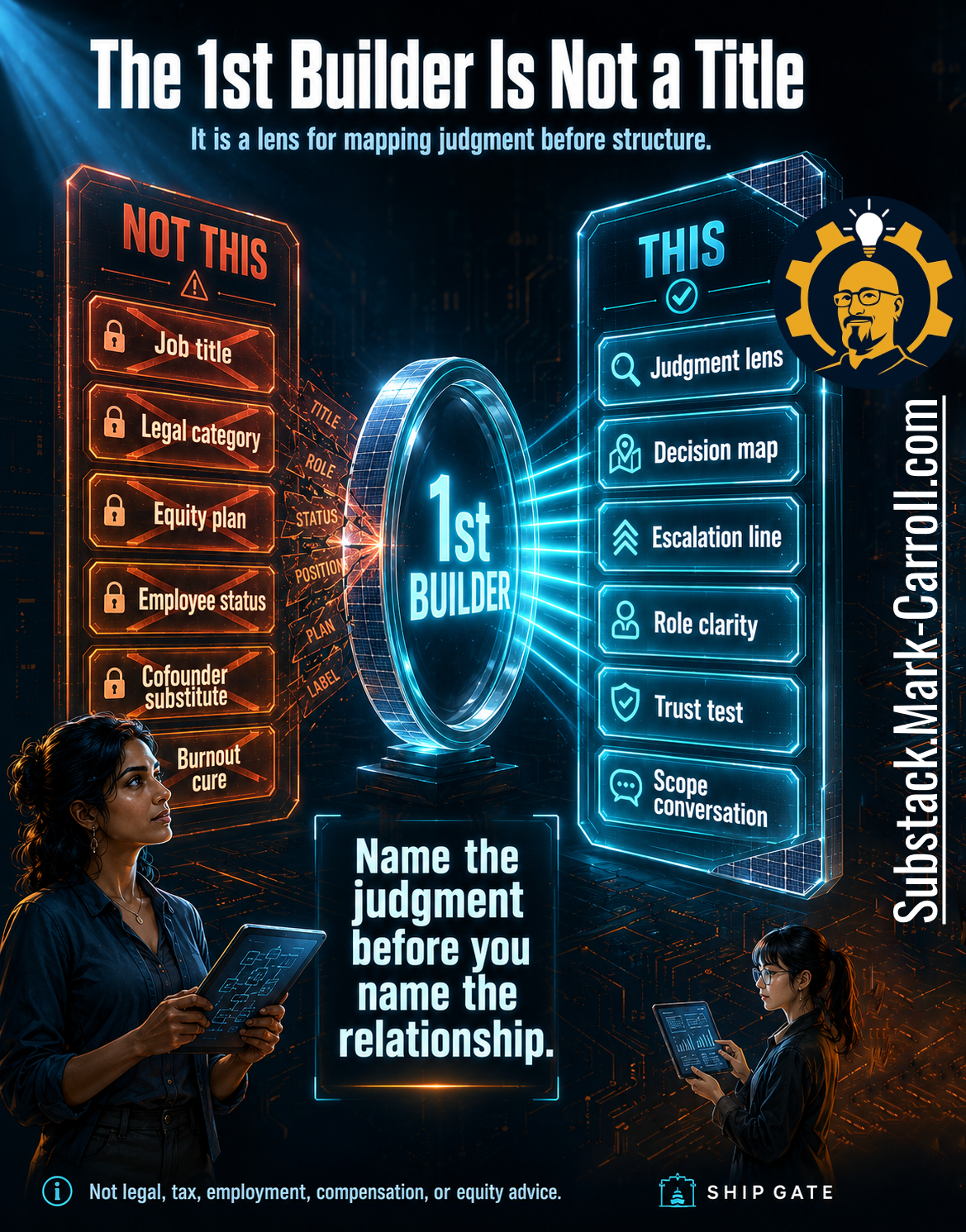
Name the judgment before you name the relationship.
Title, structure, and the compensation conversation all come later, with the right professional guidance. The first move is simpler and harder: name the judgment this person is already carrying or could safely carry.
Why is “first hire” the wrong starting question?
Most early role conversations start in the wrong place.
The founder asks, “Is this person a contractor, employee, advisor, or cofounder?” That question matters, eventually a lot. The problem is timing. Ask it too early, and the relationship gets forced into a label that does not match the judgment being carried.
A contractor may be treated like a task-taker while quietly making precedent-level customer decisions. A possible cofounder may be offered too much authority too quickly because the founder is exhausted and lonely at 2 in the morning.
Mara had already made that mistake once.
Her friend Jess wanted to help. Mara, tired and optimistic, offered a cofounder-sized conversation before defining the actual judgment domain. Jess expected strategic authority. Mara expected execution help plus some thinking support. Both were operating from different maps.
The relationship became tense because the title conversation outran the decision-rights conversation.
That is the avoidable mistake.
I have made a version of that mistake myself.
Not because the other person was wrong. Not because the relationship lacked goodwill. Usually the opposite was true. The person was smart, generous, and energized by the work. I was energized too. And because I believe so deeply in collaboration, I have sometimes let the spirit of partnership outrun the operating clarity.
That is where the trouble starts.
A big conversation can feel like alignment when it is really only possibility. Someone hears strategic trust. Someone else hears helpful contribution. One person thinks the relationship is becoming a role. The other thinks the work is still being explored.
I have seen that pattern in my own collaborations, and I have seen versions of it inside larger organizations too. Everyone agrees on the meeting. Nobody has actually named the decision.
The mistake is not trusting people.
The mistake is trusting the relationship more than you have scoped the judgment.
Before the title, map the decisions.
What can this person own and decide without asking?
What can this person recommend, but must escalate?
What does the founder keep, because the risk, precedent, or accountability is too high?
A decision map is not bureaucracy. A decision map is an honesty tool.