Before You Name the Relationship, Name the Judgment
🔒 Leader’s Dispatch: Volume 48 (Buildership > Solopreneur, Part 4 of 8 Part Series)

Before You Name the Relationship, Name the Judgment
👋 Welcome to my paid subscriber-only edition of Empathy Engine (🔒 Leader’s Dispatch). Each week I build evidence-informed tools for product professionals, and team leads who have moved past the hype and are now wrestling with the real operating cost of hybrid AI stacks and contemporary organizations.
The fastest way to make an early collaboration messy is to give it a generous title before defining the decisions underneath it.
Mara Okonkwo did not make her first big people mistake because she was careless. She made it because she was relieved. FlowPilot was working, customers were paying, and the product had started pulling real gravity into her calendar.
AI helped her build faster than she could have imagined a few years earlier. Drafts, prototypes, automations, customer summaries, onboarding flows, sales follow-ups, and support ideas all moved through her stack with astonishing speed. The problem was no longer whether Mara could produce enough work.
Previously:

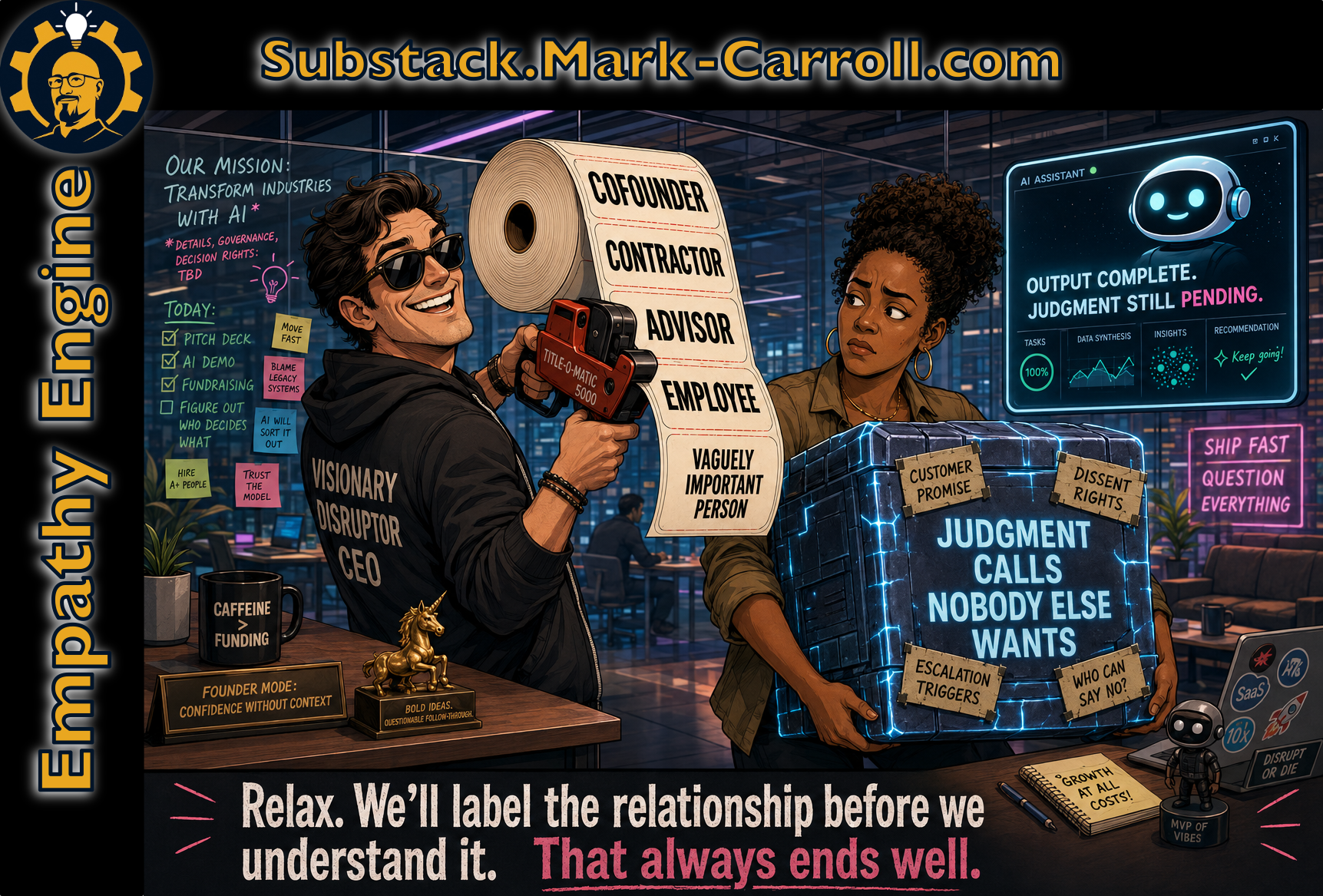
The problem was that every meaningful judgment call still routed back through Mara. Then Jess wanted in. Jess was a friend, smart, trusted, available, and excited.
Mara was tired enough, grateful enough, and optimistic enough to reach for the warmest label in the room. Co-founder. The label felt generous, serious, and clarifying.
For about three weeks.
Jess heard “co-founder” and expected strategic authority. Mara meant trusted execution help with some judgment around onboarding and customer experience. Neither person was trying to be unreasonable, but both were operating from different invisible definitions.
The title arrived before the decision rights. That was the mistake. Not the friendship, not the ambition, and not even the desire to stop carrying everything alone.
I have lived a version of that mistake myself. More than once, I accepted the label “coach” before the decision rights underneath it were clear. I quietly assumed the word meant I had permission to challenge the system, surface uncomfortable tradeoffs, and help leadership change how decisions actually moved through the organization. Some of the people who brought me in quietly assumed “coach” meant I would help teams move faster without disturbing the leaders, incentives, or approval habits creating the drag in the first place.
The gap first showed up when a team-level problem traced back to a leadership-level decision. I thought I was there to help name that. They thought I was there to keep the team positive while the structure stayed untouched. If I could re-run that moment, I would say one sentence before accepting the label: “When you say coach, do you want me to improve team behavior only, or do I have permission to challenge the decisions shaping that behavior?”
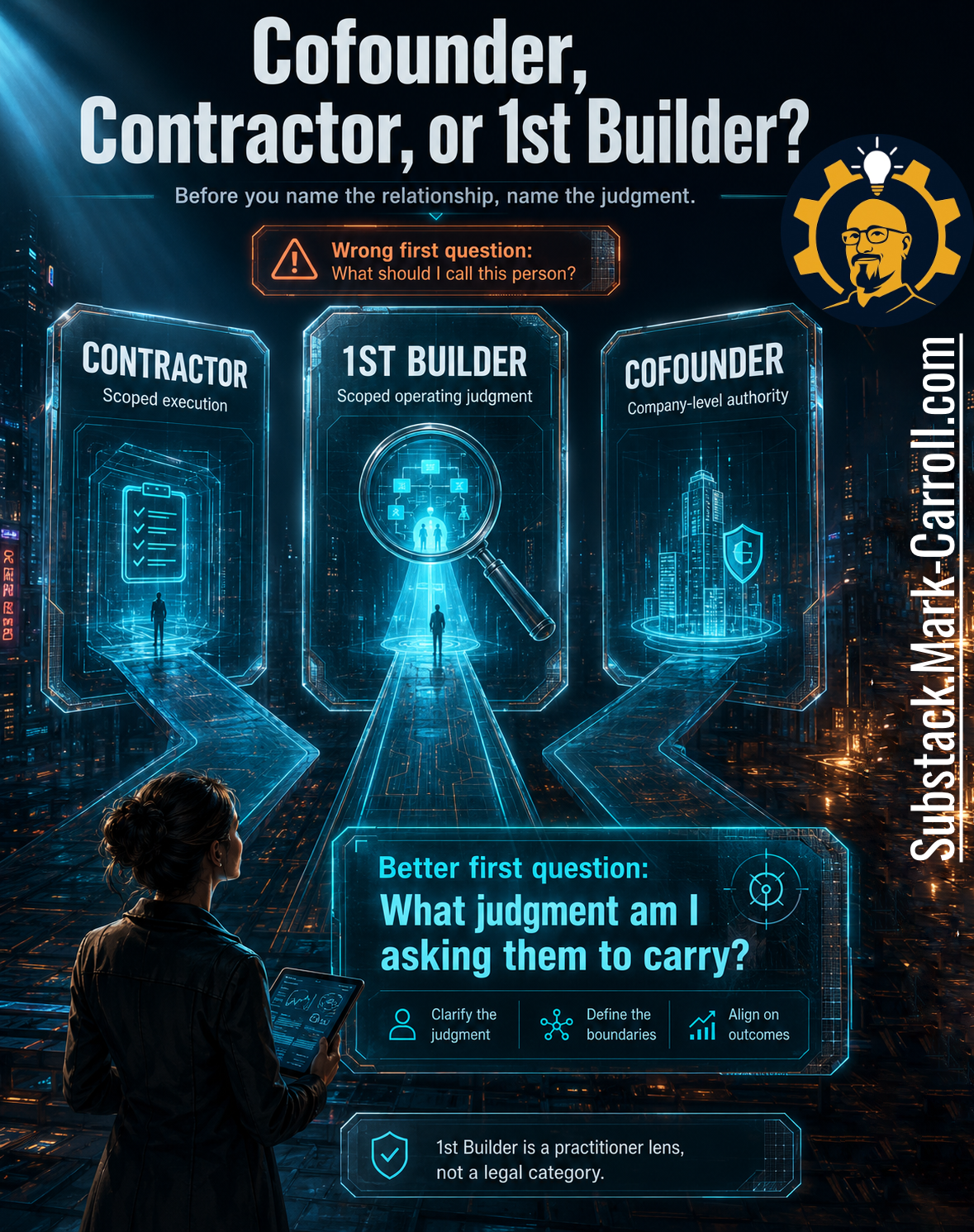
In this series, a 1st Builder is a proposed lens for the first person who helps carry scoped operating judgment with a founder, without automatically becoming a co-founder or merely functioning as a task contractor. Keep the term modest. 1st Builder is a practitioner lens, not a legal category.
Before we talk about whether someone is a co-founder, contractor, or something else, we need to slow down and ask the question the title often hides. The title is not the starting point. The judgment is.
Research Binder: the receipts (citations + source notes) are compiled in a PDF at the bottom of this post.
Why Is the Solo Win Still Real in the AI Era?
Solo founding is not a failure state. In the AI era, solo founding may be the smartest first move. A founder can test faster, prototype faster, publish faster, automate more, and delay premature hiring.
The mistake is not building alone. The mistake is assuming that because AI helped you multiply output, AI also solved judgment. Those two forms of leverage are related, but they are not the same.
AI can help you produce drafts, prototypes, automations, summaries, and options. That is real leverage. For a solo founder, that leverage can be transformational.
A founder who once needed a team to explore five directions can now explore fifty. A founder who once needed a contractor to draft the first version can now generate ten variations before lunch. A founder who once needed a small operations team to keep workflows moving can now stitch together tools, agents, automations, and dashboards.
That is the solo win. The win is real. No founder should be shamed for taking it seriously.
The catch is that every new output still asks a question. Is this right? Is this safe to ship? Does this match the customer promise? Does this move the company forward, or just make the founder feel productive?
AI can multiply options. The founder still has to decide what matters. That is where output leverage turns into judgment load.
The first visual distinction matters. AI expands the output stack.
It does not automatically expand the founder’s judgment capacity.

This is the moment many founders misread. They think they need “help.” The sharper question is what kind of help: execution, company-level partnership, or scoped judgment close enough to the work to challenge assumptions before the product promise bends. Reaching for a title to cover all three is where the trouble starts.
Is the Real Choice Co-founder or Contractor?
The early-stage founder often reaches for familiar labels because familiar labels feel safer. Co-founder sounds serious. Contractor sounds flexible. Advisor sounds low-risk. Employee sounds official. Partner sounds warm enough to avoid the harder conversation. Each label carries a story before the people involved have agreed on the work.
The label may describe the arrangement. It should not be asked to create the arrangement. That is too much structural work for one word to do.
The problem is not that these labels are useless. The problem is using them before the work underneath them has been named. That is why “co-founder or contractor” can be the wrong first question. The better move is to look beneath the label and ask what kind of judgment, authority, and accountability are actually being shared.
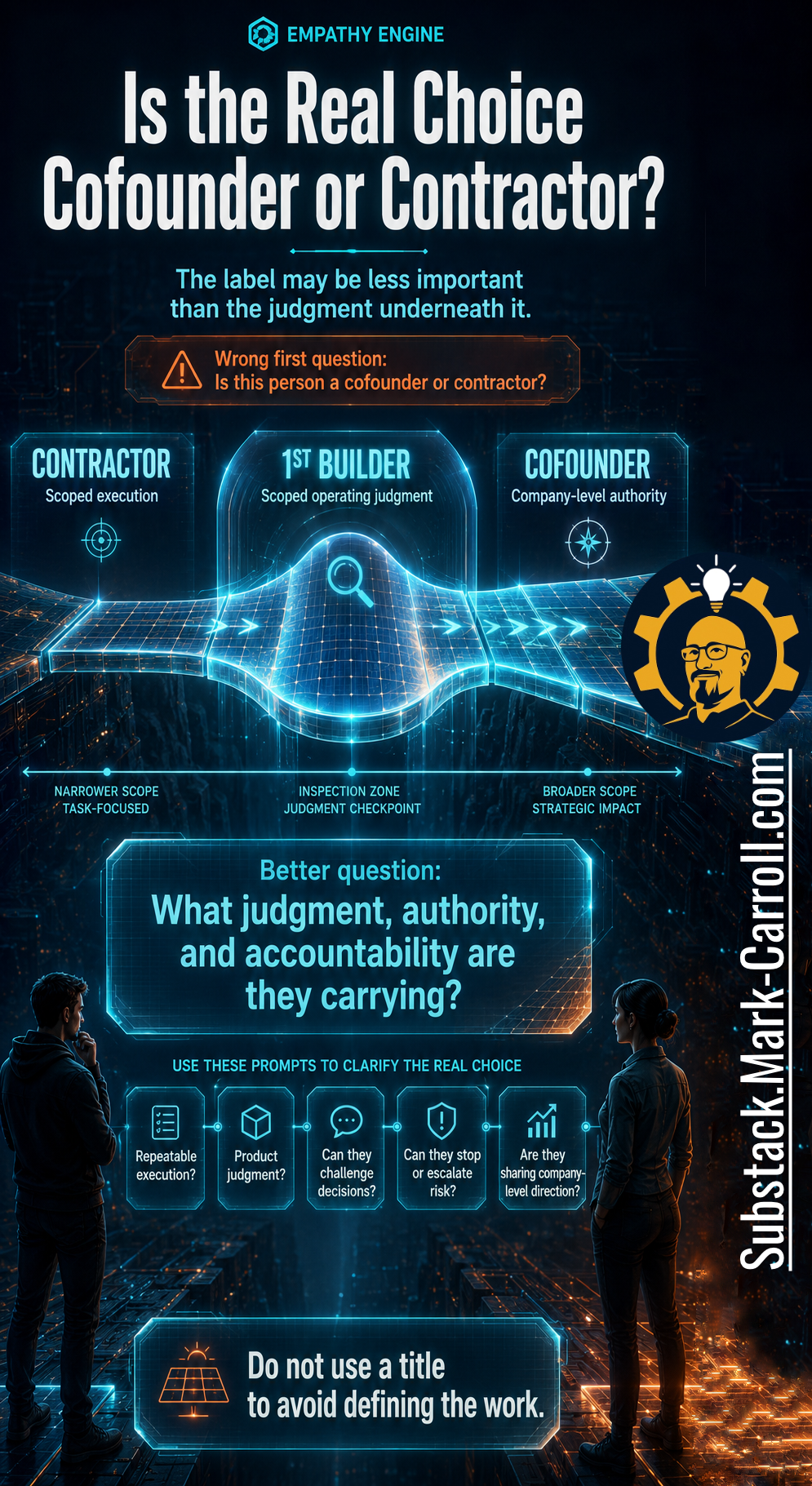
This is where the proposed 1st Builder lens begins to matter, but not as a shiny new job title. The lens is useful only if it helps a founder see the middle more clearly. The second it becomes a status badge, we have already ruined it.
That does not mean the answer is automatically “1st Builder.” It means the founder should stop reaching for a label and start mapping the judgment. The label should follow the reality, not decorate the wish.
How Did AI Move the Bottleneck From Output to Judgment?
Before AI, the bottleneck often looked like production. Who will write the draft? Who will build the prototype? Who will turn the founder’s rough thought into something the market can actually see?
After AI, the bottleneck changes shape. Now the founder can generate the draft, prototype, summary, workflow, and customer note faster. But speed creates a second-order problem.
Which draft is actually good? Which prototype is trustworthy? Which output should be ignored entirely?
The bottleneck moved. The work did not disappear. A meaningful portion of the work shifted from producing to judging.
This is one of the strangest traps in AI-native work. From the outside, the founder looks less alone because the stack appears to be doing more. From the inside, the founder may feel more alone because every meaningful call still needs a human judgment layer.
My own writing process is where I feel this shift most directly. For this series, I can ask several AI tools to critique the same draft, and within minutes I may have pages of smart, confident, mostly useful advice. One tool wants stronger narrative. Another wants more evidence. Another wants compression. Another catches a sequencing issue everyone else missed.
That pile of almost-right output does not feel like magic after the first minute. Bad output is easy to reject. The real cognitive load comes from advice that sounds polished enough to pass if I am tired, but still carries the wrong assumption, the wrong emphasis, or the wrong risk.
The hard part is not that the tools disagree. The hard part is that several of them can be right from different angles. One critique may protect the evidence fence, another may protect the reader’s attention, another may protect the series architecture, and another may protect the emotional flow.
That is when the question stops being, “Can I produce this?” The question becomes, “Can I judge what belongs?” The tools can give me competing partial truths. The call only I can make is which truth governs the next move.
The real question is no longer only “How do we produce more?” The better question is “Who helps decide what deserves trust?” That is where the first-human question becomes much sharper.
This is a common hidden constraint for AI-native founders.
Output fans outward. Judgment narrows back toward the human.
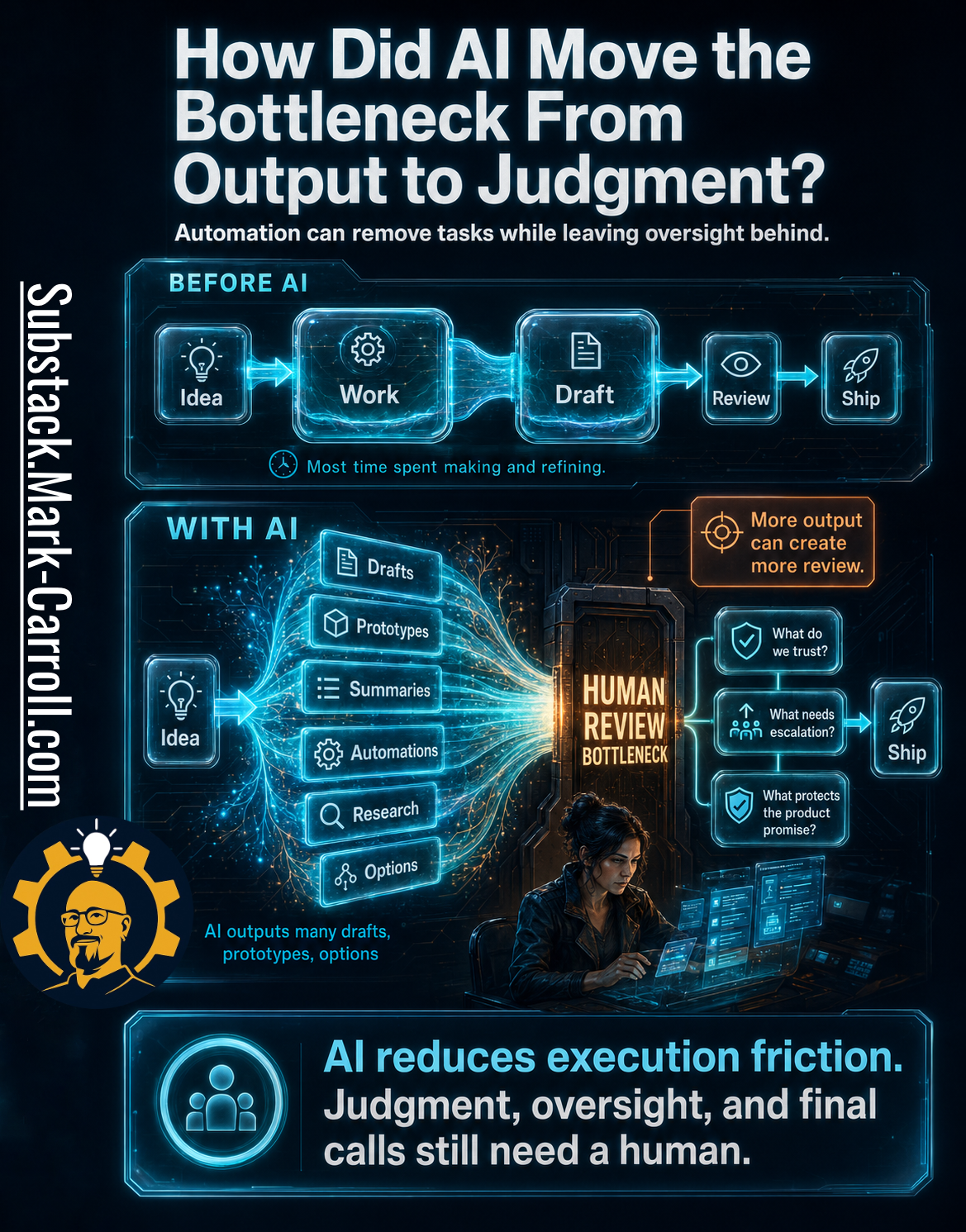
This does not mean the founder needs to supervise every keystroke. That would defeat the point of leverage. Control theater is still theater, even when the dashboard glows blue.
The real question is which decisions can safely move away from the founder, which decisions need review, and which decisions must always escalate. That distinction is not administrative trivia. That distinction is how a founder keeps leverage from becoming chaos.
Why Do Decision Rights Matter Before Titles?
A title without decision rights can feel clear because everyone recognizes the word. That recognition is deceptive. Familiar words can hide unfamiliar expectations.
“Co-founder” sounds clear until one person thinks it means company-level strategy and another thinks it means trusted execution. “Contractor” sounds clear until the person starts protecting product judgment, challenging assumptions, and shaping customer promises. “Advisor” sounds clear until the advisor is effectively operating a key part of the business every week. “Partner” sounds clear until no one knows who can say no. Cozy ambiguity is still ambiguity.
The hard part is not the label. It is the invisible operating system underneath the label: the decision domain, the owner, the authority level, the escalation trigger, and the review cadence. Who owns this call, how much authority do they actually have, what forces a decision up to you, and how often do you revisit it. Those questions sound administrative until the relationship gets stressed. Then they become the relationship.
Organizational research has long treated role ambiguity as more than a communication nuisance. When people are unclear about who owns which responsibilities, coordination gets harder and stress tends to rise. Research on psychological safety points the same way from another angle. Teams catch more problems when people can challenge assumptions without fear of being punished for it. The point is not that every early collaboration needs corporate ceremony. The point is that unclear decision rights eventually become emotional debt.
Intake and prioritization work taught me the same lesson in a quieter form. A request comes in, everyone agrees it matters, and the team wants to be helpful. Without clear decision rights, helpfulness becomes the intake process.
The specific decision that exposes the gap is usually simple: does this new request displace something already committed, or does it wait? If nobody has agreed who owns that call, the decision gets made by pressure, proximity, or guilt. When the rights are clear, the Team Lead can still consult the right voices, but the work does not get rerouted through whoever happened to be easiest to interrupt.
That clarity protects the team when a request comes in sideways. Nobody has to guess whether the loudest stakeholder owns the priority. The decision path is visible before the pressure arrives.
Mara did not need a better title for Jess. She needed a decision-rights conversation before the title. She needed to say what Jess could own, what Jess could influence, and what Mara was not ready to share.
That kind of clarity can feel awkward early. It may even feel less warm than the generous label. But warmth without structure is not kindness when the stakes rise. A title can create expectations faster than it creates clarity. Decision rights are how you prevent a warm label from becoming a cold structure.