Why a Hard-to-Enter Market Isn’t an Opportunity Until You Know Which Kind of Friction You’re Facing
A barrier can be real without being an opportunity.
👋 Welcome to my paid subscriber-only edition of Empathy Engine (🔒 Leader’s Dispatch). Each week I build evidence-forward tools for product leads who need to say no, defend tradeoffs, and lock in decisions before they get rewritten later.
In April 2023, a bookkeeper posted a short message to a bookkeeping forum. The books were done. The client wanted the filing done too. She wrote that she is a bookkeeper, not a CPA, and that the asking had to stop.1
One post from one forum proves nothing about how often this happens. It does show a person who found the edge of her work and stood on the right side of it in the busiest month of the year. She did not describe an advantage. She described a line.
Nina reads the thread on a Tuesday night, in a tab beside the offer she has been building for a week. Documentation support for small medical practices, built around policies and records in an audit-ready folder. Twelve years of operations work across healthcare, home services, and logistics sit behind it, and the offer feels earned. Her notes hold one sentence she is proud of. Most people are scared of this, and that is the moat.
Three episodes of inspection have taught Nina to distrust glamour.
The risk now runs the other way. She has started to read difficulty as evidence.
Nina and the professionals she consults in this piece are a fictional composite built from recurring patterns in the research, not real people.
Then she asks the question that ruins the pitch. What, exactly, is the friction doing?
Her sentence ran three leaps together. We see difficulty and start imagining defensibility. We see fewer entrants and start imagining margin. We see paperwork and start imagining a market for removing it. Some of those leaps survive inspection. None survives without it.
I’ve seen requirements treated as though they created protection simply by existing. Sometimes they created useful discipline. Sometimes they created recurring work. Sometimes they only told us where another question began. The requirement was real. The protection we imagined around it wasn’t.
This episode swaps the castle for a filter. Friction comes in three kinds, and the economics is a fourth question that sits outside them. By the end you will have the Regulatory Friction & Boundary Filter, six questions that organize what you do not yet know about a regulated market. It doesn’t answer the legal ones.
Episode 4:

Research Binder: the receipts, methodology notes, and source boundaries are compiled at the bottom of this post.
The Word Everyone Reaches For
Moat is a fine word for a castle and a weak word for a market. It arrives with a conclusion attached. The wall keeps rivals out, so the owner inside keeps the margin. When people call compliance, licensing, or paperwork a moat, they usually borrow that conclusion without earning it.
The research behind this episode supports a narrower sentence. A requirement can change who enters, what work keeps arriving, and which activity a person may perform. Whether any of that produces a margin is a separate question, and the research does not answer it for solo builders in any market.
I use regulatory friction as a working label for the license requirements, approvals, compliance rules, and standards that sit between a builder and a market. It is a practitioner label with no legal standing, and it tells you nothing about which rules apply to you. The first graphic makes the swap.
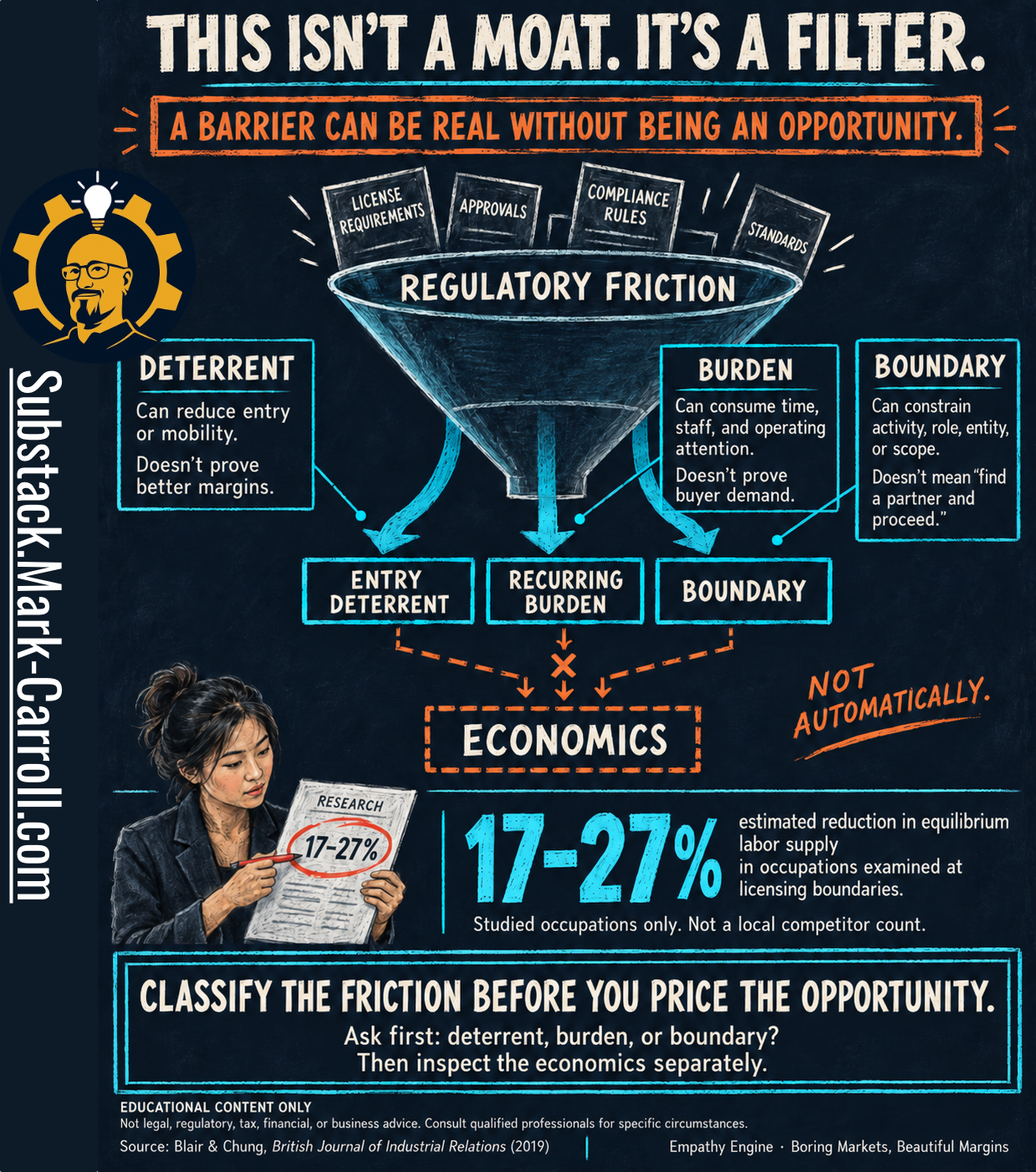
Friction goes in the top and three conditions come out, each with its own limit. A deterrent can reduce entry or mobility, and it doesn’t prove better margins. A burden can consume time, staff, and operating attention, and it doesn’t prove buyer demand. A boundary can constrain activity, role, entity, or scope, and it doesn’t mean “find a partner and proceed.” Economics sits below all three, and the graphic marks the path to it with two words. Not automatically.
The number in the lower left is one of the best-supported in this episode. Peter Blair and Bobby Chung estimated that occupational licensing reduced equilibrium labor supply by 17 to 27 percent in the occupations and research designs they studied.2 It counts labor supply in studied occupations. It says nothing about the competitors in your town or what any of them earn.
That is enough to say a deterrent is real. Pricing an opportunity takes more. Classify the friction before you price the opportunity.
Same Friction. Different Job.
Nina spends the night sorting her one proud sentence into parts. Most people are scared of this holds three separate claims, and only one is about entry. It is hard to get in. Some work never stops once you are in. Some acts belong to someone with a credential. The tail of her sentence, and that is the moat, assumes an economic result none of the three delivers.
The second graphic opens with the question she has been avoiding. Which problem am I actually looking at?
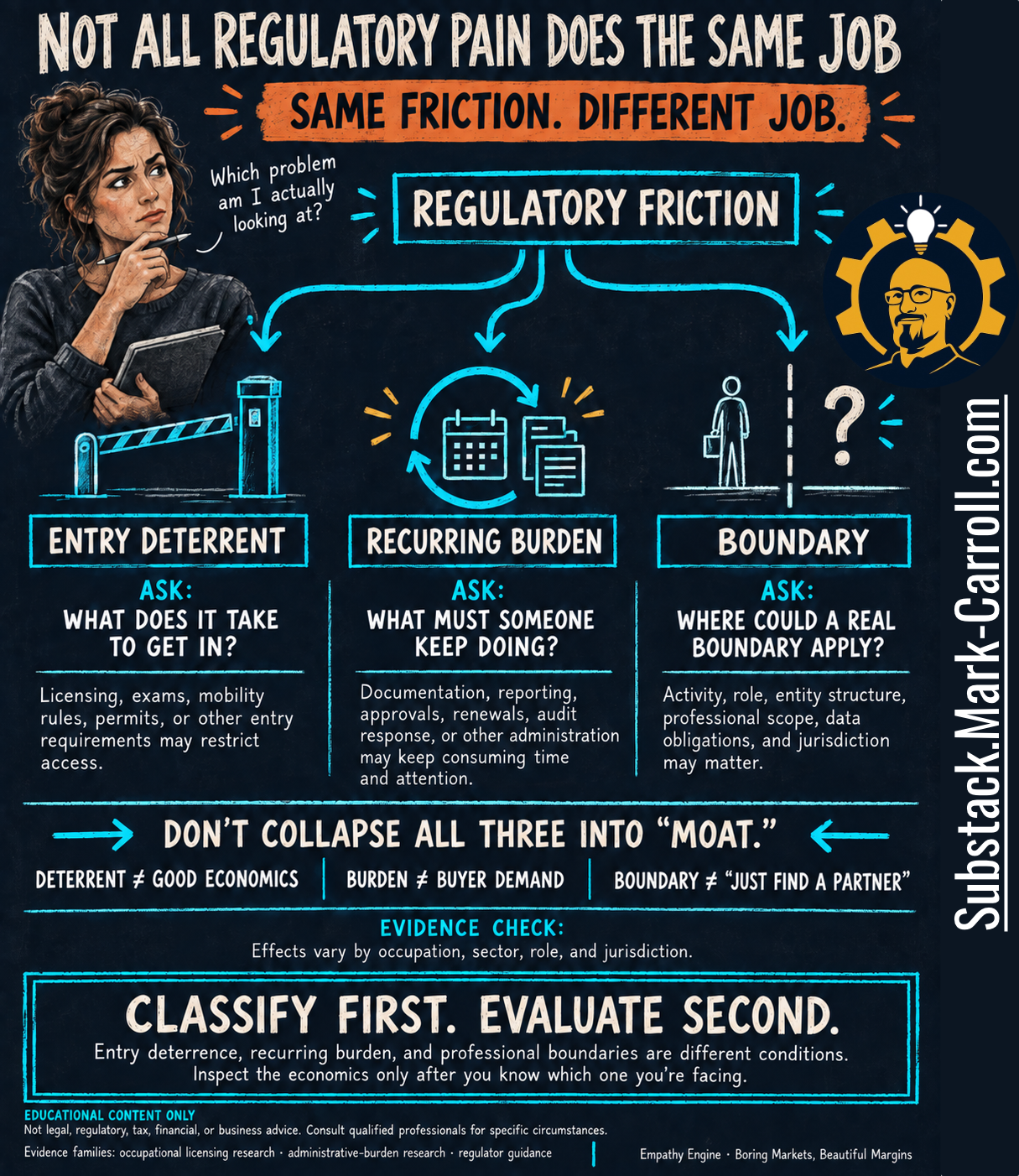
One question per condition. What does it take to get in? What must someone keep doing? Where could a real boundary apply? The third is worded on purpose. It asks where a boundary could apply, and it leaves where one does apply to a qualified professional who knows your facts and your jurisdiction.
The band across the middle is the warning to attach to every regulated-market pitch. Don’t collapse all three into “moat.” A deterrent is not good economics. A burden is not buyer demand. A boundary is not “just find a partner.” Effects vary by occupation, sector, role, and jurisdiction.
Classify first. Evaluate second. Nina now has three columns where she used to have a castle.
Some Friction Keeps People Out
Start with the deterrent, since it has the most direct peer-reviewed estimates of the three. Requirements can reduce access, and the third graphic asks who is on the outside of the gate.
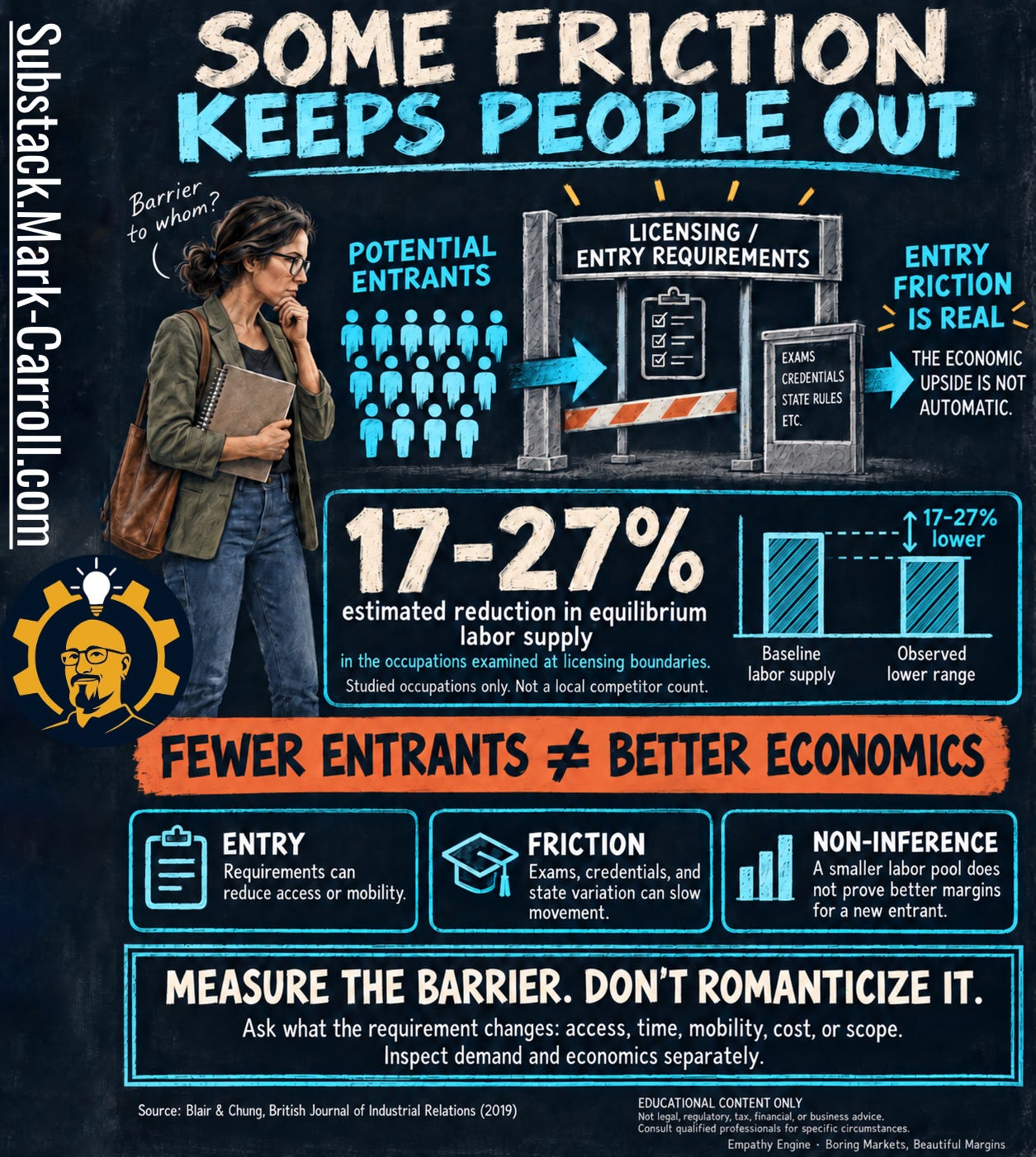
Barrier to whom? A deterrent sorts people into inside and outside, and you are the person outside. Johnson and Kleiner found that state-specific licensing exams were associated with lower interstate movement of workers in the occupations they studied, though they caution that their design doesn’t fully establish causality.3 Exams, credentials, and state variation can slow movement.
The widest banner carries the point of the section. Fewer entrants ≠ better economics. A smaller labor pool does not prove better margins for a new entrant. Entry friction is real. The economic upside is not automatic.
For the person outside the gate, the deterrent is also a bill. Where a credential is required, that means exam preparation and experience hours before your first invoice, at a size this research cannot tell you. Nothing in it shows that a margin follows.
Measure the barrier. Don’t romanticize it. Ask what the requirement changes: access, time, mobility, cost, or scope. Then inspect demand and economics separately.
Some Friction Follows You Home Every Night
Entry may be a moment. The workload keeps returning. The door opened, and the work didn’t end. The woman in the graphic asks the question every operator eventually asks. Who owns this next week?
I’ve watched teams clear the gate and then spend every week servicing what came after it. Records had to be refreshed, evidence had to be maintained, questions had to be answered, and exceptions had to be chased. The approval was static. The operating environment was not. The real operating question became: who owns this next week?
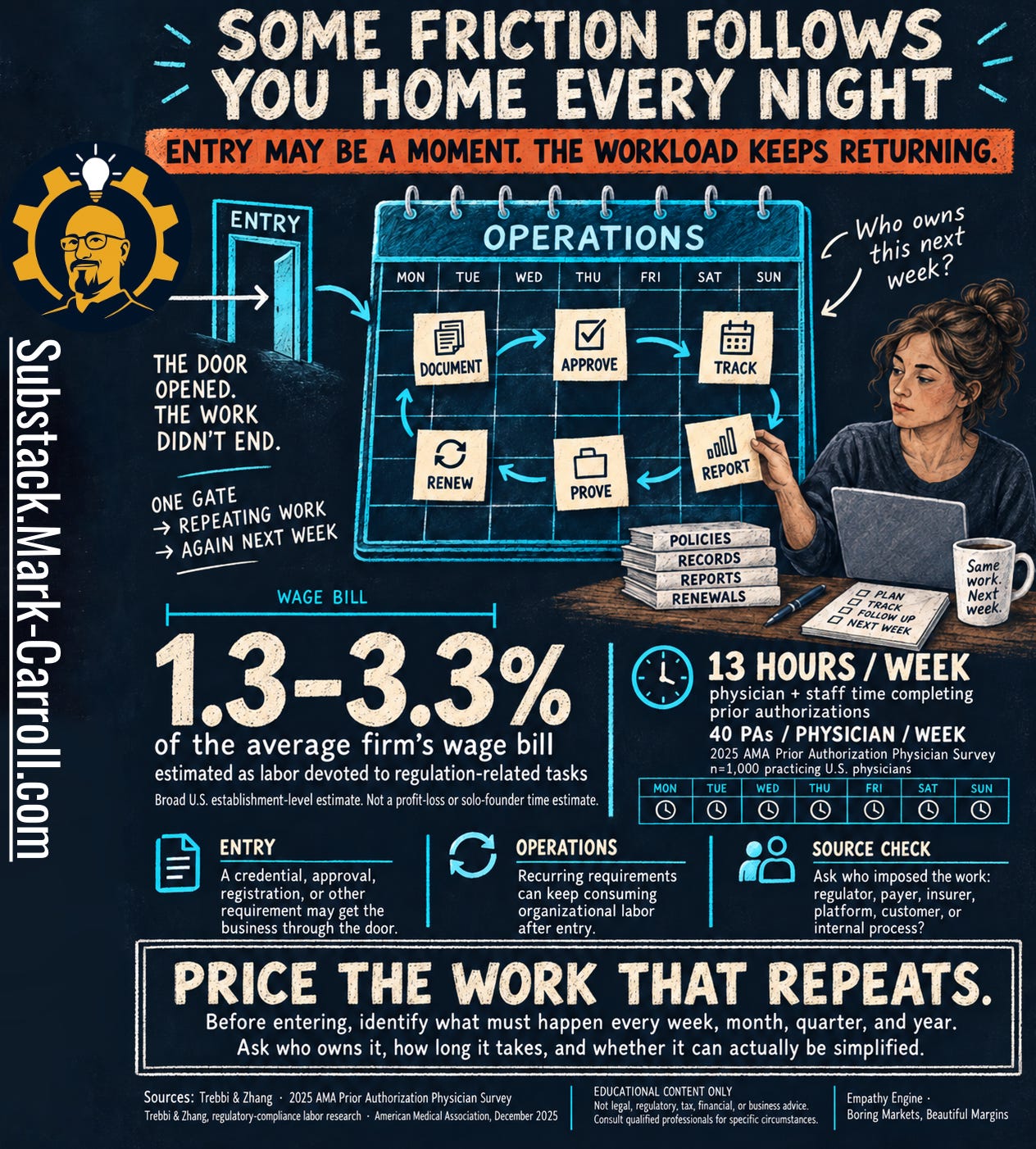
Two numbers anchor the graphic, and each carries a boundary. Francesco Trebbi and Miao Ben Zhang estimated that labor devoted to regulation-related tasks equals 1.3 to 3.3 percent of the average U.S. firm’s wage bill, using establishment-level data on roughly 400,000 firms a year from 2002 to 2014.4 That describes an average firm’s payroll. It says nothing about profit or about your evenings.
The second number is narrower. In the American Medical Association’s December 2025 survey of 1,000 U.S. physicians, respondents reported 13 hours a week of physician and staff time on prior authorizations and 40 authorizations per physician per week. Ninety-five percent of surveyed physicians reported care delays.5 That is a health-care example only, and it doesn’t travel to bookkeeping, real estate, or trades.
The graphic’s third box asks who imposed the work. A regulator, a payer, an insurer, a platform, a customer, and your own internal process each create recurring work, and each responds differently when you try to remove it. Prior authorization is a requirement health plans impose. That makes it a strong example of recurring burden and a weak example of regulation in the narrow sense.
Price the work that repeats. Before entering, identify what must happen every week, month, quarter, and year. Ask who owns it, how long it takes, and whether it can actually be simplified. That is the Workflow Pain Index applied to obligation.
Boring is not the opportunity. Repeated paid pain is. A recurring requirement supplies the repeated part. Whether anyone pays to remove it is the next question, and in some markets somebody already does.
Some Friction Is a Boundary, Not a Chore
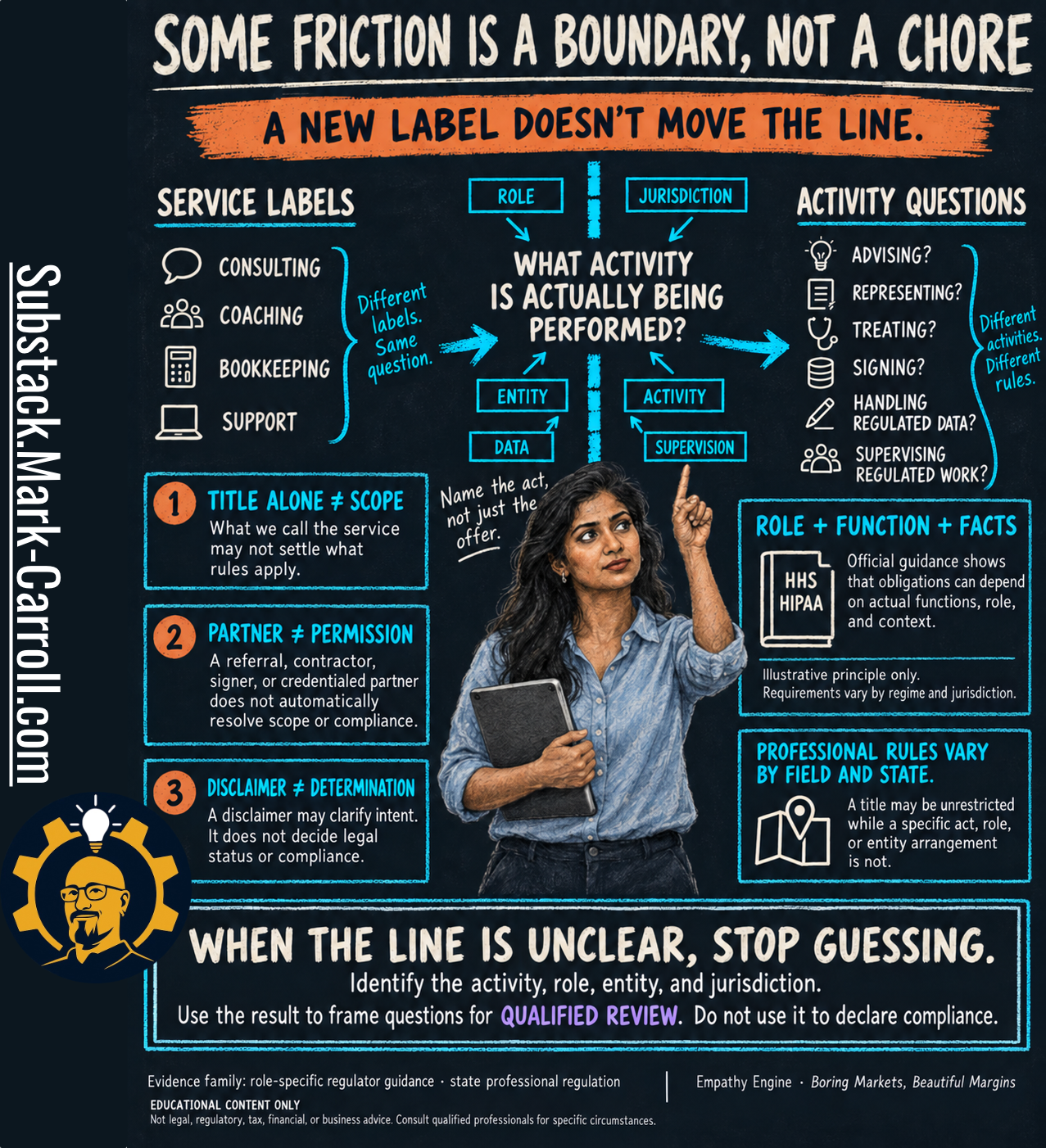
A chore can be delegated, outsourced, or automated. A boundary can decide who is permitted to do the work at all.
Nina’s first instinct sounds reasonable. Great, she thinks, I’ll package the annoying part. Then she takes the four service lines in her draft and rewrites each as a verb. Review a practice’s records. Tell a practice what to change. Handle information a patient would consider private. Supervise a junior contractor doing the same. She circles two and cannot tell, from an outline, whether either puts her inside a regulated role. Nobody can, without her facts. Name the act, not just the offer. A new label doesn’t move the line.