Why Customers Don’t Switch Service Providers: Even When a Better Option Exists
What looks like a “trust moat” may be a pile of verification, transition, and continuity risks the newcomer has not removed.
👋 Welcome to my paid subscriber-only edition of Empathy Engine (🔒 Leader’s Dispatch). Each week I build evidence-forward tools for product leads who need to say no, defend tradeoffs, and lock in decisions before they get rewritten later.
There are two stories about the same kind of moment, and they refuse to agree with each other.
In the first, a company runs an expensive diagnostic, can’t fix the problem, and quotes a full replacement. The homeowner calls the one-person plumber she already uses. He’s there in twenty minutes. He fixes it in ten.
That is the story trust is supposed to explain. The familiar provider wins. The bigger operation loses.
In the second, a general contractor’s regular guy goes quiet. No call, no text, no kept window. The GC calls a larger outfit he’s never used before. They show up when they say they will. He pays a documented 322% premium in that one case, and does not regret it.
Same category of decision. Opposite ending.
If trust explains the first story, it has to explain why it vanished in the second. If reliability explains the second, it has to explain why the plumber’s homeowner didn’t go looking for a bigger, unfamiliar brand instead.
It is tempting to call one of these irrational. It is even more tempting to reach for a single word, trust, and let it explain both. The incumbent has the relationship, the familiar name, the years of history. The challenger has the better system. Surely trust is the variable that decides it.
That explanation is satisfying because it makes the problem feel emotional. It also hides most of the work.
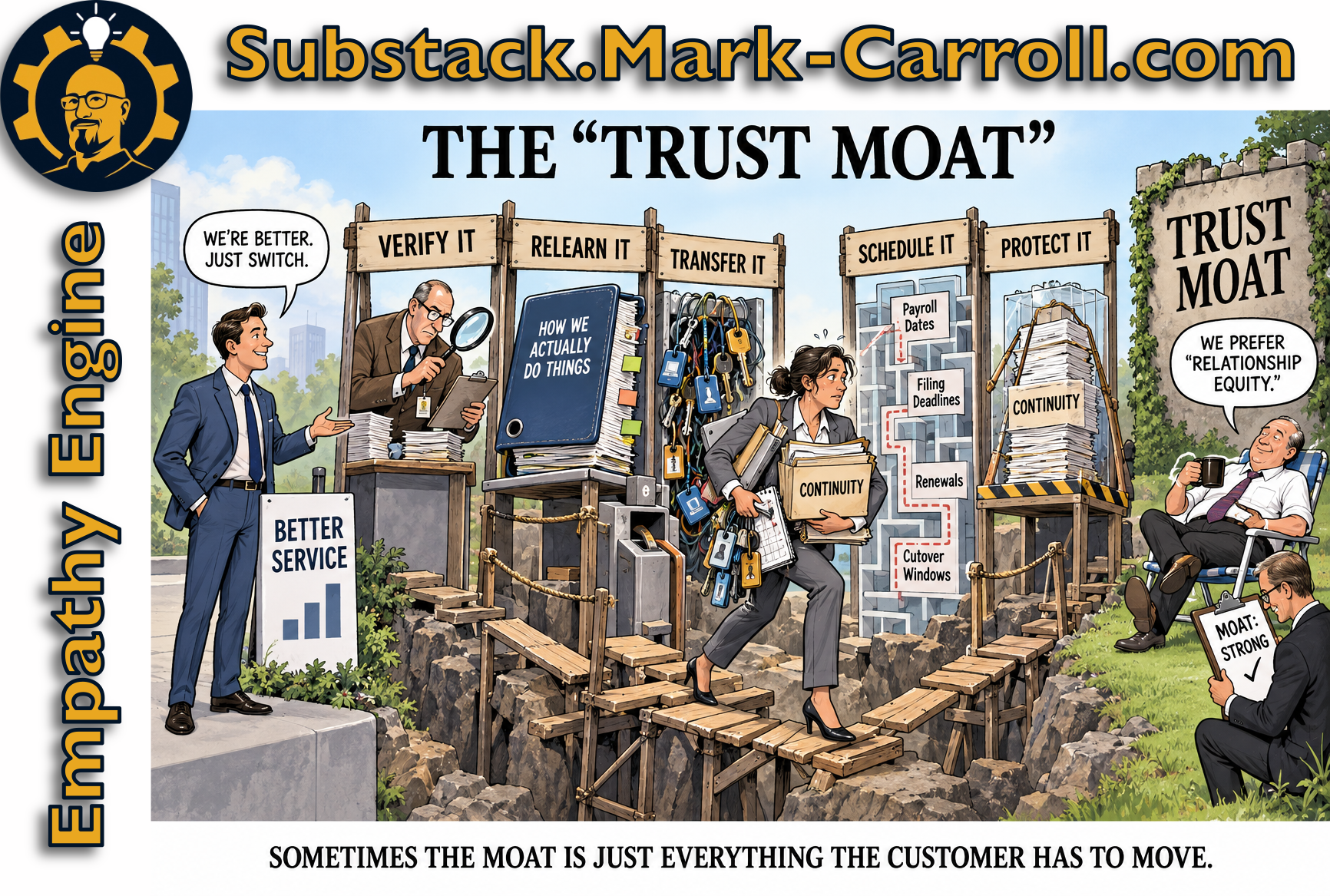
The buyer may not be protecting a relationship. The buyer may be protecting a filing deadline, a set of credentials, a history of exceptions, a fragile cutover, or a process no one has documented well enough to move. The buyer may not know whether your cleaner method will produce a better result. They may not even be able to tell whether the work you propose is necessary.
The better offer may still leave the buyer with the harder problem.
That is the uncomfortable idea in this episode. In service-heavy markets, the product is rarely just the promised output. The purchase can also include the buyer’s ability to verify the work, transfer accumulated context, survive the transition, and recover when something goes wrong.
Call that trust if you want. Just do not stop there. What the newcomer sees and what the buyer still has to solve are two different lists, and confusing them is the whole mistake.
Research Binder: the receipts, methodology notes, and source boundaries are compiled at the bottom of this post.
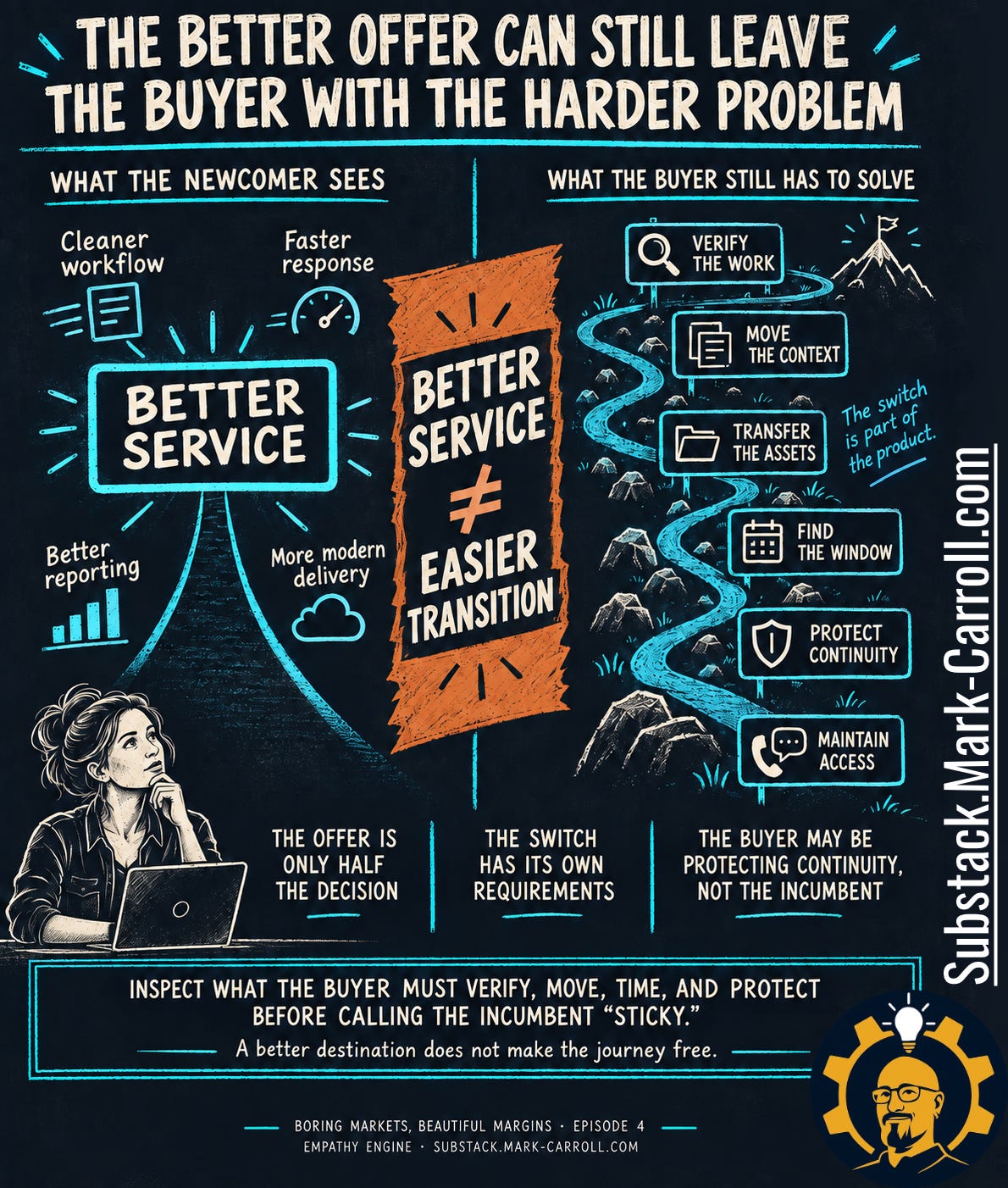
None of that newcomer list buys a shorter transition. A cleaner workflow doesn’t verify itself, a sharper report doesn’t move a credential, and a faster response time doesn’t schedule a safe cutover. The switch has its own price, whether you put it on the invoice or the buyer discovers it later.
“Trust” is a crowded suitcase
When a buyer says, “I trust my accountant,” the sentence can hold several different meanings.
It might mean:
She knows the history behind the books.
He remembers which customer always pays late.
They have the portal access, payroll calendar, prior filings, and supporting records.
Someone answers when a deadline gets close.
The buyer believes the provider is competent.
The buyer cannot easily judge whether the provider is competent.
The current arrangement is familiar.
Changing it would be disruptive.
Those are not interchangeable.
Trust is a willingness to rely on someone when you are vulnerable. Reputation is information borrowed from other people. Familiarity is recognition. Satisfaction is an evaluation of past experience. Loyalty is continued preference or behavior. Switching cost is what makes leaving expensive. Lock-in is what constrains the exit. Responsiveness is communication behavior. Availability is capacity.
Blend them together and “trust” becomes a story that can explain anything after the fact, including two opposite outcomes from the same category of decision.
Keep them separate and the market starts to become inspectable. That is the whole method behind this episode: six separate questions instead of one flattering word. The first one is whether the buyer can actually judge the work at all.
I’ve seen this in coaching work more times than I can count. A leader will tell me, “We trust her,” about the person everyone depends on. Then we start pulling the sentence apart. She knows where everything is. She remembers why the exceptions exist. People know she’ll answer. And if she disappeared for two weeks, nobody is entirely sure who could reconstruct the history. Some of that is trust. Some of it is competence, context, responsiveness, and a dependency the organization hasn’t documented yet.
The buyer may not be able to check the work
Some services contain what economists call credence attributes. The buyer may be able to see that something improved while still being unable to determine whether the prescribed intervention was necessary, whether a less expensive intervention would have worked, or whether the expert chose the right level of service.
That distinction matters. A repair can work without proving that it was the only repair the buyer needed. A tax return can be filed without making every underlying judgment legible to the client. An IT environment can become more stable without the owner being able to evaluate every configuration decision.
Controlled experiments in stylized credence markets show that the rules around expert responsibility and independent checking can materially change provider behavior.1 In one laboratory study, giving buyers access to a second opinion reduced overtreatment, but the value of that option weakened when searching became more costly.2
Those findings do not prove widespread overtreatment in bookkeeping, accounting, or managed IT. They do not make every expert service a credence market. They do establish a narrower point: when the buyer cannot fully evaluate what should have been done, a technically superior claim is not self-authenticating.
“We do this better” asks the buyer to evaluate the very thing the buyer may not be equipped to evaluate. A working fix and a necessary fix are not the same claim.
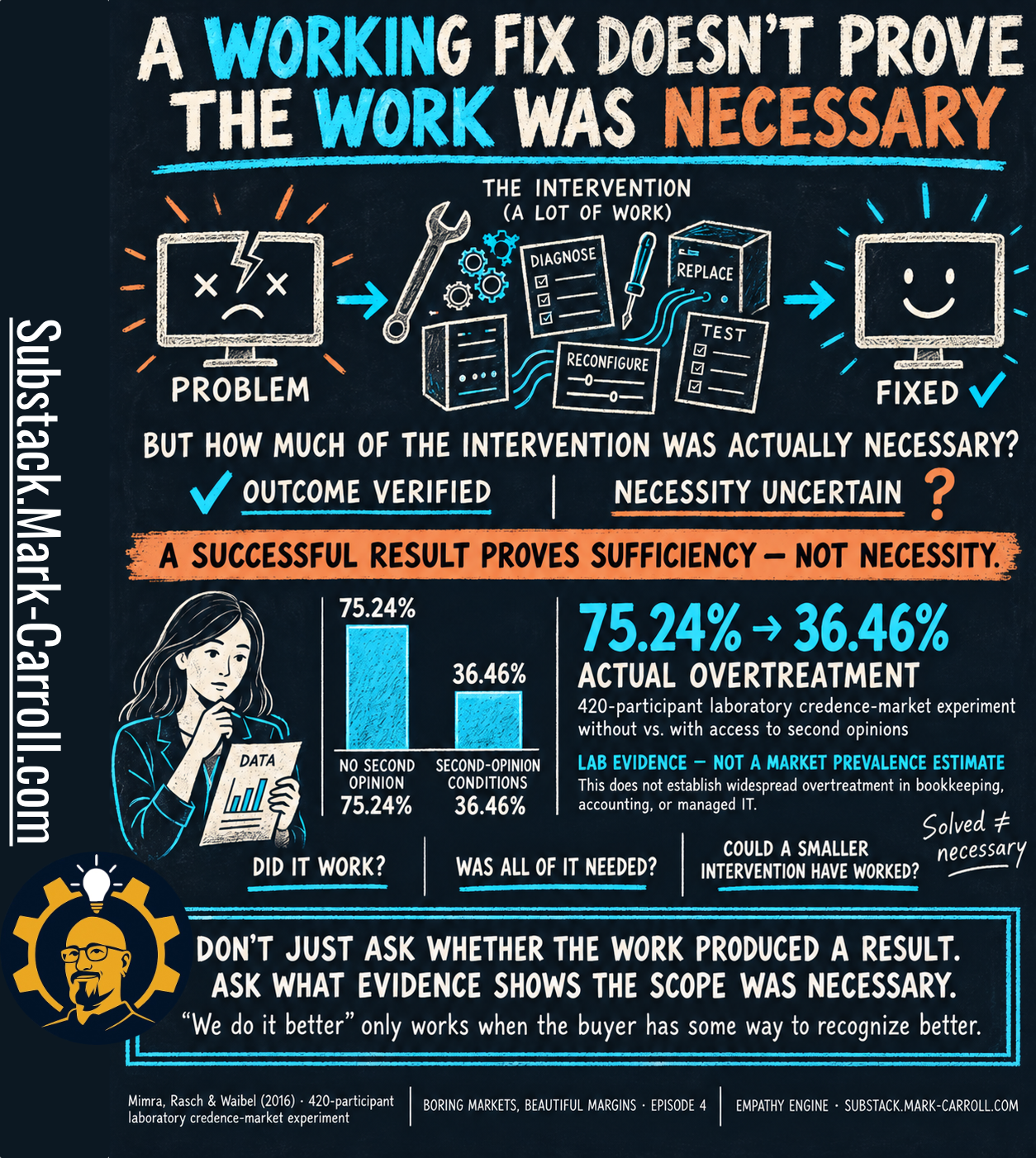
The buyer can usually confirm the screen went from broken to fixed. They may still be unable to tell whether the diagnosis, the replacement, the reconfiguration, and the test were all necessary, or whether a smaller intervention would have worked. That gap is exactly what a “we do it better” pitch has to close, and a case study or a credential doesn’t close it by itself. It only works when the buyer has some independent way to recognize better, not just a claim of it.
The switch has its own product requirements
Imagine a small business replacing a long-time bookkeeper.
The new provider is not inheriting a clean list of monthly tasks. They may be inheriting years of categorization habits, undocumented exceptions, account mappings, spreadsheet patches, owner preferences, payroll rhythms, filing dependencies, and unresolved questions.
Or imagine replacing a managed IT provider. The new firm may need administrative access, device inventories, licensing records, network documentation, backup information, vendor contacts, security configurations, and a workable sequence for taking control without interrupting the business.
The proposed service and the transition into that service are different products.
Research on business-to-business switching costs separates procedural, financial, and relational burdens rather than treating switching as one price tag. In one qualitative study of recent staffing-agency switchers, researchers identified eight distinct switching-cost facets: uncertainty, search, learning, setup, sunk investment, lost performance, brand relationship loss, and personal relationship loss.3 In a companion study of one supplier’s business customers, relational switching costs predicted lower actual switching even after satisfaction was included, while satisfaction was the strongest predictor of share of wallet.3 That combination is important. It means staying can reflect real satisfaction, real relationship value, real switching burden, or some mixture of all three.
This is where lazy disruption stories fail. They look at an incumbent’s weak interface or slow workflow and assume the buyer is tolerating obvious mediocrity. But a buyer can dislike part of the service and still make a rational decision to stay, because the task in front of them is visible and the context behind it is not.
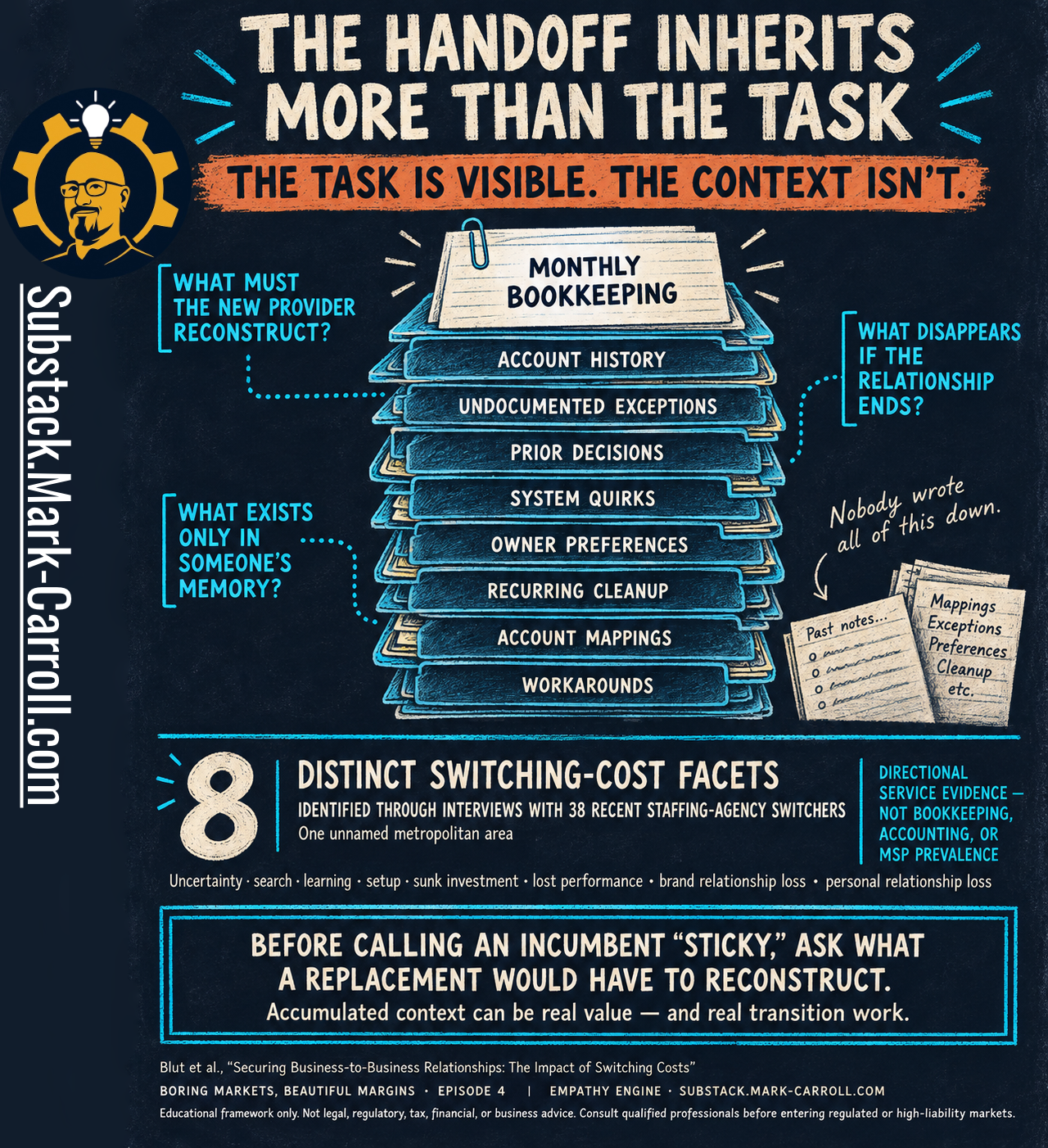
That changes the economics of entry. The newcomer isn’t only selling next month’s bookkeeping. Someone has to pay for recovering last year’s context first, and that cost may not be in the proposal yet. Some of what’s on that stack may be documented and easy to move. Some of it lives only in a person’s memory, and can become expensive to transfer the moment that person stops answering.
The relevant comparison is not:
Old provider versus better provider.
It is:
Old provider, with known performance and embedded context, versus a new provider plus the cost and uncertainty of becoming operational.
That does not prove the incumbent has a moat. It means the entrant has two jobs: improve the service and make the transition survivable.
Accumulated context is useful until it becomes invisible
Relationship history can create genuine value.
The provider may know why the business does something that looks inefficient. They may remember the customer exception that never made it into the procedure. They may understand which recurring error is harmless and which one signals a serious problem. They may know who actually makes a decision despite what the org chart says.
That knowledge is not identical to trust. It is operational context.
The danger comes when context exists only inside a person, an inbox, a spreadsheet, or an undocumented sequence of workarounds. At that point, the relationship may be valuable and fragile at the same time.
But context living somewhere inconvenient is not automatically the same thing as a provider holding a buyer hostage. Some of what looks like lock-in is just ordinary transition work, done badly or not at all.
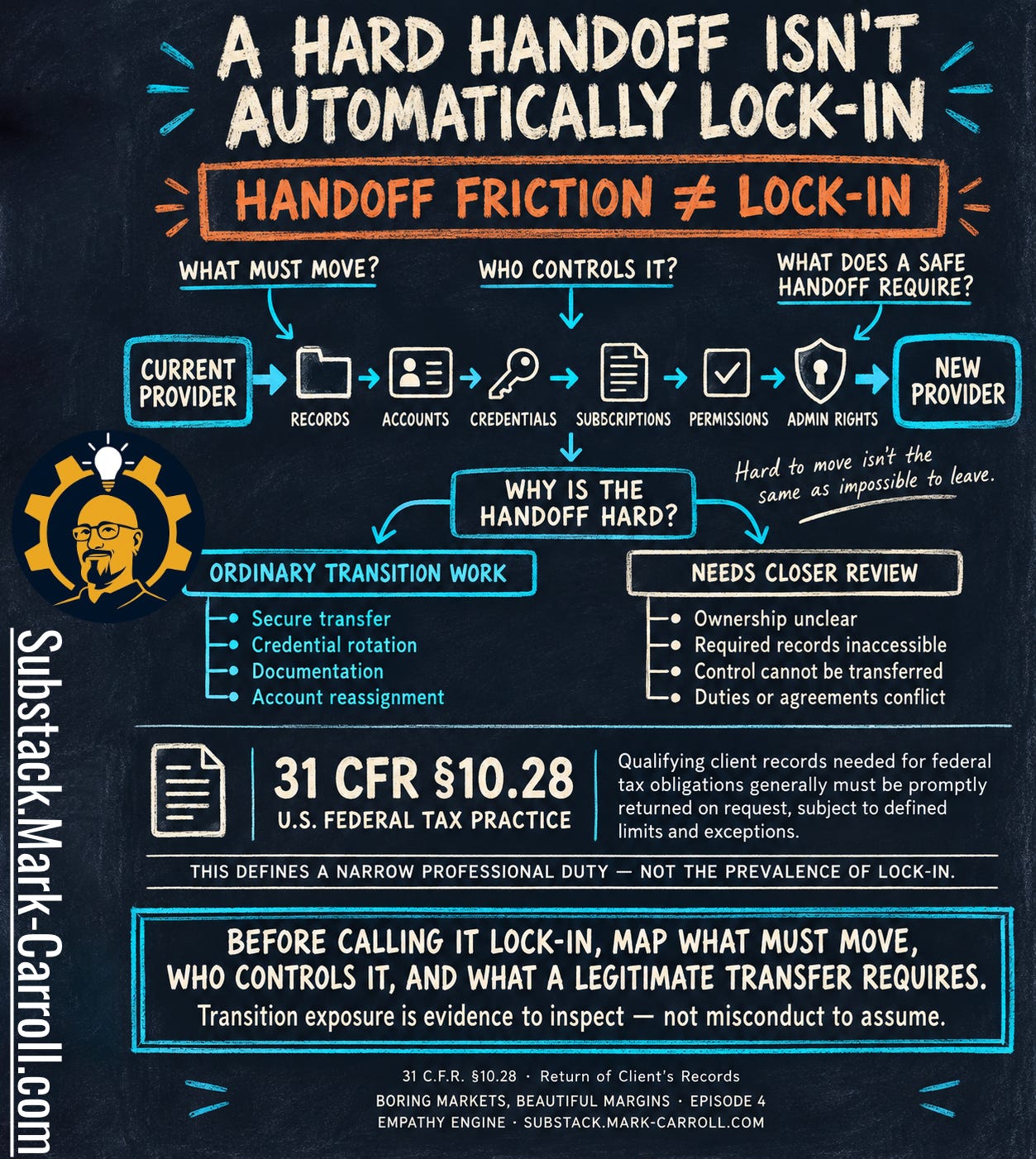
For tax practitioners, federal rules impose duties to return client records needed for compliance, subject to defined limits and exceptions.4 That is an authoritative statement about professional obligations. It is not evidence that records are routinely withheld, nor does it measure how much portability changes switching behavior. It defines a narrow professional duty, not the prevalence of lock-in.
The practical inspection question is simpler:
Can the buyer identify what must move, who controls it, and what a safe handoff requires?
If the answer is no, the entrant has found transition exposure. They have not yet found misconduct, demand, or a profitable opportunity.
Timing can turn friction on or off
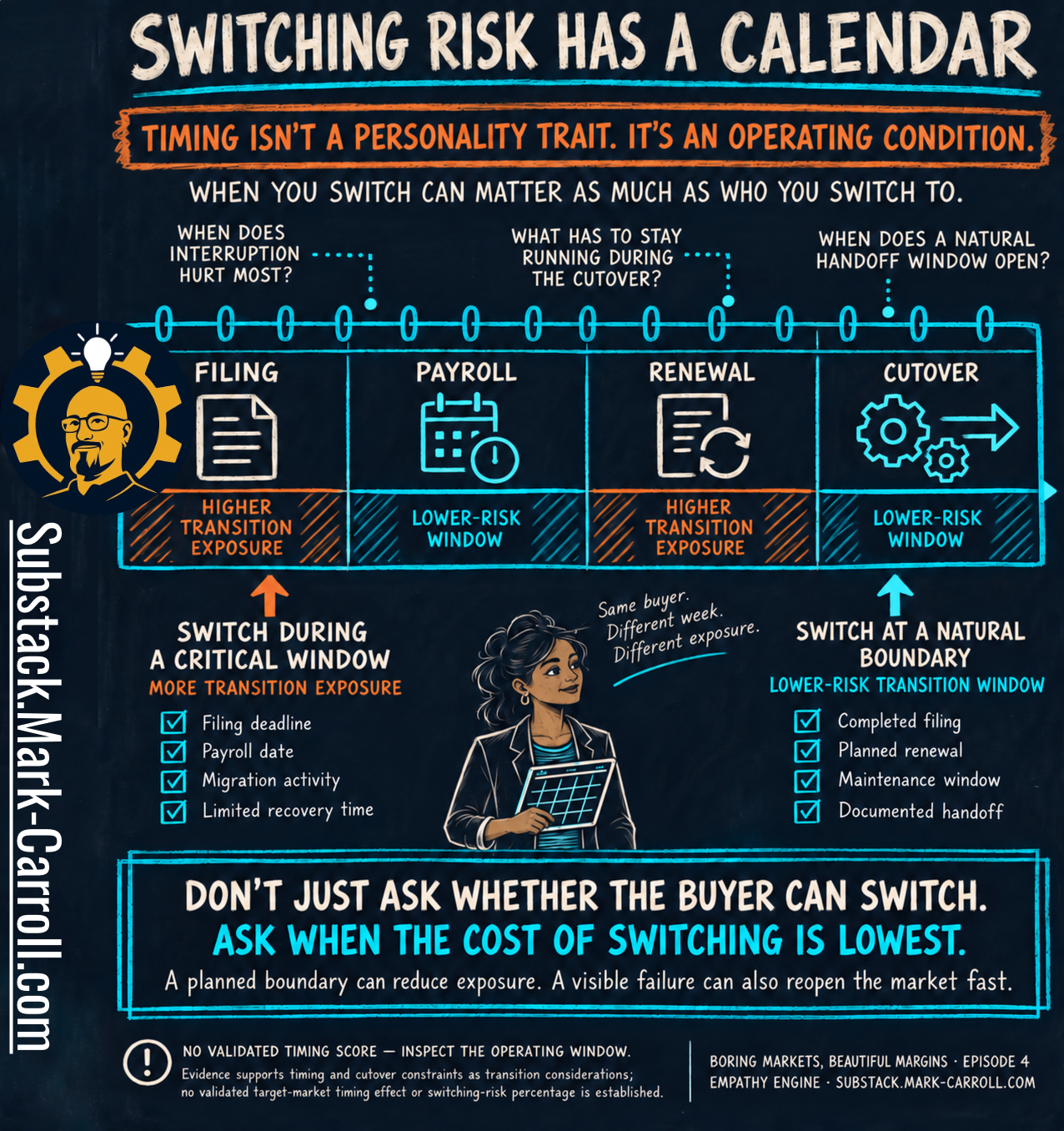
The same buyer may be highly switchable in June and nearly immovable in March.
Accounting has filing cycles. Payroll has recurring deadlines. Managed IT has maintenance windows, renewals, migrations, and periods when interruption is unusually costly. A planned boundary can lower transition risk. An active crisis can either accelerate switching or make any transition intolerable.
This is one reason a market cannot be labeled “sticky” without asking when.