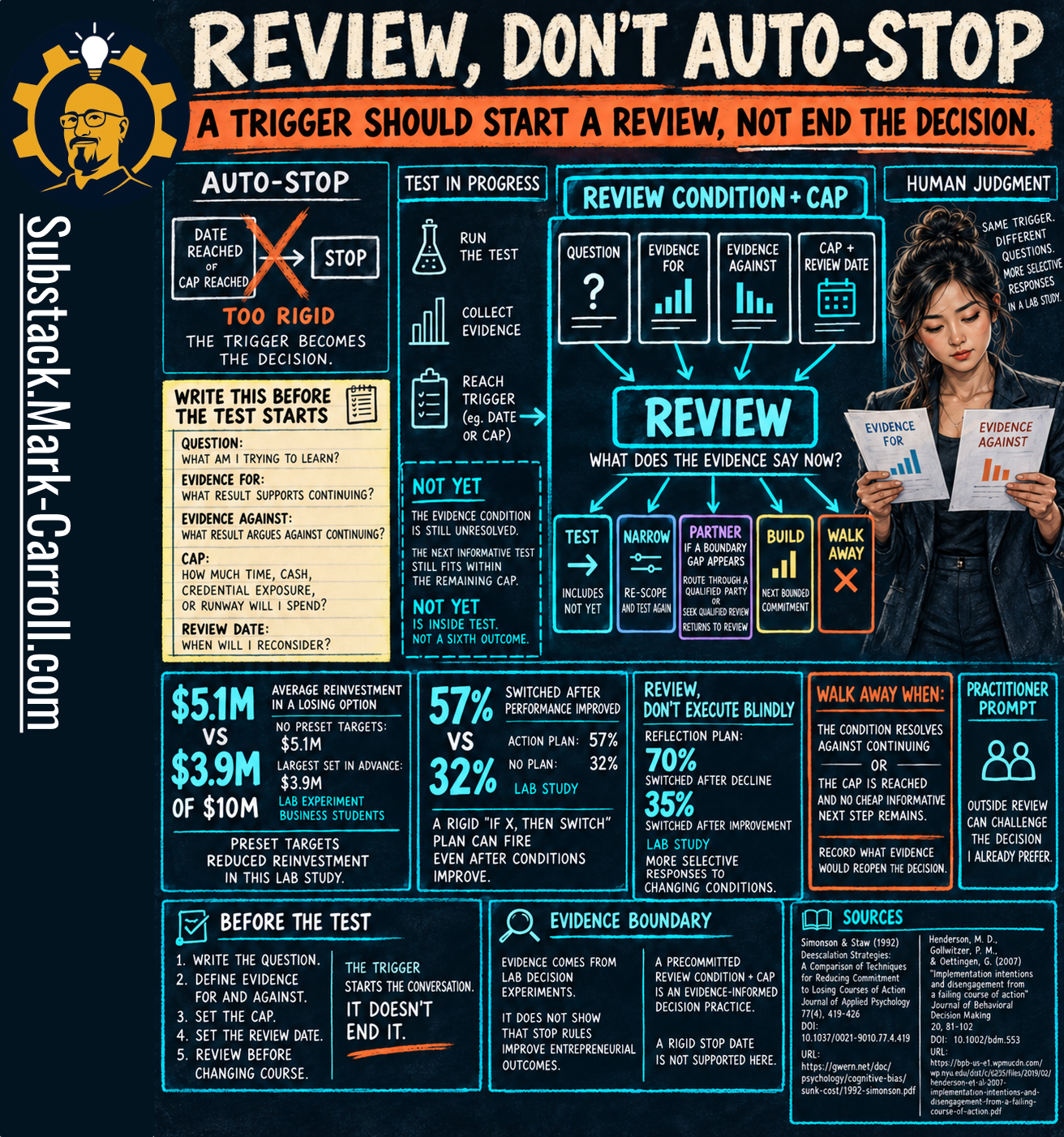
Inspect first. Then make the next bounded move.
👋 Welcome to my paid subscriber-only edition of Empathy Engine (🔒 Leader’s Dispatch). Each week I build evidence-forward tools for product leads who need to say no, defend tradeoffs, and lock in decisions before they get rewritten later.
Nina finally had a market with pain, buyers, trust gaps, and workflow mess. The question was no longer whether it was interesting. The question was what it was asking of her.
A few months earlier, that list would have been enough. She would have seen the offer before she saw the evidence, named it, priced it, and started listening for the sound of a Stripe notification. Six episodes of inspection had made her suspicious of exactly that feeling, because the moment a market starts to look like a story is the moment the story starts filling in what the evidence hasn’t.
Her notes from the season covered the kitchen table, and they did not agree with each other. The oldest page held the broad AI consulting offer that owners nodded at and never bought. The newest held Dave’s Thursday, the morning his dispatcher rebuilt the day by hand, and the narrower question it had left her with. When an emergency reassigns a crew, what travels with the job, and who confirms it arrived? Dave had said, twice, that he would probably pay for help with that.
Her phone sat face up beside the pages, open to a post a friend had sent about twenty boring businesses that quietly print money. Nina read three of them before she noticed that none of the twenty mentioned a buyer.
She took a clean page and wrote one line at the top before she let herself open anything else. What I already want to do. Under it she wrote BUILD, and then she circled it, because she knew she would spend the rest of the night trying to prove it.
Nina, Dave, and Dave’s company are a fictional composite built from recurring patterns in the research, not real people or a real business.
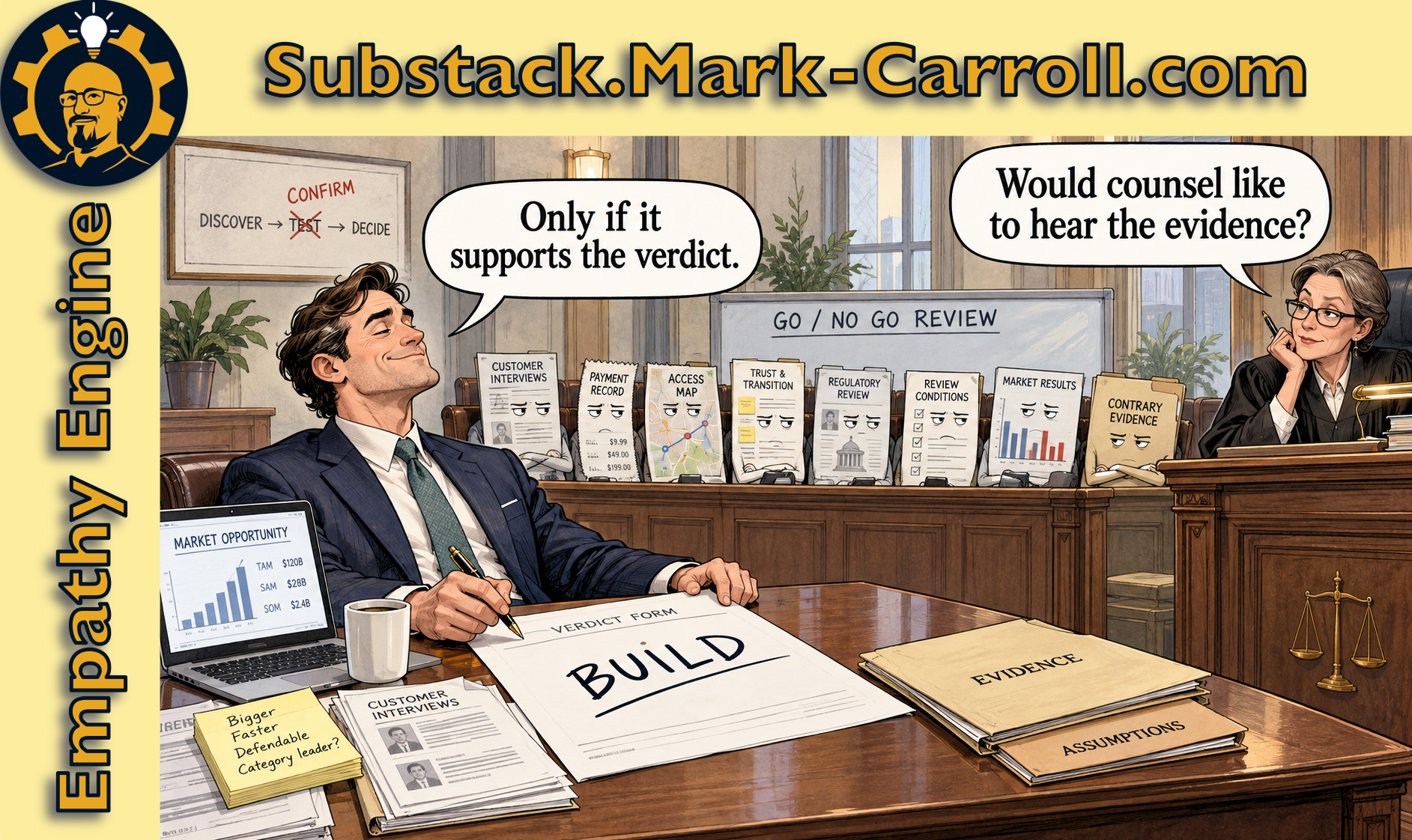
During a transformation review, I watched a PI Planning board become the evidence for a verdict the room had already reached. The board was real. The dependencies were real. The progress markers were real. But somewhere between planning and review, those signals stopped being evidence about the work and became proof that the transformation itself was working. The question had quietly shifted from “What does this board actually tell us?” to “How does this board support the conclusion we already prefer?”
A planning board can show movement without proving improvement.
The danger starts when the verdict arrives before the inspection.
This episode assembles the season into one tool, the Boring Market Inspection Kit, and nothing in it is new to you. You have already asked where an opportunity’s confidence came from, where the value in a business actually lives, and whether a pain repeats often enough to show up on the Workflow Pain Index. You have asked what has to transfer when work changes hands, what you are allowed to do, and what would have to move with the work. The Kit puts those questions in one order and adds a record at the end.
Its decision logic isn’t new either, and it doesn’t pretend to be. Stage-gate reviews, kill criteria, and scientific-method approaches to entrepreneurship have handled the mechanics of continuing or stopping for years. The Kit adapts that practice for solo builders in unglamorous service markets and makes you write the decision down before you defend it. By the end you’ll have the Kit and Nina’s completed decision record. It won’t tell you whether a market will work. It will tell you which next move your current evidence can actually support.
Episode 6:

Research Binder: the receipts, methodology notes, and source boundaries are compiled at the bottom of this post.
Boring Isn’t the Signal
The post on Nina’s phone treats boring as the find. This whole season has argued the other way. Boring is scenery. It tells you where fewer people are looking and says nothing about whether anyone there will pay, let you in, trust you, or let you do the work. So the Kit starts from the premise printed across the top of its first graphic. Boring isn’t the signal. Evidence is what you inspect.
Nina stopped sorting her notes by episode and started sorting them by question, and the pile collapsed into five. What exact work hurts, and who actually pays? Can she reach the person who actually decides? What must move, transfer, or be believed when the work changes hands? What is she actually allowed to do? What result would change her course?
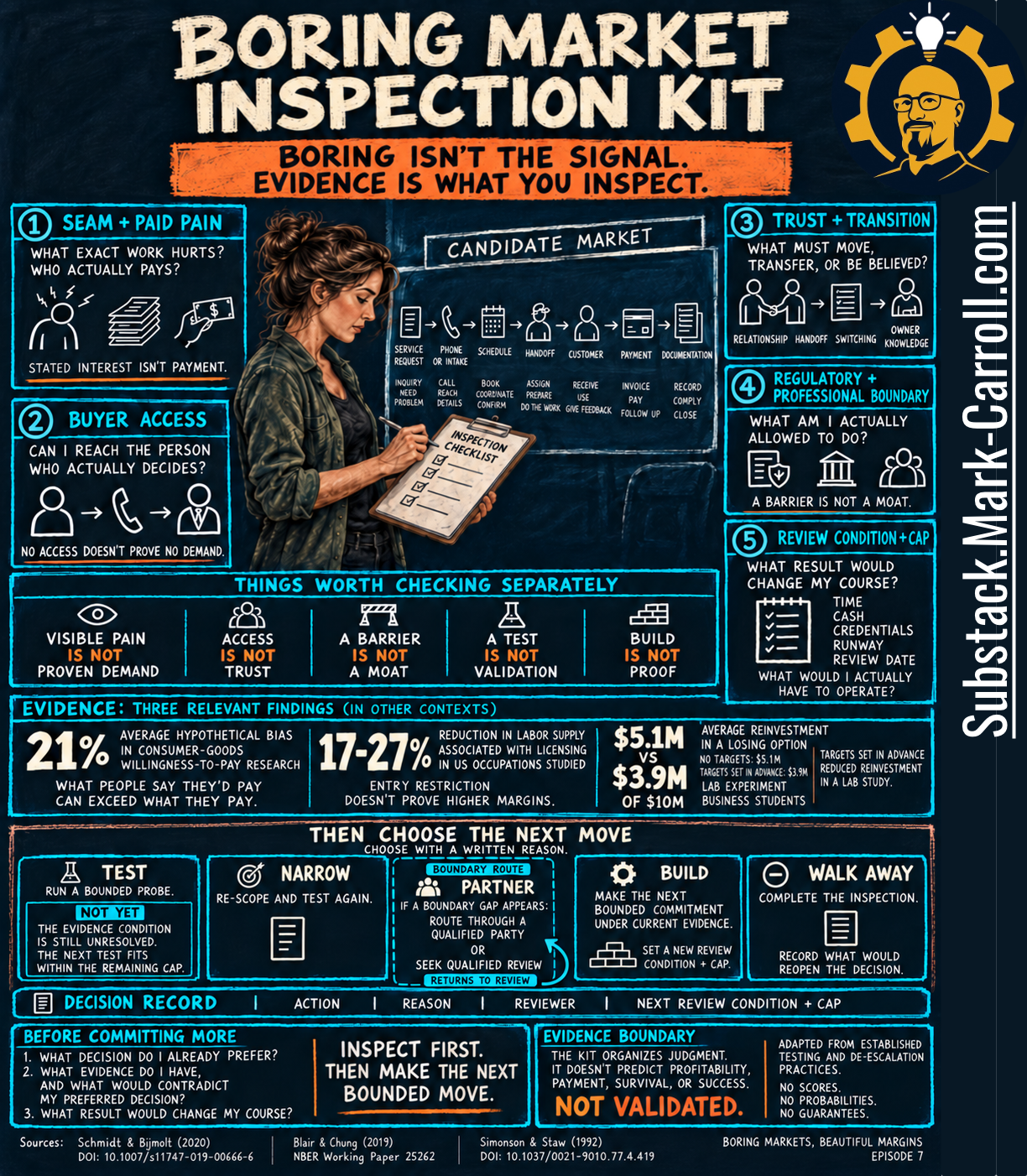
The order of the five fields is deliberate. Paid pain comes first, because nothing downstream matters if nobody pays to remove it. Access comes before trust, because a buyer you never reached can’t tell you whether they believe you. The review condition and cap come last, because they force the question every earlier field lets you postpone, which is what you would actually have to operate and what it would cost to find out.
The row across the middle collects the five confusions the season kept running into, each one a pair of things a builder wants to treat as one on the night they most want a yes. The three numbers below it each come from a different population, and the graphic labels them that way. None of them describes your market. Each describes a mechanism worth looking for in your market, and the next five sections take the fields one at a time, beginning with the one most founders answer too fast.
I’d Probably Pay for That
Episode 3 ended with a sentence Nina had underlined. The Workflow Pain Index can inspect the repeated, but paid still has to be validated downstream, and that worksheet was never built to validate it. Downstream is here, and Dave’s own words were the problem. He had said I’d probably pay for that twice, and he meant it both times. Nina had heard the same sentence from owners in Episode 1 about a different offer, and none of them paid.
A technician recalled a version of this on X in September. A modem, router, and server sat in an attic under a hole in the roof about two feet across, in standing water. He told the customer what the fix was, and the customer declined. Three months later the gear had been moved downstairs, and they still wouldn’t pay to replace equipment that had sat in the rain.1 The pain was visible, expensive, and real, and it never became a purchase order.
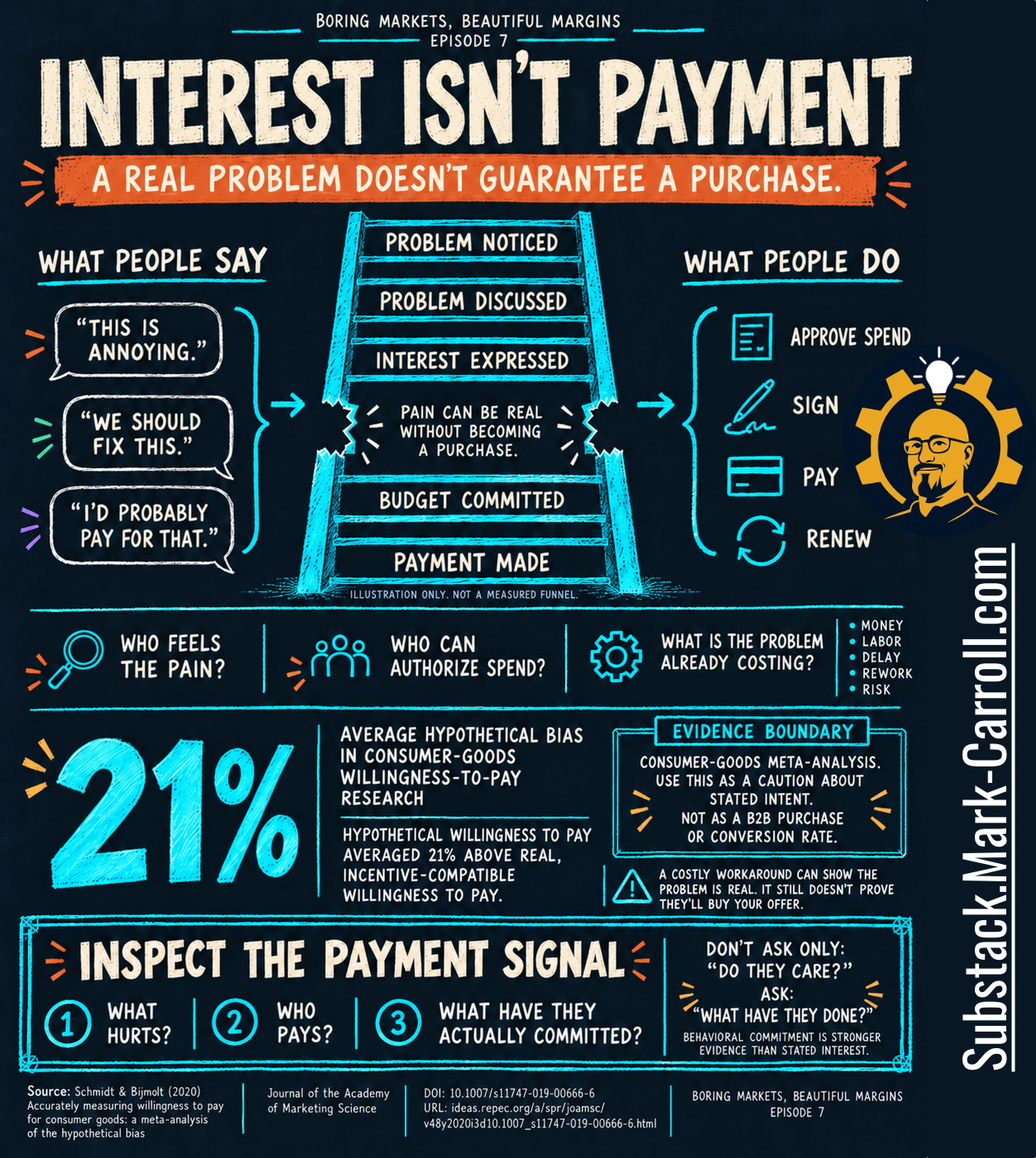
The ladder on the graphic has a break in it on purpose, between interest expressed and budget committed, and most of what a builder hears in early conversations lives above that break. The label underneath matters as much as the ladder. It is an illustration, not a measured funnel, because nobody has measured how often small-business pain crosses that gap, and this article won’t pretend to.
What we do have is a caution from a neighboring field. In a meta-analysis of consumer-goods research, hypothetical willingness to pay averaged 21 percent above real, incentive-compatible willingness to pay.2 The evidence boundary on the graphic says how far that number travels. It is not a B2B purchase rate or a conversion rate. It is a reason to treat I’d probably pay for that as a statement of intent, which is a different object from money changing hands.
The three questions under the ladder split one fact Nina had been treating as whole. Dave’s dispatcher feels the pain every Thursday. Dave is the one who can authorize spend. The problem already costs the shop rework when a tech arrives without notes and delay when a restaurant waits on a call back. A costly workaround like the dispatcher’s group chat shows the pain is real, and it says nothing about whether Dave will pay a stranger to change it. When Nina asked what Dave had actually committed, the honest answer was nothing yet. In the Workflow Pain Index’s vocabulary, his payment was Not Observed.
That is why the graphic ends on a different question. Asking whether they care gets you sympathy. Asking what they have done gets you evidence, because behavioral commitment already cost the buyer something. Sometimes, though, the first thing a builder learns is that the offer never reached anyone who could make that commitment at all.
Silence Is Not the Same Evidence as No
Dave was easy to reach. Nina had found him through a referral chain three people long, and by now he answered her texts from job sites, which made him a misleading sample of one. The second shop on her list had an office manager who took messages and an owner who was on a roof until six. Her offer, if it got that far, would be a forwarded email in that office manager’s inbox, the corporate void where PDFs go to die, scaled down to a twelve-person shop.
In August, an automation builder posted in a GoHighLevel community after cold-calling HVAC shops with a lead-conversion offer he had already built. The calls ended before the second sentence of his script, with some version of not interested, or I’ve got enough jobs.3 Commenters pointed to peak season and a labor shortage. Shops with full calendars weren’t short of what he was selling.
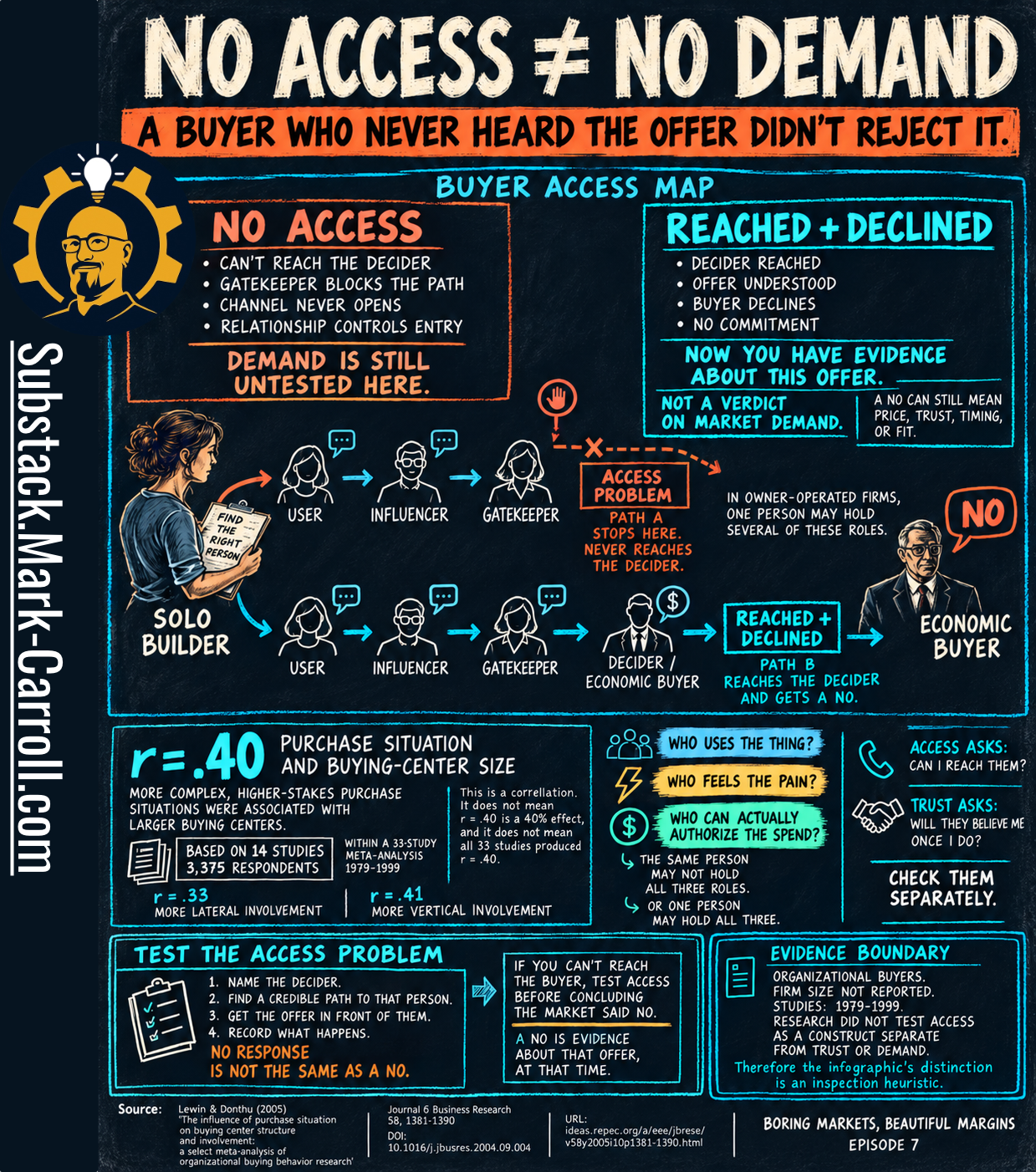
The map gives Nina’s second shop and the HVAC caller separate paths, because they produced different findings. Path A stops at the gatekeeper and never reaches the decider, which is where Nina stood, and demand is still untested there. Path B reaches the decider and gets a no, which is the HVAC call. That is evidence about this offer, and a no can still mean price, trust, timing, or fit. Peak season is timing.
The buying-center research behind the graphic is narrower than the distinction it supports. A meta-analysis of organizational buying studies found that more complex purchase situations were associated with larger buying centers, r = .40.4 That correlation comes from organizational buyers in studies run between 1979 and 1999, with firm size unreported, and none of those studies tested access as something separate from trust or demand. The graphic calls its own distinction an inspection heuristic, which is the right label. In owner-operated firms one person may hold several roles, and at Dave’s shop the dispatcher feels the pain while Dave authorizes the spend, so Dave’s interest and his dispatcher’s frustration are two separate pieces of evidence.
r = .40 means that more complex purchase situations tended to be associated with larger buying centers. As one went up, the other tended to go up too. It does not mean “40% more,” “40% likely,” or that complexity caused larger buying centers.
A rough way to read correlation coefficients is:
r = 0: no linear relationship
r around .10: weak
r around .30: moderate
r around .50 or higher: fairly strong
Nina ran the four steps at the bottom on her second shop. She could name the decider. She had no credible path to him, though Dave knew him from the supply house and that might become one. The offer hadn’t reached him, so there was nothing yet to record. No response is not the same as a no, and if you can’t reach the buyer, test access before concluding the market said anything at all. Access gets you into the room, though. It doesn’t make the room trust you.
The Book Walked Out With the Seller
By now Nina’s offer had shrunk to something she could say in one sentence. She would not run anyone’s Thursdays, because the last episode had settled that. She would sit with a shop’s dispatcher for two weeks and build what Dave’s shop was missing, a reassignment card that travels with an emergency job and a step where the tech confirms he has what he needs, and the shop would own it afterward. It sounded portable until she wrote down where the card’s contents currently lived, and most of the answers were a person.
Acquisition threads make this point more bluntly than research does. In a bookkeeping forum in 2025, someone planning to buy a practice with roughly $200,000 in revenue asked for advice, and the commenters barely mentioned price. They said the clients might be there for the owner, and one described a colleague whose seller reopened down the street and took the book back.5 In an accounting forum that December, a buyer of two firms said he wouldn’t do it again, and another commenter said clients are usually loyal to the owner.6 Nobody disputed that the practices had revenue. The question was whether the revenue would follow the work to a new name.
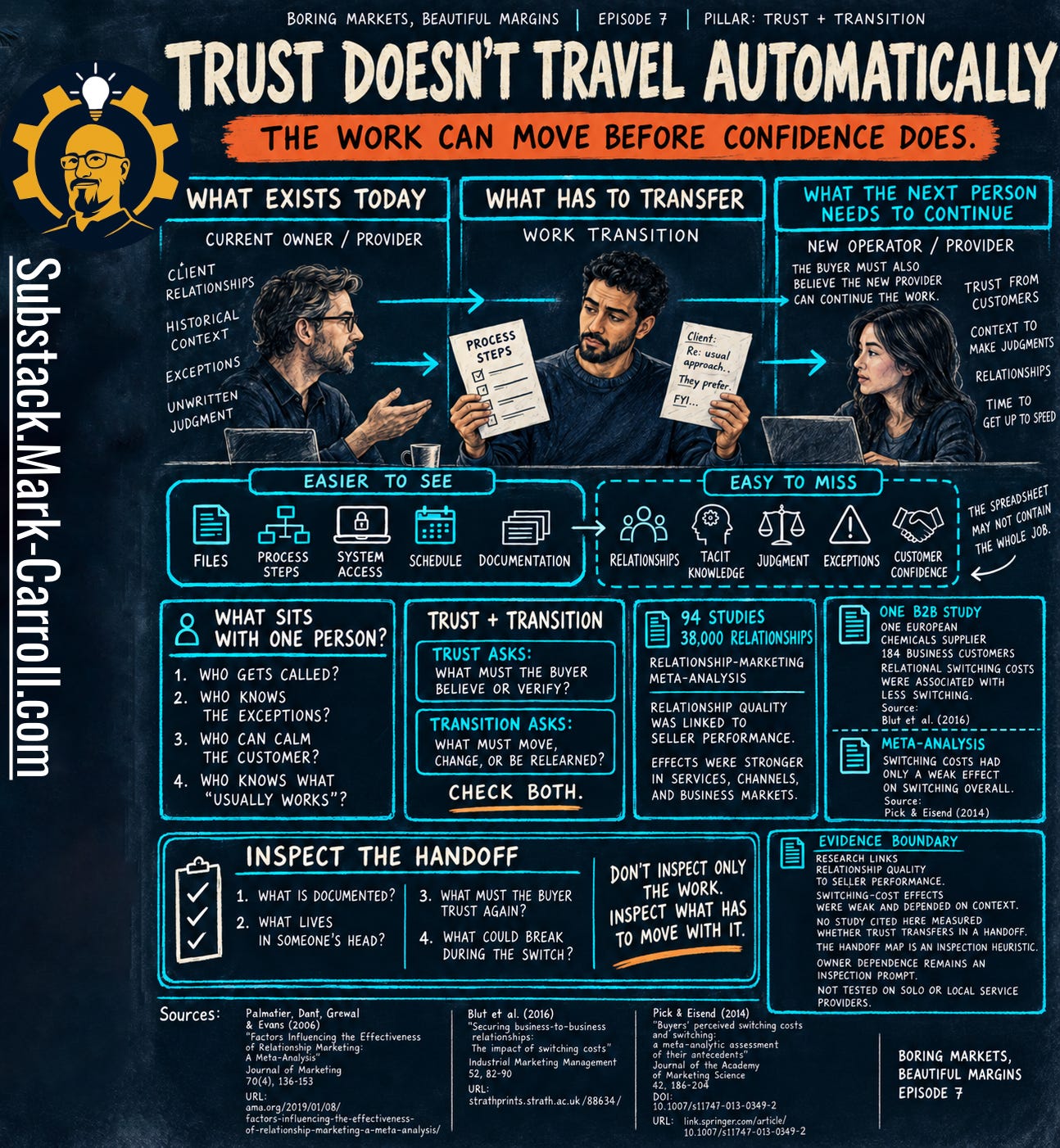
The work can move before confidence does. The middle figure on the graphic holds two pages, the process steps and a note about how a client usually likes things done, and the second page is the one that never makes it into the system. The spreadsheet may not contain the whole job, which is what Dave’s dispatcher demonstrated at 9:20 on a Thursday.
The four questions on the left are the question this season asked about where value lives in a business, turned on a single handoff. At Dave’s shop the dispatcher gets called, knows the exceptions, and knows what usually works, while Dave is the one who can calm the customer. Every one of those answers is a person Nina’s card would have to learn from without replacing.
The research supports the direction and stops short of the claim builders want. Relationship quality is linked to seller performance across a large body of relationship-marketing studies, with stronger effects in services and business markets.7 Among one supplier’s business customers, relational switching costs were associated with less switching,8 yet across the broader literature switching costs have only a weak effect on switching.9 Trust matters, and it is not a wall. The graphic’s evidence boundary is candid about the rest. No study cited here measured whether trust transfers in a handoff, and none tested solo or local providers, so the handoff map and its owner-dependence prompt are inspection tools.
That is why the graphic asks two questions instead of giving a verdict. Trust asks what the buyer must believe, and transition asks what must move or be relearned. For Nina, Dave had to believe a stranger could sit beside his dispatcher during a live week without breaking it, and the dispatcher had to believe the card would carry what she knew about the restaurant’s back door. When Nina reached the last inspection question, what could break during the switch, her honest answer was a Thursday, and two weeks of setup would include two of them. Then she reached the line on the card she wanted most and found it wasn’t hers to write.
A Barrier Can Be Real Without Being Your Advantage
The field she kept wanting to add was triage. When the restaurant calls with a tripped main, should the tech treat it as urgent or finish the current job first? The dispatcher answered that from experience every week, and a card that captured her answer would be the most useful line on it. It would also be a non-electrician writing guidance about when an electrical fault needs a licensed person on site. Episode 5 had taught Nina what that sentence is. It is a boundary question, and it does not get answered late at night by the person who wants the answer to be yes.
A bookkeeper described the same kind of gate from the other side in 2025. An accountant told her that accountants believe they can do the work themselves, so the path to competing with them was the license, and she didn’t want the hours or the tax work.10 The credential wasn’t protecting her market. It stood between her and the part of it she wanted.
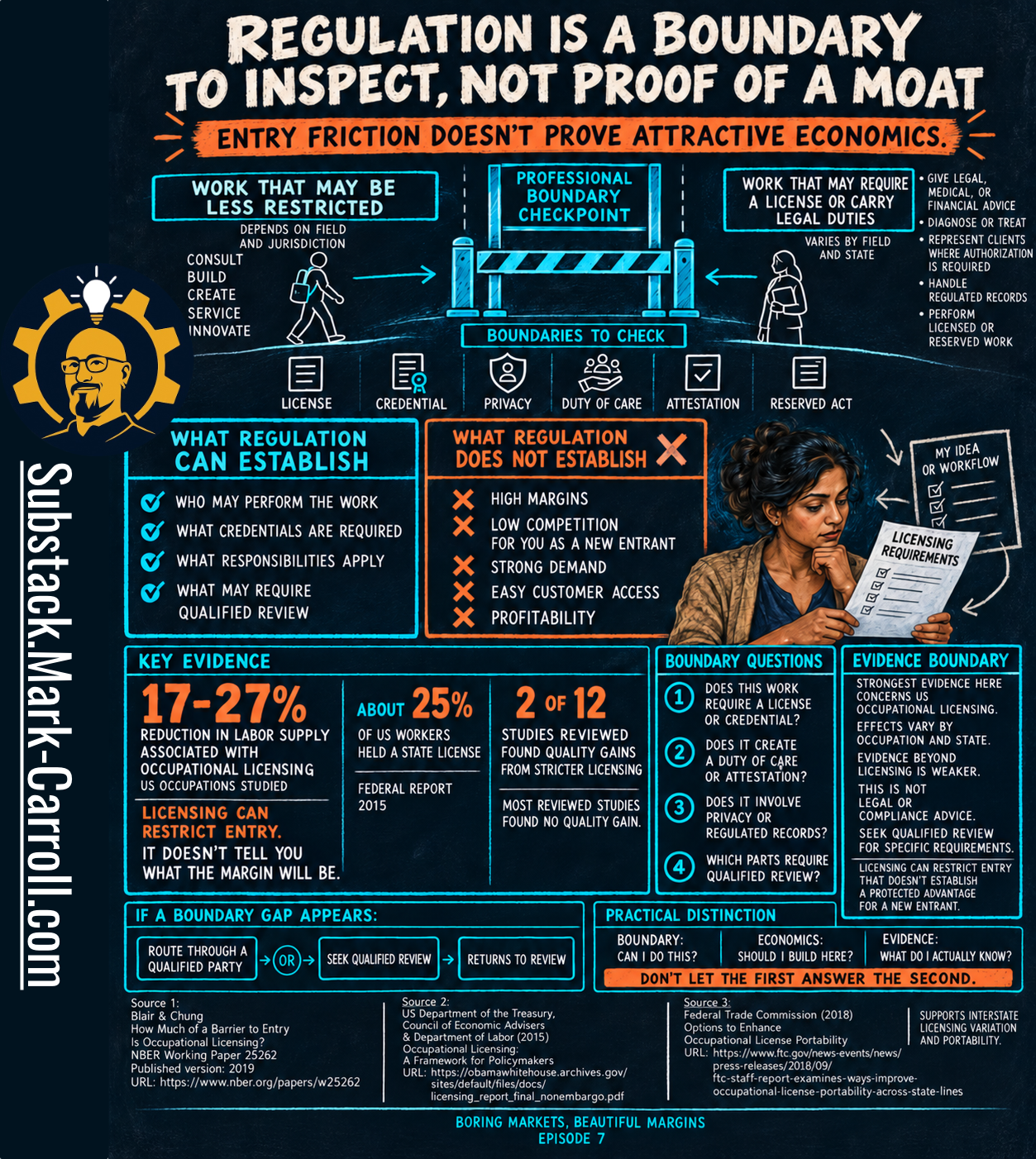
Entry friction doesn’t prove attractive economics, and the two boxes under the checkpoint show why. Regulation can establish who may do the work and what responsibilities attach to it. It does not establish margins, demand, easy access, or profit for a new entrant, and builders tend to read the first box and hear the second. The market doesn’t owe you an exception because the business model looks good in Notion.
The licensing evidence is the strongest on any graphic this season, and it still doesn’t say what builders hope. In a study of U.S. occupations, licensing was associated with a 17 to 27 percent reduction in labor supply.11 A 2015 federal report found that about a quarter of U.S. workers held a state license and that only 2 of the 12 studies it reviewed found quality gains from stricter licensing.12 Licensing can restrict entry, and it still doesn’t tell you what the margin will be. Outside licensing the evidence gets thinner and varies by field and state, which is why none of it substitutes for qualified review of your own facts.
Nina ran the four boundary questions on her card. The triage line might require a license, and it might create a duty if a tech relied on it. Customer addresses and site notes touched privacy, so she marked that to check. The triage line, for certain, needed qualified review. So she took the route at the bottom of the graphic. Dave’s licensed electrician would write the triage line in his own words, and the card would carry it. Nina would build the card without authoring the judgment.
That is the only meaning PARTNER has in this Kit. It isn’t the friendly option, and it isn’t knowing someone with a license. When a boundary gap appears, you route through a qualified party or seek qualified review, the move Episode 5 simply called qualified review, and then you return to the decision. The practical distinction at the bottom of the graphic keeps three questions apart, whether you can do this, whether you should build here, and what you actually know, and it refuses to let the first answer stand in for the second.

Precommit the Review. Don’t Precommit the Answer.
The HVAC builder from August ended his post caught between two things he didn’t want. He didn’t want to throw away the hours he had spent, and he didn’t want to keep grinding on calls that died before the second sentence.3 He had never written down what result would tell him which to do, so every new call reopened the same argument. Once we start, most of us become very talented lawyers for our previous decisions. The landing page is built, people have been told, six weeks are gone, and one more month starts to sound entirely reasonable.
I’ve sat in release-readiness reviews where “not ready” existed on the slide but not in the room. By then, communications were scheduled, teams were staffed, dependencies had moved, and leaders had already told people what was coming. The review became a search for mitigations instead of a genuine decision about readiness. The gate still existed. The option to fail it had disappeared.
A gate is only real if “not yet” is still allowed.
Otherwise it’s ceremony with a timestamp.