


Case Closed. Evidence Pending.
👋 Welcome to my paid subscriber-only edition of Empathy Engine (🔒 Leader’s Dispatch). Each week I build evidence-forward tools for product leads who need to say no, defend tradeoffs, and lock in decisions before they get rewritten later.
Paul Hendricks caught Maya at the elevator after the quarterly forecast review.
“Your Segment C number was off again,” he said. “My regional leads tell me Dev isn’t checking his sources. That’s twice this year. It should be in his review.”
The doors opened, and he was gone before she could answer.
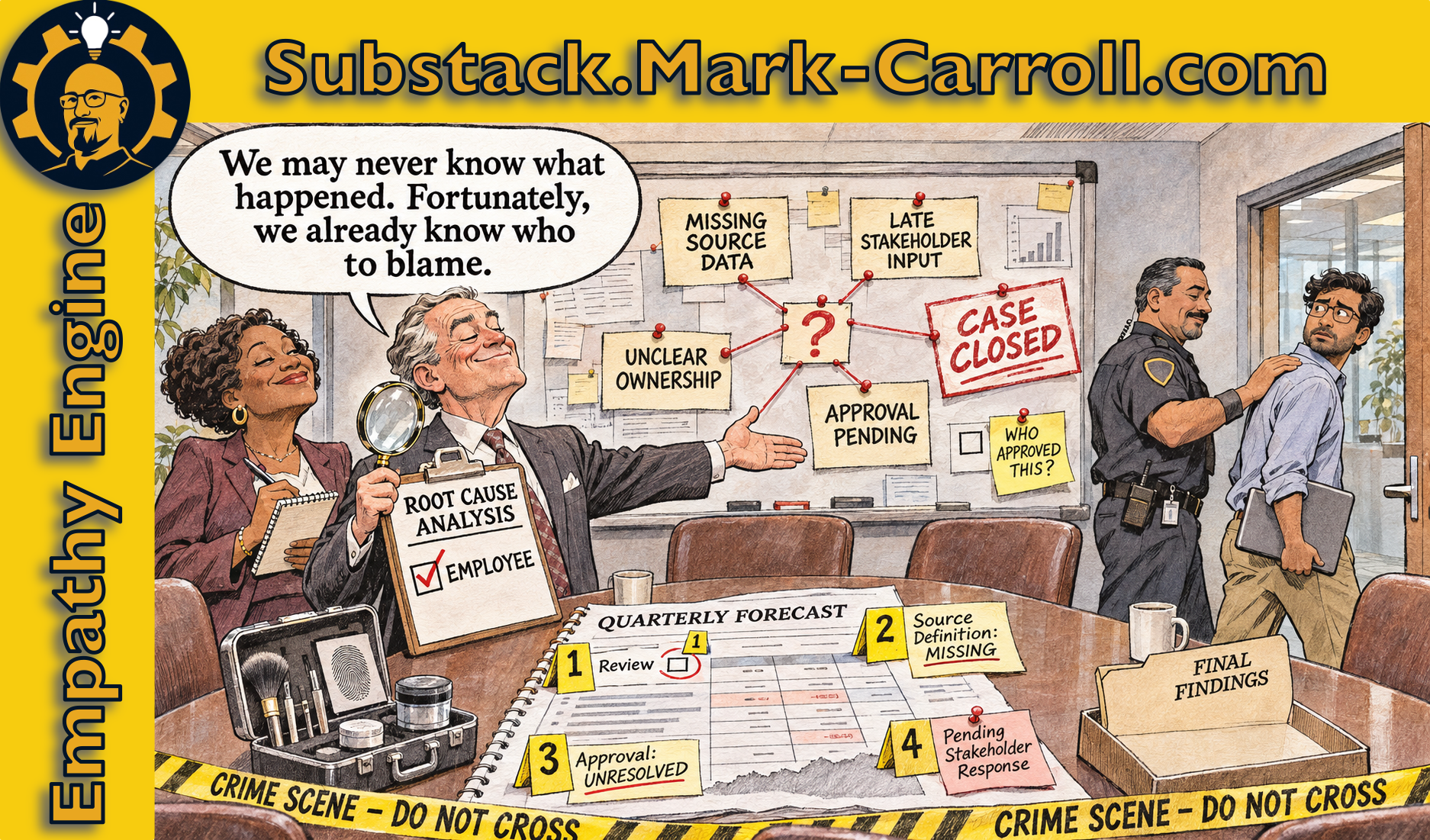
From a new analyst, those words would have earned an obvious question: how do you know? But Paul runs commercial planning. He sits two levels above Maya, and he’s usually right about the numbers. Coming from him, the same sentence sounded like a finding.
That evening Maya opened Dev’s performance notes.
Under Forecast Quality she typed “Dev was responsible for” and stopped.
Part of Paul’s sentence was plainly true. Segment C, the Central regional split, had missed by more than the other two segments, and its line on the forecast review carried no check mark. And this time the expectation was clear. Three weeks earlier, after the regional splits went out unmarked, Maya had put the standard in writing: any new or changed definition counts, and if there isn’t time to confirm one, mark it unconfirmed and tell her before it leaves the team.
The rest of Paul’s sentence she hadn’t checked. That Dev caused the miss. That the cause was skipped source checks. That it had happened twice. She was about to put another leader’s conclusion into Dev’s record under her own name.
She highlighted the half sentence and left it there.
(Maya and Dev are fictional characters who appear throughout this series. Their story illustrates a managerial decision, not a research finding.)
Research Binder: the receipts, methodology notes, and source boundaries are compiled at the bottom of this post.
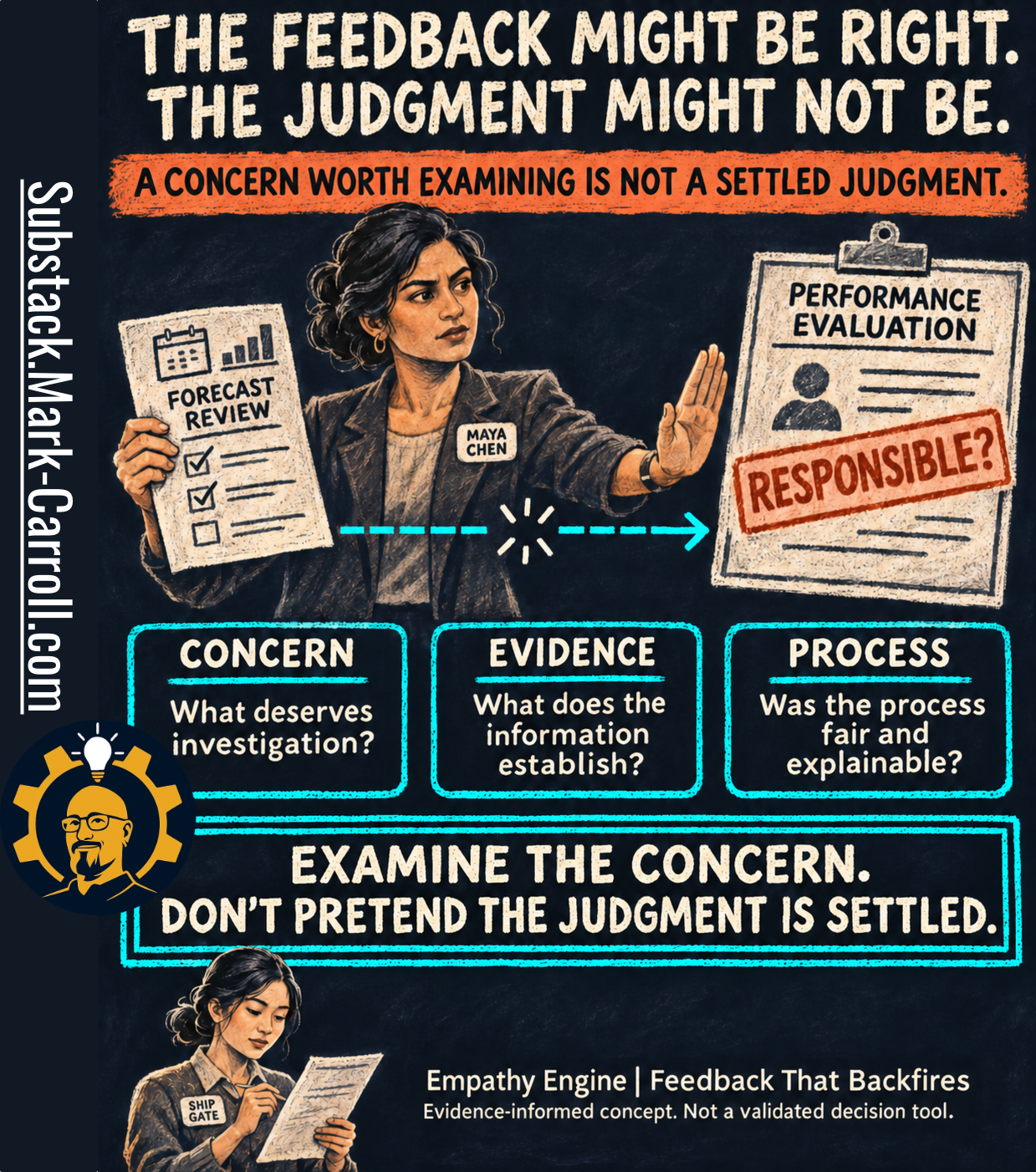
A concern worth examining is not a settled judgment. Maya had a concern: a segment that missed and a review step left blank. What she didn’t have was the judgment Paul handed her. The infographic splits that difference into three questions most managers answer in a single breath. Concern: what deserves investigation? Evidence: what does the information establish? Process: was the process fair and explainable?
Those questions come apart in real life. A real concern can arrive with thin evidence. A fair process can end in a conclusion the employee dislikes. A weak process doesn’t make a real problem vanish. The three draw on separate research traditions, and nobody has tested them together as a model, so treat them as a way to slow down rather than a validated decision tool.
Examine the concern. Don’t pretend the judgment is settled.
What could Paul actually know?
The next morning Maya wrote down what Paul could have seen. He had the review deck, so the Segment C variance was firsthand. The explanation, “isn’t checking his sources,” wasn’t in any deck. It was someone’s theory about why a number missed, and it had reached Paul through his regional leads.
She checked the one part she could verify from her desk. The other miss this year, in Q2, was on the mid-market segment, and another analyst had owned it then. Dev took over the segment work in July. Whatever “twice” meant, it didn’t mean twice for Dev.
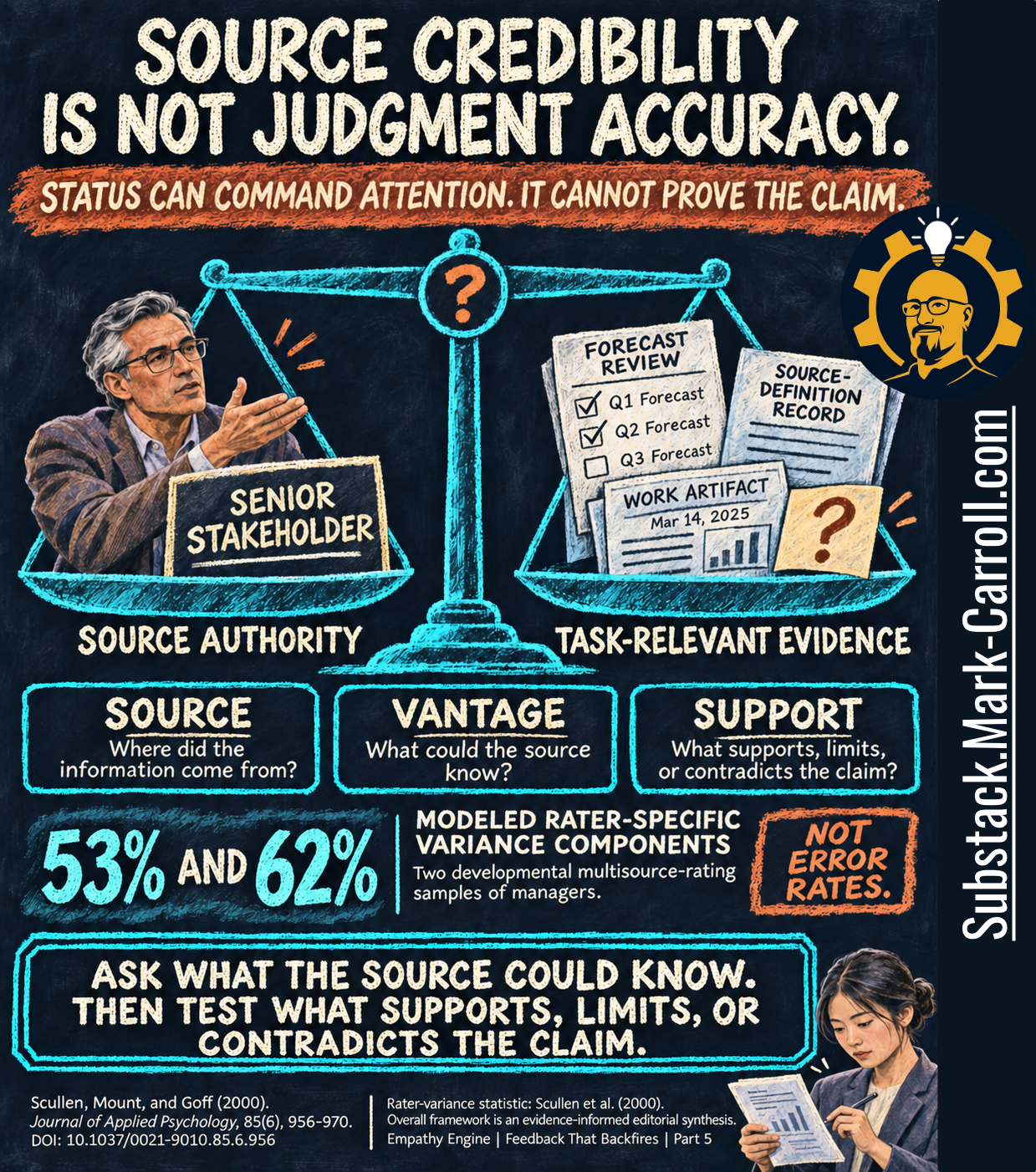
Status can command attention. It cannot prove the claim. That isn’t a knock on Paul. Credibility does real work. In 1979, Daniel Ilgen, Cynthia Fisher and Susan Taylor organized feedback research around a sequence: whether people perceive feedback, accept it, and are willing to respond. How credible the source seems runs through that sequence. Their idea of credibility includes expertise, and expertise includes familiarity with the person’s actual work, which seniority doesn’t supply on its own. All of it concerns how feedback is received. Perceived credibility is not accuracy.
The percentages on the infographic carry their own warning label. Steven Scullen, Michael Mount and Maynard Goff modeled performance ratings of managers in two developmental multisource-rating samples. Idiosyncratic rater components accounted for about 53% and 62% of rating variance across the two samples. Those are not error rates. They don’t say how often any rater, Paul included, gets a judgment wrong. They are a reason not to treat a rating as if it were independent of the person giving it.
So Maya’s question wasn’t whether she respected Paul. It was the infographic’s sequence. Source: where did the information come from? Vantage: what could the source know? Support: what supports, limits, or contradicts the claim?
That raises the objection this episode has to answer. Shouldn’t the truth matter regardless of who says it? Yes. That’s exactly why Paul’s title can’t stand in for it.
Maya asked Paul which lead had raised the issue. He named Priya Nair, who covers the Central region.
Secondhand doesn’t mean second-rate
One shortcut was still open. Paul hadn’t seen the problem happen, so Maya could file the whole thing under hearsay. She called Priya instead.
Priya had seen something specific. Segment C ran high for her territory, and the account list behind it still held two accounts that moved to enterprise in August. She didn’t know who maintained the list or how account moves reached forecasting. She had said nothing about Dev. “Isn’t checking his sources” had joined the story somewhere between Priya’s message and the elevator.
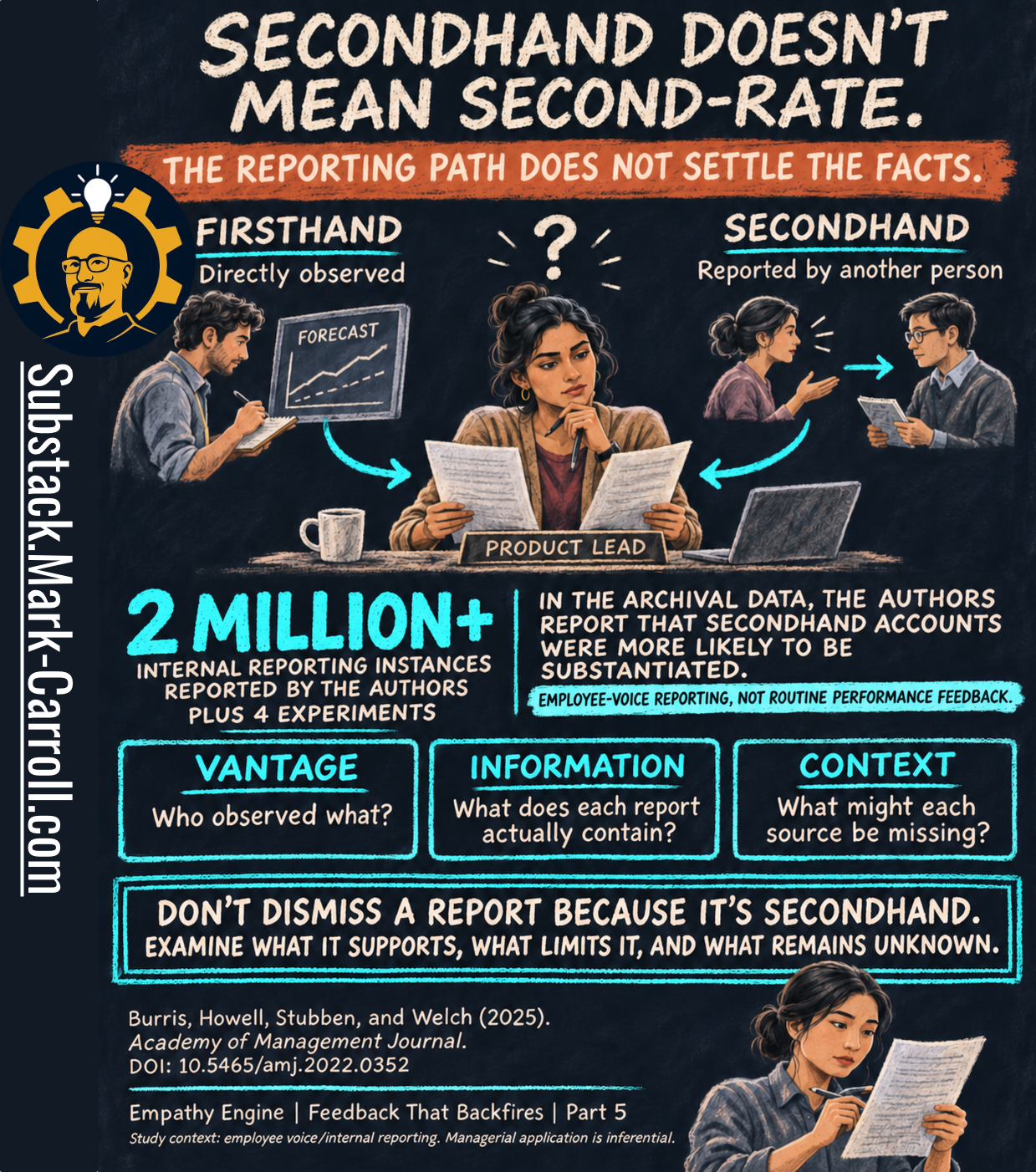
The reporting path does not settle the facts. A firsthand observer can see an outcome without its background. A secondhand account can carry a record the observer never saw, or it can pick up distortion along the way.
The strongest research here comes with a scope line attached. Burris, Howell, Stubben and Welch studied how managers judge secondhand accounts of employee voice, in the Academy of Management Journal. The authors report archival data covering more than two million internal reporting instances, plus four experiments. In that reporting setting, they report, secondhand accounts were more likely to be substantiated than firsthand ones.
Read the scope before you borrow the finding. The setting was internal employee-voice reporting, not routine performance feedback, and substantiation inside a reporting system isn’t the same thing as factual truth. Carrying the result into Maya’s situation is an inference. What it does undercut is the reflex that secondhand means ignore.
Maya ran the infographic’s three questions against what she now had.
Vantage. Who observed what? Priya saw the territory number and the account list. Paul saw a variance in a deck.
Information. What does each report contain? Priya’s held two misassigned accounts. Paul’s held a verdict.
Context. What might each source be missing? Priya didn’t know how account moves reached the forecast team. Paul didn’t know what Priya had actually found.
Don’t dismiss a report because it’s secondhand.
Examine what it supports, what limits it, and what remains unknown.
The gap is real. Whose gap is it?
Now Maya had something she could inspect. What she had was an observation, not an attribution.
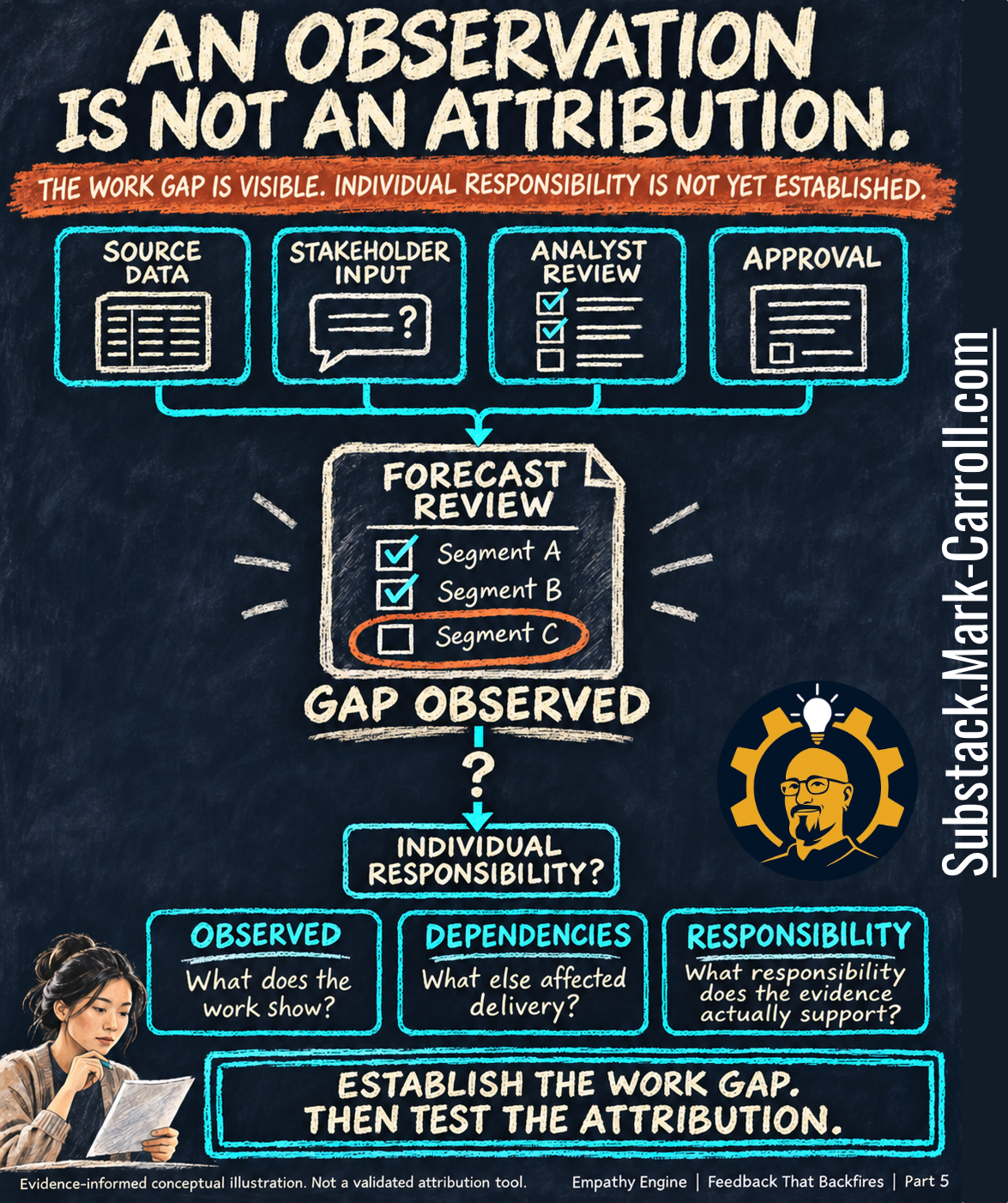
The work gap is visible. Individual responsibility is not yet established. The diagram’s top row shows how a segment forecast gets made on Maya’s team: source data, stakeholder input, analyst review, approval. Those are the work streams that feed the result, not a list of proven causes.
Maya sorted what she had under the infographic’s three headings.
Observed. What does the work show? Segment C’s analyst review was never checked off, and its account list still included the two reassigned accounts.
Dependencies. What else affected delivery? The account moves came from commercial. When and how they were supposed to reach Dev, she didn’t know.
Responsibility. What responsibility does the evidence actually support? The unchecked review step was Dev’s. The approval was hers. She had signed off on a forecast with an empty box on it.
That last line stung more than anything Paul had said.
She could feel the pull in the other direction, too: point at the commercial handoff and clear Dev completely. That’s the same jump, reversed. Establish the work gap. Then test the attribution. Testing it needed Dev.
