The sentence felt finished
👋 Welcome to my paid subscriber-only edition of Empathy Engine (🔒 Leader’s Dispatch). Each week I build evidence-forward tools for product leads who need to say no, defend tradeoffs, and lock in decisions before they get rewritten later.
Maya Chen found the sentence three lines into Dev’s mid-cycle development notes. (Maya and Dev are fictional, built to illustrate this series.)
“You need to be more strategic.”
She had written it twenty minutes earlier, and it had felt finished. It was short, it was serious, and she believed it was true.

I’ve given feedback along the lines of “You need to take ownership.” Looking back, that sentence leaves too much for the other person to supply. If I mean “raise the dependency before the planning meeting,” I need to say that. I also need to check whether resolving it requires authority they don’t have. My concern about the unfinished work might still be valid. But I haven’t made the request clear just because I’ve named a quality I want to see in the person.
Research Binder: the receipts, methodology notes, and source boundaries are compiled at the bottom of this post.
Last week, Maya reopened one feedback conversation with Dev and found it less settled than it felt. One of her three examples was wrong, Dev had understood her ask differently, and the conditions around the work had shifted.
Previous:

Now she was writing again, and she noticed something about her own draft. The sentence named a judgment. It didn’t say what it was asking for.
Last week I promised to look at what a feedback message points at. The research narrowed that into a more useful question: what does the message itself specify?
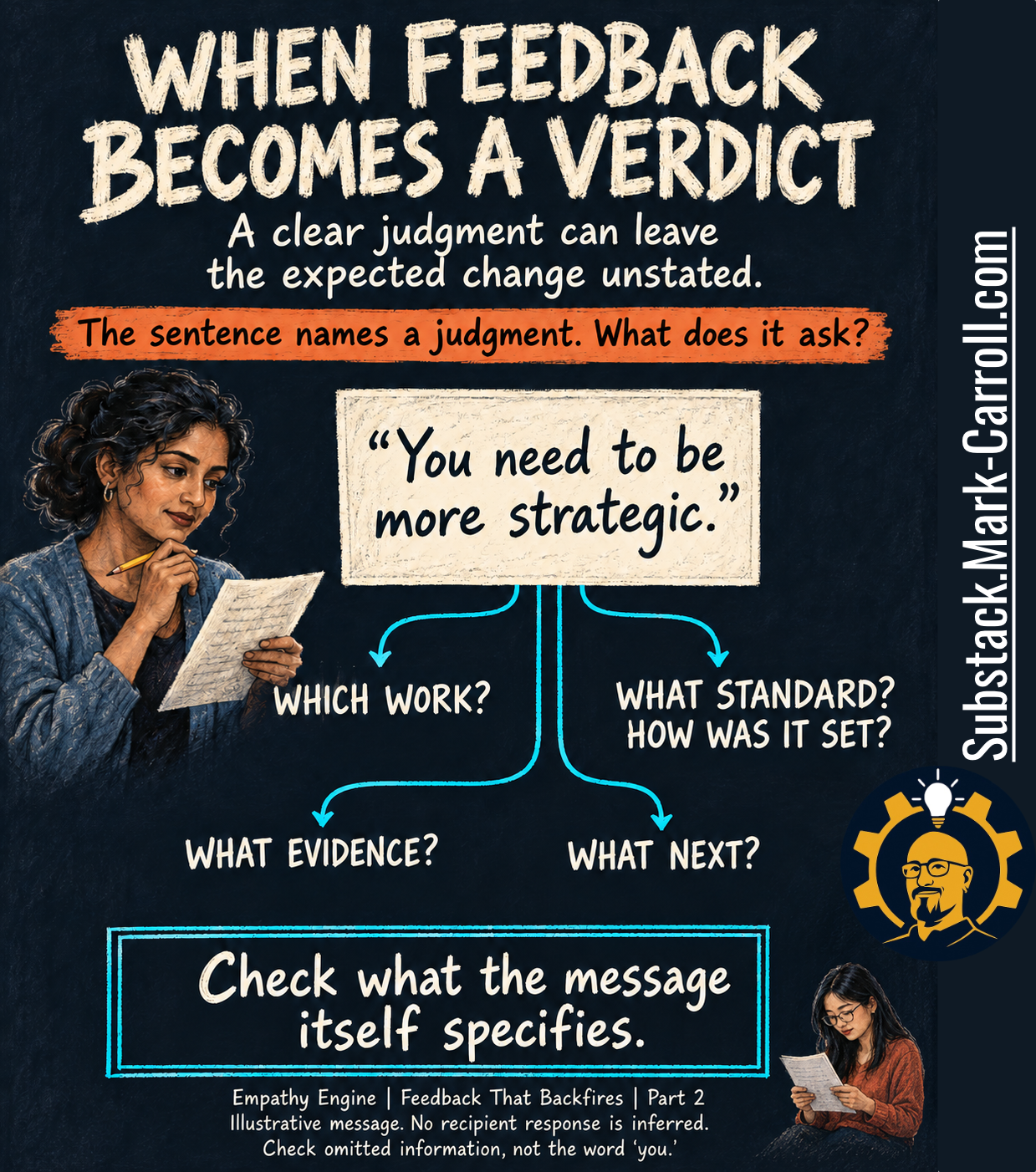
Read Maya’s sentence again and ask what it leaves unstated.
Which work? It names no forecast, no draft, no decision.
What standard, and how was it set? “Strategic” names a quality without saying what it looks like in Dev’s role, or whether anyone ever said so.
What evidence? Nothing in the sentence says what Maya saw.
What next? Nothing says what should change in the next forecast.
Two cautions keep this check honest. First, missing from the message doesn’t mean unknown to Dev. This is a check on the words on the page, not on his mind. Maya hasn’t sent them, so there is no response to read into.
Second, the problem isn’t the word “you.” Rewrite the line as “More strategic thinking is needed” and the pronoun is gone. Every question is still open.
A clear judgment can leave the expected change unstated.
An average isn’t a forecast
First, the same counterweight as last week.
In 1996, Avraham Kluger and Angelo DeNisi published a meta-analysis of 131 papers and 607 effect sizes, each comparing a feedback group with a no-feedback control. The studies were published before 1996, and most were laboratory research.
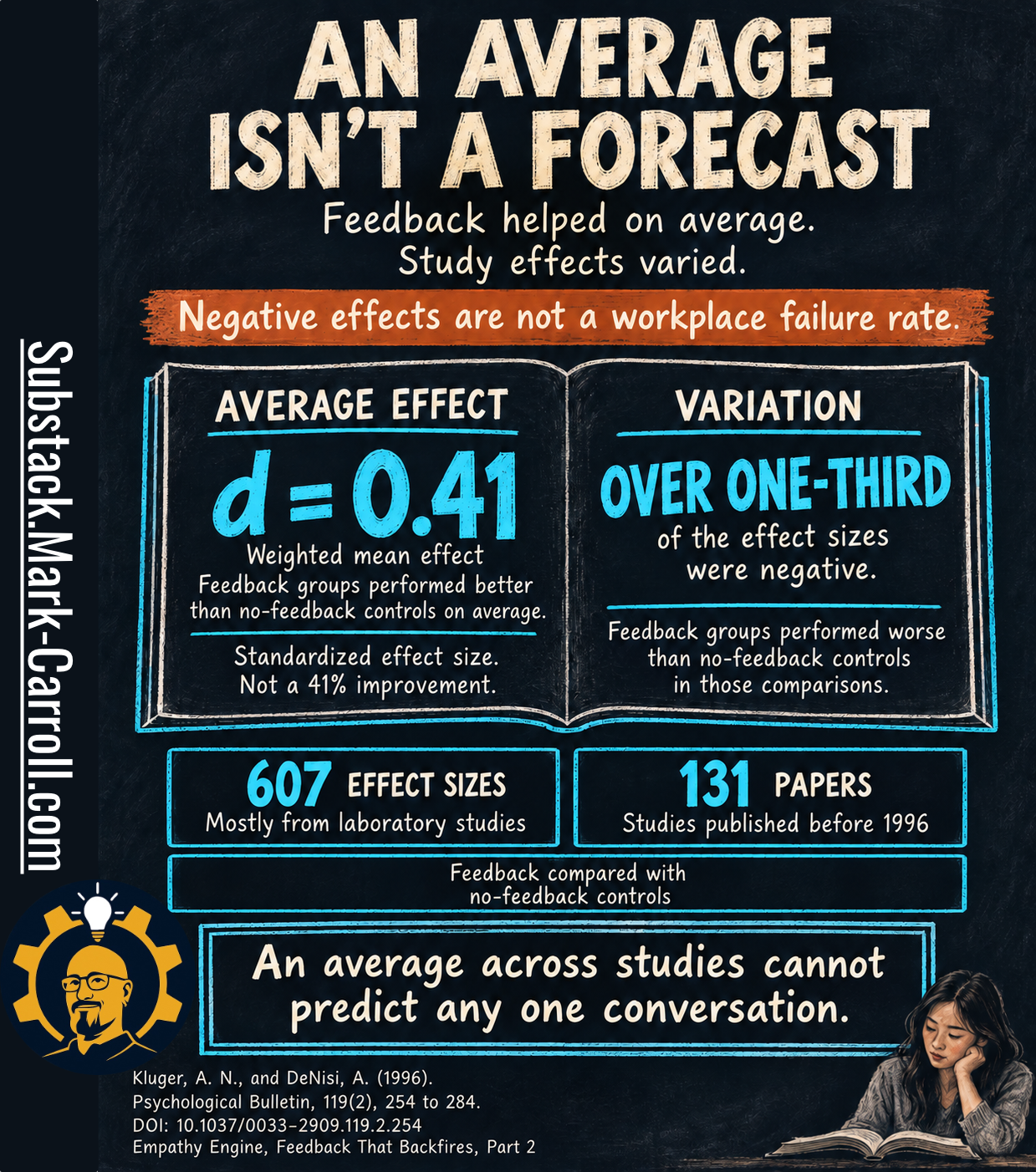
Feedback helped on average. The weighted mean effect was d = 0.41: feedback groups outperformed no-feedback controls on average. That’s a standardized effect size, not a 41% improvement.
Study effects also varied. Over a third of the effect sizes were negative, meaning the feedback group performed worse than its control in those comparisons.
Both facts describe studies, not conversations. Negative effects are not a workplace failure rate. An average across studies cannot predict any one conversation, including Maya’s.
The same paper proposed one explanation for the variation: feedback may draw attention away from the task and toward the self. The authors noted that attention to the self was not directly measured, so I looked for tests that compare person-focused and task-focused wording directly.
Changing “you” isn’t the whole question
The cleanest test I found changed almost nothing. In 2022, researchers Gok and Fyfe ran two experiments in which people learned invented scripts and received feedback after each answer. The wording was either self-focused or task-focused, crossed with success or failure feedback.
After a wrong answer in Experiment 1, one version read “You answered this question incorrect!” The other read “The answer was incorrect!” In Experiment 2, the feedback also displayed the given and correct answers.
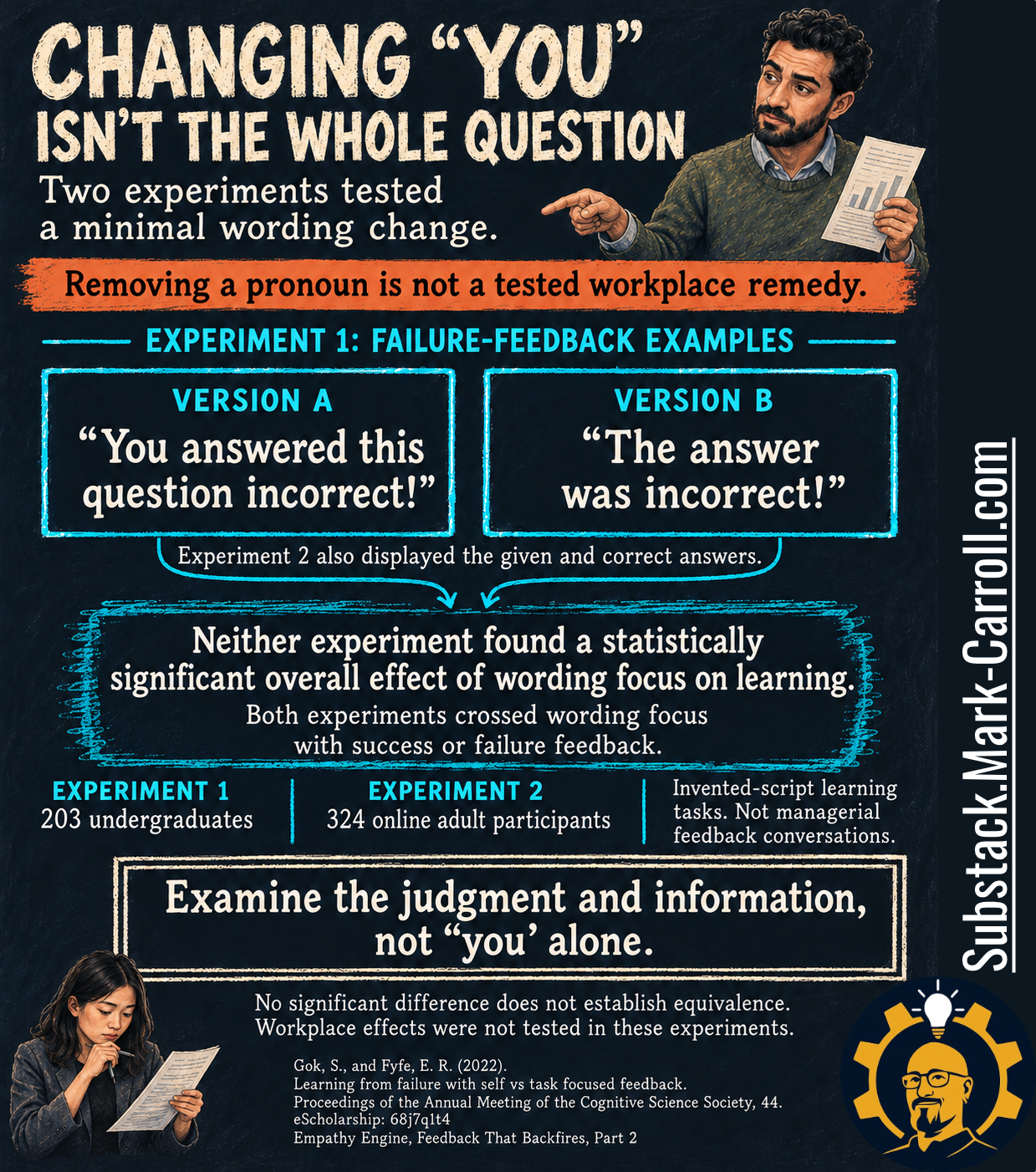
Neither experiment found a statistically significant overall effect of wording focus on learning. Experiment 1 involved 203 undergraduates; Experiment 2 involved 324 adults recruited online through Mechanical Turk. In Experiment 2, a self-reported measure of ego threat didn’t differ by wording focus either.
Two limits cut in opposite directions. No significant difference does not establish equivalence; a small effect could exist that these experiments couldn’t detect. And these were invented-script learning tasks, not managerial feedback conversations.
So these experiments don’t support a pronoun shortcut. Removing a pronoun is not a tested workplace remedy. Examine the judgment and the information, not “you” alone.
What did the record actually include?
How often does written feedback specify these things? The best evidence I found is narrow.
In 2021, Lee and colleagues analyzed the written narrative feedback records of one emergency-department training program: 928 records from 14 preceptors. The researchers coded each record against SBIA, a four-part structure: situation, behavior, impact and action.
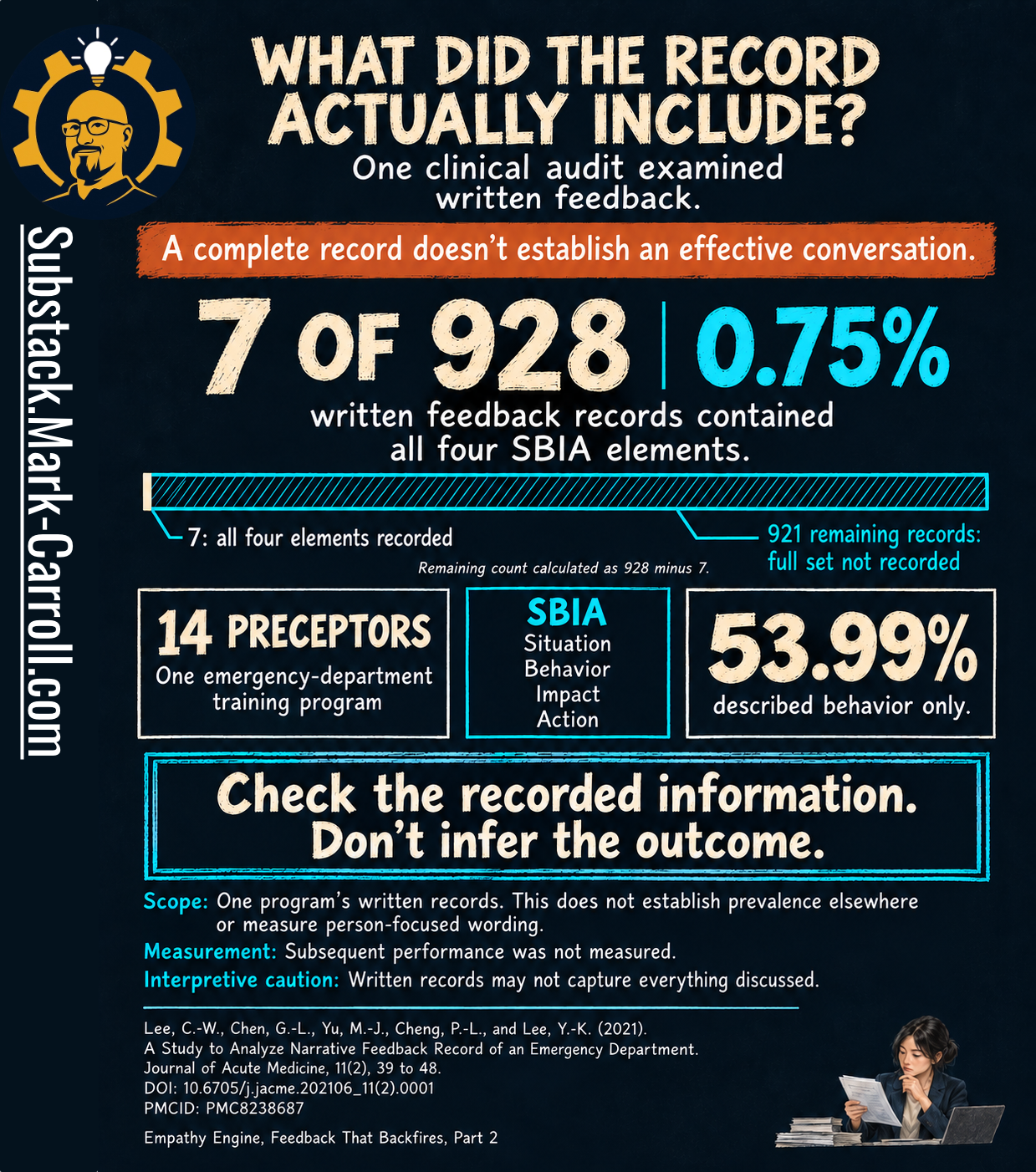
Seven of the 928 records, 0.75%, contained all four SBIA elements. The other 921 didn’t record the full set. More than half, 53.99%, described behavior only.
Read the scope before the number. This is one program’s written records, so it doesn’t establish prevalence elsewhere, and it doesn’t measure person-focused wording. Subsequent performance wasn’t measured. And written records may not capture everything discussed aloud.
The caution runs the other way, too. A complete record doesn’t establish an effective conversation. Check the recorded information. Don’t infer the outcome.
What the audit offers Maya is modest: measured against four parts, most of one program’s records named a behavior and stopped there.
The intervention isn’t the ingredient
The strongest outcome evidence I found comes from health care, where feedback is tested as a whole intervention.
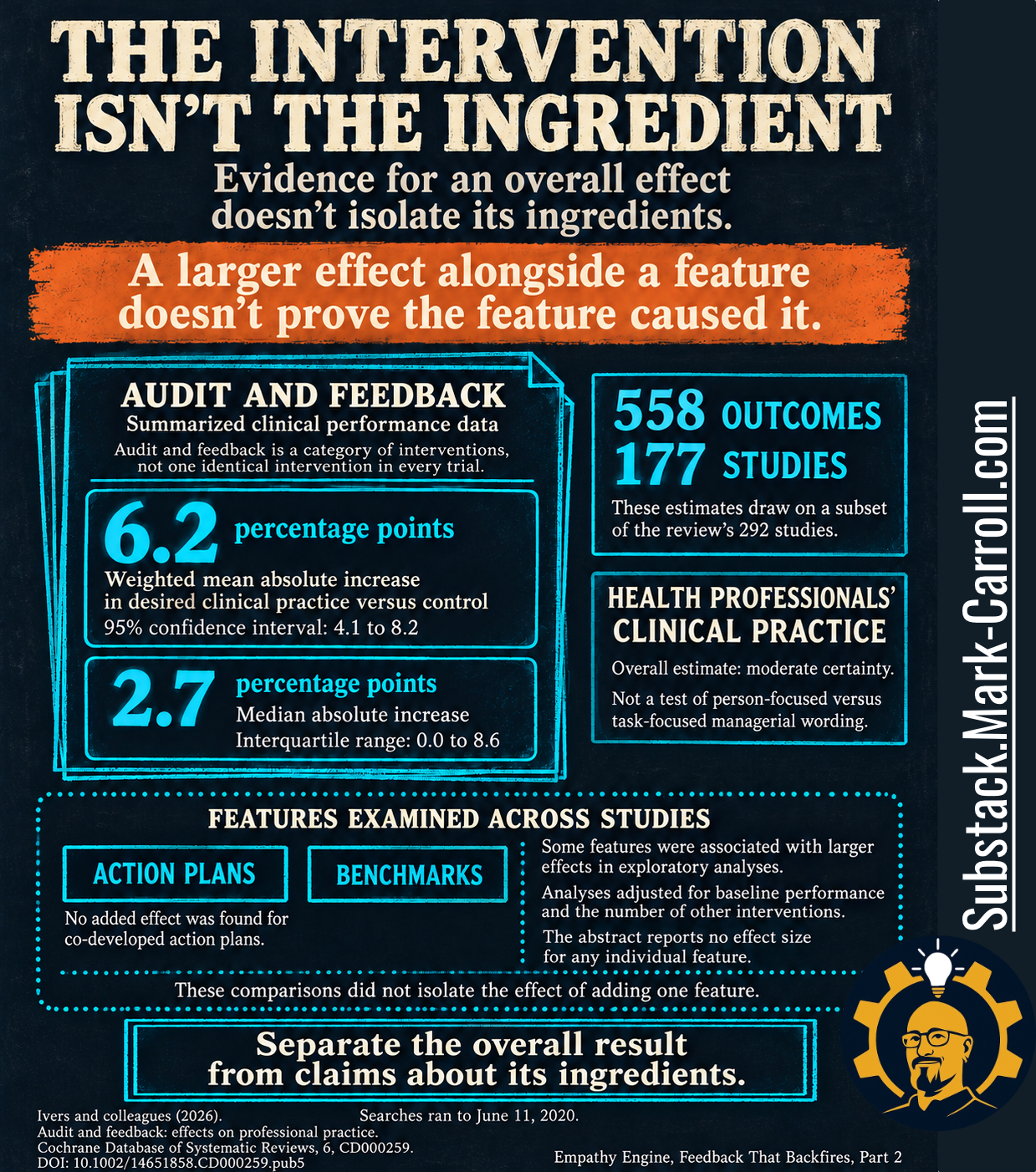
Audit and feedback means giving health professionals summarized data on their own clinical performance, sometimes with benchmarks or action plans attached. It’s a category of interventions, not one identical intervention in every trial. A Cochrane review by Ivers and colleagues, updated in 2026, includes 292 studies; its main estimates draw on 558 outcomes in 177 of them. Searches ran to June 11, 2020.