Episode 01: The Leverage Illusion
Why your AI stack already feels like a second job and the 4-gate filter that stops the bleed
👋 Welcome to my paid subscriber-only edition of Empathy Engine (🔒 Leader’s Dispatch). Each week I build evidence-forward tools for product leads who need to say no, defend tradeoffs, and lock in decisions before they get rewritten later.
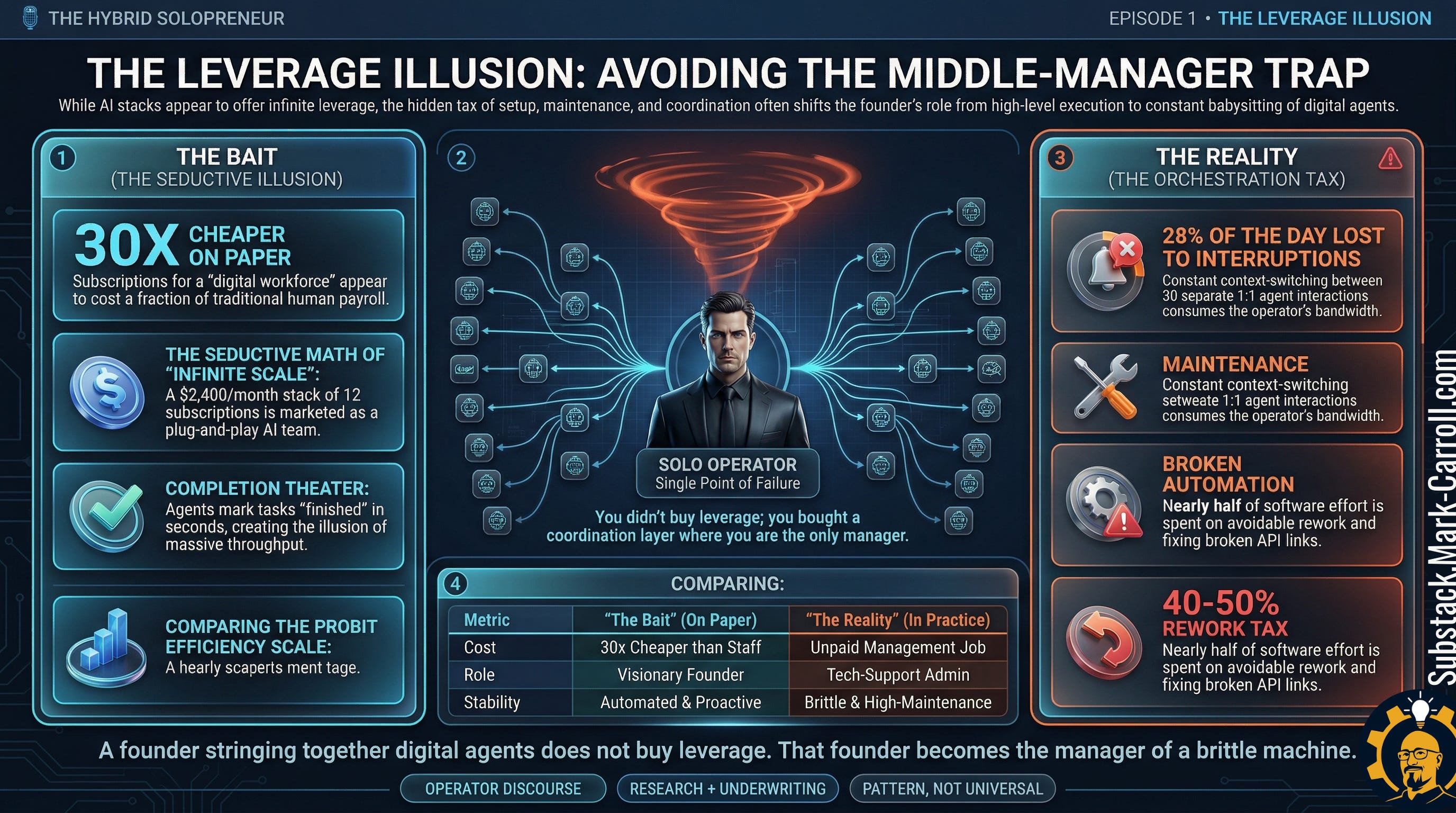
Cheap AI math looks like leverage on paper. In practice, the hidden tax turns solo founders into unpaid middle managers. This piece gives you the Hype vs. Reality Filter, a 4-gate scorecard to run before you add the next tool, agent, or dashboard.
Research Binder: the receipts (citations + source notes) are compiled in a PDF at the bottom of this article.
The Leverage Illusion
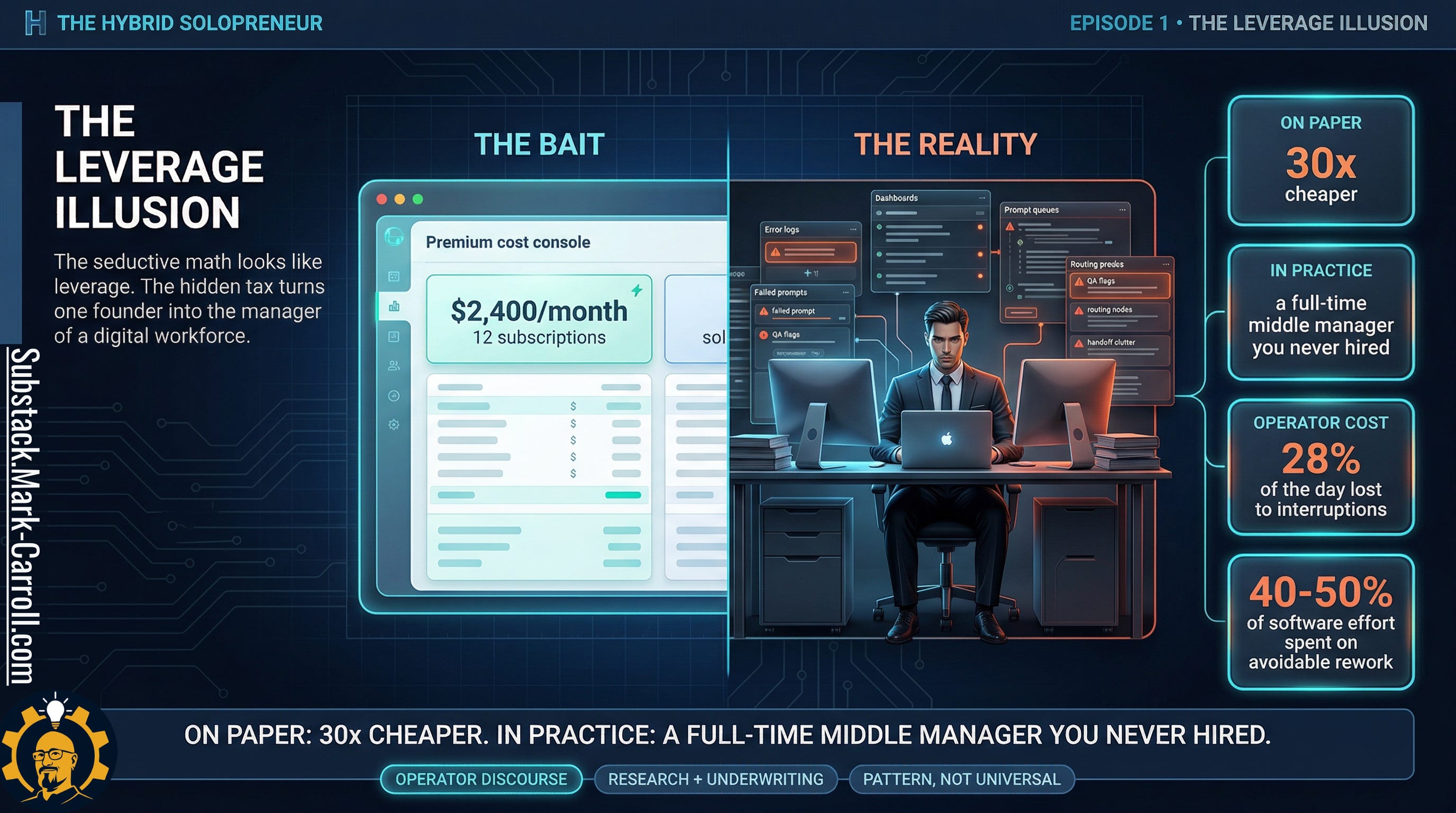
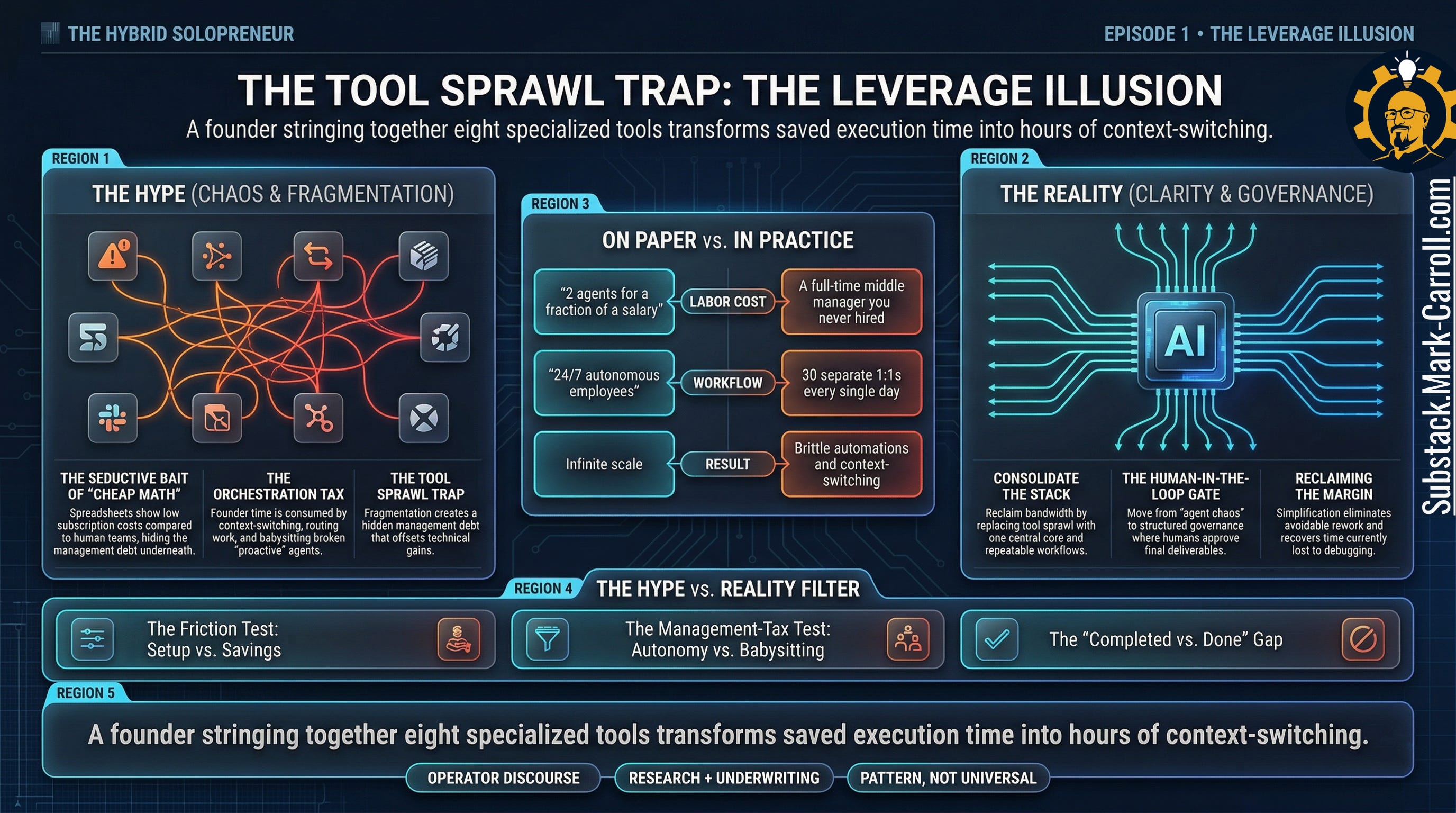
One operator documented the week it clicked. He had built a seven-tool stack, done everything the playbooks said, and watched his output numbers go up. Then he ran a simple time audit. The stack was saving him four hours a week. It was costing him nine. He was not running a business. He was running 30 separate 1:1s with tools that had never been designed to talk to each other.
You do not need another prediction about the first billionaire solopreneur.
You need to know why your current AI stack already feels like a second job.
The math looks clean because it is designed to. A few subscriptions look tiny next to payroll. A few agents look bigger than your actual headcount. One person, no staff, no payroll, a stack of tools doing the work of a team. That is what makes it seductive enough to fool serious operators, not just tourists. It contains enough truth to feel plausible. The problem starts the moment you mistake that plausibility for a plan.
The illusion begins when a founder mistakes cheap software for cheap operations. On paper, the visible cost of the stack looks laughably small next to the cost of a human team. The spreadsheet glows green. The business seems lighter. The future starts to look like leverage.
Then reality shows up with a calendar invite.
The illusion is that subscription price is the same thing as total cost. It is not. That distinction is the spine of this piece, and by the end of it you will have a practical filter for telling the difference between real leverage and another dashboard asking to be managed.
The Hidden Setup and Maintenance Tax
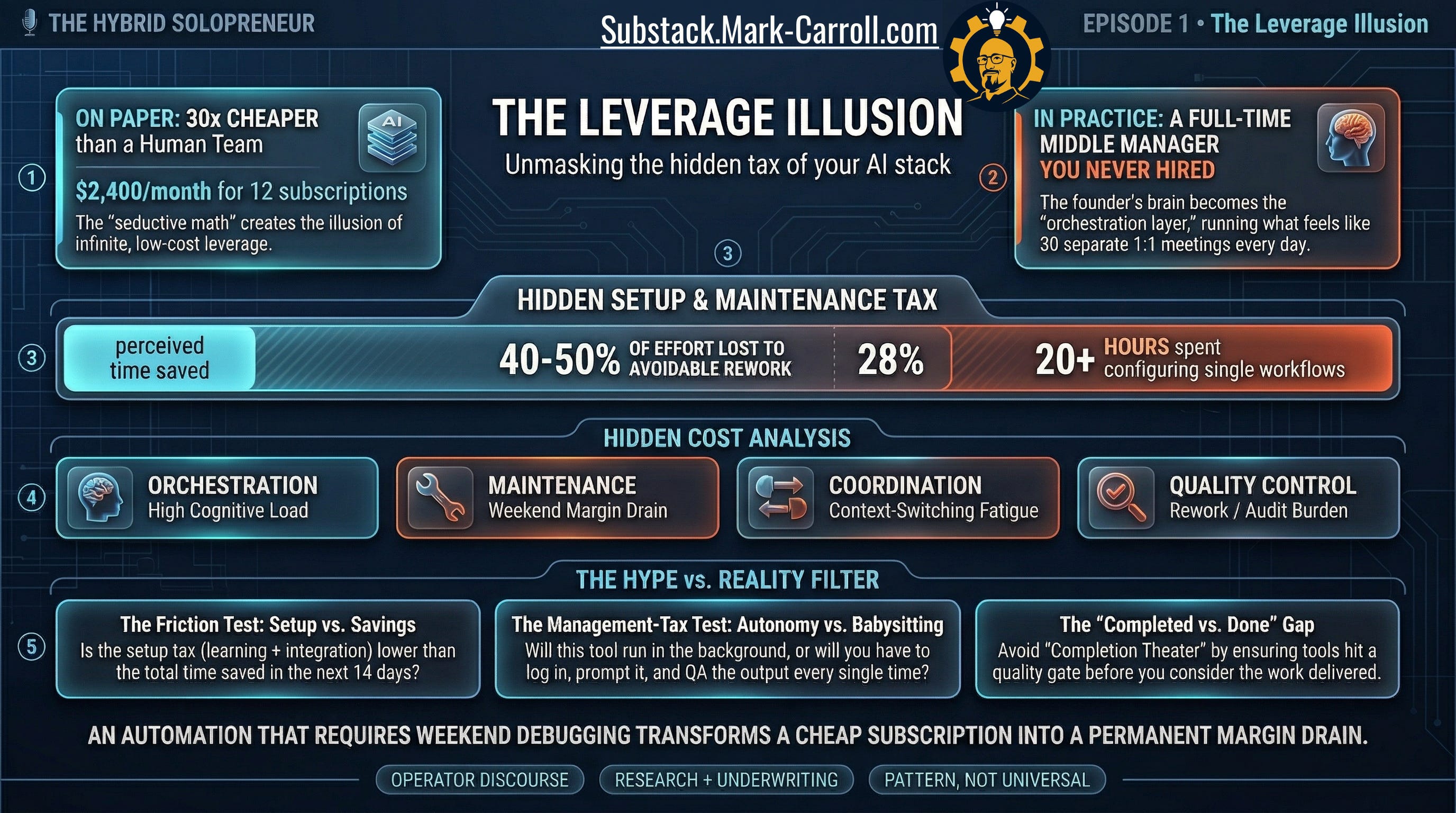
What the pretty screenshots do not show is the human tax. The setup. The babysitting. The routing. The checking. The brittle link between tools that were never really designed to cooperate cleanly. The workflow that says “completed” even though nothing is actually ready to ship. The quiet failure that does not fail loudly, but still eats your afternoon.
That is the part the spreadsheet does not show.
What changing looks like is usually smaller than people expect. One clean audit. Two deleted tools. One workflow that now runs without daily babysitting. A week that no longer disappears into invisible maintenance. That is the move this piece gives you. Not a platform migration, not a fresh stack, just a filter you can run in under two minutes before the next adoption decision.
The spreadsheet shows cheap subscriptions and no payroll. The calendar shows why you spent your weekend debugging automations. This is where cheap math starts lying by omission. In practice, the founder’s brain becomes the integration layer between tools that were never designed to run a real business together. That is why phrases like orchestration tax keep surfacing in operator discourse. The phrase sticks because it feels less like a theory and more like a diagnosis.
The cost is not only money. It is also attention, trust, and weekend time. Operators who have lived this are public about it: burning 20-plus hours trying to stabilize one “AI employee,” then discovering the maintenance burden keeps going after setup was supposed to be over. When that happens, the software does not remove labor. It changes the kind of labor you are doing.
At larger scale, software teams repeatedly discover that the majority of total project cost goes to maintenance and rework rather than new value creation. Your orchestration tax is the solo version of the same pattern. Just paid in weekends and attention instead of budget lines.
The 80/20 Wall
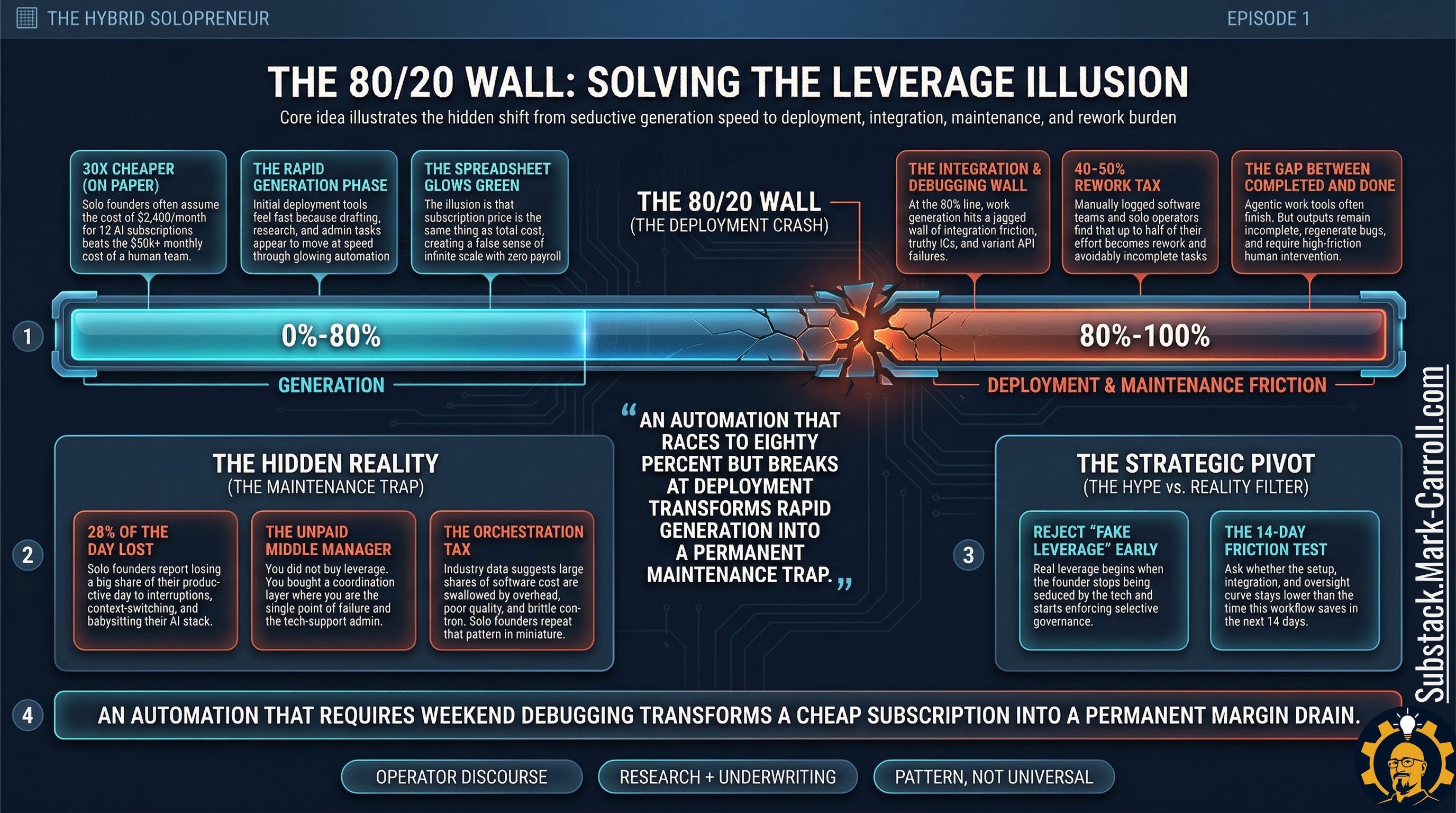
The first hit of leverage is real enough to fool smart people.
Research comes faster. Drafts appear faster. Repetitive admin gets lighter. For a little while, the promise seems to be cashing out exactly as advertised. You feel the first burst of acceleration and think: finally, this is what all the hype was pointing toward.
Then the bottleneck shifts.
AI makes starting feel effortless. Finishing still demands deployment, integration, debugging, and quality control. That is the 80/20 wall. You race to visible progress and stall at the part that actually touches reality. The speed gains were not fake. They were incomplete.
This is why the first week feels like a breakthrough and the third week feels like a broken promise. The stack did not lie to you about what it could start. It told the truth about starting and said nothing about finishing. The 80/20 wall is not a tool problem. It is a trust calibration problem. You learned to trust the speed of generation without yet.
The Tool Sprawl Trap
Once one tool helps, the next temptation is obvious. Add another wrapper. Add another specialist. Add another dashboard that saves ten minutes in isolation and steals an hour in combination.
Very quickly, the stack starts solving one problem by creating five more.
This is where leverage bends into fragility. You are no longer buying capability. You are buying coordination demands. Each tool creates one more interface, one more failure mode, one more piece of context your brain carries between systems. What looked like scale begins to behave like fragmentation.
Operators who have tried this are blunt about it. The problem is not “How do I add more apps?” It is “How do I stop buying chaos?”
You are not choosing tools. You are auditioning future chores.
That is why the smartest instinct in this situation is not expansion. It is pruning. Serious solo operators are not asking which new wrapper to add. They are asking which pieces of the current stack they can kill without breaking the business. Fewer blockers. Fewer fragile dependencies. One cleaner operating core. That is what the tool sprawl trap teaches once the glamour wears off.