


Why the Work Around a Boring Business Isn’t an Opportunity Until You Know What Has to Move With It
Pain earns an inspection. Not a build.
👋 Welcome to my paid subscriber-only edition of Empathy Engine (🔒 Leader’s Dispatch). Each week I build evidence-forward tools for product leads who need to say no, defend tradeoffs, and lock in decisions before they get rewritten later.
Nina did not want to own the truck. She wanted to fix the handoff that made three trucks late every Thursday.
She had been coming back to Dave’s shop for most of a month. Same regional electrical and facilities company she shadowed in Episode 2, same six crews, same dispatcher running the week out of a spreadsheet and the day out of a group chat. The trucks were fine. The crews were good. The property manager waiting on a late truck at ten on a Thursday did not care about either.
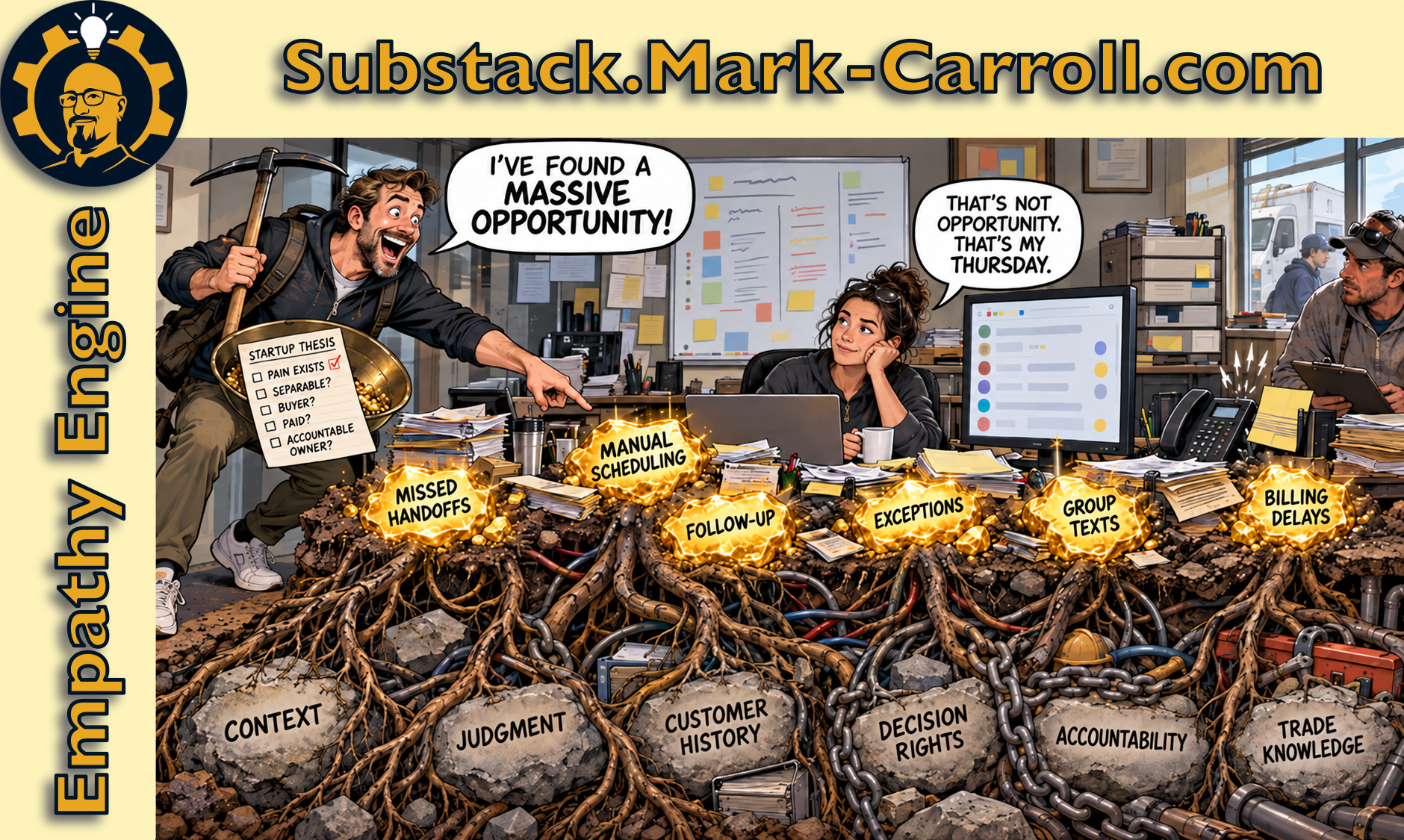
This Thursday went the way the last three had. At 8:10 a commercial client canceled a panel inspection. At 9:05 a crew finished early two towns over. At 9:20 a restaurant called with a tripped main and a lunch rush forty minutes out. The dispatcher moved three jobs in eleven minutes, in the group chat, from memory. One tech got an address and no notes. Another got the right notes for the wrong building. By ten, Dave was answering his phone with the tailgate down, repairing the day.
Nina saw an offer in it before lunch and wrote it in one line. Remote dispatch and follow-up for small electrical and HVAC shops. They keep the trucks. I run the Thursdays.
She had already crossed out the other option on that page. Starting a facilities-coordination company of her own meant owning the crews and the phone, and Episode 2 had shown her where that phone ends up. The overlay looked like the season finally paying out. Unglamorous, repeated, painful, and no van required.
Nina, Dave, and Dave’s company are a fictional composite built from recurring patterns in the research, not real people or a real business.
It took her until Friday to name what she had watched. The shop wasn’t failing to schedule work. It was rescheduling reality, all morning, by hand. That is a different problem, and it raised the question that ruined the line in her notebook. If the Thursdays leave Dave’s building, what has to leave with them?
I have watched work look complete in the system before it was usable in the real world. A ticket moved to another team with the requirement, the due date, and the expected output all intact, but the decision history and operating assumptions stayed with the people who had been in the earlier conversations. The receiving team did not reject the handoff. They simply had to reopen the conversation to understand what they had supposedly inherited.
The task moved. The context did not.
The correction loop was the handoff telling us what we forgot to send.
I use Digital Overlay as a working label for the operating layer around a service business, the intake, scheduling, dispatch, estimates, documentation, closeout, billing, follow-up, and warranty work that surrounds the job. It is a practitioner label, not a proven market category. It names something to inspect, not something to build. This is the season’s thinnest evidence on the commercial question, so the episode leans on the inspection and leaves the opportunity open.
By the end you’ll have the Asset-Light Overlay Map, a way to inspect the work around a business before you offer to take any of it. It won’t tell you whether anyone will pay.
Episode 5:

Research Binder: the receipts, methodology notes, and source boundaries are compiled at the bottom of this post.
Last Week’s Six Questions, One Step From the Truck
Episode 5 ended with a promise. The work that exists because regulated work exists would get the same six questions. Nina keeps it that night.
What is the actual activity? Scheduling, dispatch, estimate follow-up, closeout, and the calls in between. Not the electrical work. She writes that sentence twice.
What creates the entry friction? For the office work, she can’t find much, and she marks it to confirm rather than assume.
What keeps recurring after entry? All of it. Every week has a Thursday.
Where could a real boundary apply? Right next to her. The electrical work may sit behind licensing, permit, and inspection rules she doesn’t hold and can’t read from an outline. Anything she would schedule or promise about that work goes to qualified review, the way last week taught her.
Who already owns the burden? The dispatcher, the office coordinator, and whoever answers Dave’s cell.
What does the economic evidence actually say? Nothing yet.
The six questions did their job. They told Nina she can stand near the truck without pretending to drive it. They did not tell her whether the work around the truck can leave the building. The rest of this episode is the inspection it takes to answer the recurring-work, boundary, and ownership questions closely enough to stop guessing.
The Job Is the Visible Part
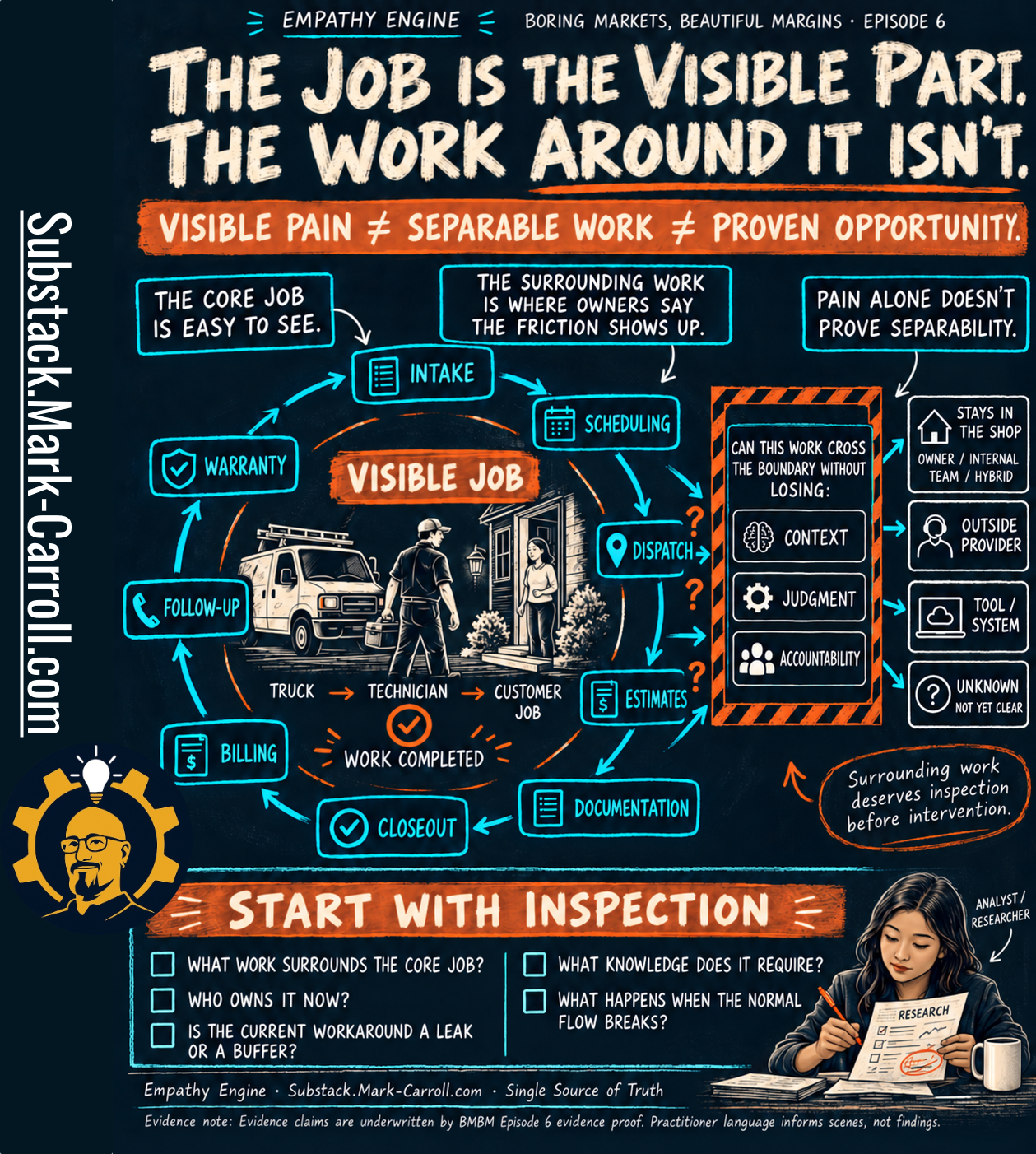
The truck, the technician, and the finished job are easy to point at. The ring of work around them is easy to treat as background, and it is where owners say the friction shows up. One operations consultant described a job marked complete on a Friday whose invoice didn’t go out until the following Wednesday, because sending it was still something a person had to remember.[1] He sells operations help, so discount the frame and keep the scene. Direct measurement of how much burden lives in that ring across small service firms is sparse. The people living with it are the best witnesses we have.
Visible pain ≠ separable work ≠ proven opportunity. Each sign is its own test. Pain tells you where to look. Whether the work can separate from the job is a second question. Whether anyone would pay for that separation is a third, and the first two don’t answer it.
Episode 3’s Workflow Pain Index asked whether a pain repeats and costs something. This episode asks whether it can move without losing context, judgment, or accountability. Stays in the shop is the first destination on the graphic for a reason, because in the practitioner rooms behind this episode it is the answer owners describe most. The question marks sit beside scheduling, dispatch, and estimates, where Nina’s Thursday broke and where the research kept raising the hardest questions about judgment and context.
Nina can already answer two of the checklist questions for Dave’s shop. What surrounds the core job? All nine nodes. Who owns it now? The dispatcher owns the board, and Dave’s phone owns the exceptions. Leak or buffer, she can’t say yet.
Messy Doesn’t Mean Broken
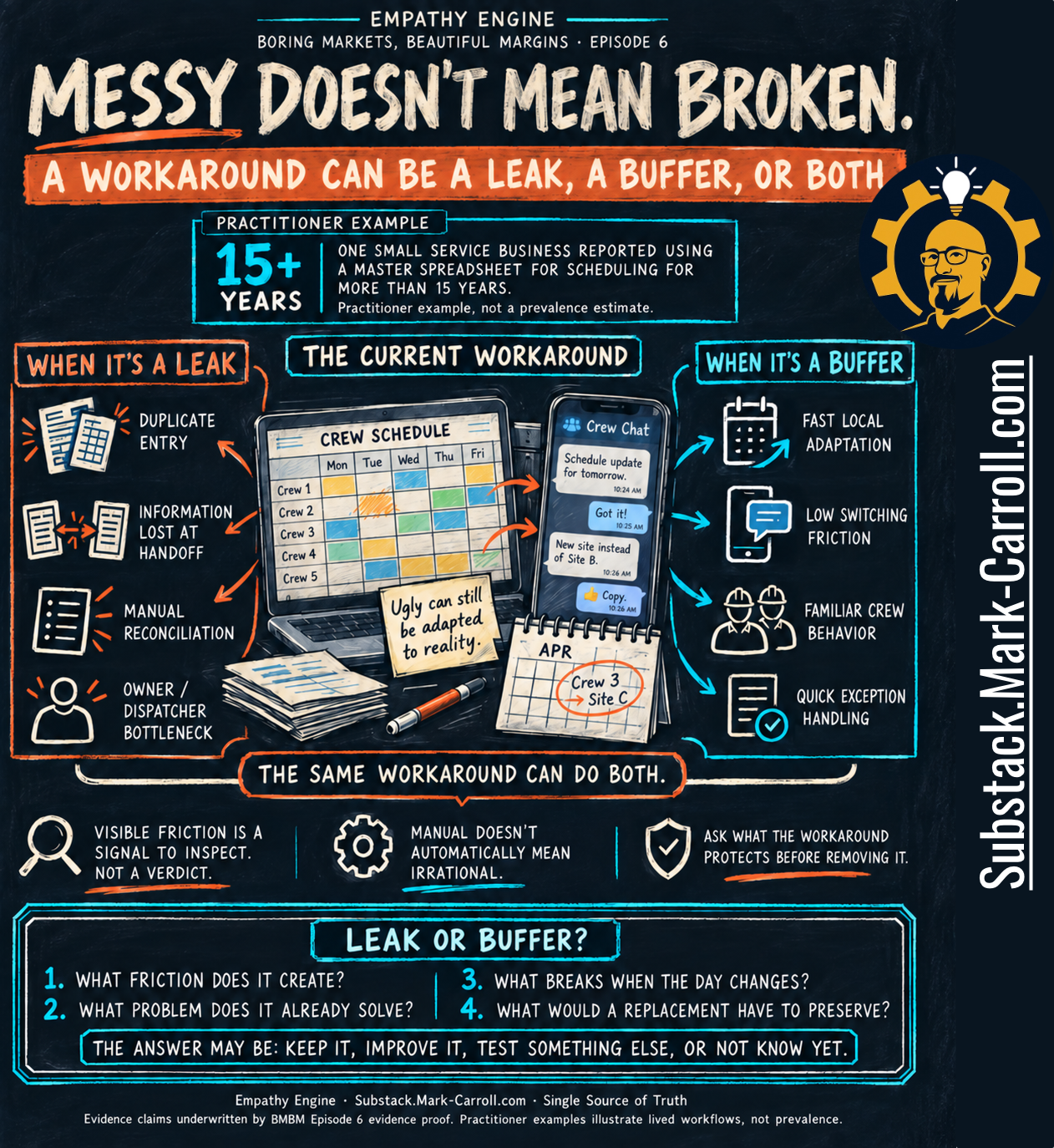
In one small-business forum thread, a practitioner described scheduling crews in the same Google Sheet for more than fifteen years, texting assignments the afternoon before because the schedule kept changing until the end of the day.[2] One business, not a prevalence estimate. It still forces the right question. Why did the thing survive?
Nina’s first draft of the offer had a slide titled Replace the spreadsheet. She deleted it after asking Dave’s dispatcher why the sheet was still there. It predated her time in the job, and it bent when the day bent. Nothing they had tried since bent as well.
Information-systems research has a name for what she was looking at. Steven Alter’s theory of workarounds treats them as deliberate adaptations to obstacles in the system people were given, with consequences that can run either way.[3] That is the leak-or-buffer split. A leak creates work, through duplicate entry, lost handoff information, manual reconciliation, or a dispatcher who becomes the bottleneck. A buffer absorbs variability, through fast local adaptation, familiar crew habits, and quick exception handling.
The same workaround can do both in the same minute. Dave’s group chat was a buffer at 9:20, when the restaurant called and a truck was moving in under a minute. It was a leak at 9:21, when the tech on that truck got the address and none of what the dispatcher knew about the building.
Visible friction is a signal to inspect, not a verdict, and manual doesn’t automatically mean irrational. So the first question isn’t how to automate it. Ask what friction the workaround creates, then what problem it already solves. A replacement has to survive both answers. The graphic leaves four honest outcomes, keep it, improve it, test something else, or not know yet. Builders skip the last one.
Thursday Is the Test
Process maps have excellent manners. Intake, schedule, service, closeout. On a quiet Tuesday that’s the whole business, and anyone watching would think the office could be run from anywhere.
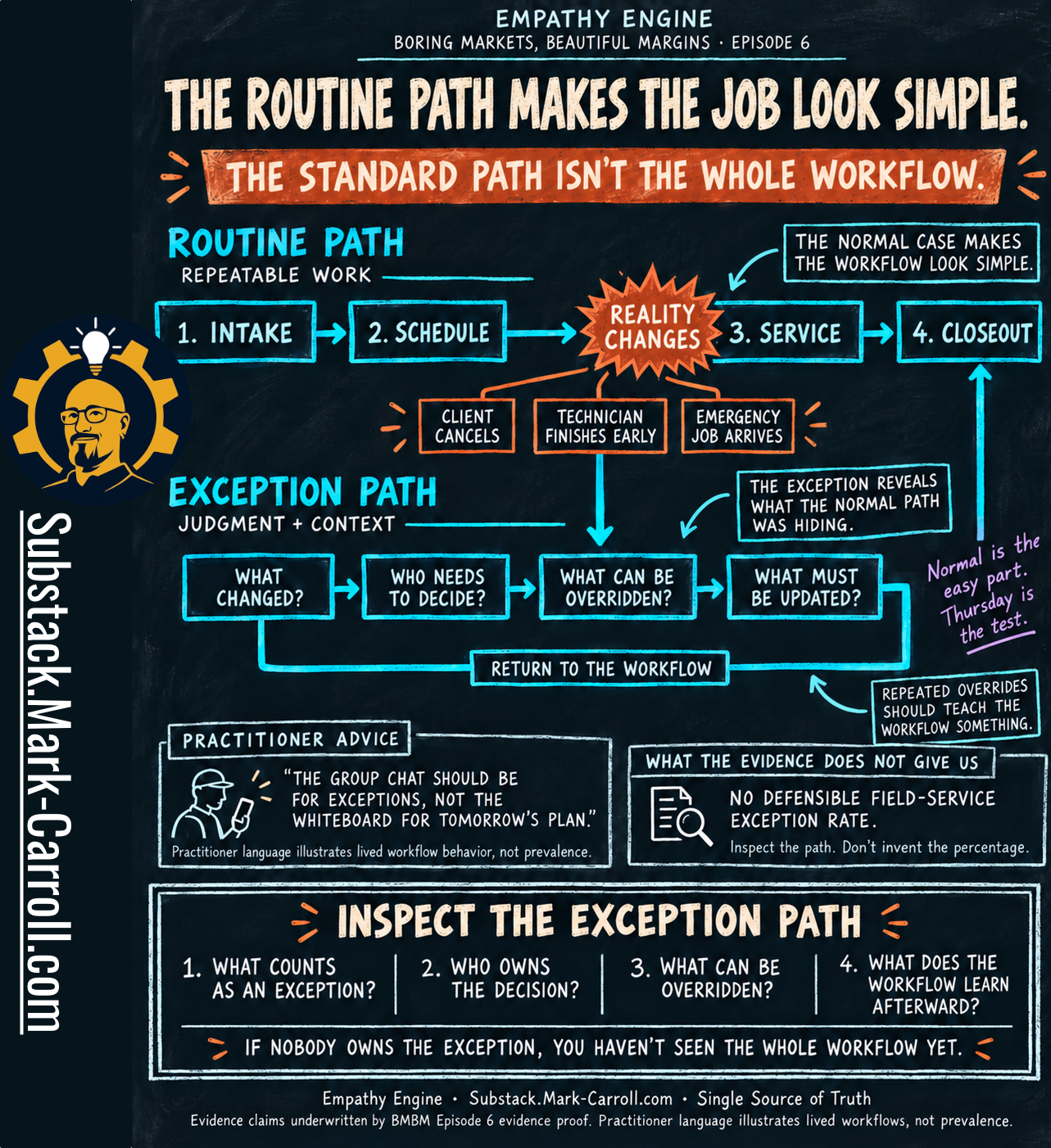
Then a client cancels, a tech finishes early, an emergency lands. Nina’s Thursday had all three before 9:30, and each one dropped the day onto a path with different questions. What changed? Who decides? What can be overridden? What has to be updated before the work returns to the routine?
The practitioner advice on the graphic comes from a thread about crew scheduling. “The group chat should be for exceptions, not the whiteboard for tomorrow’s plan.”[4] It sits in quiet tension with the crew chat in the second graphic, which carries tomorrow’s plan, and both can be true in one shop. A chat holding tomorrow’s plan is doing a job the spreadsheet can’t. A chat holding every exception is also holding context nobody wrote down.
Nobody in the evidence behind this episode measured how often small service firms leave the routine path, and I won’t borrow a number from hospital alert systems to fill the gap. Human-factors research has long described how people rely on, ignore, and override automated systems, which is one reason a standard path still needs someone watching its edges.[5] That supports the mechanism. It doesn’t size it.
What Nina can do is count. She scrolls back through a week of Dave’s group chat and marks every override. Most trace to two recurring causes. One shop, one week, no rate. Still, repeated overrides should teach the workflow something, and at Dave’s shop the answer to who owns the decision was Dave’s phone. If nobody owns the exception, you haven’t seen the whole workflow yet.
Sent Is Not the Same as Usable
Go back to 9:20. The dispatcher sends the tech the restaurant’s address. He arrives to a locked service entrance, a manager he has never met, and a panel in a room nobody mentioned. He calls the dispatcher. She calls the restaurant. The main stays tripped another twenty minutes. The file arrived. The orientation didn’t.
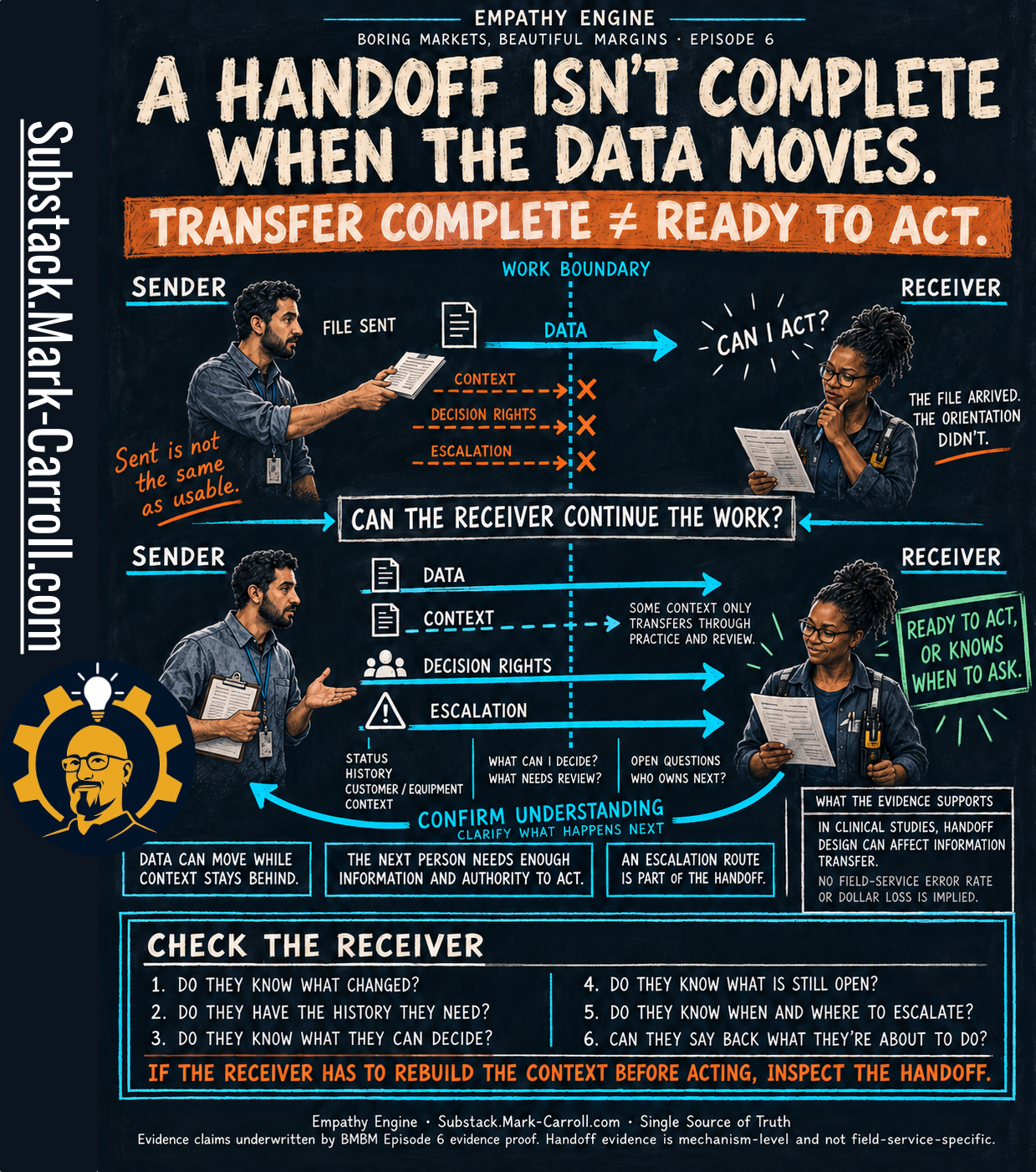
Data is visible, so we celebrate the send. Context isn’t, so we notice it only when the receiver calls back. The repaired handoff doesn’t pretend everything crosses. Context travels on a dashed line because some of it only transfers through practice and review, and the receiver’s standard is ready to act, or knows when to ask. Nobody receives a handoff that anticipates everything. A usable one tells you when to call. And the loop has to close. The receiver confirms what they understood, and the sender clarifies what happens next, because a handoff is confirmation, not transmission.
The best-matched evidence here is clinical. A 2024 systematic review and meta-analysis found structured handoffs associated with fewer defined handoff errors in the acute-care studies it examined.[6] That is a hospital finding about a mechanism. It says nothing about how often dispatch handoffs fail in electrical shops or what those failures cost.
I have watched a requirements package arrive exactly when the plan said it would and still fail as a handoff. The receiving team had the requirement, the acceptance language, and the due date, but not the decision history behind them. They could read what had been decided. They could not tell which assumptions were fixed, which ones were negotiable, or why several obvious alternatives were already off the table. The people who had supposedly finished the work ended up rebuilding the conversation for the people who had inherited it.
The artifact arrived on time. The judgment arrived later.
Of the six receiver questions, the last is the one a builder can observe from outside. Can they say back what they’re about to do? If the receiver has to rebuild the context before acting, inspect the handoff.
The Task Moved. The Questions Came Back.
The fourth graphic is one handoff. The fifth is what happens when the task itself changes hands and keeps coming back, and Nina’s notebook offer puts her on its right side, as the new performer of Dave’s Thursdays.
The word task makes work sound more detachable than it sometimes is. “Reassign the 9:20 call” sounds portable. “Reassign the 9:20 call, knowing the restaurant’s service door stays locked until eleven, the panel is in dry storage, and the manager on shift has never met your tech” is a different object. The first is a task. The second is a task plus context.
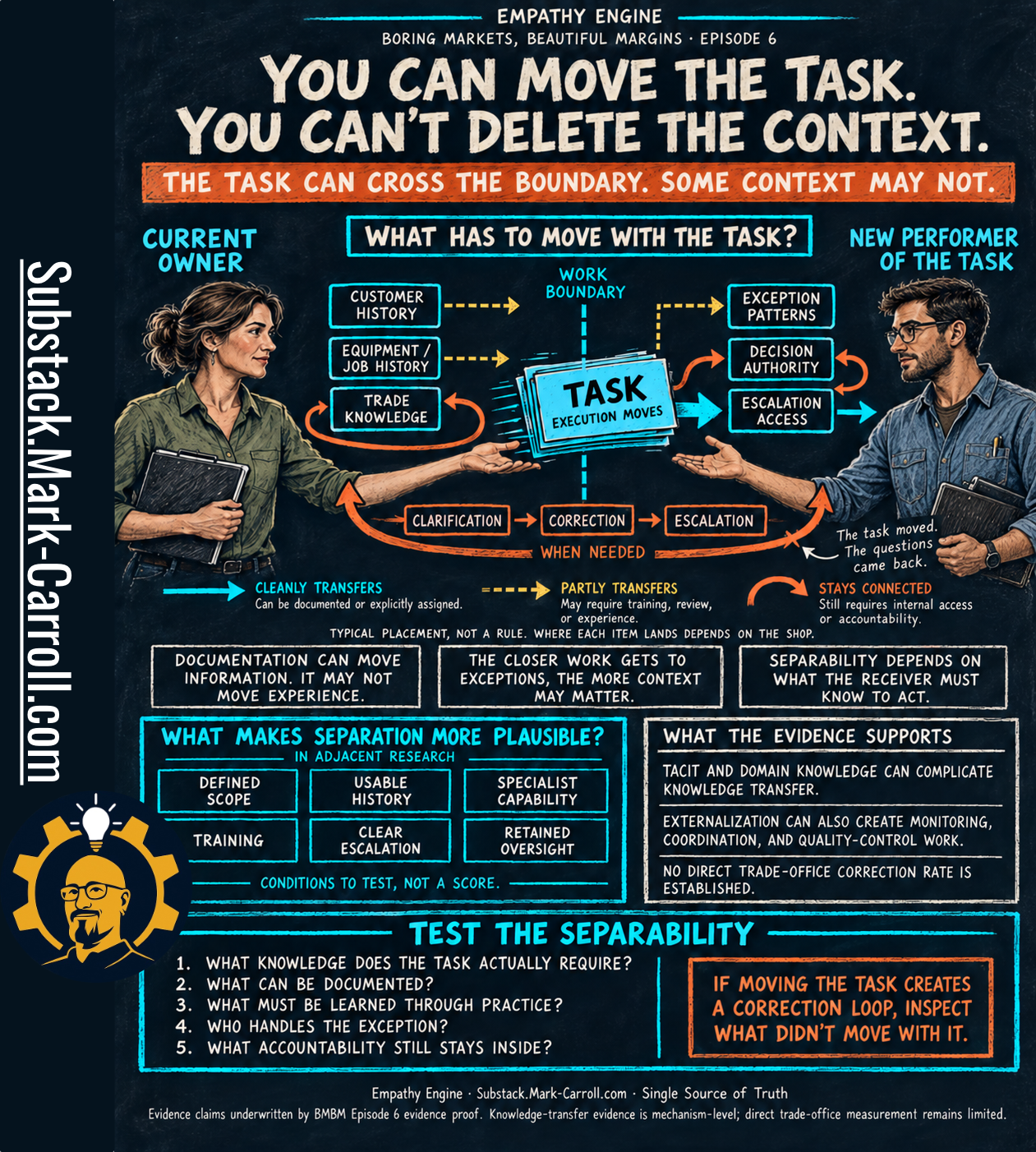
The practitioner rooms describe what happens when only the first one moves. In a self-employed forum, a commenter described an HVAC friend who spent more time correcting his offshore assistant’s estimates than it would have taken to write them himself. The thread’s answer wasn’t a cheaper assistant. It was someone who knows a shutoff from a gate valve.[7] An electricians’ forum put it more bluntly. Hire into the office too early and you’re just paying someone to be confused with you.[8] An old HVAC thread keeps getting quoted because it compresses the problem into one exchange, in which a tech explains that the person on the phone answers the phone for a living.[9] Three rooms, one mechanism. When the receiver lacks the trade context, the task comes back as correction.
Customer history sits on the dashed line for the same reason. Plenty of it lives in records. Plenty more lives in sentences like before you call her, there’s something you should know. Where each item lands depends on the shop, and the graphic says so.
The research cuts both ways. Knowledge-transfer studies find that how well knowledge moves depends on the knowledge itself and on who receives it,[10] and a 2024 systematic review found that documentation can carry information without carrying the experience that makes it usable.[11] Yet context-heavy work does cross organizational boundaries in some settings, when there is usable history, real specialist capability, clear escalation, and retained oversight.[10] Those are conditions to test, not a score. Externalization can also create monitoring, coordination, and quality-control work of its own, and no direct trade-office correction rate is established.
Nina tests them on herself. She knows scheduling across three industries. She doesn’t know which tripped main means a bad breaker and which means an electrician has to be on site before anyone promises a time. In her offer, she would own that exception, on Dave’s customer’s call, without Dave’s authority. That is the hard cost, and it would be hers.
The Tool Isn’t the Transition
We price the destination. We underprice the journey.
Nina’s second draft dropped the idea of running Dave’s Thursdays. She would set up field-service software for shops like his, get the crews onto it, and leave. No exceptions to own. Just the tool.
