


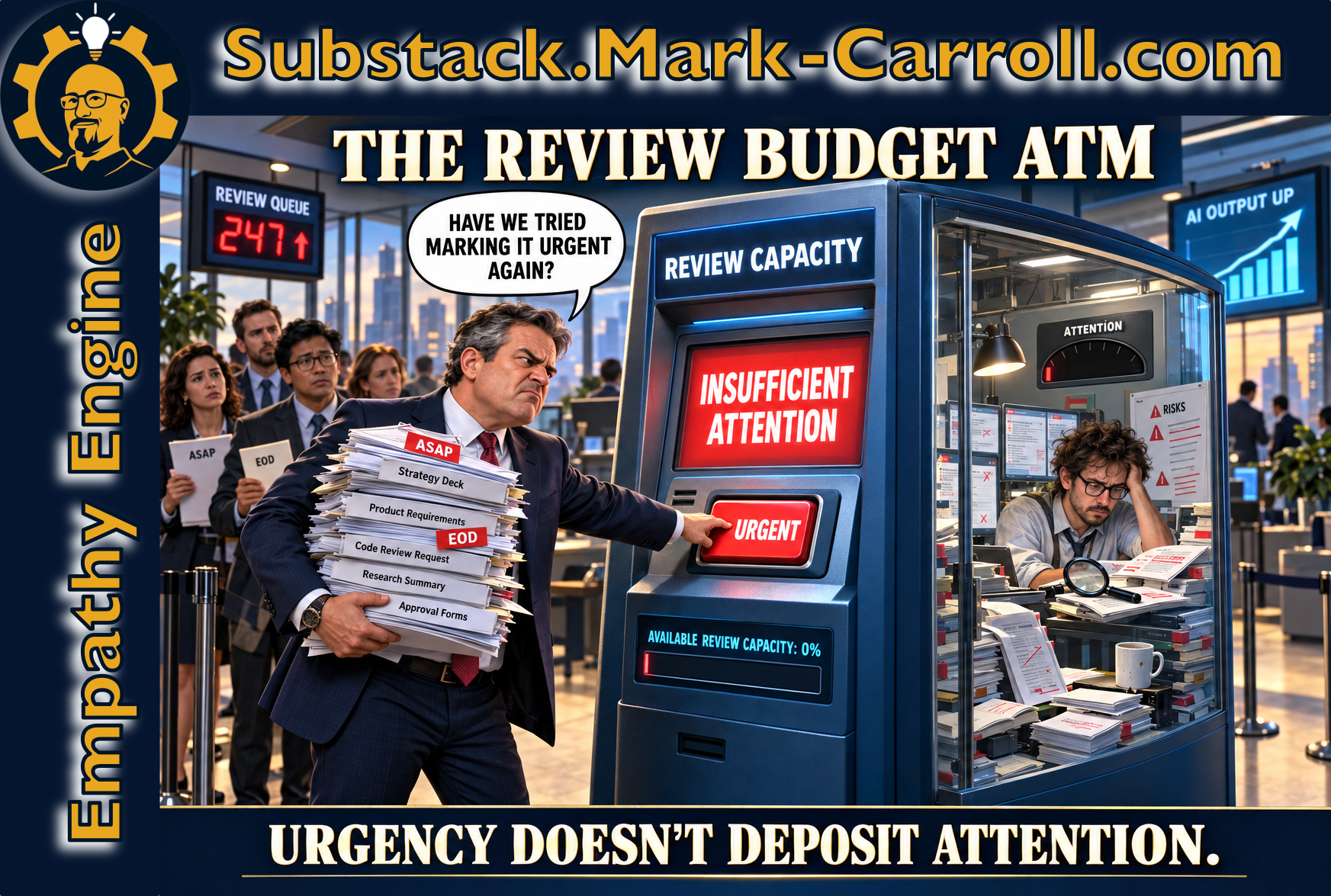
Urgent Isn’t a Review Depth
Plain-English premise: AI can draft the deck in minutes. Someone still has to understand it before it moves.
Judgment Seat: The reviewer who inherits the reading the moment someone says “quick review.”
👋 Welcome to the opening of The Judgment Layer. For seven issues, this series will examine what happens after AI makes output easier to produce: who reads it, verifies it, challenges it, and ultimately stands behind it. We begin with the last human in the chain and the Review Budget that turns finite attention from an invisible burden into an explicit decision.
Research Binder: the receipts (citations + source notes) are compiled in a PDF at the bottom of this post.
⚡ Pressure
Generation got faster. In many workflows, the remaining verification capacity is still unnamed.
🎯 Payoff
This issue gives you the Review Budget: a way to name your team’s finite review capacity and route the work that does not fit it.
Pressure Moment
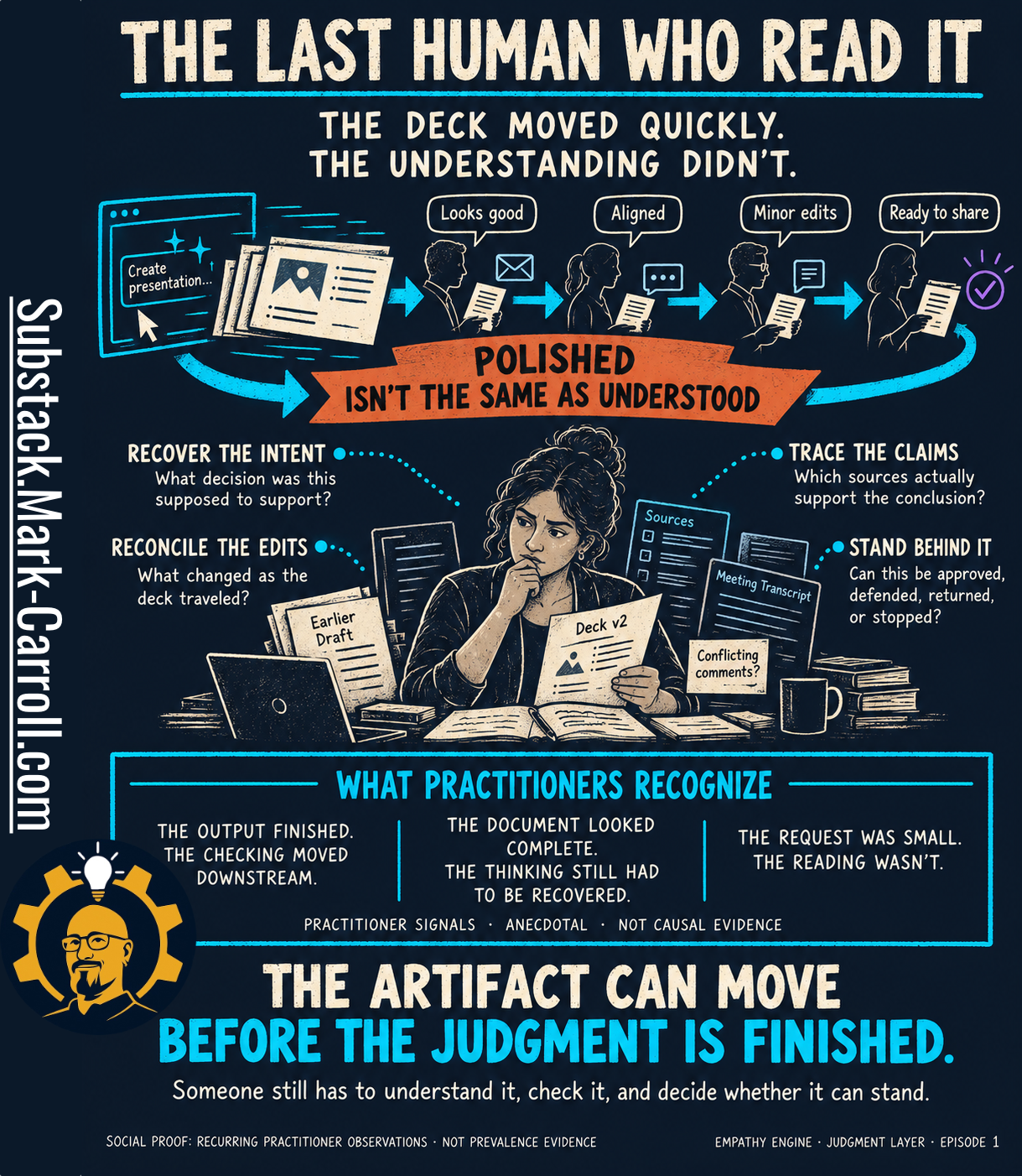
A teammate used AI to draft a slide deck. It reached a manager, who asked for a “quick review.” The manager ran the deck back through AI, then sent it forward for confirmation. The deck kept moving. What actually got checked stayed unclear. That is one practitioner’s public account, not a documented record of every hand the deck passed through or a measured time cost. Read it as a recognizable pattern, not a verified case file. The pattern it points to is ordinary: an artifact can look finished several times over before anyone has actually finished the judgment underneath it.
I’ve had AI-drafted decks land in my inbox after two or three people had already given them a “quick review.” The slides looked finished, the language sounded confident, and the status updates were neatly summarized. Yet once I started checking the story against the actual work, I found the missing dependency, the unresolved decision, and the risk that had somehow softened into a “watch item.” Nobody had been careless. Each person had reviewed a different piece of the deck, and by the time it reached me, “Can you take a quick look?” really meant, “Can you figure out whether any of us should trust this?”
🧭 The Judgment Move
Orienting sentence: A Review Budget names how much qualified review capacity your team actually has this week, matches depth to consequence, and routes anything that does not fit instead of quietly shrinking the check.
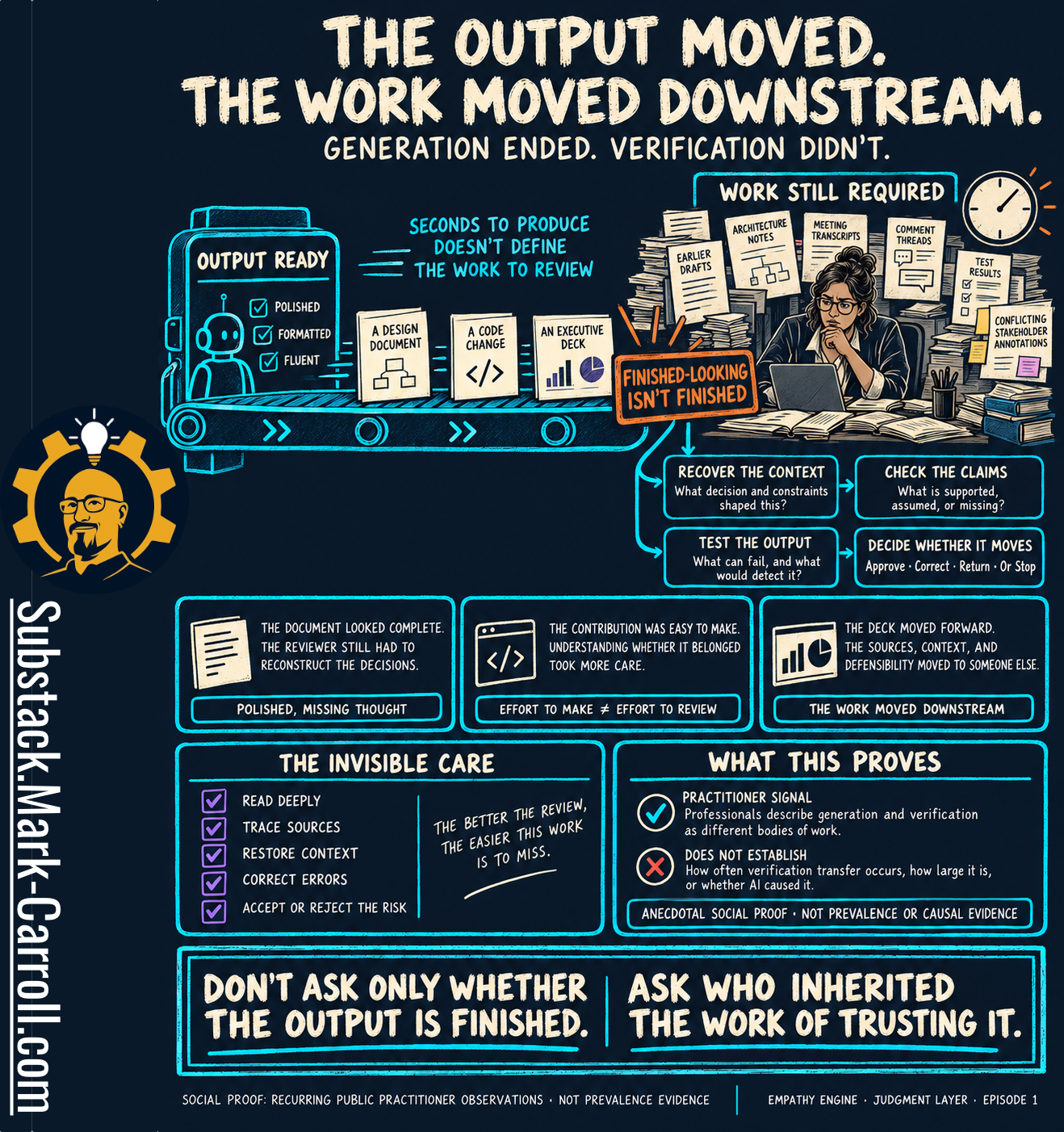
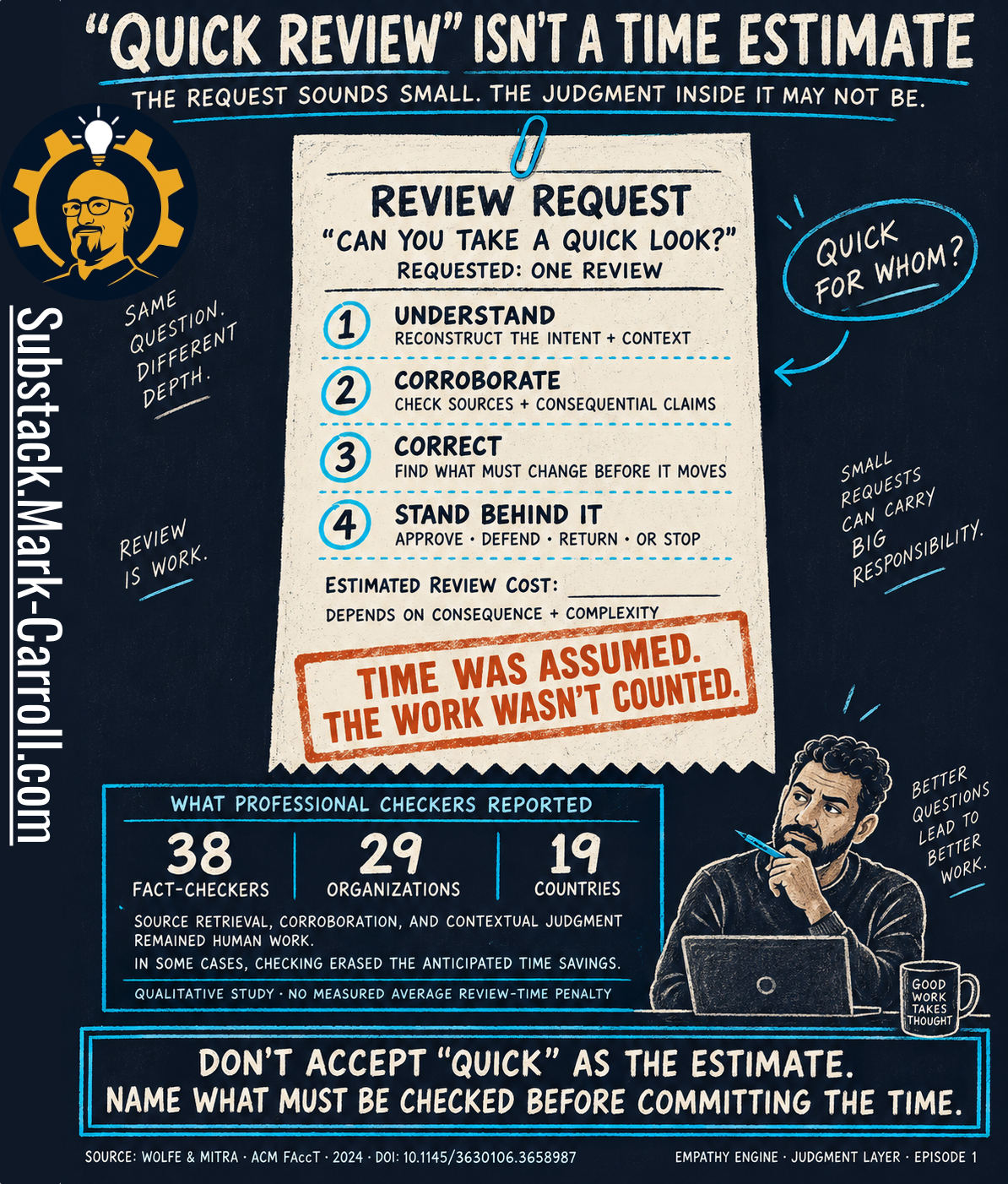
The reviewer’s job was never “read it fast.” It was: recover the intent, corroborate the claims, correct what is wrong, and decide whether the work can stand behind it. “Quick” was never a time estimate. It named the handoff, not the four jobs sitting inside it.
Step 1: Name this week’s review capacity in three tiers, light, standard, and deep, at the team or role level. Do not track it against individuals.
Step 2: For each artifact ready for approval, ask what breaks if it is wrong, how reversible the decision is, what remains uncertain, and whether a valid check can catch failure.
Step 3: Assign review depth from those answers, not from how the request was worded. Urgent is not a depth.
Step 4: When incoming demand exceeds available capacity, route the overflow. Return it, narrow it, defer it, automate the parts with valid deterministic checks, reassign it, or escalate it.
Step 5: If none of those routes are available and the work must move anyway, record that the risk was consciously accepted, and by whom.
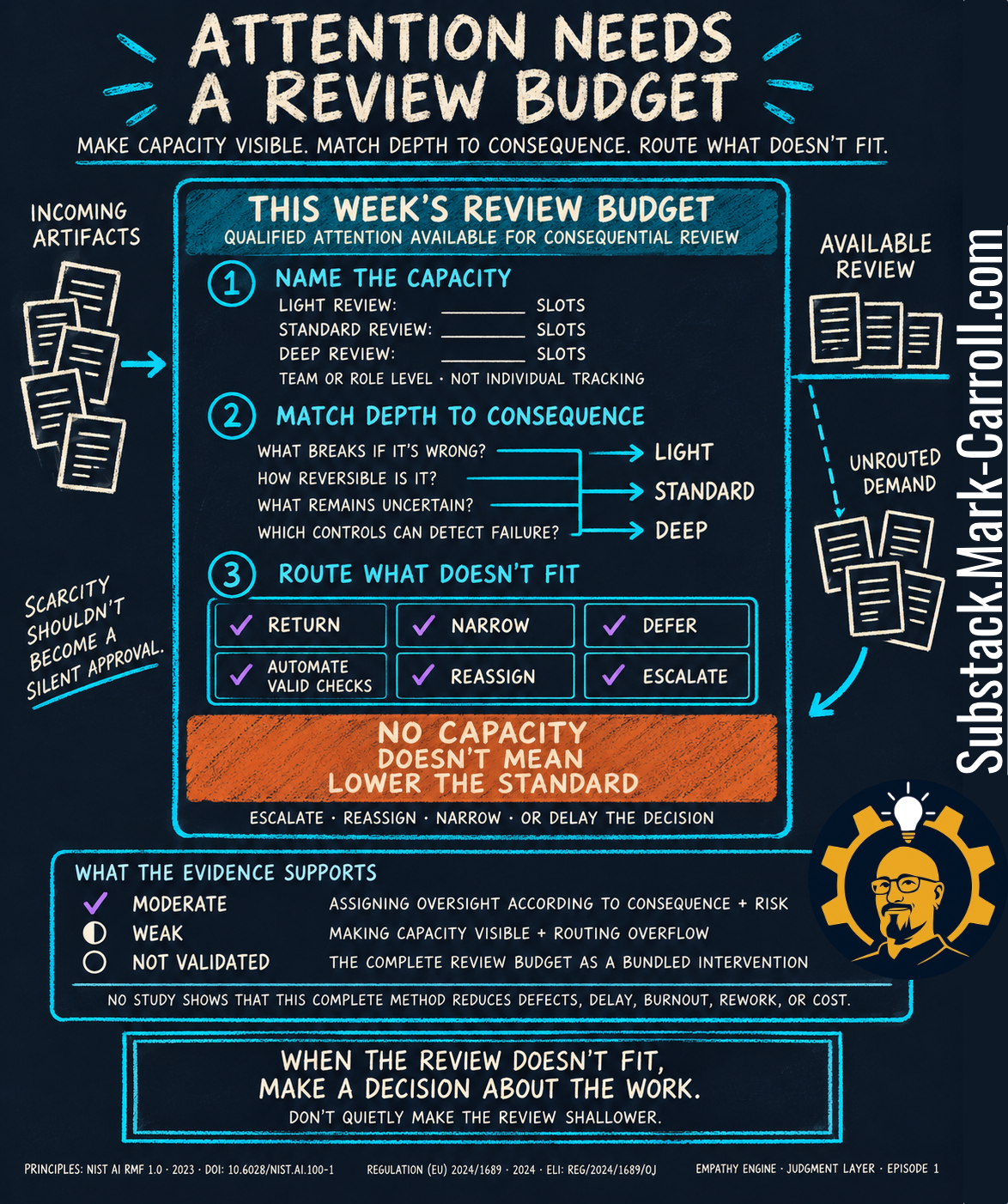
Done state: every artifact that reaches approval carries a named review depth and a named owner. Any missing time, context, expertise, or authority is visible before approval, not after.
Constraint: the Review Budget only works if leadership treats a depleted budget as a routing decision, not a performance problem.
I remember sitting with a leadership team after several deliverables had backed up waiting for approval. Their first question wasn’t, “Which work should move first?” It was, “Who owns this?” A name went onto the screen, everyone relaxed slightly, and the meeting moved on. Nothing had been deprioritized, no additional reviewer had been assigned, and the same person still had more work than anyone could responsibly check. We hadn’t solved the capacity problem. We had simply given it someone’s name.
Limitation: this move cannot manufacture reviewer expertise, add hours to a day, or prove that a lighter review was safe. It only makes the shortage visible enough to govern.
🧪 What Holds Up
Primary claim label: Evidence.
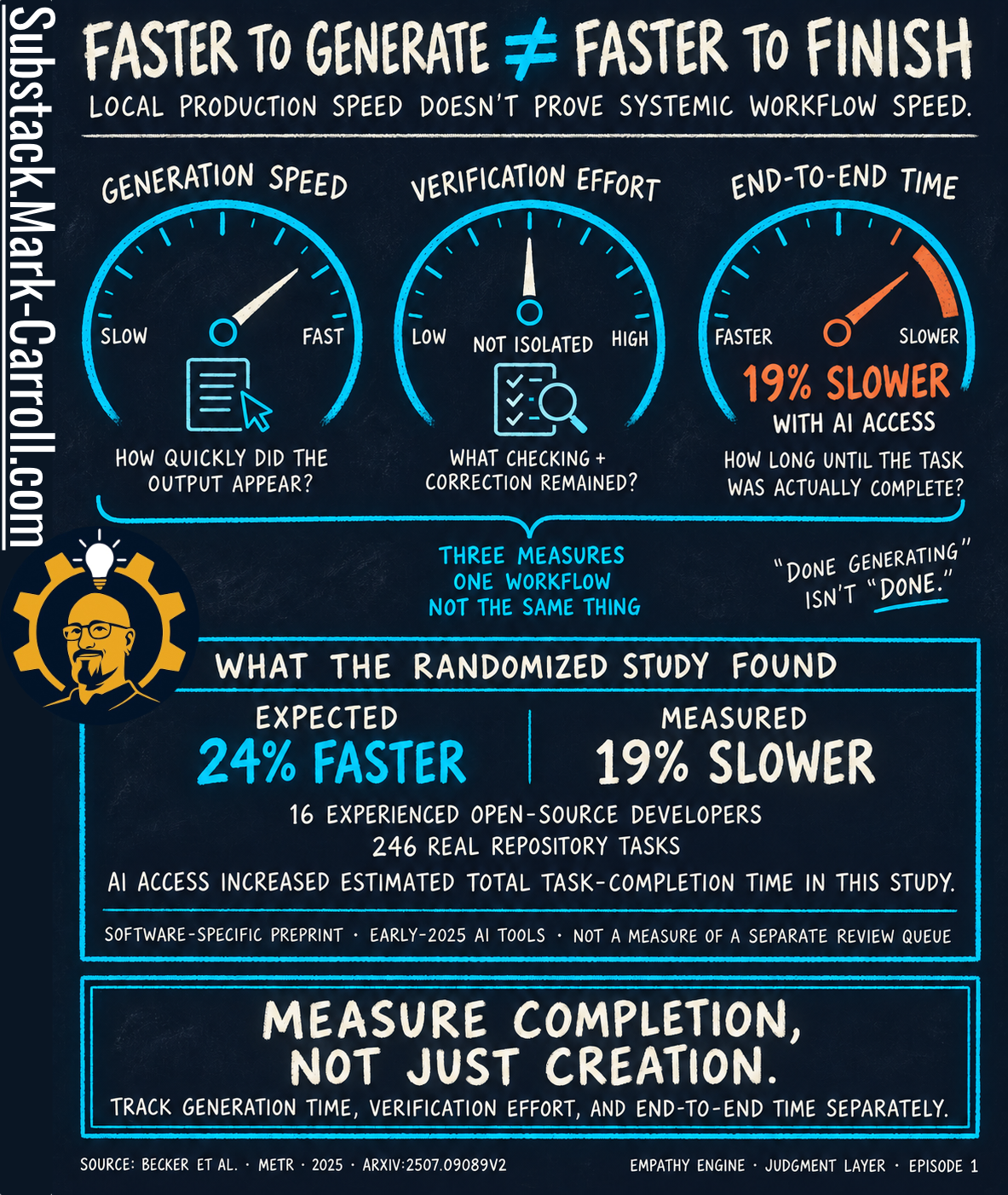
Basis: A randomized study of sixteen experienced developers across two hundred forty-six real repository tasks found that AI access made completion nineteen percent slower, even though the same developers had expected a twenty-four percent gain. Generation speed, checking effort, and total completion time are three different measurements, and the first does not predict the other two.
A separate meta-analysis of one hundred six experiments found that human-AI combinations underperformed the better standalone actor on average, even while outperforming humans working alone. A human’s presence in the loop is not, by itself, evidence of meaningful oversight. Oversight requires attention, context, expertise, and the authority to actually stop the work, not just a name on the approval.
