The words were ready
👋 Welcome to my paid subscriber-only edition of Empathy Engine (🔒 Leader’s Dispatch). Each week I build evidence-forward tools for product leads who need to say no, defend tradeoffs, and lock in decisions before they get rewritten later.
The email from Paul Hendricks arrived at 8:12 on Monday morning. (Maya and Dev are fictional, built to illustrate this series.)
“Northeast partners walked into Friday’s review blind on the account changes. Again. Dev isn’t strategic, and he seems checked out lately. This needs to be dealt with before year-end.”

Maya Chen knew which change he meant. On Thursday at four, commercial had moved a block of Northeast accounts into enterprise, and Dev had rebuilt the forecast overnight. It was the late change she and Dev had been waiting for since the 360 debrief. The one that would show whether his change notes went out and whether anyone on the other side noticed.
According to Paul, someone had noticed. Just not the note.
She opened a calendar invite for Wednesday. Thirty minutes. Subject: Forecast partner communication. Then she opened a blank document and wrote the opening she would use.
“Dev, I want to talk about Friday’s review. The Northeast partners saw the account changes for the first time on screen. We agreed after your 360 that changes would reach affected partners before the next review. I’d like to understand what happened and agree on what changes from here.”
She read it twice. It named the event. It named the standard and where it came from. It asked for his account before asking for anything else. It didn’t say “strategic” or “checked out.” Six weeks ago she couldn’t have written it. By any measure this series has offered, it was a good message.
Her cursor was on Send when she noticed what she couldn’t answer. She knew exactly what she would say on Wednesday. She didn’t know what should happen after she said it.
I’ve walked into conversations with a script I was proud of. The wording was specific, the tone was right, and I had rehearsed the hard sentence until it sounded calm. More than once, the conversation went fine and the situation didn’t change, because the thing I had prepared so carefully was the wrong thing to be doing. The work was waiting on a decision someone else owned, or my evidence was a story someone had told me. Better wording wouldn’t have fixed either one. I had to check the decision before I polished the sentence.
Research Binder: the receipts, methodology notes, and source boundaries are compiled at the bottom of this post.
Previous:

For six weeks Maya has been learning to inspect one piece of feedback at a time. What changed after a conversation. What a message actually asked for. What the next conversation was for. What the work could show. What the source could know. What a report leaves open. Last week I promised that this week she would have a high-stakes conversation coming and would run all of it before she walked in.
This is that conversation. The series ends with the question it has been circling since October: what can a leader inspect before trying to perfect the sentence?
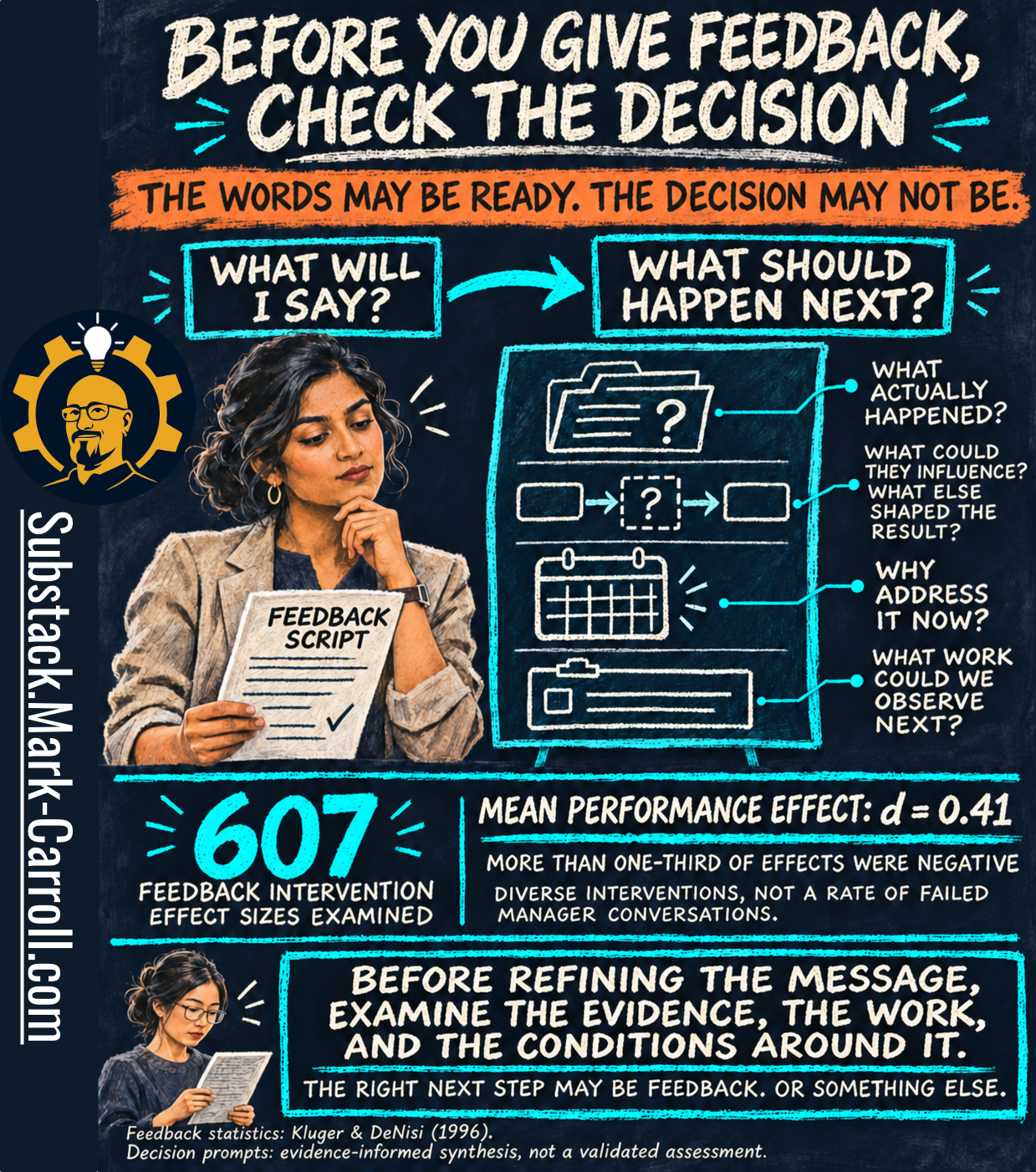
Look at the two boxes across the top. What will I say? What should happen next? Maya had spent Monday morning in the first box, and she had done it well. The feedback script in her hand has a check mark on it, and it earned one.
The orange banner names what the check mark doesn’t cover. The words may be ready. The decision may not be.
The board on the right holds the questions that live in the second box.
What actually happened? Not what Paul wrote. What the work and the record show.
What could they influence? What else shaped the result? What was in Dev’s control on Thursday night, and what wasn’t.
Why address it now? What is gained by acting this week, and what is lost by waiting.
What work could we observe next? Where a change would show up, if one happens.
Maya’s script answered none of them. It was a careful message built on a decision she hadn’t examined: that this was a feedback problem, that it was Dev’s, and that Wednesday was the moment.
Feedback still isn’t the villain
Same counterweight as every week, and the finale needs it most, because almost everything below is about the moments when a feedback conversation isn’t the next step.
In 1996, Avraham Kluger and Angelo DeNisi published a meta-analysis in Psychological Bulletin that pooled 607 feedback intervention effect sizes. On average, feedback improved measured performance: d = 0.41, the standardized ruler from Episode 1, not a 41% improvement. And more than one-third of the effects were negative, meaning the feedback group did worse than its comparison group.
Read the caption under that number before you borrow it. These were diverse interventions, mostly older and often laboratory studies. More than one-third of effect sizes is not a rate of failed manager conversations. It doesn’t say how often your one-on-ones help or hurt. What it does say is the thing this series has leaned on since October: average benefit hides real variation, so a well-intended, well-worded message doesn’t settle what happens next.
That’s why the bottom of the page puts the order where it does.
Before refining the message, examine the evidence, the work, and the conditions around it.
The right next step may be feedback. Or something else.
One boundary before Maya starts. The checks in this episode are not a validated assessment, and the caption on that page says so: decision prompts, evidence-informed synthesis. Each one draws on research. Nobody has tested them together. I’ll show you what each piece rests on, and where the evidence stops.
“Dev isn’t strategic”
Maya closed the invite without sending it and copied one sentence from Paul’s email into a fresh page.
Dev isn’t strategic.
She recognized it. In Episode 2 she had written nearly the same words into Dev’s development notes and found they named a judgment without saying what they asked for. In Episode 6 the phrase turned up again in an anonymous 360 comment, and she and Dev agreed it gave him nothing to act on. Now it was back, from the most senior person in the story, attached to a real event.
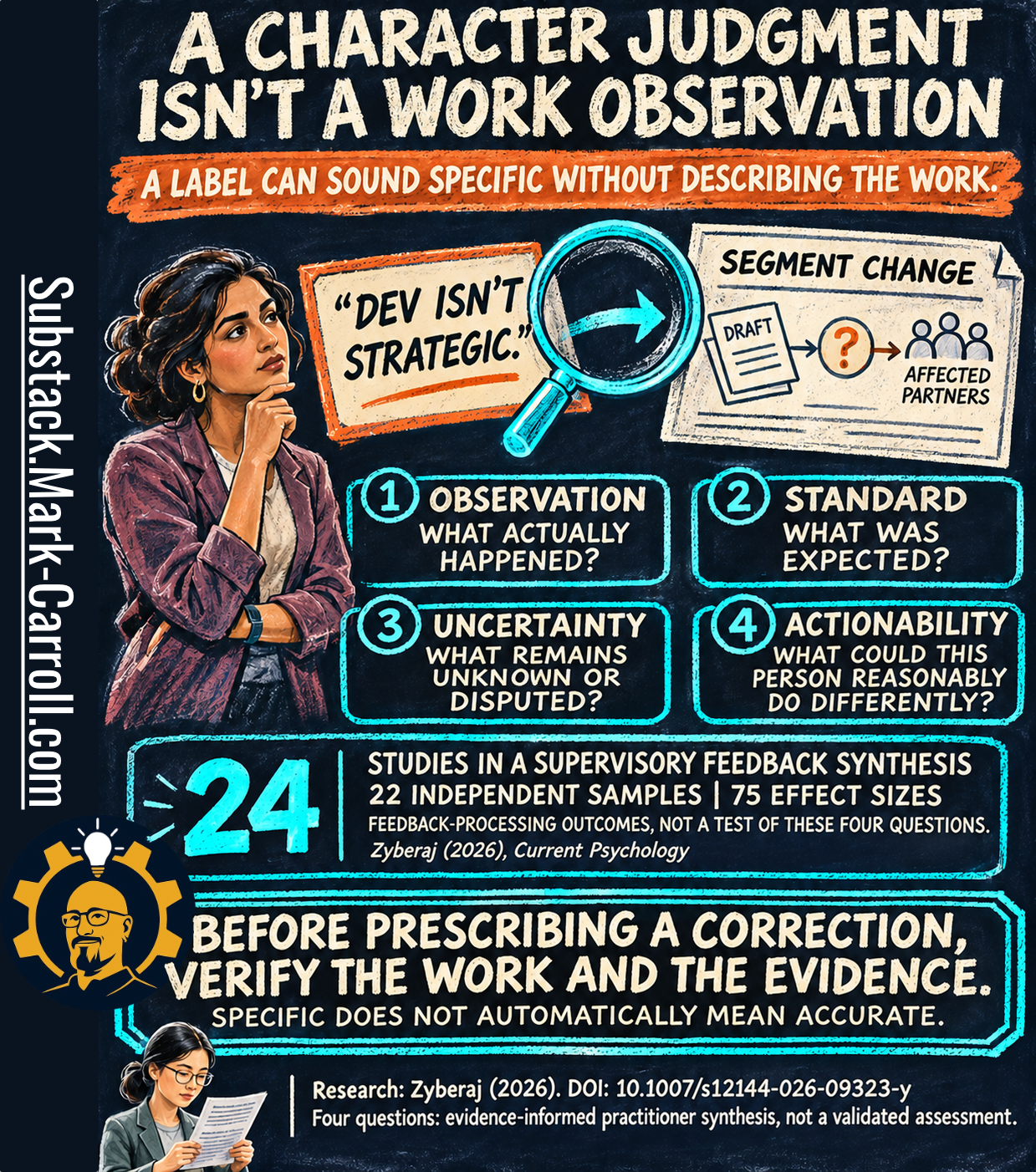
The orange card on the left is Paul’s sentence. The magnifying glass points it at the work: a segment change, a draft, a question mark, and the affected partners on the other side. The banner says why the label can’t stay where it is. A label can sound specific without describing the work.
“Isn’t strategic” sounds like a finding. It has no date, no deliverable and no standard. So Maya took the four questions in order and answered them only with what she could check before Wednesday.
Observation: what actually happened? The forecast’s change log showed the commercial request at 4:05 on Thursday, moving fourteen Northeast accounts into enterprise. Dev’s rebuild was logged at 11:40 that night. Since the 360 debrief, Dev had been copying Maya on his change notes. Her inbox held one, sent at 11:52 p.m., describing the account move and its effect on the Northeast numbers. It went to the partner list. The log showed a second change: at 7:30 on Friday morning, after the draft had gone to stakeholders, Dev lowered the mid-market churn assumption. Her inbox held no note about that one.
Standard: what was expected? Dev’s own plan from the 360 debrief: when a segment or a number changes after a draft has gone to stakeholders, send the affected partners a short change note before the next review. His wording. Status, in Episode 2’s terms: previously communicated, and agreed.
Uncertainty: what remains unknown or disputed? Whether the Northeast partners received the Thursday note. Whether Dev sent anything about the churn change through a channel she wasn’t copied on. Whether he read a small assumption change as “a number changes.”
Actionability: what could this person reasonably do differently? He could send a note for an assumption change. He could not make a note reach people who weren’t on the list he was given.
The four answers didn’t add up to Paul’s sentence, and they didn’t add up to her script either. Her script said the partners saw the changes for the first time on screen, as if no note had gone out. One had. The label had pointed her at the wrong problem, and part of the right one.
The number at the bottom of the page needs its caption read at full weight. In 2026, Jetmir Zyberaj published a systematic review and multilevel meta-analysis in Current Psychology on supervisory feedback: 24 studies, 22 independent samples, 75 effect sizes. It examined how characteristics of supervisors’ feedback related to how employees processed it: whether they perceived it, accepted it, wanted to respond and intended to act.
Those are feedback-processing outcomes, not later performance, and most of the evidence was correlational and self-reported. Results also varied a lot across studies. So it supports something modest: what feedback contains is related to how it’s received. It doesn’t show that turning a label into an observation improves anyone’s work, and it isn’t a test of these four questions. The caption says exactly that.
The last line on the page matters as much as the first. Specific does not automatically mean accurate. Paul’s email was specific. It named a region, a meeting and a day. It was still wrong about part of what happened, and the part it got right needed checking before anyone acted on it. A precise-sounding claim earns inspection, not a pass.
Before prescribing a correction, verify the work and the evidence.
The list Maya promised
The Thursday note had gone out. So why had the Northeast partners walked in blind?
Maya opened the distribution list on Dev’s 11:52 note and compared it with Friday’s attendee list. The note had gone to the Northeast account owner of record, Rob Alvarez, and three planning contacts. Rob had moved to the enterprise team in October. The two regional leads who presented Northeast on Friday weren’t on the note at all.
She knew where the list came from, because she had sent it. At the end of Episode 6 her notebook page had a line with her name on it: get the partner list from commercial ops, chase Paul on the account-move handoff. She did get the list, the Monday after the debrief, and forwarded it to Dev the same afternoon. She never checked it against last month’s regional split. She chased Paul once. He didn’t answer, and the question slid off her list.
The next infographic uses a different manager and a different sentence. The shape is the same.
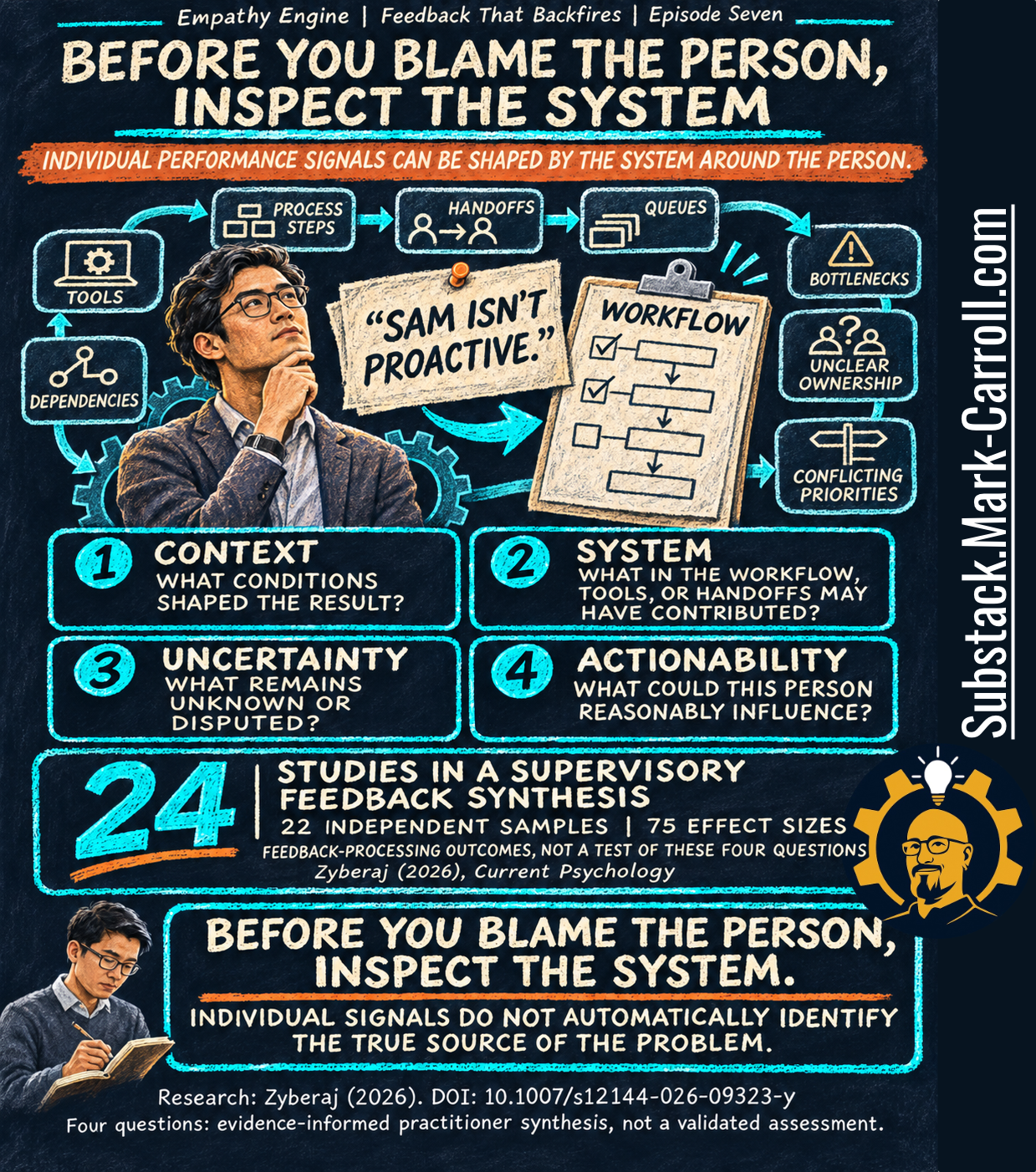
The manager on this page is looking at “Sam isn’t proactive.” Around him is everything the sentence leaves out: tools, process steps, handoffs, queues, bottlenecks, unclear ownership, conflicting priorities and dependencies. The banner under the headline puts it carefully. Individual performance signals can be shaped by the system around the person. Can be. Not always are.
Maya ran the four questions against Thursday night.
Context: what conditions shaped the result? A change requested at 4:05 p.m., a review at 9:00 the next morning, and one evening to rebuild and notify.
System: what in the workflow, tools, or handoffs may have contributed? A partner list that predated the regional split and still named an owner who had left the team. No defined path for account moves to reach forecasting, and an open question about that path that she owned and had let drop.
Uncertainty: what remains unknown or disputed? Who in commercial is supposed to tell forecasting about account moves. Whether the Northeast leads would have read a note if they’d had one.
Actionability: what could this person reasonably influence? The Northeast note: Dev sent it, on time, to the list he was given. The churn note: entirely his.
That last answer is why this check exists, and why it can’t be used to clear everyone. The stale list explained the Northeast miss. It didn’t explain the churn change, which had nothing to do with partners Dev couldn’t reach. The system and the person had each contributed something, to different parts of the same Friday.
The number on this page is the Zyberaj synthesis from the last section, and the caption is honest about its reach: feedback-processing outcomes, not a test of these four questions. It doesn’t speak to systems at all. Its job here is narrower. It reminds us that how feedback lands is research territory. Whether the feedback should be aimed at the person is a separate question.
For that question, other research does more work.
In 2000, Travis Tubre and Judith Collins published a meta-analysis in the Journal of Management on role ambiguity, meaning unclear expectations about what a job requires. Its corrected correlation with job performance was ρ = −.21. Role conflict, meaning competing demands, came in at ρ = −.07, a negligible association. These are correlations, not causes. ρ = −.21 does not mean 21% lower performance. It does mean unclear roles and worse performance tend to travel together.
In 2015, Stephen Courtright and colleagues pooled 107 independent samples covering 7,563 teams in the Journal of Applied Psychology. How work was structured between people, including how much their tasks and outcomes depended on each other, was related to how teams functioned and performed. That’s team-level evidence. It can’t tell Maya how much of Friday belonged to Dev.
And evaluators don’t always correct for context on their own. In 2013, Samuel Swift and colleagues found that experienced professionals judging applicants for admission and promotion sometimes gave too little weight to how much easier some candidates’ environments had been. That’s selection and promotion, not a developmental conversation, so treat it as adjacent.
Practitioner accounts point the same way and carry no more weight than an account. One manager posted this month about an employee labeled hard to reach. The employee turned out to be taking deadlines from three managers, and none of the three had agreed whose came first. That’s one story. It’s useful because it’s recognizable, not because it proves anything about how often this happens.
None of this says systems usually cause performance gaps. The research I found doesn’t say how often. It says the person and the conditions around the work are both worth inspecting before the conversation is aimed at one of them. A dependency does not erase accountability. It changes what accountability must include.
For Maya, it changed whose name went on the first line.
Before you blame the person, inspect the system.
The pull to wait
By Monday afternoon Maya had a new temptation, and it felt like integrity.
Half of Friday was hers. Raising the churn note on Wednesday, while her own stale list sat behind the bigger miss, felt unfair. Dev was still sore from the 360. Year-end reviews were two weeks out. Better, surely, to fix the list first, wait until things settled, and then talk about everything at once.
She noticed how reasonable each sentence sounded. Then she noticed that none of them named a date.
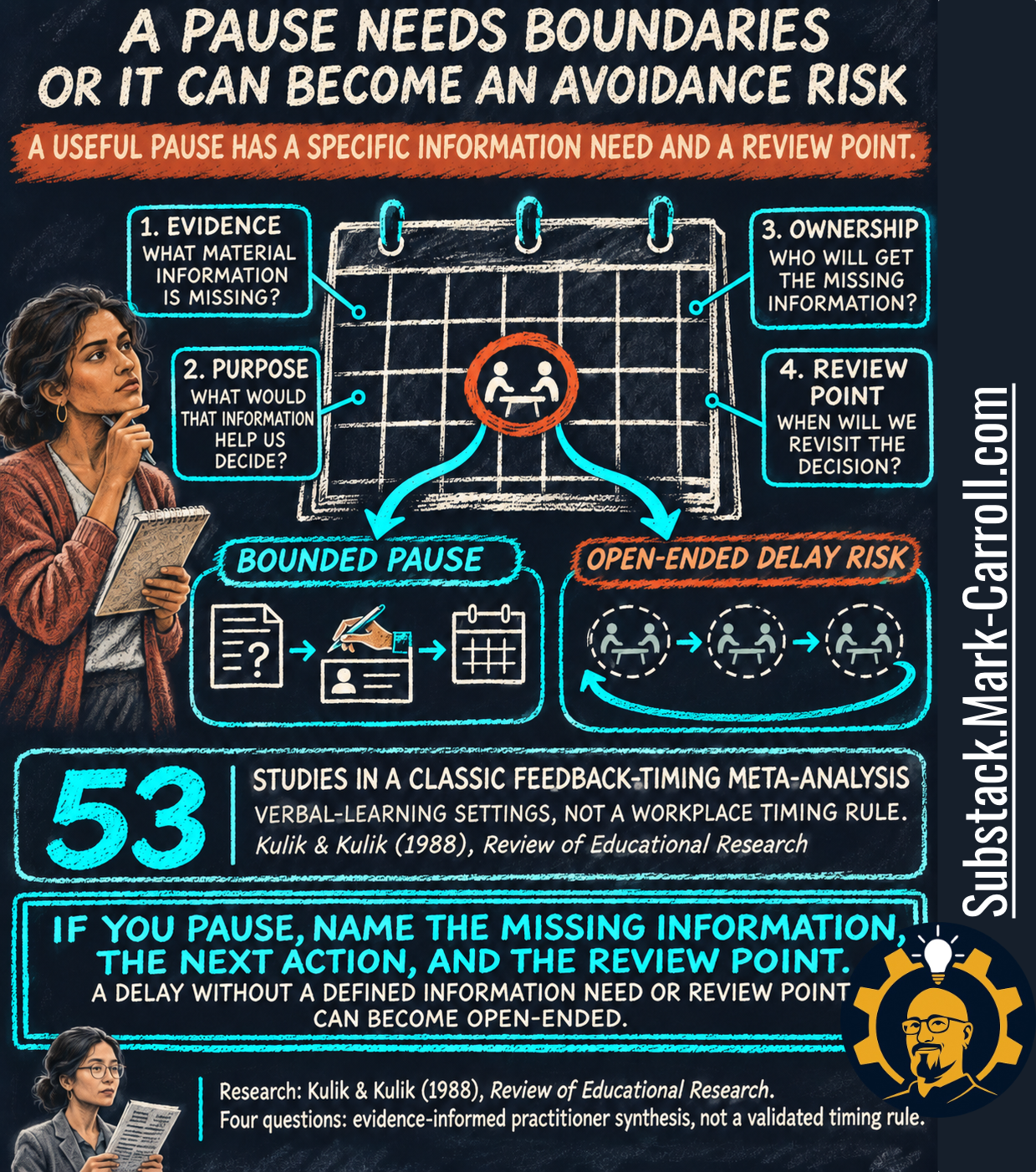
The headline doesn’t say pausing is wrong. It says a pause needs boundaries or it can become an avoidance risk. The banner names the boundaries: a useful pause has a specific information need and a review point.
Look at the two paths at the bottom. On the left, the bounded pause: a document with a question mark, someone getting the answer, a date on the calendar. On the right, the open-ended delay: the same meeting, postponed, then postponed again, looping back to where it started. Maya’s Monday-afternoon reasoning was drawing the right-hand path.
So she put each thread through the four questions around the calendar.
The Northeast list
Evidence: what material information is missing? Who in commercial is supposed to send account moves to forecasting, and what the current Northeast partner list should be.
Purpose: what would that information help us decide? How change notes reach the right people next time. Not whether Dev failed, because the note had gone out.
Ownership: who will get the missing information? Maya.
Review point: when will we revisit the decision? Friday’s forecast sync, with a corrected list or a named owner for one.
That was a real pause, with a reason, an owner and a date. Her next action was an email to the commercial ops lead that afternoon and a visit to Paul’s office on Tuesday instead of another unanswered message.
The churn note
Evidence: What was missing? Whether Dev had sent the note somewhere else, and whether he thought an assumption change counted. Only Dev could answer either one, and he would answer in the conversation itself.
Purpose, ownership, review point: Nothing to collect first, so nothing to pause for.
Waiting would have gathered no information. It would only have spent the time before the next late change, which could arrive any Thursday at four. Wednesday stayed on the calendar, for the churn note alone.
That was the move she had almost missed. A pause on one thread doesn’t have to pause the other. She could verify the list and still have the supported conversation now.
What the research does and doesn’t say about waiting
The number on the page comes with its own warning. In 1988, James and Chen-Lin Kulik published a meta-analysis of 53 studies on feedback timing in verbal learning. Applied classroom studies tended to favor immediate feedback. Some list-learning experiments favored delay. The caption draws the line I drew in Episode 3: verbal-learning settings, not a workplace timing rule. No study I found tells a manager whether Wednesday beats next week.
The research on holding feedback back is newer and just as bounded. In 2026, Alexander Coutts, Boon Han Koh and Zahra Murad published preregistered online experiments in Management Science in which participants played advisers and workers. Advisers sometimes withheld performance information, positive as well as negative. Vague, unhelpful negative information was held back more often than positive information. The participants weren’t workplace managers, so this doesn’t tell us how often real managers stay silent. It does show that holding back is a choice people make, and that vagueness makes it easier.
Practitioners describe the same slide in plainer words. A manager wrote this month about deciding to give feedback one day, finding it awkward the next, and watching it drift to Friday and then the following week. That’s one account, offered as recognition, not evidence.
The four questions are practitioner safety design, not a tested intervention. Their purpose is to make a pause visible to anyone, including the person doing the pausing. If the missing information can’t be named, nothing is being verified. If there’s no review point, it isn’t a pause.
If you pause, name the missing information, the next action, and the review point.
What would count as change
The last question on Infographic 1’s board was the one Maya usually answered after a conversation, if at all: what work could we observe next? On Monday evening she answered it first.
She had a reason to. Friday was itself the follow-through on an earlier conversation. After the 360 debrief, Dev agreed to send change notes. On Thursday night he sent one. On Friday the partners still didn’t know. An agreement, an action and a result, and the three didn’t line up.
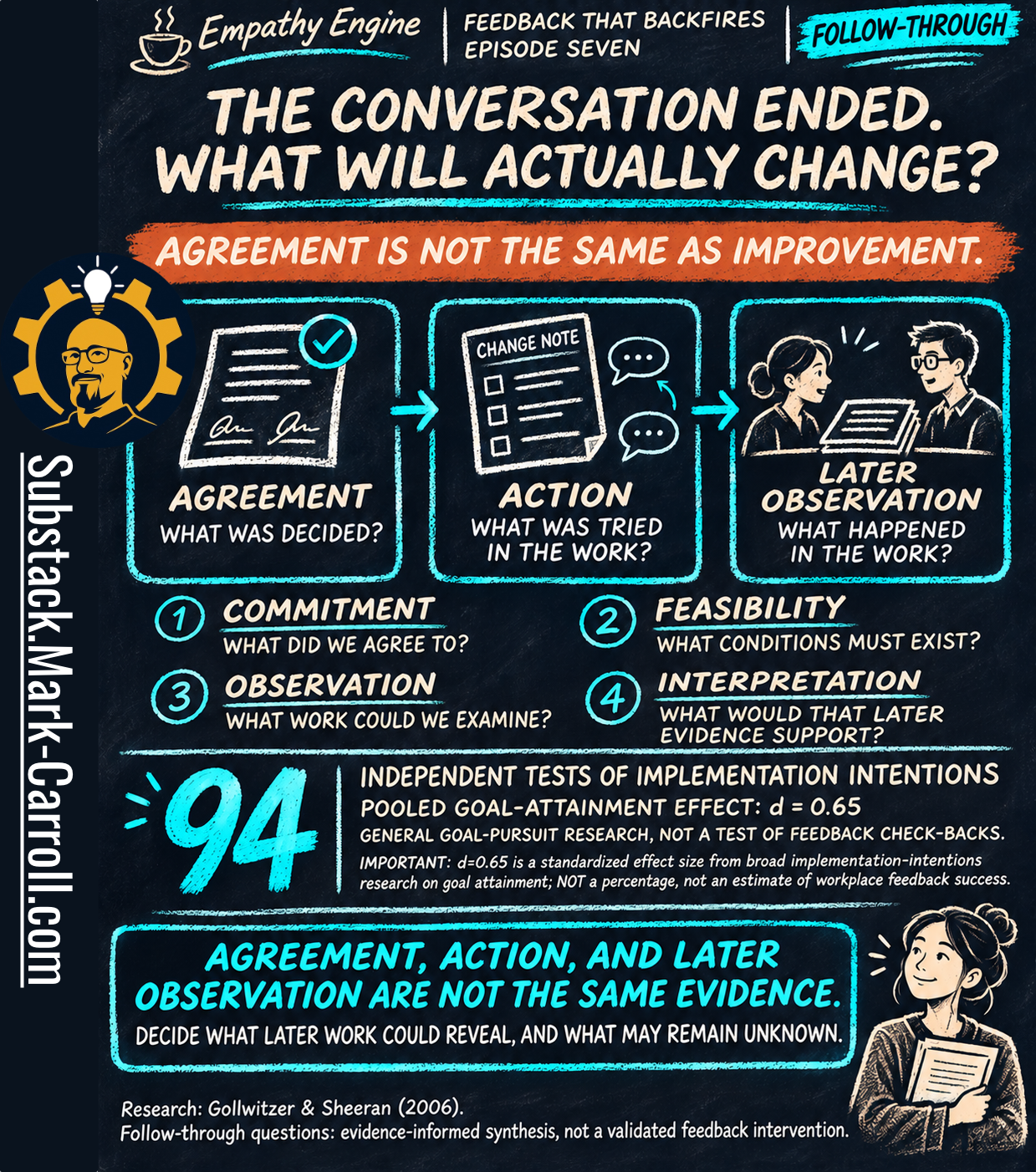
The headline asks the question every manager asks a week too late. The conversation ended. What will actually change? The banner answers the half that’s knowable in advance: agreement is not the same as improvement.
Read the three panels left to right with Friday in mind.
Agreement: what was decided? Dev’s plan from the debrief: change notes to affected partners when anything moves after a draft goes out.
Action: what was tried in the work? One note on the account move, sent on time. No note on the churn assumption.
Later observation: what happened in the work? Two Northeast leads saw the account changes for the first time on screen, because the note went to a list that didn’t include them.
Each panel is a different kind of evidence, and none of them stands in for the others. Dev’s agreement didn’t guarantee the action. His action didn’t guarantee the result. And the result, taken alone, would have pinned the whole thing on him.
So before writing a word of the new conversation, Maya wrote the four numbered questions for what it might produce.
Commitment: what did we agree to? If Dev agrees on Wednesday: change notes cover any number that moves after a draft goes to stakeholders, assumption changes included.
Feasibility: what conditions must exist? A partner list that matches who actually presents each region. Maya’s job, due Friday. And about ten minutes on the evening of a late change, which Dev had said was workable.
Observation: what work could we examine? The next late change: whether a note goes out, to whom, and before the review. She is copied on the notes. She can also ask the regional leads afterward whether they knew.
Interpretation: what would that later evidence support? A note sent shows an action taken. A lead saying they knew shows a note reached someone. Neither shows the forecast got better. If no late change happens for a month, the honest label is Unknown, as Episode 4 put it, not Improved.
Writing this before the conversation changed the conversation. Maya couldn’t promise Dev that a sent note would count as success, because Friday had already shown it might not. She also couldn’t treat the next quiet week as proof of anything.
The number on the page is one Episode 4 used, and its small print does more work here than the number. In 2006, Peter Gollwitzer and Paschal Sheeran pooled 94 independent tests of implementation intentions, if-then plans that link a situation to an action. Those plans improved goal attainment, d = 0.65. The card spells out the limit in capital letters: a standardized effect from broad goal-pursuit research, not a percentage, and not an estimate of workplace feedback success. It isn’t a test of a manager’s check-back either.
A trial from health care adds a caution worth knowing. In 2013, Noah Ivers and colleagues randomly assigned primary-care clinics to receive performance feedback alone, or feedback plus a worksheet for setting goals and action plans. The worksheet made no significant difference to the main clinical outcomes. Only 10 of the 20 physicians given the worksheet used it even once. A planning step can look obviously useful and still not change much. It can also simply not get used.
That’s the honest frame for everything on this page. Writing down the commitment, the conditions, the observation and its meaning doesn’t make change happen. It makes it possible to tell, later, what did and didn’t happen, and what remains unknown.
Agreement, action, and later observation are not the same evidence. Decide what later work could reveal, and what may remain unknown.
Paul’s sentence, again
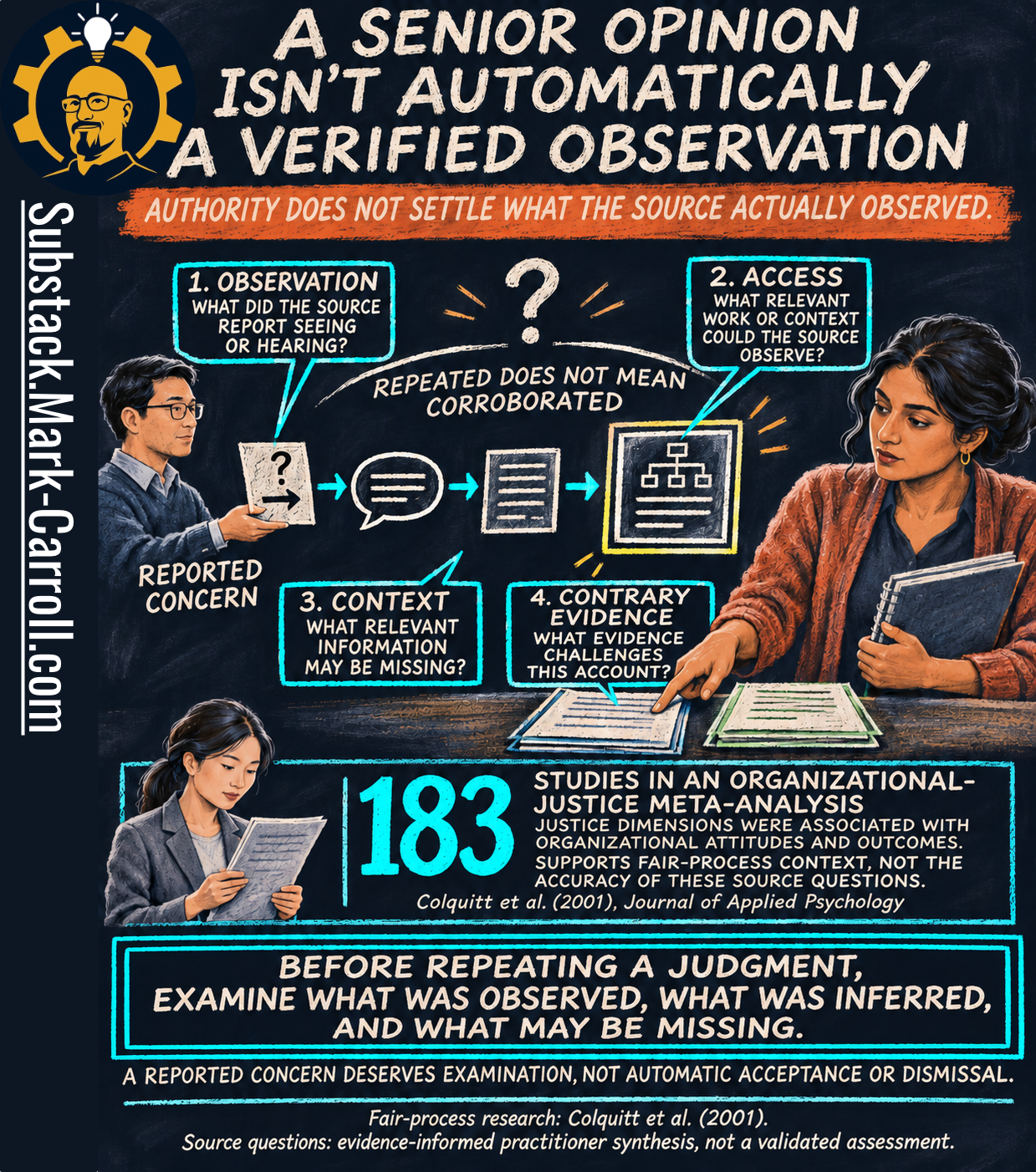
The first four checks apply to almost every consequential conversation. The next two apply only when something triggers them. Maya had both triggers in one email.
The first was the source. Everything Paul wrote arrived secondhand, from the most senior person in the story, and it carried two judgments Maya hadn’t seen anyone observe. On Tuesday morning she walked to his office instead of sending another message.