


Previous:

Chaos Agents (Part 2 of 3): The Bond (Dependency and Spread)
1 Bypass for the Star. 3 Requests by Friday (The Script That Stops Contagion)
One exception becomes precedent. Precedent becomes silence. Silence becomes key-person risk.
One exception granted.
Three engineers request it within 60 days.
The Invitation Filter catches this at three gates: pre-offer, Day 30, Day 90.
Procedural injustice predicts a 51% commitment drop before the quarter closes.
Takeaway (read this first)
Exception contagion starts when a bypass becomes visible and repeatable. Containment comes from treating every exception like a policy change with an audit trail. This dispatch gives you the Exception Pathway plus a quick-start containment script you can use the next time a “just this once” request hits your inbox. Result: fewer fire drills, fewer off-channel decisions, more early warnings.
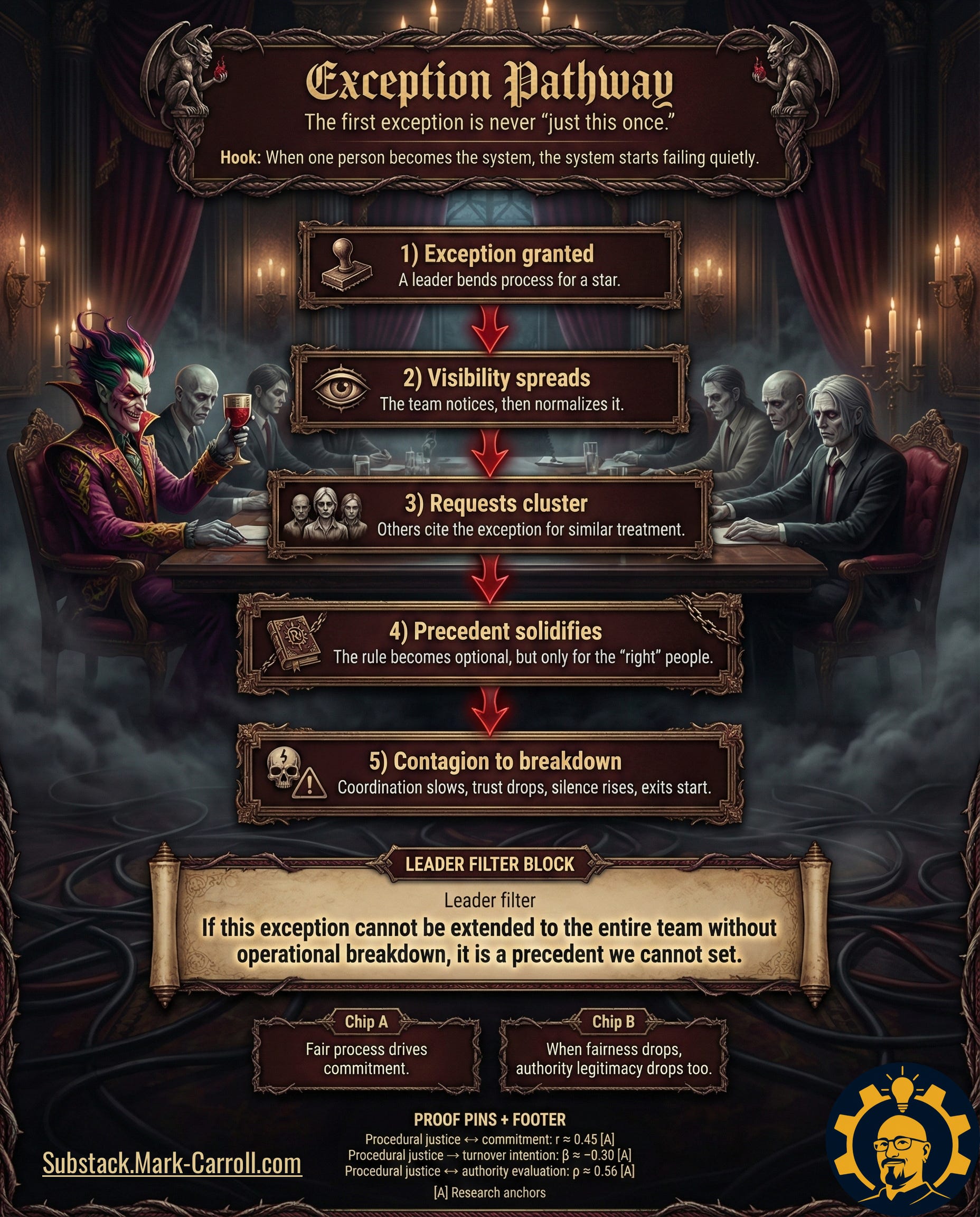
Exception granted → visibility → requests → precedent → breakdown
Quick-start (10 minutes, no new tools)
Goal: stop “special” from turning into “standard” before the copycats show up.
Step 1: Name the exception in one sentence
Example: “Requesting a bypass of the standard intake and approval flow for this delivery.”
Step 2: Require a written rationale, two lines max
Line 1: why now
Line 2: what tradeoff gets delayed or dropped
Step 3: Log the exception where work lives
Ticket, decision log, shared doc, whatever the team actually uses.
Step 4: Add an expiry
Example: “Valid for this one delivery only. Expires Friday.”
Step 5: Close the loop publicly
Example: “Exception granted, rationale logged, expiry set, next request routes through the normal gate.”
Copy/paste: the Exception Gate Script
“Happy to help. Quick check first: can you log this request so the team can review it through the same process we use for everyone? If this truly needs an exception, we can grant one with a short written rationale, an explicit tradeoff, and an expiry.”
Cold open: the first exception
A star asks for one exception. Leadership grants it. Everybody smiles. Somebody jokes about how the process slows real talent down, and the room laughs because laughter is cheaper than saying, “This feels unfair.”
Six months later, rules are optional for the right people. Documentation lives in tribal memory and private DMs. The team gets quieter, not because work got easier. Speaking up stopped producing change. Attrition shows up with polite calendar declines and a sudden wave of “exploring options.”
Reader promise: This dispatch shows the earliest exception-contagion signals and the operational controls that shut them down with systems, not vibes.
Translator box: what these symbols mean (so the stats stay useful)
Readers should not need a statistics degree to use a governance tool.
r (correlation)
A measure of how strongly two things move together. When r is positive, both tend to rise together. When r is negative, one tends to fall as the other rises. Correlation shows relationship strength, not causation.
How to read r in this dispatch:
r ≈ 0.45 between procedural justice and commitment means fair process and commitment tend to rise together, with a moderate-to-strong relationship.
r ≈ −0.45 between commitment and turnover intention means higher commitment tends to travel with lower intent to leave.
ρ (rho)
A correlation reported in many research summaries. Meta-analyses often use ρ when summarizing across studies.
How to read ρ in this dispatch:
ρ ≈ 0.56 between procedural justice and authority evaluation means perceived fairness strongly relates to whether people see leadership as legitimate.
ρ ≈ 0.34 between justice and withdrawal means unfairness relates to people pulling back before they quit.
β (beta, regression or path coefficient)
A predictive weight inside a model that estimates how much one factor predicts another while accounting for other factors in that model. Beta shows relative predictive strength within a specific dataset and model structure.
How to read β in this dispatch:
β ≈ 0.54 from procedural justice → social influence means fairness strongly predicts the strength of social influence in that model.
β ≈ 0.91 from social influence → turnover intention means social influence is a very strong predictor of exit intent in that model.
β ≈ −0.30 from procedural justice → turnover intention means fairness predicts lower exit intent in that model.
Important clarifier: β = 0.91 does not mean 91% of people quit. The number reflects predictive strength within the model’s structure, not a percentage of people affected.
R² (variance explained)
How much of the variation in an outcome is statistically accounted for by predictors in a study.
How to read R² in this dispatch:
R² ≈ 0.46 for silence → effectiveness means silence-related factors explained about 46% of the variance in an effectiveness index in that dataset.
≈ (approximately)
Rounded values from specific studies or syntheses. Useful for direction and mechanism, not universal constants.
Integrity note: Some numbers come from meta-analyses across many studies, others come from single models. Treat them as direction and mechanism, not fate.
Why this works: one exception becomes a system
Exceptions do not stay local. Exceptions become precedent. Precedent changes behavior. Behavior changes incentives. Incentives build dependency.
Narrative progression (the exception pathway in human terms)
Exception granted. A leader bends process for a star.
Visibility spreads. People notice, then normalize.
Requests cluster. Others cite the precedent.
Precedent solidifies. Rules become optional for the “right” people.
Breakdown begins. Trust drops, silence rises, coordination slows, exits start.
Operational translation: Every exception is a policy change. Writing it down makes it governable. Leaving it unwritten turns it into folklore, and folklore scales fast.
Read the graphic like this: Treat the arrows as a timeline. Visibility marks the point where containment becomes urgent.
How disruption becomes contagious: factions, thralls, fog
This section uses executive language for a pattern that feels almost supernatural when you live inside it. Systems can behave like vampires. Systems feed on exceptions, then ask for more blood.
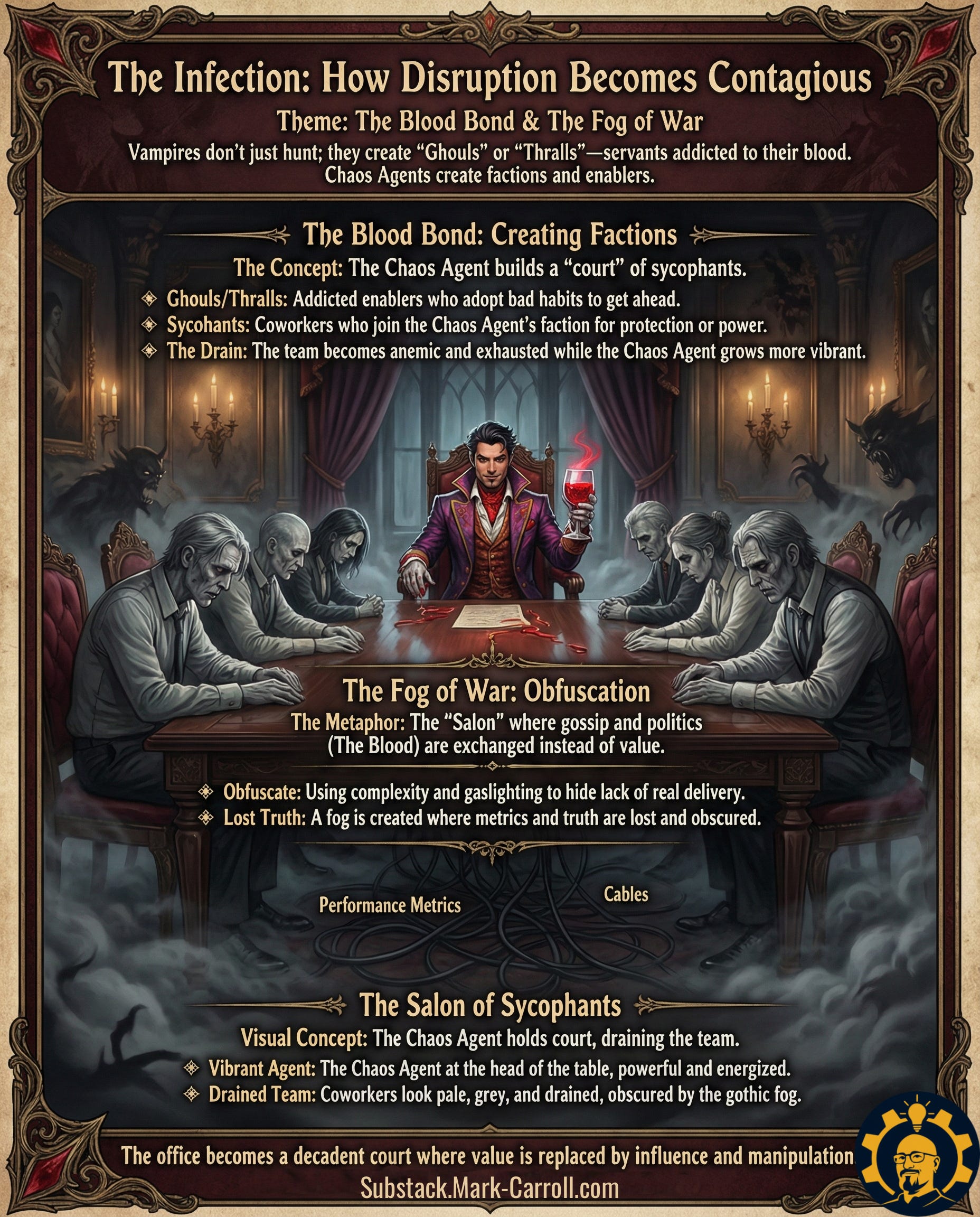
Read the graphic like this: Look for where work stops being checkable. Checkability is oxygen for governance.
A) The blood bond: enabling factions form
Observable behaviors:
People optimize for proximity to the star, not outcomes.
Status becomes the shortcut to resources, attention, and approvals.
Meetings shift from solving to signaling.
Common leadership misread: “Alignment.”
More accurate read: Survival strategy. People stop betting on process and start betting on access.
Leader move (small, fast): Ask one question in public: “What process would we defend if this decision showed up in an audit?” Silence after that question is data.
B) The fog of war: obfuscation becomes cover
Observable behaviors:
Back-channeling replaces visible decisions.
Artifacts go missing, then reappear as “final.”
“Trust me” becomes a delivery strategy.
Common leadership misread: “High ownership.”
More accurate read: Un-auditable power. Ownership without checkability becomes a private kingdom.
Leader move (small, fast): Require one artifact for every bypass: a logged rationale plus an expiry. No artifact, no exception.
Silence is not peace. Silence is risk moving off-record
Silence signals that the feedback loop broke. Silence signals that speaking up stopped paying.
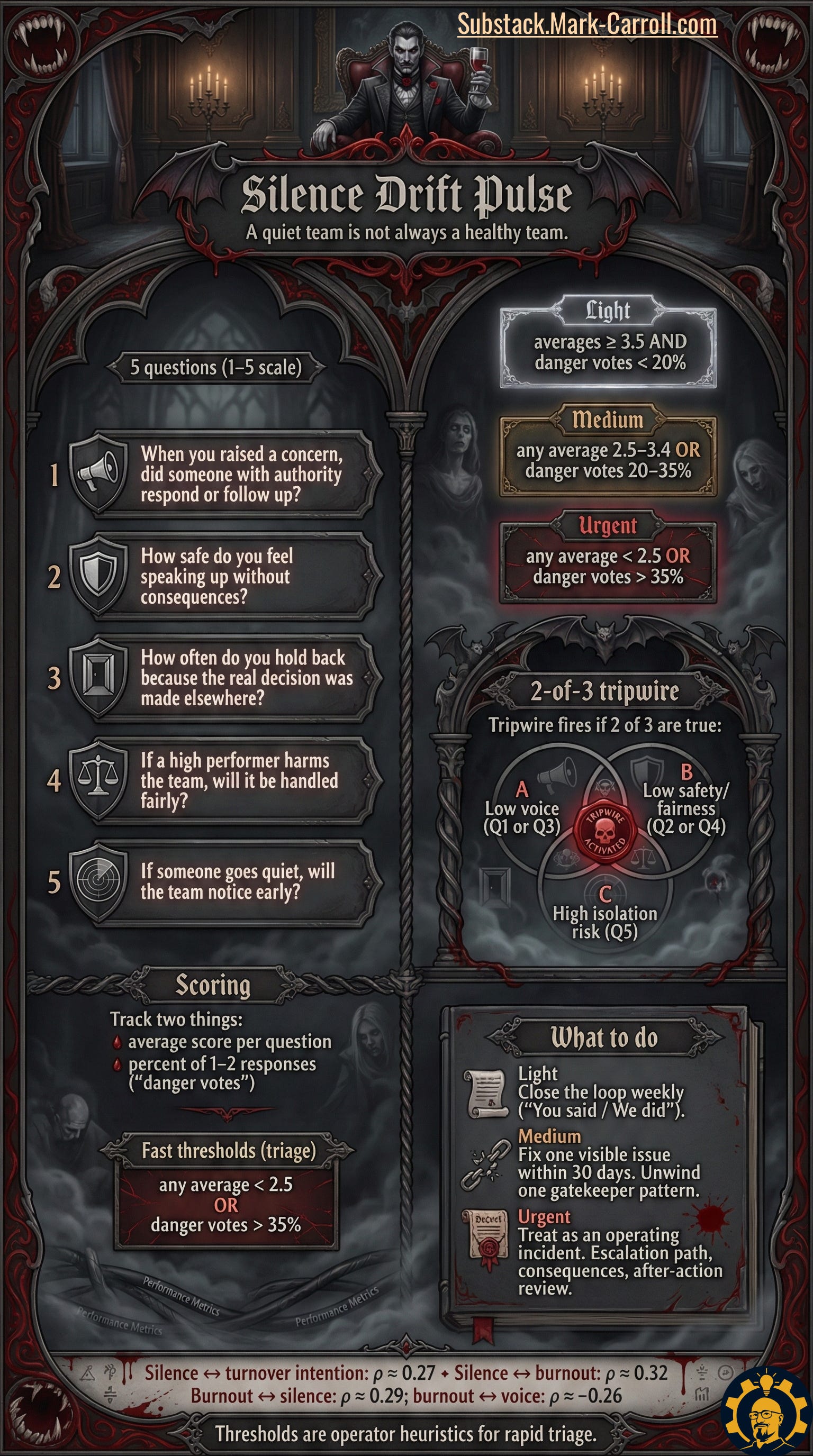
Read the graphic like this: These five questions run a signal scan, not a culture survey. Speed matters more than perfection.
