How founders and early contributors can define responsibilities, decision roles, and expectations before discussing percentages
Mara thought the hard part was over.
Tariq had finished the project, but “finished” did not quite describe what had happened. He had caught an assumption Mara and her AI stack had missed, protected a customer commitment, improved the workflow, and made several judgment calls without waiting for instructions. He had not merely completed assigned work. He had started carrying part of the operating reality.

Mara wanted to acknowledge that. She began talking about a larger role, a longer relationship, and the possibility of something tied to the upside. The language sounded generous because she meant it generously.
Tariq listened, then asked the question that stopped the conversation: “What exactly am I building toward?”
Mara could have answered with a percentage. She could have reached for a title such as founding employee, partner, or cofounder. But none of those labels would answer the question Tariq had actually asked.
They had not defined what he would contribute next, which outcomes he would carry, what he could decide, what Mara would retain, what each of them expected, or what either believed had already been promised. The percentage question was not wrong. It had arrived before the operating relationship had a shape.
Most advice about early contributors begins with mechanics. How much equity should the first employee receive? What percentage is fair? Which structure should be used, and how should it vest? Those questions may become necessary. They are rarely the first useful ones.
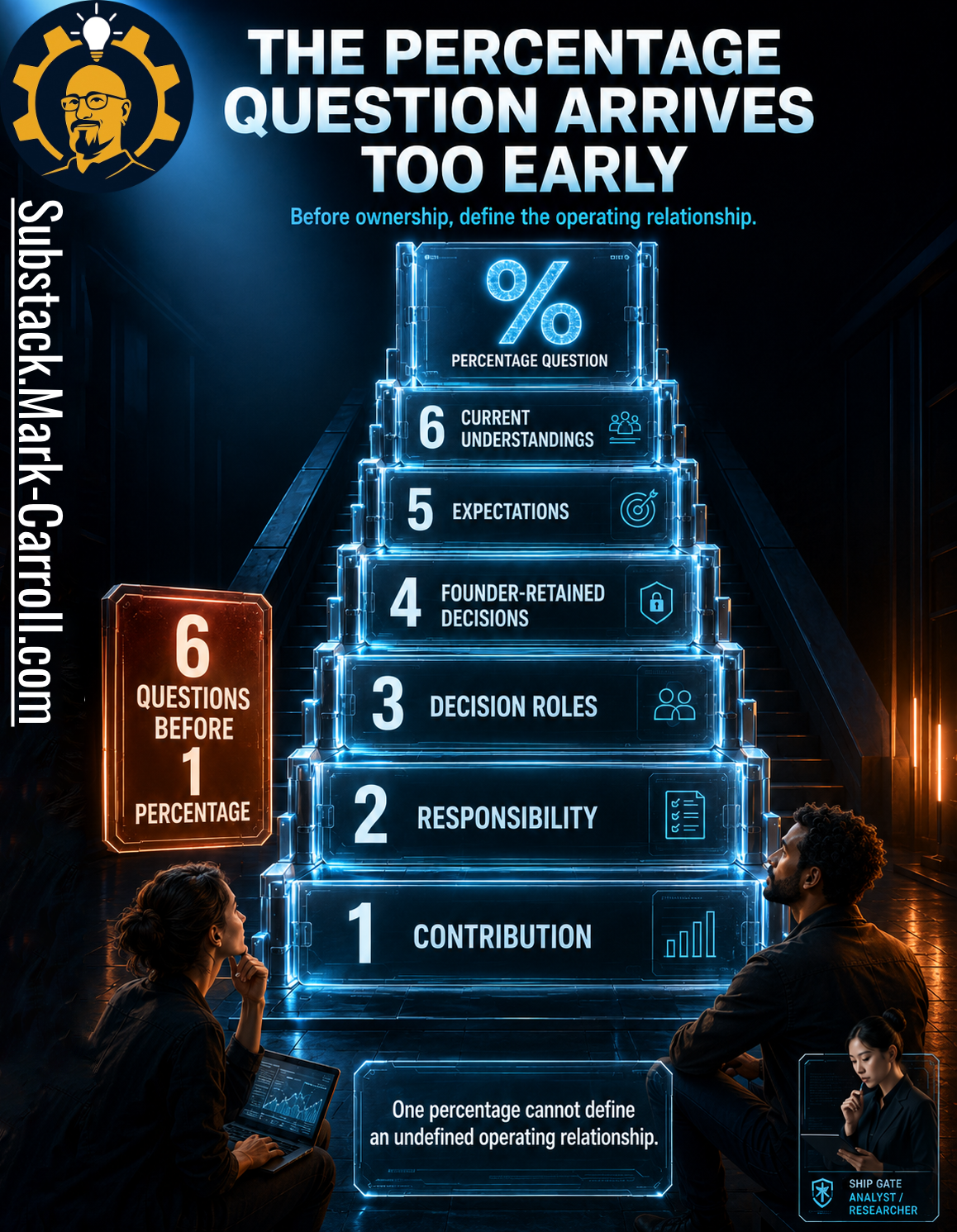
One percentage cannot define an undefined operating relationship.
Research Binder: the receipts (citations + source notes) are compiled in a PDF at the bottom of this post.
I have seen this most clearly in transformation and facilitation rooms where someone was named the owner before anyone had defined what ownership meant operationally. The title might have been Product Owner, lead, or accountable executive, and the room would relax as though the question had been settled.
Then I would ask, “What can this person decide without coming back to this group?” Very often, the answer became vague. They could coordinate the work, report the status, and absorb the consequences, but they could not change the priority, approve the resource, or make the exception.
That was the tell. The title gave the organization the appearance of clarity without requiring it to release any authority. The person had been handed the accountability story before anyone had named what they would actually carry.
Why Founders Should Define the Operating Relationship Before Discussing Equity
Before discussing ownership, a founder and an early contributor need to understand what the percentage would supposedly recognize. Past contribution, future responsibility, decision authority, financial sacrifice, and long-term commitment are different things. Startup conversations often compress them into one number because a number feels decisive.
This article does not argue that hard work creates entitlement. It does not argue that founders should surrender control whenever someone becomes valuable. It argues that compensation math cannot repair an operating relationship nobody has defined.
Six questions should come before one percentage. What will this person contribute? What will they be responsible for? What may they decide? Which decisions stay with the founder? What does each person expect? What do both understand to be true right now?
I call that practice Builder Stake. It names the conversation that should happen before anyone tries to turn contribution into a percentage. Builder Stake is an educational framework, not a legal, tax, compensation, or equity method.
The research behind this piece points in the same direction: clearer roles, expectations, decision processes, and explanations matter. Most of that research comes from larger organizations, so I am using it as a signal, not as a startup law.
The point is not to delay every financial conversation until the relationship becomes perfectly knowable. Young ventures change too quickly for that. The point is to stop asking a percentage to carry information it cannot hold.
How a Venture Moves From One Human Center of Judgment to Two
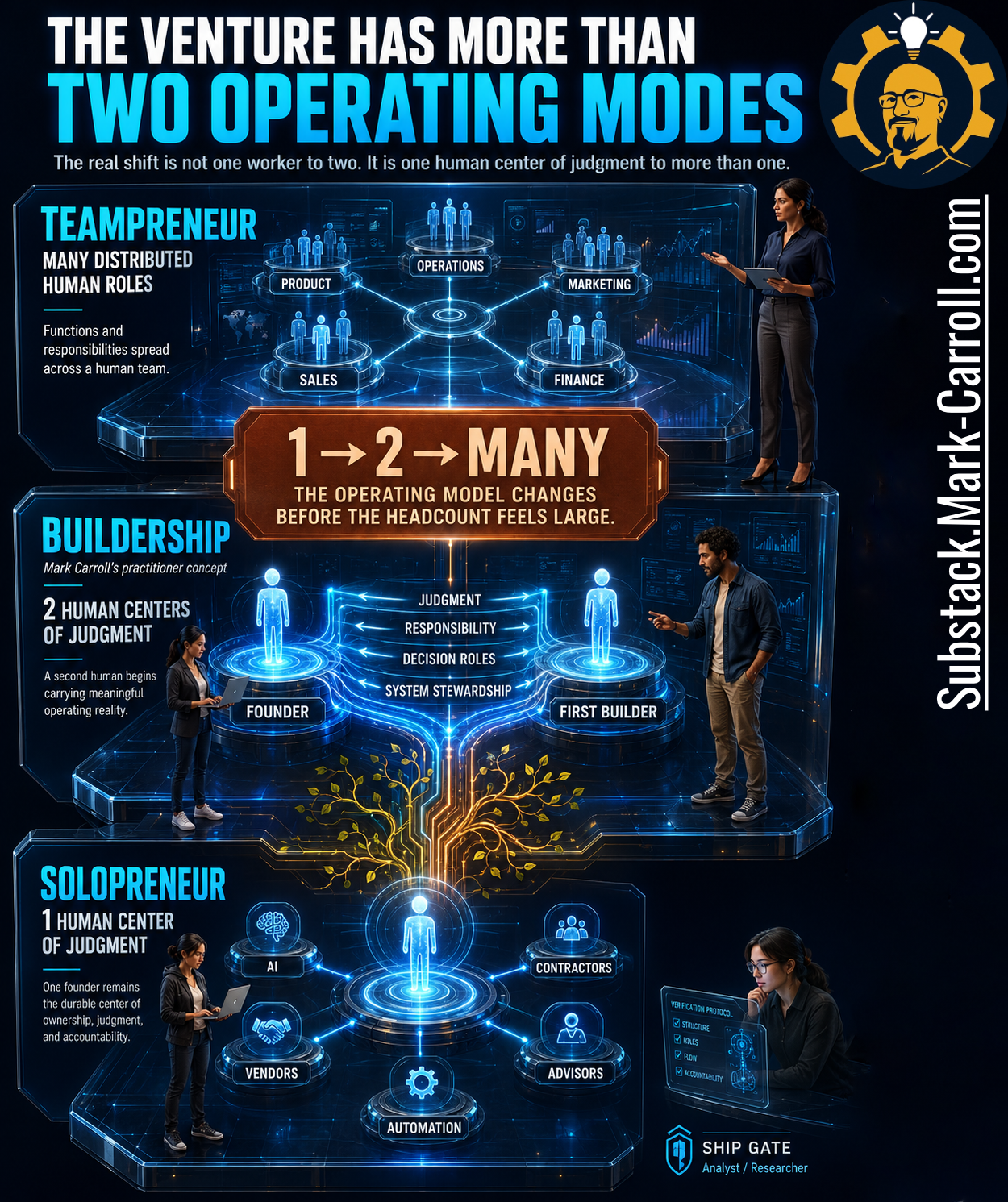
A venture does not move through only two operating modes.
The usual story begins with a solopreneur and jumps directly to a team. That skips the strange middle period when one founder is no longer carrying every meaningful judgment alone, but the company does not yet have a distributed human organization.
A solopreneur may use AI, automation, contractors, vendors, and advisors. Those resources can extend output dramatically, but one human still holds the durable center of judgment and accountability. When something ambiguous happens, one person decides what it means and what happens next.
A teampreneur has many human roles spread across product, operations, marketing, sales, finance, and delivery. Judgment no longer sits inside one relationship. The venture has become a human system.
Between those two sits Founder + 1st Builder. This is the point where another person begins carrying decisions, consequences, and operating memory the founder once held alone. The term describes an operating relationship, not a legal category, worker classification, ownership tier, or automatic path to cofounder status.
The progression is not one worker, two workers, then many workers. It is one human center of judgment, then two, then many distributed human roles. The operating model changes before the headcount feels large.
I noticed that shift during a transformation when an internal leader I had been coaching stopped coming to me for the answer and started bringing me a diagnosis. They could see the system problem, explain the tradeoff, and recommend a route without waiting for me to frame it first.
The moment that stayed with me happened in a meeting where I was prepared to raise a concern, and they raised it before I did. They used the same underlying logic, but in language the organization could hear more easily. Nothing had changed formally. The work simply had a second human center of judgment now.
How Role Ambiguity Hurts Early-Stage Teams Even When the Work Still Gets Done
Mara had seen an earlier version of this problem with Jess.
Jess had an important title and meaningful work. Customers knew her, the workflow depended on her, and Mara spoke about her as someone central to the company. On the surface, the process worked.
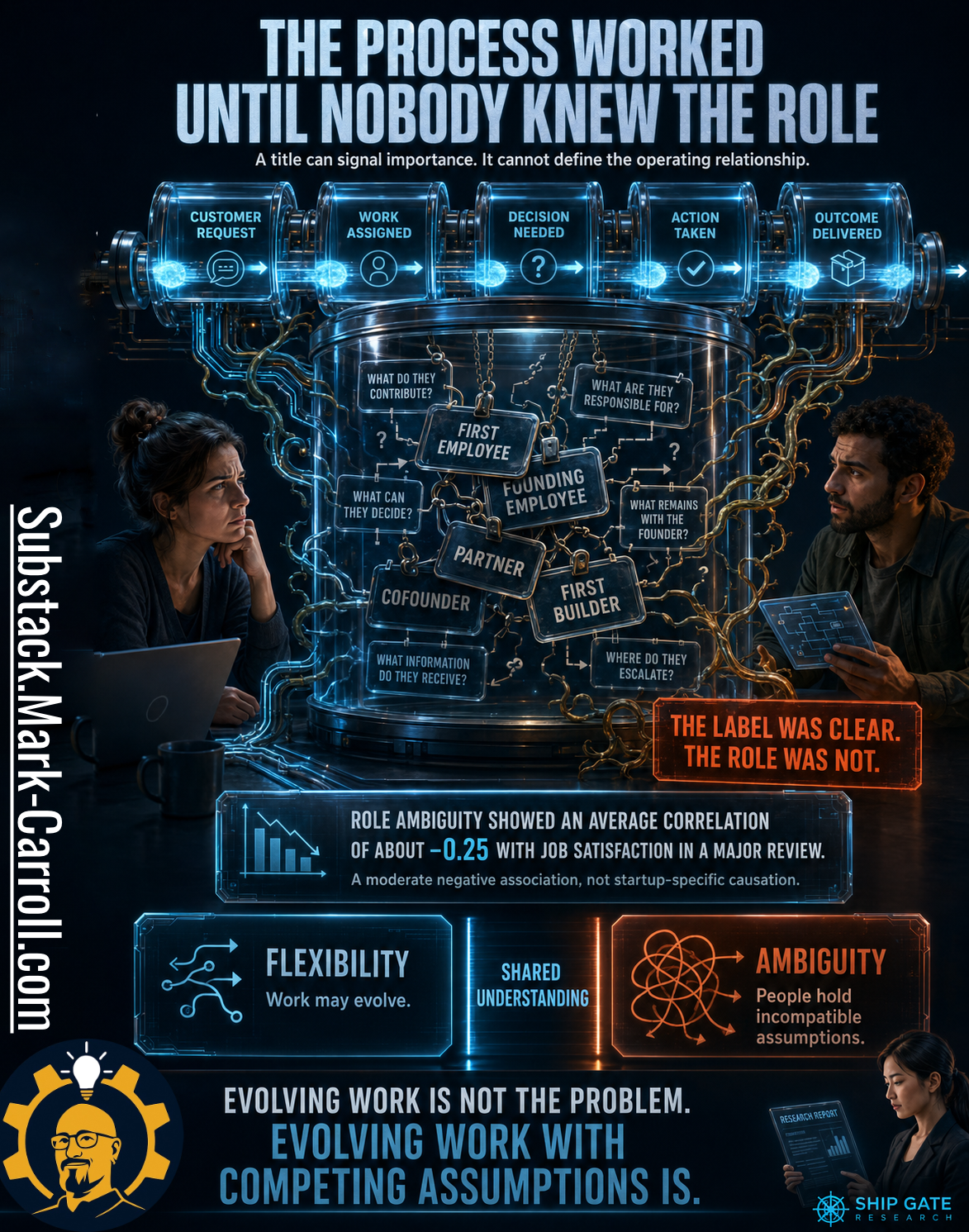
What never became clear was the role underneath the label. Was Jess expected to execute Mara’s decisions or shape them? Could she change the customer process, or only recommend changes? Was she responsible for delivery alone, or for the outcomes delivery produced?
Mara thought flexibility was a sign of trust. Jess increasingly experienced the same flexibility as an invisible standard she could never quite locate. The label was clear. The role was not.
Research across many organizations links role ambiguity with lower satisfaction and greater strain. That does not prove unclear roles cause every startup conflict, but it does match what I have seen in practice: the work can keep moving while confidence quietly drains out of the relationship.
Clarity does not mean freezing a young company in place. A 1st Builder’s role may change every month because the market, product, and customer base are changing too. Flexibility means the work can move while both people understand how changes will be discussed.
Ambiguity means each person carries a different operating map. The founder sees room for initiative. The contributor sees an undefined test. The founder sees trust. The contributor sees decisions that can be reversed without warning.
Evolving work is not the problem.
Evolving work with competing assumptions is.
What Responsibility Without Authority Looks Like in a Startup
The phrase “take ownership” sounds empowering until the first consequential decision arrives.
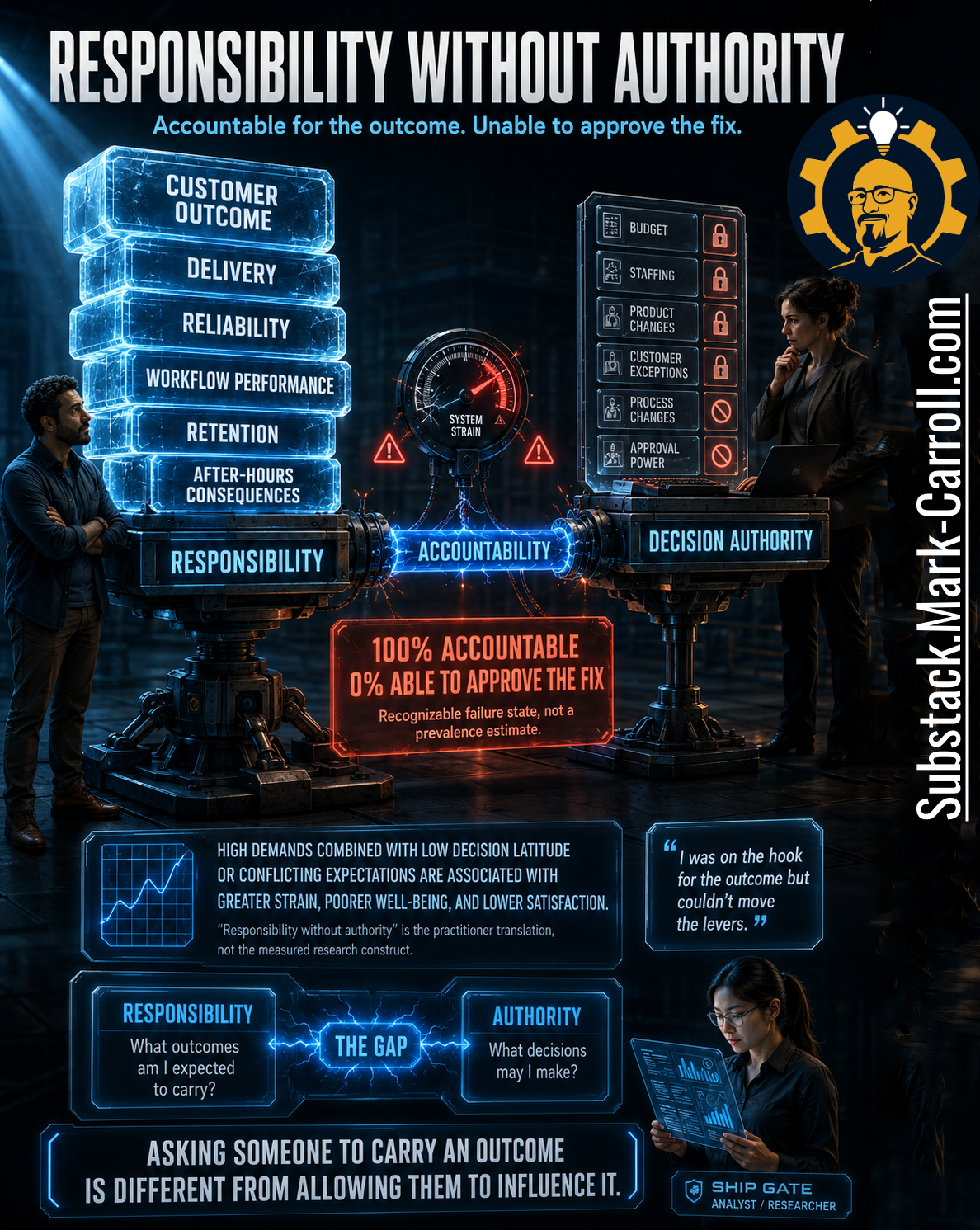
Suppose Tariq is accountable for a customer outcome. He sees that the current workflow will fail, but he cannot approve the process change, adjust the budget, alter the product commitment, or make an exception for the customer. The outcome belongs to him. The levers do not.
That is responsibility without authority.
Research uses several related ideas to describe this pattern, including low decision latitude and role conflict. The labels vary, but the lived experience is familiar: people are asked to carry pressure without access to the decisions that would relieve it.
I have carried that mismatch in enterprise transformation work. I was expected to improve delivery across a program, but I did not control the priorities, staffing, or dependency decisions shaping the outcome.
Day to day, it felt like seeing the same blockage clearly, explaining it in multiple rooms, and still watching the team closest to the work carry the pressure. I could facilitate the decision, but I could not make it.
In the best cases, a senior leader finally clarified who had the authority to act. In the worst cases, nothing truly changed. The team remained accountable for the result while every fix that could change the outcome still required permission from somewhere else.
Founders do not need to release every decision. Some choices properly stay with them because they involve capital, legal commitments, reputation, irreversible strategy, or promises the contributor cannot see. The problem begins when those boundaries remain invisible.
A founder can say, “You own this customer outcome,” while still expecting every unusual decision to return for approval. The contributor hears responsibility. The operating system delivers escalation.
Ownership mentality also needs a cleaner definition. Here it means noticing what matters, exercising judgment, acting without being chased, and caring about consequences within a known scope. It does not mean legal ownership, equity, or governance rights.
The answer is not unlimited authority. It is an honest description of where authority exists, where it stops, and what happens at the edge.
Asking someone to carry an outcome is different from allowing them to influence it.
How Vague Founder Promises Create Competing Expectations
Early-stage relationships often run on warm language.
“We’ll take care of you.” “We’ll revisit this after revenue.” “You’ll participate in the upside.” “This could become something bigger.”
A founder may mean appreciation, possibility, or an honest admission that the future is not yet knowable. The contributor may hear future compensation, an ownership conversation, a long-term role, or eventual recognition for current sacrifice. Nobody has to be dishonest for one sentence to create two memories.
Psychological-contract research helps explain why that matters. People respond not only to formal agreements, but also to what they believe has been promised or mutually understood. When those expectations feel broken, trust and commitment tend to suffer long before anyone reaches a legal argument.
No formal promise does not always mean no expectation was created.
That is not a legal conclusion. It is a relationship warning. Psychological expectations can be real without becoming enforceable rights.
Mara’s job is not to predict everything that may become possible. Her job is to distinguish what is true now from what may be discussed later. Tariq’s job is not to treat every hopeful comment as a guarantee, but he cannot clarify language Mara refuses to clarify.
Three categories help. A current understanding describes what both people believe is true now. A future topic names something they may discuss later without turning it into a present commitment. An actual commitment is something clearly promised, agreed, and properly documented.
The middle category is where trouble hides. “Future topic” cannot become a cleaner version of “we’ll take care of you.” Maybe later is not the same as nothing was implied.
Ambiguity can feel generous in the moment. It becomes expensive when both people remember it differently.