
The Boring Document That Held More Power Than the CEO
AA-008: Finale: The Charter That Held

Previous:
📜 Finale: The Charter That Held
“The boring document that kept ownership visible after leadership changed.”
*****⚙ THE ARCHITECTS OF AUTONOMY*****
Research Binder: the receipts (citations + source notes) are compiled in a PDF at the bottom of this article.
Boards can discuss AI risk across the audit committee, the risk committee, the tech steering group, the full board, the strategy offsite, and the executive session, then assign it to engineering, compliance, and legal, and still fail the simplest test in governance.
Who owns the risk when the names change?
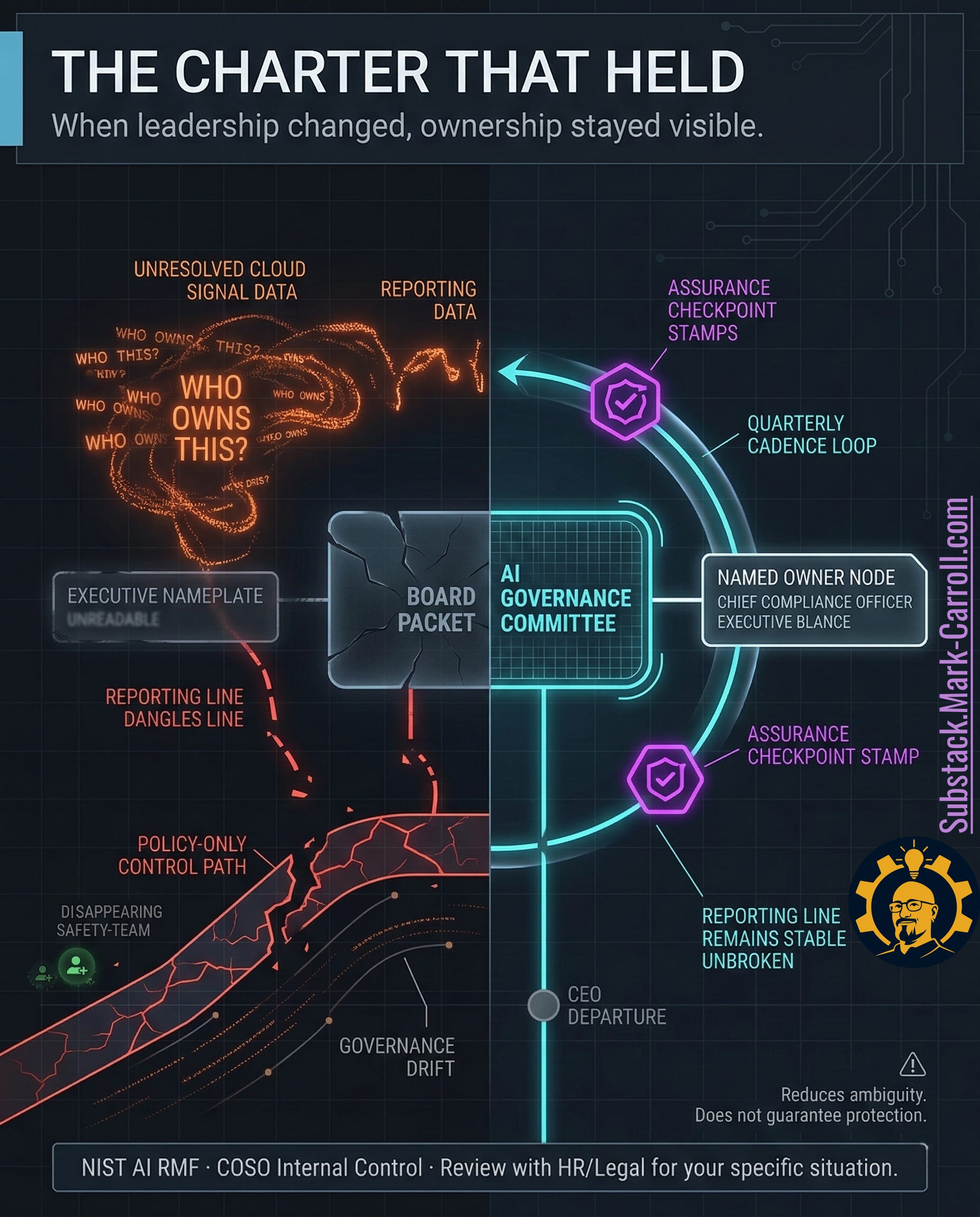
🧭 Cold Open
You are in a boardroom that smells like burnt coffee, laser toner, and the specific kind of politeness people use when something expensive has gone missing.
The CEO is gone.
The safety lead is gone.
The org chart was updated last week, which is corporate for “we moved the boxes around and prayed nobody would ask the rude follow-up.”
A board packet sits open under cold fluorescent light. AI appears everywhere. AI strategy. AI risk. AI oversight. AI monitoring. AI readiness. Concern is abundant. Concern has never had a hiring problem.
Responsibility is another story.
Someone at the table says management owns it.
Nobody argues. Nobody relaxes either.
The general counsel flips back three pages, then six, then forward again, like the answer might appear if the pages feel sufficiently judged. A committee chair asks whether the risk committee owns the issue or whether it sits with audit. A compliance lead says the controls are being reviewed. Engineering says they are following policy. Someone else says the policy was refreshed in Q4.
That sounds almost comforting.
Then the question lands.
Which executive owns it now?
Not who touched it. Not who briefed it. Not who cared about it most last quarter. Who owns it now.
Silence does the work no one wants to do.
A slide footer still carries the last executive sponsor’s name. One reporting line ends in a box that no longer exists. A dashboard blinks green for a team that no longer exists. A packet still circulates. A process still claims to be alive. The empty box is still there, neat and official, as if presentation could substitute for ownership.
Nothing on paper tells the next person what they just inherited.
That is the reveal.
The risk is not new. The model is not new. The concern is not new.
The ownership is missing.
If it is not written, it is not owned.
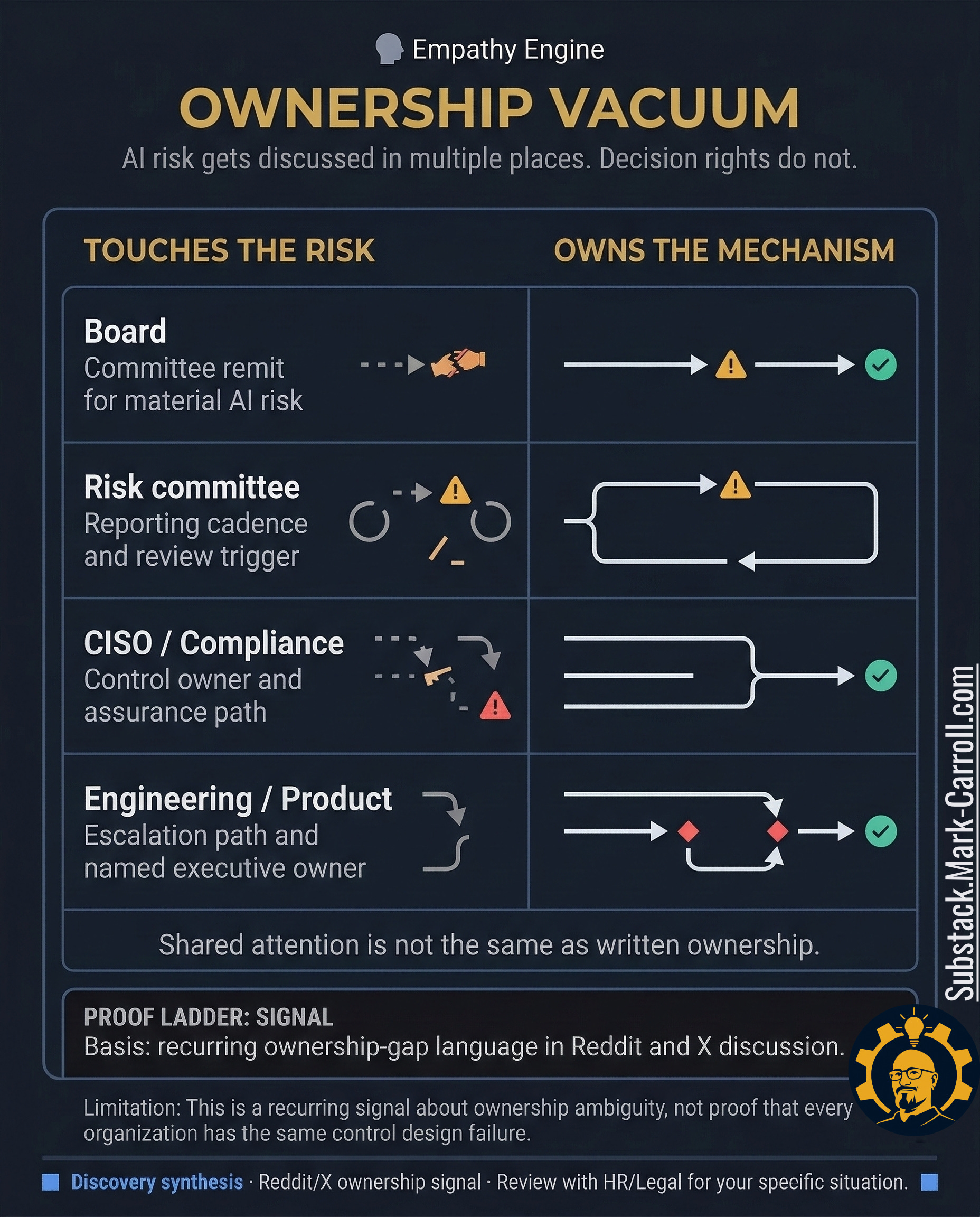
🧱 The Mechanism
Most governance failures do not begin with malice. Most begin with a handoff.
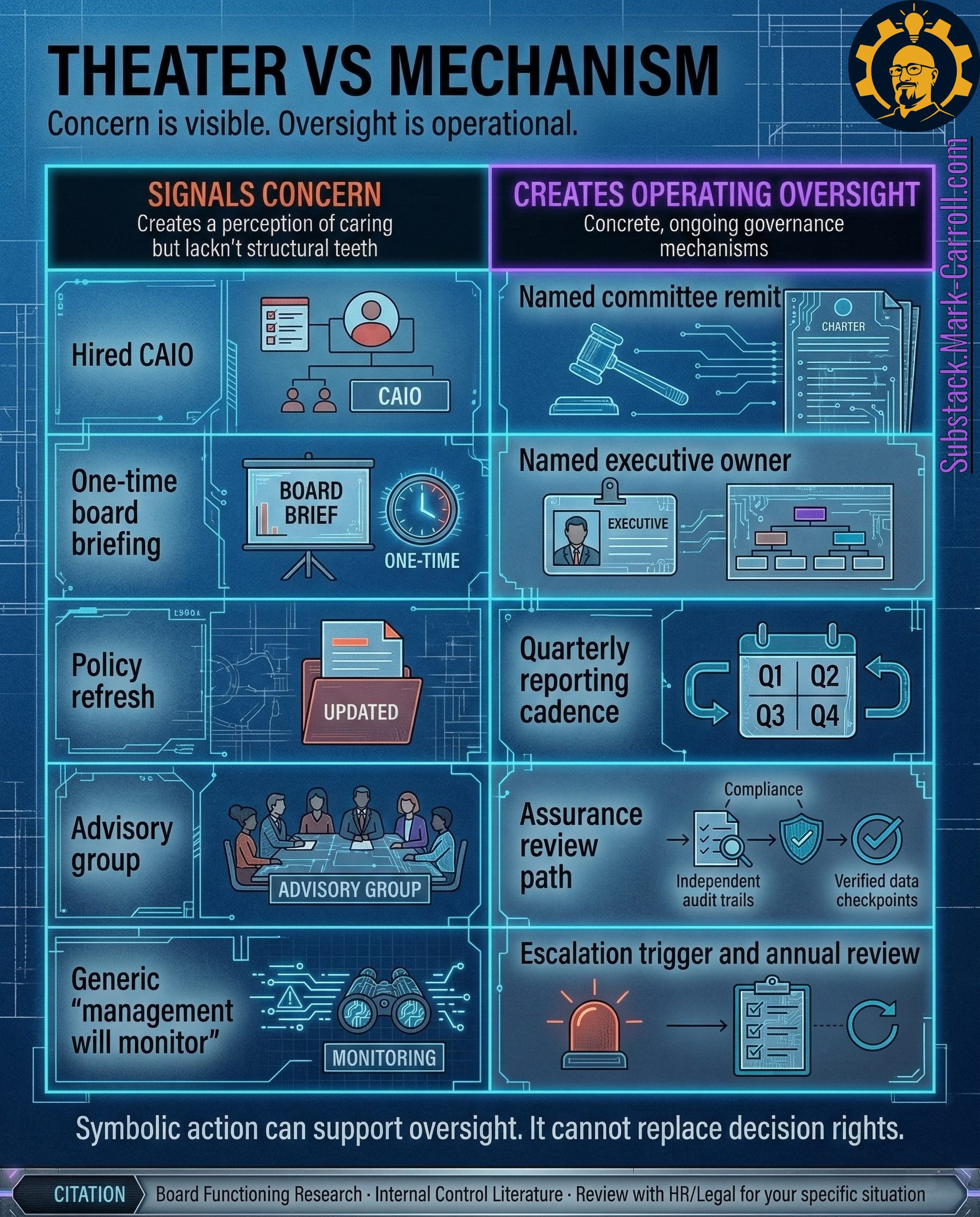
A charter matters because a charter does four boring, glorious things.
A charter gives oversight a home. A committee remit beats a hallway understanding every time.
A charter names an owner. “The team” is not an owner. “Management” is not an owner. “We monitor it” is not an owner wearing a fake mustache.
A charter creates cadence. Quarterly review. Escalation trigger. Assurance path. Annual look-back. Memory is not a control. Rhythm is.
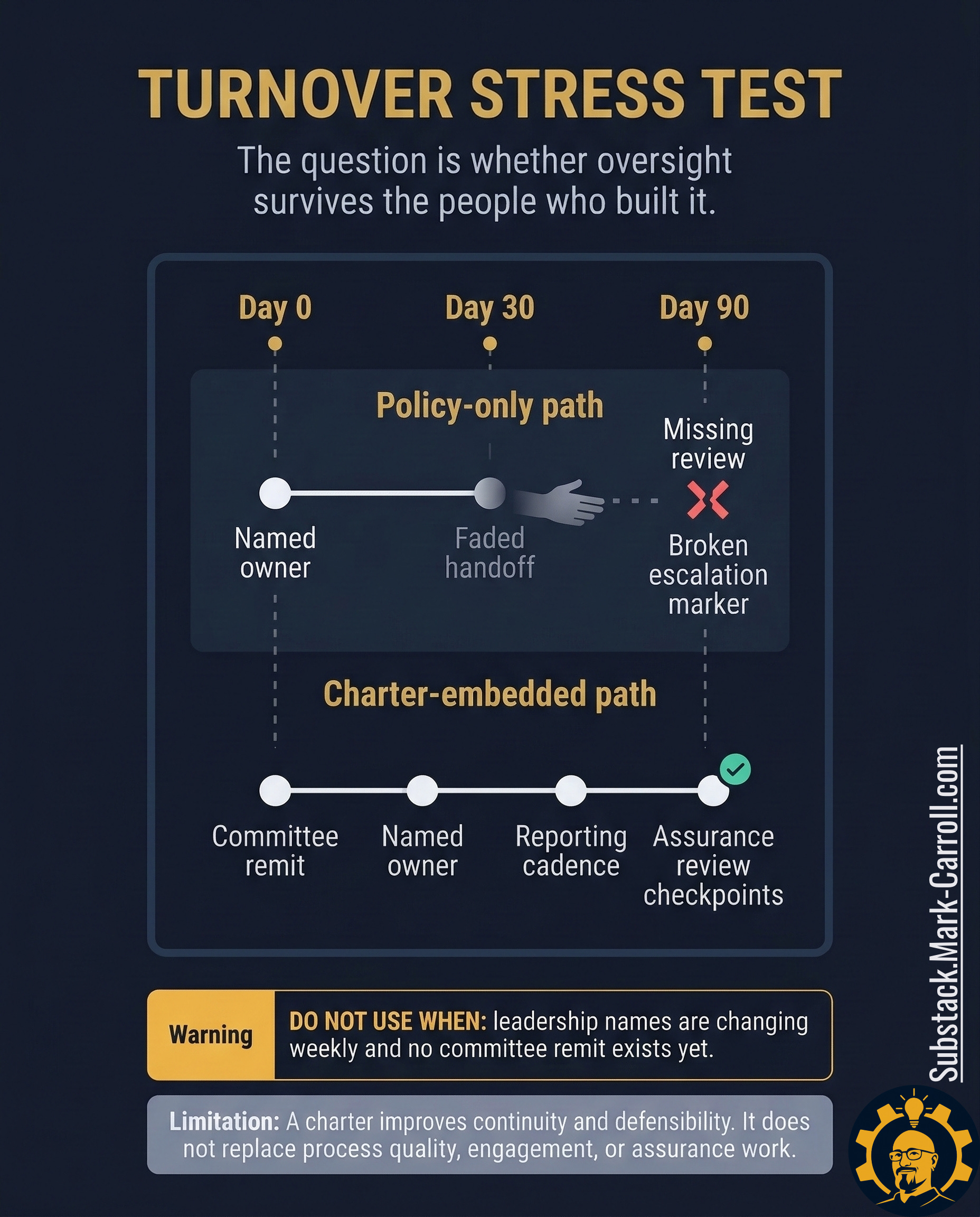
A charter survives the people who built the first version. Policies can float. Dashboards can impress. Concern can spread. Written accountability is what remains when the champions leave.
Run one AI workflow through two paths and the difference stops being abstract.
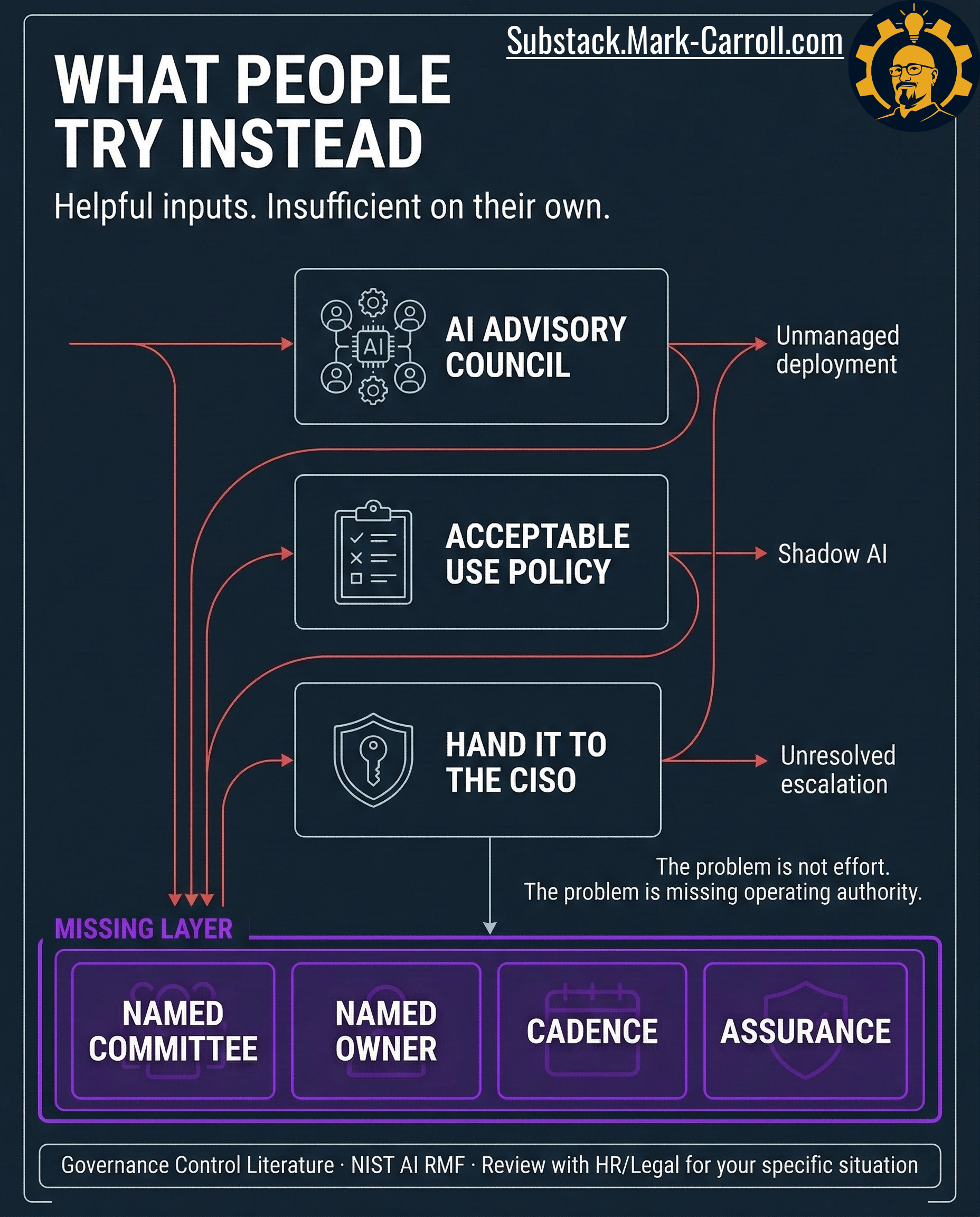
Path One: A customer-facing GenAI chatbot vendor contract. The board gets briefed. A CAIO is hired. A policy is refreshed. An advisory council meets. Everyone agrees the topic is serious. Then the executive sponsor leaves. The contract auto-renews anyway. The quarterly review slips. The empty box stays empty. Engineering still ships. Compliance still worries. Nobody can tell you who has authority to kill it, who has to report it, or where assurance lands.
Path Two: Less theater, more scaffolding. The risk committee remit is written. The executive owner is named. Reporting cadence is fixed. Assurance review has a route. A leader exits. The route still exists. Another name fills the role. The mechanism holds.
Organizations tolerate fuzzy ownership for three reasons. Fuzzy ownership ships faster. Fuzzy ownership blames slower. Fuzzy ownership survives meetings better than clarity does.
Redline: “We already care about AI” is not an ownership model.
🏛 The Architects
Designers
The board chair who stays until 11:07 p.m. rewriting the risk committee charter so the next board packet cannot hide behind “strategic alignment.”
The general counsel who forces the question of whether autonomous-agent oversight sits inside a real committee remit or floats between deck language and managerial optimism.
The governance lead who writes one sentence into the charter knowing it will outlast six excited meetings and three executive sponsors.
Inspectors
The internal auditor who opens the deck, points at the org chart, and asks the one question no one wants answered: “Show me the written control path for the new automated decision system.”
The enterprise buyer who wants to know which named executive owns the model risk before procurement signs.
The regulator who does not care who was passionate about AI last quarter. They care where responsibility lives now.
Enforcers
The D&O insurer who quietly raises the premium until someone finally writes the sentence that can be audited.
The procurement clause that turns “we should monitor our AI vendors” into “you must review training-data controls and remediation status.”
The litigation hold that arrives after the fact and reveals the empty box had more authority than the org chart ever admitted.
This is why the charter matters more than it looks like it should. A charter is dull enough to survive the people who prefer exciting solutions.
🔖 The Turn
The problem is not that leaders do not care. Care is a terrible storage system. A charter does not make anyone wise. It simply makes the next person unable to claim they did not know.
The empty box does not care who used to sit in it.
Blueprint Stamp: Accountability must be executable.
💸 The Cost
Cost to individuals
New leaders inherit invisible risk. Operators get told to “be careful” inside systems no one has fully mapped. Compliance teams get the scramble without the authority. The next manager gets the blame for a route that was never written down in the first place.
Cost to institutions
Without written ownership, oversight becomes rediscovery. Meetings repeat. Reviews drift. Dashboards perform confidence. Audit energy gets spent proving people cared instead of proving the system worked. Regulators treat undocumented ownership as a control deficiency on day one. Every reorg leaves another empty box.
Cost to the future
A system that depends on heroic adults in the room is not a system. It is weather with credentials.
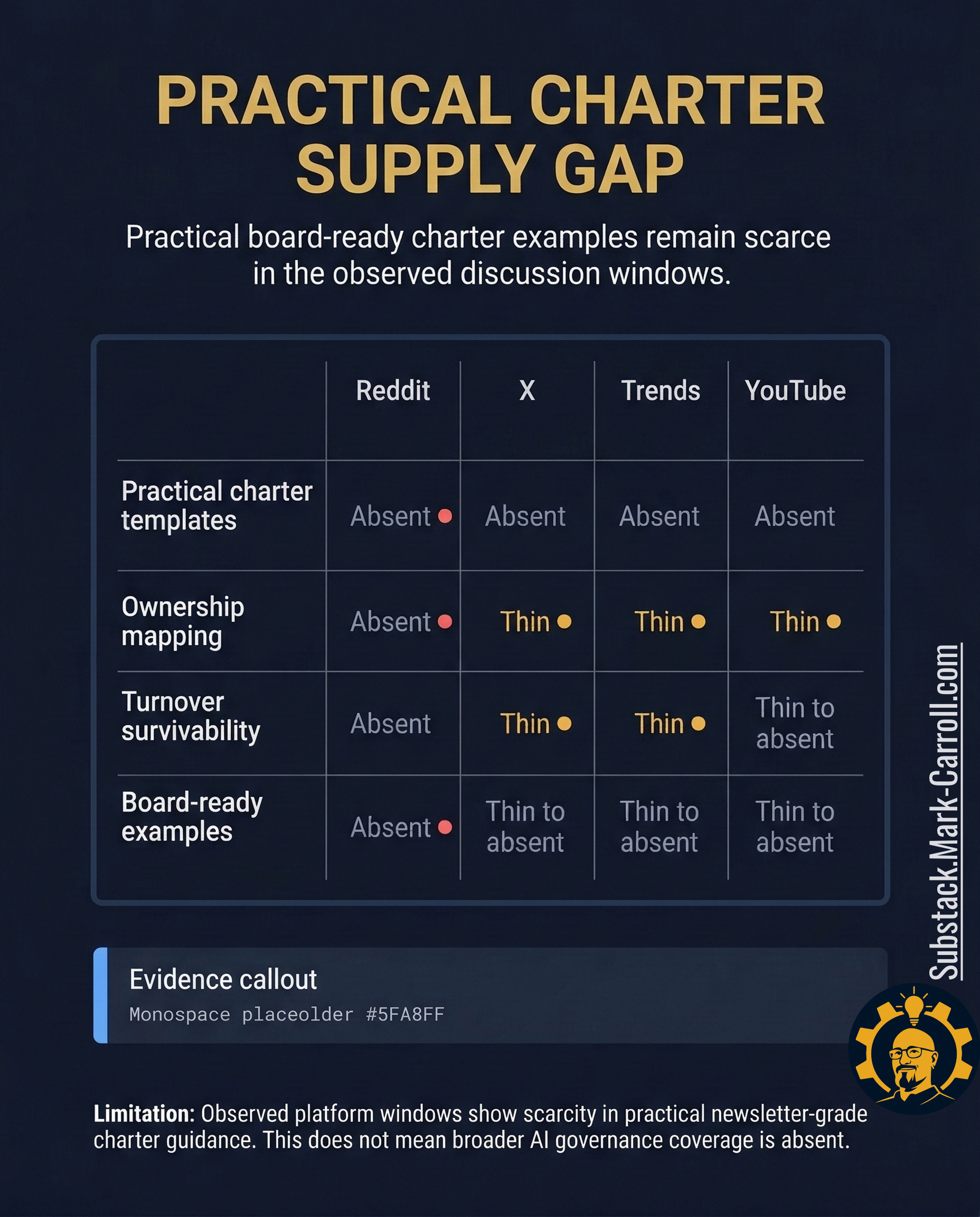
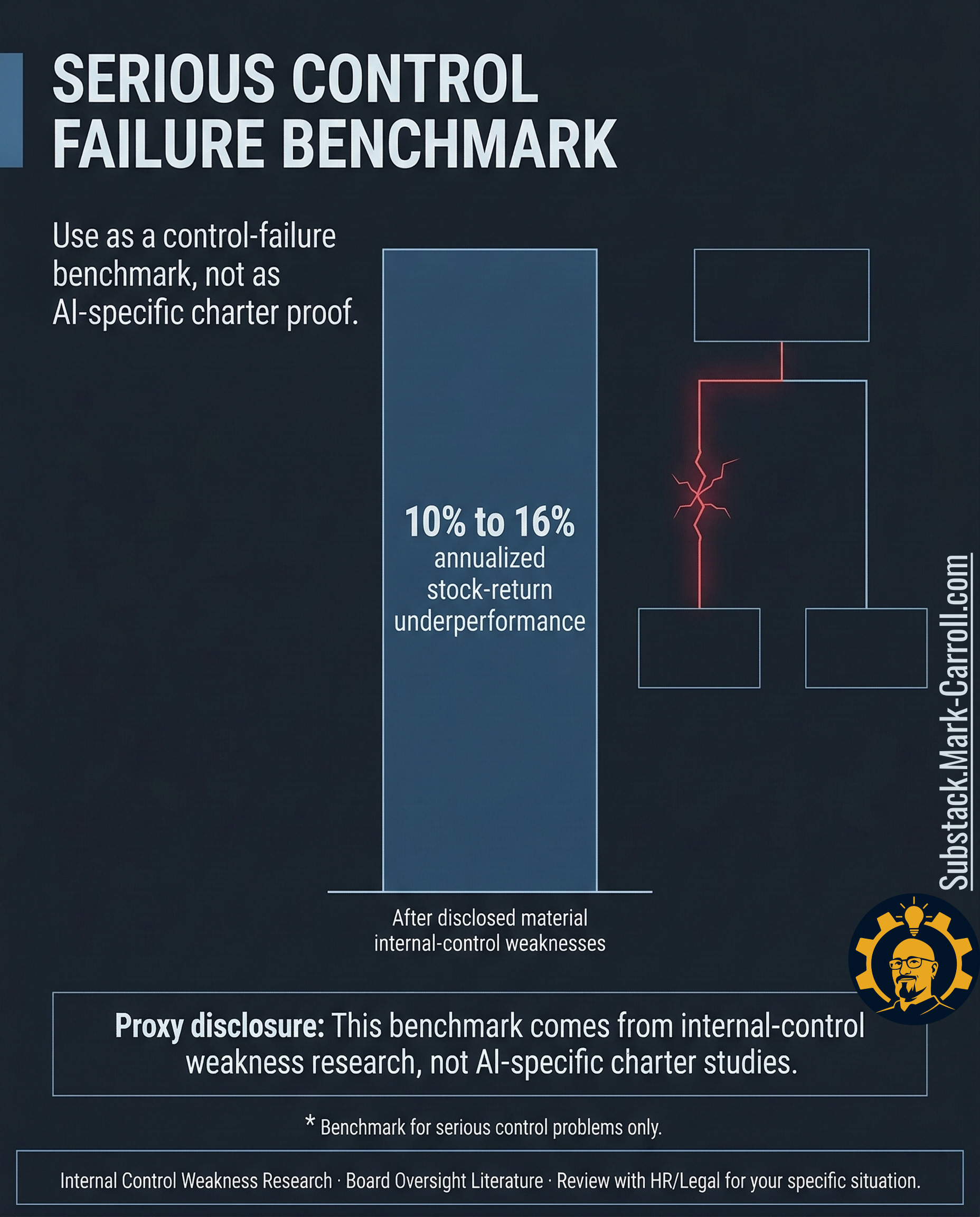
One evidence-safe benchmark belongs here. Firms disclosing material internal control weaknesses showed roughly 10 to 16 percent annualized stock-return underperformance relative to comparable peers in the years following disclosure. That is a benchmark for serious control failure, not a direct price tag on a missing AI charter clause. There is no strong peer-reviewed evidence that directly quantifies the financial cost of AI-specific charter failure. What the evidence does support: unmanaged AI governance gaps that affect reporting quality or compliance exposure are the kind of issue that can rise to the level of a material control weakness. When they do, the market tends to notice.
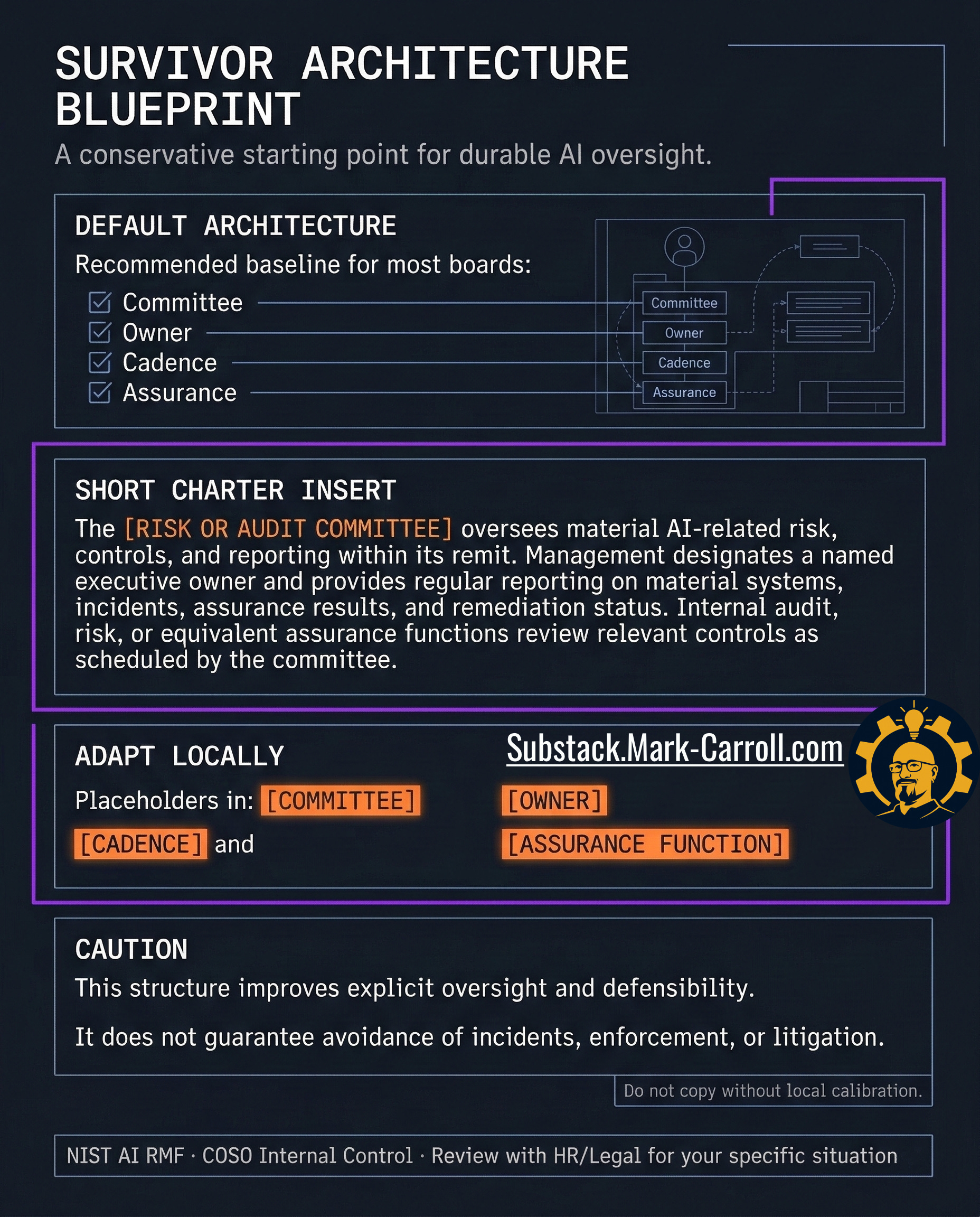
Caution: This structure improves explicit oversight and defensibility. It does not guarantee avoidance of incidents, enforcement, or litigation. The underwriting verdict for this approach was “underwritable with changes,” not “drop in one paragraph and become immortal.”
Blueprint Stamp: If it cannot be audited, it is marketing.
🧰 Autonomy Survival Kit
3 moves for operators to force clarity
Pick one AI workflow and write three lines. Committee. Owner. Next review.
If one of those lines is blank, leave it blank. Show someone else the blank. The discomfort of the empty box is the point.
Find one governance document that already exists and add one real escalation trigger. Not “raise as appropriate.” A trigger. A route. A clock. Do this to force a decision from the top, not to decorate the problem.
Label one AI oversight claim Strong, Mixed, or Weak. Any claim with no evidence label is borrowed confidence wearing office clothes. Audit the claim before the regulators do.
2 moves for leaders
Decide where AI oversight actually lives. Risk committee. Audit committee. Another defined home. Pick one. “Management” is not a place. Your job here is allocation. Close the loop the operators exposed.
Require a named executive owner and an assurance path before any sentence containing “we monitor this” gets repeated upward. Then verify, once a year, that the owner is still in the role and the path still works. Written ownership that no one checks is the next generation of empty box.
1 tonight exercise
Write this on one page.
Committee is ______ Owner is ______ Next review is ______
Every blank is a risk you are currently asking turnover to manage for you.
Copy this into your next charter review:
“The [RISK OR AUDIT COMMITTEE] oversees material AI-related risk, controls, and reporting within its remit. Management designates a named executive owner and provides regular reporting on material systems, incidents, assurance results, and remediation status. Internal audit, risk, or equivalent assurance functions review relevant controls as scheduled by the committee.”
That paragraph is not a shield. It is a start.
Materials List
Long-Run Stock Returns Following Internal Control Disclosures, Journal of Business Finance & Accounting, 2025 (proxy benchmark; not AI-specific)
Internal Control Quality and Bank Risk-Taking and Performance, Auditing: A Journal of Practice and Theory, 2020
Are Audit Committees Overloaded?, Management Science, 2024
NIST AI Risk Management Framework
COSO Internal Control — Integrated Framework
EU AI Act, Board and Accountability Provisions
Selected public charter-language examples, SEC EDGAR filings

🏁 Closing Stinger
My upcoming book, Collaborate Better, is built around one stubborn belief: collaboration does not fail because people lack intelligence or good intentions. It fails when decisions lose structure, accountability loses memory, and nobody can still point to the line that says who owns what. That is why this finale matters to me. It lives right at the center of that argument. You can follow the book at CollaborateBetter.us
The champions left. The empty box stayed. The charter remembered.
That is where this case file closes. The next one begins where wishful thinking runs into the bill. Profit With Proof is my next Public Broadcast series, built for the moment leaders need more than opinions and vibes. They need numbers. Its core promise is simple: trace the cost, show the proof, and make waste, drag, and bad tradeoffs impossible to hide once the meeting ends.

This piece is really about one question: what survives when the champion leaves?
You can brief the board, refresh the policy, hire the expert, and still have an empty box where ownership should be. The charter is not glamorous. That is exactly why it matters. It is the boring document that keeps accountability from dissolving into memory, politics, and “we thought someone else had it.”
If this resonated with you, tell me where your organization still confuses attention with ownership.