


Your AI Stack May Be Working Too Well
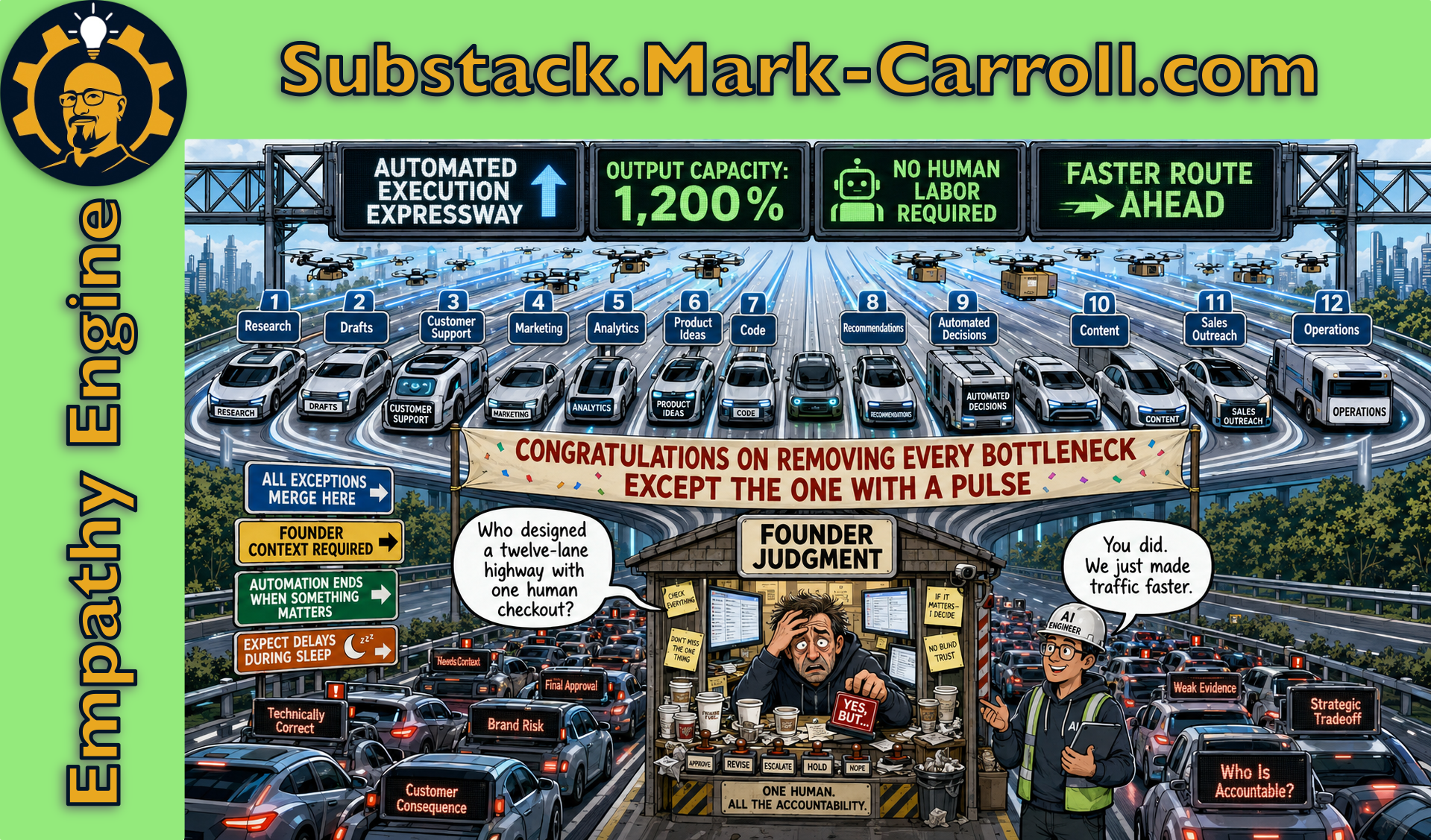
Opening Note
👋 Welcome to my paid subscriber-only edition of Empathy Engine (🔒 Leader’s Dispatch). Each week I build evidence-forward tools for product leads who need to say no, defend tradeoffs, and lock in decisions before they get rewritten later.
This article closes the Buildership series. Buildership and the 1st Builder are proposed practitioner frameworks, not validated academic constructs, legal structures, or guarantees of better outcomes. Nothing here is legal, tax, employment, equity, or compensation advice.
Mara, Jess, Tariq, and FlowPilot form an illustrative case. Their story shows how these operating choices can unfold, but it is not evidence by itself. The research claims in this article come from the cited sources, while the case exists to make the decisions easier to see.
The Judgment Bottleneck: What AI-Native Founders Should Build Next
Mara’s stack worked. The agents drafted, the research system gathered, and support triage sorted tickets before she opened her laptop. Workflow automations ran quietly in the background, handling in minutes what once consumed whole afternoons.
Then the work reached the point where the rules stopped helping. A customer request did not fit the policy. A draft was technically accurate but wrong for the moment. An automation did exactly what it had been told and still produced an outcome Mara would never have approved.
The stack kept moving. The decisions came back to her.
Research Binder: the receipts (citations + source notes) are compiled in a PDF at the bottom of this post.
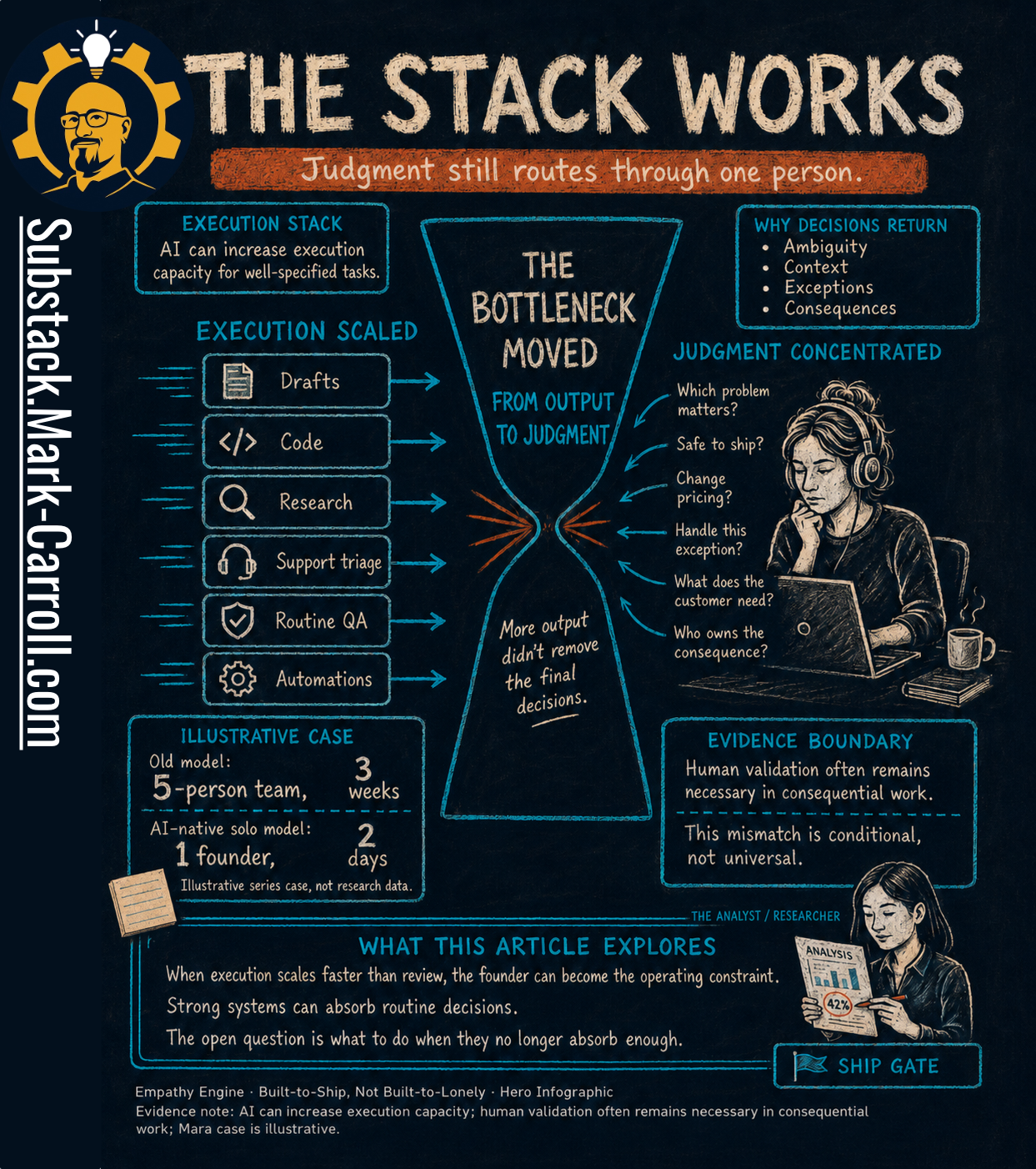
AI had expanded FlowPilot’s production capacity. It had not expanded Mara’s attention, context, or willingness to stand behind every consequential output. Once execution began moving faster than review, she became the place where unfinished judgment accumulated.
That is the problem this capstone is built to examine. The earlier articles explored the judgment load many solo founders carry, introduced the 1st Builder as a proposed lens, and mapped decision rights before titles. The final question is more practical: what keeps returning to the founder, and what kind of response does that constraint actually deserve?
My own publishing work made that question harder to avoid. AI now carries a large share of the research, synthesis, drafting, iteration, visual planning, and production support behind a series like this. It still cannot decide what I believe, which claim is worth defending, where the evidence is too thin, or whether a polished paragraph sounds like me instead of a competent imitation.
The Validation Logjam
The promise of AI leverage sounds simple. If the system produces more, the founder gets time back. That happens in some workflows, but production and evaluation do not always improve at the same speed.
Mara’s stack could create more drafts, recommendations, and customer responses than she could have produced manually. Each one still entered a slower process. Someone had to read it, understand the surrounding context, and decide whether the venture should act on it.
Generate. Review. Contextualize. Accept the consequence. AI moved the first stage faster, while the remaining work stayed attached to human judgment.
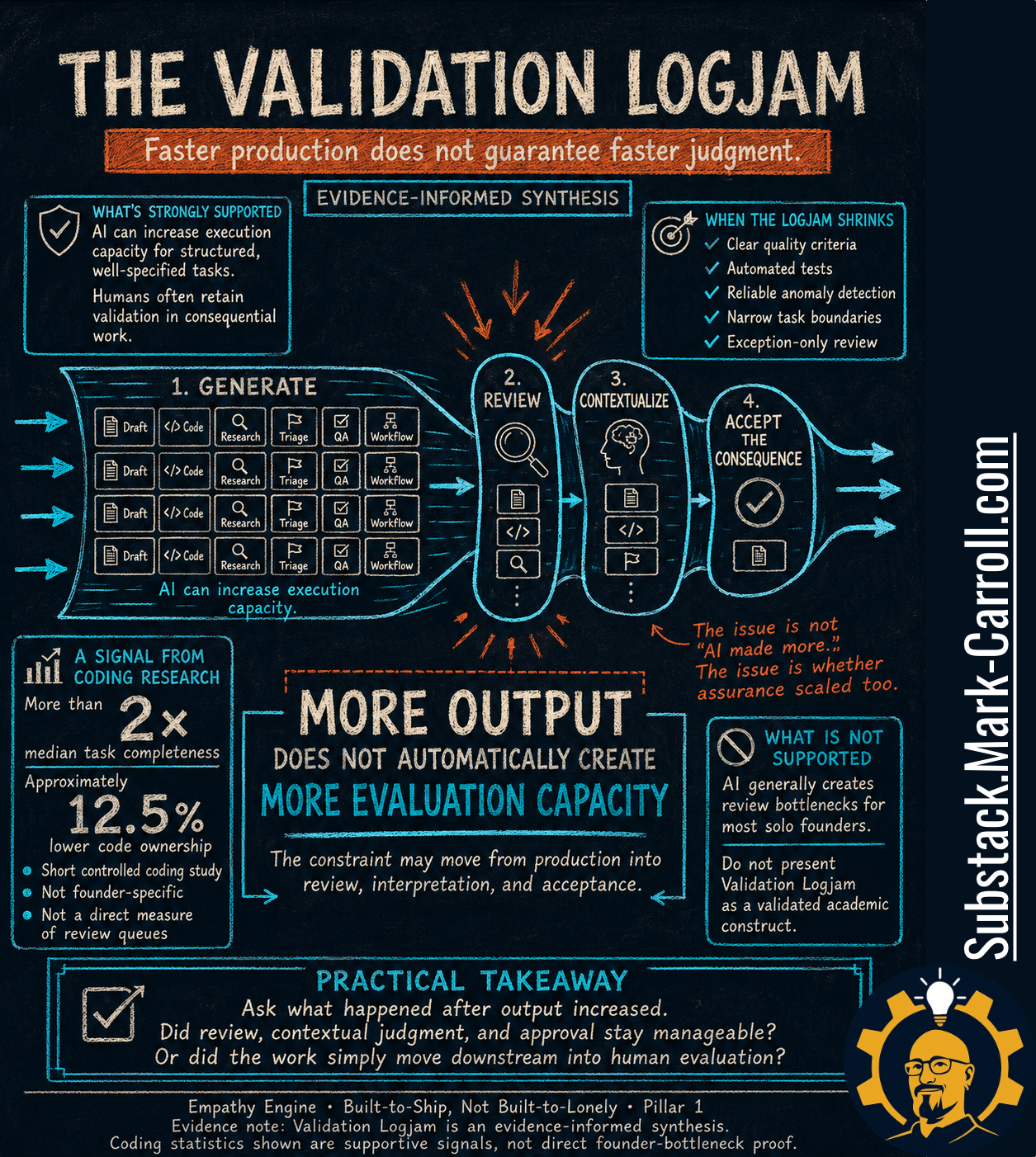
I use Validation Logjam as a practitioner description for that mismatch. It is a pattern to test inside a venture, not a universal law. The evidence appears in the queue: more work reaches completion, yet more work also waits for interpretation and approval.
The useful check is straightforward. After output increased, did review remain manageable? Did the founder actually regain time, or did the work move downstream and arrive wearing a different label?
Execution, Judgment, Authority, and Accountability
AI can generate, classify, route, test, and recommend inside boundaries someone else established. Those are meaningful capabilities. They are still different from deciding what should happen when the situation falls outside the rule.
Execution produces the output. Recommendation presents an option.
Judgment interprets the context and weighs the tradeoff.
Decision authority is the recognized right to choose. Accountability begins after the choice, when someone must explain the result, correct the failure, and carry the consequence.
A system can send a message while the founder still owns the promise inside it. A model can recommend a refund while a person decides whether the exception should change policy. An agent can deploy code while someone else answers for whether it belonged in production.
This is where the moral crumple zone becomes relevant. A human may be blamed for an automated outcome without having held enough control to prevent it. The risk grows whenever responsibility remains human while authority, visibility, and intervention are poorly designed.
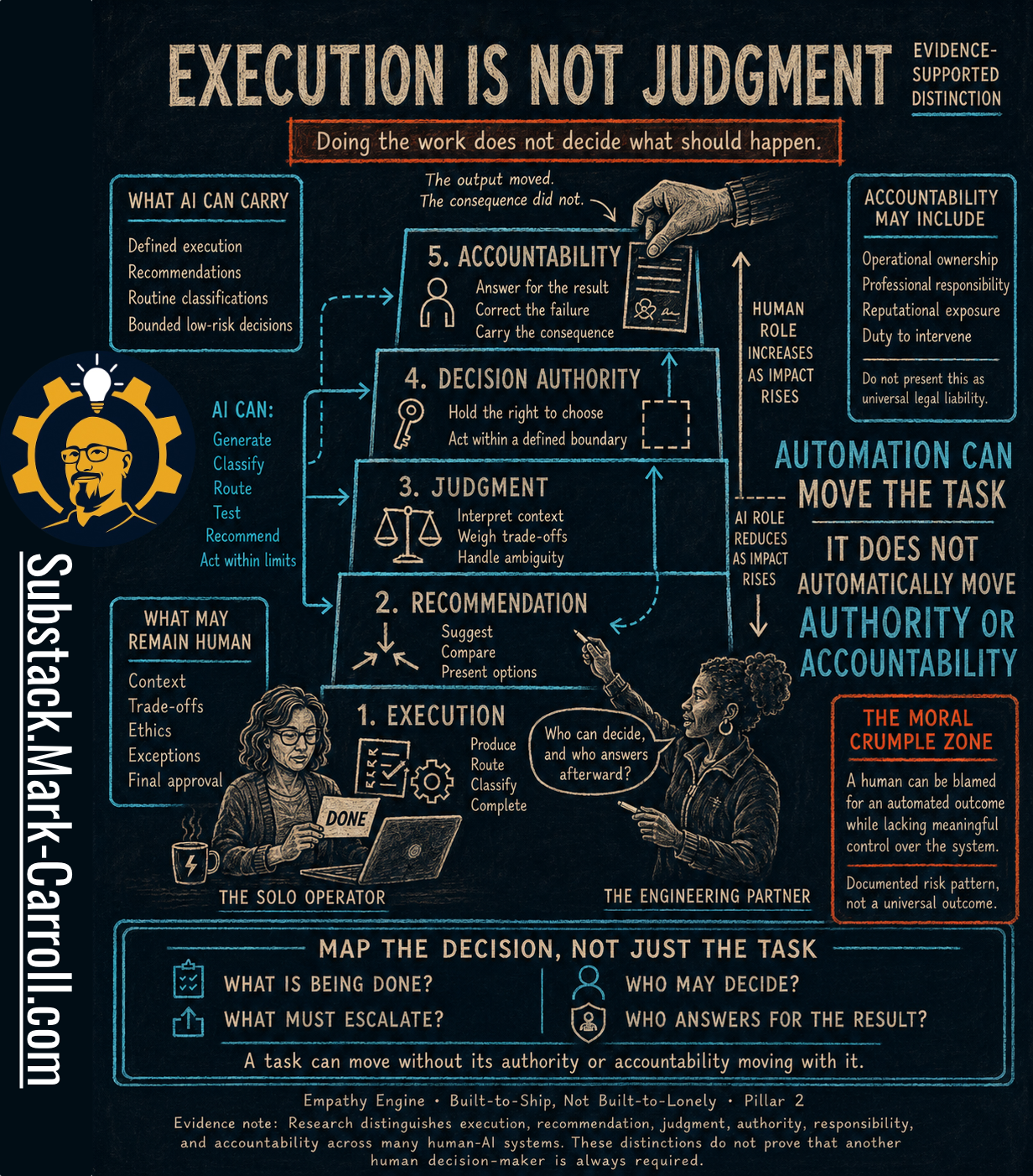
Task maps are no longer enough. Founders need decision maps that show who may act, which cases move upward, and who answers once the choice becomes real. That is the operating system underneath the automation.
The Single-Nervous-System Tradeoff
One decision center can move quickly. Mara understood the customer, the product history, the pricing logic, and the long-term risk without asking for a briefing. For a certain size and season of venture, that concentration is an advantage.
The exposure arrives through recurrence. Product questions return. Customer exceptions return. Contractor decisions and automation failures return.
Eventually the issue is less about whether the founder can make the call. The business starts waiting for the founder to become available.
Mara could handle the decisions. The sharper question was whether FlowPilot could wait for her.
Metaphorically, the venture ran on one nervous system. That gave it speed and coherence, but it also concentrated memory, approval, and context in one person. When Mara stepped away, routine work continued until it encountered something unusual, sensitive, or irreversible.
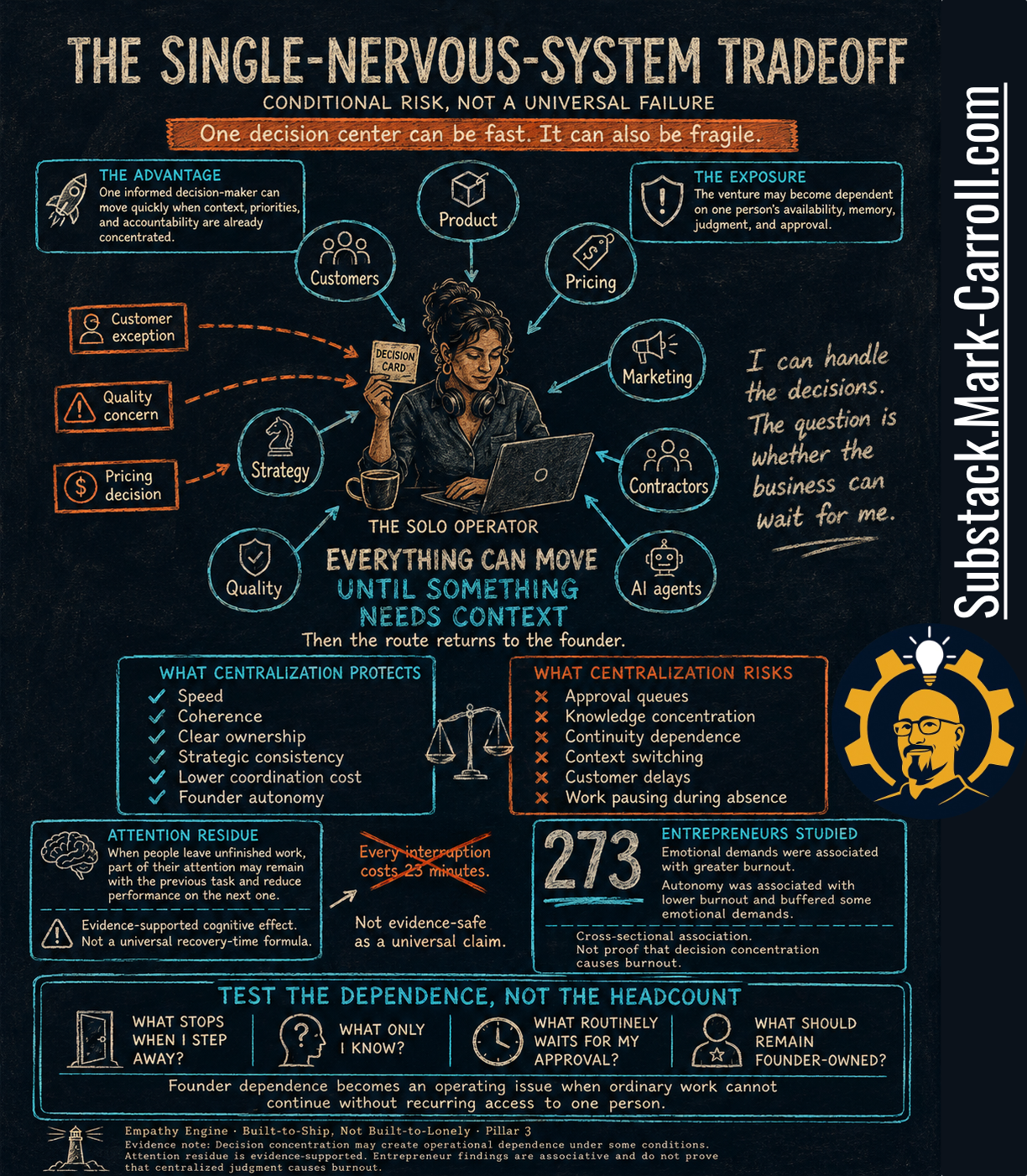
Founder dependence becomes an operating concern when ordinary work repeatedly stalls at the same point. Step away and watch what happens. The work that pauses reveals where the venture still relies on access to one person.
My own version of that risk is editorial. Other people or tools could perform many of the tasks, but too much of the standard for what counts as good, true, useful, and ready still lives in my judgment. When I am unavailable, work continues to accumulate, yet it cannot reliably clear the final gate.
I have not fully tested how much of that dependence better systems could remove. Staying available has been easier than finding out. That is also part of the problem.
Improve the System Before Expanding the Structure
Recurring overload often gets diagnosed as a people shortage. Sometimes it is. Other times the venture is paying a human to compensate for a decision that was never standardized.
Mara saw the same pricing exception, onboarding question, and escalation pattern come back week after week. Each return felt like proof that she needed help. It was also evidence that FlowPilot had failed to turn experience into a usable operating rule.
Routine work should not require recurring heroics. A repeated decision deserves a checklist, template, threshold, or recorded default before it deserves another permanent role.
Start with repeatability. When the same question arrives in roughly the same form, document the decision path. Then test observability: can quality be checked through acceptance criteria, alerts, or a visible threshold?
Authority can also be bounded. A spending limit, service-recovery range, risk tolerance, or reversible action gives the system room to proceed. The exceptions still move upward, but ordinary cases stop pretending they are exceptional.
Some work will resist codification. Novel, customer-sensitive, ethically consequential, or strategically irreversible decisions still need contextual judgment. The point is to preserve a person’s attention for those cases instead of spending it on every case.
Systems create work of their own. They need maintenance, monitoring, and revision when the venture changes. A badly designed system can bury the same problem inside more alerts and documentation.
