


The Quote Looked Finished. Where Did It Come From?
Plain-English premise: AI can make customer voice sound finished before anyone can say where it came from. Someone still has to know what it can support.
Judgment Seat: The researcher or PM who presents customer voice they didn’t entirely produce, and everyone who inherits the slide after them
👋 Last week’s closing promised an episode about “customer voice” that may be partly or wholly synthetic. The research changed my mind again. It didn’t show that synthetic customer voice is fake, or that teams routinely pass it off as real. It showed that where material came from and what it can support are separate questions, and a slide’s appearance can’t answer either. Episode Five separated assisted output from independent capability; this week turns to the evidence the work stands on
Research Binder: the receipts (citations + source notes) are compiled in a PDF at the bottom of this post.
⚡ Pressure
AI can produce fluent customer voice faster than anyone can say where it came from.
🎯 Payoff
This issue gives you the Evidence Provenance Line: five fields that keep a customer-voice claim’s origin, AI role, checks, supported use, and limits attached to it
Pressure Moment
A research team gave an AI model 122 transcripts from 61 adults living with heart failure: one clinical consultation and one follow-up interview per person. The model proposed themes and picked representative quotations to illustrate each one. When the team compared its themes with an independent human-led analysis, every human theme had an AI counterpart. Then the first author opened the transcripts and checked the quotations by hand, one at a time. Most matched. Some quotations had been reworded, and others contained words no participant said. Finding a theme counterpart hadn’t verified the words beneath it
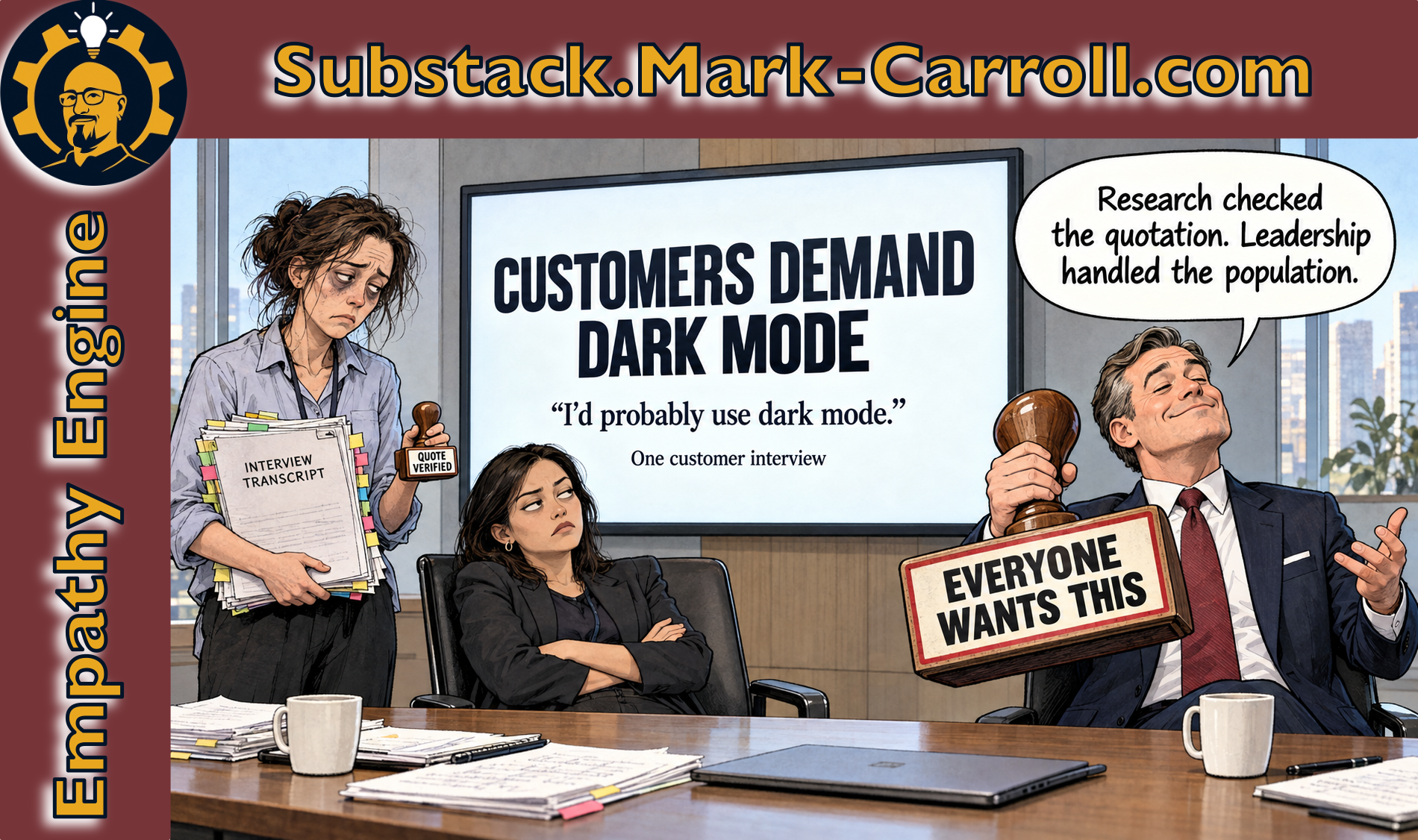
I remember reviewing a slide that said customers found onboarding confusing. There was a quotation beneath it, and we could trace that quotation to an interview. What we couldn’t trace was the move from one person’s experience to a statement about customers generally. I asked what else supported the heading. The quotation stayed useful, but the claim above it needed narrowing.
Two Questions on Every Slide
That study separates two questions a slide tends to blur: where did the material come from, and what can it support for this use? An interview, an AI summary, a simulated panel, and a blend of all three can produce sentences that look identical inside quotation marks. They aren’t identical as evidence.
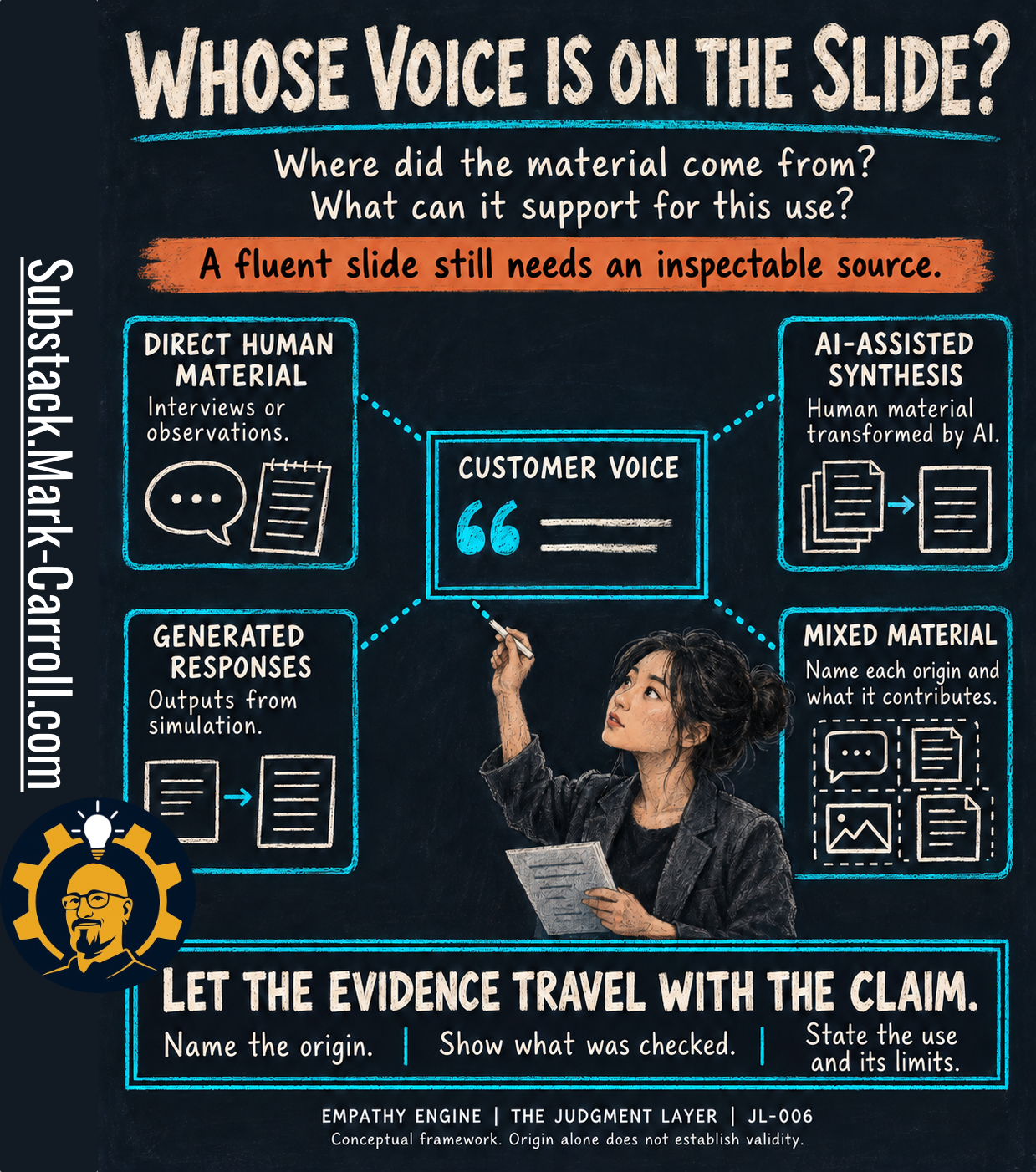
A fluent slide still needs an inspectable source. That isn’t a verdict on any origin: a real interview can be unrepresentative, and a grounded simulation can perform well on a bounded task. Let the evidence travel with the claim, because origin alone doesn’t establish validity.
Name the Source
Each origin needs its own check. For direct human material, locate the original record. For AI-assisted synthesis, check the output against those records. For generated responses, ask what inputs and comparisons support them. For mixed material, ask what each part contributes and how each was checked.
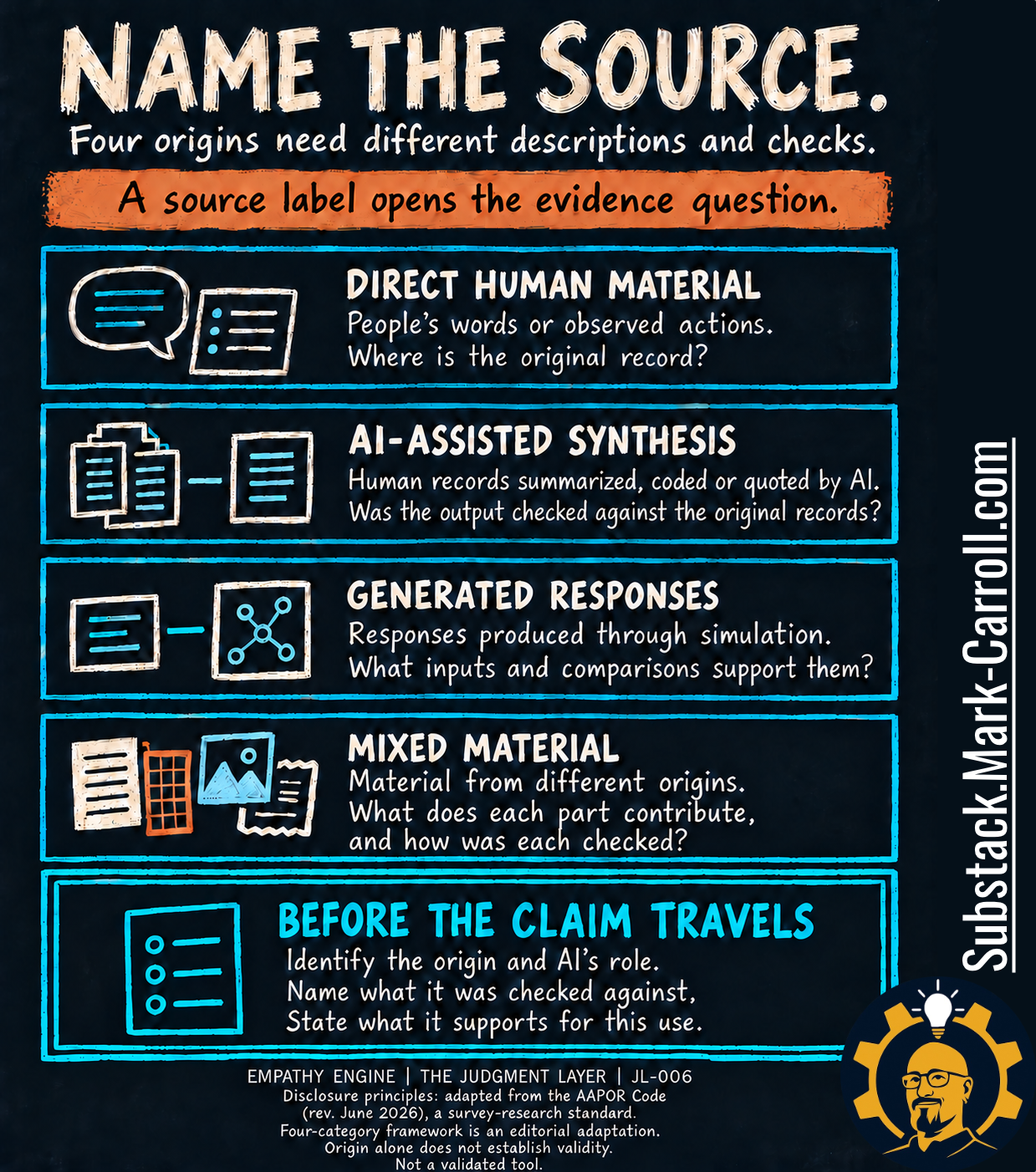
The four-category split is my editorial framework, but survey research already draws the same line. AAPOR’s Code of Professional Ethics and Practices, revised June 2026, says AI-generated cases “are not research ‘participants’” and “must be identified as having been created through artificial intelligence.” When a sample mixes AI-generated and human data, the report must “clearly identify to the reader that not all participants were human.” Reports must also state the task AI performed and when its output was validated, and “disclose if this information is unknown or not available.”
The Code expects adherence from all public-opinion and survey researchers, regardless of AAPOR membership. It doesn’t name product teams. Applying its disclosure principles to product slides is my adaptation, and the Code doesn’t validate the proposed aid. A source label opens the evidence question. It doesn’t close it.
Every Human Theme Had a Counterpart
So Hyeon Bang and colleagues (JAMIA, August 2026) ran GPT-5.2 through an eleven-prompt protocol on 61 clinical consultations and 61 reflexive interviews, without the human codebook. All seven human themes had at least one similar counterpart among the AI’s nine, though overlap across theme pairs was moderate (0.44 by human raters, 0.51 by AI). Of 123 batch-level quotations, about 68% were verbatim, 20% paraphrased, 3% truncated, 6% partly hallucinated, and 3% fully hallucinated.
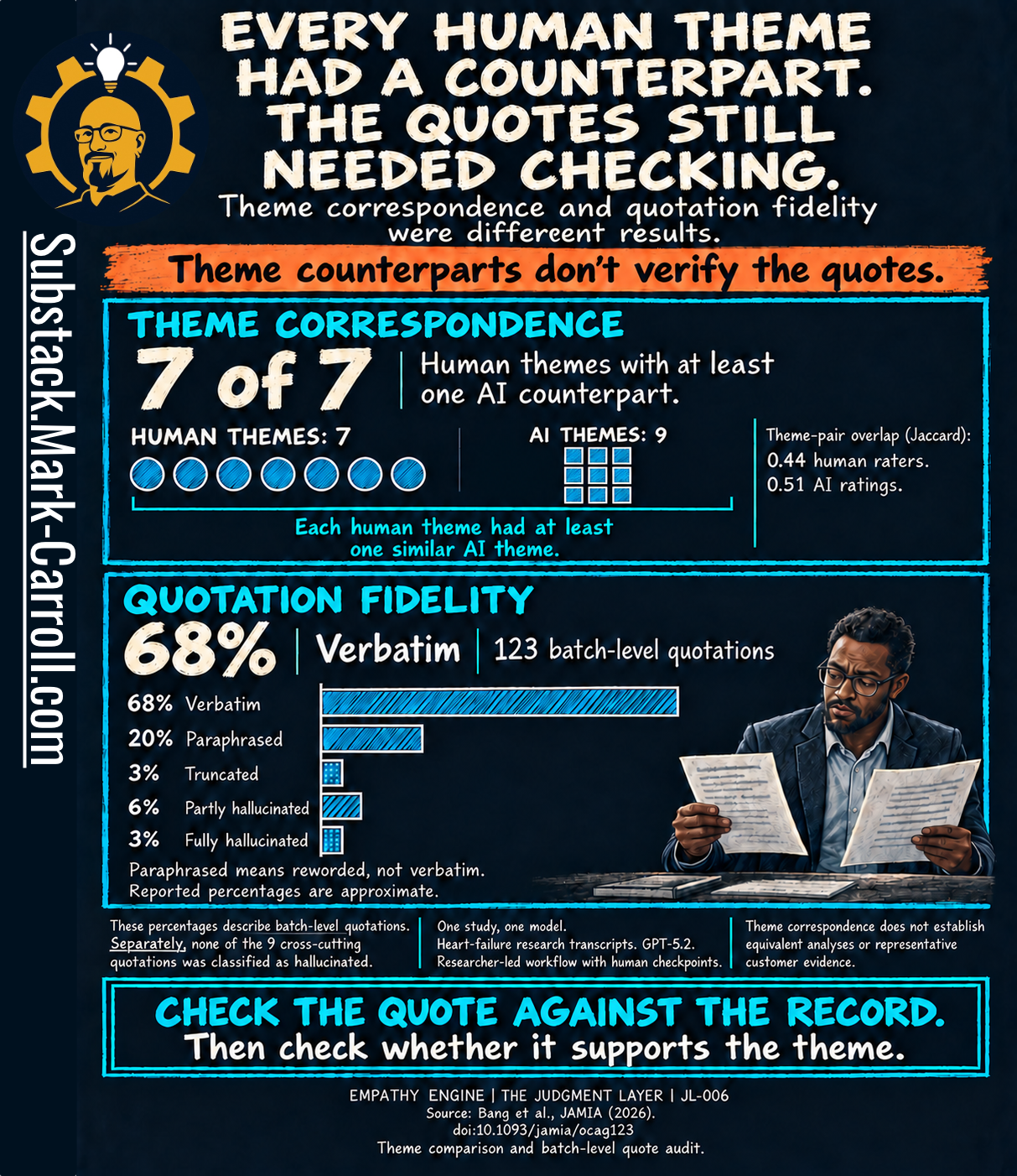
Theme counterparts don’t verify the quotes, and a slide can easily borrow confidence from one to cover the other. Calling the remaining 32% fake would erase distinctions the researchers made; a paraphrase can preserve meaning. But a reworded sentence inside quotation marks is presented as something a person said. The authors also noted that some verbatim quotations didn’t clearly support their assigned themes. A real sentence can still be the wrong evidence.
This was a researcher-led workflow, and the errors are a reason for its human checkpoints, not the result of skipping them; none of the nine final cross-cutting quotations was classified as hallucinated. It’s one study, one model, one clinical population. And even a quotation that passes both checks can’t show how widely an experience is shared. Check the quote against the record. Then check whether it supports the theme.
Plausible Answers Still Need Comparison
Generated responses may draw on real interview transcripts, but they aren’t recorded answers from participants. To assess how well they stand in for people, compare them with human answers on the same task. Pew Research Center ran that comparison on September 30, 2026.. It gave Claude Opus 4.6, the best-performing model it evaluated, the demographics and 2025 political typology answers of real panelists, then compared those “digital twins” with human results across three survey waves.
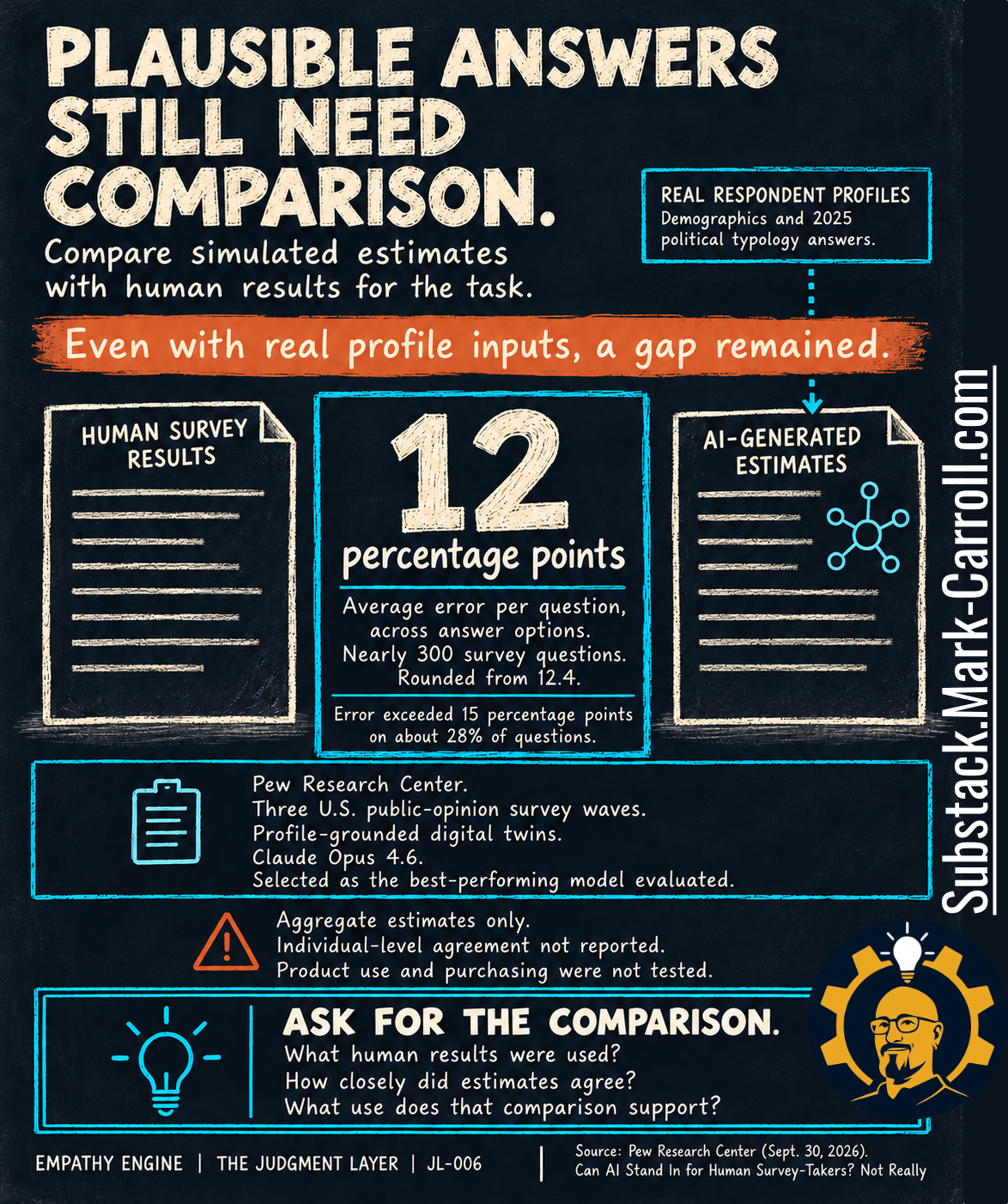
Even with real profile inputs, a gap remained: an average error of 12 percentage points per question across answer options (rounded from 12.4) over nearly 300 questions, and above 15 points on about 28% of them. Subgroup errors ran larger, and people chose “not sure” about four times as often as their twins. These are aggregate results on opinion questions, not individual predictions or product use. Ask for the comparison: what human results were used, how closely did the estimates agree, and what use does that comparison support?
Real Inputs Can Change the Result
The strongest counterpoint comes from Park, Zou, Kamphorst and colleagues (arXiv preprint, revised June 2026). They built GPT-4o agents from interviews averaging about two hours with 1,052 US adults, then tested each agent against its own person on General Social Survey attitude items held out of the agent’s inputs
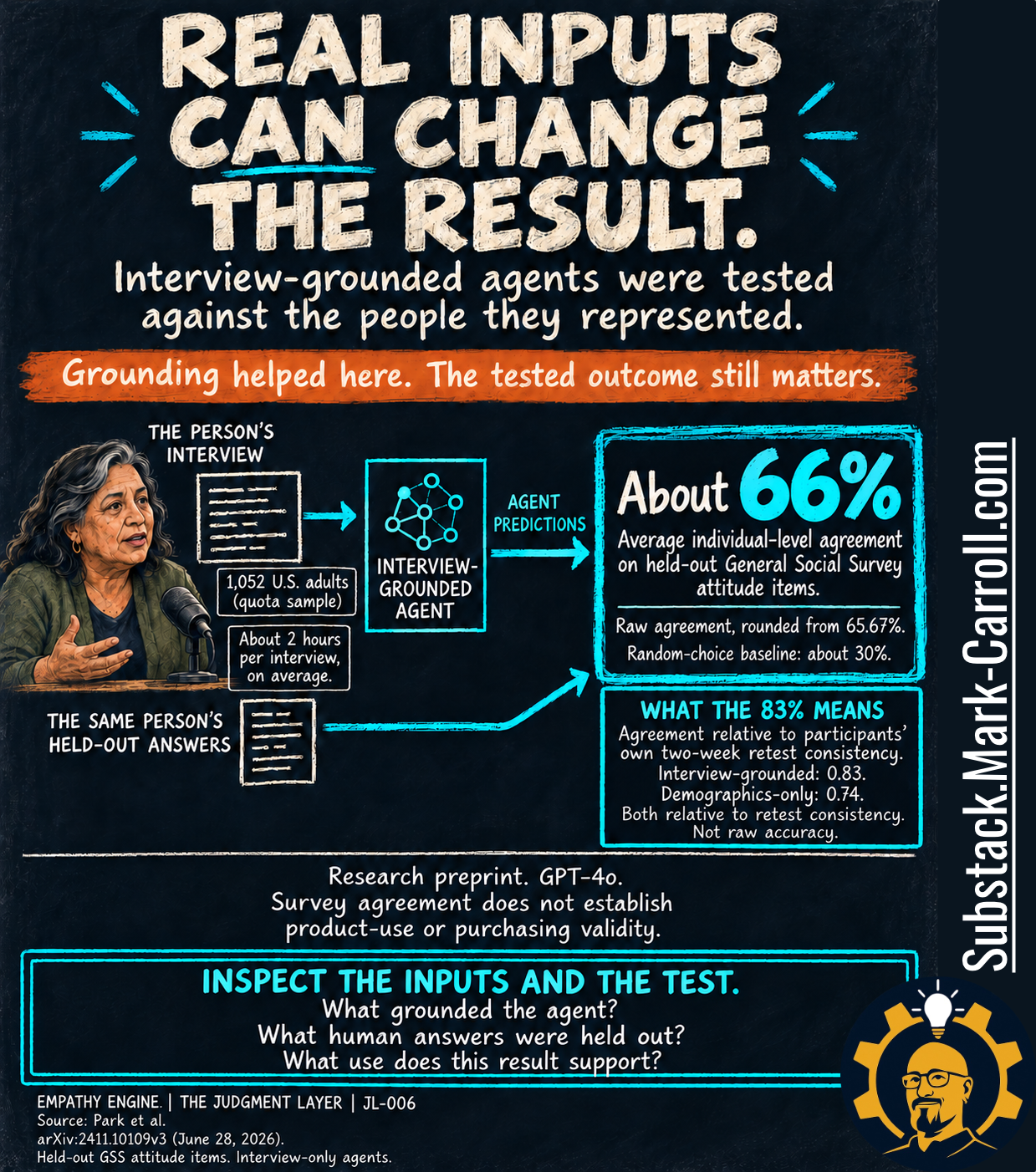
Interview-grounded agents matched about 66% of individuals’ held-out answers (65.67%), against a random-choice baseline near 30%. The “83%” you may see cited is relative to participants’ own two-week retest consistency: 0.83 for interview-grounded agents, 0.74 for demographics-only. Neither is raw accuracy, and the final sample skewed more educated, female, and Democratic than its census-quota targets.
Grounding helped here. The tested outcome still matters: these were attitude items, not product use or purchasing. Pew and Park don’t belong on one scoreboard, because their inputs, tasks, and units of evaluation differ. For any simulation, disappointing or impressive, inspect the inputs and the test, and ask what use the result supports.
A Bare Label Can Discount the Truth
The obvious fix is to stamp “AI” on anything AI touched and let readers adjust. Altay and Gilardi (PNAS Nexus, 2024) tested what a stamp like that does. In two preregistered experiments with 4,976 participants in the United States and United Kingdom, people rated news headlines, some labeled “AI-generated.”
